
To independently distinguish between regular and irregular polygons
To independently distinguish between regular and irregular polygons. Year 5 - Shape (GDS) Lesson 3
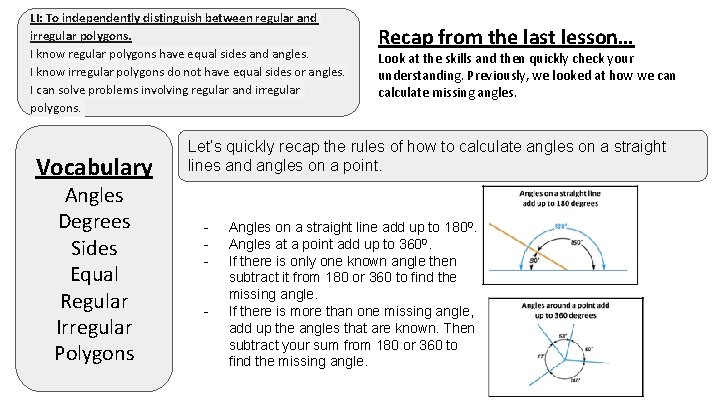
LI: To independently distinguish between regular and irregular polygons. I know regular polygons have equal sides and angles. I know irregular polygons do not have equal sides or angles. I can solve problems involving regular and irregular polygons. Vocabulary Angles Degrees Sides Equal Regular Irregular Polygons Recap from the last lesson… Look at the skills and then quickly check your understanding. Previously, we looked at how we can calculate missing angles. Let’s quickly recap the rules of how to calculate angles on a straight lines and angles on a point. - Angles on a straight line add up to 1800. Angles at a point add up to 3600. If there is only one known angle then subtract it from 180 or 360 to find the missing angle. If there is more than one missing angle, add up the angles that are known. Then subtract your sum from 180 or 360 to find the missing angle.
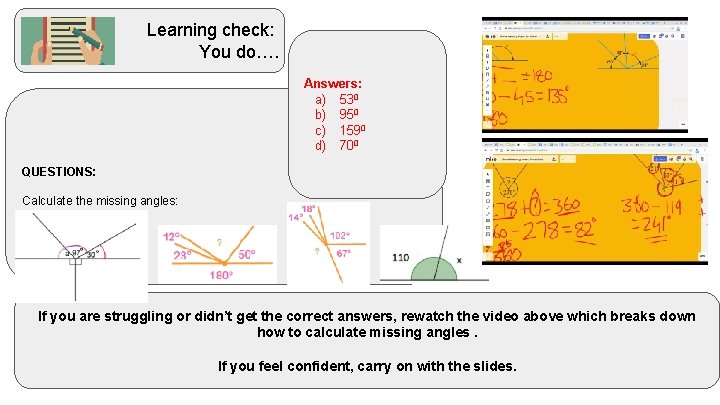
Learning check: You do…. Answers: a) 530 b) 950 c) 1590 d) 700 QUESTIONS: Calculate the missing angles: If you are struggling or didn’t get the correct answers, rewatch the video above which breaks down how to calculate missing angles. If you feel confident, carry on with the slides.
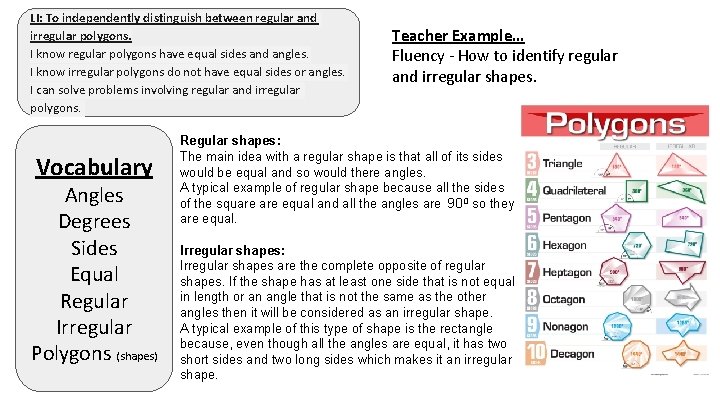
LI: To independently distinguish between regular and irregular polygons. I know regular polygons have equal sides and angles. I know irregular polygons do not have equal sides or angles. I can solve problems involving regular and irregular polygons. Vocabulary Angles Degrees Sides Equal Regular Irregular Polygons (shapes) Teacher Example… Fluency - How to identify regular and irregular shapes. Regular shapes: The main idea with a regular shape is that all of its sides would be equal and so would there angles. A typical example of regular shape because all the sides of the square equal and all the angles are 90 0 so they are equal. Irregular shapes: Irregular shapes are the complete opposite of regular shapes. If the shape has at least one side that is not equal in length or an angle that is not the same as the other angles then it will be considered as an irregular shape. A typical example of this type of shape is the rectangle because, even though all the angles are equal, it has two short sides and two long sides which makes it an irregular shape.
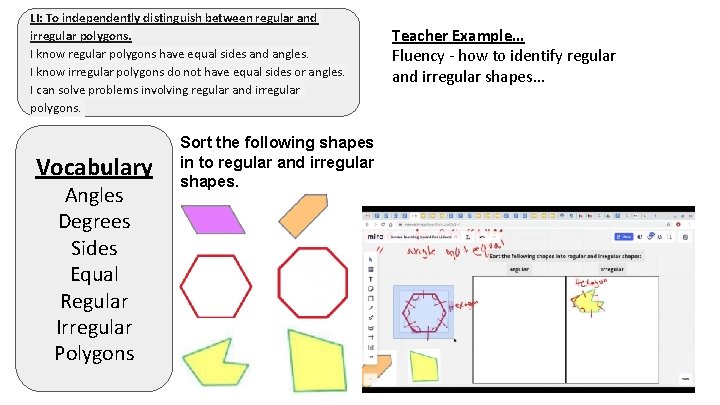
LI: To independently distinguish between regular and irregular polygons. I know regular polygons have equal sides and angles. I know irregular polygons do not have equal sides or angles. I can solve problems involving regular and irregular polygons. Vocabulary Angles Degrees Sides Equal Regular Irregular Polygons Sort the following shapes in to regular and irregular shapes. Teacher Example… Fluency - how to identify regular and irregular shapes. . .
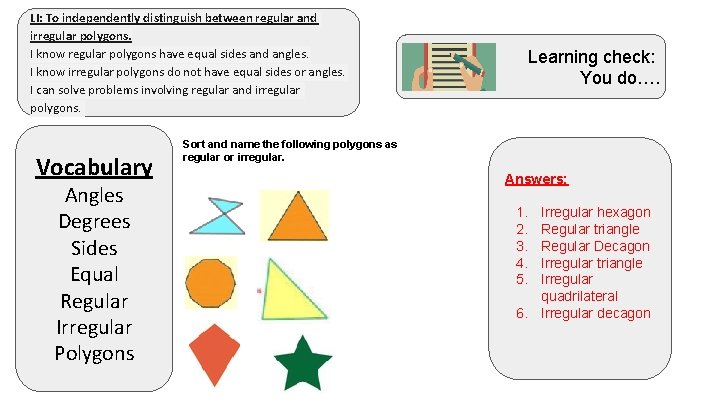
LI: To independently distinguish between regular and irregular polygons. I know regular polygons have equal sides and angles. I know irregular polygons do not have equal sides or angles. I can solve problems involving regular and irregular polygons. Vocabulary Angles Degrees Sides Equal Regular Irregular Polygons Learning check: You do…. Sort and name the following polygons as regular or irregular. Answers: 1. 2. 3. 4. 5. Irregular hexagon Regular triangle Regular Decagon Irregular triangle Irregular quadrilateral 6. Irregular decagon
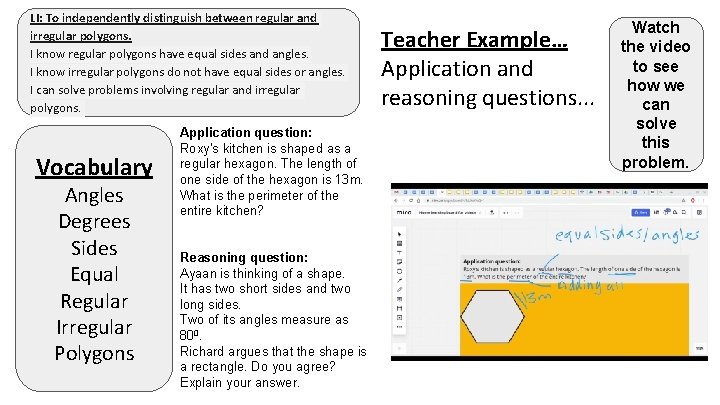
LI: To independently distinguish between regular and irregular polygons. I know regular polygons have equal sides and angles. I know irregular polygons do not have equal sides or angles. I can solve problems involving regular and irregular polygons. Vocabulary Angles Degrees Sides Equal Regular Irregular Polygons Application question: Roxy’s kitchen is shaped as a regular hexagon. The length of one side of the hexagon is 13 m. What is the perimeter of the entire kitchen? Reasoning question: Ayaan is thinking of a shape. It has two short sides and two long sides. Two of its angles measure as 800. Richard argues that the shape is a rectangle. Do you agree? Explain your answer. Teacher Example… Application and reasoning questions. . . Watch the video to see how we can solve this problem.
LI: To independently distinguish between regular and irregular polygons. I know regular polygons have equal sides and angles. I know irregular polygons do not have equal sides or angles. I can solve problems involving regular and irregular polygons. Vocabulary Angles Degrees Sides Equal Regular Irregular Polygons Learning check: You do…. Q 1 Tracey is placing wallpaper in her room which is in the shape of a regular quadrilateral. One side of the room is 405 cm long. Each sheet of paper will cover 50 cm. How many full sheets of wallpaper will she need altogether? Q 2 Sammy draws an isosceles triangle. Gavin draws an equilateral triangle. They both say that they’ve drawn regular shapes. Who do you agree with? Explain your answer.
LI: To independently distinguish between regular and irregular polygons. I know regular polygons have equal sides and angles. I know irregular polygons do not have equal sides or angles. I can solve problems involving regular and irregular polygons. Vocabulary Angles Degrees Sides Equal Regular Irregular Polygons Learning check: Answers: Q 1 Tracey is placing wallpaper in her room which is in the shape of a regular quadrilateral. One side of the room is 405 cm long. Each sheet of paper will cover 50 cm. How many full sheets of wallpaper will she need altogether? 405 X 4 = 1620 divided by 50 = 32. 4 therefore 32 full sheets of wallpaper. Q 2 Sammy draws an isosceles triangle. Gavin draws an equilateral triangle. They both say that they’ve drawn regular shapes. Who do you agree with? Explain your answer. Gavin because all sides and angles in an equilateral triangle are equal, whereas only two sides and two angles are equal in an isosceles triangle.
Well done! Now complete the worksheet below on the google doc. You can either write the answers on the google doc, or write it out on paper and send a picture of your work to your teacher. https: //docs. google. com/document/d/1 OV 2 D 8 PPi. BIDb. Vy. PQst. FO 1 Wlb. RKEv. A 97 Eua. T 5 a. Sk. GFb. A/edit# Remember to log onto maths whizz as well this week!
- Slides: 10