
To describe positions on Earths surface we have
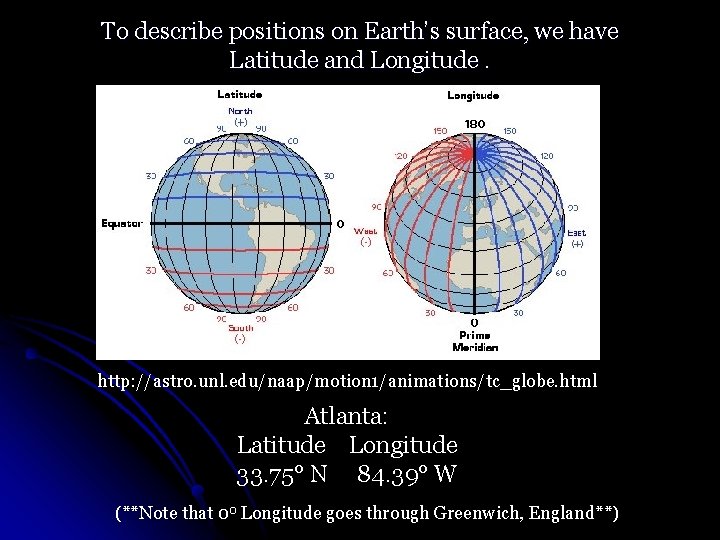
To describe positions on Earth’s surface, we have Latitude and Longitude. http: //astro. unl. edu/naap/motion 1/animations/tc_globe. html Atlanta: Latitude Longitude 33. 75° N 84. 39° W (**Note that 00 Longitude goes through Greenwich, England**)

July 2016 00 Longitude passes near Barcelona, Spain also.
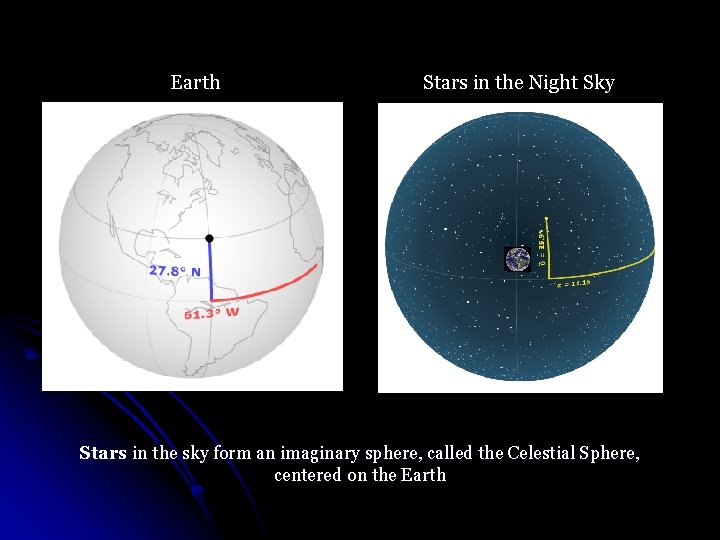
Earth Stars in the Night Sky Stars in the sky form an imaginary sphere, called the Celestial Sphere, centered on the Earth
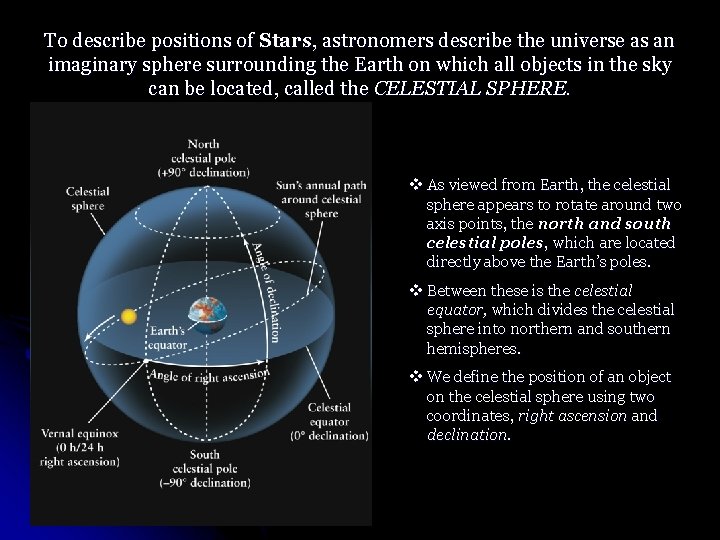
To describe positions of Stars, astronomers describe the universe as an imaginary sphere surrounding the Earth on which all objects in the sky can be located, called the CELESTIAL SPHERE. v As viewed from Earth, the celestial sphere appears to rotate around two axis points, the north and south celestial poles, which are located directly above the Earth’s poles. v Between these is the celestial equator, which divides the celestial sphere into northern and southern hemispheres. v We define the position of an object on the celestial sphere using two coordinates, right ascension and declination.
Celestial (Equatorial) Coordinates l We need coordinates “fixed” to the celestial sphere. Declination and Right Ascension Declination-Latitude RA – Longitude A star’s Dec & RA will change very little in your lifetime.
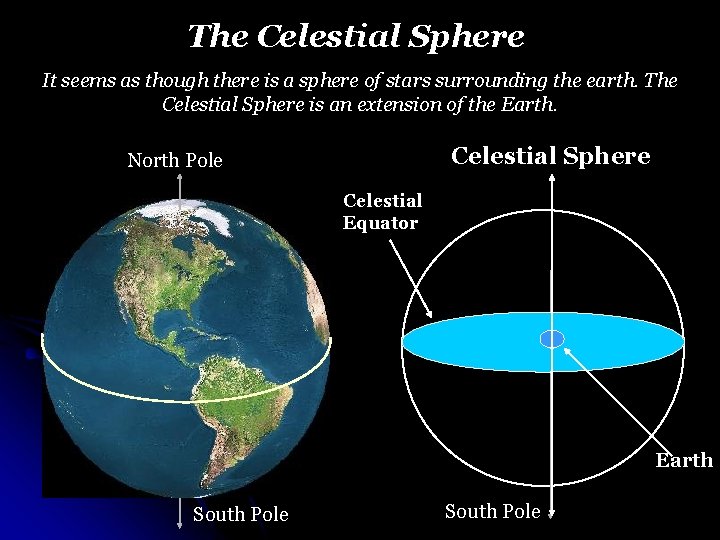
The Celestial Sphere It seems as though there is a sphere of stars surrounding the earth. The Celestial Sphere is an extension of the Earth. Celestial Sphere North Pole Celestial Equator Earth South Pole
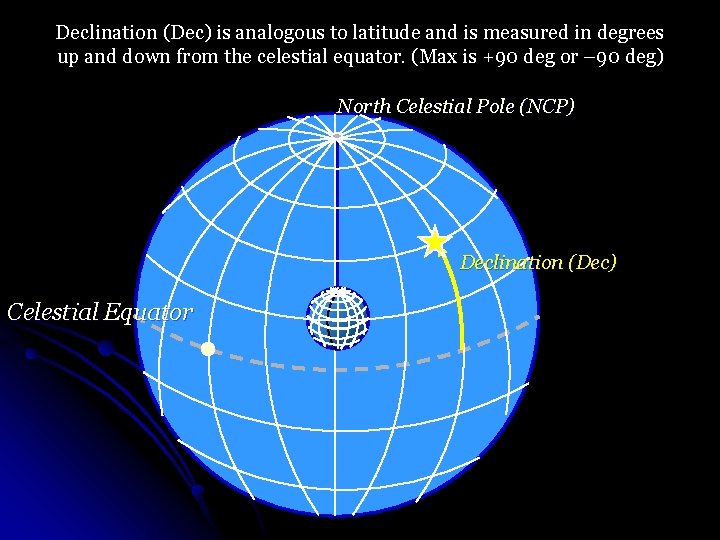
Declination (Dec) is analogous to latitude and is measured in degrees up and down from the celestial equator. (Max is +90 deg or – 90 deg) North Celestial Pole (NCP) Declination (Dec) Celestial Equator
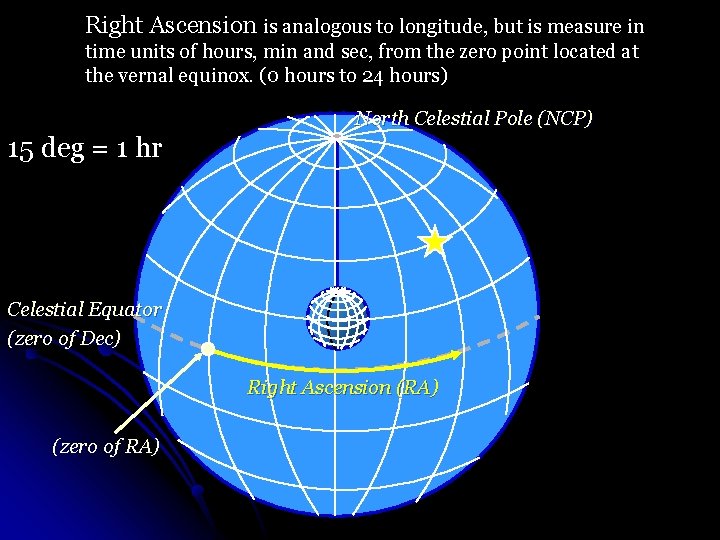
Right Ascension is analogous to longitude, but is measure in time units of hours, min and sec, from the zero point located at the vernal equinox. (0 hours to 24 hours) North Celestial Pole (NCP) 15 deg = 1 hr Celestial Equator (zero of Dec) Right Ascension (RA) (zero of RA)

Right Ascension & Declination With these two directions, any object can be located on the celestial sphere. North Celestial Pole (NCP) Declination (Dec) Celestial Equator (zero of Dec) Right Ascension (RA) (zero of RA)
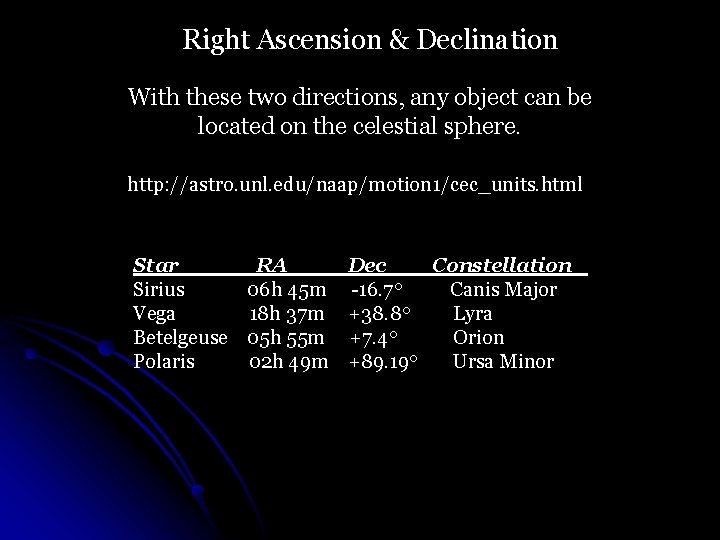
Right Ascension & Declination With these two directions, any object can be located on the celestial sphere. http: //astro. unl. edu/naap/motion 1/cec_units. html Star RA Dec Constellation Sirius 06 h 45 m -16. 70 Canis Major Vega 18 h 37 m +38. 80 Lyra Betelgeuse 05 h 55 m +7. 40 Orion Polaris 02 h 49 m +89. 190 Ursa Minor
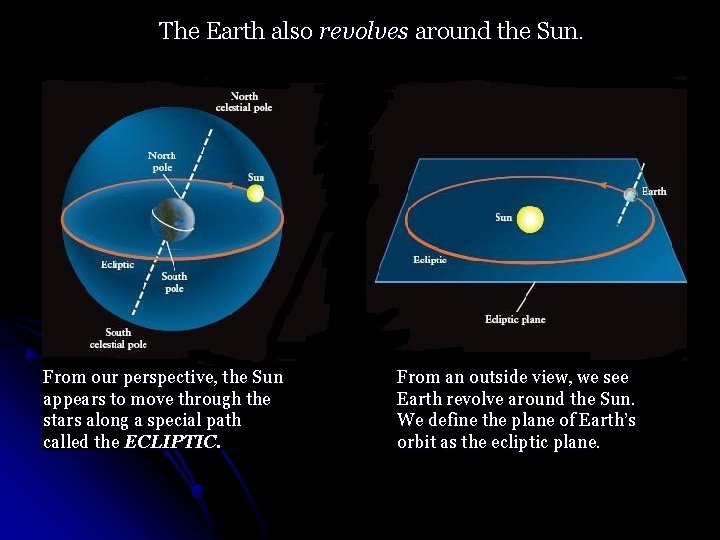
The Earth also revolves around the Sun. From our perspective, the Sun appears to move through the stars along a special path called the ECLIPTIC. From an outside view, we see Earth revolve around the Sun. We define the plane of Earth’s orbit as the ecliptic plane.
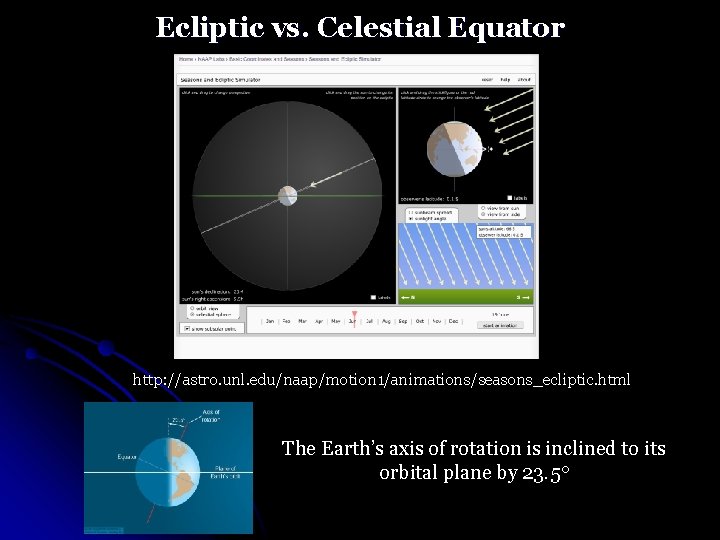
Ecliptic vs. Celestial Equator http: //astro. unl. edu/naap/motion 1/animations/seasons_ecliptic. html The Earth’s axis of rotation is inclined to its orbital plane by 23. 50
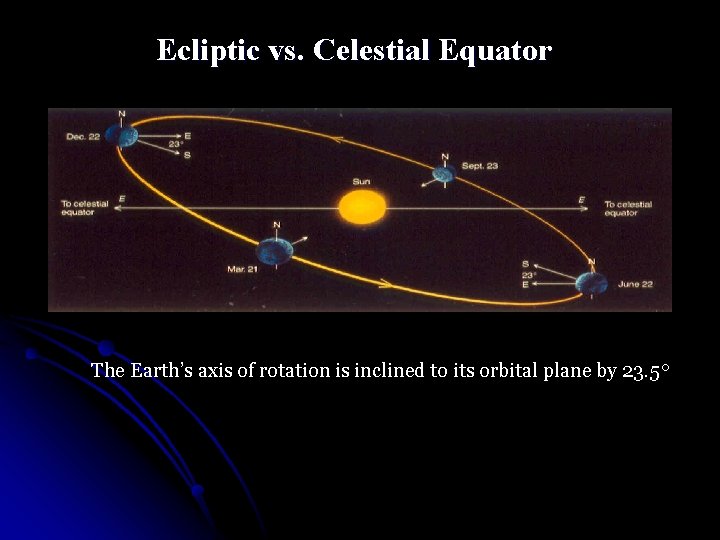
Ecliptic vs. Celestial Equator The Earth’s axis of rotation is inclined to its orbital plane by 23. 50
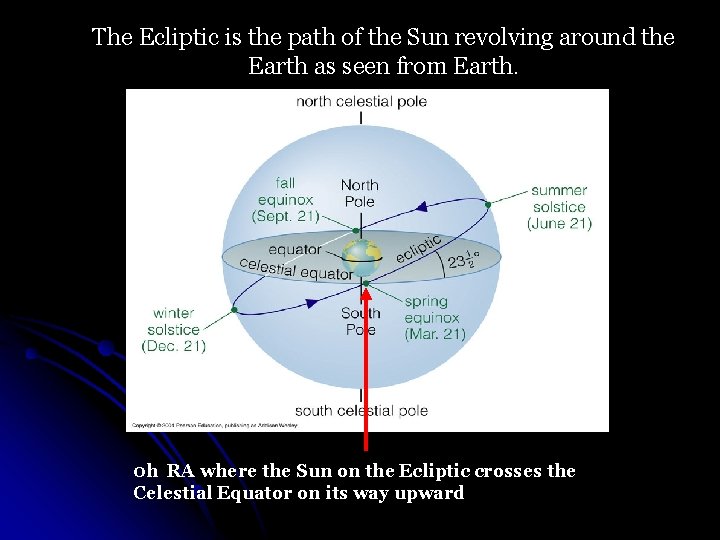
The Ecliptic is the path of the Sun revolving around the Earth as seen from Earth. 0 h RA where the Sun on the Ecliptic crosses the Celestial Equator on its way upward
While standing on the surface of the Earth, how does the night sky move over time? The apparent westward motion of the Sun, Moon, and stars across our sky each day is caused by Earth’s rotation. At middle latitudes, we see the Sun, Moon, and many of the stars first come into view moving upward, rising at some point along the eastern horizon. Then, they appear to arc across the sky. Finally, they disappear somewhere along the western horizon. We generalize this motion to make statements such as, “The Sun rises in the east and sets in the west. ”
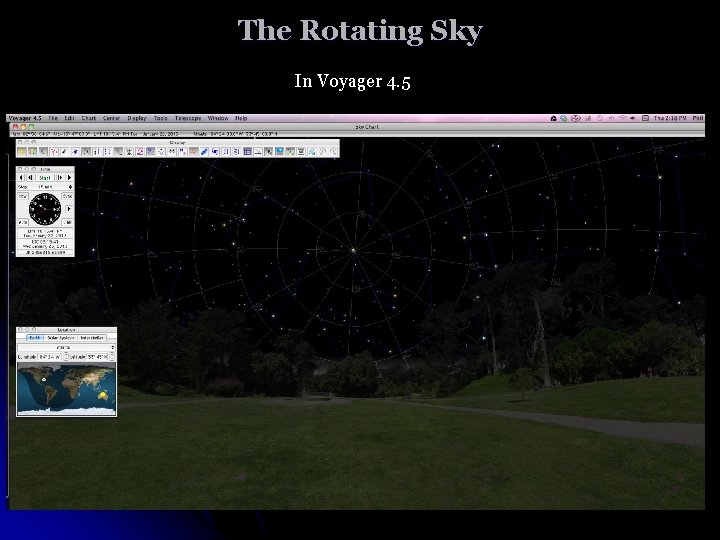
The Rotating Sky In Voyager 4. 5
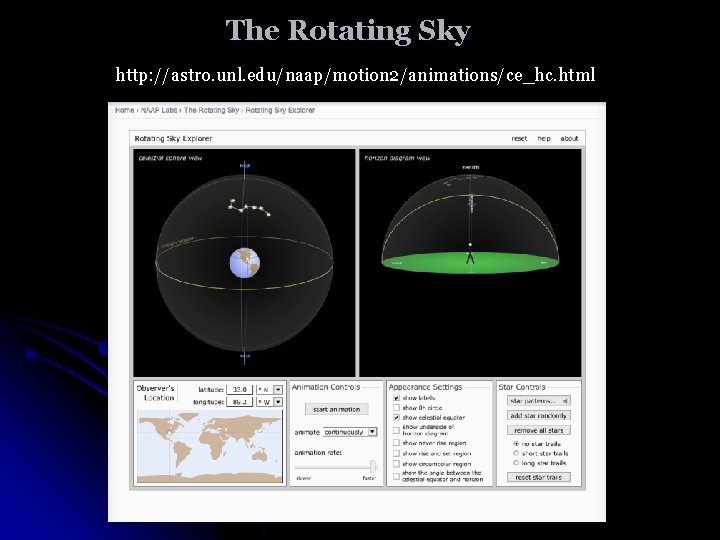
The Rotating Sky http: //astro. unl. edu/naap/motion 2/animations/ce_hc. html
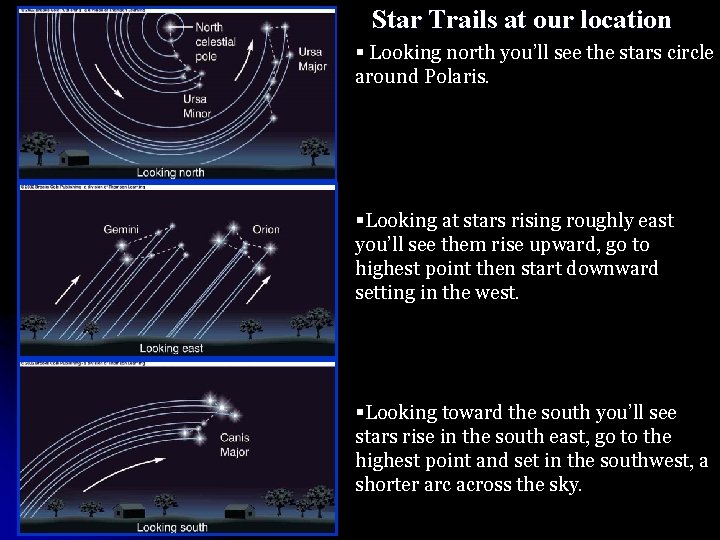
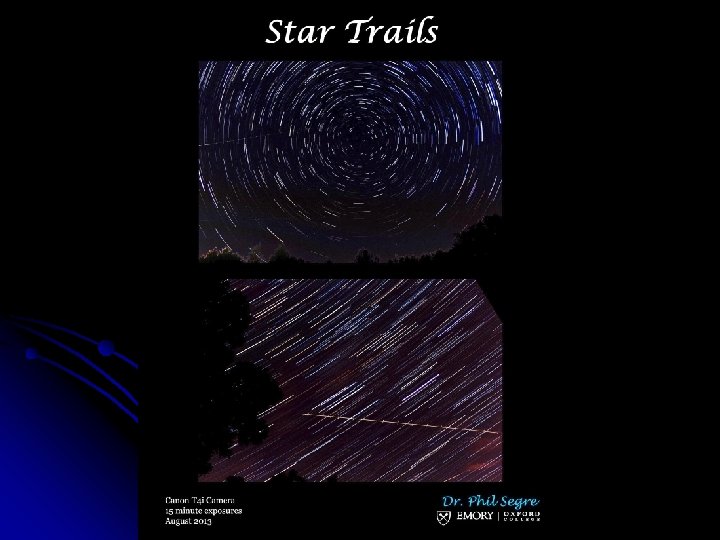
Star Trails at our location § Looking north you’ll see the stars circle around Polaris. §Looking at stars rising roughly east you’ll see them rise upward, go to highest point then start downward setting in the west. §Looking toward the south you’ll see stars rise in the south east, go to the highest point and set in the southwest, a shorter arc across the sky.
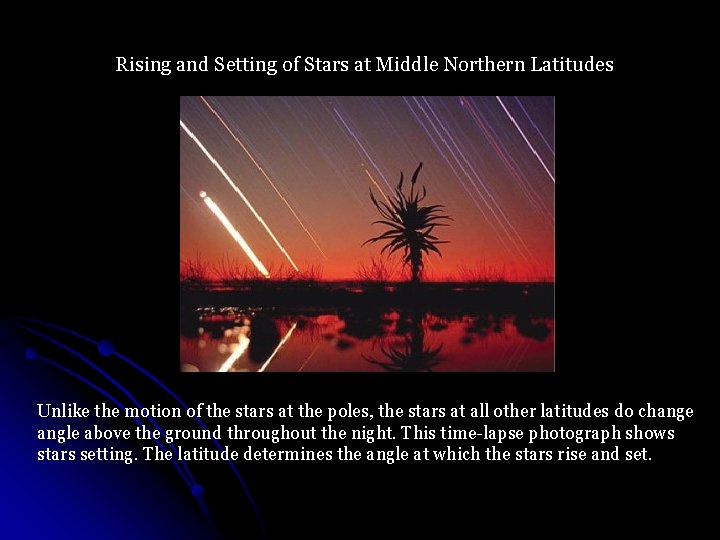
Rising and Setting of Stars at Middle Northern Latitudes Unlike the motion of the stars at the poles, the stars at all other latitudes do change angle above the ground throughout the night. This time-lapse photograph shows stars setting. The latitude determines the angle at which the stars rise and set.
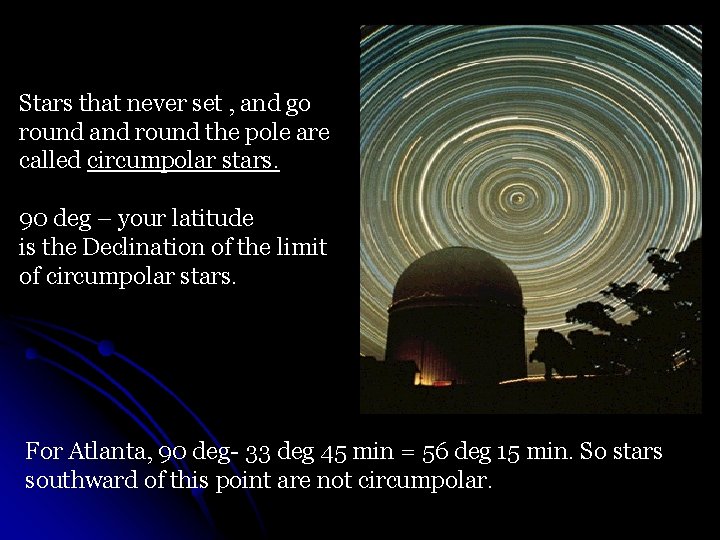
Stars that never set , and go round and round the pole are called circumpolar stars. 90 deg – your latitude is the Declination of the limit of circumpolar stars. For Atlanta, 90 deg- 33 deg 45 min = 56 deg 15 min. So stars southward of this point are not circumpolar.
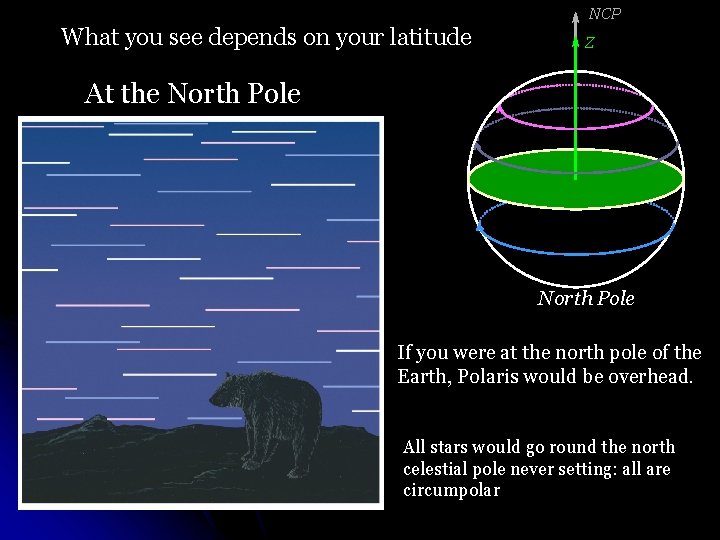
NCP What you see depends on your latitude Z At the North Pole If you were at the north pole of the Earth, Polaris would be overhead. All stars would go round the north celestial pole never setting: all are circumpolar
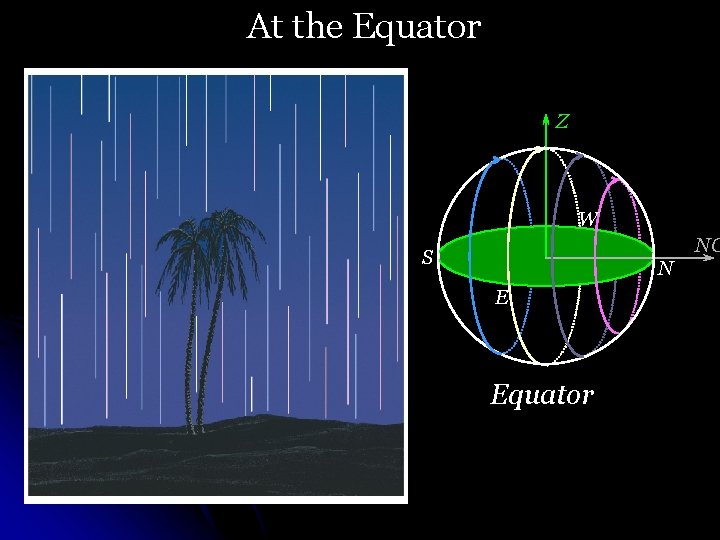
At the Equator Z W NC S N E Equator
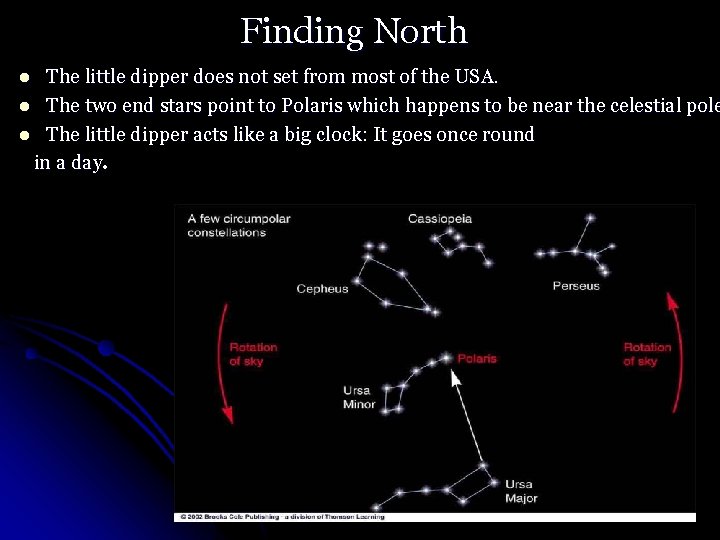
Finding North The little dipper does not set from most of the USA. l The two end stars point to Polaris which happens to be near the celestial pole l The little dipper acts like a big clock: It goes once round in a day. l
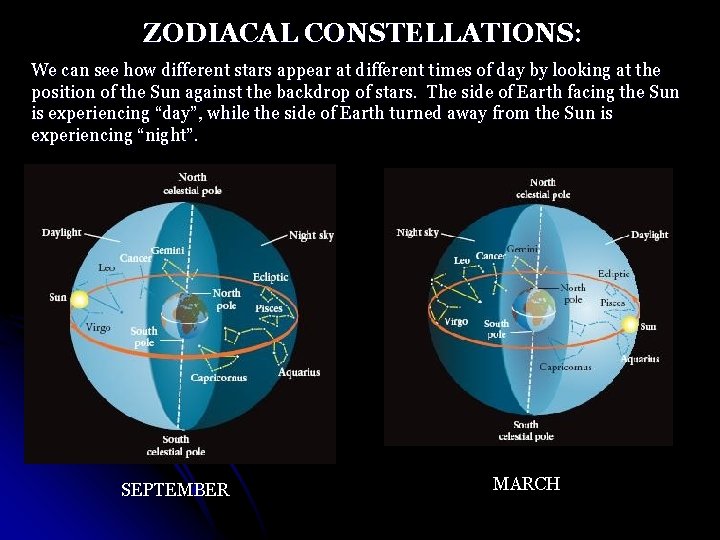
ZODIACAL CONSTELLATIONS: We can see how different stars appear at different times of day by looking at the position of the Sun against the backdrop of stars. The side of Earth facing the Sun is experiencing “day”, while the side of Earth turned away from the Sun is experiencing “night”. SEPTEMBER MARCH
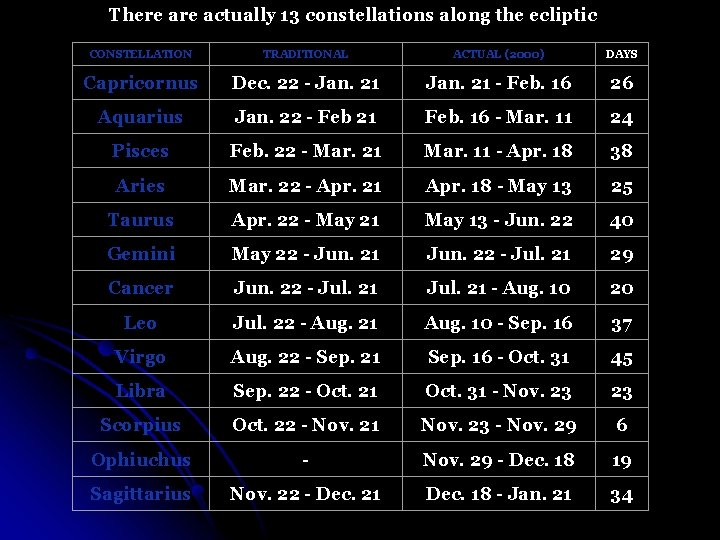
There actually 13 constellations along the ecliptic CONSTELLATION TRADITIONAL ACTUAL (2000) DAYS Capricornus Dec. 22 - Jan. 21 - Feb. 16 26 Aquarius Jan. 22 - Feb 21 Feb. 16 - Mar. 11 24 Pisces Feb. 22 - Mar. 21 Mar. 11 - Apr. 18 38 Aries Mar. 22 - Apr. 21 Apr. 18 - May 13 25 Taurus Apr. 22 - May 21 May 13 - Jun. 22 40 Gemini May 22 - Jun. 21 Jun. 22 - Jul. 21 29 Cancer Jun. 22 - Jul. 21 - Aug. 10 20 Leo Jul. 22 - Aug. 21 Aug. 10 - Sep. 16 37 Virgo Aug. 22 - Sep. 21 Sep. 16 - Oct. 31 45 Libra Sep. 22 - Oct. 21 Oct. 31 - Nov. 23 23 Scorpius Oct. 22 - Nov. 21 Nov. 23 - Nov. 29 6 Ophiuchus - Nov. 29 - Dec. 18 19 Sagittarius Nov. 22 - Dec. 21 Dec. 18 - Jan. 21 34
- Slides: 26