
To be or not to be BRscaling in
To be or not to be, BR-scaling in h. QCD Sang-Jin Sin (HYU) @him-wcu 09. 10 With Y. Seo, J. P. Shock, D. Zoakos(0911. xxxx) CY. Park, KH. Jo, BH Lee(0909. 3914 )
Introduction: Dynamical mass* �A good way summarizing the effect of the interaction. � Brown and Rho: m* goes lower. � Based on tendency near chiral restoration. � C 14 and other remarkable applications. � � Yet. No observable support. � Lattice calculation with density is still difficult. � So, need new idea. l 0910 HIM-WCU l 2009 -10 -31 l 2
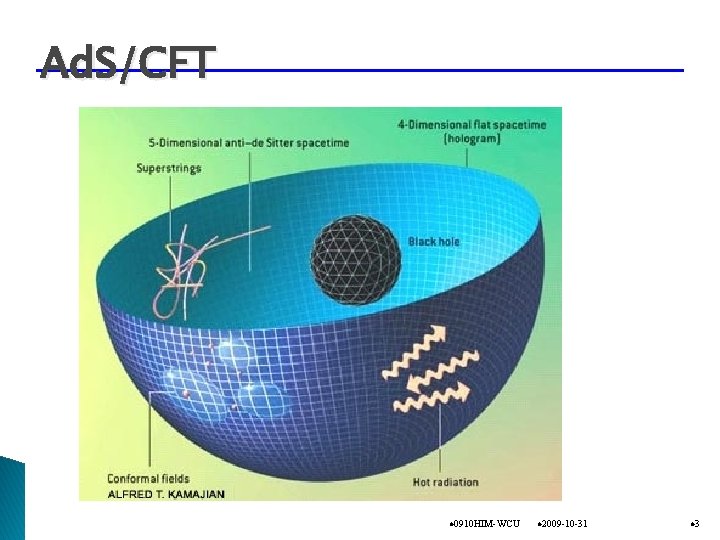
Ad. S/CFT l 0910 HIM-WCU l 2009 -10 -31 l 3
Bottom Up Approach � Gluon dynamics is replaced by Ad. S 5. � Flavor dyn. By space filling branes. � Meson=fluctuation of branes. l 0910 HIM-WCU l 2009 -10 -31 l 4
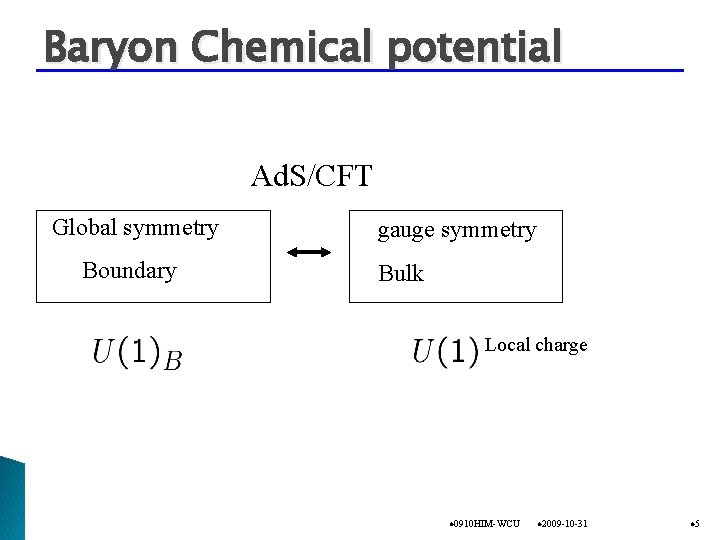
Baryon Chemical potential Ad. S/CFT Global symmetry Boundary gauge symmetry Bulk Local charge l 0910 HIM-WCU l 2009 -10 -31 l 5
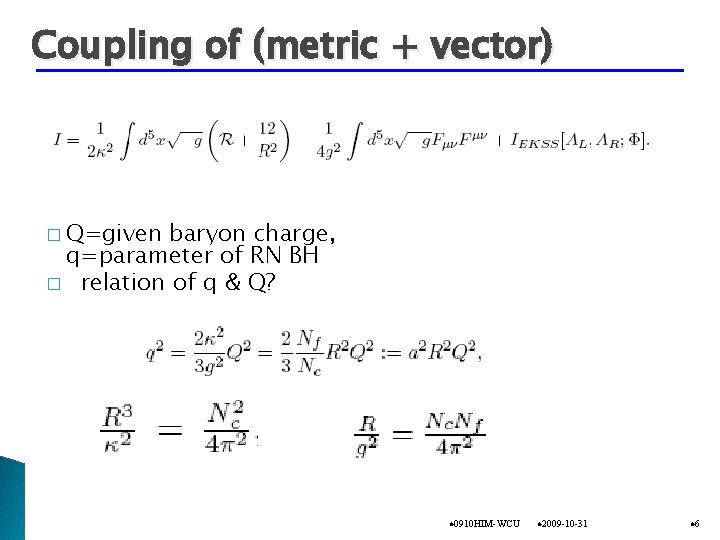
Coupling of (metric + vector) � Q=given baryon charge, q=parameter of RN BH � relation of q & Q? l 0910 HIM-WCU l 2009 -10 -31 l 6
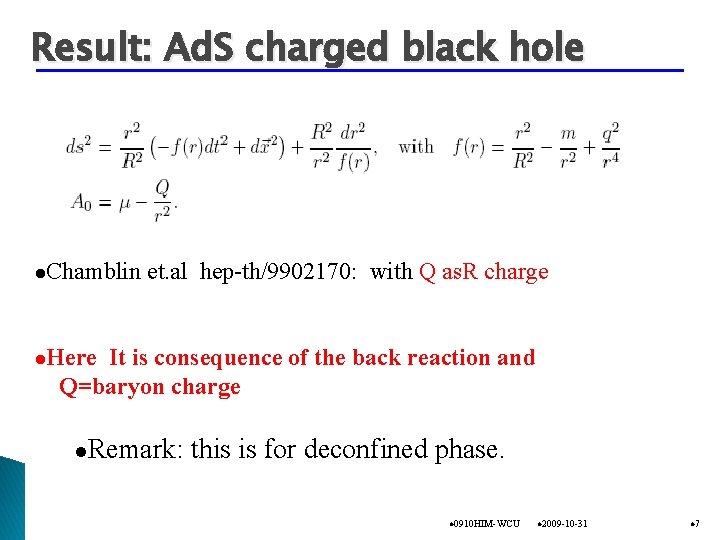
Result: Ad. S charged black hole l l Chamblin et. al hep-th/9902170: with Q as. R charge Here It is consequence of the back reaction and Q=baryon charge l Remark: this is for deconfined phase. l 0910 HIM-WCU l 2009 -10 -31 l 7
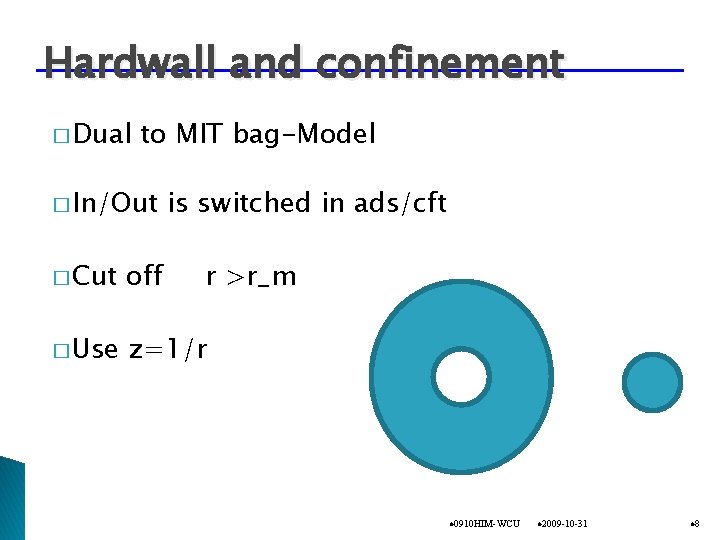
Hardwall and confinement � Dual to MIT bag-Model � In/Out is switched in ads/cft � Cut off r >r_m � Use z=1/r l 0910 HIM-WCU l 2009 -10 -31 l 8
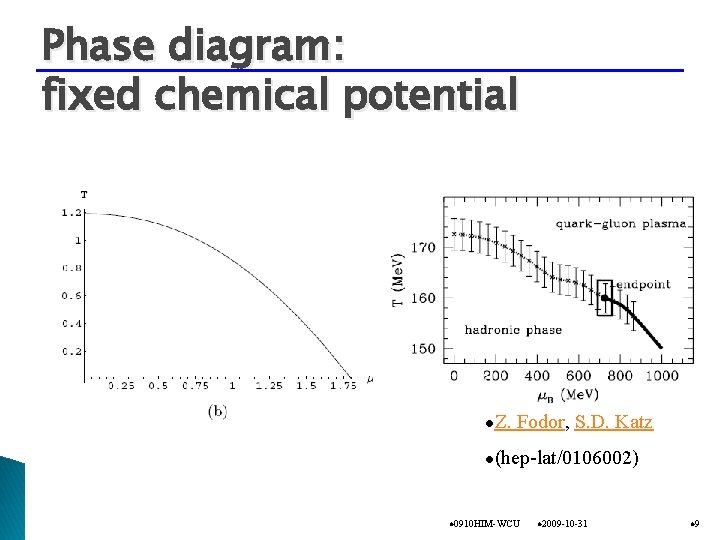
Phase diagram: fixed chemical potential l Z. Fodor, S. D. Katz l (hep-lat/0106002) l 0910 HIM-WCU l 2009 -10 -31 l 9
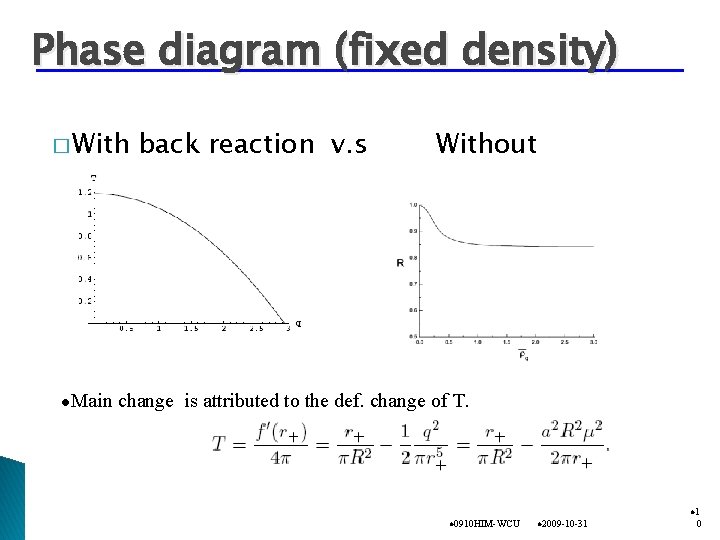
Phase diagram (fixed density) � With l back reaction v. s Without Main change is attributed to the def. change of T. l 1 l 0910 HIM-WCU l 2009 -10 -31 0
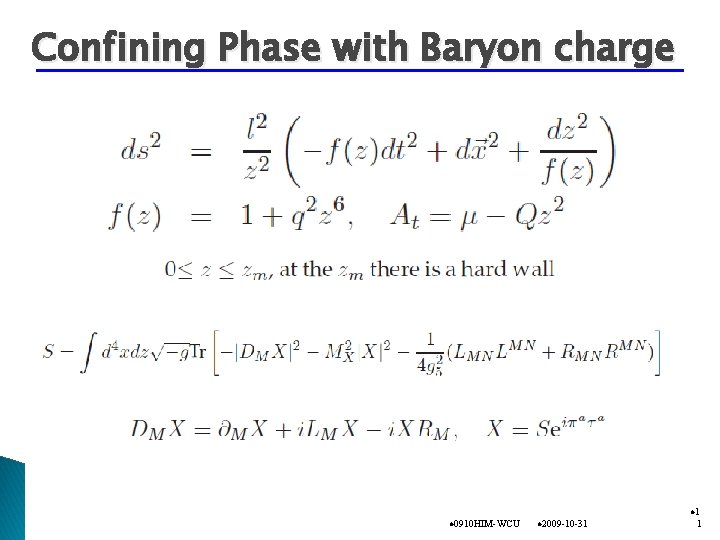
Confining Phase with Baryon charge l 1 l 0910 HIM-WCU l 2009 -10 -31 1
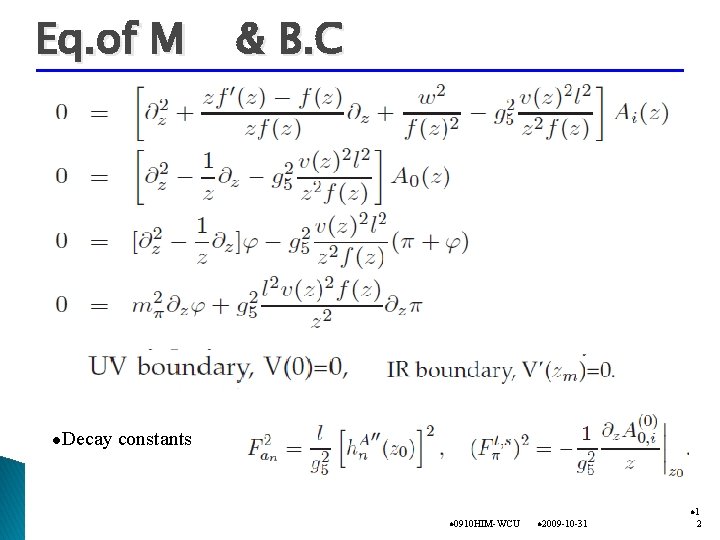
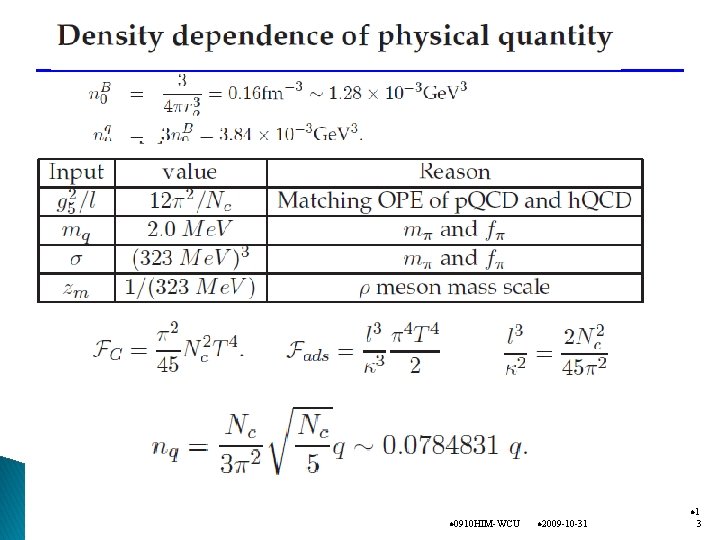
Eq. of M l & B. C Decay constants l 1 l 0910 HIM-WCU l 2009 -10 -31 2
l 1 l 0910 HIM-WCU l 2009 -10 -31 3
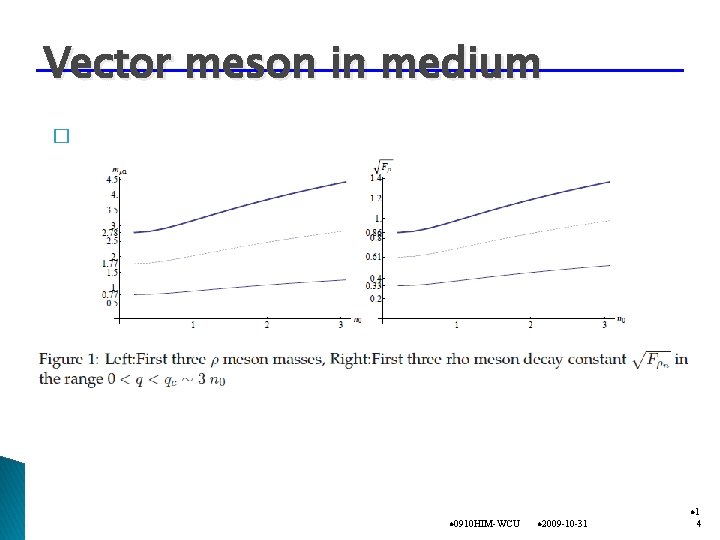
Vector meson in medium � l 1 l 0910 HIM-WCU l 2009 -10 -31 4
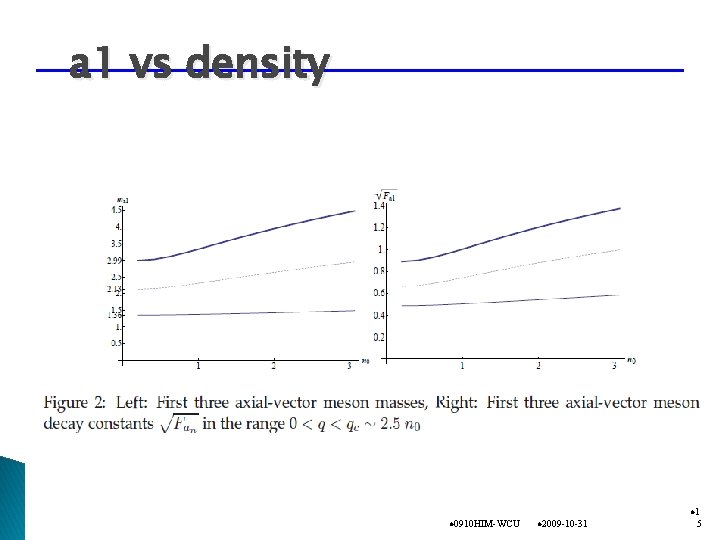
a 1 vs density l 1 l 0910 HIM-WCU l 2009 -10 -31 5
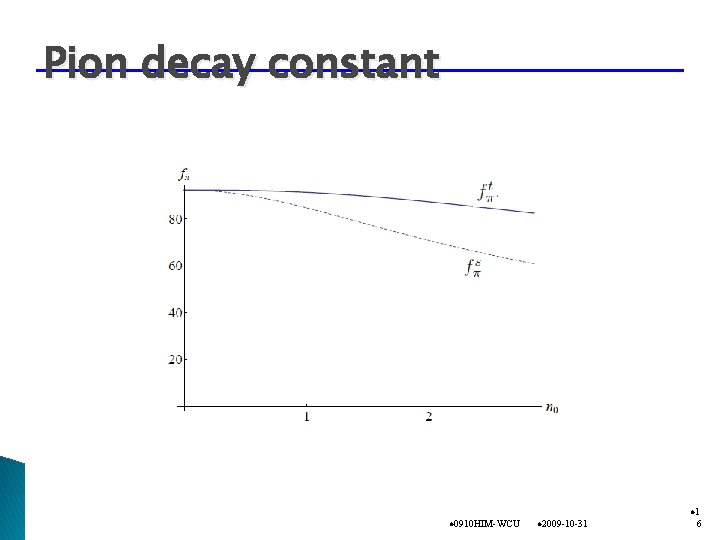
Pion decay constant l 1 l 0910 HIM-WCU l 2009 -10 -31 6
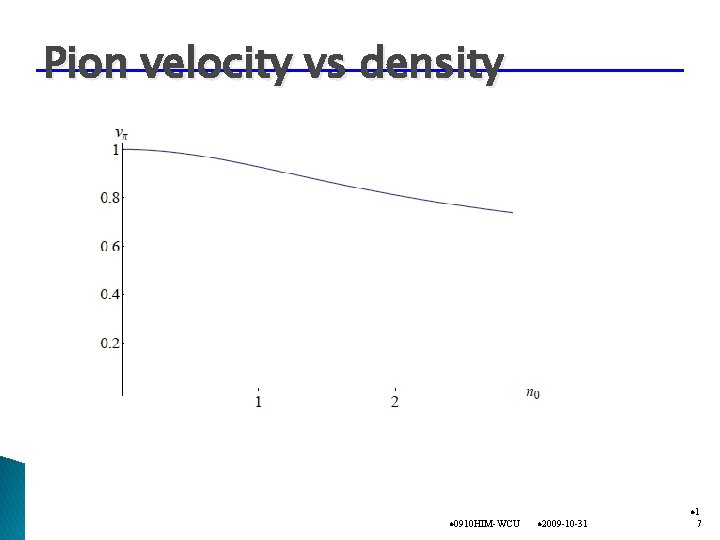
Pion velocity vs density l 1 l 0910 HIM-WCU l 2009 -10 -31 7
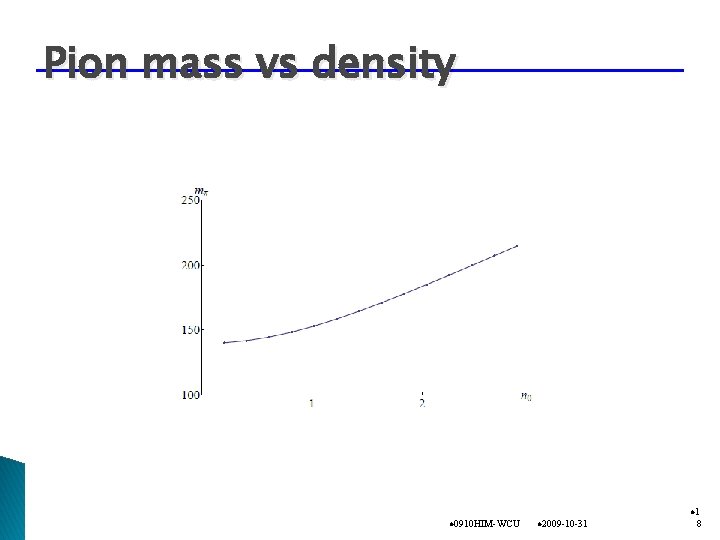
Pion mass vs density l 1 l 0910 HIM-WCU l 2009 -10 -31 8
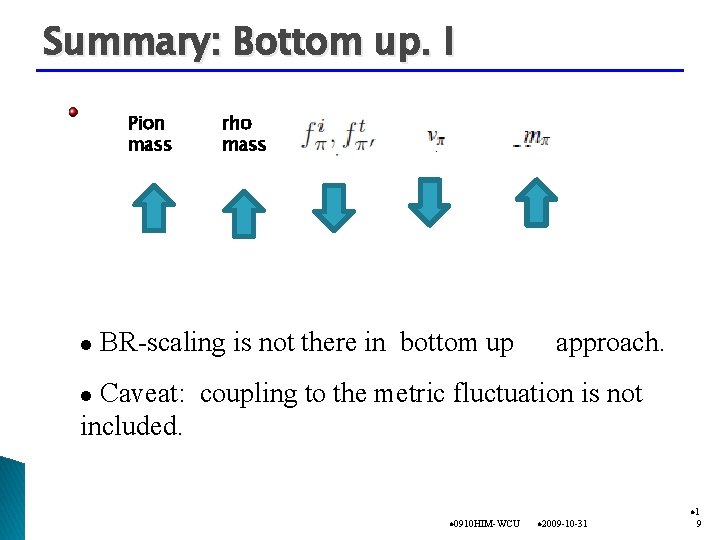
Summary: Bottom up. I Pion mass l rho mass BR-scaling is not there in bottom up approach. Caveat: coupling to the metric fluctuation is not included. l l 1 l 0910 HIM-WCU l 2009 -10 -31 9
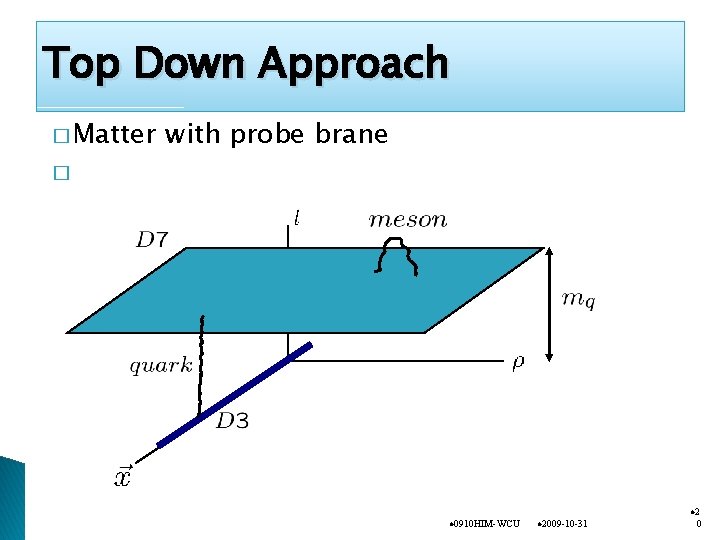
Top Down Approach � Matter with probe brane � l 2 l 0910 HIM-WCU l 2009 -10 -31 0
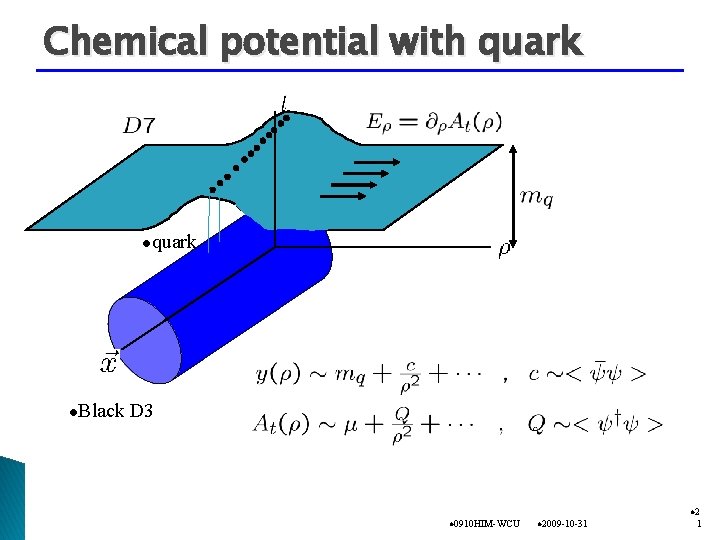
Chemical potential with quark l l quark Black D 3 l 2 l 0910 HIM-WCU l 2009 -10 -31 1
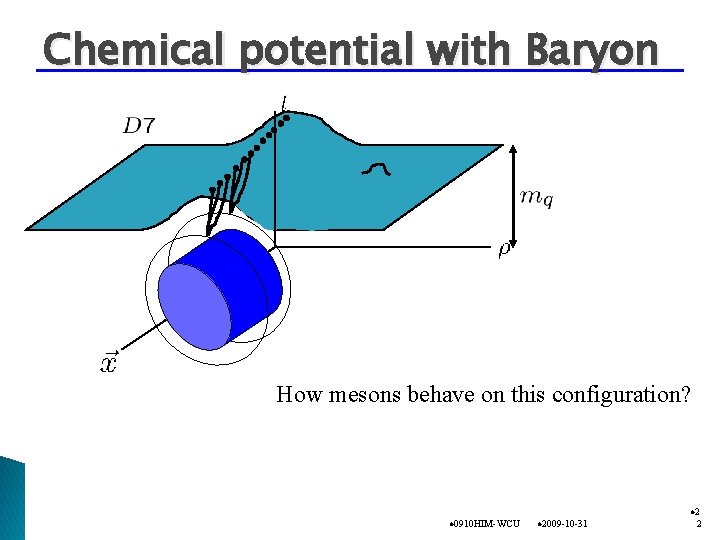
Chemical potential with Baryon How mesons behave on this configuration? l 2 l 0910 HIM-WCU l 2009 -10 -31 2
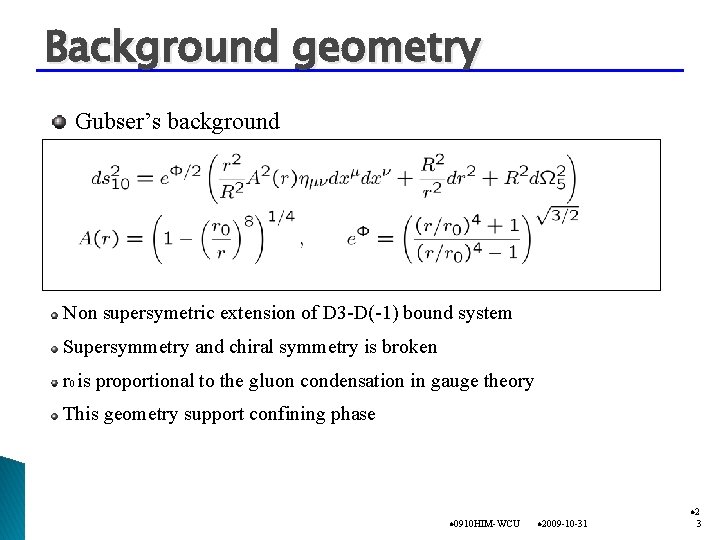
Background geometry Gubser’s background Non supersymetric extension of D 3 -D(-1) bound system Supersymmetry and chiral symmetry is broken r 0 is proportional to the gluon condensation in gauge theory This geometry support confining phase l 2 l 0910 HIM-WCU l 2009 -10 -31 3
Hardwares: DBI action � Theoretical equipments are actions and eq. of M � How D-branes vibrate : DBI l 2 l 0910 HIM-WCU l 2009 -10 -31 4
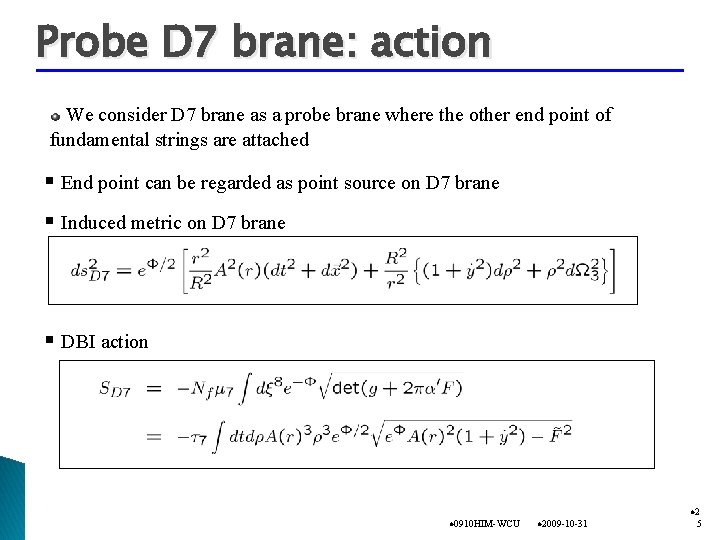
Probe D 7 brane: action We consider D 7 brane as a probe brane where the other end point of fundamental strings are attached § End point can be regarded as point source on D 7 brane § Induced metric on D 7 brane § DBI action l 2 l 0910 HIM-WCU l 2009 -10 -31 5
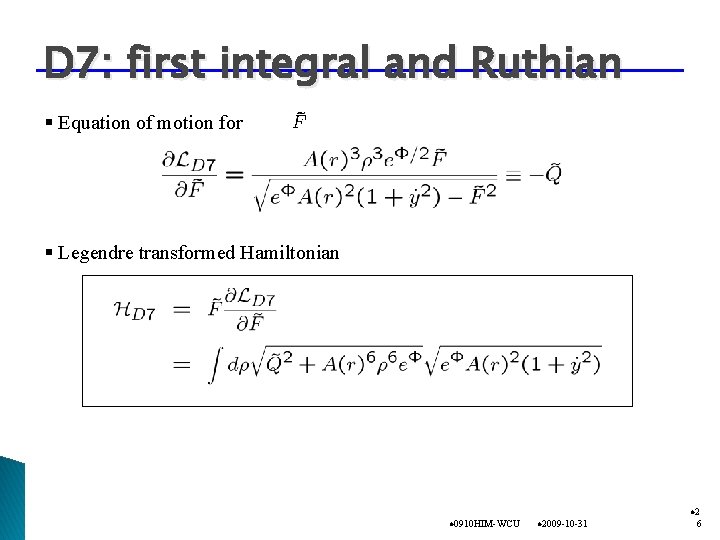
D 7: first integral and Ruthian § Equation of motion for § Legendre transformed Hamiltonian l 2 l 0910 HIM-WCU l 2009 -10 -31 6
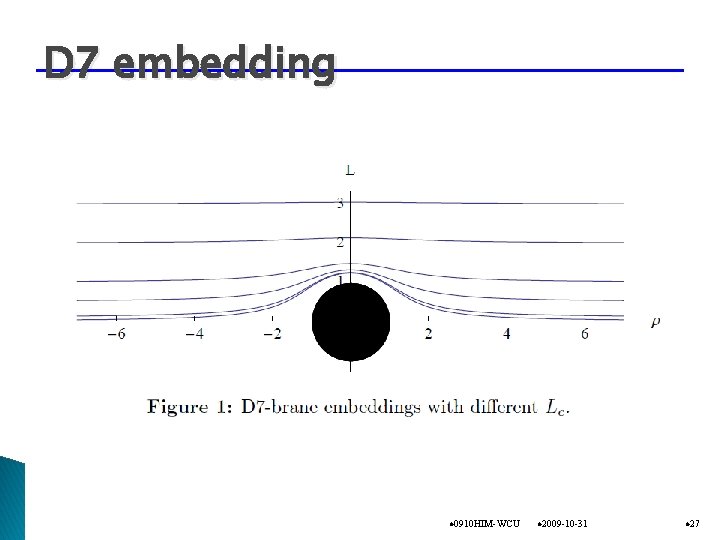
D 7 embedding l 0910 HIM-WCU l 2009 -10 -31 l 27
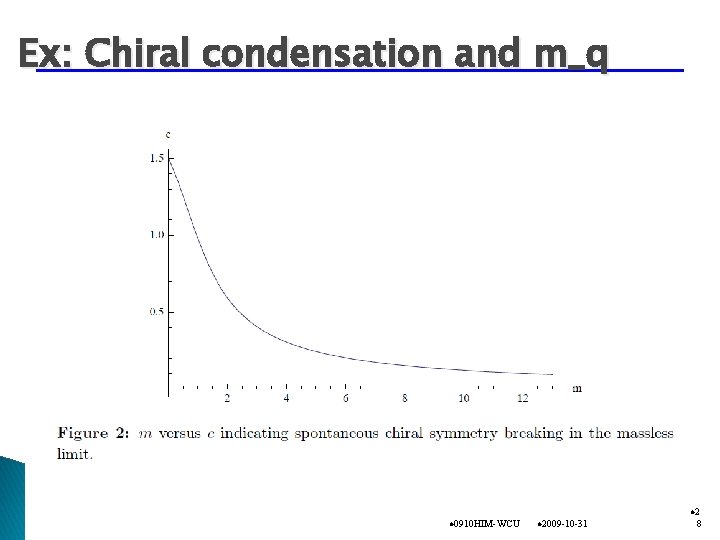
Ex: Chiral condensation and m_q l 2 l 0910 HIM-WCU l 2009 -10 -31 8
D 5 � For dense matter we need D 5. � Add baryon vertices in uniform fashion along D 3 direction (spacial direction). Remark: For single or non-uniform density distribution It is difficult. l 2 l 0910 HIM-WCU l 2009 -10 -31 9
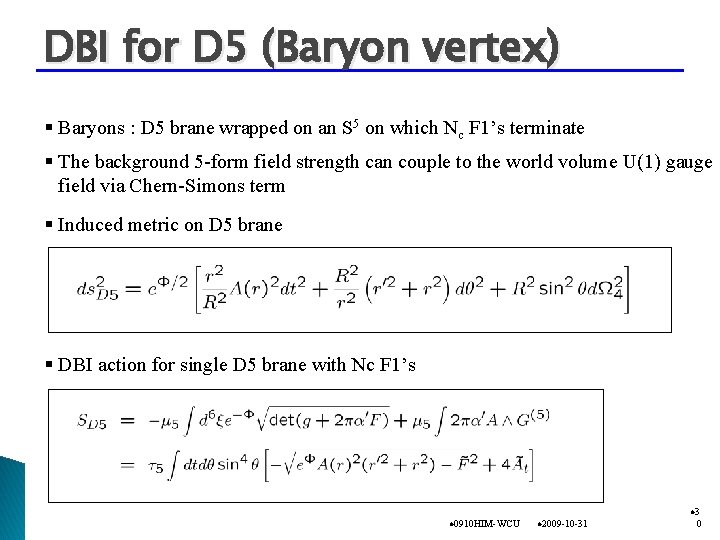
DBI for D 5 (Baryon vertex) § Baryons : D 5 brane wrapped on an S 5 on which Nc F 1’s terminate § The background 5 -form field strength can couple to the world volume U(1) gauge field via Chern-Simons term § Induced metric on D 5 brane § DBI action for single D 5 brane with Nc F 1’s l 3 l 0910 HIM-WCU l 2009 -10 -31 0
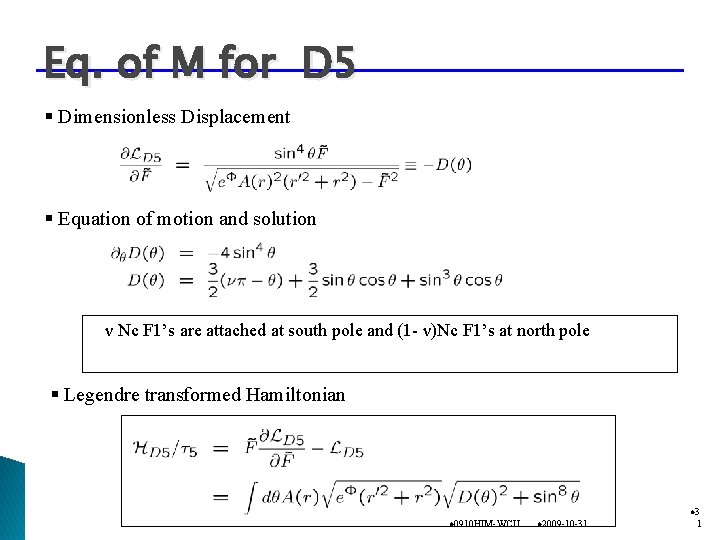
Eq. of M for D 5 § Dimensionless Displacement § Equation of motion and solution ν Nc F 1’s are attached at south pole and (1 - ν)Nc F 1’s at north pole § Legendre transformed Hamiltonian l 3 l 0910 HIM-WCU l 2009 -10 -31 1
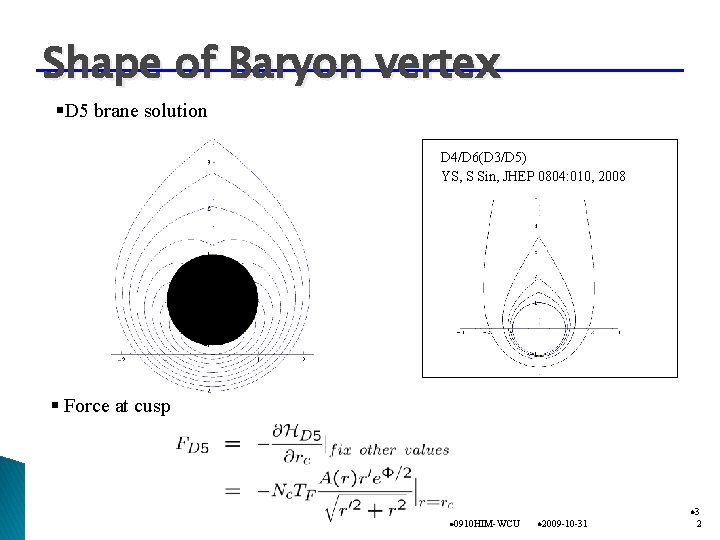
Shape of Baryon vertex §D 5 brane solution D 4/D 6(D 3/D 5) YS, S Sin, JHEP 0804: 010, 2008 § Force at cusp l 3 l 0910 HIM-WCU l 2009 -10 -31 2
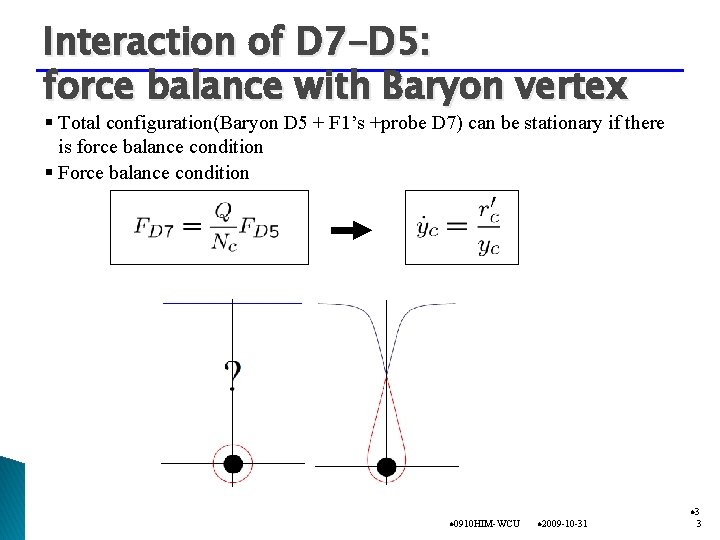
Interaction of D 7 -D 5: force balance with Baryon vertex § Total configuration(Baryon D 5 + F 1’s +probe D 7) can be stationary if there is force balance condition § Force balance condition l 3 l 0910 HIM-WCU l 2009 -10 -31 3
l 3 l 0910 HIM-WCU l 2009 -10 -31 4
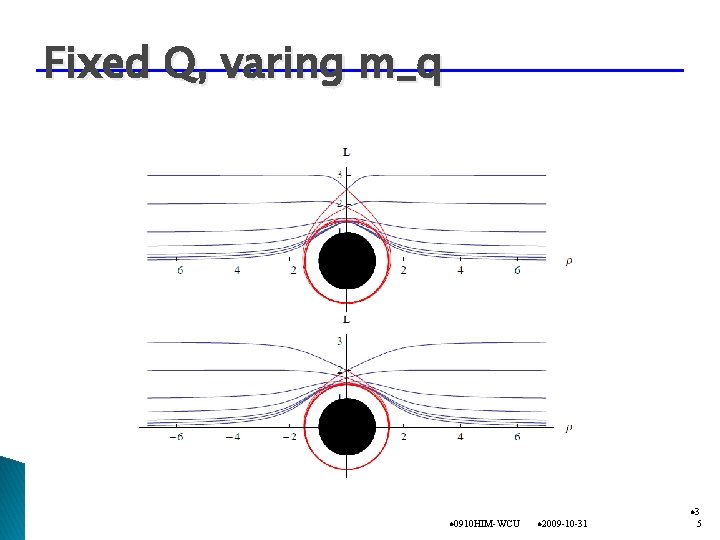
Fixed Q, varing m_q l 3 l 0910 HIM-WCU l 2009 -10 -31 5
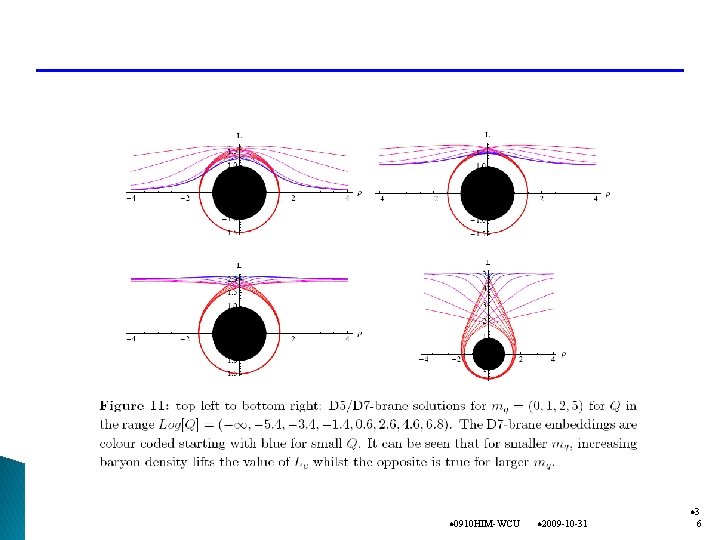
l 3 l 0910 HIM-WCU l 2009 -10 -31 6
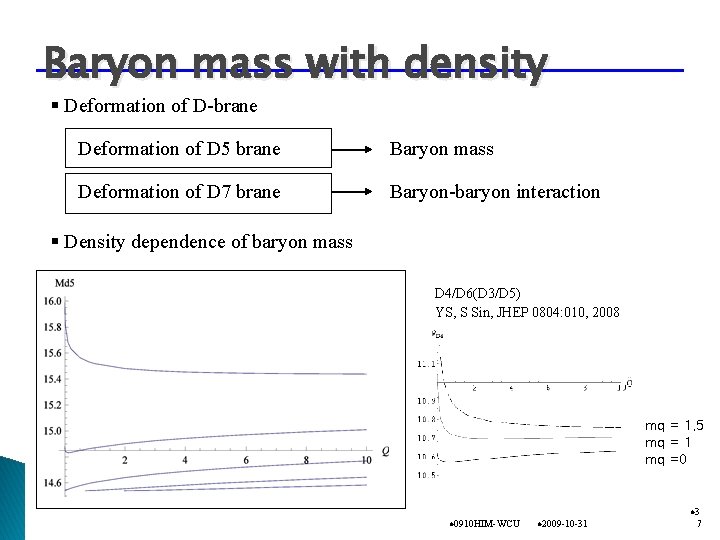
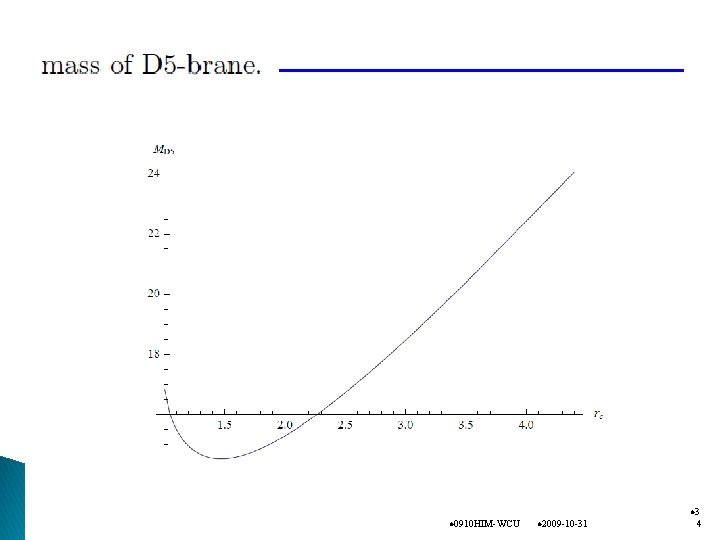
Baryon mass with density § Deformation of D-brane Deformation of D 5 brane Baryon mass Deformation of D 7 brane Baryon-baryon interaction § Density dependence of baryon mass D 4/D 6(D 3/D 5) YS, S Sin, JHEP 0804: 010, 2008 mq = 1. 5 mq = 1 mq =0 l 3 l 0910 HIM-WCU l 2009 -10 -31 7
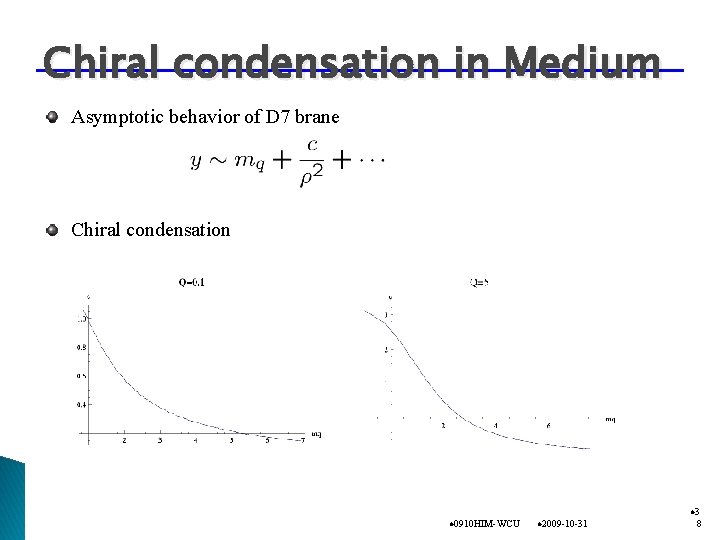
Chiral condensation in Medium Asymptotic behavior of D 7 brane Chiral condensation l 3 l 0910 HIM-WCU l 2009 -10 -31 8
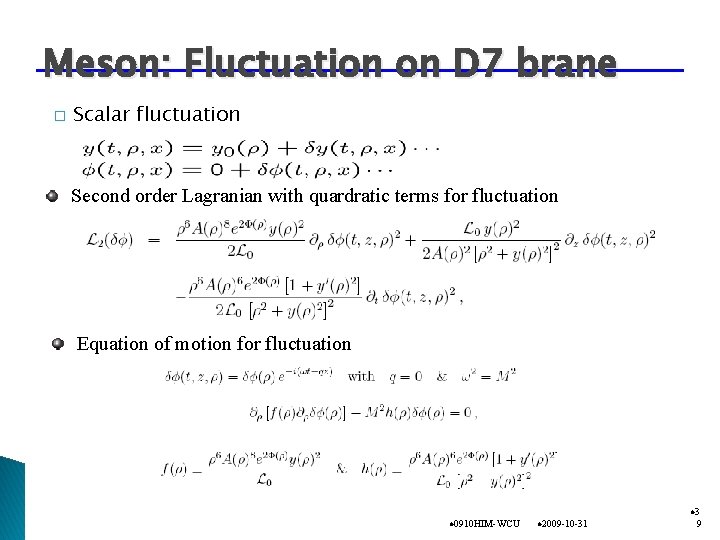
Meson: Fluctuation on D 7 brane � Scalar fluctuation Second order Lagranian with quardratic terms for fluctuation Equation of motion for fluctuation l 3 l 0910 HIM-WCU l 2009 -10 -31 9
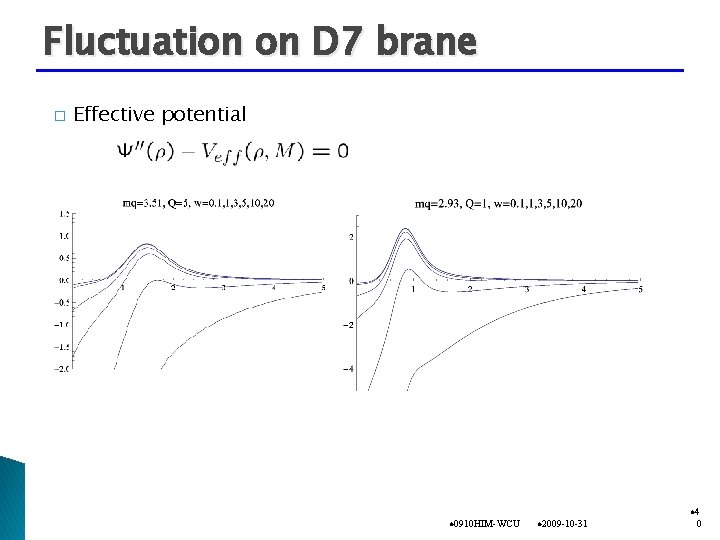
Fluctuation on D 7 brane � Effective potential l 4 l 0910 HIM-WCU l 2009 -10 -31 0
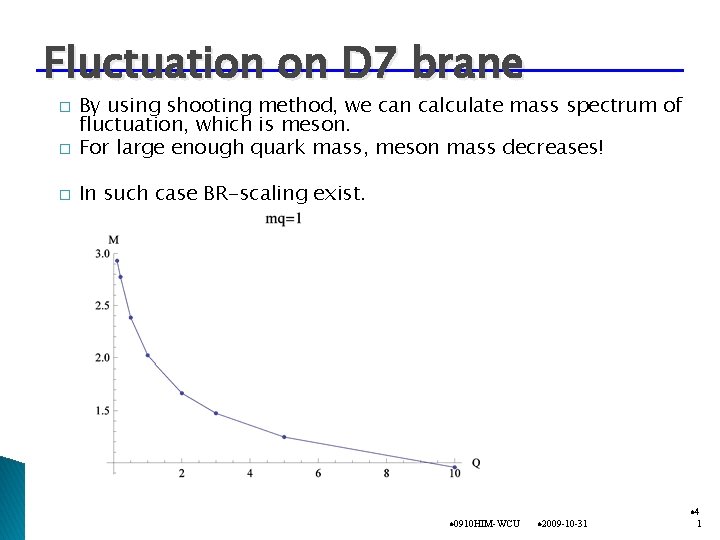
Fluctuation on D 7 brane � By using shooting method, we can calculate mass spectrum of fluctuation, which is meson. For large enough quark mass, meson mass decreases! � In such case BR-scaling exist. � l 4 l 0910 HIM-WCU l 2009 -10 -31 1
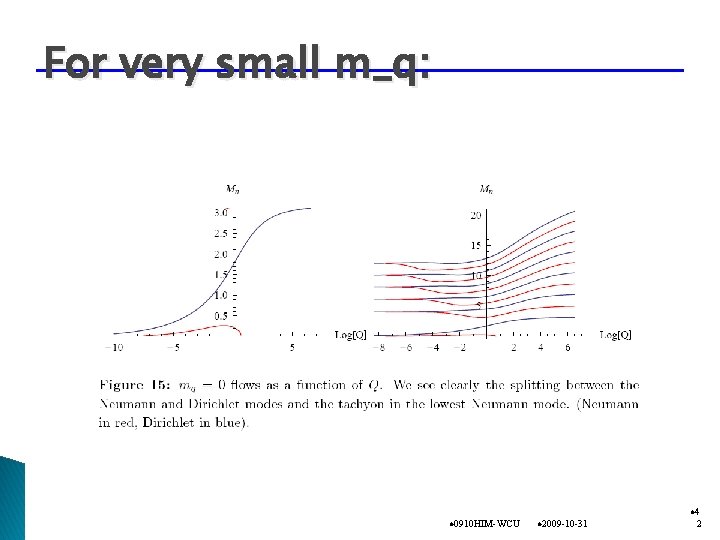
For very small m_q: l 4 l 0910 HIM-WCU l 2009 -10 -31 2
Summary � BR scaling is possible for some model for appreciable quark mass, while it is not there in some of the model. � Remark: So are we are still in pion mode. Vector mode will be reported in future. (Rho Seo SJS) l 4 l 0910 HIM-WCU l 2009 -10 -31 3
Conclusion: What next? � Here, we studied Density dependences. � Following objects are calculable in hqcd: � 0. Phase diagram (not critical point/crossover). � 1. equation of state. � 2. all Thermodnamic quantities. � 3. condensations (chiral , gluon, meson … ) � 4. susceptiblities. compressibility � 5. spectral functions. � 6. Symmetry energies. � 7. Differnet models and Different modes. � Etc ……. l 4 l 0910 HIM-WCU l 2009 -10 -31 4
- Slides: 44