
To be able to count vertices on 3
To be able to count vertices on 3 -D shapes Success criteria: ü I can use my knowledge of 3 -D shapes edges and faces to count the number of vertices of 3 -D shapes, both using real 3 -D shapes and using 2 -D representations of 3 -D shapes ü I can explain my reasoning when using my knowledge of 3 -D shapes edges and faces to count the number of vertices of 3 -D shapes, both using real 3 -D shapes and using 2 -D representations of 3 -D shapes Stage 2 - Spring Block 3 - Properties of Shape - Lesson 10 - To be able to count vertices on 3 -D shapes
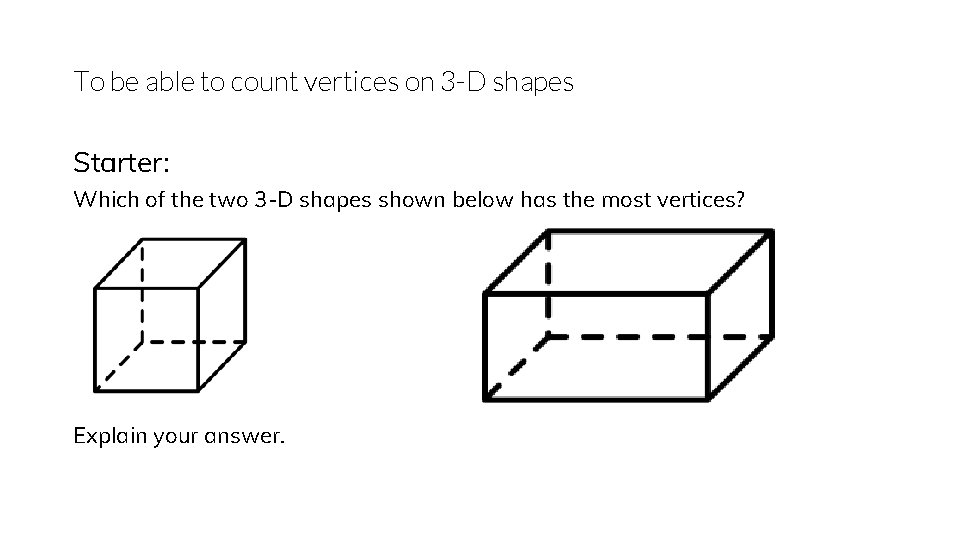
To be able to count vertices on 3 -D shapes Starter: Which of the two 3 -D shapes shown below has the most vertices? Explain your answer.
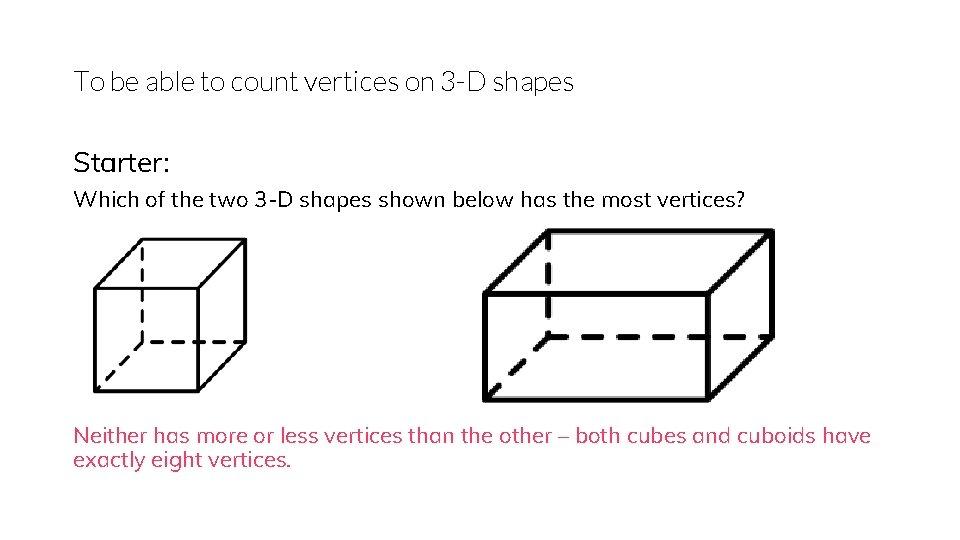
To be able to count vertices on 3 -D shapes Starter: Which of the two 3 -D shapes shown below has the most vertices? Neither has more or less vertices than the other – both cubes and cuboids have exactly eight vertices.
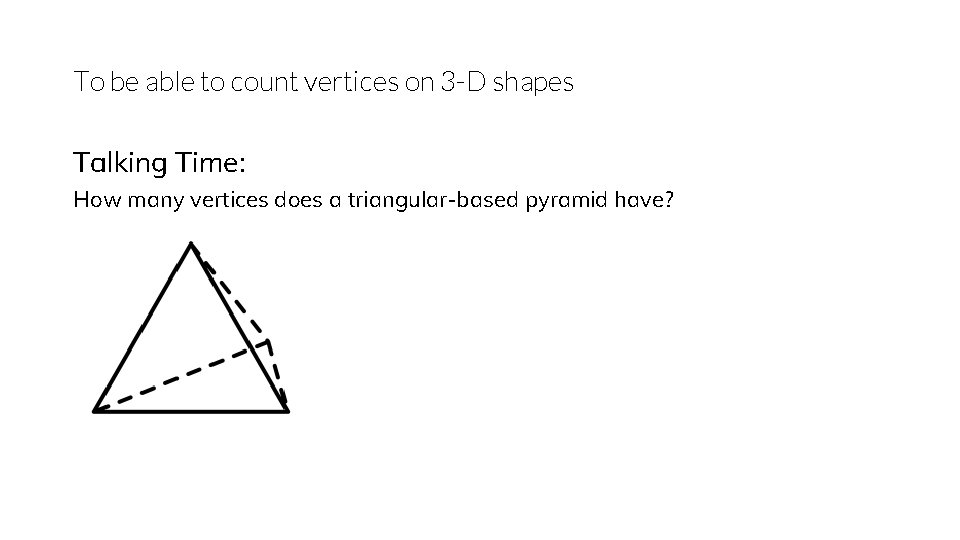
To be able to count vertices on 3 -D shapes Talking Time: How many vertices does a triangular-based pyramid have?
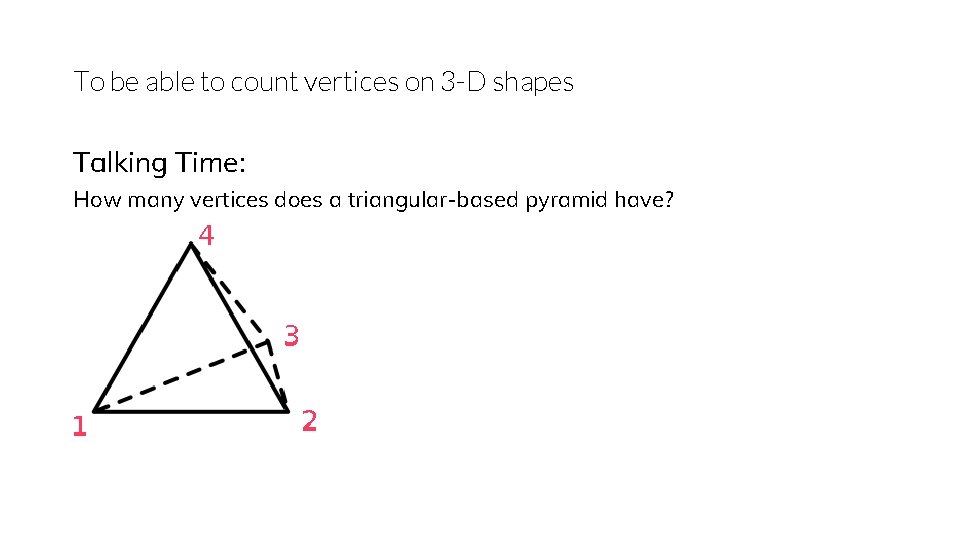
To be able to count vertices on 3 -D shapes Talking Time: How many vertices does a triangular-based pyramid have? 4 3 1 2
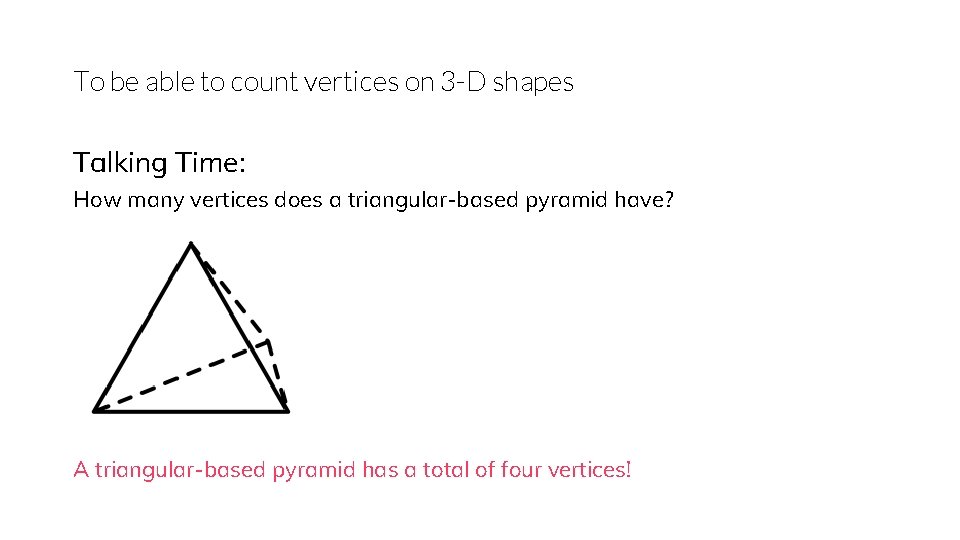
To be able to count vertices on 3 -D shapes Talking Time: How many vertices does a triangular-based pyramid have? A triangular-based pyramid has a total of four vertices!
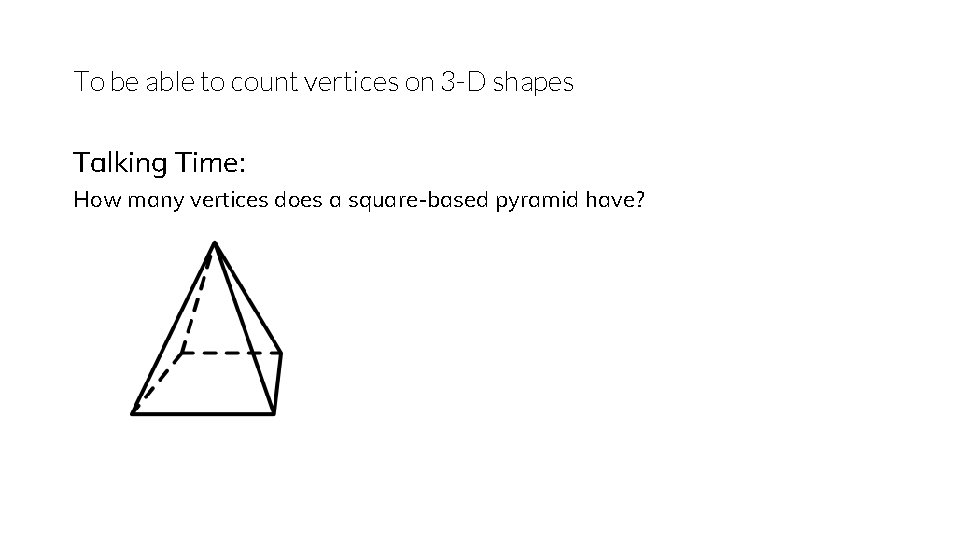
To be able to count vertices on 3 -D shapes Talking Time: How many vertices does a square-based pyramid have?
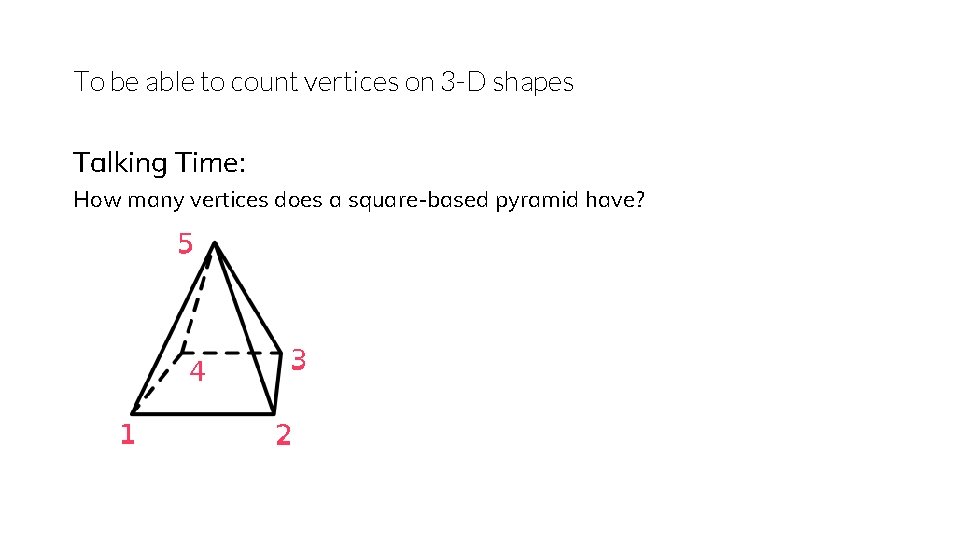
To be able to count vertices on 3 -D shapes Talking Time: How many vertices does a square-based pyramid have? 5 4 1 3 2
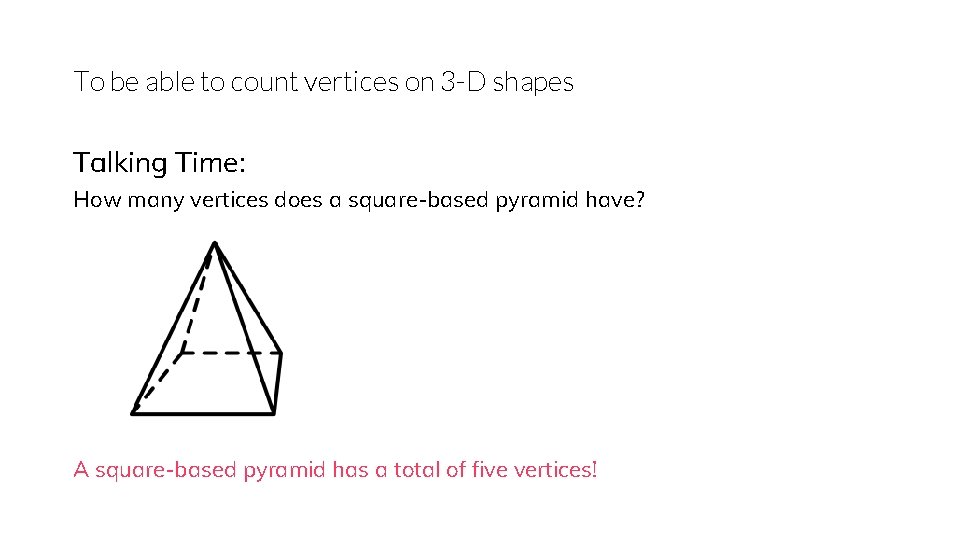
To be able to count vertices on 3 -D shapes Talking Time: How many vertices does a square-based pyramid have? A square-based pyramid has a total of five vertices!
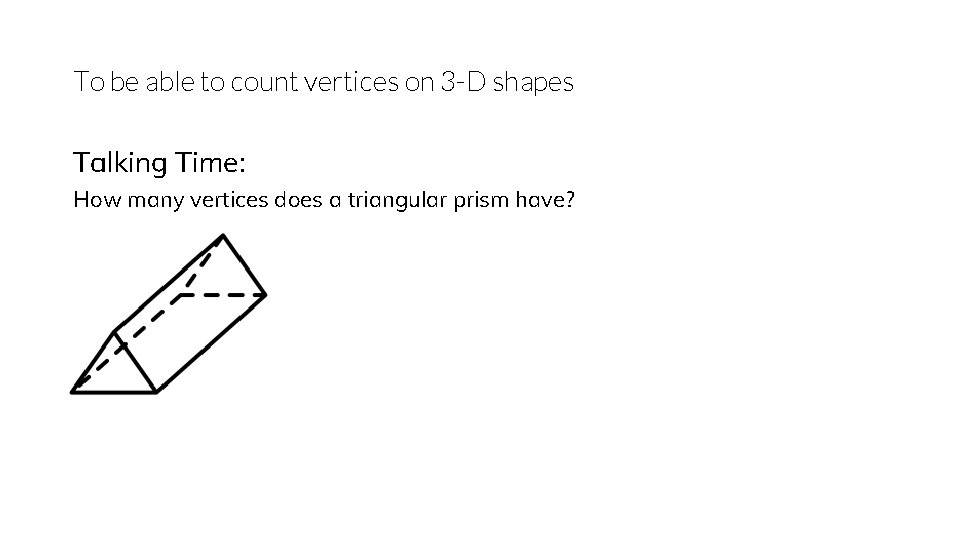
To be able to count vertices on 3 -D shapes Talking Time: How many vertices does a triangular prism have?
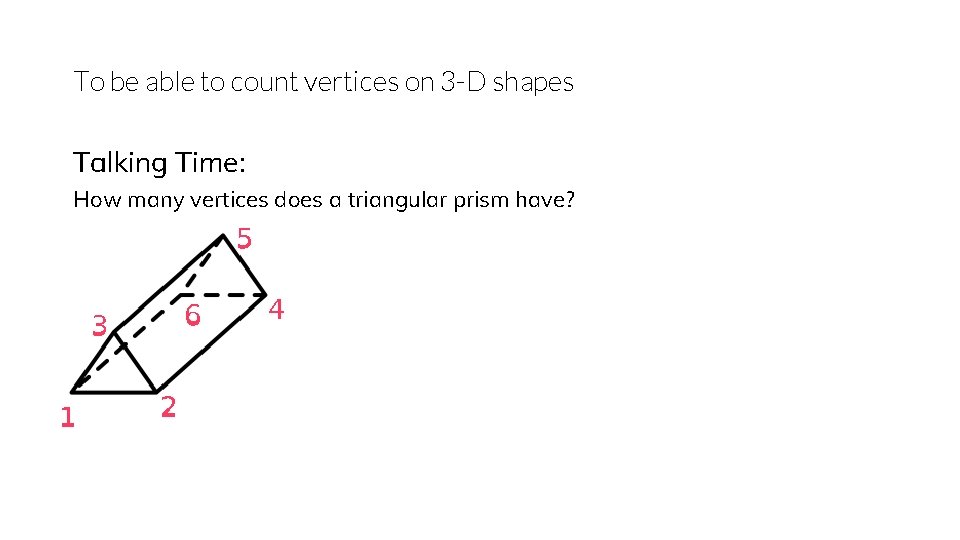
To be able to count vertices on 3 -D shapes Talking Time: How many vertices does a triangular prism have? 5 6 3 1 2 4
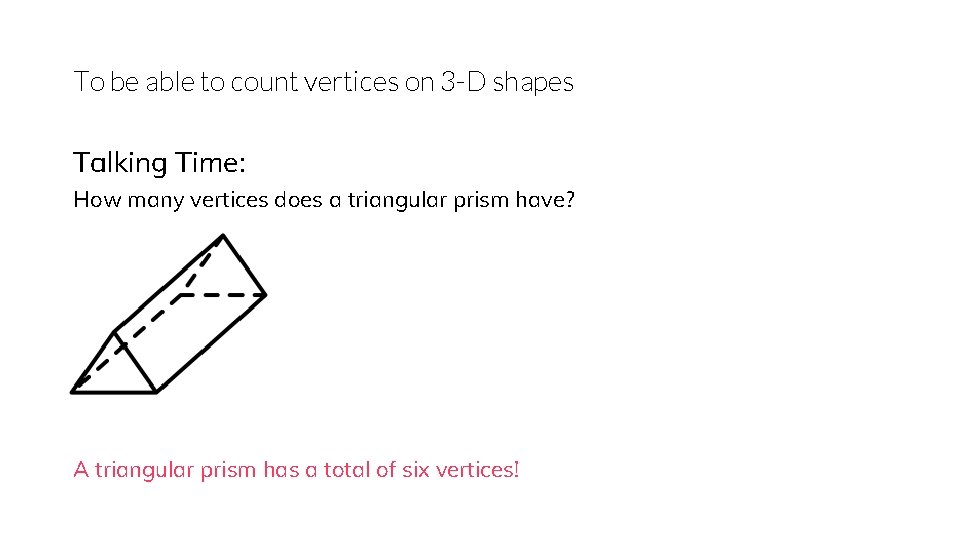
To be able to count vertices on 3 -D shapes Talking Time: How many vertices does a triangular prism have? A triangular prism has a total of six vertices!
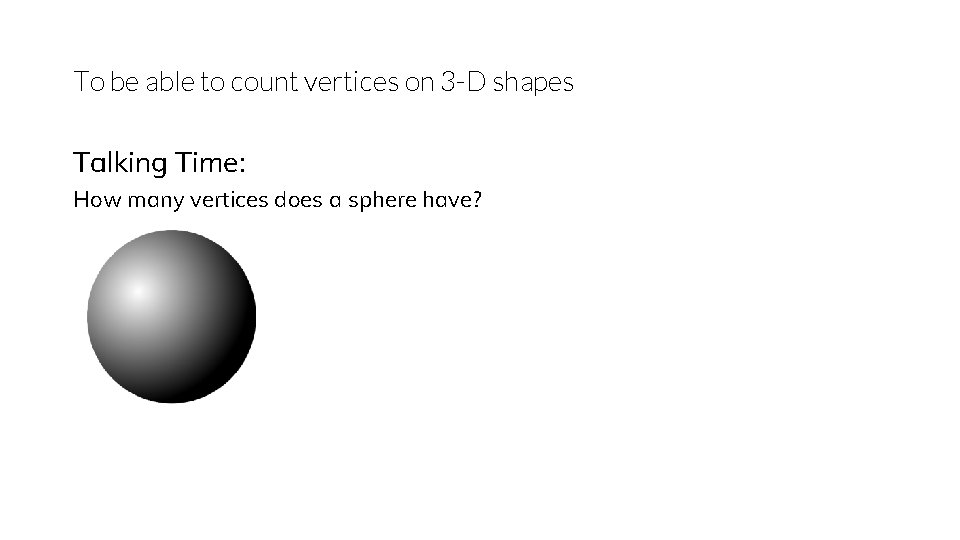
To be able to count vertices on 3 -D shapes Talking Time: How many vertices does a sphere have?
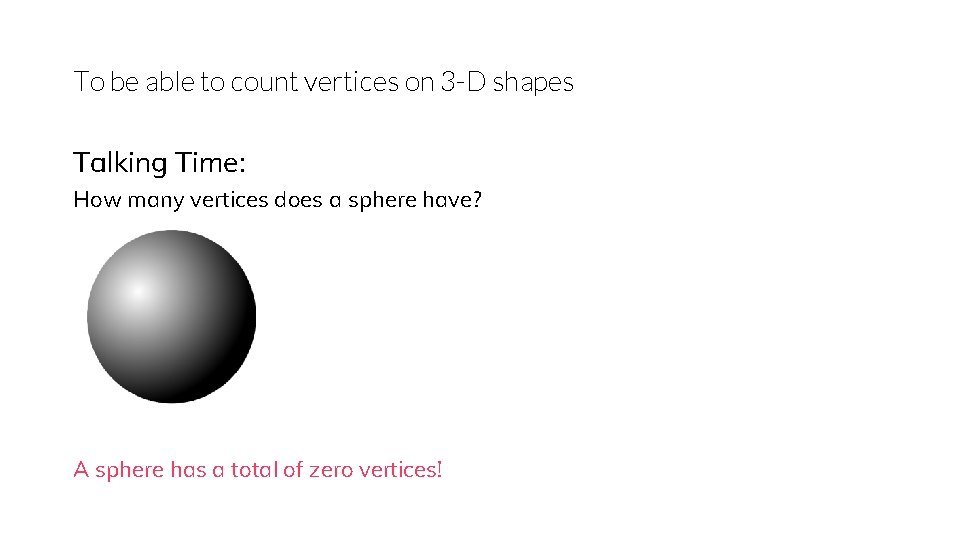
To be able to count vertices on 3 -D shapes Talking Time: How many vertices does a sphere have? A sphere has a total of zero vertices!
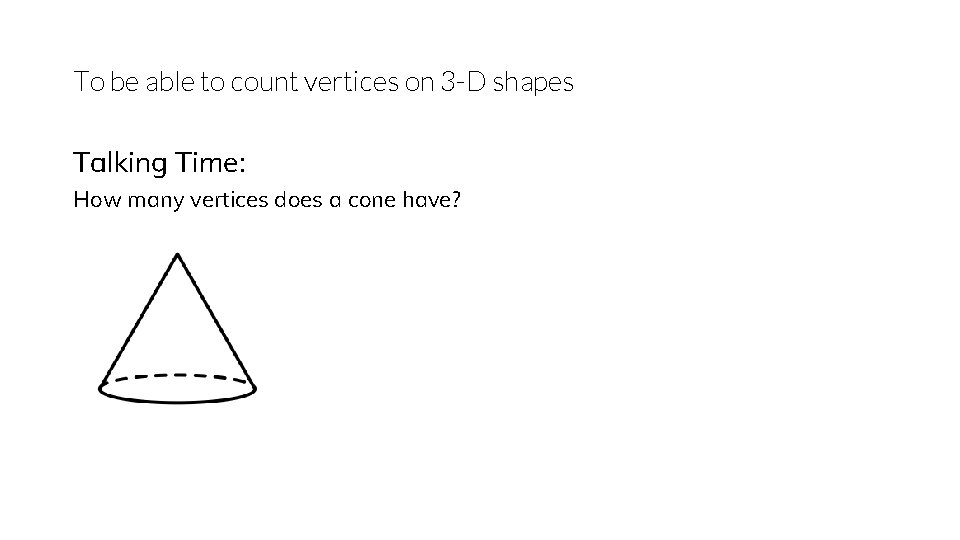
To be able to count vertices on 3 -D shapes Talking Time: How many vertices does a cone have?
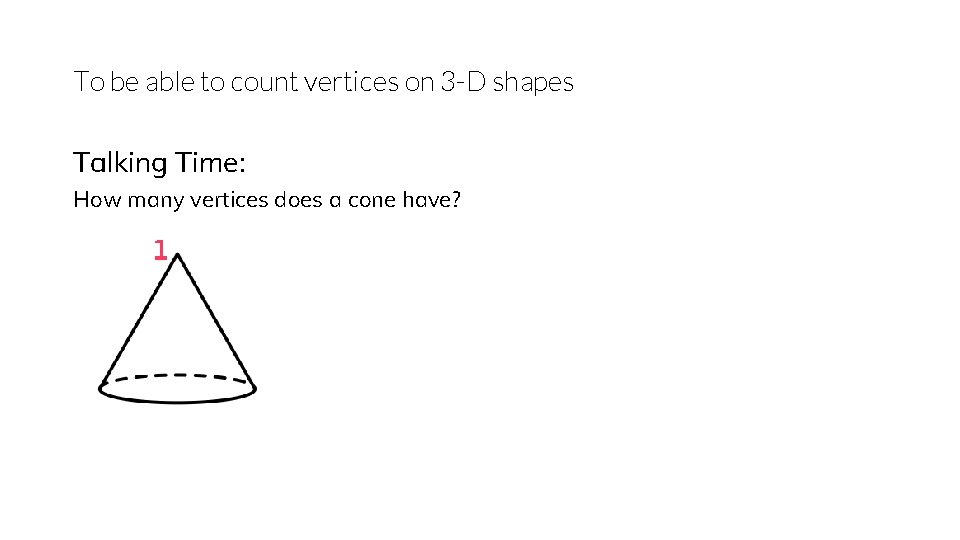
To be able to count vertices on 3 -D shapes Talking Time: How many vertices does a cone have? 1
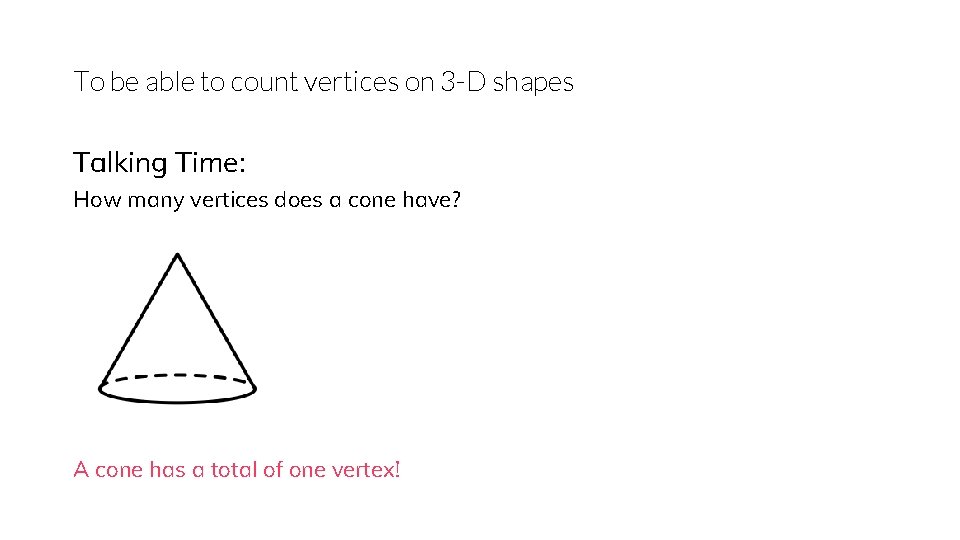
To be able to count vertices on 3 -D shapes Talking Time: How many vertices does a cone have? A cone has a total of one vertex!
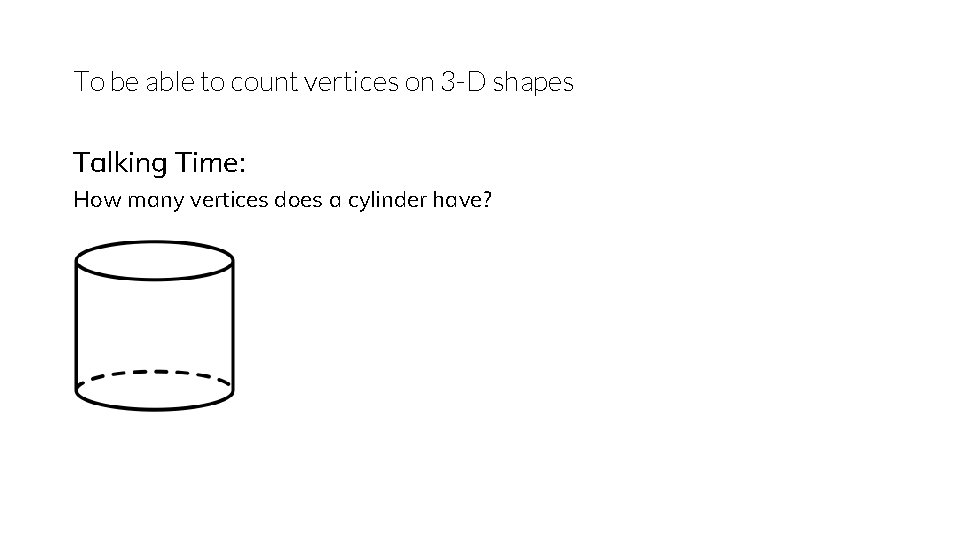
To be able to count vertices on 3 -D shapes Talking Time: How many vertices does a cylinder have?
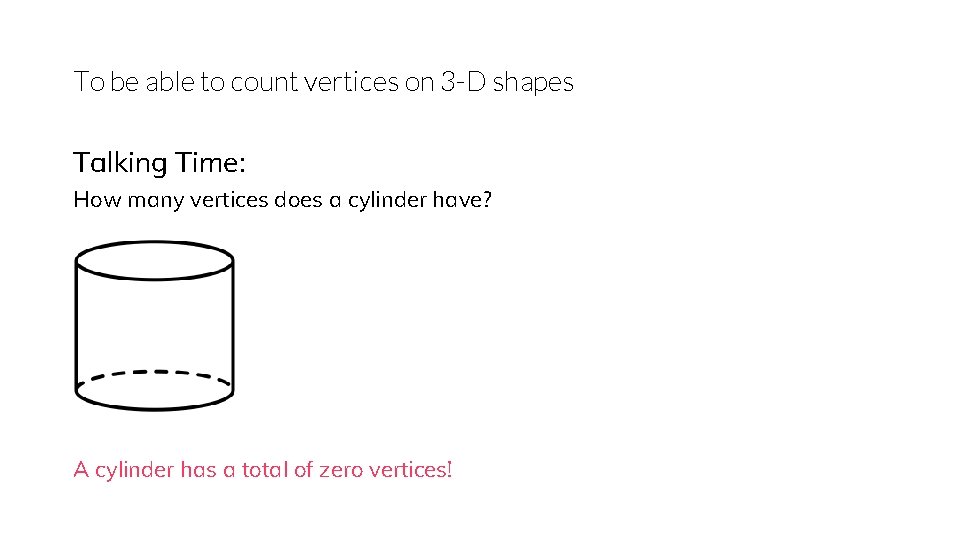
To be able to count vertices on 3 -D shapes Talking Time: How many vertices does a cylinder have? A cylinder has a total of zero vertices!
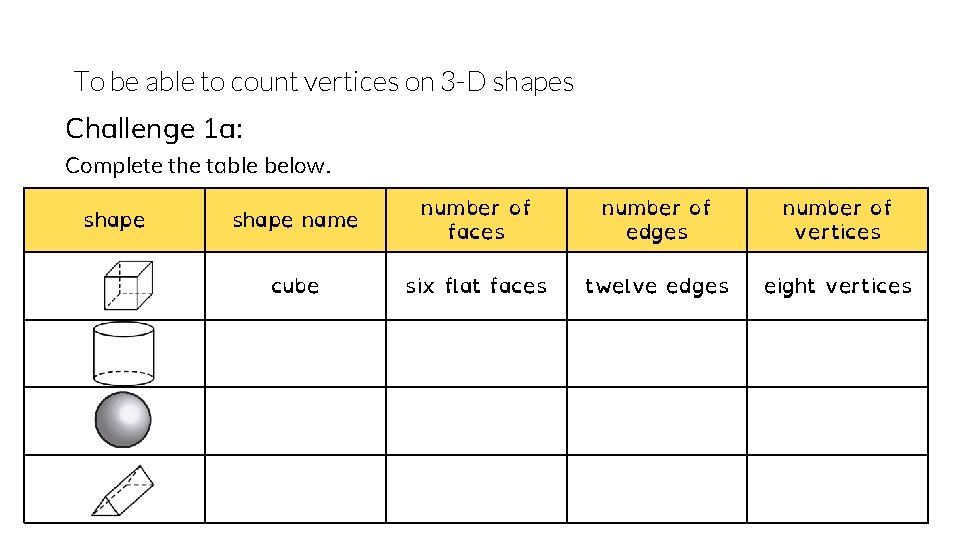
To be able to count vertices on 3 -D shapes Challenge 1 a: Complete the table below. shape name number of faces number of edges number of vertices cube six flat faces twelve edges eight vertices
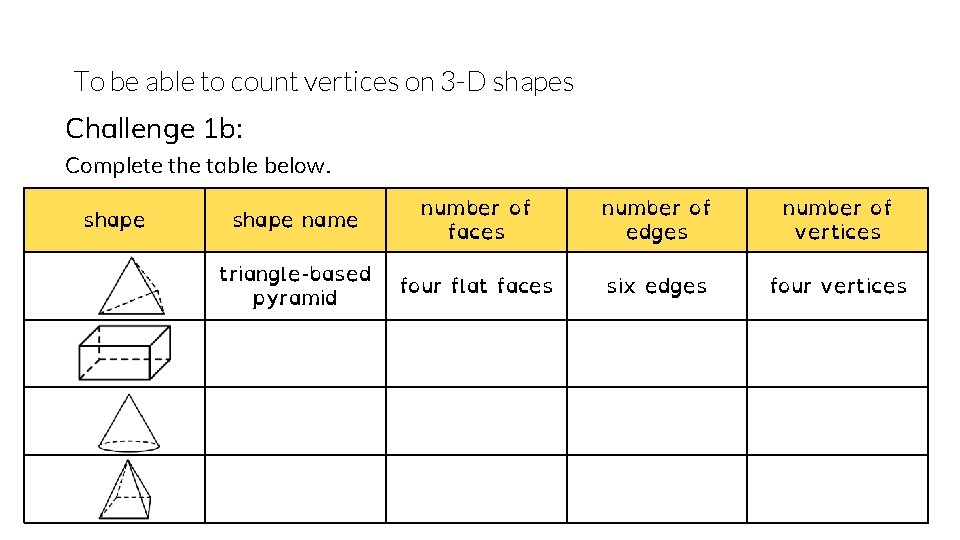
To be able to count vertices on 3 -D shapes Challenge 1 b: Complete the table below. shape name number of faces number of edges number of vertices triangle-based pyramid four flat faces six edges four vertices
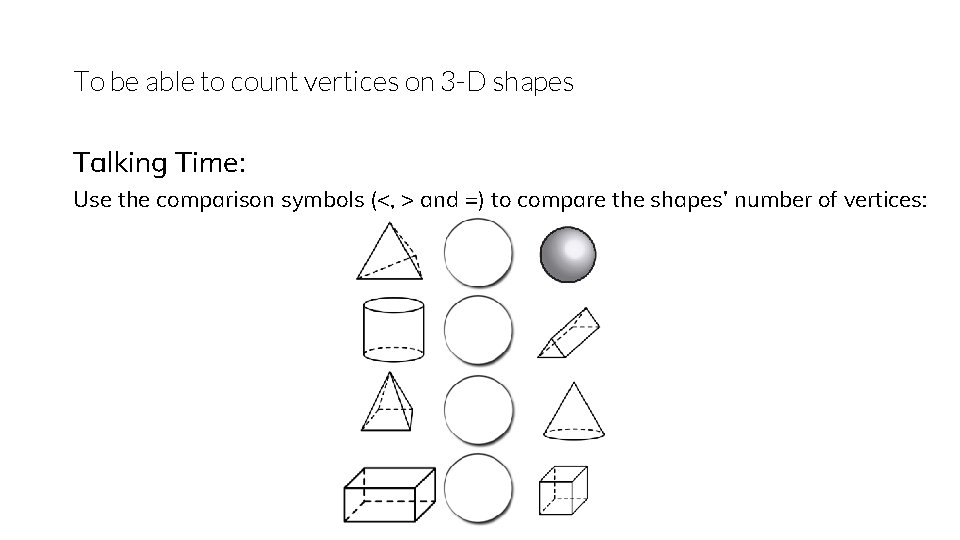
To be able to count vertices on 3 -D shapes Talking Time: Use the comparison symbols (<, > and =) to compare the shapes’ number of vertices:
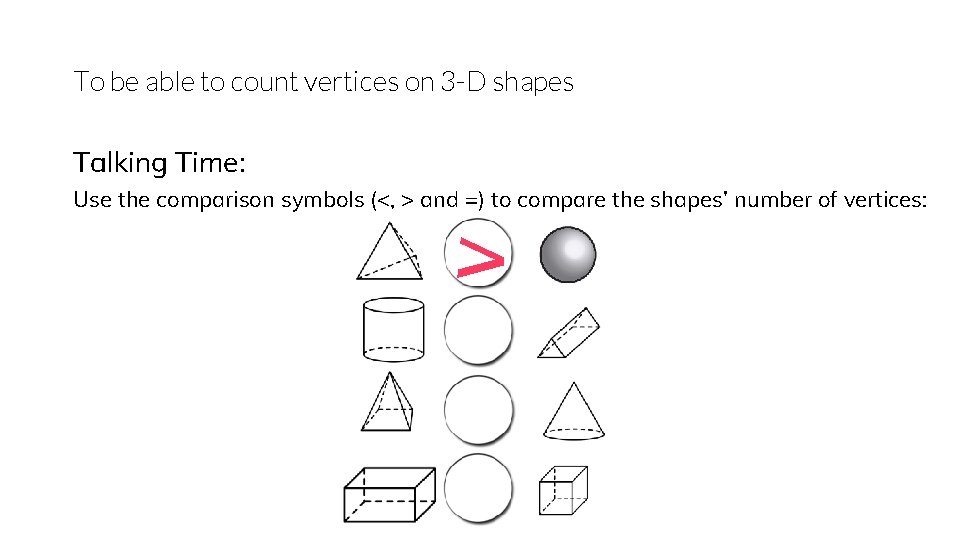
To be able to count vertices on 3 -D shapes Talking Time: Use the comparison symbols (<, > and =) to compare the shapes’ number of vertices: >
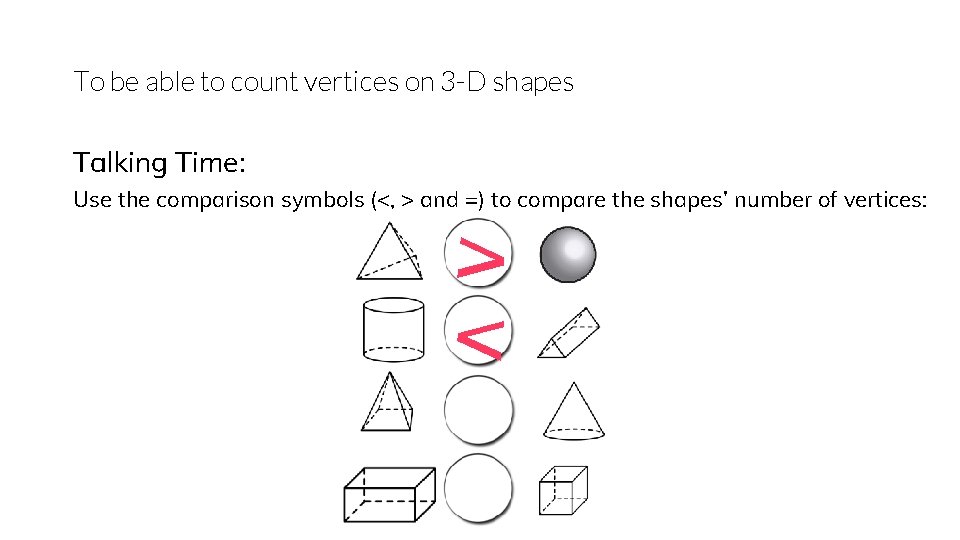
To be able to count vertices on 3 -D shapes Talking Time: Use the comparison symbols (<, > and =) to compare the shapes’ number of vertices: > <
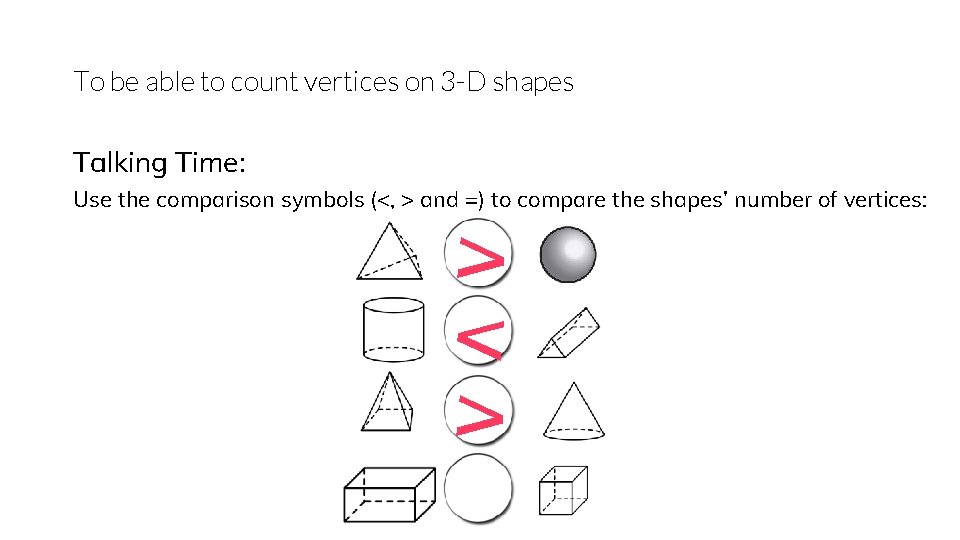
To be able to count vertices on 3 -D shapes Talking Time: Use the comparison symbols (<, > and =) to compare the shapes’ number of vertices: > < >
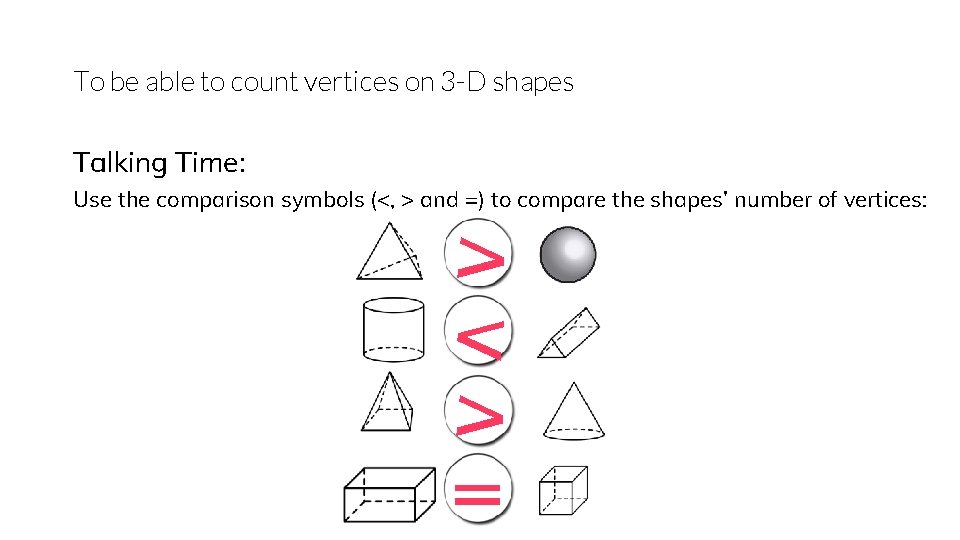
To be able to count vertices on 3 -D shapes Talking Time: Use the comparison symbols (<, > and =) to compare the shapes’ number of vertices: > < > =
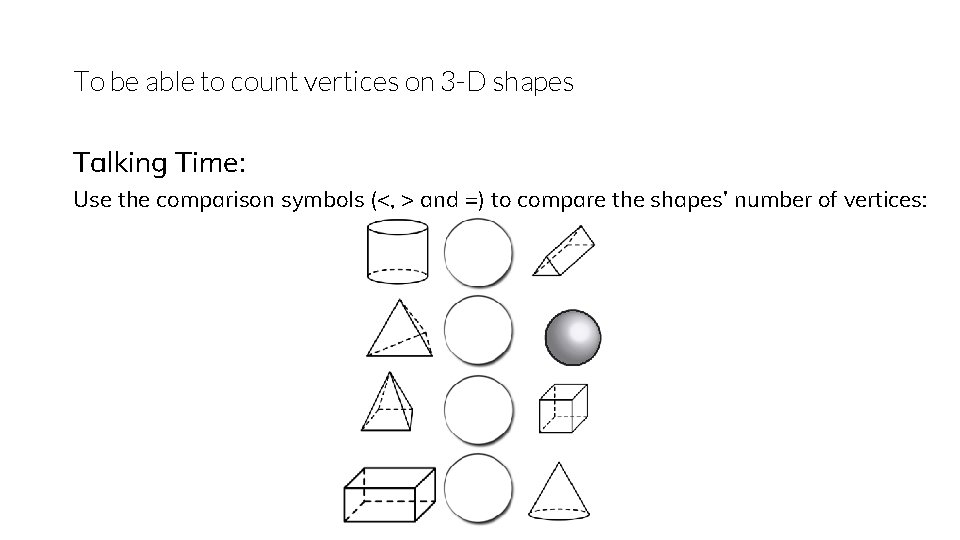
To be able to count vertices on 3 -D shapes Talking Time: Use the comparison symbols (<, > and =) to compare the shapes’ number of vertices:
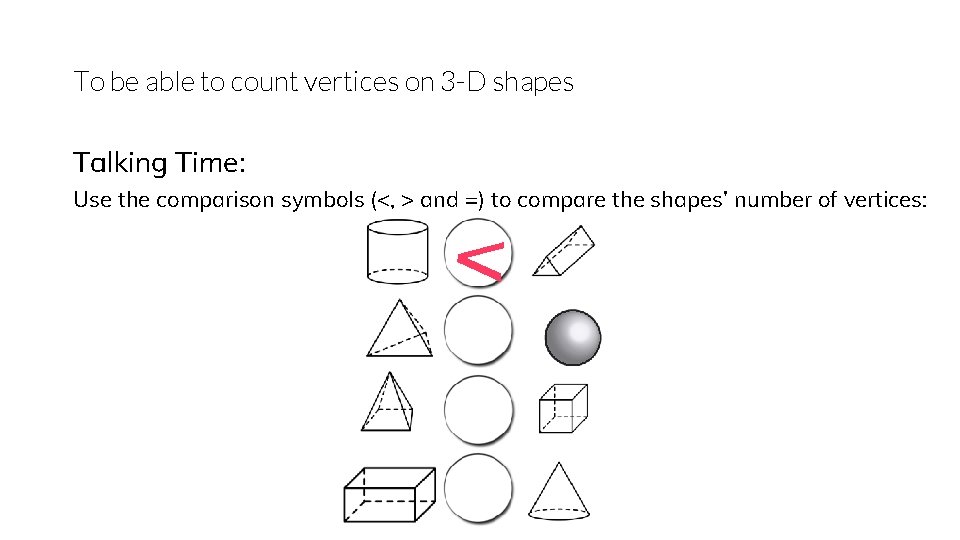
To be able to count vertices on 3 -D shapes Talking Time: Use the comparison symbols (<, > and =) to compare the shapes’ number of vertices: <
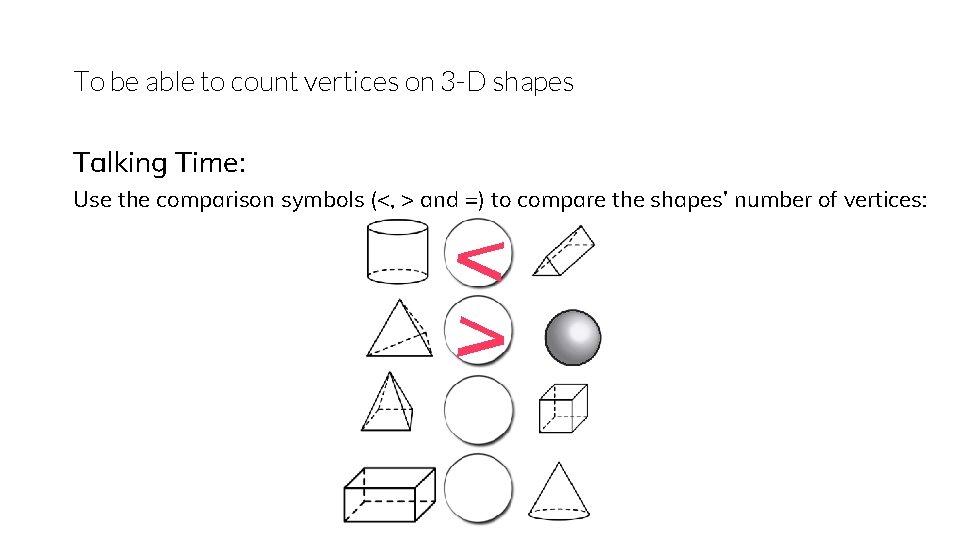
To be able to count vertices on 3 -D shapes Talking Time: Use the comparison symbols (<, > and =) to compare the shapes’ number of vertices: < >
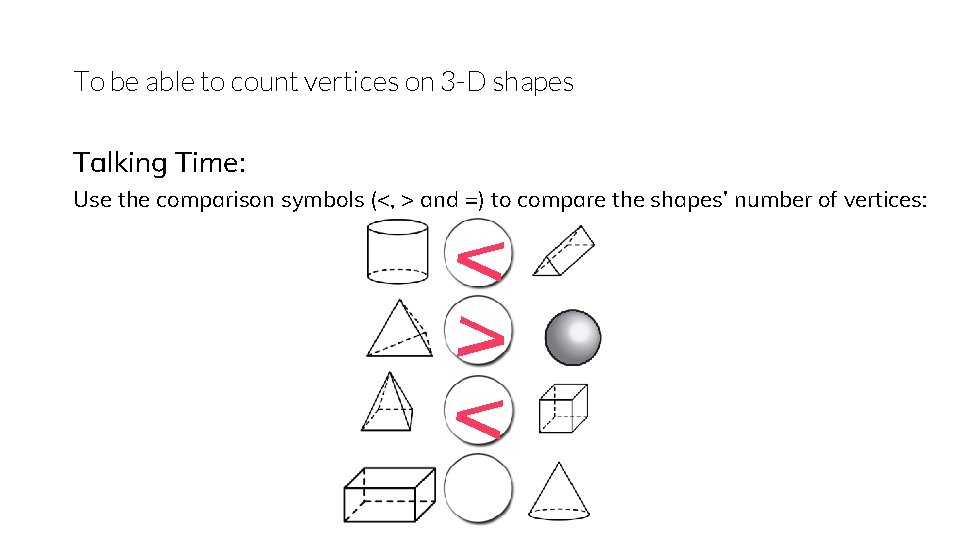
To be able to count vertices on 3 -D shapes Talking Time: Use the comparison symbols (<, > and =) to compare the shapes’ number of vertices: < > <
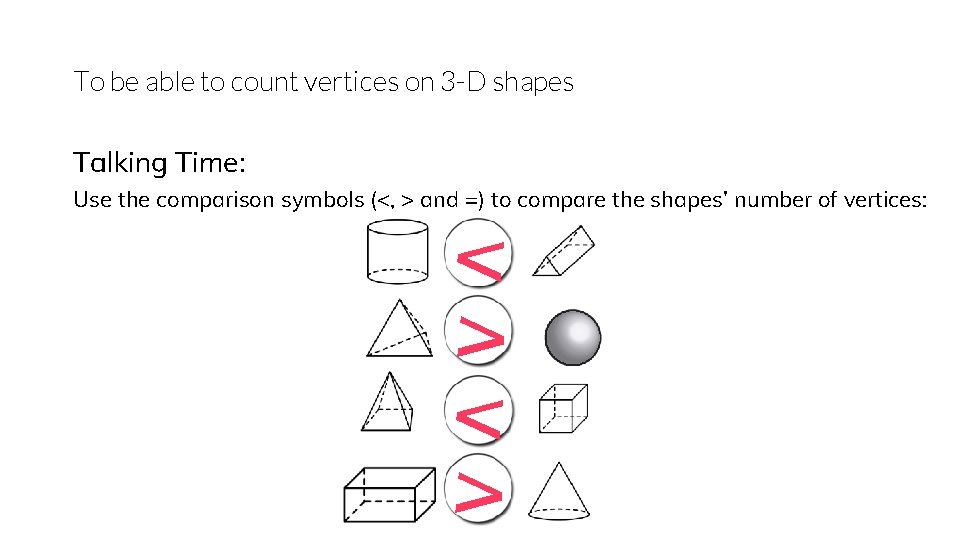
To be able to count vertices on 3 -D shapes Talking Time: Use the comparison symbols (<, > and =) to compare the shapes’ number of vertices: < >
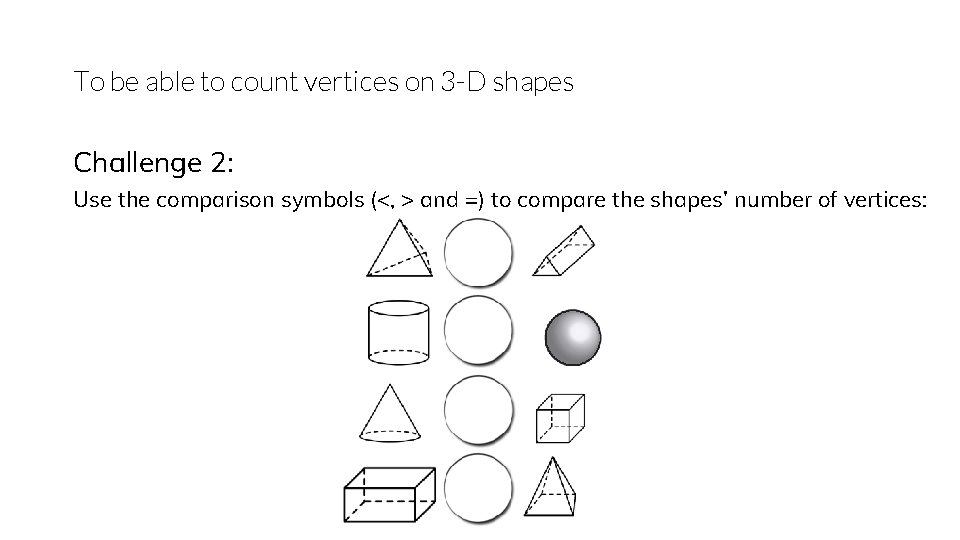
To be able to count vertices on 3 -D shapes Challenge 2: Use the comparison symbols (<, > and =) to compare the shapes’ number of vertices:
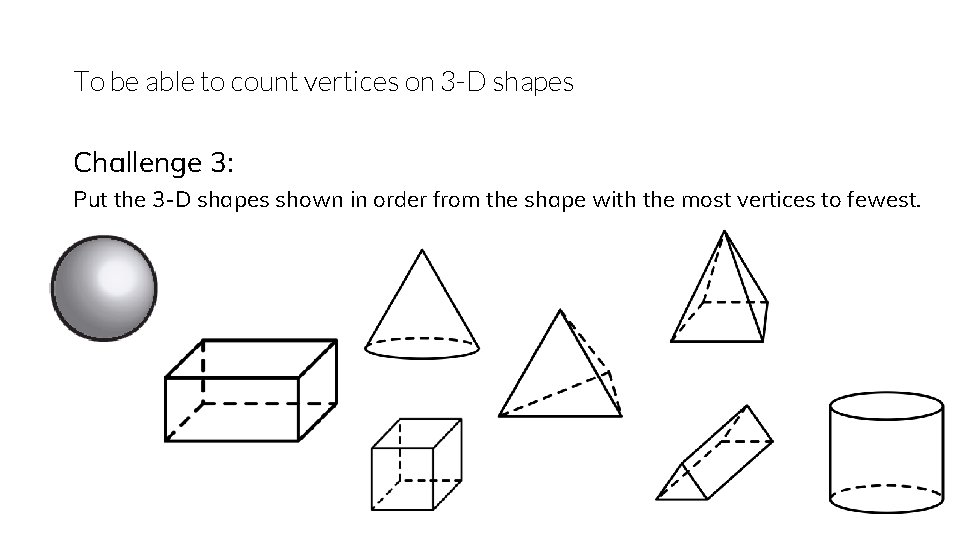
To be able to count vertices on 3 -D shapes Challenge 3: Put the 3 -D shapes shown in order from the shape with the most vertices to fewest.
To be able to count vertices on 3 -D shapes Talking Time: James says, “Cuboids are the only 3 -D shape with eight vertices. ” Do you agree? Explain your answer. Ruth says, “ 3 -D shapes with flat circular faces have zero vertices. ” Do you agree? Explain your answer.
To be able to count vertices on 3 -D shapes Talking Time: James says, “Cuboids are the only 3 -D shape with eight vertices. ” No, I do not agree. Cubes also have eight vertices. Ruth says, “ 3 -D shapes with flat circular faces have zero vertices. ” No, I do not agree. Although cylinders have zero vertices, cones have one vertex.
To be able to count vertices on 3 -D shapes Challenge 4: Yasmin says, “ 3 -D shapes with triangular faces have five vertices. ” Do you agree? Explain your answer.
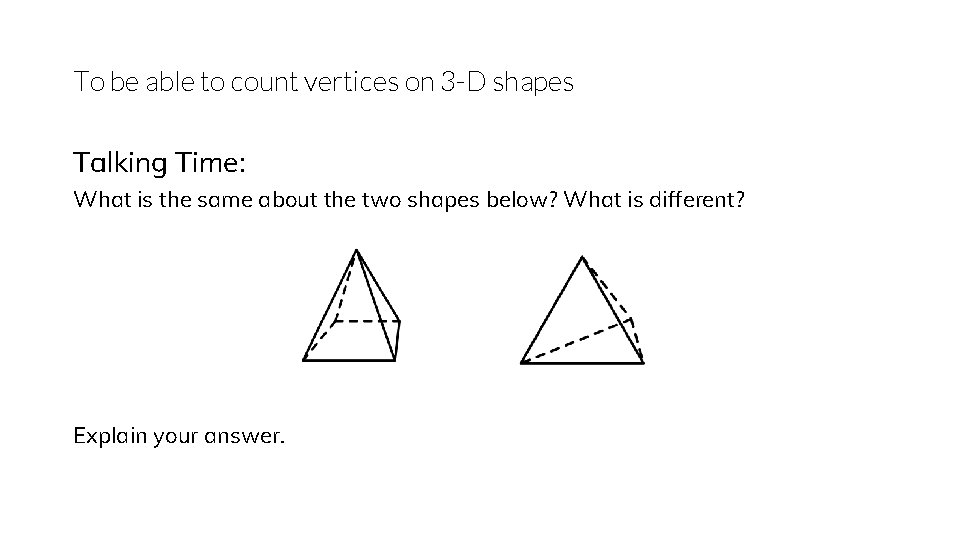
To be able to count vertices on 3 -D shapes Talking Time: What is the same about the two shapes below? What is different? Explain your answer.
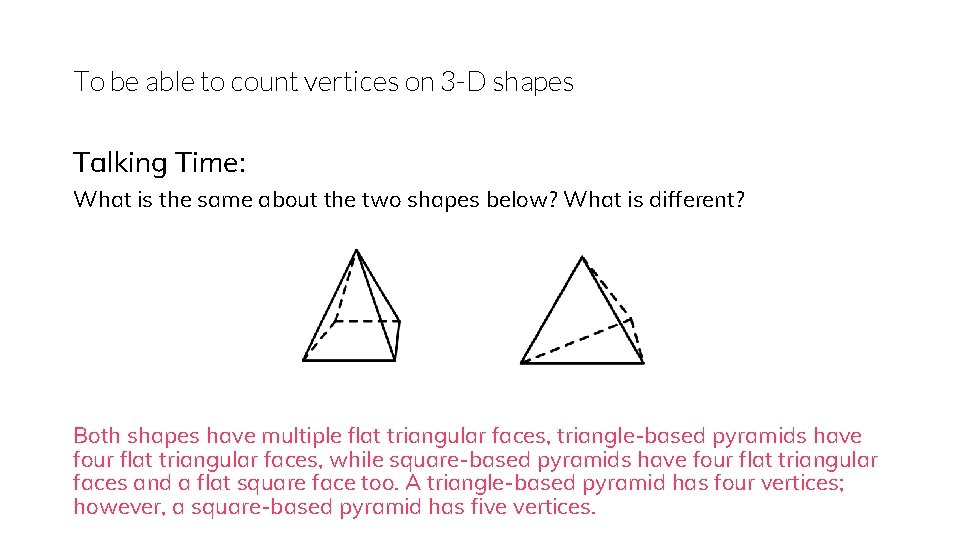
To be able to count vertices on 3 -D shapes Talking Time: What is the same about the two shapes below? What is different? Both shapes have multiple flat triangular faces, triangle-based pyramids have four flat triangular faces, while square-based pyramids have four flat triangular faces and a flat square face too. A triangle-based pyramid has four vertices; however, a square-based pyramid has five vertices.
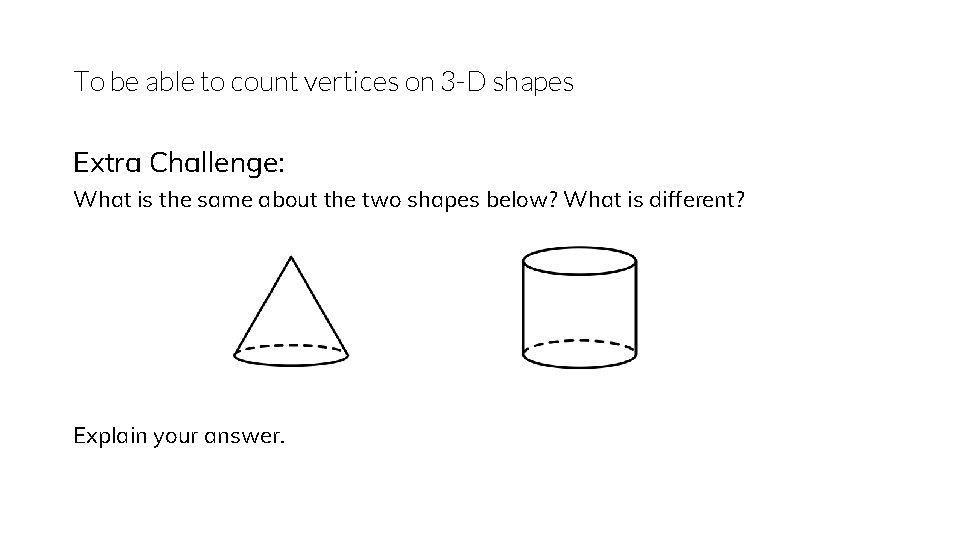
To be able to count vertices on 3 -D shapes Extra Challenge: What is the same about the two shapes below? What is different? Explain your answer.
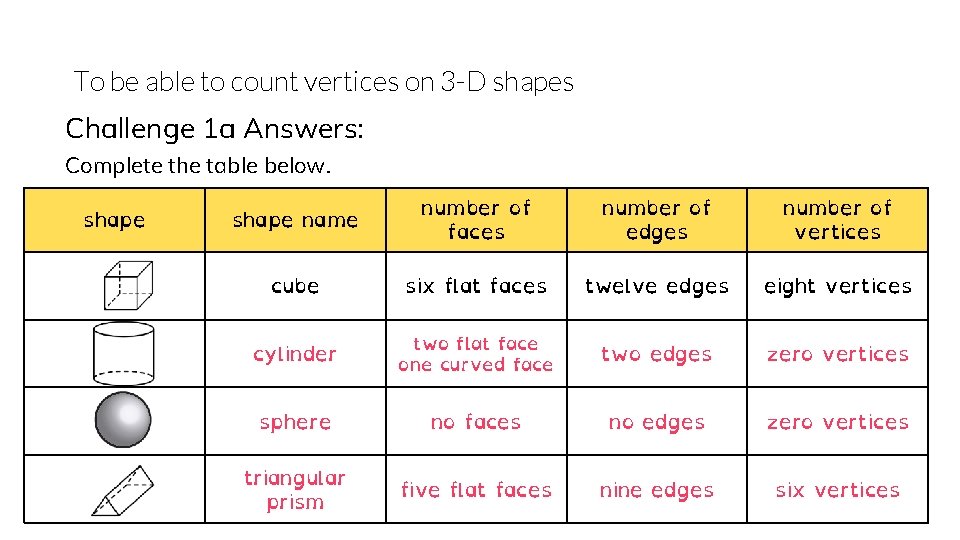
To be able to count vertices on 3 -D shapes Challenge 1 a Answers: Complete the table below. shape name number of faces number of edges number of vertices cube six flat faces twelve edges eight vertices cylinder two flat face one curved face two edges zero vertices sphere no faces no edges zero vertices triangular prism five flat faces nine edges six vertices
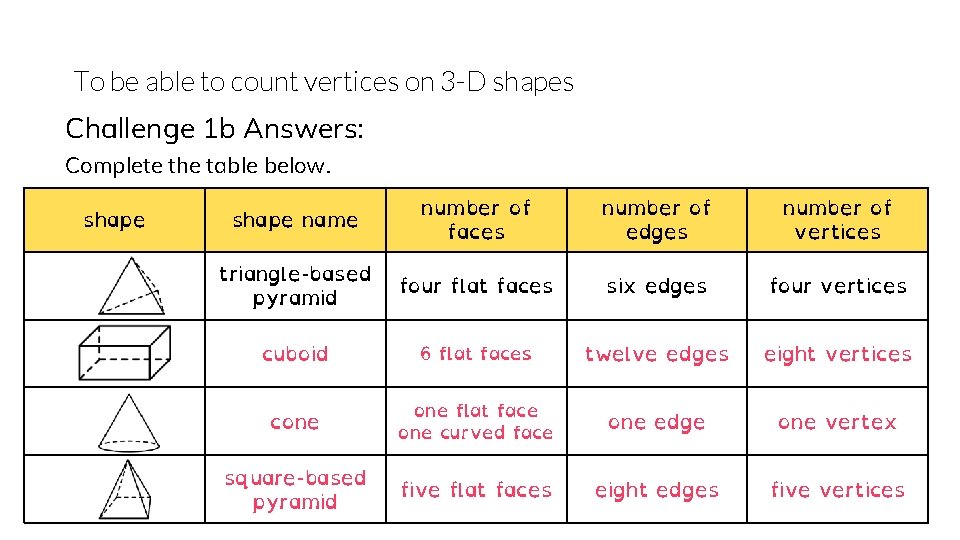
To be able to count vertices on 3 -D shapes Challenge 1 b Answers: Complete the table below. shape name number of faces number of edges number of vertices triangle-based pyramid four flat faces six edges four vertices cuboid 6 flat faces twelve edges eight vertices cone flat face one curved face one edge one vertex square-based pyramid five flat faces eight edges five vertices
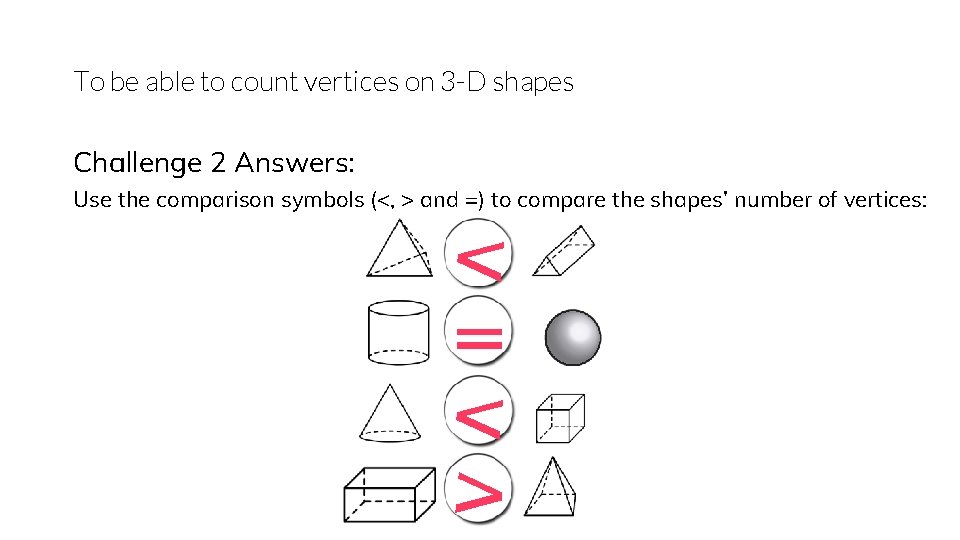
To be able to count vertices on 3 -D shapes Challenge 2 Answers: Use the comparison symbols (<, > and =) to compare the shapes’ number of vertices: < = < >
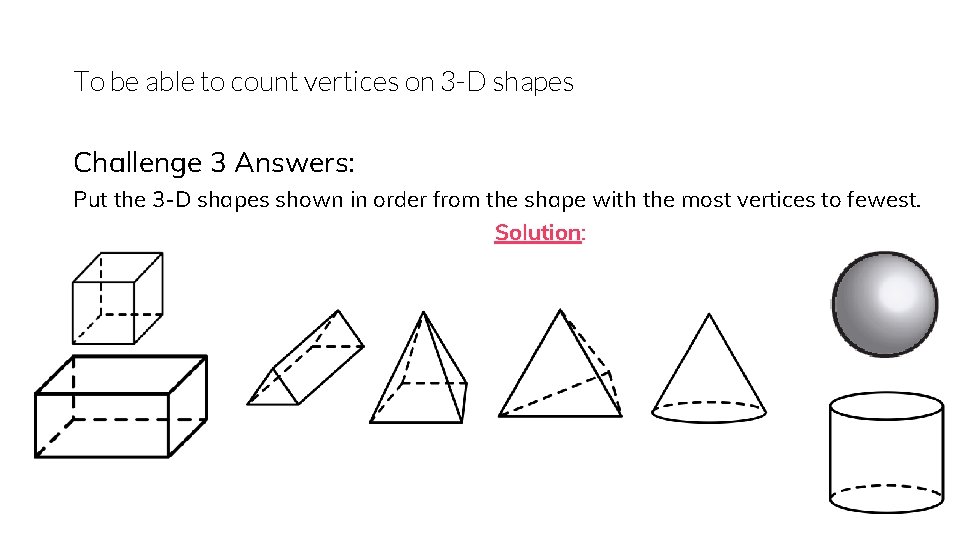
To be able to count vertices on 3 -D shapes Challenge 3 Answers: Put the 3 -D shapes shown in order from the shape with the most vertices to fewest. Solution:
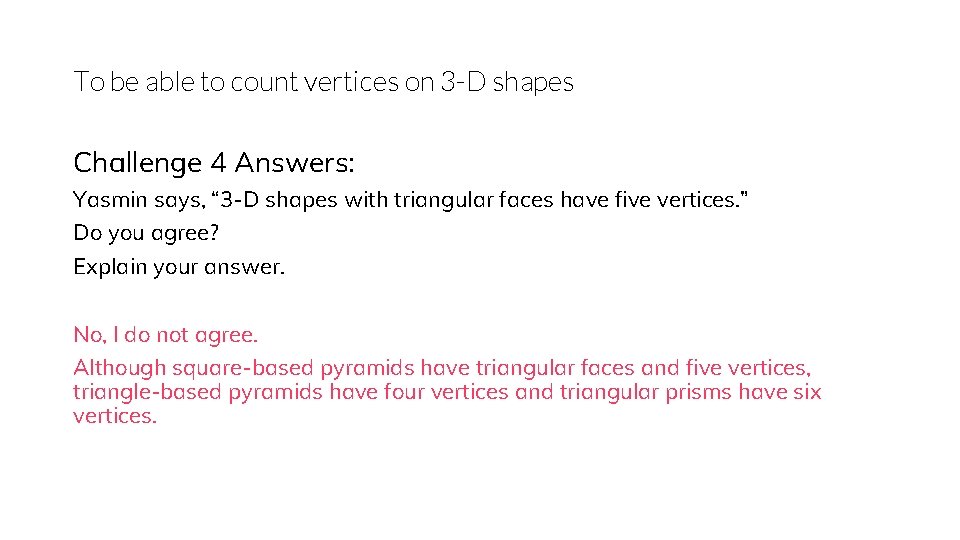
To be able to count vertices on 3 -D shapes Challenge 4 Answers: Yasmin says, “ 3 -D shapes with triangular faces have five vertices. ” Do you agree? Explain your answer. No, I do not agree. Although square-based pyramids have triangular faces and five vertices, triangle-based pyramids have four vertices and triangular prisms have six vertices.
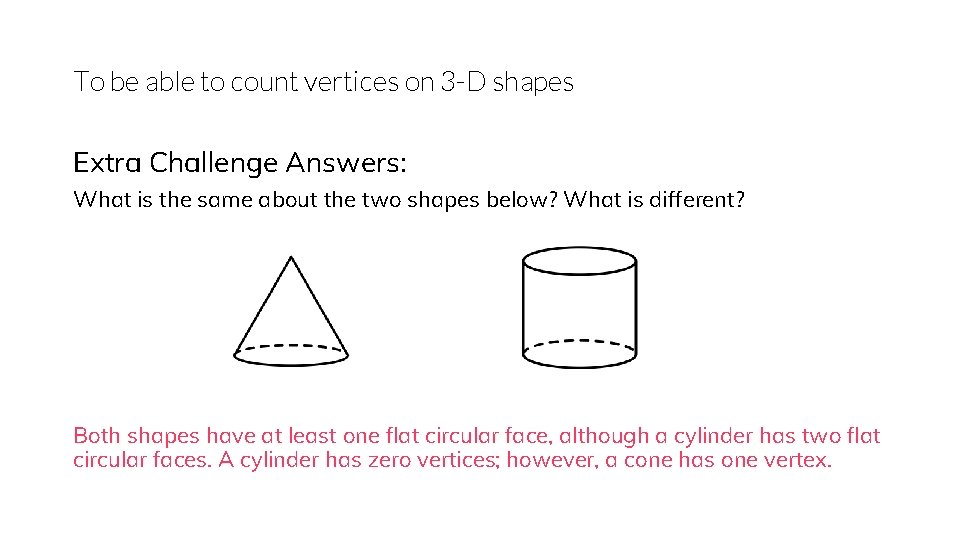
To be able to count vertices on 3 -D shapes Extra Challenge Answers: What is the same about the two shapes below? What is different? Both shapes have at least one flat circular face, although a cylinder has two flat circular faces. A cylinder has zero vertices; however, a cone has one vertex.
To be able to count vertices on 3 -D shapes Evaluation: 3 -D shapes have an odd number of vertices. Is Astrobee’s statement always, sometimes or never true. Explain your answer.
To be able to count vertices on 3 -D shapes Evaluation: 3 -D shapes have an odd number of vertices. Astrobee’s statement is only sometimes true. For example, it’s partly true as cones have one vertex and square-based pyramids have five vertices. However, many 3 D shapes have an even number of vertices: cubes and cuboids (eight vertices), triangle-based pyramids (four vertices) and triangular prisms (six vertices).
To be able to count vertices on 3 -D shapes Success criteria: ü I can use my knowledge of 3 -D shapes edges and faces to count the number of vertices of 3 -D shapes, both using real 3 -D shapes and using 2 -D representations of 3 -D shapes ü I can explain my reasoning when using my knowledge of 3 -D shapes edges and faces to count the number of vertices of 3 -D shapes, both using real 3 -D shapes and using 2 -D representations of 3 -D shapes Stage 2 - Spring Block 3 - Properties of Shape - Lesson 10 - To be able to count vertices on 3 -D shapes
- Slides: 48