
TMVA Toolkit for Multivariate Analysis Jrg Stelzer DESY
- Slides: 19
TMVA – Toolkit for Multivariate Analysis Jörg Stelzer(*) – DESY, Hamburg ACAT 2008, 3 rd-7 th Nov, Erice, Sicily (*)For the TMVA developer team: A. Höcker, P. Speckmayer, J. Stelzer, H. Voss and many contributors
MVA in HEP In a time of ever larger dataset with an ever smaller signal fraction it becomes increasingly important to use all the features of signal and background data that are present. That means that not only the variable distributions of the signal must be evaluated against the background, but in particular the information hidden in the variable correlations must be explored. The possible complexities of the data distributed in a high-dimensional space are difficult to disentangle manually and without the help of automata. Machinated multivariate analysis needed for data analysis in High Energy Physics 11/3/2008 TMVA – Toolkit for Multivariate Analysis
Outline of the Presentation The basics of multivariate analysis? A short introduction to the idea of TMVA and its history Quick survey of available classifiers And how to judge their performance An outlook to TMVA 4 11/3/2008 TMVA – Toolkit for Multivariate Analysis
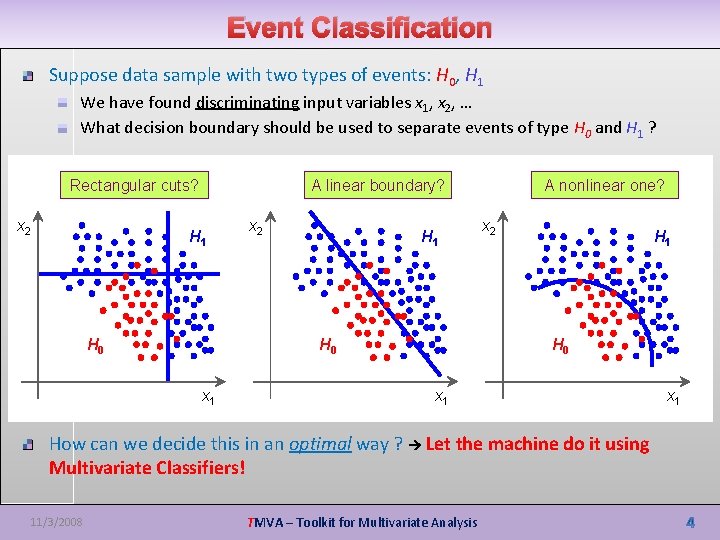
Event Classification Suppose data sample with two types of events: H 0, H 1 We have found discriminating input variables x 1, x 2, … What decision boundary should be used to separate events of type H 0 and H 1 ? Rectangular cuts? x 2 A linear boundary? H 1 H 0 x 2 H 1 H 0 x 1 A nonlinear one? x 2 H 1 H 0 x 1 How can we decide this in an optimal way ? Let the machine do it using Multivariate Classifiers! 11/3/2008 TMVA – Toolkit for Multivariate Analysis x 1
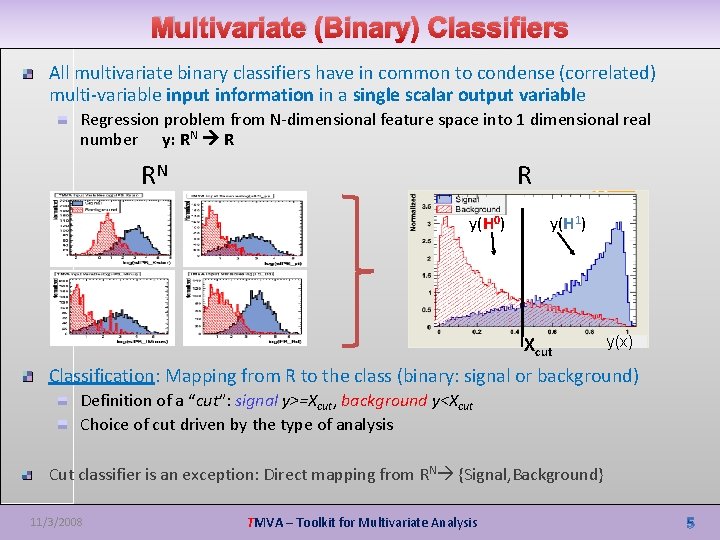
Multivariate (Binary) Classifiers All multivariate binary classifiers have in common to condense (correlated) multi-variable input information in a single scalar output variable Regression problem from N-dimensional feature space into 1 dimensional real number y: RN R RN R y(H 0) y(H 1) Xcut y(x) Classification: Mapping from R to the class (binary: signal or background) Definition of a “cut”: signal y>=Xcut, background y<Xcut Choice of cut driven by the type of analysis Cut classifier is an exception: Direct mapping from RN {Signal, Background} 11/3/2008 TMVA – Toolkit for Multivariate Analysis
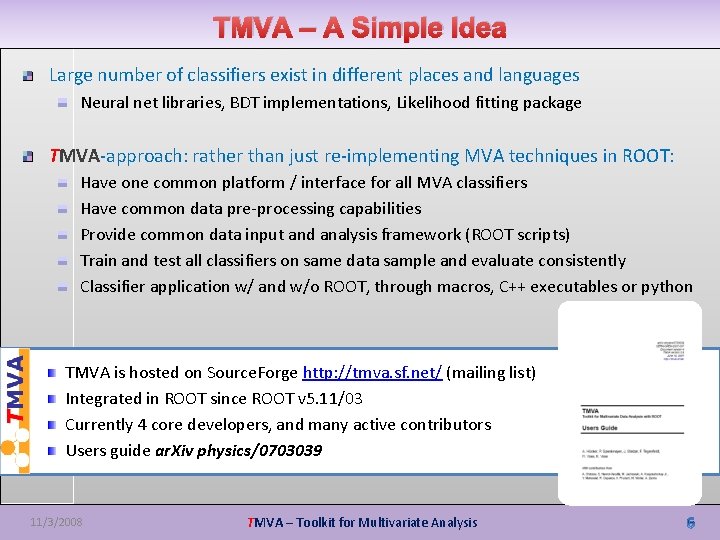
TMVA – A Simple Idea Large number of classifiers exist in different places and languages Neural net libraries, BDT implementations, Likelihood fitting package TMVA-approach: rather than just re-implementing MVA techniques in ROOT: Have one common platform / interface for all MVA classifiers Have common data pre-processing capabilities Provide common data input and analysis framework (ROOT scripts) Train and test all classifiers on same data sample and evaluate consistently Classifier application w/ and w/o ROOT, through macros, C++ executables or python TMVA is hosted on Source. Forge http: //tmva. sf. net/ (mailing list) Integrated in ROOT since ROOT v 5. 11/03 Currently 4 core developers, and many active contributors Users guide ar. Xiv physics/0703039 11/3/2008 TMVA – Toolkit for Multivariate Analysis
Features of the TMVA Data Handling Data input format: ROOT TTree or ASCII Supports selection of any subset or combination or function of available variables and arrays (var 1=“sin(x)+3*y”, var 2=“…”) just like ROOT’s TTree: : Draw() Supports application of pre-selection cuts (possibly independent for signal and bkg) Supports global event weights for signal or background input files Supports use of any input variable as individual event weight Supports various methods for splitting data into training and test samples: Block wise, randomly, periodically User defined training and test trees Preprocessing of input variables (e. g. , decorrelation, PCA) Improves performance of projective Likelihood 11/3/2008 TMVA – Toolkit for Multivariate Analysis
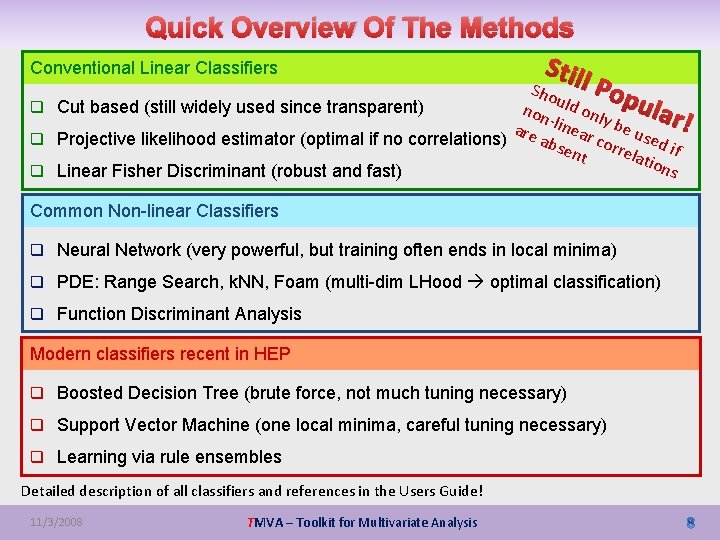
Quick Overview Of The Methods Stil Conventional Linear Classifiers Sho l Po u q Cut based (still widely used since transparent) non ld onl pula y are -linear be us r! e abs q Projective likelihood estimator (optimal if no correlations) c ent orrela d if tion s q Linear Fisher Discriminant (robust and fast) Common Non-linear Classifiers q Neural Network (very powerful, but training often ends in local minima) q PDE: Range Search, k. NN, Foam (multi-dim LHood optimal classification) q Function Discriminant Analysis Modern classifiers recent in HEP q Boosted Decision Tree (brute force, not much tuning necessary) q Support Vector Machine (one local minima, careful tuning necessary) q Learning via rule ensembles Detailed description of all classifiers and references in the Users Guide! 11/3/2008 TMVA – Toolkit for Multivariate Analysis
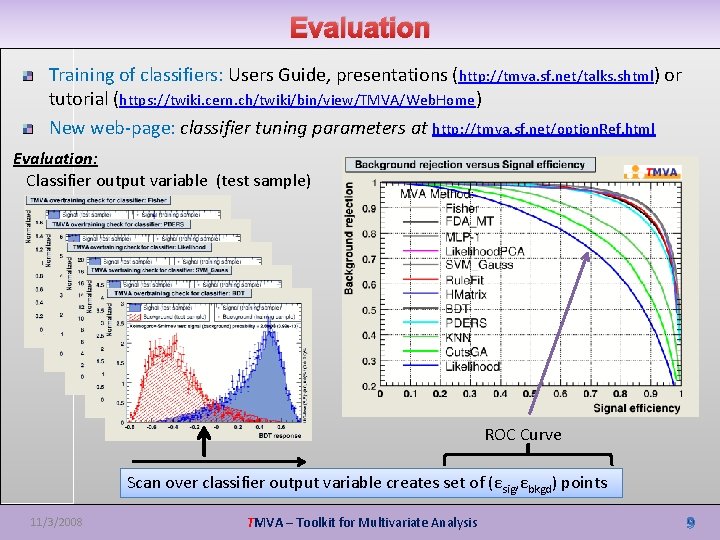
Evaluation Training of classifiers: Users Guide, presentations (http: //tmva. sf. net/talks. shtml) or tutorial (https: //twiki. cern. ch/twiki/bin/view/TMVA/Web. Home) New web-page: classifier tuning parameters at http: //tmva. sf. net/option. Ref. html Evaluation: Classifier output variable (test sample) ROC Curve Scan over classifier output variable creates set of (εsig, εbkgd) points 11/3/2008 TMVA – Toolkit for Multivariate Analysis
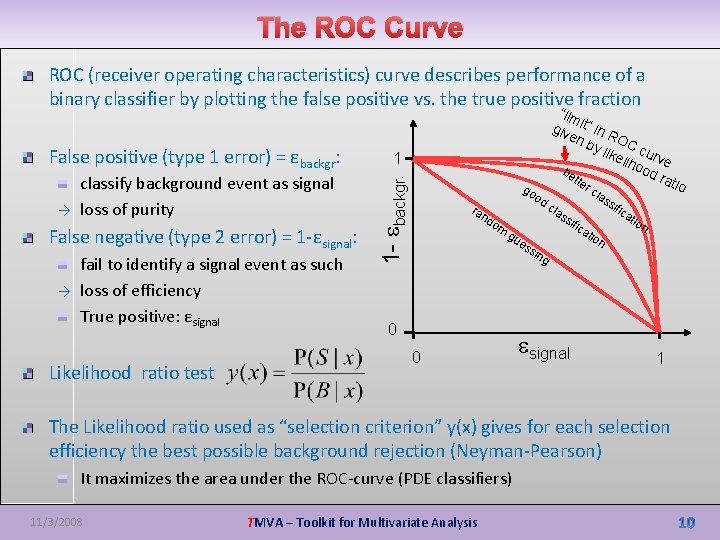
The ROC Curve ROC (receiver operating characteristics) curve describes performance of a binary classifier by plotting the false positive vs. the true positive fraction classify background event as signal → loss of purity False negative (type 2 error) = 1 -εsignal: fail to identify a signal event as such → loss of efficiency True positive: εsignal Likelihood ratio test 1 1 - ebackgr. False positive (type 1 error) = εbackgr: “lim giv it” in R en by OC c like u liho rve od be ra t go od ra nd o m sin tio cla ss ific ati ica es 0 cla ss if gu 0 ter tio on n g esignal 1 The Likelihood ratio used as “selection criterion” y(x) gives for each selection efficiency the best possible background rejection (Neyman-Pearson) It maximizes the area under the ROC-curve (PDE classifiers) 11/3/2008 TMVA – Toolkit for Multivariate Analysis
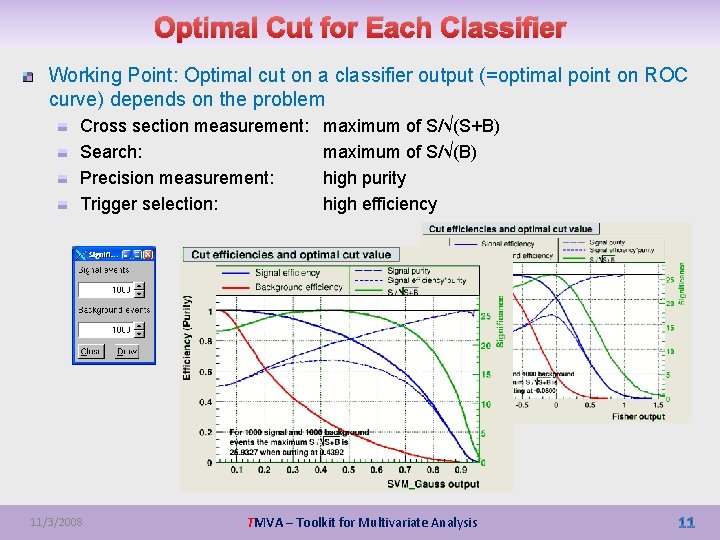
Optimal Cut for Each Classifier Working Point: Optimal cut on a classifier output (=optimal point on ROC curve) depends on the problem Cross section measurement: Search: Precision measurement: Trigger selection: 11/3/2008 maximum of S/√(S+B) maximum of S/√(B) high purity high efficiency TMVA – Toolkit for Multivariate Analysis
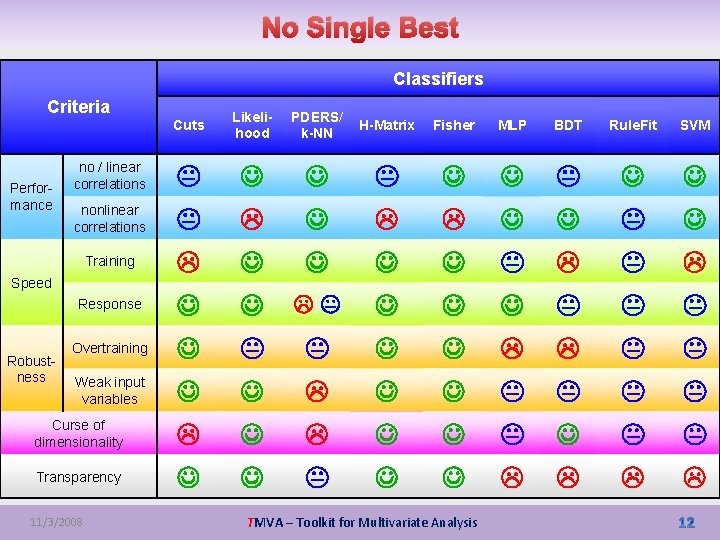
No Single Best Classifiers Criteria Cuts Likelihood PDERS/ k-NN H-Matrix Fisher MLP BDT Rule. Fit SVM no / linear correlations nonlinear correlations Training Response / Overtraining Weak input variables Curse of dimensionality Transparency Performance Speed Robustness 11/3/2008 TMVA – Toolkit for Multivariate Analysis
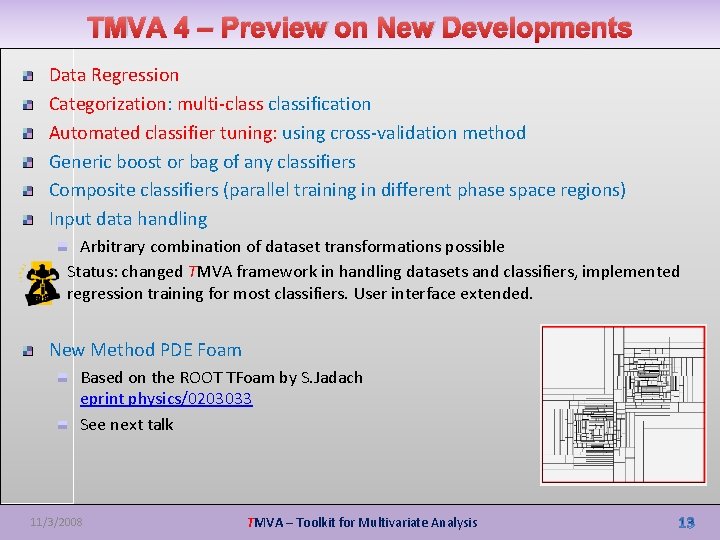
TMVA 4 – Preview on New Developments Data Regression Categorization: multi-classification Automated classifier tuning: using cross-validation method Generic boost or bag of any classifiers Composite classifiers (parallel training in different phase space regions) Input data handling Arbitrary combination of dataset transformations possible Status: changed TMVA framework in handling datasets and classifiers, implemented regression training for most classifiers. User interface extended. New Method PDE Foam Based on the ROOT TFoam by S. Jadach eprint physics/0203033 See next talk 11/3/2008 TMVA – Toolkit for Multivariate Analysis
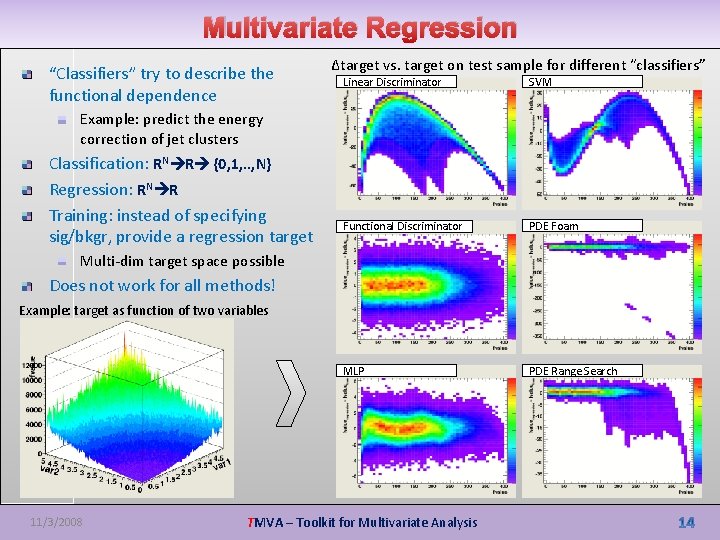
Multivariate Regression “Classifiers” try to describe the functional dependence Δtarget vs. target on test sample for different “classifiers” Linear Discriminator SVM Functional Discriminator PDE Foam MLP PDE Range Search Example: predict the energy correction of jet clusters Classification: RN R {0, 1, . . , N} Regression: RN R Training: instead of specifying sig/bkgr, provide a regression target Multi-dim target space possible Does not work for all methods! Example: target as function of two variables 11/3/2008 TMVA – Toolkit for Multivariate Analysis
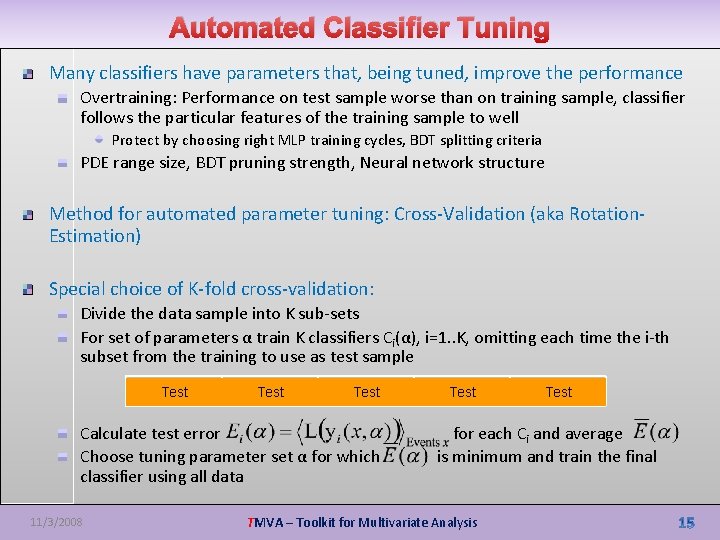
Automated Classifier Tuning Many classifiers have parameters that, being tuned, improve the performance Overtraining: Performance on test sample worse than on training sample, classifier follows the particular features of the training sample to well Protect by choosing right MLP training cycles, BDT splitting criteria PDE range size, BDT pruning strength, Neural network structure Method for automated parameter tuning: Cross-Validation (aka Rotation. Estimation) Special choice of K-fold cross-validation: Divide the data sample into K sub-sets For set of parameters α train K classifiers Ci(α), i=1. . K, omitting each time the i-th subset from the training to use as test sample Train Test Calculate test error Choose tuning parameter set α for which classifier using all data 11/3/2008 Train Test for each Ci and average is minimum and train the final TMVA – Toolkit for Multivariate Analysis
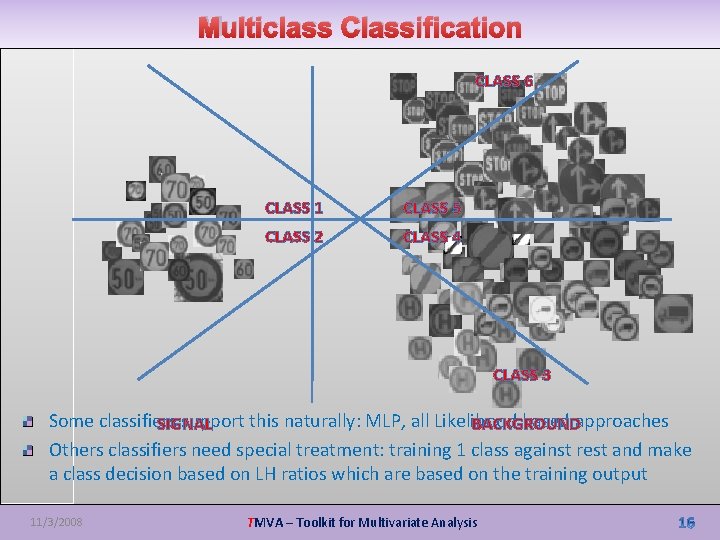
Multiclass Classification CLASS 6 CLASS 1 CLASS 5 CLASS 2 CLASS 4 CLASS 3 Some classifiers support this naturally: MLP, all Likelihood based approaches SIGNAL BACKGROUND Others classifiers need special treatment: training 1 class against rest and make a class decision based on LH ratios which are based on the training output 11/3/2008 TMVA – Toolkit for Multivariate Analysis
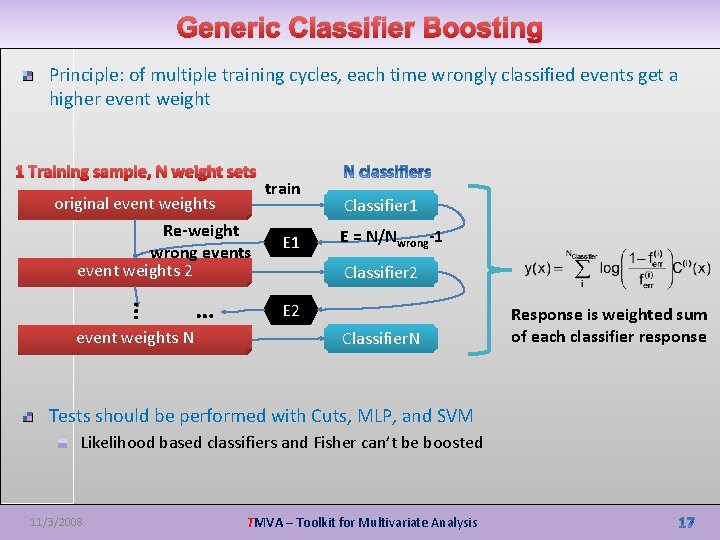
Generic Classifier Boosting Principle: of multiple training cycles, each time wrongly classified events get a higher event weight 1 Training sample, N weight sets original event weights … Re-weight wrong events event weights 2 event weights N … train E 1 Classifier 1 E = N/Nwrong-1 Classifier 2 E 2 Classifier. N Tests should be performed with Cuts, MLP, and SVM Likelihood based classifiers and Fisher can’t be boosted 11/3/2008 TMVA – Toolkit for Multivariate Analysis Response is weighted sum of each classifier response
Further Plans TMVA to be made multi-threaded and run on multi-core architectures Automatic tuning time consuming. Many users have multi-core machines and could take advantage of parallel computing Composite classifiers Let’s say you want to train a NN for tau selection differently in the detector barrel and endcap regions. The composite classifier can set this up and train automatically, need to specify the variable the region selector is based on (η) Let’s assume an N-class problem, and you want to use N Fisher classifiers one for each class to separate it from the rest. Then one could use a neural net on top to get a multiclassifier Just for convenience, can already be done manually Current stable TMVA version 3. 9. 5 for ROOT 5. 22 (middle of December), afterwards moving to TMVA 4 Not everything at once: 1) Regression and generic classifier boosting 2) Multi-classification, automatic classifier tuning 3) Composite classifiers Multi-core some time along the way 11/3/2008 TMVA – Toolkit for Multivariate Analysis
Summary Event selection in multi-dimensional parameter space should be done using multivariate techniques Complex correlations between input variables need “machine treatment” Optimal event selection is based on the likelihood ratio PDE RS, k. NN, and Foam estimate the probability density in N dimensions but suffer from high dimensions Other classifiers with similar performance can be used in many cases: Fishers Linear discriminant simple and robust Neural networks very powerful but difficult to train (multiple local minima) Support Vector machines one global minimum but needs careful tuning Boosted Decision Trees “brute force method” with very good performance Interesting new features to come in TMVA 4 Regression will be very useful for a large variety of applications Automatic tuning of parameters will improve quality of results, no need to be an expert 11/3/2008 TMVA – Toolkit for Multivariate Analysis