
TMMAC An Energy Efficient Multi Channel MAC Protocol

- Slides: 25
TMMAC: An Energy Efficient Multi. Channel MAC Protocol for Ad Hoc Networks Jingbin Zhang†, Gang Zhou†, Chengdu Huang‡, Sang H. Son†, John A. Stankovic† †Department of Computer Science, University of Virginia ‡Department of Computer Science, University of Illinois University of Virginia 1
Motivation § TMMAC: A TDMA based multi-channel MAC protocol using a single half duplex radio transceiver. § Why Multi-channel? Ø Increase the bandwidth Ø Most IEEE 802. 11 devices can switch channels dynamically. § Why a single radio transceiver? Ø Using multiple radio transceivers increases both the cost and energy consumption Ø Most IEEE 802. 11 devices use a single half-duplex radio transceiver § Why TDMA? Ø Increase the life time of the mobile devices Ø Improve throughput University of Virginia 2
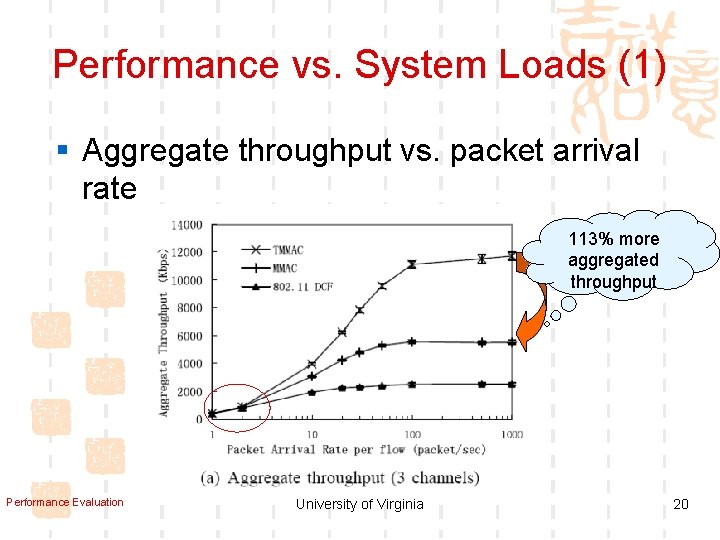
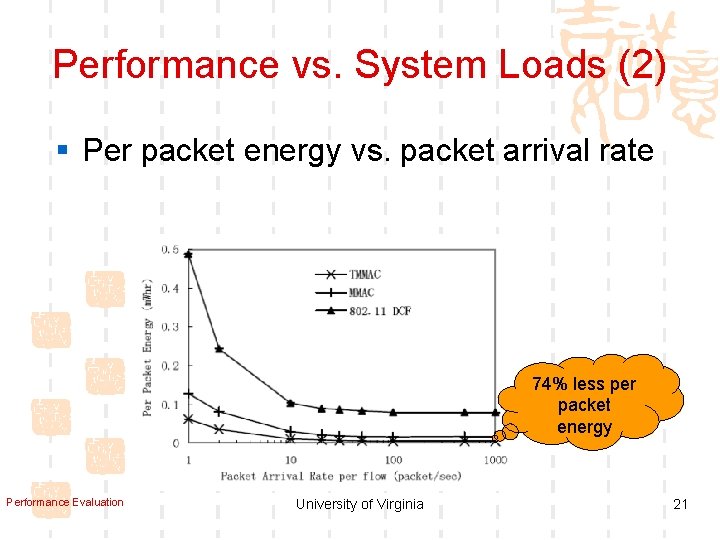
Contribution § Novel multi-channel MAC Ø Energy efficient: 74% less per packet energy Ø High throughput: 113% higher throughput Ø Supporting broadcast efficiently. § Accurate analytical model. § Dynamic ATIM window adjustment scheme. University of Virginia 3
Outline § § § State of the Art TMMAC Design Analytical Model Dynamic ATIM Window Adjustment Performance Evaluation Conclusion University of Virginia 4
State of the Art (1) § Special hardware support: Ø Multiple radio transceivers: [Wu et al. 2000] [Raniwala et al. 2005] [Adya et al. 2004] Ø Busy tone: [Deng et al. 1998] Ø FHSS: [Tang et al. 1999] [Tyamaloukas et al. 2000] University of Virginia 5
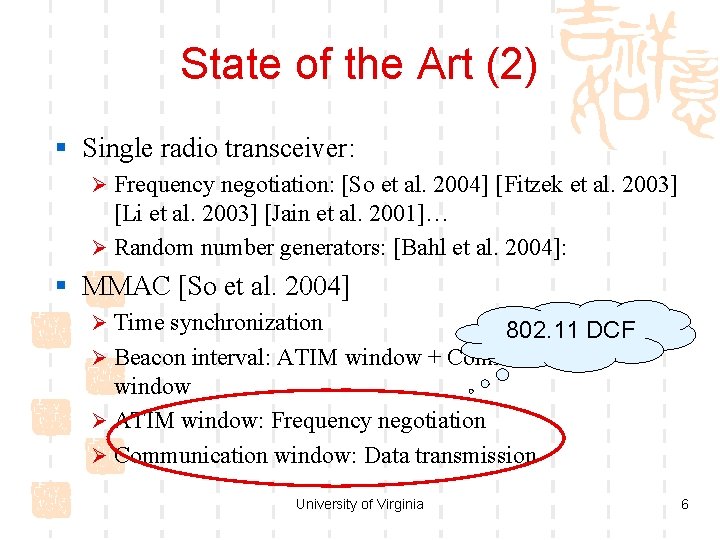
State of the Art (2) § Single radio transceiver: Ø Frequency negotiation: [So et al. 2004] [Fitzek et al. 2003] [Li et al. 2003] [Jain et al. 2001]… Ø Random number generators: [Bahl et al. 2004]: § MMAC [So et al. 2004] Ø Time synchronization 802. 11 DCF Ø Beacon interval: ATIM window + Communication window Ø ATIM window: Frequency negotiation Ø Communication window: Data transmission University of Virginia 6
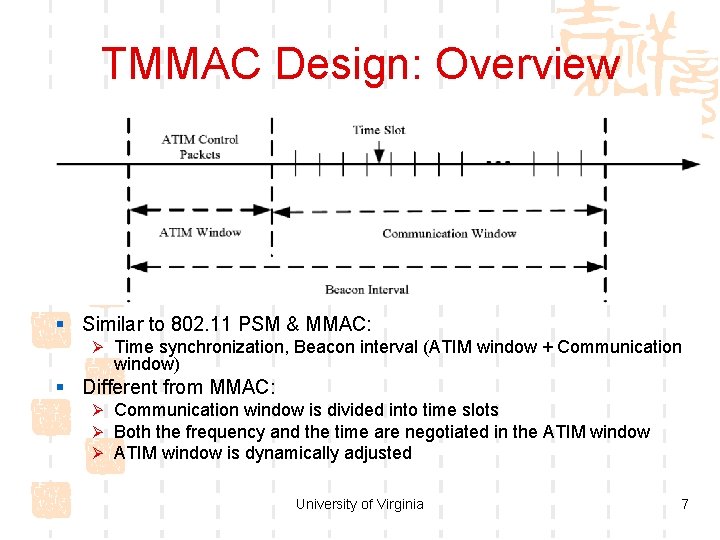
TMMAC Design: Overview § Similar to 802. 11 PSM & MMAC: Ø Time synchronization, Beacon interval (ATIM window + Communication window) § Different from MMAC: Ø Communication window is divided into time slots Ø Both the frequency and the time are negotiated in the ATIM window Ø ATIM window is dynamically adjusted University of Virginia 7
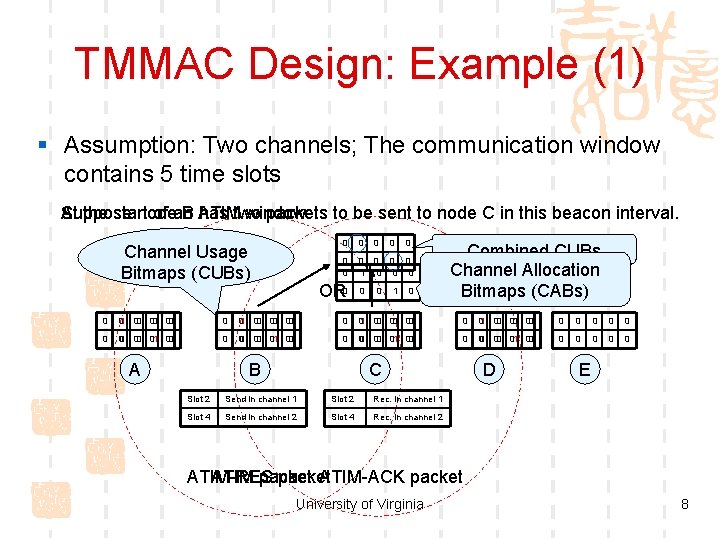
TMMAC Design: Example (1) § Assumption: Two channels; The communication window contains 5 time slots At Suppose the start node of an B ATIM has two window packets to be sent to node C in this beacon interval. Channel Usage Bitmaps (CUBs) 0 0 0 0 1 0 0 0 OR 0 0 0 1 0 0 Combined CUBs Channel Allocation Bitmaps (CABs) 0 01 00 00 00 0 0 0 00 00 01 00 0 0 0 A B C Slot 2 Send in channel 1 Slot 2 Rec. in channel 1 Slot 4 Send in channel 2 Slot 4 Rec. in channel 2 D E ATIM-RES ATIM packet ATIM-ACK packet University of Virginia 8
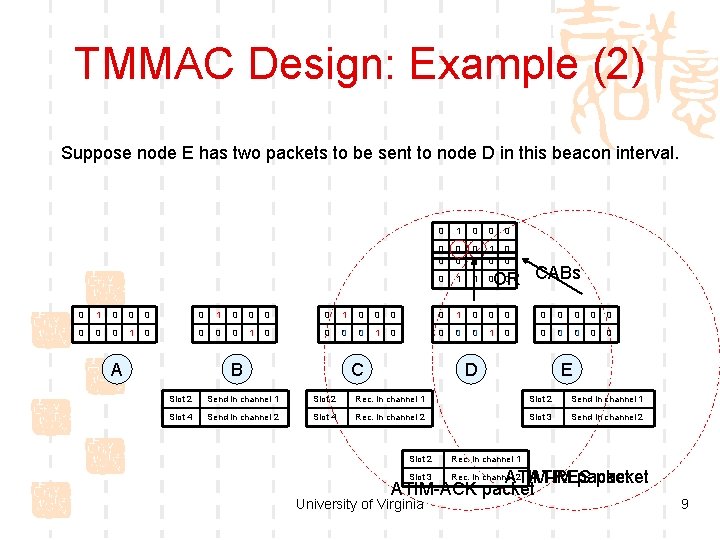
TMMAC Design: Example (2) Suppose node E has two packets to be sent to node D in this beacon interval. 0 1 0 0 0 0 0 1 1 0 CABs 0 OR 0 1 0 0 0 0 0 0 0 1 0 0 0 1 0 1 1 0 0 0 1 0 0 A B C D E Slot 2 Send in channel 1 Slot 2 Rec. in channel 1 Slot 2 Send in channel 1 Slot 4 Send in channel 2 Slot 4 Rec. in channel 2 Slot 3 Send in channel 2 Slot 2 Rec. in channel 1 Slot 3 Rec. in channel 2 ATIM packet ATIM-RES packet ATIM-ACK packet University of Virginia 9
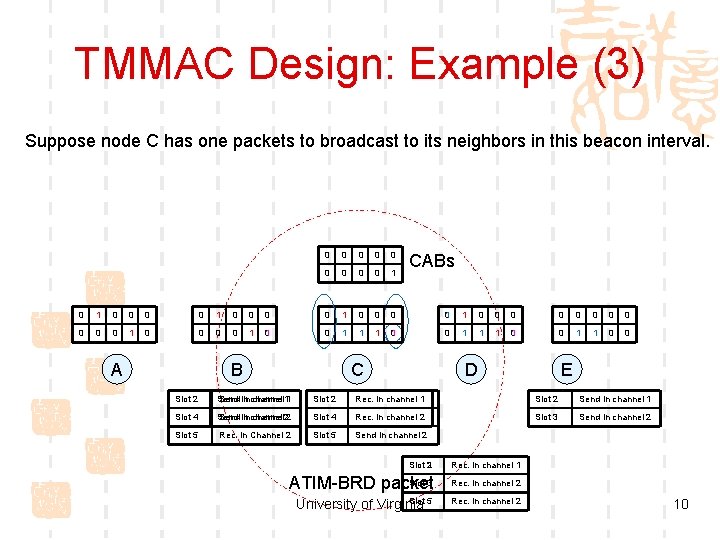
TMMAC Design: Example (3) Suppose node C has one packets to broadcast to its neighbors in this beacon interval. 0 0 0 0 0 1 CABs 0 1 0 0 0 0 1 1 0 0 0 1 0 0 1 0 1 0 1 1 0 0 A B C D E Slot 2 Send in in channel 11 Slot 2 Rec. in channel 1 Slot 2 Send in channel 1 Slot 4 Send in in channel 22 Slot 4 Rec. in channel 2 Slot 3 Send in channel 2 Slot 5 Rec. in Channel 2 Slot 5 Send in channel 2 Slot 2 1 Rec. in channel 1 Slot 3 ATIM-BRD packet Rec. in channel 2 Slot 5 University of Virginia Rec. in channel 2 10
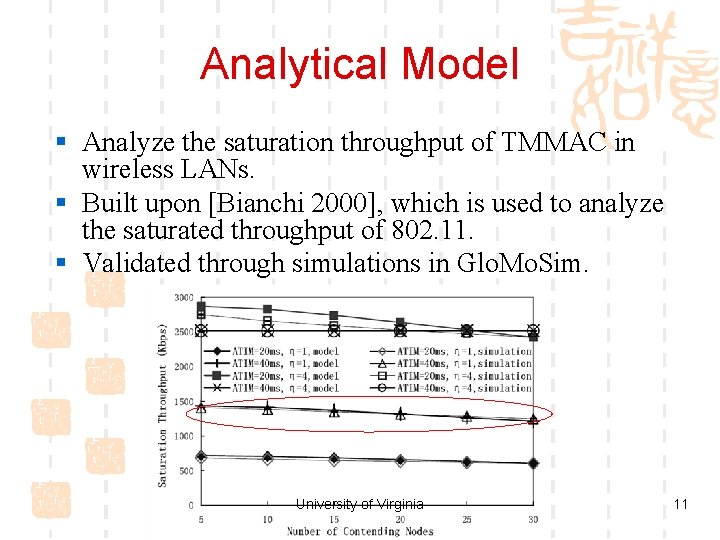
Analytical Model § Analyze the saturation throughput of TMMAC in wireless LANs. § Built upon [Bianchi 2000], which is used to analyze the saturated throughput of 802. 11. § Validated through simulations in Glo. Mo. Sim. University of Virginia 11
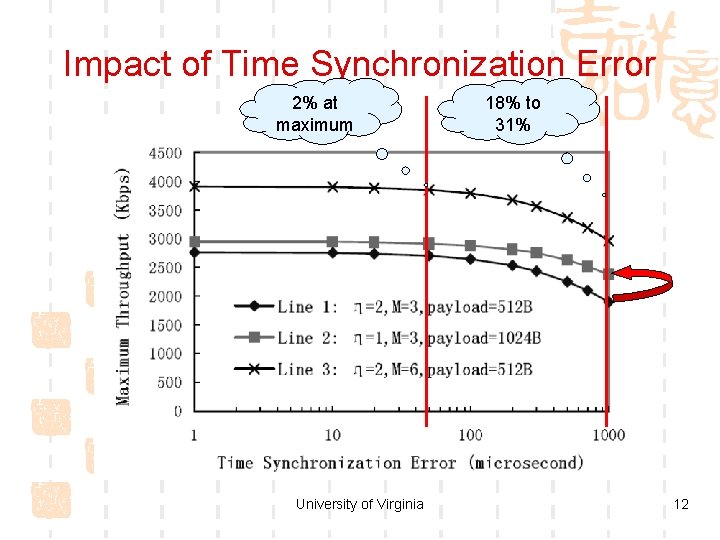
Impact of Time Synchronization Error 2% at maximum University of Virginia 18% to 31% 12
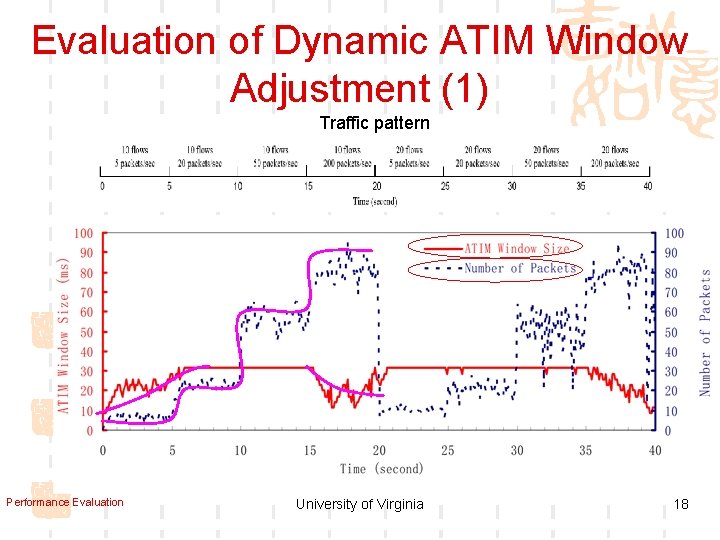
Motivation § There is no fixed optimal ATIM window size when the network is saturated. § A smaller ATIM window is preferred when Dynamic ATIM Window Adjustment the network is not saturated. § The dynamic ATIM window scheme used in 802. 11 PSM is not applicable. [Jung et al. 2002] University of Virginia 13
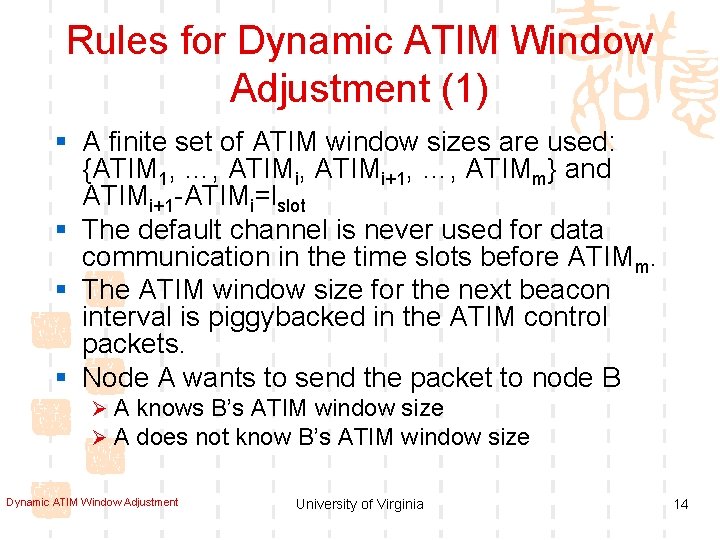
Rules for Dynamic ATIM Window Adjustment (1) § A finite set of ATIM window sizes are used: {ATIM 1, …, ATIMi+1, …, ATIMm} and ATIMi+1 -ATIMi=lslot § The default channel is never used for data communication in the time slots before ATIMm. § The ATIM window size for the next beacon interval is piggybacked in the ATIM control packets. § Node A wants to send the packet to node B Ø A knows B’s ATIM window size Ø A does not know B’s ATIM window size Dynamic ATIM Window Adjustment University of Virginia 14
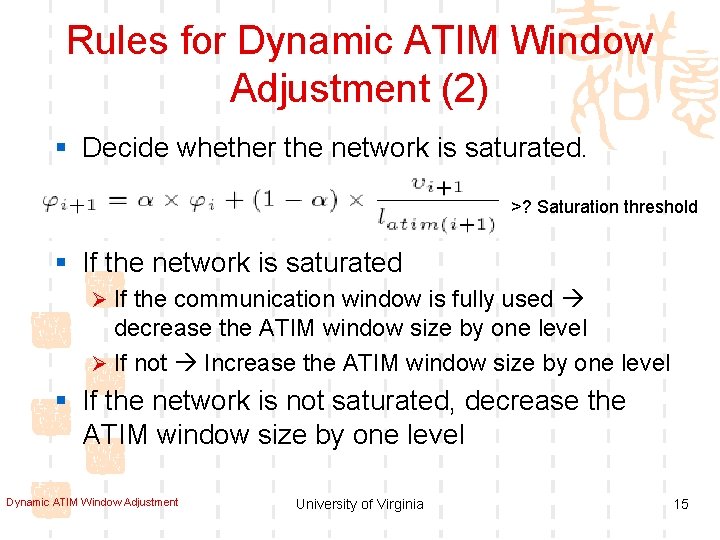
Rules for Dynamic ATIM Window Adjustment (2) § Decide whether the network is saturated. >? Saturation threshold § If the network is saturated Ø If the communication window is fully used decrease the ATIM window size by one level Ø If not Increase the ATIM window size by one level § If the network is not saturated, decrease the ATIM window size by one level Dynamic ATIM Window Adjustment University of Virginia 15
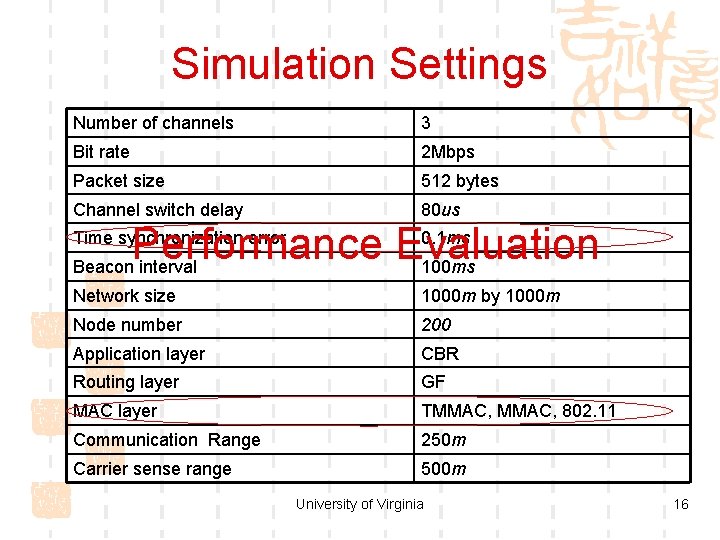
Simulation Settings Number of channels 3 Bit rate 2 Mbps Packet size 512 bytes Channel switch delay 80 us 0. 1 ms Performance Evaluation Beacon interval 100 ms Time synchronization error Network size 1000 m by 1000 m Node number 200 Application layer CBR Routing layer GF MAC layer TMMAC, 802. 11 Communication Range 250 m Carrier sense range 500 m University of Virginia 16
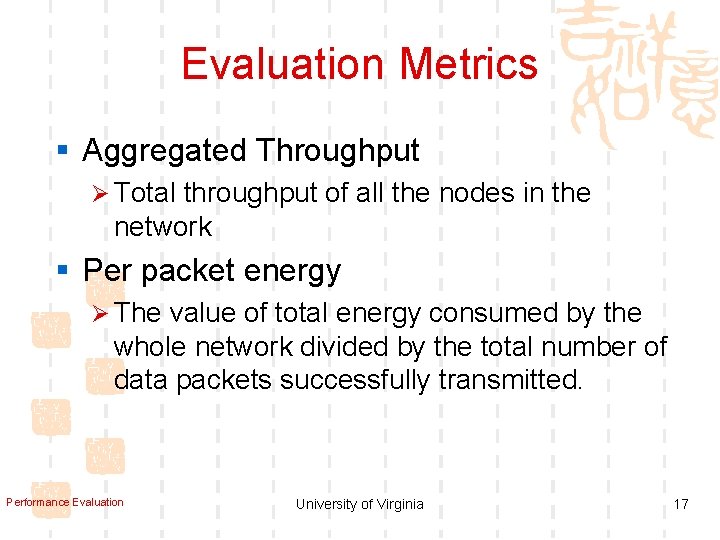
Evaluation Metrics § Aggregated Throughput Ø Total throughput of all the nodes in the network § Per packet energy Ø The value of total energy consumed by the whole network divided by the total number of data packets successfully transmitted. Performance Evaluation University of Virginia 17
Evaluation of Dynamic ATIM Window Adjustment (1) Traffic pattern Performance Evaluation University of Virginia 18
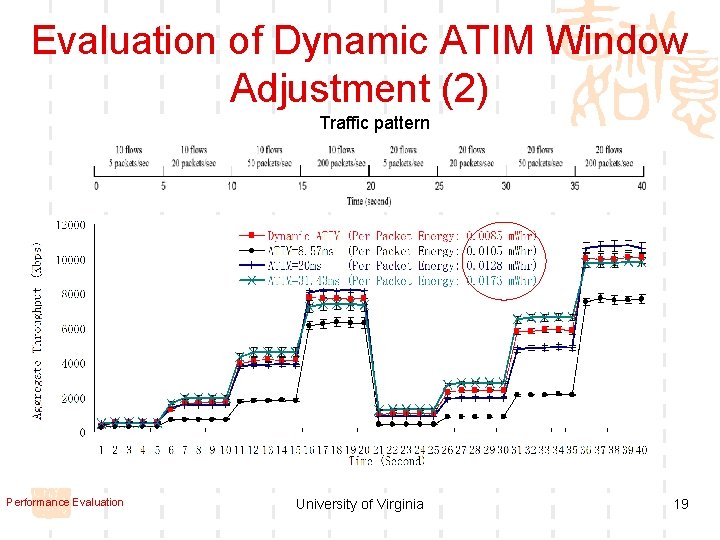
Evaluation of Dynamic ATIM Window Adjustment (2) Traffic pattern Performance Evaluation University of Virginia 19
Performance vs. System Loads (1) § Aggregate throughput vs. packet arrival rate 113% more aggregated throughput Performance Evaluation University of Virginia 20
Performance vs. System Loads (2) § Per packet energy vs. packet arrival rate 74% less per packet energy Performance Evaluation University of Virginia 21
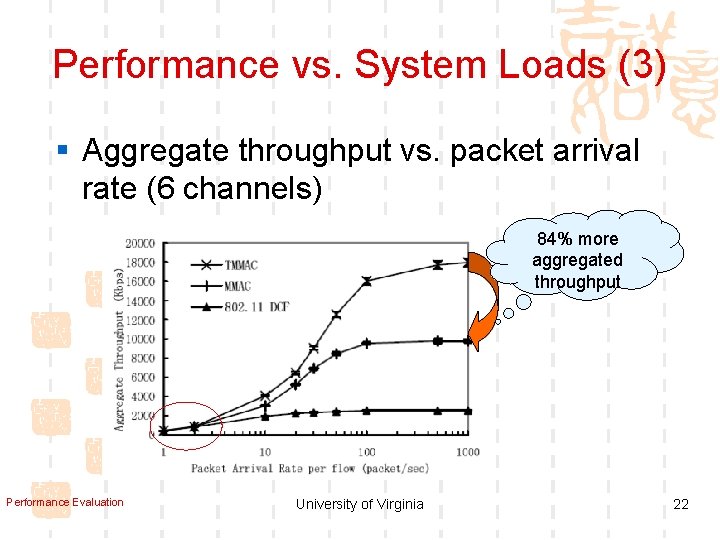
Performance vs. System Loads (3) § Aggregate throughput vs. packet arrival rate (6 channels) 84% more aggregated throughput Performance Evaluation University of Virginia 22
Conclusion § TMMAC exploits the advantage of both multiple channels and TDMA in an efficient way. § TMMAC achieves high communication throughput and low energy consumption. Ø 113% higher communication throughput Ø 74% less per packet energy University of Virginia 23
Publication § § § § Jingbin Zhang, Gang Zhou, Sang H. Son, John A. Stankovic, Kamin Whitehouse, "Performance Analysis of Group Based Detection for Sparse Wireless Sensor Networks, " in Submission. Jingbin Zhang, Gang Zhou, Chengdu Huang, Sang H. Son, John A. Stankovic, "TMMAC: An Energy Efficient Multi-Channel MAC Protocol for Ad Hoc Networks, " 2007 IEEE International Conference on Communications (IEEE ICC'07), Glasgow, Scotland, 2007. Jingbin Zhang, Ting Yan, John A. Stankovic, Sang H. Son, "Thunder: Towards Practical, Zero Cost Acoustic Localization for Outdoor Wireless Sensor Networks, " ACM SIGMOBILE Mobile Computing and Communications Review (ACM MC 2 R), Special Issue on Localization Technologies and Algorithms, 2007. Jingbin Zhang, Ting Yan, Sang H. Son, "Deployment Strategies for Differentiated Detection in Wireless Sensor Networks, " Third Annual IEEE International Conference on Sensor Mesh and Ad Hoc Communications and Networks (IEEE SECON'06), Reston, VA, 2006. Shan Lin, Jingbin Zhang, Gang Zhou, Lin Gu, Tian He, John A. Stankovic, "ATPC: Adaptive Transmission Power Control for Wireless Sensor Networks, " 4 th ACM International Conference on Embedded Networked Sensor Systems (ACM Sen. Sys'06), Boulder, Colorado, 2006. Jingbin Zhang, Gang Zhou, Sang H. Son, John A. Stankovic, "Ears on the Ground: An Acoustic Streaming Service in Wireless Sensor Networks, " Fifth IEEE/ACM International Conference on Information Processing in Sensor Networks (IEEE/ACM IPSN'06, Demo Abstract), Nashville, TN, 2006. Arsalan Avatoii, Jingbin Zhang, Sang H. Son, "Group-Based Event Detection in Undersea Sensor Networks, " Second International Workshop on Networked Sensing Systems (INSS'05), San Diego, California, 2005. University of Virginia 24
Questions? University of Virginia 25