
Tma 8 ivotn prostredie ako sas marketingovej komunikcie
- Slides: 21
Téma 8: Životné prostredie ako súčasť marketingovej komunikácie Ing. Rastislav Strhan, Ph. D. Environmentálny marketing
What is Greenwashing? p. Greenwashing is the practice of companies of falsely spinning and describing their products as environmentally friendly. p. It is a deceptive use of “Green” PR of “Green” marketing. p. When is the term “greenwashing” used?
History of Greenwashing p The term “greenwashing” was first introduced by Jay Westerveld, an environmentalist from New York. p 1986 essay on how hotels proclaimed to be environmentally friendly. p 1960 s - the environmental movement became very popular and advertising was a major part of this. p 1970 s - the first Earth Day was introduced ( “green” and “ecofriendly” products).
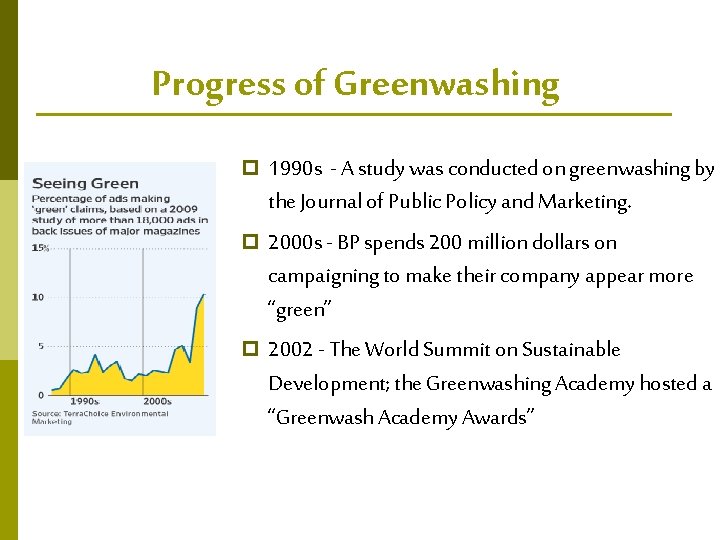
Progress of Greenwashing 1990 s - A study was conducted on greenwashing by the Journal of Public Policy and Marketing. p 2000 s - BP spends 200 million dollars on campaigning to make their company appear more “green” p 2002 - The World Summit on Sustainable Development; the Greenwashing Academy hosted a “Greenwash Academy Awards” p
1 Greenwash is misleading the public by stressing environmental credentials of a Person, a product or an organization when these are unfounded or irrelevant p 2 Greenwash is an environmental claim which is unsubstantiated (a fib) or irrelevant (a distraction) p
1. p 2. p 3. p 4. p 5. p 6. p 7. p The The sin sin of of suggestive pictures the hidden trade off no proof vagueness irrelevance lesser of two evils fibbing
1 The sin of suggestive pictures : p Green images that indicate a (unjustified) green impact, like flowers blooming from exhaust pipes p
2 The sin of the hidden trade off: Suggestion of being Green, based on a single environmental attribute, while blurring all other parameters which are maybe more important, p like a Hummer that is claiming that it is a Hybrid p
3 The sin of no proof Claims that could be right, but are not supported by any evidence, or by any reliable third party certification, p like Household lamps that promote their energy efficiency without any supporting figures or certification. p
4 The sin of vagueness Claims that are expressed with fluffy language with no clear meaning , p like ‘planet-friendly’ packaging p
5 The sin of irrelevance environmental claims that are redundantand unimportant for customers seeking environmentally preferable products. It is irrelevant and therefore distracts the consumer from finding a truly greener option. p Like ‘unleaded fuel (all fuel in Europe is unleaded p
6 The sin of lesser of two evils These are “green” claims that may be true within the product category, but that risk distracting the consumer from the greater Health- or other negative impacts of the category as a whole p Like organic cigarettes p
7 The sin of fibbing out-right lying, and produce totally fabricated claims or data p Like driving climate neutral p
ICC International Code of Environmental Advertising p p p Basic principles Article 1 All environmental advertising should be legal, decent, honest and truthful. It should be consistent with environmental regulations and mandatory programmes and should conform to the principles of fair competition, as generally accepted in business. No advertisements or claims should be such as to impair public confidence in the efforts made by the business community to improve its environmental performance. Honesty Article 2 Advertisements should be so framed as not to abuse consumers' concern for the environment, or exploit their possible lack of environmental knowledge.
ICC International Code of Environmental Advertising Environmental behaviour p Article 3 p Advertisements should not appear to approve or encourage actions, which contravene the law, self-regulatory codes or generally accepted standards of environmentally responsible behaviour. p
ICC International Code of Environmental Advertising p p p Truthful presentation Article 4 Advertisements should not contain any statement or visual presentation likely to mislead consumers in any way about the environmental aspects or advantages of products, or about the actions being taken by the advertiser in favour of the environment. Corporate advertisements can refer to specific products or actions, but not imply without justification that they extend to the whole performance of a company, group or industry. An environmental claim should be relevant to the particular product and relate only to aspects that exist or are likely to be realised during the product's life. It should be clear what it relates to, e. g. the product or its packaging. A pre-existing but previously not disclosed aspect should not be advertised as new. Environmental claims should be up to date, and where appropriate be reassessed with regard to relevant developments. Vague or non-specific claims of environmental benefit that may convey a range of meanings to consumers should only be made if they are valid in all reasonable foreseeable circumstances without qualifications. If this is not the case, general environmental claims should either be qualified or avoided. In particular, claims such as "environmentally friendly„ or "ecologically safe" implying that a product or an activity has no impact - or only a positive impact - on the environment should not be used unless a very high standard of proof is available. As long as there are no definitive, generally accepted methods for measuring sustainability or confirming its accomplishment, no claim of achieving it should be made. Qualifications should be clear, prominent and readily understandable; proximity to the claim being qualified is recommended to make sure they are read together.
ICC International Code of Environmental Advertising p p p p Scientific research Article 5 Advertisements should only use technical demonstrations or scientific findings about environmental impact, when backed by serious scientific work. Environmental jargon or scientific terminology is acceptable provided it is relevant and used in a way that can be readily understood by those to whom the message is directed. Testimonials Article 6 In view of the rapid developments in environmental science and technology, particular care should be taken to ensure that, when testimonials or endorsements are used to support an environmental claim, changes in product formulation or market circumstances have not made the testimonial out of date.
ICC International Code of Environmental Advertising p p p Superiority and comparative claims Article 7 Any comparative assertion should be specific and make clear the basis for the comparison. Environmental superiority over competitors can only be claimed when a significant advantage can be demonstrated. Products being compared should perform equivalent functions. Claims in relation to competitive products, when based on the absence of a harmful component or a damaging effect are only acceptable when other products in the category do include the component or cause the effect. Comparative claims, whether relating to the advertiser's own prior process or product or to those of a competitor, should be so worded as to avoid confusion of absolute and relative values. Improvements related to a product and its packaging should be stated separately, and should not be aggregated.
ICC International Code of Environmental Advertising p p Product life-cycle, components and elements Article 8 Environmental claims should not imply that they relate to more stages of a product life-cycle, or to more properties of a product, than justified and should where necessary clearly indicate to which stage or which property they refer. When advertisements refer to the reduction of components or elements having an environmental impact it should be clear what has been reduced. Alternative processes, components or elements, if any, should bring a significant environmental improvement, taking all relevant aspects of the product life cycle into consideration. Environmental claims should not be based on the absence of components, features or impacts that have never been associated with the product category. A claim of "…free", or of the same effect, should only be made when the level of the specified substance does not exceed that of an acknowledged trace contaminant* or background level.
ICC International Code of Environmental Advertising p p p Signs and symbols Article 9 Environmental signs or symbols should only be used in advertisement when the source of these signs or symbols is clearly indicated, and there is no confusion over the meaning. Such signs and symbols should not falsely suggest official approval or third-party certification. Waste handling Article 10 Environmental claims referring to waste handling are acceptable provided that the recommended method of separation, collection, processing or disposal is generally accepted or conveniently available to a reasonable proportion of consumers concerned. If not, the extent of availability should be accurately described.
ICC International Code of Environmental Advertising p p p p Substantiation Article 11 Claims, descriptions or illustrations relating to verifiable facts should be capable ofsubstantiation. Advertisers should have such substantiation available so that they can produce evidence without delay to the self-regulatory bodies responsible for the operation of the ICC International Code of Advertising Practice. Implementation Article 12 This Code is to be applied nationally and internationally, and should be the basis for the decisions by bodies set up for the purpose of self-regulation. Any request for interpretation of the principles contained in this Code should be submitted to the ICC Code Interpretation Panel.