
TM Anatomy of an Effective Leadership Development Strategy
- Slides: 32
TM Anatomy of an Effective Leadership Development Strategy A Guide to Creating a High-Impact Approach to Developing Leadership Talent
TM Overview CLC Learning and Development has identified 20 key components organizations should include in their leadership development strategies. Use this information to ensure that your organization’s strategy incorporates the components needed for success. Additionally, use each component’s maturity model to determine the current state of their leadership development strategy and identify focus areas for improvement. Instructions: § Review each component individually and understand the definition and purpose of each component using the description at the top of the page. § Looking at the maturity levels, identify your organization’s current level of maturity (Level 3 being the most mature). § Using the maturity level information, and taking into consideration the importance of the individual component to your particular organization, identify areas you would like to prioritize for development, based on your organization’s business strategy. § Use the action steps on each page to determine next steps for your focus areas. § Access the associated CLC Learning and Development support resources to help you take those next steps and advance your leadership development strategy. CLC Learning and Development, Corporate Leadership Council © 2010 The Corporate Executive Board Company. All Rights Reserved. LDR 6979510 PRO 2
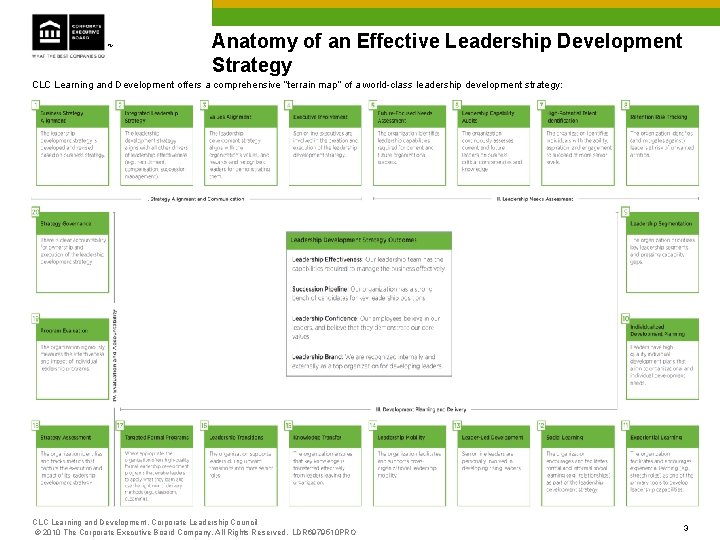
TM Anatomy of an Effective Leadership Development Strategy CLC Learning and Development offers a comprehensive “terrain map” of a world-class leadership development strategy: CLC Learning and Development, Corporate Leadership Council © 2010 The Corporate Executive Board Company. All Rights Reserved. LDR 6979510 PRO 3
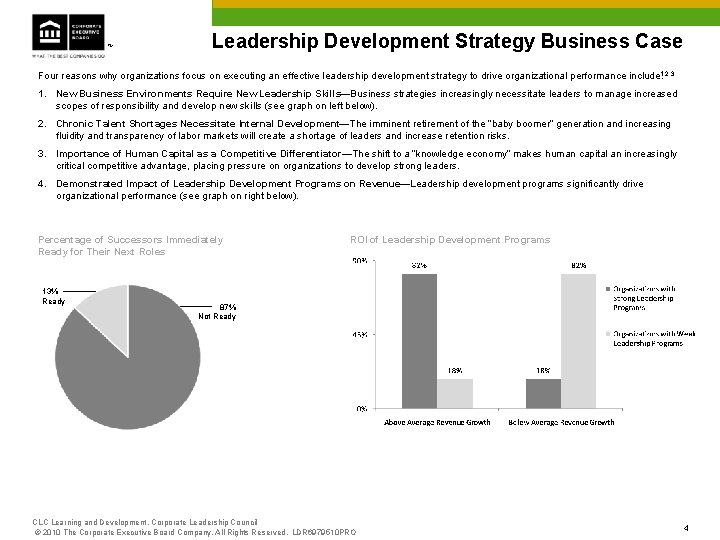
TM Leadership Development Strategy Business Case Four reasons why organizations focus on executing an effective leadership development strategy to drive organizational performance include: 1, 2, 3 1. New Business Environments Require New Leadership Skills—Business strategies increasingly necessitate leaders to manage increased scopes of responsibility and develop new skills (see graph on left below). 2. Chronic Talent Shortages Necessitate Internal Development—The imminent retirement of the “baby boomer” generation and increasing fluidity and transparency of labor markets will create a shortage of leaders and increase retention risks. 3. Importance of Human Capital as a Competitive Differentiator—The shift to a “knowledge economy” makes human capital an increasingly critical competitive advantage, placing pressure on organizations to develop strong leaders. 4. Demonstrated Impact of Leadership Development Programs on Revenue—Leadership development programs significantly drive organizational performance (see graph on right below). Percentage of Successors Immediately Ready for Their Next Roles 13% Ready ROI of Leadership Development Programs 87% Not Ready CLC Learning and Development, Corporate Leadership Council © 2010 The Corporate Executive Board Company. All Rights Reserved. LDR 6979510 PRO 4
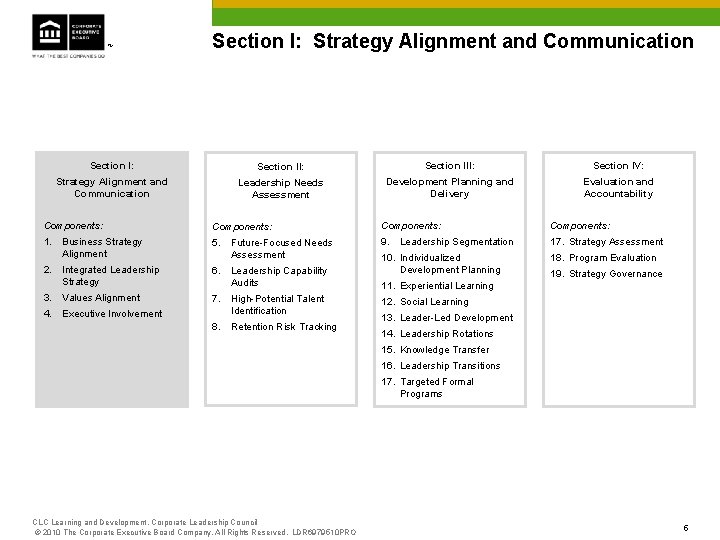
TM Section I: Strategy Alignment and Communication Section I: Section III: Section IV: Strategy Alignment and Communication Leadership Needs Assessment Development Planning and Delivery Evaluation and Accountability Components: 1. Business Strategy Alignment 5. Future-Focused Needs Assessment 9. Leadership Segmentation 17. Strategy Assessment 6. Leadership Capability Audits 10. Individualized Development Planning 18. Program Evaluation 2. Integrated Leadership Strategy 3. Values Alignment 7. High-Potential Talent Identification 4. Executive Involvement 8. Retention Risk Tracking 19. Strategy Governance 11. Experiential Learning 12. Social Learning 13. Leader-Led Development 14. Leadership Rotations 15. Knowledge Transfer 16. Leadership Transitions 17. Targeted Formal Programs CLC Learning and Development, Corporate Leadership Council © 2010 The Corporate Executive Board Company. All Rights Reserved. LDR 6979510 PRO 5
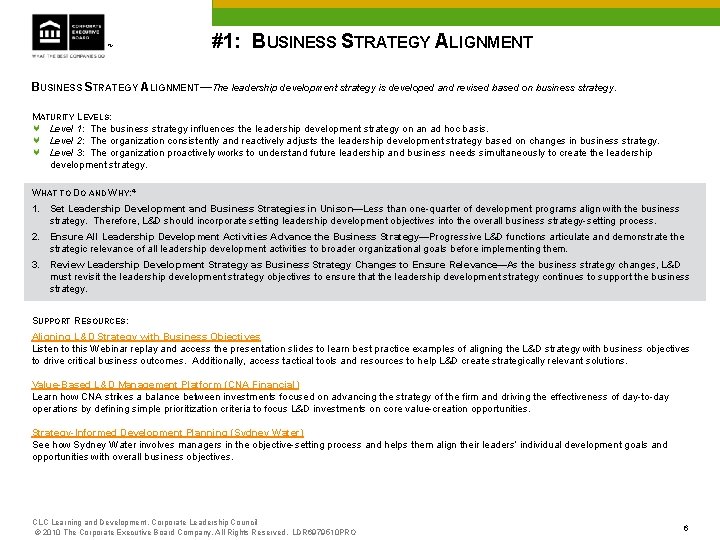
TM #1: BUSINESS STRATEGY ALIGNMENT—The leadership development strategy is developed and revised based on business strategy. MATURITY LEVELS: Level 1: The business strategy influences the leadership development strategy on an ad hoc basis. Level 2: The organization consistently and reactively adjusts the leadership development strategy based on changes in business strategy. Level 3: The organization proactively works to understand future leadership and business needs simultaneously to create the leadership development strategy. WHAT TO DO AND WHY: 4 1. Set Leadership Development and Business Strategies in Unison—Less than one-quarter of development programs align with the business strategy. Therefore, L&D should incorporate setting leadership development objectives into the overall business strategy-setting process. 2. Ensure All Leadership Development Activities Advance the Business Strategy—Progressive L&D functions articulate and demonstrate the strategic relevance of all leadership development activities to broader organizational goals before implementing them. 3. Review Leadership Development Strategy as Business Strategy Changes to Ensure Relevance—As the business strategy changes, L&D must revisit the leadership development strategy objectives to ensure that the leadership development strategy continues to support the business strategy. SUPPORT RESOURCES : Aligning L&D Strategy with Business Objectives Listen to this Webinar replay and access the presentation slides to learn best practice examples of aligning the L&D strategy with business objectives to drive critical business outcomes. Additionally, access tactical tools and resources to help L&D create strategically relevant solutions. Value-Based L&D Management Platform (CNA Financial) Learn how CNA strikes a balance between investments focused on advancing the strategy of the firm and driving the effectiveness of day-to-day operations by defining simple prioritization criteria to focus L&D investments on core value-creation opportunities. Strategy-Informed Development Planning (Sydney Water) See how Sydney Water involves managers in the objective-setting process and helps them align their leaders’ individual development goals and opportunities with overall business objectives. CLC Learning and Development, Corporate Leadership Council © 2010 The Corporate Executive Board Company. All Rights Reserved. LDR 6979510 PRO 6
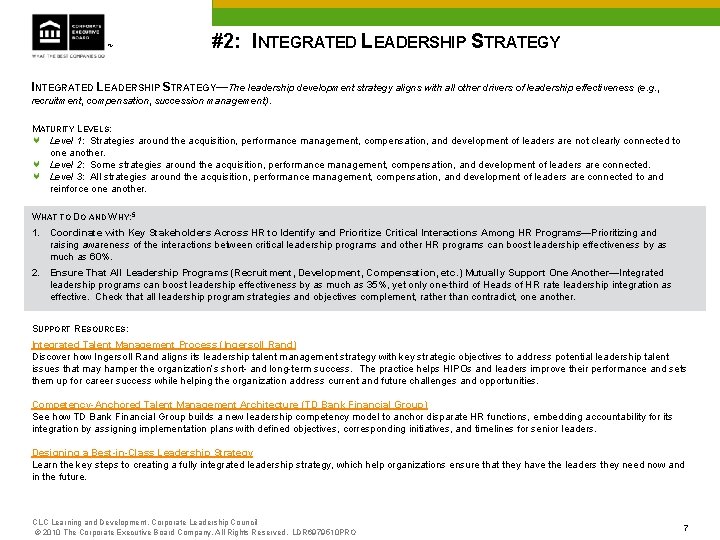
TM #2: INTEGRATED LEADERSHIP STRATEGY—The leadership development strategy aligns with all other drivers of leadership effectiveness (e. g. , recruitment, compensation, succession management). MATURITY LEVELS: Level 1: Strategies around the acquisition, performance management, compensation, and development of leaders are not clearly connected to one another. Level 2: Some strategies around the acquisition, performance management, compensation, and development of leaders are connected. Level 3: All strategies around the acquisition, performance management, compensation, and development of leaders are connected to and reinforce one another. WHAT TO DO AND WHY: 5 1. Coordinate with Key Stakeholders Across HR to Identify and Prioritize Critical Interactions Among HR Programs—Prioritizing and raising awareness of the interactions between critical leadership programs and other HR programs can boost leadership effectiveness by as much as 60%. 2. Ensure That All Leadership Programs (Recruitment, Development, Compensation, etc. ) Mutually Support One Another—Integrated leadership programs can boost leadership effectiveness by as much as 35%, yet only one-third of Heads of HR rate leadership integration as effective. Check that all leadership program strategies and objectives complement, rather than contradict, one another. SUPPORT RESOURCES : Integrated Talent Management Process (Ingersoll Rand) Discover how Ingersoll Rand aligns its leadership talent management strategy with key strategic objectives to address potential leadership talent issues that may hamper the organization’s short- and long-term success. The practice helps HIPOs and leaders improve their performance and sets them up for career success while helping the organization address current and future challenges and opportunities. Competency-Anchored Talent Management Architecture (TD Bank Financial Group) See how TD Bank Financial Group builds a new leadership competency model to anchor disparate HR functions, embedding accountability for its integration by assigning implementation plans with defined objectives, corresponding initiatives, and timelines for senior leaders. Designing a Best-in-Class Leadership Strategy Learn the key steps to creating a fully integrated leadership strategy, which help organizations ensure that they have the leaders they need now and in the future. CLC Learning and Development, Corporate Leadership Council © 2010 The Corporate Executive Board Company. All Rights Reserved. LDR 6979510 PRO 7
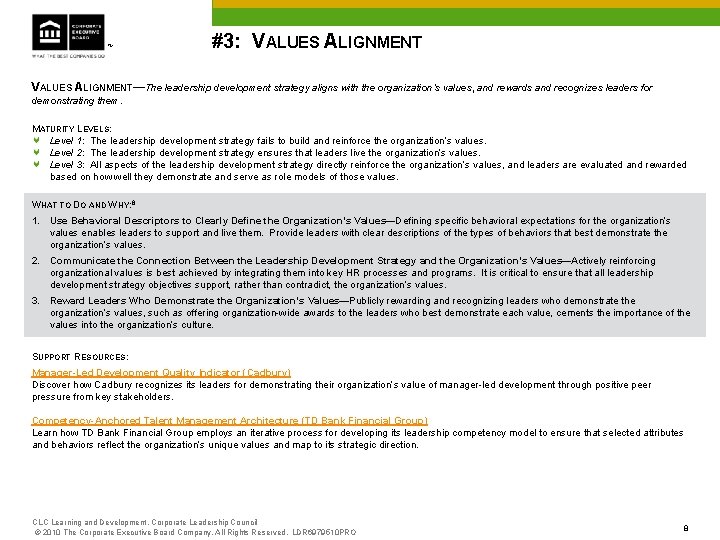
TM #3: VALUES ALIGNMENT—The leadership development strategy aligns with the organization’s values, and rewards and recognizes leaders for demonstrating them. MATURITY LEVELS: Level 1: The leadership development strategy fails to build and reinforce the organization’s values. Level 2: The leadership development strategy ensures that leaders live the organization’s values. Level 3: All aspects of the leadership development strategy directly reinforce the organization’s values, and leaders are evaluated and rewarded based on how well they demonstrate and serve as role models of those values. WHAT TO DO AND WHY: 6 1. Use Behavioral Descriptors to Clearly Define the Organization’s Values—Defining specific behavioral expectations for the organization’s values enables leaders to support and live them. Provide leaders with clear descriptions of the types of behaviors that best demonstrate the organization’s values. 2. Communicate the Connection Between the Leadership Development Strategy and the Organization’s Values—Actively reinforcing organizational values is best achieved by integrating them into key HR processes and programs. It is critical to ensure that all leadership development strategy objectives support, rather than contradict, the organization’s values. 3. Reward Leaders Who Demonstrate the Organization’s Values—Publicly rewarding and recognizing leaders who demonstrate the organization’s values, such as offering organization-wide awards to the leaders who best demonstrate each value, cements the importance of the values into the organization’s culture. SUPPORT RESOURCES : Manager-Led Development Quality Indicator (Cadbury) Discover how Cadbury recognizes its leaders for demonstrating their organization’s value of manager-led development through positive peer pressure from key stakeholders. Competency-Anchored Talent Management Architecture (TD Bank Financial Group) Learn how TD Bank Financial Group employs an iterative process for developing its leadership competency model to ensure that selected attributes and behaviors reflect the organization’s unique values and map to its strategic direction. CLC Learning and Development, Corporate Leadership Council © 2010 The Corporate Executive Board Company. All Rights Reserved. LDR 6979510 PRO 8
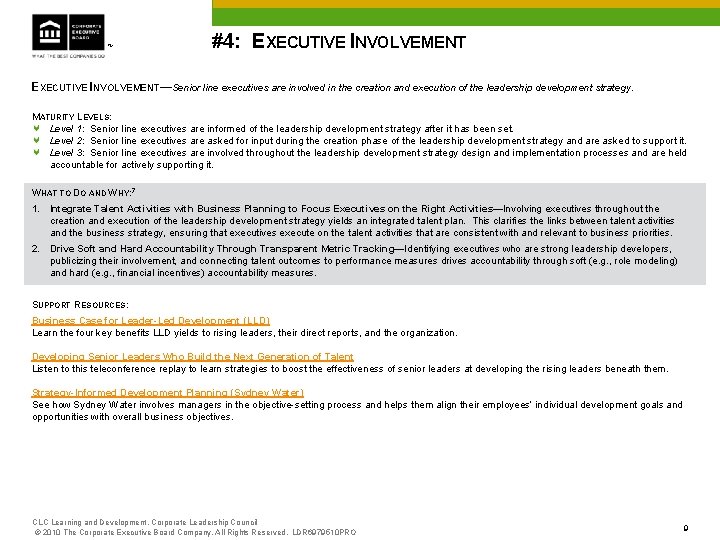
TM #4: EXECUTIVE INVOLVEMENT—Senior line executives are involved in the creation and execution of the leadership development strategy. MATURITY LEVELS: Level 1: Senior line executives are informed of the leadership development strategy after it has been set. Level 2: Senior line executives are asked for input during the creation phase of the leadership development strategy and are asked to support it. Level 3: Senior line executives are involved throughout the leadership development strategy design and implementation processes and are held accountable for actively supporting it. WHAT TO DO AND WHY: 7 1. Integrate Talent Activities with Business Planning to Focus Executives on the Right Activities—Involving executives throughout the creation and execution of the leadership development strategy yields an integrated talent plan. This clarifies the links between talent activities and the business strategy, ensuring that executives execute on the talent activities that are consistent with and relevant to business priorities. 2. Drive Soft and Hard Accountability Through Transparent Metric Tracking—Identifying executives who are strong leadership developers, publicizing their involvement, and connecting talent outcomes to performance measures drives accountability through soft (e. g. , role modeling) and hard (e. g. , financial incentives) accountability measures. SUPPORT RESOURCES : Business Case for Leader-Led Development (LLD) Learn the four key benefits LLD yields to rising leaders, their direct reports, and the organization. Developing Senior Leaders Who Build the Next Generation of Talent Listen to this teleconference replay to learn strategies to boost the effectiveness of senior leaders at developing the rising leaders beneath them. Strategy-Informed Development Planning (Sydney Water) See how Sydney Water involves managers in the objective-setting process and helps them align their employees’ individual development goals and opportunities with overall business objectives. CLC Learning and Development, Corporate Leadership Council © 2010 The Corporate Executive Board Company. All Rights Reserved. LDR 6979510 PRO 9
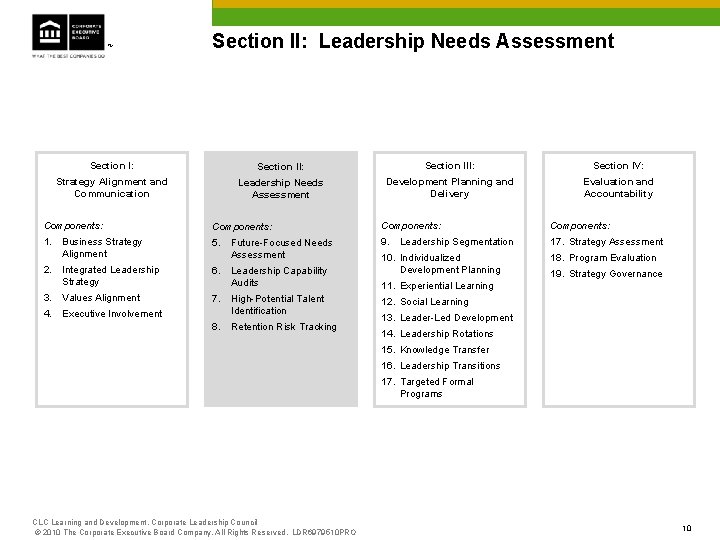
TM Section II: Leadership Needs Assessment Section I: Section III: Section IV: Strategy Alignment and Communication Leadership Needs Assessment Development Planning and Delivery Evaluation and Accountability Components: 1. Business Strategy Alignment 5. Future-Focused Needs Assessment 9. Leadership Segmentation 17. Strategy Assessment 6. Leadership Capability Audits 10. Individualized Development Planning 18. Program Evaluation 2. Integrated Leadership Strategy 3. Values Alignment 7. High-Potential Talent Identification 4. Executive Involvement 8. Retention Risk Tracking 19. Strategy Governance 11. Experiential Learning 12. Social Learning 13. Leader-Led Development 14. Leadership Rotations 15. Knowledge Transfer 16. Leadership Transitions 17. Targeted Formal Programs CLC Learning and Development, Corporate Leadership Council © 2010 The Corporate Executive Board Company. All Rights Reserved. LDR 6979510 PRO 10
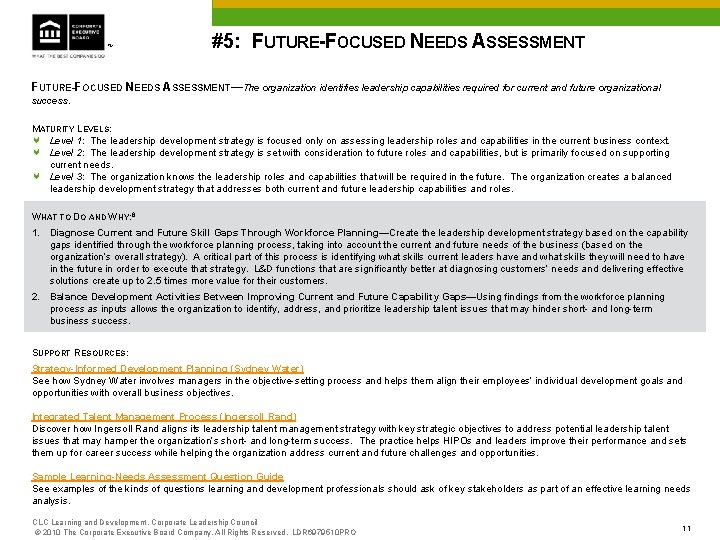
TM #5: FUTURE-FOCUSED NEEDS ASSESSMENT—The organization identifies leadership capabilities required for current and future organizational success. MATURITY LEVELS: Level 1: The leadership development strategy is focused only on assessing leadership roles and capabilities in the current business context. Level 2: The leadership development strategy is set with consideration to future roles and capabilities, but is primarily focused on supporting current needs. Level 3: The organization knows the leadership roles and capabilities that will be required in the future. The organization creates a balanced leadership development strategy that addresses both current and future leadership capabilities and roles. WHAT TO DO AND WHY: 8 1. Diagnose Current and Future Skill Gaps Through Workforce Planning—Create the leadership development strategy based on the capability gaps identified through the workforce planning process, taking into account the current and future needs of the business (based on the organization’s overall strategy). A critical part of this process is identifying what skills current leaders have and what skills they will need to have in the future in order to execute that strategy. L&D functions that are significantly better at diagnosing customers’ needs and delivering effective solutions create up to 2. 5 times more value for their customers. 2. Balance Development Activities Between Improving Current and Future Capability Gaps—Using findings from the workforce planning process as inputs allows the organization to identify, address, and prioritize leadership talent issues that may hinder short- and long-term business success. SUPPORT RESOURCES : Strategy-Informed Development Planning (Sydney Water) See how Sydney Water involves managers in the objective-setting process and helps them align their employees’ individual development goals and opportunities with overall business objectives. Integrated Talent Management Process (Ingersoll Rand) Discover how Ingersoll Rand aligns its leadership talent management strategy with key strategic objectives to address potential leadership talent issues that may hamper the organization’s short- and long-term success. The practice helps HIPOs and leaders improve their performance and sets them up for career success while helping the organization address current and future challenges and opportunities. Sample Learning-Needs Assessment Question Guide See examples of the kinds of questions learning and development professionals should ask of key stakeholders as part of an effective learning needs analysis. CLC Learning and Development, Corporate Leadership Council © 2010 The Corporate Executive Board Company. All Rights Reserved. LDR 6979510 PRO 11
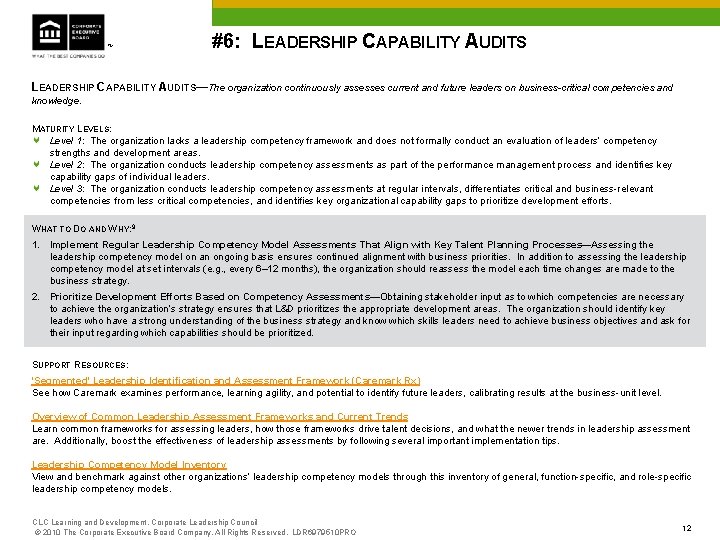
TM #6: LEADERSHIP CAPABILITY AUDITS—The organization continuously assesses current and future leaders on business-critical competencies and knowledge. MATURITY LEVELS: Level 1: The organization lacks a leadership competency framework and does not formally conduct an evaluation of leaders’ competency strengths and development areas. Level 2: The organization conducts leadership competency assessments as part of the performance management process and identifies key capability gaps of individual leaders. Level 3: The organization conducts leadership competency assessments at regular intervals, differentiates critical and business-relevant competencies from less critical competencies, and identifies key organizational capability gaps to prioritize development efforts. WHAT TO DO AND WHY: 9 1. Implement Regular Leadership Competency Model Assessments That Align with Key Talent Planning Processes—Assessing the leadership competency model on an ongoing basis ensures continued alignment with business priorities. In addition to assessing the leadership competency model at set intervals (e. g. , every 6– 12 months), the organization should reassess the model each time changes are made to the business strategy. 2. Prioritize Development Efforts Based on Competency Assessments—Obtaining stakeholder input as to which competencies are necessary to achieve the organization’s strategy ensures that L&D prioritizes the appropriate development areas. The organization should identify key leaders who have a strong understanding of the business strategy and know which skills leaders need to achieve business objectives and ask for their input regarding which capabilities should be prioritized. SUPPORT RESOURCES : 'Segmented' Leadership Identification and Assessment Framework (Caremark Rx) See how Caremark examines performance, learning agility, and potential to identify future leaders, calibrating results at the business-unit level. Overview of Common Leadership Assessment Frameworks and Current Trends Learn common frameworks for assessing leaders, how those frameworks drive talent decisions, and what the newer trends in leadership assessment are. Additionally, boost the effectiveness of leadership assessments by following several important implementation tips. Leadership Competency Model Inventory View and benchmark against other organizations’ leadership competency models through this inventory of general, function-specific, and role-specific leadership competency models. CLC Learning and Development, Corporate Leadership Council © 2010 The Corporate Executive Board Company. All Rights Reserved. LDR 6979510 PRO 12
TM #7: HIGH-POTENTIAL TALENT IDENTIFICATION HIGH-POTENTIAL (HIPO) TALENT IDENTIFICATION—The organization identifies individuals with the ability, aspiration, and engagement to succeed at more senior levels. MATURITY LEVELS: Level 1: The organization identifies top talent inconsistently across the organization. Level 2: The organization centrally manages top talent identification and calibrates across business units. Membership in the top talent pool changes infrequently. Level 3: The organization maintains a dynamic top talent pool that is regularly calibrated throughout the organization. Membership in this pool changes dynamically to reflect changes in business needs and in the abilities, aspirations, and engagement levels of rising leaders. WHAT TO DO AND WHY: 10 1. Communicate a Uniform Definition of High Potential—Using a standardized HIPO definition across the organization supports building a consistent standard of leadership, which facilitates effective succession planning and leader mobility. High potential is not the same as high performance; in addition to a leader’s ability, the organization should consider his/her engagement level and aspiration to succeed in more senior positions. Additionally, the organization should ensure that the competencies they require for HIPO status link back to the business strategy to ensure that HIPOs are developing skill sets that are key to achieving business objectives. 2. Create a Formal, Consistently Applied Identification Process—Implementing a formal process with concrete criteria to identify HIPOs ensures that potential assessments are done in a consistent manner across the organization. Standardizing HIPO criteria across the organization improves consistency within the HIPO pool and increases the perception of the fairness of the selection process. 3. Continuously Reassess Individuals’ High-Potential Status—HIPO talent pools should remain dynamic, as individuals’ aspirations and engagement levels fluctuate. Likewise, leaders who are considered high potential in one role, may not be in another, as new roles often require different abilities. To ensure that leaders in the HIPO pool are truly high potential, the organization must assess all leaders against the organization’s standardized HIPO definition on an on-going basis. SUPPORT RESOURCES : 'Segmented' Leadership Identification and Assessment Framework (Caremark Rx) See how Caremark examines performance, learning agility, and potential to identify future leaders, calibrating results at the business-unit level. High-Potential and Transition-Based Leadership Development Model (ANZ Banking Group Ltd. ) See how ANZ prepares leaders to execute against business goals through maintaining a focus on identifying and developing HIPOs. Standard Performance and Potential Definitions and Talent Investment Prioritization Matrix (Exelon) Learn how Exelon creates standard performance and potential definitions to facilitate apples-to-apples comparisons of the organization’s talent. CLC Learning and Development, Corporate Leadership Council © 2010 The Corporate Executive Board Company. All Rights Reserved. LDR 6979510 PRO For more information on identifying high-potential talent, visit the CLC Human Resources Web site. 13
TM #8: RETENTION RISK TRACKING—The organization identifies (and mitigates against) leaders at risk of unwanted attrition. MATURITY LEVELS: Level 1: The organization does not actively identify retention risks within the leadership ranks. Level 2: The organization reactively identifies and addresses leadership retention risks on an as-needed basis. Level 3: The organization has a formal process for proactively identifying critical leadership retention risks and actively implements strategies to mitigate against these risks. WHAT TO DO AND WHY: 11 1. Identify Leaders in Critical Roles Based on the Role’s Impact on the Business—Understanding which roles are the greatest risk to the business if left vacant enables the organization to manage those potential threats to business performance proactively. 2. Proactively Assess Leaders’ Risk of Leaving the Organization to Enable the Organization to Take Targeted Steps to Mitigate Against Attrition—Evaluating the retention risk of leaders in key positions enables the organization to take targeted steps to mitigate against attrition risks. Organizations should enable key business leaders’ managers to identify retention risk signs. 3. Identify and Implement Retention Strategies for High-Risk Leaders to Prevent Losing Them—Encouraging managers of high-impact leaders to take a personalized approach to retaining those at a high-risk of leaving allows them to identify individuals’ personal preferences and motivations, leading to more effective retention strategies. SUPPORT RESOURCES : Strategy-Informed Development Planning (Sydney Water) See how Sydney Water identifies key talent segments, including those at risk of leaving the organization, during the objective-setting process. 'Segmented' Leadership Identification and Assessment Framework (Caremark Rx) See how Caremark takes a segmented approach to leadership assessment and identification, enabling them to proactively address issues that may lead to voluntary departures of their high-impact talent. Experience- and Risk-Driven Development Profiles (John Deere) Learn how John Deere’s managers and L&D practitioners work in tandem to create Development Profiles for the organization’s key talent. The Development Profiles capture information regarding individuals’ backgrounds, development focus areas, career preferences, and potential retention issues. CLC Learning and Development, Corporate Leadership Council © 2010 The Corporate Executive Board Company. All Rights Reserved. LDR 6979510 PRO 14
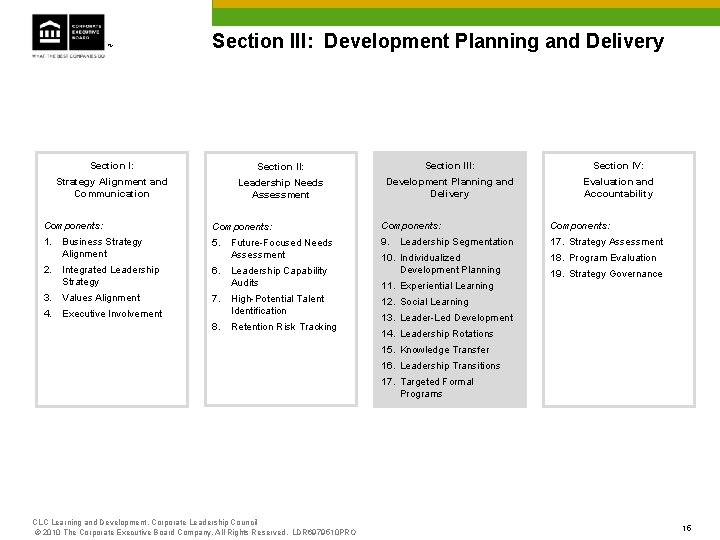
TM Section III: Development Planning and Delivery Section I: Section III: Section IV: Strategy Alignment and Communication Leadership Needs Assessment Development Planning and Delivery Evaluation and Accountability Components: 1. Business Strategy Alignment 5. Future-Focused Needs Assessment 9. Leadership Segmentation 17. Strategy Assessment 6. Leadership Capability Audits 10. Individualized Development Planning 18. Program Evaluation 2. Integrated Leadership Strategy 3. Values Alignment 7. High-Potential Talent Identification 4. Executive Involvement 8. Retention Risk Tracking 19. Strategy Governance 11. Experiential Learning 12. Social Learning 13. Leader-Led Development 14. Leadership Rotations 15. Knowledge Transfer 16. Leadership Transitions 17. Targeted Formal Programs CLC Learning and Development, Corporate Leadership Council © 2010 The Corporate Executive Board Company. All Rights Reserved. LDR 6979510 PRO 15
TM #9: LEADERSHIP SEGMENTATION—The organization prioritizes key leadership segments and pressing capability gaps. MATURITY LEVELS: Level 1: The organization has no formal method for prioritizing its leadership development efforts. Level 2: The organization prioritizes and manages specific leadership development opportunities based on leadership level. Level 3: The organization prioritizes key leadership groups based on business needs and capability gaps. The organization provides development opportunities to fit these unique needs. WHAT TO DO AND WHY: 12 1. Identify Specific Needs of Individual Leadership Segments—Segment the leadership population both by level and by the type of impact leaders have on the organization (e. g. , operational, business/functional, strategic). Use this information to identify the unique needs of various leadership segments. 2. Provide Targeted Development Opportunities—Identify appropriate development activities based on the unique needs of individual leadership segments. SUPPORT RESOURCES : Impact-Oriented Leadership Segmentation (Coles Myer Ltd. ) See how Coles Myer Ltd. segments its leadership population by both level and type of impact leaders need to have on the organization. Coles Myer supplements its segmentation approach by explicitly stating how leaders within each segment should allocate their time and which skills they should focus on developing. Value-Based L&D Management Platform (CNA Financial) Discover how CNA Financial employs a value-based L&D management platform to articulate its primary sources of value creation and to create a “strategically-relevant” L&D portfolio. Segment-Specific Coaching Models (St. George Bank) Learn how St. George Bank offers segment-specific coaching modules for frontline, middle, and senior managers, recognizing that development challenges differ based on the skills and experience of managers and their direct reports. CLC Learning and Development, Corporate Leadership Council © 2010 The Corporate Executive Board Company. All Rights Reserved. LDR 6979510 PRO 16
TM #10: INDIVIDUALIZED DEVELOPMENT PLANNING—Leaders have high-quality individual development plans that align to organizational and individual development needs. MATURITY LEVELS: Level 1: Individual development plans for leaders are used inconsistently throughout the organization. Level 2: Most leaders have development plans, but they vary in quality and are inconsistently applied. Leaders receive somewhat useful support from their managers. Level 3: Nearly all leaders have high-quality development plans that are aligned with organizational and individual needs. Leaders actively apply their development plans with useful support from their managers. WHAT TO DO AND WHY: 13 1. Provide L&D Support to Help Leaders Design High-Quality Development Plans—Less than half of managers effectively align development goals to both individual and organizational needs. L&D must support leaders through aligning their development plans to MBOs by providing guidance as to which capability gaps leaders should prioritize based on individual development needs, career preferences, and the organization’s objectives. Additionally, enabling leaders to self-diagnose and identify appropriate development activities to close gaps empowers them to drive their own development. 2. Hold Leaders and Their Managers Accountable for Having Strong Development Plans—Beyond asking leaders and their managers to complete development plans, L&D must ensure that development plans are high quality through tracking the effectiveness of plans and publicizing those results. SUPPORT RESOURCES : “Reverse-Engineered” Development Plans (Goldman Sachs) See how Goldman Sachs identifies critical success factors of individuals’ career development, yielding a range of job-specific suggestions to senior management for experiences that individuals can be offered both within and beyond their current roles. On-Demand Individual Development Plans (IBM) Enable leaders to self-diagnose their development needs, strategize as to how to best fill any gaps, and monitor their own progress against development goals. Manager-Led Development Quality Indicator (Cadbury) Learn how Cadbury holds managers accountable for high-quality development through positive pressure from key stakeholders. CLC Learning and Development, Corporate Leadership Council © 2010 The Corporate Executive Board Company. All Rights Reserved. LDR 6979510 PRO 17
TM #11: EXPERIENTIAL LEARNING—The organization facilitates and encourages experiential learning (e. g. , stretch roles) as one of the primary tools to develop leadership capabilities. MATURITY LEVELS: Level 1: The leadership development strategy focuses exclusively on classroom training opportunities. Level 2: The leadership development strategy includes specific experiential learning opportunities for select employees. Level 3: The leadership development strategy orients heavily around specific experiential development opportunities for all leaders. WHAT TO DO AND WHY: 14 1. Identify Experiential Development Opportunities That Support the Leadership Development Strategy—On-the-job activities must provide learning that is both urgent and important, yet almost half of on-the-job learning activities fall short on both of these dimensions. In order to obtain maximum learning, leaders’ development plans must contain a variety of on-the-job activities that fall into the following six categories: access to best practices, scope expansion, change and adversity, challenging relationships, persuading and teaching, and making difficult decisions. 2. Help Leaders Prepare for and Reflect on On-the-Job Learning Activities—Experience-based learning can result in three times more improvement in leader performance than formal training programs. In order for leaders to capitalize on the learning available through on-the-job development activities, L&D must offer guidance to the leader and his/her manager on preparing for and reflecting on the development activity. SUPPORT RESOURCES : “Reverse-Engineered” Development Plans (Goldman Sachs) See how Goldman Sachs identifies critical success factors of individuals’ career development, yielding a range of job-specific suggestions to senior management for experiences that individuals can be offered both within and beyond their current roles. Experiential Learning Toolkit (State Farm Insurance Co. ) See how State Farm ensures the sustainability of experiential learning as part of its broader approach to leadership development by educating and enabling leaders to apply what they learned to their day-to-day work. Building Learning Strategies Beyond the Classroom—Case Profiles of Experiential Learning in Action Listen to this teleconference replay and learn how organizations, including Sun Microsystems, Duke Energy, and Convergys boost individual and organizational performance by unlocking the "developmental value" resident in experiential forms of learning. CLC Learning and Development, Corporate Leadership Council © 2010 The Corporate Executive Board Company. All Rights Reserved. LDR 6979510 PRO 18
TM #12: SOCIAL LEARNING—The organization encourages and facilitates formal and informal social learning (e. g. , relationships) as a part of the leadership development strategy. MATURITY LEVELS: Level 1: Managers are encouraged to provide informal networking opportunities to their employees on an ad hoc basis. Level 2: The organization offers some formal networking programs (e. g. , mentoring). Level 3: The organization nurtures informal networks, offers a variety of formal social learning opportunities, and provides support resources to ensure that employees extract learning from their social interactions. WHAT TO DO AND WHY: 15 1. Boost Extraction from Learning Through Work by Activating Support Networks—Support from peers, direct reports, and managers can boost learning application from on-the-job learning activities by as much as 14%, 13%, and 12%, respectively. 2. Facilitate Leadership Network Building—L&D can leverage the intrinsic learning available through relationships by implementing formal mentoring programs and encouraging leaders to build informal peer networks. SUPPORT RESOURCES : Enabling Employees to Collectively Learn from Successes (Shell) Review Shell's structured peer learning exercise, which is a forum for employees to understand the root cause of their successes, identify best practices, and re-apply them in their day-to-day work. Peer Consulting Cohorts (Bombardier) Learn how Bombardier develops managers via peer cohorts, where learners provide consulting advice to one another on large-scale projects. Event-Based Networking Learning (American Express) See how American Express helps managers identify networking partners for their direct reports based on observed successes to ensure actionable employee learning. CLC Learning and Development, Corporate Leadership Council © 2010 The Corporate Executive Board Company. All Rights Reserved. LDR 6979510 PRO 19
TM #13: LEADER-LED DEVELOPMENT (LLD)—Senior line leaders are personally involved in developing rising leaders. MATURITY LEVELS: Level 1: The organization does not expect leaders to develop other leaders. Senior leaders are not held accountable for developing other leaders. Level 2: The organization expects leaders to develop other leaders, but provides little guidance to senior leaders on how to do so. Senior leaders are not held accountable for developing other leaders. Level 3: The organization selects and rewards senior leaders for their abilities to develop others, explicitly requires them to develop others, and holds them accountable for supporting rising leader development. WHAT TO DO AND WHY: 16 1. Demonstrate the Business Importance of LLD to Leaders—Senior leaders who are effective at developing rising leaders can boost the performance of their direct reports by as much as 27%. Additionally, the best developers of other leaders are 1. 5 times more likely to exceed their financial goals. Get leaders to commit to LLD by demonstrating to them LLD’s impact on the bottom line. 2. Provide Resources and Support to Enable Leaders to Develop Others Effectively—Mandating senior leaders to develop others without ensuring that they are effective at it does not increase rising leaders’ performance; leaders who receive no LLD perform at the same level as those who receive poor LLD. Senior leaders have the business expertise and extensive experience needed to develop others; however, in order for them to do this effectively, L&D must provide support to enable leaders to transfer their knowledge and experience to others. 3. Hold Senior Leaders Accountable for Developing Others Through Hard and Soft Accountability—Incorporating effectiveness at developing others into performance standards and publicly recognizing those who are highly effective drives a culture of LLD. SUPPORT RESOURCES : Business Case for Leader-Led Development Learn the four key benefits LLD yields to rising leaders, their direct reports, and the organization. A Senior Leader’s Guide to Leader-Led Development Distribute this guide to senior leaders to show them how to more effectively develop their direct reports by focusing on the right activities and establishing a solid foundation for coaching partnerships. Actionable Leaders-as-Teachers Framework (Becton, Dickenson and Company) See how BD uses line leaders to fulfill teaching responsibilities, yielding instructional benefits and strengthening leaders’ coaching capabilities beyond the classroom. CLC Learning and Development, Corporate Leadership Council © 2010 The Corporate Executive Board Company. All Rights Reserved. LDR 6979510 PRO 20
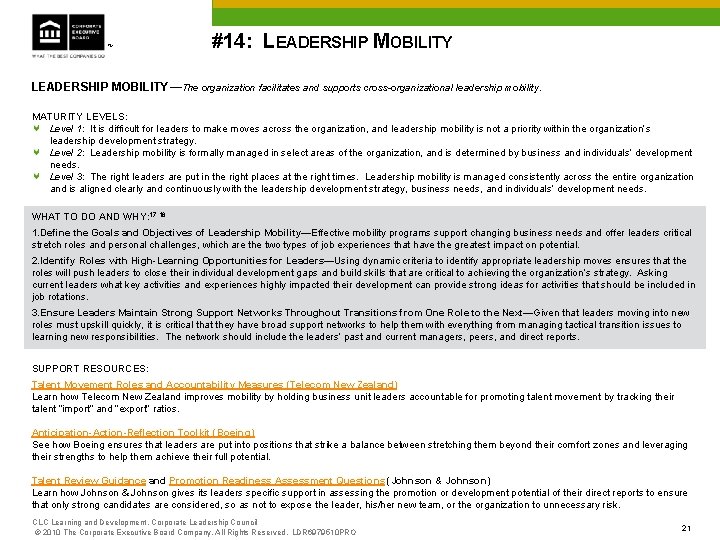
TM #14: LEADERSHIP MOBILITY—The organization facilitates and supports cross-organizational leadership mobility. MATURITY LEVELS: Level 1: It is difficult for leaders to make moves across the organization, and leadership mobility is not a priority within the organization’s leadership development strategy. Level 2: Leadership mobility is formally managed in select areas of the organization, and is determined by business and individuals’ development needs. Level 3: The right leaders are put in the right places at the right times. Leadership mobility is managed consistently across the entire organization and is aligned clearly and continuously with the leadership development strategy, business needs, and individuals’ development needs. WHAT TO DO AND WHY: 17, 18 1. Define the Goals and Objectives of Leadership Mobility—Effective mobility programs support changing business needs and offer leaders critical stretch roles and personal challenges, which are the two types of job experiences that have the greatest impact on potential. 2. Identify Roles with High-Learning Opportunities for Leaders—Using dynamic criteria to identify appropriate leadership moves ensures that the roles will push leaders to close their individual development gaps and build skills that are critical to achieving the organization’s strategy. Asking current leaders what key activities and experiences highly impacted their development can provide strong ideas for activities that should be included in job rotations. 3. Ensure Leaders Maintain Strong Support Networks Throughout Transitions from One Role to the Next—Given that leaders moving into new roles must upskill quickly, it is critical that they have broad support networks to help them with everything from managing tactical transition issues to learning new responsibilities. The network should include the leaders’ past and current managers, peers, and direct reports. SUPPORT RESOURCES: Talent Movement Roles and Accountability Measures (Telecom New Zealand) Learn how Telecom New Zealand improves mobility by holding business unit leaders accountable for promoting talent movement by tracking their talent “import” and “export” ratios. Anticipation-Action-Reflection Toolkit (Boeing) See how Boeing ensures that leaders are put into positions that strike a balance between stretching them beyond their comfort zones and leveraging their strengths to help them achieve their full potential. Talent Review Guidance and Promotion Readiness Assessment Questions (Johnson & Johnson) Learn how Johnson & Johnson gives its leaders specific support in assessing the promotion or development potential of their direct reports to ensure that only strong candidates are considered, so as not to expose the leader, his/her new team, or the organization to unnecessary risk. CLC Learning and Development, Corporate Leadership Council © 2010 The Corporate Executive Board Company. All Rights Reserved. LDR 6979510 PRO 21
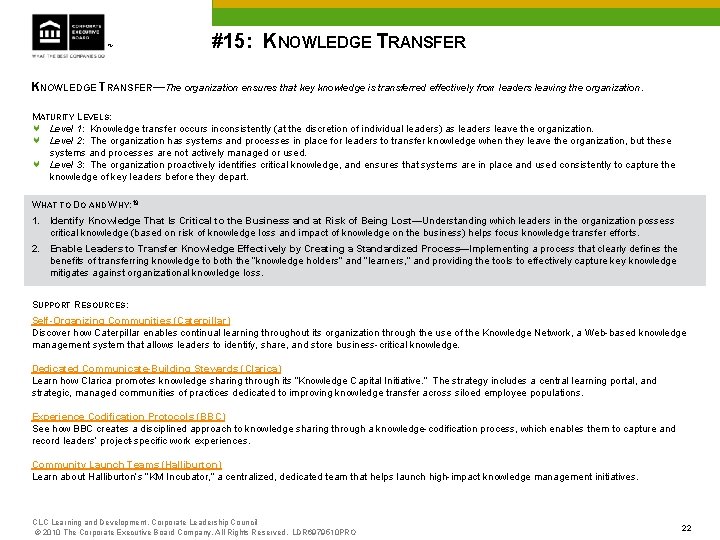
TM #15: KNOWLEDGE TRANSFER—The organization ensures that key knowledge is transferred effectively from leaders leaving the organization. MATURITY LEVELS: Level 1: Knowledge transfer occurs inconsistently (at the discretion of individual leaders) as leaders leave the organization. Level 2: The organization has systems and processes in place for leaders to transfer knowledge when they leave the organization, but these systems and processes are not actively managed or used. Level 3: The organization proactively identifies critical knowledge, and ensures that systems are in place and used consistently to capture the knowledge of key leaders before they depart. WHAT TO DO AND WHY: 19 1. Identify Knowledge That Is Critical to the Business and at Risk of Being Lost—Understanding which leaders in the organization possess critical knowledge (based on risk of knowledge loss and impact of knowledge on the business) helps focus knowledge transfer efforts. 2. Enable Leaders to Transfer Knowledge Effectively by Creating a Standardized Process—Implementing a process that clearly defines the benefits of transferring knowledge to both the “knowledge holders” and “learners, ” and providing the tools to effectively capture key knowledge mitigates against organizational knowledge loss. SUPPORT RESOURCES : Self-Organizing Communities (Caterpillar) Discover how Caterpillar enables continual learning throughout its organization through the use of the Knowledge Network, a Web-based knowledge management system that allows leaders to identify, share, and store business-critical knowledge. Dedicated Communicate-Building Stewards (Clarica) Learn how Clarica promotes knowledge sharing through its “Knowledge Capital Initiative. ” The strategy includes a central learning portal, and strategic, managed communities of practices dedicated to improving knowledge transfer across siloed employee populations. Experience Codification Protocols (BBC) See how BBC creates a disciplined approach to knowledge sharing through a knowledge-codification process, which enables them to capture and record leaders’ project-specific work experiences. Community Launch Teams (Halliburton) Learn about Halliburton’s “KM Incubator, ” a centralized, dedicated team that helps launch high-impact knowledge management initiatives. CLC Learning and Development, Corporate Leadership Council © 2010 The Corporate Executive Board Company. All Rights Reserved. LDR 6979510 PRO 22
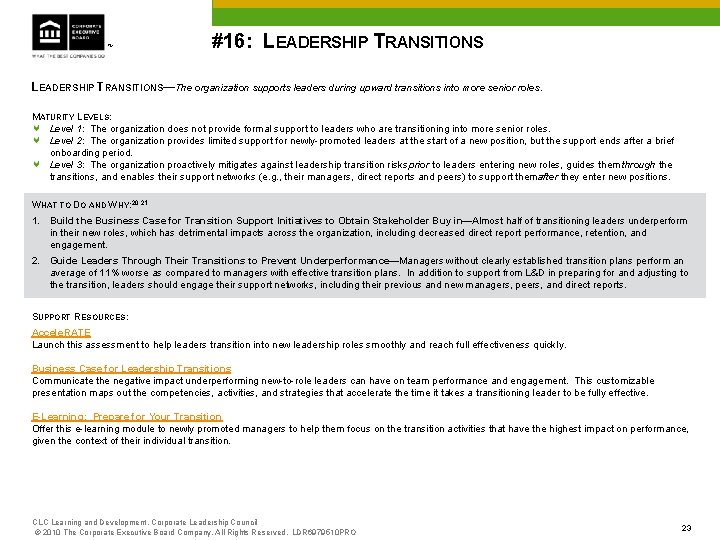
TM #16: LEADERSHIP TRANSITIONS—The organization supports leaders during upward transitions into more senior roles. MATURITY LEVELS: Level 1: The organization does not provide formal support to leaders who are transitioning into more senior roles. Level 2: The organization provides limited support for newly-promoted leaders at the start of a new position, but the support ends after a brief onboarding period. Level 3: The organization proactively mitigates against leadership transition risks prior to leaders entering new roles, guides them through the transitions, and enables their support networks (e. g. , their managers, direct reports and peers) to support themafter they enter new positions. WHAT TO DO AND WHY: 20, 21 1. Build the Business Case for Transition Support Initiatives to Obtain Stakeholder Buy in—Almost half of transitioning leaders underperform in their new roles, which has detrimental impacts across the organization, including decreased direct report performance, retention, and engagement. 2. Guide Leaders Through Their Transitions to Prevent Underperformance—Managers without clearly established transition plans perform an average of 11% worse as compared to managers with effective transition plans. In addition to support from L&D in preparing for and adjusting to the transition, leaders should engage their support networks, including their previous and new managers, peers, and direct reports. SUPPORT RESOURCES : Accele. RATE Launch this assessment to help leaders transition into new leadership roles smoothly and reach full effectiveness quickly. Business Case for Leadership Transitions Communicate the negative impact underperforming new-to-role leaders can have on team performance and engagement. This customizable presentation maps out the competencies, activities, and strategies that accelerate the time it takes a transitioning leader to be fully effective. E-Learning: Prepare for Your Transition Offer this e-learning module to newly promoted managers to help them focus on the transition activities that have the highest impact on performance, given the context of their individual transition. CLC Learning and Development, Corporate Leadership Council © 2010 The Corporate Executive Board Company. All Rights Reserved. LDR 6979510 PRO 23
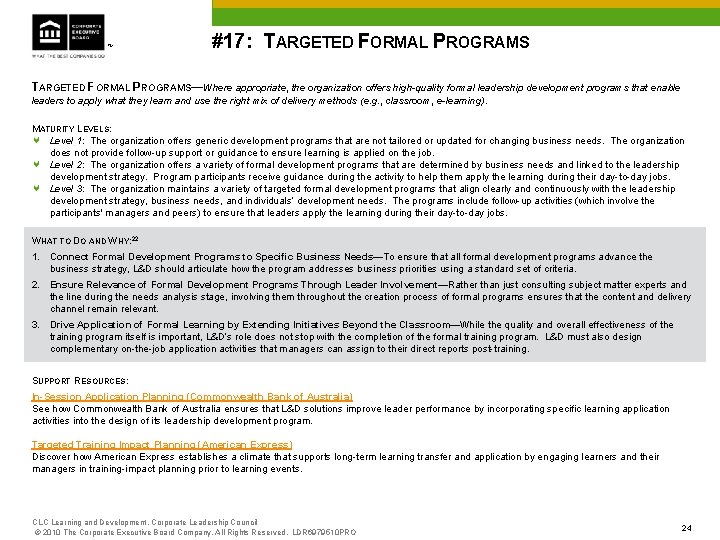
TM #17: TARGETED FORMAL PROGRAMS—Where appropriate, the organization offers high-quality formal leadership development programs that enable leaders to apply what they learn and use the right mix of delivery methods (e. g. , classroom, e-learning). MATURITY LEVELS: Level 1: The organization offers generic development programs that are not tailored or updated for changing business needs. The organization does not provide follow-up support or guidance to ensure learning is applied on the job. Level 2: The organization offers a variety of formal development programs that are determined by business needs and linked to the leadership development strategy. Program participants receive guidance during the activity to help them apply the learning during their day-to-day jobs. Level 3: The organization maintains a variety of targeted formal development programs that align clearly and continuously with the leadership development strategy, business needs, and individuals’ development needs. The programs include follow-up activities (which involve the participants' managers and peers) to ensure that leaders apply the learning during their day-to-day jobs. WHAT TO DO AND WHY: 22 1. Connect Formal Development Programs to Specific Business Needs—To ensure that all formal development programs advance the business strategy, L&D should articulate how the program addresses business priorities using a standard set of criteria. 2. Ensure Relevance of Formal Development Programs Through Leader Involvement—Rather than just consulting subject matter experts and the line during the needs analysis stage, involving them throughout the creation process of formal programs ensures that the content and delivery channel remain relevant. 3. Drive Application of Formal Learning by Extending Initiatives Beyond the Classroom—While the quality and overall effectiveness of the training program itself is important, L&D’s role does not stop with the completion of the formal training program. L&D must also design complementary on-the-job application activities that managers can assign to their direct reports post-training. SUPPORT RESOURCES : In-Session Application Planning (Commonwealth Bank of Australia) See how Commonwealth Bank of Australia ensures that L&D solutions improve leader performance by incorporating specific learning application activities into the design of its leadership development program. Targeted Training Impact Planning (American Express) Discover how American Express establishes a climate that supports long-term learning transfer and application by engaging learners and their managers in training-impact planning prior to learning events. CLC Learning and Development, Corporate Leadership Council © 2010 The Corporate Executive Board Company. All Rights Reserved. LDR 6979510 PRO 24
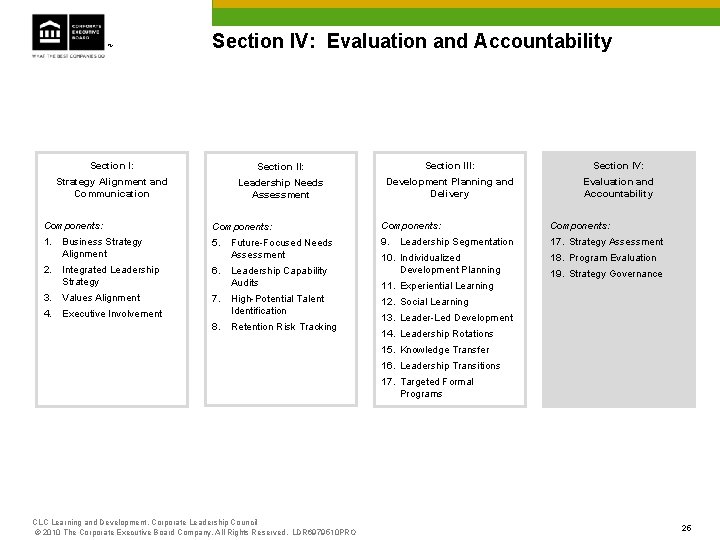
TM Section IV: Evaluation and Accountability Section I: Section III: Section IV: Strategy Alignment and Communication Leadership Needs Assessment Development Planning and Delivery Evaluation and Accountability Components: 1. Business Strategy Alignment 5. Future-Focused Needs Assessment 9. Leadership Segmentation 17. Strategy Assessment 6. Leadership Capability Audits 10. Individualized Development Planning 18. Program Evaluation 2. Integrated Leadership Strategy 3. Values Alignment 7. High-Potential Talent Identification 4. Executive Involvement 8. Retention Risk Tracking 19. Strategy Governance 11. Experiential Learning 12. Social Learning 13. Leader-Led Development 14. Leadership Rotations 15. Knowledge Transfer 16. Leadership Transitions 17. Targeted Formal Programs CLC Learning and Development, Corporate Leadership Council © 2010 The Corporate Executive Board Company. All Rights Reserved. LDR 6979510 PRO 25
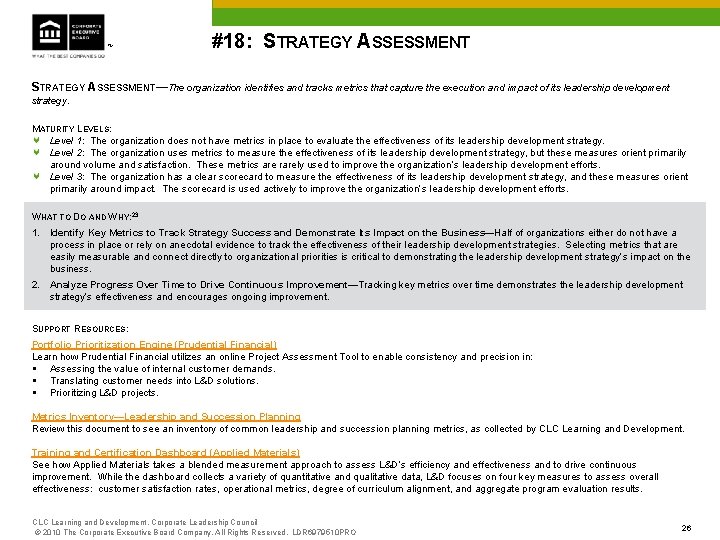
TM #18: STRATEGY ASSESSMENT—The organization identifies and tracks metrics that capture the execution and impact of its leadership development strategy. MATURITY LEVELS: Level 1: The organization does not have metrics in place to evaluate the effectiveness of its leadership development strategy. Level 2: The organization uses metrics to measure the effectiveness of its leadership development strategy, but these measures orient primarily around volume and satisfaction. These metrics are rarely used to improve the organization’s leadership development efforts. Level 3: The organization has a clear scorecard to measure the effectiveness of its leadership development strategy, and these measures orient primarily around impact. The scorecard is used actively to improve the organization’s leadership development efforts. WHAT TO DO AND WHY: 23 1. Identify Key Metrics to Track Strategy Success and Demonstrate Its Impact on the Business—Half of organizations either do not have a process in place or rely on anecdotal evidence to track the effectiveness of their leadership development strategies. Selecting metrics that are easily measurable and connect directly to organizational priorities is critical to demonstrating the leadership development strategy’s impact on the business. 2. Analyze Progress Over Time to Drive Continuous Improvement—Tracking key metrics over time demonstrates the leadership development strategy’s effectiveness and encourages ongoing improvement. SUPPORT RESOURCES : Portfolio Prioritization Engine (Prudential Financial) Learn how Prudential Financial utilizes an online Project Assessment Tool to enable consistency and precision in: § Assessing the value of internal customer demands. § Translating customer needs into L&D solutions. § Prioritizing L&D projects. Metrics Inventory—Leadership and Succession Planning Review this document to see an inventory of common leadership and succession planning metrics, as collected by CLC Learning and Development. Training and Certification Dashboard (Applied Materials) See how Applied Materials takes a blended measurement approach to assess L&D’s efficiency and effectiveness and to drive continuous improvement. While the dashboard collects a variety of quantitative and qualitative data, L&D focuses on four key measures to assess overall effectiveness: customer satisfaction rates, operational metrics, degree of curriculum alignment, and aggregate program evaluation results. CLC Learning and Development, Corporate Leadership Council © 2010 The Corporate Executive Board Company. All Rights Reserved. LDR 6979510 PRO 26
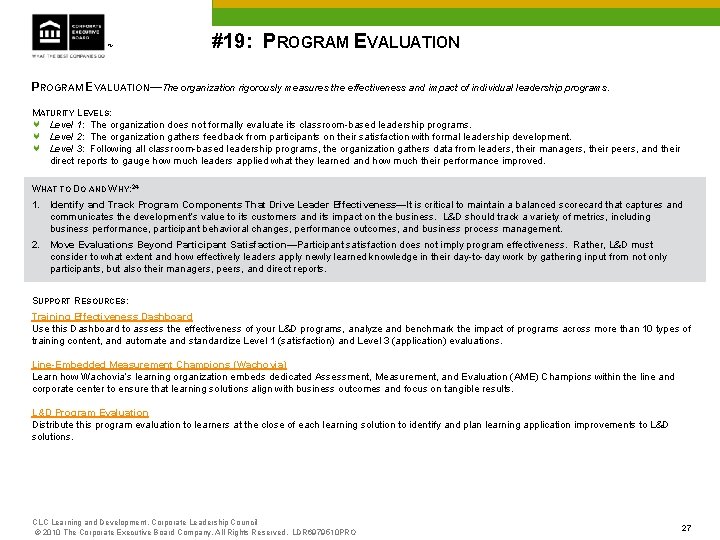
TM #19: PROGRAM EVALUATION—The organization rigorously measures the effectiveness and impact of individual leadership programs. MATURITY LEVELS: Level 1: The organization does not formally evaluate its classroom-based leadership programs. Level 2: The organization gathers feedback from participants on their satisfaction with formal leadership development. Level 3: Following all classroom-based leadership programs, the organization gathers data from leaders, their managers, their peers, and their direct reports to gauge how much leaders applied what they learned and how much their performance improved. WHAT TO DO AND WHY: 24 1. Identify and Track Program Components That Drive Leader Effectiveness—It is critical to maintain a balanced scorecard that captures and communicates the development’s value to its customers and its impact on the business. L&D should track a variety of metrics, including business performance, participant behavioral changes, performance outcomes, and business process management. 2. Move Evaluations Beyond Participant Satisfaction—Participant satisfaction does not imply program effectiveness. Rather, L&D must consider to what extent and how effectively leaders apply newly learned knowledge in their day-to-day work by gathering input from not only participants, but also their managers, peers, and direct reports. SUPPORT RESOURCES : Training Effectiveness Dashboard Use this Dashboard to assess the effectiveness of your L&D programs, analyze and benchmark the impact of programs across more than 10 types of training content, and automate and standardize Level 1 (satisfaction) and Level 3 (application) evaluations. Line-Embedded Measurement Champions (Wachovia) Learn how Wachovia’s learning organization embeds dedicated Assessment, Measurement, and Evaluation (AME) Champions within the line and corporate center to ensure that learning solutions align with business outcomes and focus on tangible results. L&D Program Evaluation Distribute this program evaluation to learners at the close of each learning solution to identify and plan learning application improvements to L&D solutions. CLC Learning and Development, Corporate Leadership Council © 2010 The Corporate Executive Board Company. All Rights Reserved. LDR 6979510 PRO 27
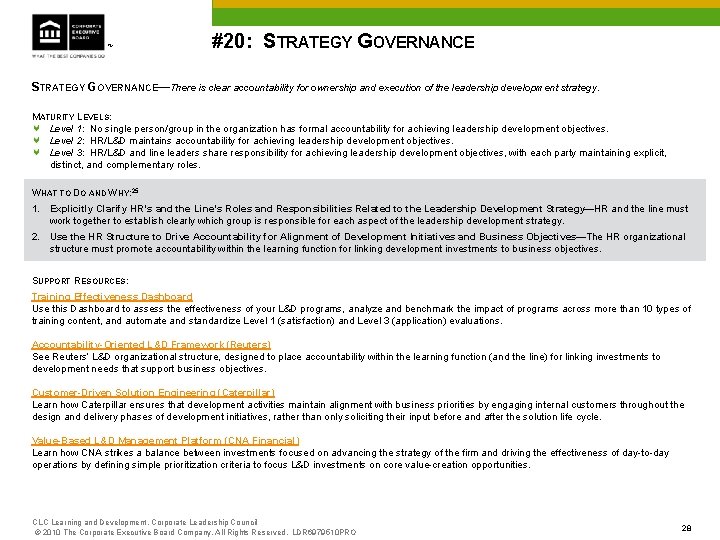
TM #20: STRATEGY GOVERNANCE—There is clear accountability for ownership and execution of the leadership development strategy. MATURITY LEVELS: Level 1: No single person/group in the organization has formal accountability for achieving leadership development objectives. Level 2: HR/L&D maintains accountability for achieving leadership development objectives. Level 3: HR/L&D and line leaders share responsibility for achieving leadership development objectives, with each party maintaining explicit, distinct, and complementary roles. WHAT TO DO AND WHY: 25 1. Explicitly Clarify HR’s and the Line’s Roles and Responsibilities Related to the Leadership Development Strategy—HR and the line must work together to establish clearly which group is responsible for each aspect of the leadership development strategy. 2. Use the HR Structure to Drive Accountability for Alignment of Development Initiatives and Business Objectives—The HR organizational structure must promote accountability within the learning function for linking development investments to business objectives. SUPPORT RESOURCES : Training Effectiveness Dashboard Use this Dashboard to assess the effectiveness of your L&D programs, analyze and benchmark the impact of programs across more than 10 types of training content, and automate and standardize Level 1 (satisfaction) and Level 3 (application) evaluations. Accountability-Oriented L&D Framework (Reuters) See Reuters’ L&D organizational structure, designed to place accountability within the learning function (and the line) for linking investments to development needs that support business objectives. Customer-Driven Solution Engineering (Caterpillar) Learn how Caterpillar ensures that development activities maintain alignment with business priorities by engaging internal customers throughout the design and delivery phases of development initiatives, rather than only soliciting their input before and after the solution life cycle. Value-Based L&D Management Platform (CNA Financial) Learn how CNA strikes a balance between investments focused on advancing the strategy of the firm and driving the effectiveness of day-to-day operations by defining simple prioritization criteria to focus L&D investments on core value-creation opportunities. CLC Learning and Development, Corporate Leadership Council © 2010 The Corporate Executive Board Company. All Rights Reserved. LDR 6979510 PRO 28
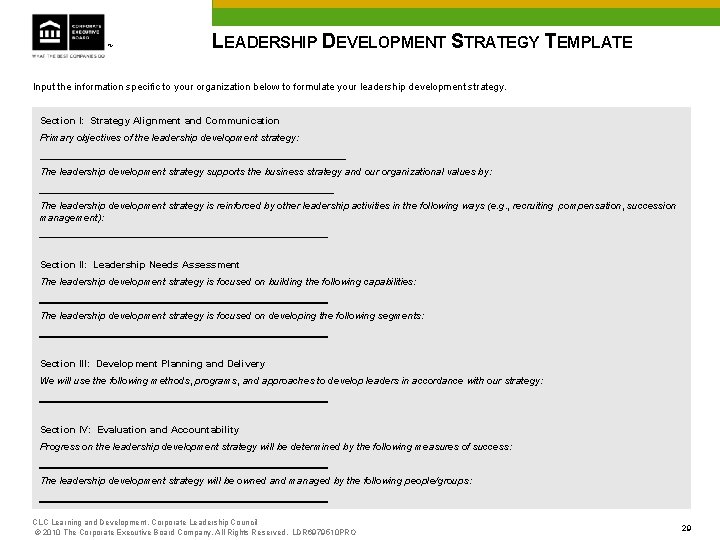
TM LEADERSHIP DEVELOPMENT STRATEGY TEMPLATE Input the information specific to your organization below to formulate your leadership development strategy. Section I: Strategy Alignment and Communication Primary objectives of the leadership development strategy: ____________________________ The leadership development strategy supports the business strategy and our organizational values by: ___________________________ The leadership development strategy is reinforced by other leadership activities in the following ways (e. g. , recruiting , compensation, succession management): _________________________________ Section II: Leadership Needs Assessment The leadership development strategy is focused on building the following capabilities: The leadership development strategy is focused on developing the following segments: Section III: Development Planning and Delivery We will use the following methods, programs, and approaches to develop leaders in accordance with our strategy: Section IV: Evaluation and Accountability Progress on the leadership development strategy will be determined by the following measures of success: The leadership development strategy will be owned and managed by the following people/groups: CLC Learning and Development, Corporate Leadership Council © 2010 The Corporate Executive Board Company. All Rights Reserved. LDR 6979510 PRO 29
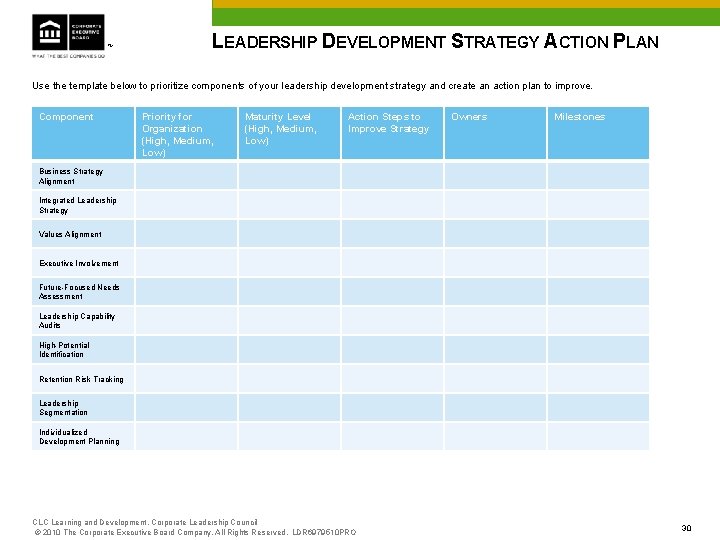
TM LEADERSHIP DEVELOPMENT STRATEGY ACTION PLAN Use the template below to prioritize components of your leadership development strategy and create an action plan to improve. Component Priority for Organization (High, Medium, Low) Maturity Level (High, Medium, Low) Action Steps to Improve Strategy Owners Milestones Business Strategy Alignment Integrated Leadership Strategy Values Alignment Executive Involvement Future-Focused Needs Assessment Leadership Capability Audits High-Potential Identification Retention Risk Tracking Leadership Segmentation Individualized Development Planning CLC Learning and Development, Corporate Leadership Council © 2010 The Corporate Executive Board Company. All Rights Reserved. LDR 6979510 PRO 30
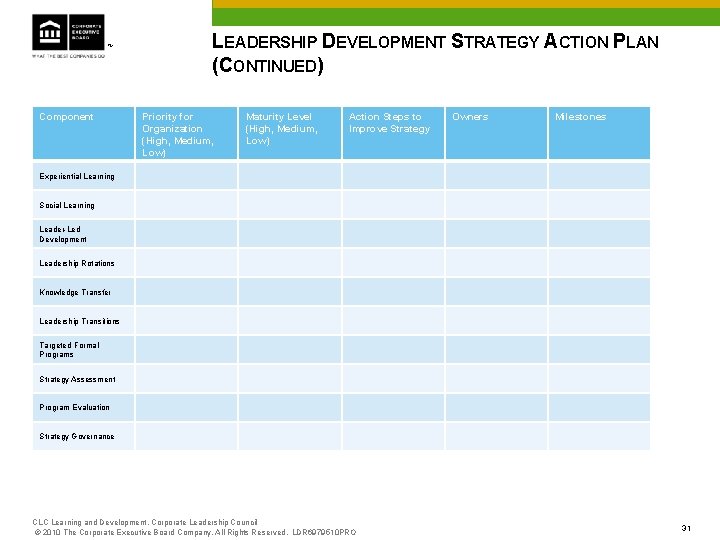
TM Component LEADERSHIP DEVELOPMENT STRATEGY ACTION PLAN (CONTINUED) Priority for Organization (High, Medium, Low) Maturity Level (High, Medium, Low) Action Steps to Improve Strategy Owners Milestones Experiential Learning Social Learning Leader-Led Development Leadership Rotations Knowledge Transfer Leadership Transitions Targeted Formal Programs Strategy Assessment Program Evaluation Strategy Governance CLC Learning and Development, Corporate Leadership Council © 2010 The Corporate Executive Board Company. All Rights Reserved. LDR 6979510 PRO 31
CORPORATE EXECUTIVE BOARD WWW. EXECUTIVEBOARD. COM TM 1 CLC Learning and Development, Business Case for Leadership Development Programs , Washington, D. C. : Corporate Executive Board, 2006. CLC Human Resources, Improving Returns on Leadership Investments, Arlington, VA: Corporate Executive Board, 2010. 3 CLC Human Resources, Rebuilding the Employment Value Proposition , Arlington, VA: Corporate Executive Board, 2010, p. 30. 4 CLC Learning and Development, Aligning L&D Strategy with Business Objectives, Arlington, VA: Corporate Executive Board, 2010, p. 6. 5 CLC Human Resources, Improving Returns on Leadership Investments, pp. 19, 26– 27. 6 CLC Learning and Development, Engaging the Workforce: Focusing on Critical Leverage Points to Drive Employee Engagement, Washington, D. C. : Corporate Executive Board, 2004, p. 97. 7 CLC Learning and Development, Business Case for LLD, Washington, D. C. : Corporate Executive Board, 2006, pp. 9, 17. 8 CLC Learning and Development, The Chief Learning Officer: Overview of Strategic Priorities and Responsibilities, Arlington, VA: Corporate Executive Board, 2010, p. 7. 9 CLC Learning and Development, Profiles of Leadership Development Tactics, Washington, D. C. : Corporate Executive Board, 2005. 10 CLC Human Resources, Realizing the Full Potential of Rising Talent (Volume I), Washington, D. C. : Corporate Executive Board, 2005. 11 CLC Human Resources, Board of Directors Succession Management Dashboards (Duke Energy), Arlington, VA: Corporate Executive Board, 2010. 12 CLC Learning and Development, Impact-Oriented Leadership Segmentation (Coles Myer Ltd. ), Washington, D. C. : Corporate Executive Board, 2005. 13 CLC Learning and Development, Engaging Managers to Drive Employee Performance and Development, Arlington, VA: Corporate Executive Board, 2010, p. 24. 14 CLC Learning and Development, Unlocking the Value of On-the-Job Learning, Arlington, VA: Corporate Executive Board, 2009. 15 CLC Learning and Development, Unlocking the Value of On-the-Job Learning. 16 CLC Learning and Development, Leaders Who Develop Leaders: Strategies for Effective Leader-Led Development, Washington, D. C. : Corporate Executive Board, 2006. 17 CLC Human Resources, Realizing the Full Potential of Rising Talent (Volume I). 18 CLC Human Resources, Methanex’s Crucible Role Implementation Strategy, Arlington, VA: Corporate Executive Board, 2010. 19 CLC Human Resources, Critical Knowledge Transfer Process (Salt River Project), Washington, D. C. : Corporate Executive Board, 2007. 20 CLC Learning and Development, Setting Leaders Up to Succeed, Washington, D. C. : Corporate Executive Board, 2005, pp. 3, 41. 21 CLC Learning and Development, Making the Transition to First-Line Management, Washington, D. C. : Corporate Executive Board, 2006, p. 25. 22 CLC Learning and Development, Aligning L&D Strategy with Business Objectives, p. 25. 23 CLC Learning and Development, Survey Results: Does Your Organization Have a Process in Place for Measuring the Overall Effectiveness of Your Entire Leadership Development Strategy, Arlington, VA: Corporate Executive Board, 2009. 24 CLC Learning and Development, Refocusing L&D on Business Results, Arlington, VA: Corporate Executive Board, 2009, p. 3. 25 CLC Learning and Development, Boosting the Predictability of L&D Returns, Washington, D. C. : Corporate Executive Board, 2004. 2