
TK Lets GO Webinar Series From Standards to
TK Let’s GO Webinar Series “From Standards to Practice, Creating a Working Plan” May 15 th, 2012 3 -4 p. m. Presenters: Osnat Zur and Elizabeth Magruder
Agenda • Welcome • Policy Update- Scott Moore, Senior Policy Advisor, Preschool California • Transitional Kindergarten Presentation: “From Standards to Practice, Creating a Working Plan” - Osnat Zur, Senior Program Associate, West. Ed and Elizabeth Magruder, Teacher and Early Education Consultant • Q&A- Please email all questions to Araceli Sandoval-Gonzalez: asandoval@preschoolcalifornia. org • Close- Ernesto Saldaña, State Field Director, Preschool California • Next Call and Webinar: May 22 nd, 2012 @ 3 pm 2
Scott Moore Policy Update For questions, please email: asandoval@preschoolcalifornia. org
An Alignment of the California Preschool Learning Foundations with Key Early Education Resources A Comprehensive Look at Alignment with California’s Infant Toddler Learning and Development Foundations, Kindergarten Content Standards, Kindergarten Common Core Standards, and Head Start Child Development and Early Learning Framework For questions, please email: asandoval@preschoolcalifornia. org 4
Overview of the Content in the Alignment Document An alignment of the Preschool Foundations with the Infant/Toddler Foundations and with the Kindergarten Content Standards in each of the following domains: • Social-Emotional Development • Language and Literacy • English Language Development • Mathematics • Visual and Performing Arts • Physical Development • Health • History-Social Science • Science For questions, please email: asandoval@preschoolcalifornia. org 5
Overview of the Content in the Alignment Document (Cont. ) An alignment of the Preschool Foundations in the domains of Language and Literacy and Mathematics with the Corresponding Common Core State Standards for Kindergarten (Embedded within Section B) An alignment of the Preschool Foundations with the Head Start Child Development and Early Learning Framework For questions, please email: asandoval@preschoolcalifornia. org 6
Alignment of the California Preschool Learning Foundations with the Common Core State Standards
The Preschool Learning Foundations Goal: To strengthen preschool education and children’s school readiness • Developed by researchers, early childhood educators, and other stakeholders. • Age Range: Describe key knowledge and skills that children acquire with appropriate support – At around 48 months of age – At around 60 months of age • Cover nine developmental domains For questions, please email: asandoval@preschoolcalifornia. org 8
The Common Core State Standards Goal: Clear and consistent goals for learning, to prepare America’s children for success in college and work • Led by the National Governors Association (NGA), and the Council of Chief State School Offices (CCSSO), and developed in collaboration with a variety of stakeholders • Age Range: Standards for every grade level (K-12 th grade) • Domains: – English-Language Arts & Literacy in History/Social Studies, Science, and Technical Subjects. – Mathematics For questions, please email: asandoval@preschoolcalifornia. org 9
The Alignment • Draws the connection between the preschool learning foundations in the domains: – Language and Literacy – Mathematics and the corresponding common core state standards. • Illustrates the developmental progression of key foundations in these domains, as they relate to specific common core state standards For questions, please email: asandoval@preschoolcalifornia. org 10
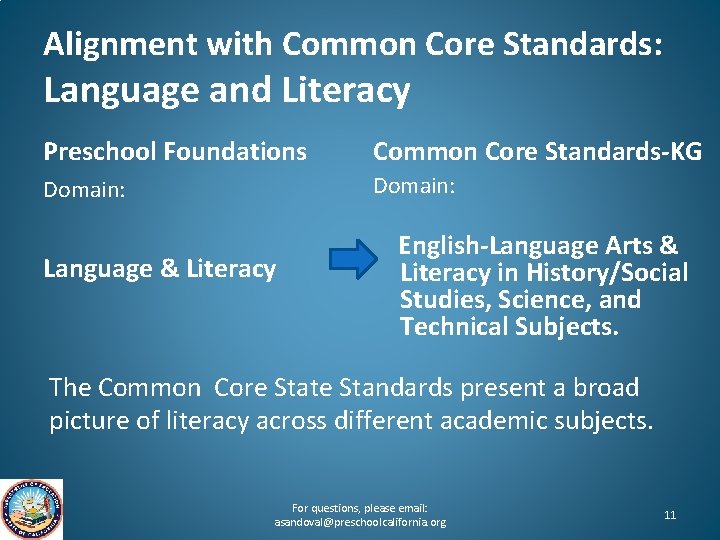
Alignment with Common Core Standards: Language and Literacy Preschool Foundations Common Core Standards-KG Domain: Language & Literacy English-Language Arts & Literacy in History/Social Studies, Science, and Technical Subjects. The Common Core State Standards present a broad picture of literacy across different academic subjects. For questions, please email: asandoval@preschoolcalifornia. org 11
Language and Literacy Alignment at Strand Level: • The preschool learning foundations and the common core state standards are organized according to the same basic categories (strands): listening and speaking, reading and writing. • The common core state standards also include a strand identified as language standards. It includes standards for grammar and vocabulary, covered under listening and speaking in the preschool foundations. For questions, please email: asandoval@preschoolcalifornia. org 12
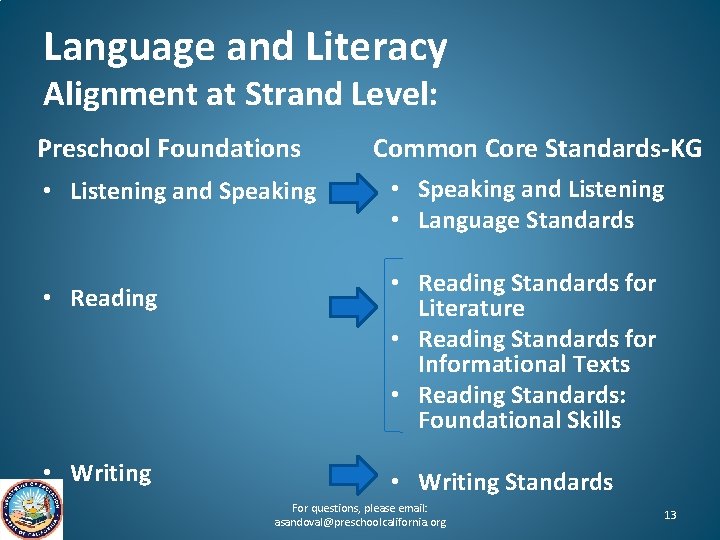
Language and Literacy Alignment at Strand Level: Preschool Foundations • Listening and Speaking • Reading • Writing Common Core Standards-KG • Speaking and Listening • Language Standards • Reading Standards for Literature • Reading Standards for Informational Texts • Reading Standards: Foundational Skills • Writing Standards For questions, please email: asandoval@preschoolcalifornia. org 13
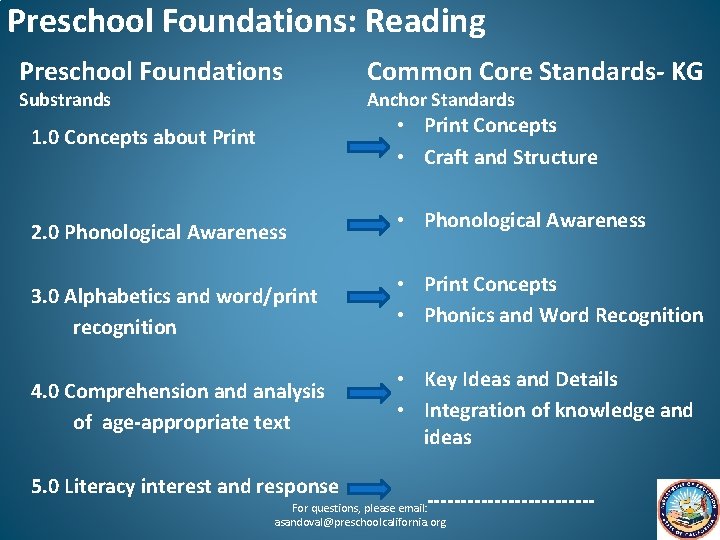
Preschool Foundations: Reading Preschool Foundations Substrands Common Core Standards- KG Anchor Standards • Print Concepts • Craft and Structure 1. 0 Concepts about Print 2. 0 Phonological Awareness 3. 0 Alphabetics and word/print recognition 4. 0 Comprehension and analysis of age-appropriate text 5. 0 Literacy interest and response • Phonological Awareness • Print Concepts • Phonics and Word Recognition • Key Ideas and Details • Integration of knowledge and ideas ------------- For questions, please email: asandoval@preschoolcalifornia. org 14
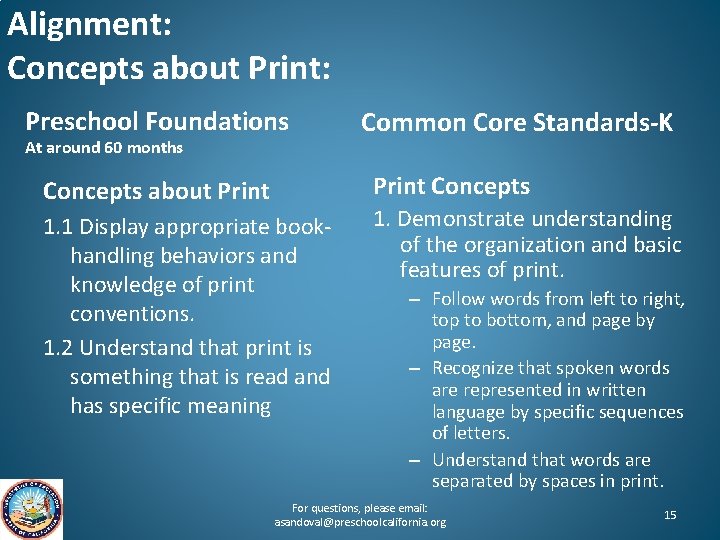
Alignment: Concepts about Print: Preschool Foundations At around 60 months Common Core Standards-K Print Concepts about Print 1. 1 Display appropriate bookhandling behaviors and knowledge of print conventions. 1. 2 Understand that print is something that is read and has specific meaning 1. Demonstrate understanding of the organization and basic features of print. – Follow words from left to right, top to bottom, and page by page. – Recognize that spoken words are represented in written language by specific sequences of letters. – Understand that words are separated by spaces in print. For questions, please email: asandoval@preschoolcalifornia. org 15
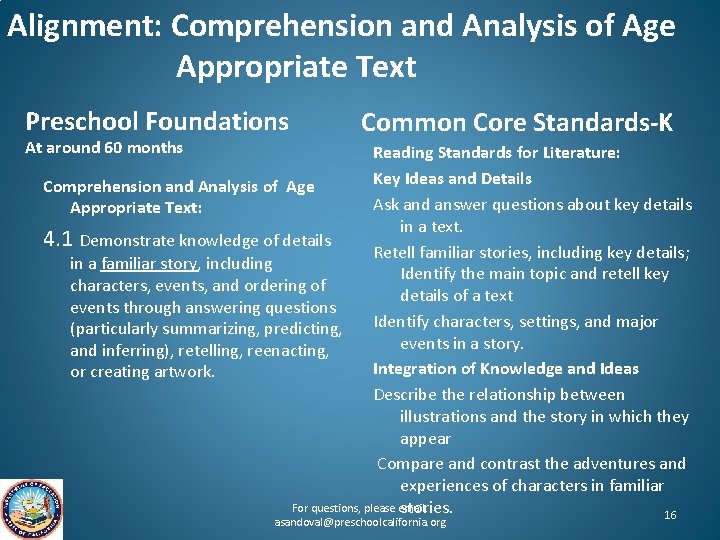
Alignment: Comprehension and Analysis of Age Appropriate Text Preschool Foundations At around 60 months Common Core Standards-K Reading Standards for Literature: Key Ideas and Details Comprehension and Analysis of Age Ask and answer questions about key details Appropriate Text: in a text. 4. 1 Demonstrate knowledge of details Retell familiar stories, including key details; in a familiar story, including Identify the main topic and retell key characters, events, and ordering of details of a text events through answering questions Identify characters, settings, and major (particularly summarizing, predicting, events in a story. and inferring), retelling, reenacting, Integration of Knowledge and Ideas or creating artwork. Describe the relationship between illustrations and the story in which they appear Compare and contrast the adventures and experiences of characters in familiar For questions, please email: stories. 16 asandoval@preschoolcalifornia. org
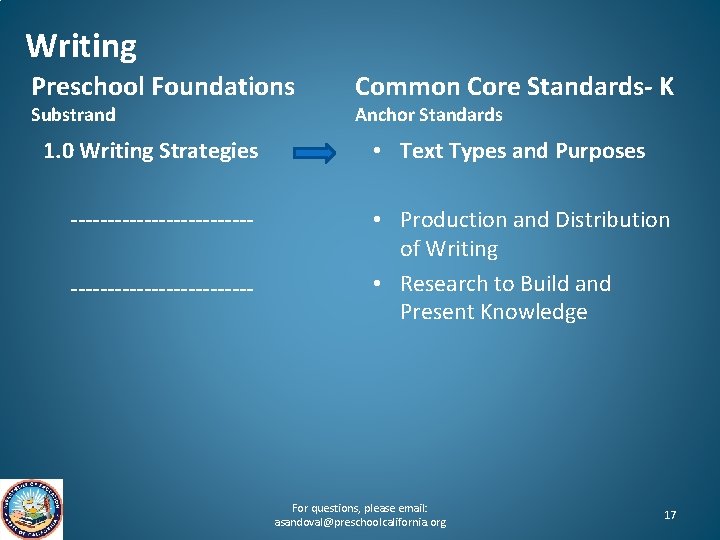
Writing Preschool Foundations Substrand 1. 0 Writing Strategies ------------------------- Common Core Standards- K Anchor Standards • Text Types and Purposes • Production and Distribution of Writing • Research to Build and Present Knowledge For questions, please email: asandoval@preschoolcalifornia. org 17
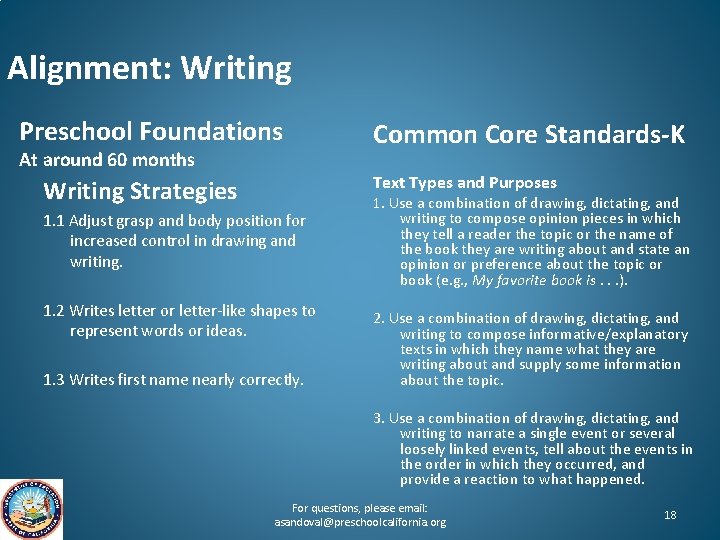
Alignment: Writing Preschool Foundations At around 60 months Common Core Standards-K Text Types and Purposes Writing Strategies 1. 1 Adjust grasp and body position for increased control in drawing and writing. 1. 2 Writes letter or letter-like shapes to represent words or ideas. 1. 3 Writes first name nearly correctly. 1. Use a combination of drawing, dictating, and writing to compose opinion pieces in which they tell a reader the topic or the name of the book they are writing about and state an opinion or preference about the topic or book (e. g. , My favorite book is. . . ). 2. Use a combination of drawing, dictating, and writing to compose informative/explanatory texts in which they name what they are writing about and supply some information about the topic. 3. Use a combination of drawing, dictating, and writing to narrate a single event or several loosely linked events, tell about the events in the order in which they occurred, and provide a reaction to what happened. For questions, please email: asandoval@preschoolcalifornia. org 18
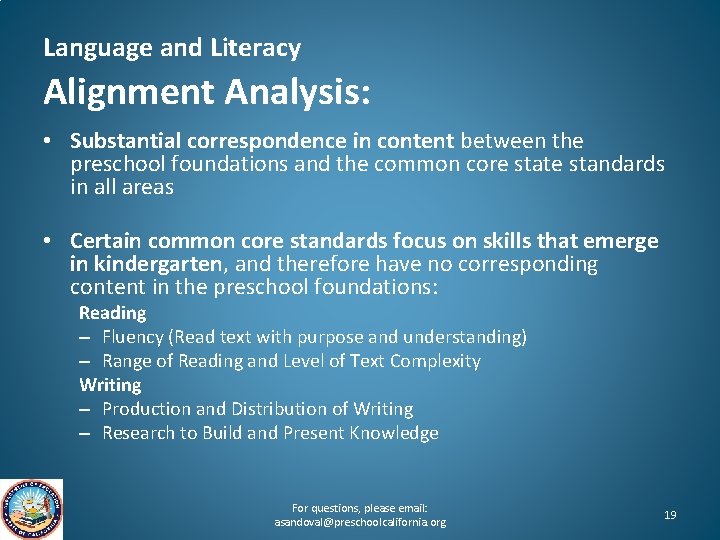
Language and Literacy Alignment Analysis: • Substantial correspondence in content between the preschool foundations and the common core state standards in all areas • Certain common core standards focus on skills that emerge in kindergarten, and therefore have no corresponding content in the preschool foundations: Reading – Fluency (Read text with purpose and understanding) – Range of Reading and Level of Text Complexity Writing – Production and Distribution of Writing – Research to Build and Present Knowledge For questions, please email: asandoval@preschoolcalifornia. org 19
Creating a working plan… Elizabeth S. Magruder, M. Ed. For questions, please email: asandoval@preschoolcalifornia. org 20
First Steps: Where Do We Begin? Preschool Learning Foundations Kindergarten Content Standards Common Core Standards for Kindergarten Examining the continuum & the commonalities For questions, please email: asandoval@preschoolcalifornia. org 21
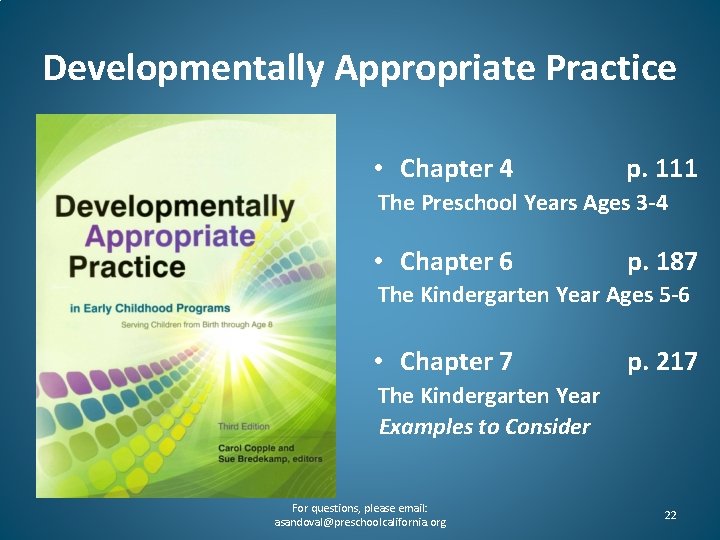
Developmentally Appropriate Practice • Chapter 4 p. 111 The Preschool Years Ages 3 -4 • Chapter 6 p. 187 The Kindergarten Year Ages 5 -6 • Chapter 7 p. 217 The Kindergarten Year Examples to Consider For questions, please email: asandoval@preschoolcalifornia. org 22
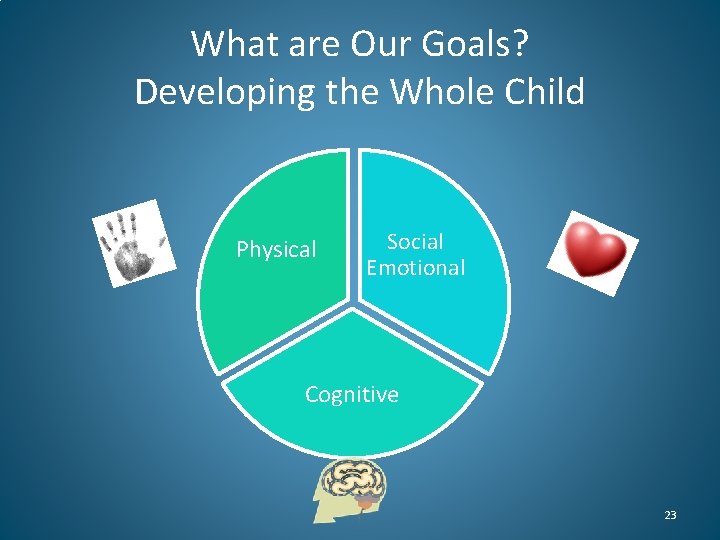
What are Our Goals? Developing the Whole Child Physical Social Emotional Cognitive 23
A Window to the Child Questions to guide us as we plan… • • • Who is this child? What knowledge and skills does s/he bring? Where does he/she enjoy interacting? When does s/he feel successful/anxious? Why? Are there opportunities or barriers? How will I best support his/her development? For questions, please email: asandoval@preschoolcalifornia. org 24
Theory into Practice… Planning our Work and Working our Plan • Create a template that works for you • Include long range and short term goals • Integrate key concepts throughout content areas and domains • Develop a plan that reflects and supports the learners in your room • Reflect on your plan-what worked/what didn’t? Why? • Modify - what changes should I consider? For questions, please email: asandoval@preschoolcalifornia. org 25
The Instructional Plan Setting purpose, goals, & outcomes • What is the purpose of this unit/lesson? • What would I like my students to come away with? • How will my students engage in the learning? • How will I group my students? • Have I planned focused opportunities for exploration, small group instruction, centerbased learning, project-based learning? • Have I considered ways to personalize learning for all of my students? For questions, please email: asandoval@preschoolcalifornia. org 26
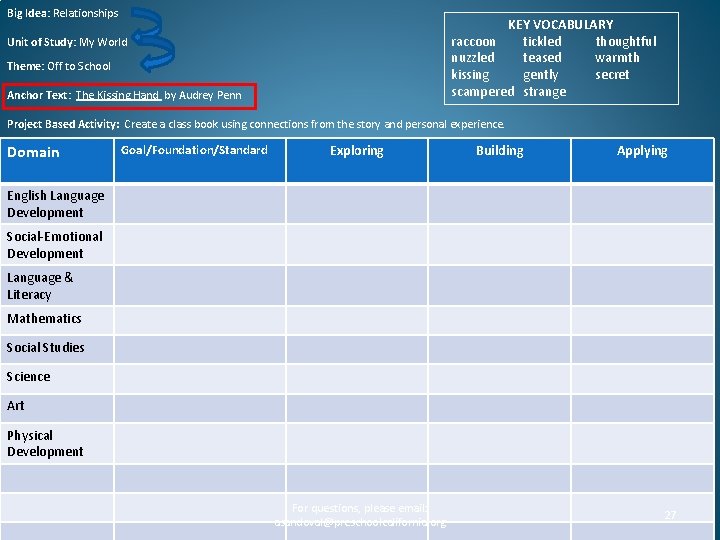
Big Idea: Relationships KEY VOCABULARY raccoon tickled thoughtful nuzzled teased warmth kissing gently secret scampered strange Unit of Study: My World Theme: Off to School Anchor Text: The Kissing Hand by Audrey Penn Project Based Activity: Create a class book using connections from the story and personal experience. Domain Goal/Foundation/Standard Exploring Building Applying English Language Development Social-Emotional Development Language & Literacy Mathematics Social Studies Science Art Physical Development For questions, please email: asandoval@preschoolcalifornia. org 27
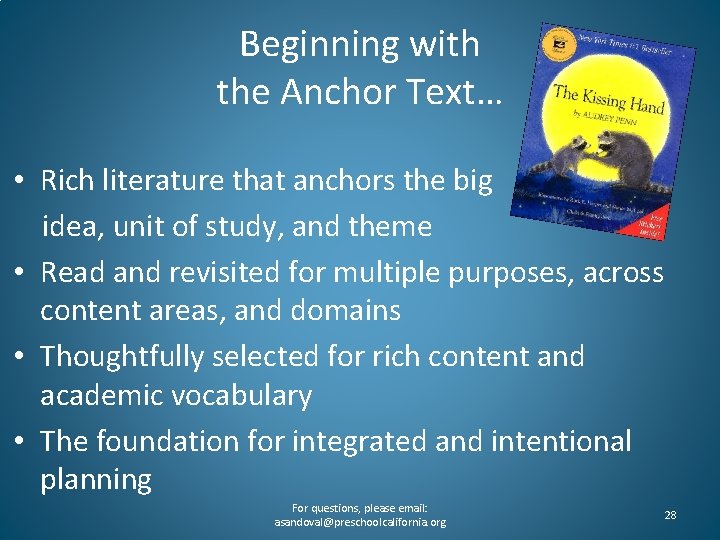
Beginning with the Anchor Text… • Rich literature that anchors the big idea, unit of study, and theme • Read and revisited for multiple purposes, across content areas, and domains • Thoughtfully selected for rich content and academic vocabulary • The foundation for integrated and intentional planning For questions, please email: asandoval@preschoolcalifornia. org 28
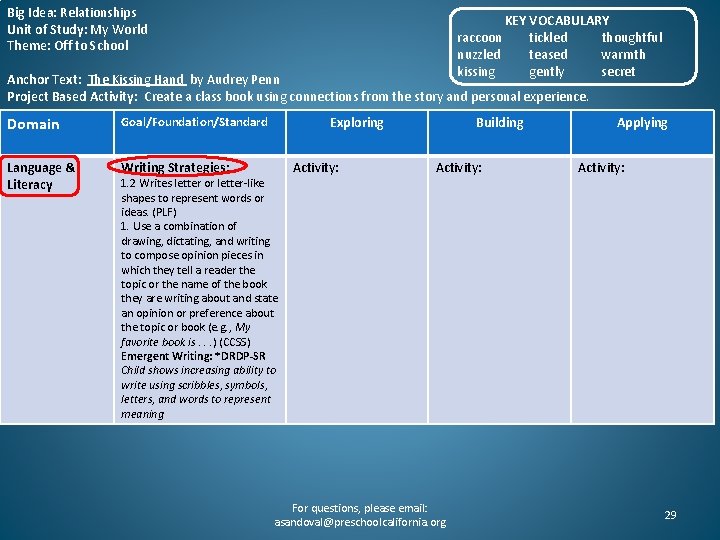
Big Idea: Relationships Unit of Study: My World Theme: Off to School KEY VOCABULARY raccoon tickled thoughtful nuzzled teased warmth kissing gently secret Anchor Text: The Kissing Hand by Audrey Penn Project Based Activity: Create a class book using connections from the story and personal experience. Domain Goal/Foundation/Standard Language & Literacy Writing Strategies: Exploring 1. 2 Writes letter or letter-like shapes to represent words or ideas. (PLF) 1. Use a combination of drawing, dictating, and writing to compose opinion pieces in which they tell a reader the topic or the name of the book they are writing about and state an opinion or preference about the topic or book (e. g. , My favorite book is. . . ) (CCSS) Emergent Writing: *DRDP-SR Child shows increasing ability to write using scribbles, symbols, letters, and words to represent meaning Activity: Building Activity: For questions, please email: asandoval@preschoolcalifornia. org Applying Activity: 29
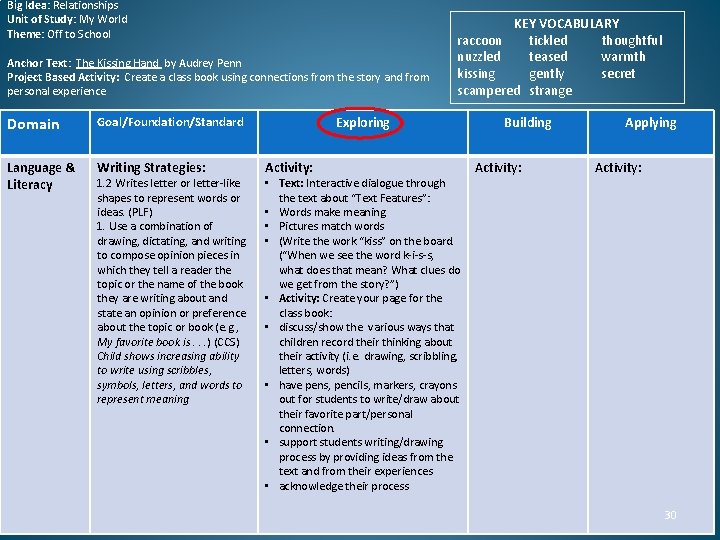
Big Idea: Relationships Unit of Study: My World Theme: Off to School Anchor Text: The Kissing Hand by Audrey Penn Project Based Activity: Create a class book using connections from the story and from personal experience Domain Goal/Foundation/Standard Language & Literacy Writing Strategies: 1. 2 Writes letter or letter-like shapes to represent words or ideas. (PLF) 1. Use a combination of drawing, dictating, and writing to compose opinion pieces in which they tell a reader the topic or the name of the book they are writing about and state an opinion or preference about the topic or book (e. g. , My favorite book is. . . ) (CCS) Child shows increasing ability to write using scribbles, symbols, letters, and words to represent meaning KEY VOCABULARY raccoon tickled thoughtful nuzzled teased warmth kissing gently secret scampered strange Exploring Activity: • Text: Interactive dialogue through the text about “Text Features”: • Words make meaning • Pictures match words • (Write the work “kiss” on the board. (“When we see the word k-i-s-s, what does that mean? What clues do we get from the story? ”) • Activity: Create your page for the class book: • discuss/show the various ways that children record their thinking about their activity (i. e. drawing, scribbling, letters, words) • have pens, pencils, markers, crayons out for students to write/draw about their favorite part/personal connection. • support students writing/drawing process by providing ideas from the text and from their experiences • acknowledge their process Building Activity: Applying Activity: 30
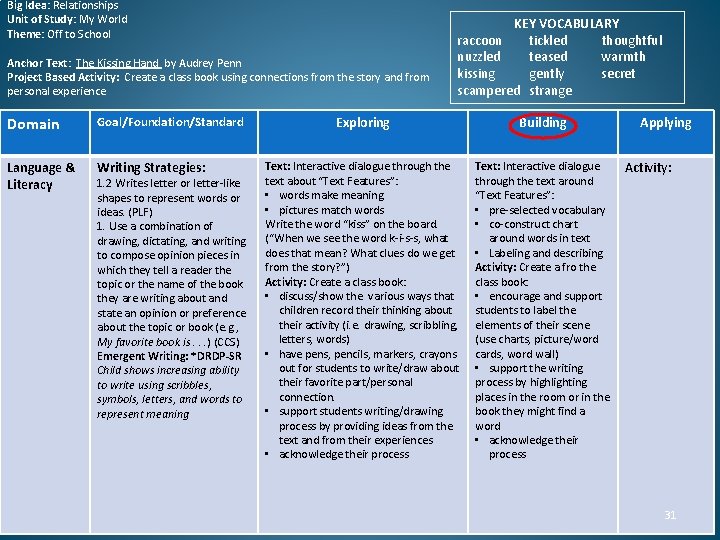
Big Idea: Relationships Unit of Study: My World Theme: Off to School Anchor Text: The Kissing Hand by Audrey Penn Project Based Activity: Create a class book using connections from the story and from personal experience Domain Goal/Foundation/Standard Language & Literacy Writing Strategies: 1. 2 Writes letter or letter-like shapes to represent words or ideas. (PLF) 1. Use a combination of drawing, dictating, and writing to compose opinion pieces in which they tell a reader the topic or the name of the book they are writing about and state an opinion or preference about the topic or book (e. g. , My favorite book is. . . ) (CCS) Emergent Writing: *DRDP-SR Child shows increasing ability to write using scribbles, symbols, letters, and words to represent meaning KEY VOCABULARY raccoon tickled thoughtful nuzzled teased warmth kissing gently secret scampered strange Exploring Building Text: Interactive dialogue through the text about “Text Features”: • words make meaning • pictures match words Write the word “kiss” on the board. (“When we see the word k-i-s-s, what does that mean? What clues do we get from the story? ”) Activity: Create a class book: • discuss/show the various ways that children record their thinking about their activity (i. e. drawing, scribbling, letters, words) • have pens, pencils, markers, crayons out for students to write/draw about their favorite part/personal connection. • support students writing/drawing process by providing ideas from the text and from their experiences • acknowledge their process Text: Interactive dialogue through the text around “Text Features”: • pre-selected vocabulary • co-construct chart around words in text • Labeling and describing Activity: Create a fro the class book: • encourage and support students to label the elements of their scene (use charts, picture/word cards, word wall) • support the writing process by highlighting places in the room or in the book they might find a word • acknowledge their process Applying Activity: 31
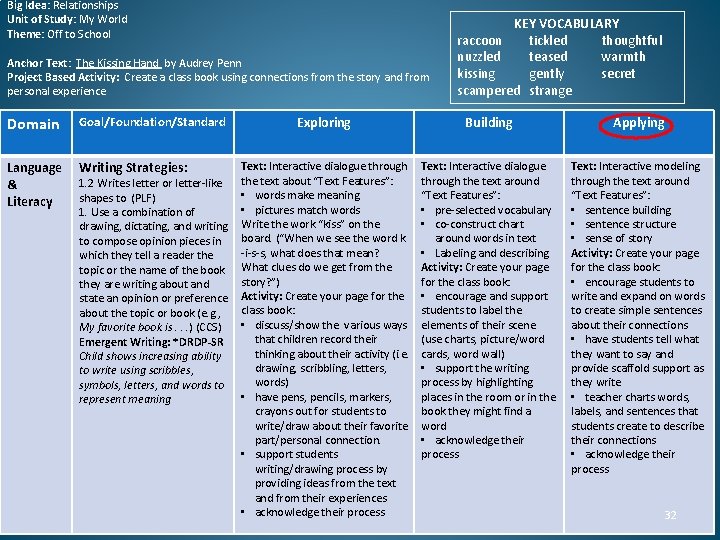
Big Idea: Relationships Unit of Study: My World Theme: Off to School Anchor Text: The Kissing Hand by Audrey Penn Project Based Activity: Create a class book using connections from the story and from personal experience Domain Goal/Foundation/Standard Language & Literacy Writing Strategies: 1. 2 Writes letter or letter-like shapes to (PLF) 1. Use a combination of drawing, dictating, and writing to compose opinion pieces in which they tell a reader the topic or the name of the book they are writing about and state an opinion or preference about the topic or book (e. g. , My favorite book is. . . ) (CCS) Emergent Writing: *DRDP-SR Child shows increasing ability to write using scribbles, symbols, letters, and words to represent meaning KEY VOCABULARY raccoon tickled thoughtful nuzzled teased warmth kissing gently secret scampered strange Exploring Building Applying Text: Interactive dialogue through the text about “Text Features”: • words make meaning • pictures match words Write the work “kiss” on the board. (“When we see the word k -i-s-s, what does that mean? What clues do we get from the story? ”) Activity: Create your page for the class book: • discuss/show the various ways that children record their thinking about their activity (i. e. drawing, scribbling, letters, words) • have pens, pencils, markers, crayons out for students to write/draw about their favorite part/personal connection. • support students writing/drawing process by providing ideas from the text and from their experiences • acknowledge their process Text: Interactive dialogue through the text around “Text Features”: • pre-selected vocabulary • co-construct chart around words in text • Labeling and describing Activity: Create your page for the class book: • encourage and support students to label the elements of their scene (use charts, picture/word cards, word wall) • support the writing process by highlighting places in the room or in the book they might find a word • acknowledge their process Text: Interactive modeling through the text around “Text Features”: • sentence building • sentence structure • sense of story Activity: Create your page for the class book: • encourage students to write and expand on words to create simple sentences about their connections • have students tell what they want to say and provide scaffold support as they write • teacher charts words, labels, and sentences that students create to describe their connections • acknowledge their process 32
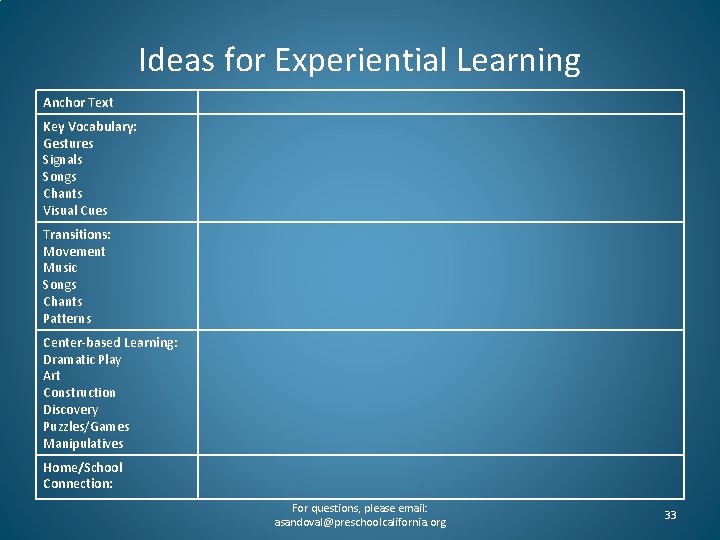
Ideas for Experiential Learning Anchor Text Key Vocabulary: Gestures Signals Songs Chants Visual Cues Transitions: Movement Music Songs Chants Patterns Center-based Learning: Dramatic Play Art Construction Discovery Puzzles/Games Manipulatives Home/School Connection: For questions, please email: asandoval@preschoolcalifornia. org 33
Tips to Consider in Planning • Bring out your key guiding resources (PLF, CCS, DAP)! • Organize and integrate curricula around Big Ideas, units of study, and themes • Select anchor texts and key vocabulary to support the Big Idea • Find opportunities to engage all learners through direct instruction, project-based, and center-based activities • Integrate your plan to include development of physical, social, and cognitive domains and as well as multiple standards • Design a comprehensive instructional plan! This will help you develop a richer lesson plan For questions, please email: asandoval@preschoolcalifornia. org 34
TK Let’s GO Webinar Series • Our next webinar will be on May 22 nd @ 3 pm • Presentation on TK/K combo classrooms § Presented by the Clovis Unified TK team and Barbara Blakely, Recently Retired LAUSD TK Teacher • May 29 th: Webinar on Assessments • Participant Call-in information: – 1 -866 -710 -0179 passcode 56647 35
- Slides: 35