
TK Dry Gas System Operation q System overview
- Slides: 10
TK Dry Gas System Operation q. System overview q. Dry Gas Consumption q. Interlocks and thresholds q. Documentation q. Operational model q. Final comments
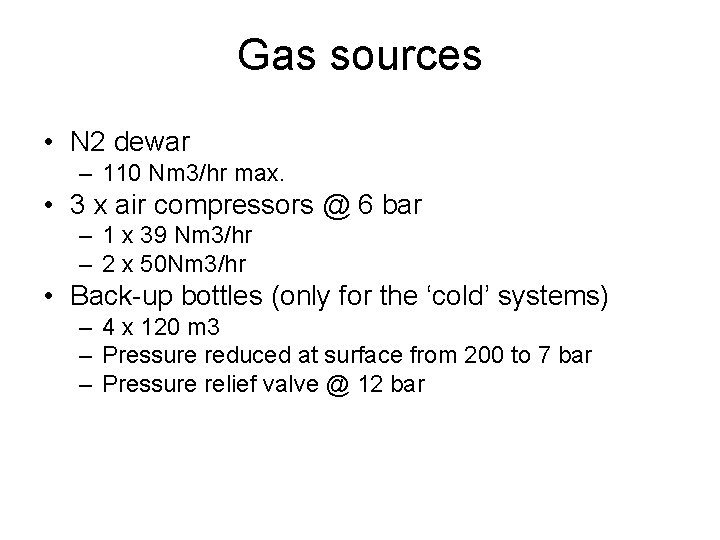
Gas sources • N 2 dewar – 110 Nm 3/hr max. • 3 x air compressors @ 6 bar – 1 x 39 Nm 3/hr – 2 x 50 Nm 3/hr • Back-up bottles (only for the ‘cold’ systems) – 4 x 120 m 3 – Pressure reduced at surface from 200 to 7 bar – Pressure relief valve @ 12 bar
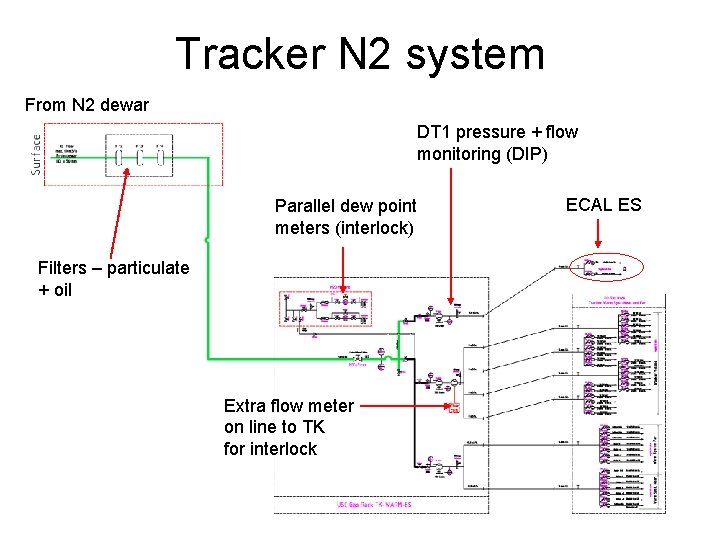
Tracker N 2 system From N 2 dewar DT 1 pressure + flow monitoring (DIP) Parallel dew point meters (interlock) Filters – particulate + oil Extra flow meter on line to TK for interlock ECAL ES
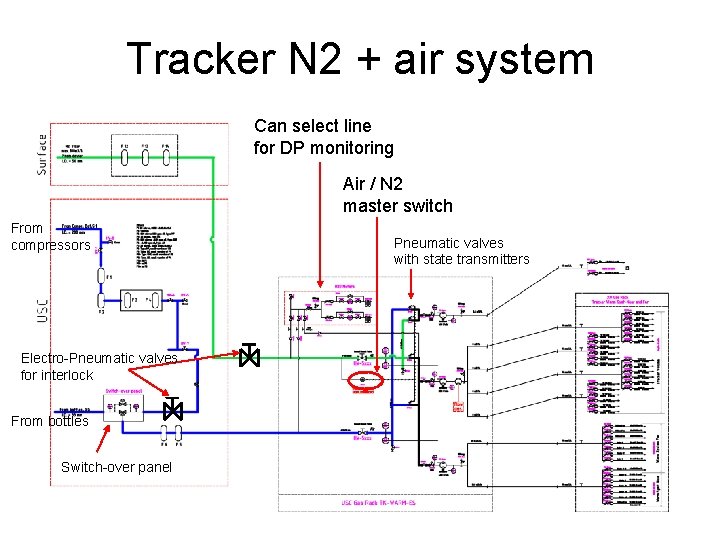
Tracker N 2 + air system Can select line for DP monitoring Air / N 2 master switch From compressors Electro-Pneumatic valves for interlock From bottles Switch-over panel Pneumatic valves with state transmitters
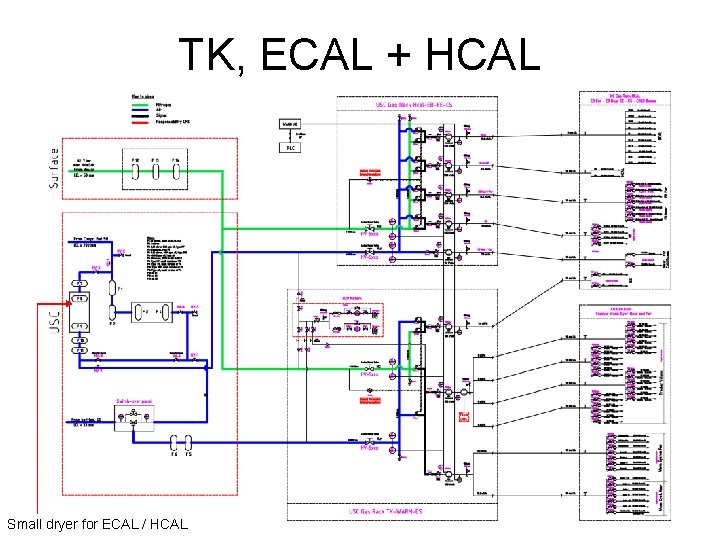
TK, ECAL + HCAL Small dryer for ECAL / HCAL
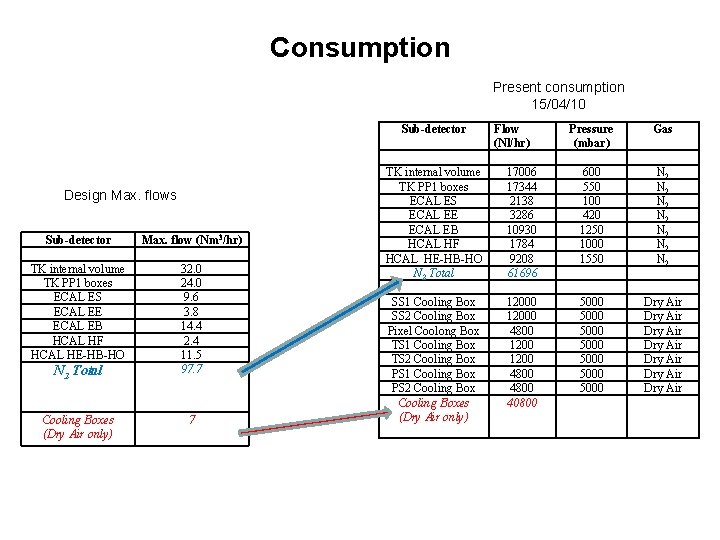
Consumption Present consumption 15/04/10 Sub-detector Design Max. flows Sub-detector Max. flow (Nm 3/hr) TK internal volume TK PP 1 boxes ECAL ES ECAL EE ECAL EB HCAL HF HCAL HE-HB-HO 32. 0 24. 0 9. 6 3. 8 14. 4 2. 4 11. 5 97. 7 N 2 Total Cooling Boxes (Dry Air only) 7 Flow (Nl/hr) Pressure (mbar) Gas TK internal volume TK PP 1 boxes ECAL ES ECAL EE ECAL EB HCAL HF HCAL HE-HB-HO N 2 Total 17006 17344 2138 3286 10930 1784 9208 61696 600 550 100 420 1250 1000 1550 N 2 N 2 SS 1 Cooling Box SS 2 Cooling Box Pixel Coolong Box TS 1 Cooling Box TS 2 Cooling Box PS 1 Cooling Box PS 2 Cooling Boxes (Dry Air only) 12000 4800 1200 4800 40800 5000 5000 Dry Air Dry Air
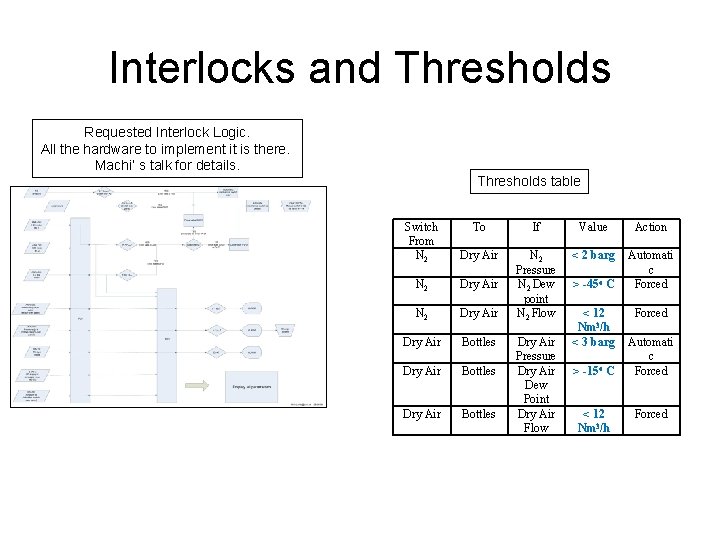
Interlocks and Thresholds Requested Interlock Logic. All the hardware to implement it is there. Machi’ s talk for details. Thresholds table Switch From N 2 To If Value Action Dry Air < 2 barg N 2 Dry Air Automati c Forced N 2 Dry Air N 2 Pressure N 2 Dew point N 2 Flow Dry Air Bottles Dry Air Pressure Dry Air Dew Point Dry Air Flow > -45 o C < 12 Nm 3/h < 3 barg > -15 o C < 12 Nm 3/h Forced Automati c Forced
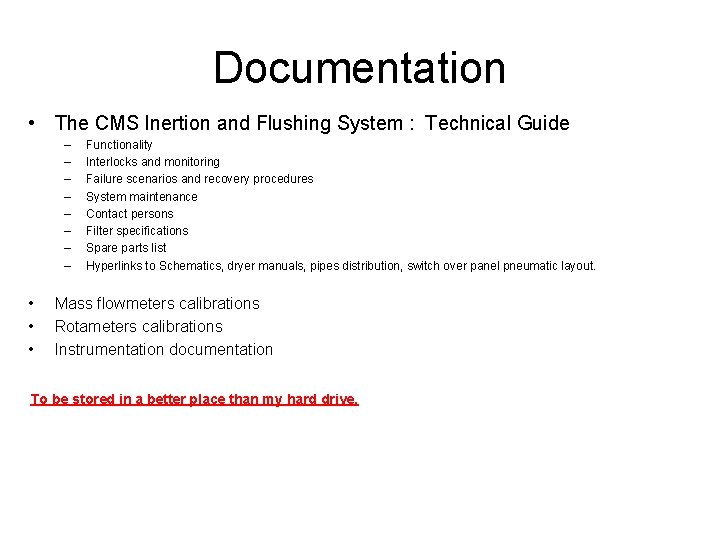
Documentation • The CMS Inertion and Flushing System : Technical Guide – – – – • • • Functionality Interlocks and monitoring Failure scenarios and recovery procedures System maintenance Contact persons Filter specifications Spare parts list Hyperlinks to Schematics, dryer manuals, pipes distribution, switch over panel pneumatic layout. Mass flowmeters calibrations Rotameters calibrations Instrumentation documentation To be stored in a better place than my hard drive.
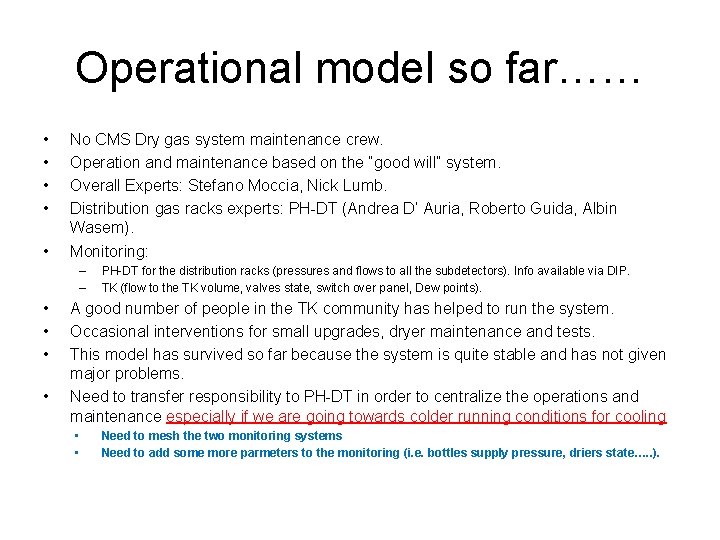
Operational model so far…… • • • No CMS Dry gas system maintenance crew. Operation and maintenance based on the “good will” system. Overall Experts: Stefano Moccia, Nick Lumb. Distribution gas racks experts: PH-DT (Andrea D’ Auria, Roberto Guida, Albin Wasem). Monitoring: – – • • PH-DT for the distribution racks (pressures and flows to all the subdetectors). Info available via DIP. TK (flow to the TK volume, valves state, switch over panel, Dew points). A good number of people in the TK community has helped to run the system. Occasional interventions for small upgrades, dryer maintenance and tests. This model has survived so far because the system is quite stable and has not given major problems. Need to transfer responsibility to PH-DT in order to centralize the operations and maintenance especially if we are going towards colder running conditions for cooling • • Need to mesh the two monitoring systems Need to add some more parmeters to the monitoring (i. e. bottles supply pressure, driers state…. . ).
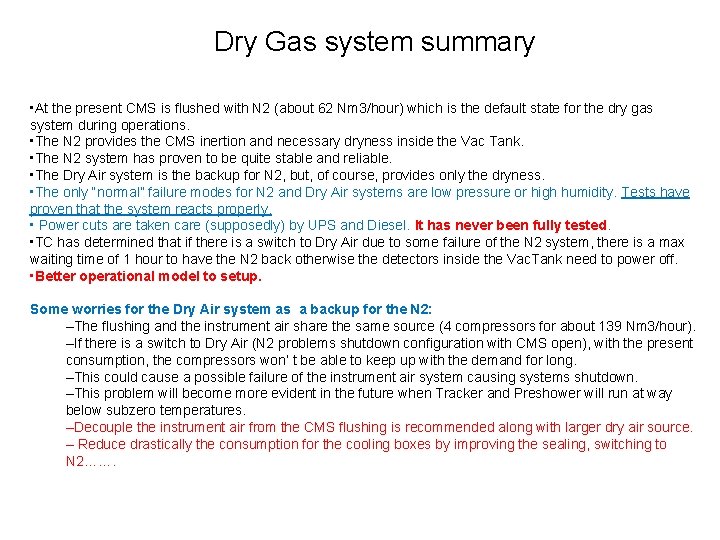
Dry Gas system summary • At the present CMS is flushed with N 2 (about 62 Nm 3/hour) which is the default state for the dry gas system during operations. • The N 2 provides the CMS inertion and necessary dryness inside the Vac Tank. • The N 2 system has proven to be quite stable and reliable. • The Dry Air system is the backup for N 2, but, of course, provides only the dryness. • The only “normal” failure modes for N 2 and Dry Air systems are low pressure or high humidity. Tests have proven that the system reacts properly. • Power cuts are taken care (supposedly) by UPS and Diesel. It has never been fully tested. • TC has determined that if there is a switch to Dry Air due to some failure of the N 2 system, there is a max waiting time of 1 hour to have the N 2 back otherwise the detectors inside the Vac. Tank need to power off. • Better operational model to setup. Some worries for the Dry Air system as a backup for the N 2: –The flushing and the instrument air share the same source (4 compressors for about 139 Nm 3/hour). –If there is a switch to Dry Air (N 2 problems shutdown configuration with CMS open), with the present consumption, the compressors won’ t be able to keep up with the demand for long. –This could cause a possible failure of the instrument air system causing systems shutdown. –This problem will become more evident in the future when Tracker and Preshower will run at way below subzero temperatures. –Decouple the instrument air from the CMS flushing is recommended along with larger dry air source. – Reduce drastically the consumption for the cooling boxes by improving the sealing, switching to N 2…….