
TK 2633 MICROPROCESSOR INTERFACING Lecture 10 Fixed Point


- Slides: 24
TK 2633 : MICROPROCESSOR & INTERFACING Lecture 10: Fixed Point Arithmetic Lecturer: Ass. Prof. Dr. Masri Ayob
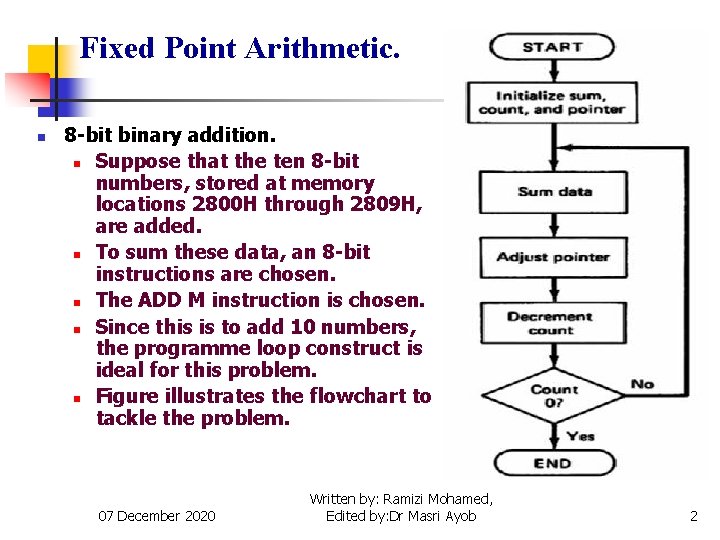
Fixed Point Arithmetic. n 8 -bit binary addition. n Suppose that the ten 8 -bit numbers, stored at memory locations 2800 H through 2809 H, are added. n To sum these data, an 8 -bit instructions are chosen. n The ADD M instruction is chosen. n Since this is to add 10 numbers, the programme loop construct is ideal for this problem. n Figure illustrates the flowchart to tackle the problem. 07 December 2020 Written by: Ramizi Mohamed, Edited by: Dr Masri Ayob 2
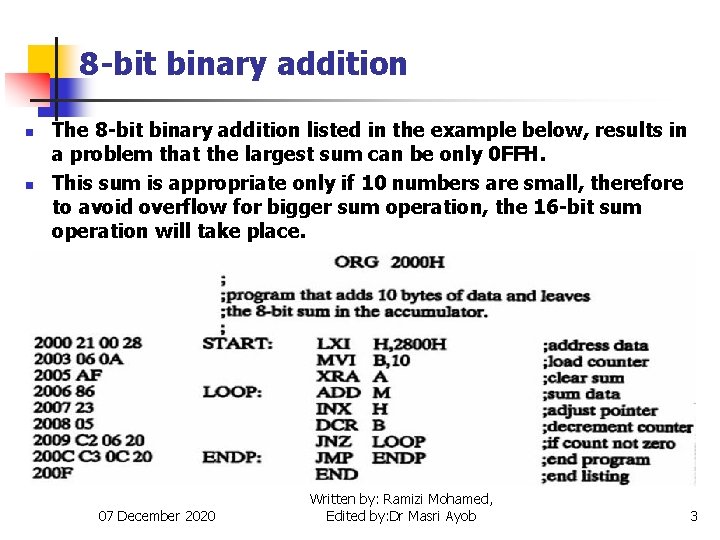
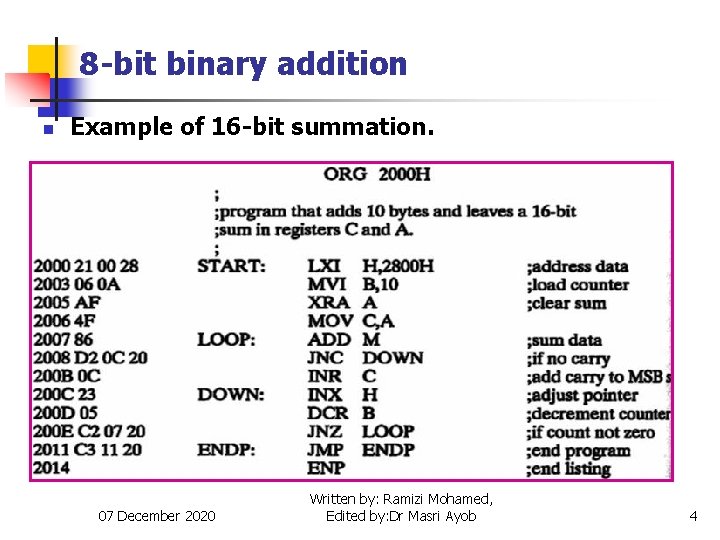
8 -bit binary addition n n The 8 -bit binary addition listed in the example below, results in a problem that the largest sum can be only 0 FFH. This sum is appropriate only if 10 numbers are small, therefore to avoid overflow for bigger sum operation, the 16 -bit sum operation will take place. 07 December 2020 Written by: Ramizi Mohamed, Edited by: Dr Masri Ayob 3
8 -bit binary addition n Example of 16 -bit summation. 07 December 2020 Written by: Ramizi Mohamed, Edited by: Dr Masri Ayob 4
8 -bit binary subtraction n n Suppose that two lists of numbers, each 10 H bytes long, appear in the memory to be subtracted. A programme must take the number stored at LIST 2 and subtract it from the number stored at LIST 1. The difference must be stored at a location in LIST 2. This operation repeats 10 H times until all sets of numbers are subtracted. Figure illustrates the process. 07 December 2020 Written by: Ramizi Mohamed, Edited by: Dr Masri Ayob 5
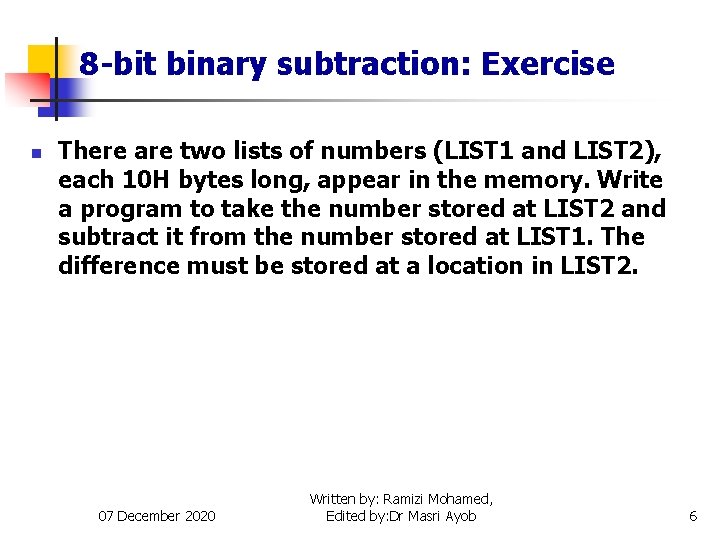
8 -bit binary subtraction: Exercise n There are two lists of numbers (LIST 1 and LIST 2), each 10 H bytes long, appear in the memory. Write a program to take the number stored at LIST 2 and subtract it from the number stored at LIST 1. The difference must be stored at a location in LIST 2. 07 December 2020 Written by: Ramizi Mohamed, Edited by: Dr Masri Ayob 6
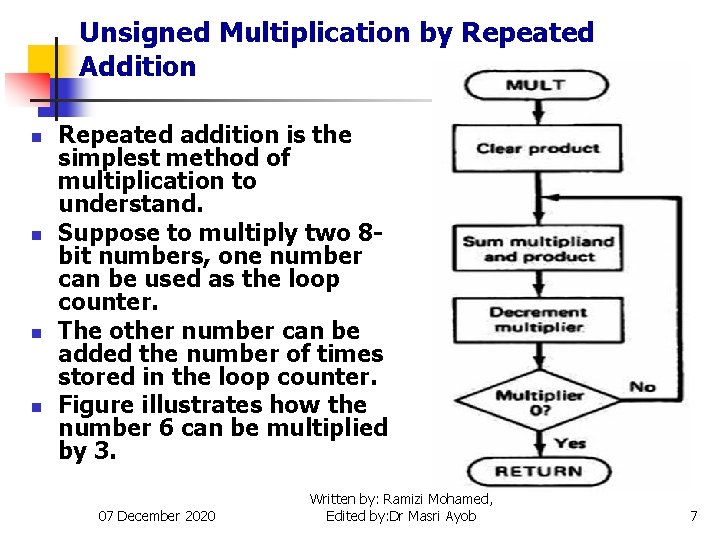
Unsigned Multiplication by Repeated Addition n n Repeated addition is the simplest method of multiplication to understand. Suppose to multiply two 8 bit numbers, one number can be used as the loop counter. The other number can be added the number of times stored in the loop counter. Figure illustrates how the number 6 can be multiplied by 3. 07 December 2020 Written by: Ramizi Mohamed, Edited by: Dr Masri Ayob 7
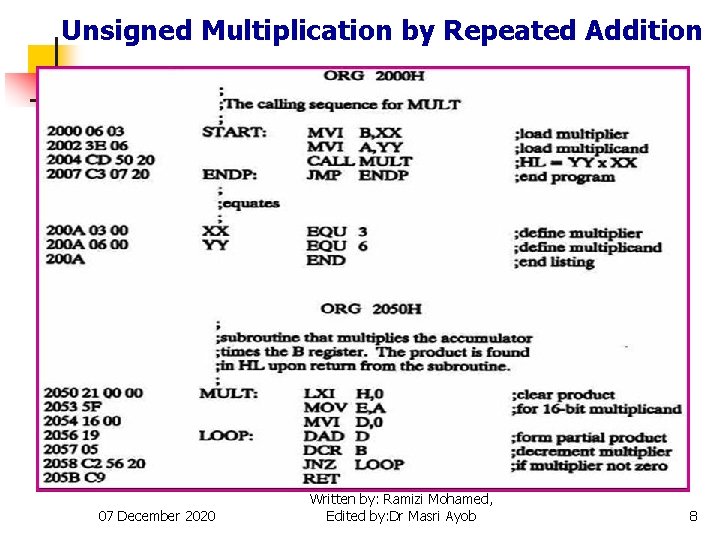
Unsigned Multiplication by Repeated Addition 07 December 2020 Written by: Ramizi Mohamed, Edited by: Dr Masri Ayob 8
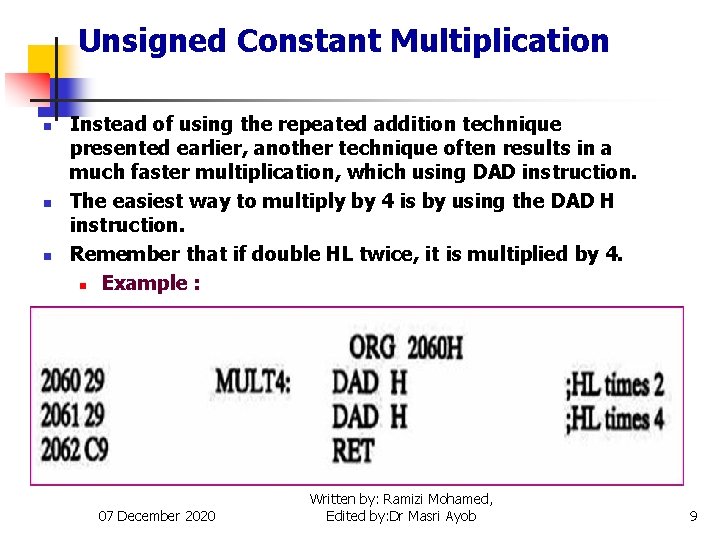
Unsigned Constant Multiplication n Instead of using the repeated addition technique presented earlier, another technique often results in a much faster multiplication, which using DAD instruction. The easiest way to multiply by 4 is by using the DAD H instruction. Remember that if double HL twice, it is multiplied by 4. n Example : 07 December 2020 Written by: Ramizi Mohamed, Edited by: Dr Masri Ayob 9
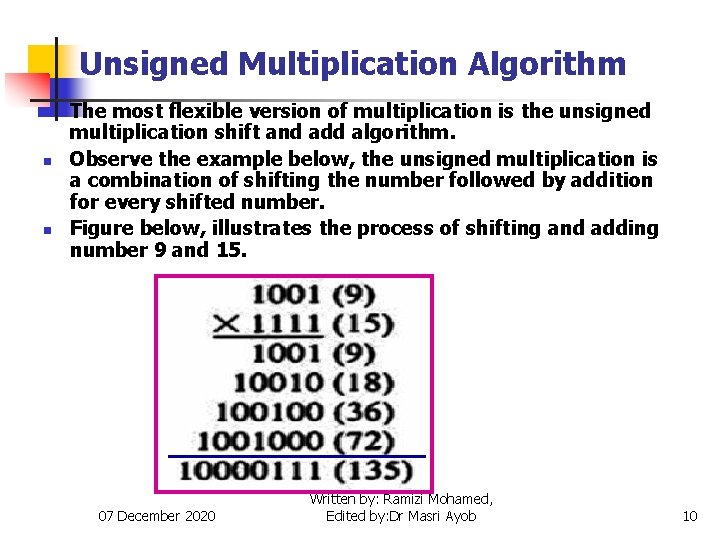
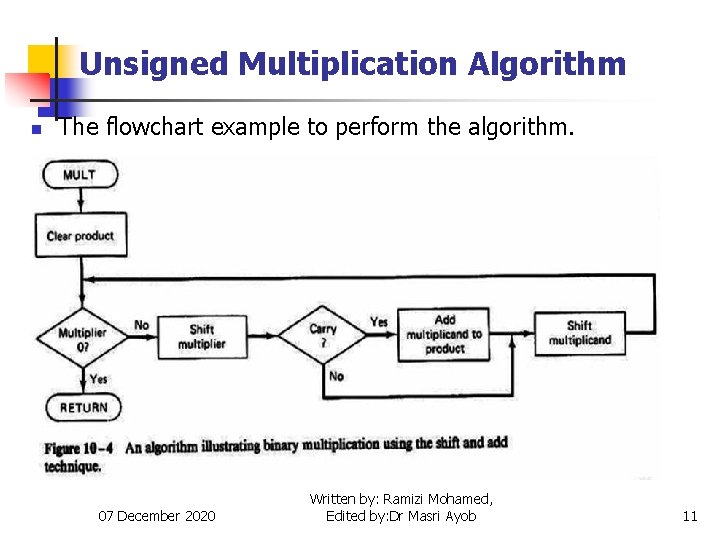
Unsigned Multiplication Algorithm n n n The most flexible version of multiplication is the unsigned multiplication shift and add algorithm. Observe the example below, the unsigned multiplication is a combination of shifting the number followed by addition for every shifted number. Figure below, illustrates the process of shifting and adding number 9 and 15. 07 December 2020 Written by: Ramizi Mohamed, Edited by: Dr Masri Ayob 10
Unsigned Multiplication Algorithm n The flowchart example to perform the algorithm. 07 December 2020 Written by: Ramizi Mohamed, Edited by: Dr Masri Ayob 11
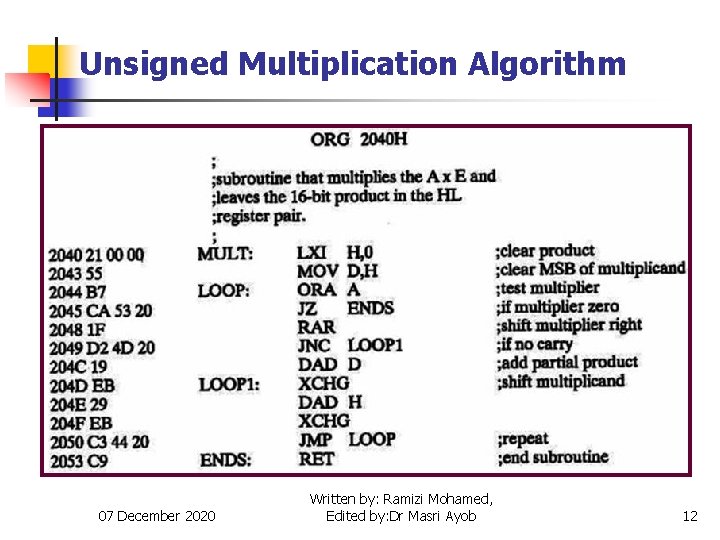
Unsigned Multiplication Algorithm 07 December 2020 Written by: Ramizi Mohamed, Edited by: Dr Masri Ayob 12
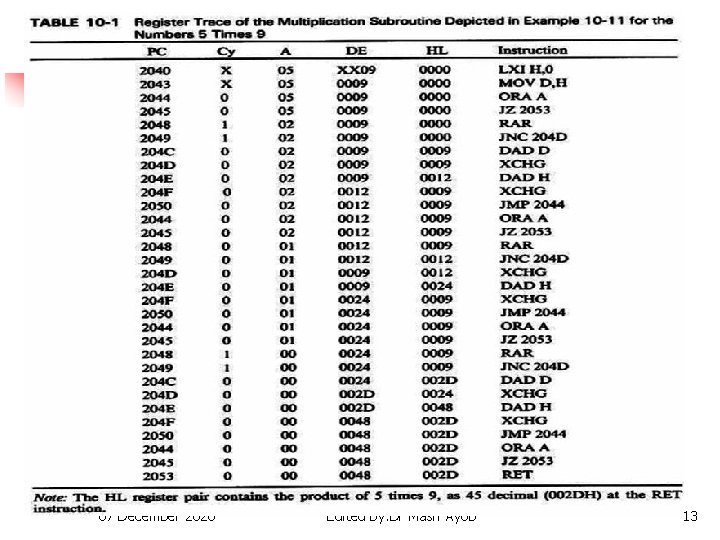
07 December 2020 Written by: Ramizi Mohamed, Edited by: Dr Masri Ayob 13
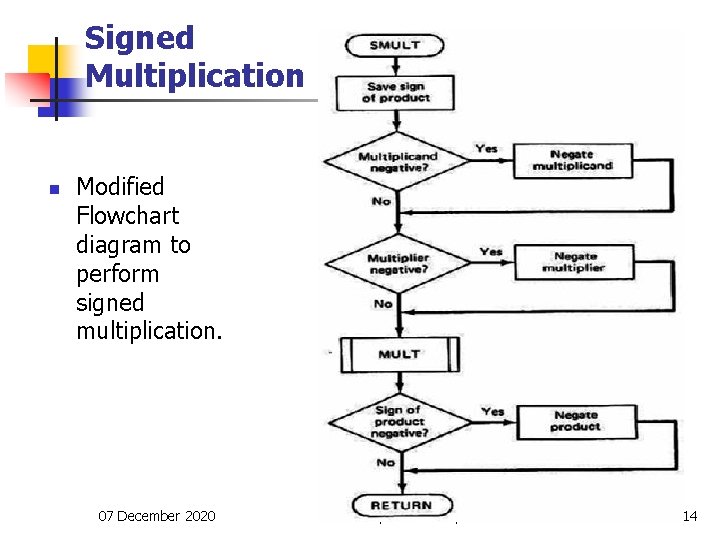
Signed Multiplication n Modified Flowchart diagram to perform signed multiplication. 07 December 2020 Written by: Ramizi Mohamed, Edited by: Dr Masri Ayob 14
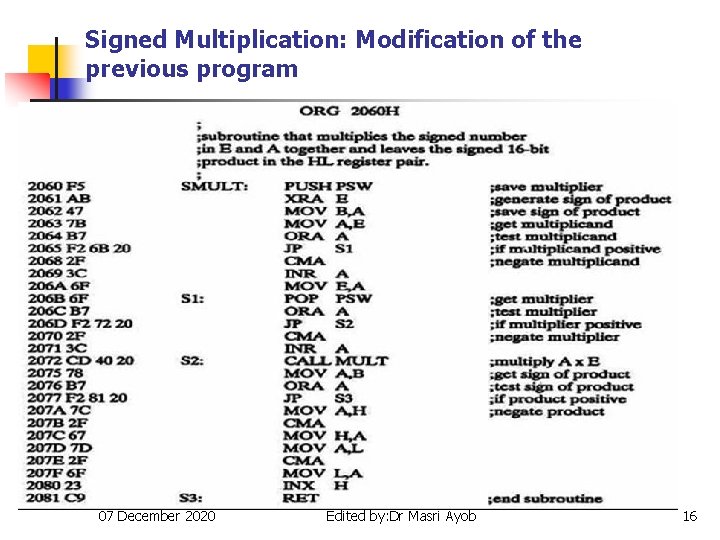
Signed Multiplication n n n To do the signed multiplication, the multiplicand multiplier are exclusive ORed together. The result, which indicates the sign of the product, is saved in the B register. Both numbers are then adjusted so that they are positive before the MULT subroutine is called. Upon returning from the MULT subroutine, the sign of the B register shows the sign of the product. For a negative result, the product in the HL register pair must be negated to form a negative product. For a positive result, the product does not change. 07 December 2020 Written by: Ramizi Mohamed, Edited by: Dr Masri Ayob 15
Signed Multiplication: Modification of the previous program 07 December 2020 Written by: Ramizi Mohamed, Edited by: Dr Masri Ayob 16
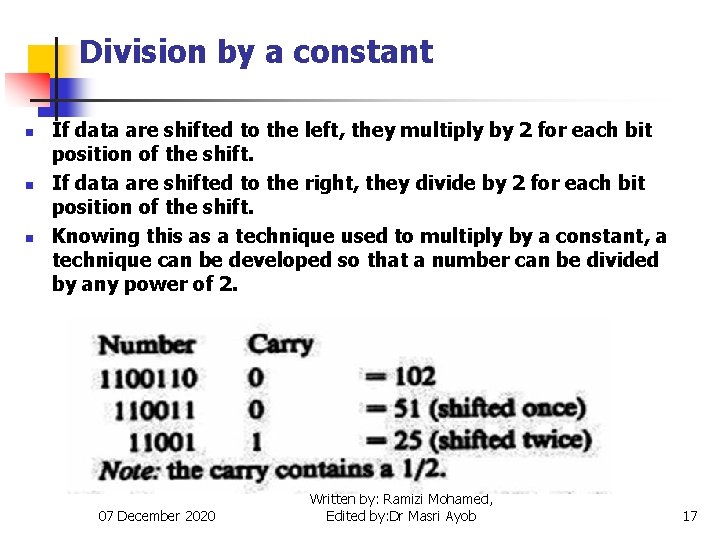
Division by a constant n n n If data are shifted to the left, they multiply by 2 for each bit position of the shift. If data are shifted to the right, they divide by 2 for each bit position of the shift. Knowing this as a technique used to multiply by a constant, a technique can be developed so that a number can be divided by any power of 2. 07 December 2020 Written by: Ramizi Mohamed, Edited by: Dr Masri Ayob 17
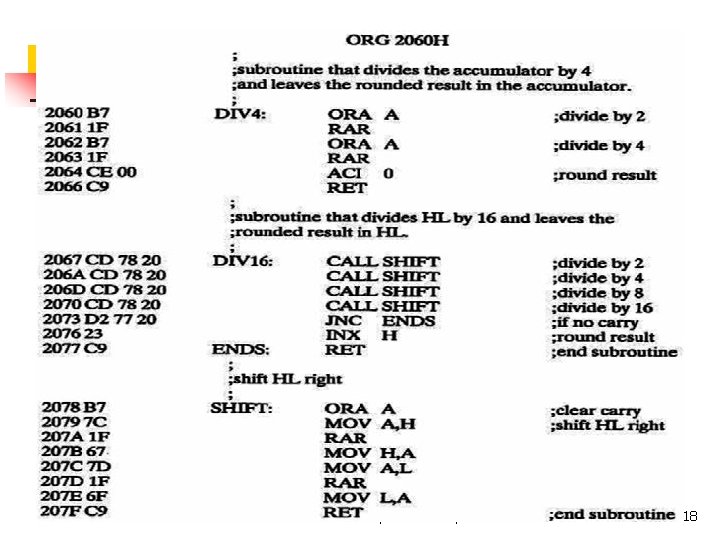
07 December 2020 Written by: Ramizi Mohamed, Edited by: Dr Masri Ayob 18
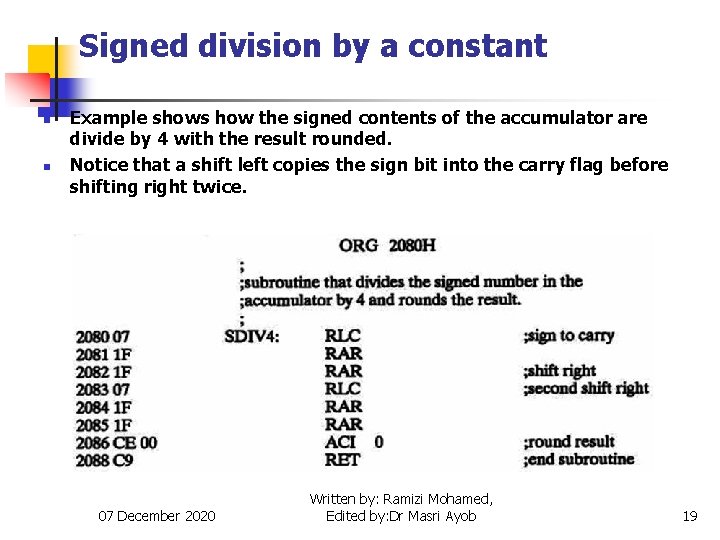
Signed division by a constant n n Example shows how the signed contents of the accumulator are divide by 4 with the result rounded. Notice that a shift left copies the sign bit into the carry flag before shifting right twice. 07 December 2020 Written by: Ramizi Mohamed, Edited by: Dr Masri Ayob 19
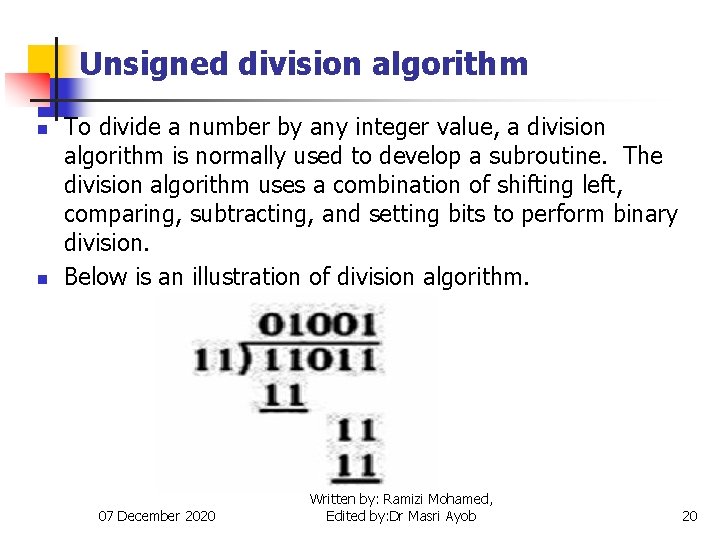
Unsigned division algorithm n n To divide a number by any integer value, a division algorithm is normally used to develop a subroutine. The division algorithm uses a combination of shifting left, comparing, subtracting, and setting bits to perform binary division. Below is an illustration of division algorithm. 07 December 2020 Written by: Ramizi Mohamed, Edited by: Dr Masri Ayob 20
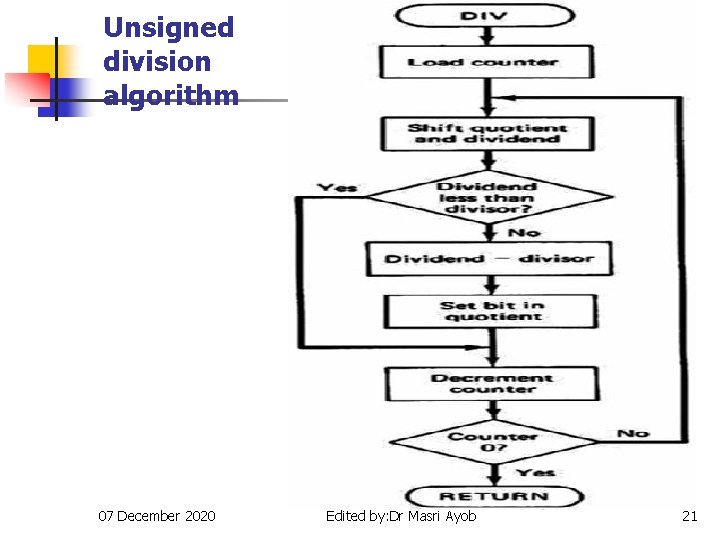
Unsigned division algorithm 07 December 2020 Written by: Ramizi Mohamed, Edited by: Dr Masri Ayob 21
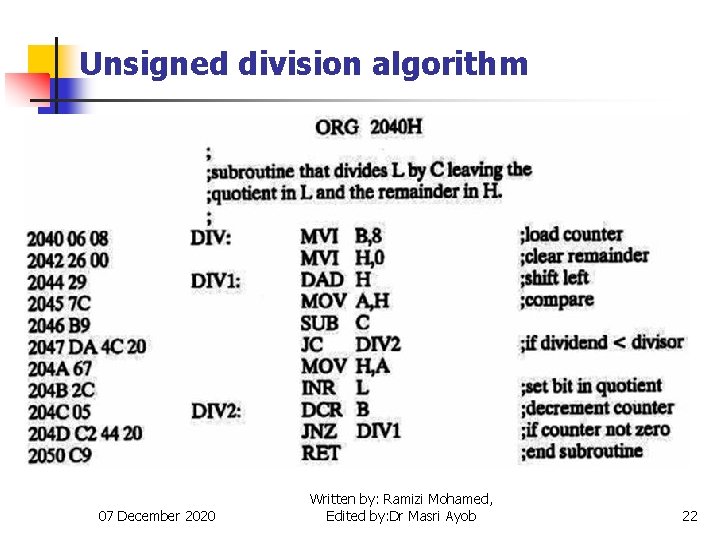
Unsigned division algorithm 07 December 2020 Written by: Ramizi Mohamed, Edited by: Dr Masri Ayob 22
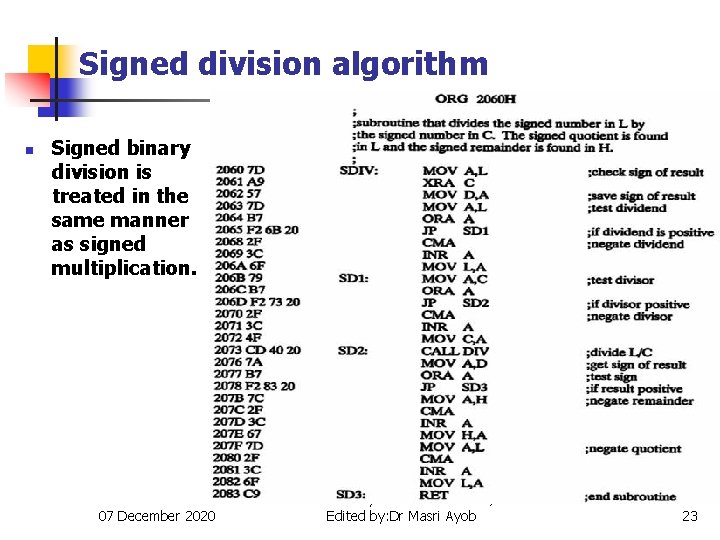
Signed division algorithm n Signed binary division is treated in the same manner as signed multiplication. 07 December 2020 Written by: Ramizi Mohamed, Edited by: Dr Masri Ayob 23
Thank you Q&A 07 December 2020 Written by: Ramizi Mohamed, Edited by: Dr Masri Ayob 24