
Titus Passing the Torch Week 1 The Background
Titus: Passing the Torch Week 1
The Background – Good Hermeneutics • Questions for us to consider: • • Who wrote this letter? When was it written, what was the context of that time? To whom is the letter written? Why is Paul writing?
Theory: Two Roman Imprisonments • Traditional understanding: Paul’s imprisonment changed • From house arrest to dungeon incarceration, but in a linear fashion • Acts 28: 17 -19, Paul’s explanation for Roman imprisonment • “I was arrested in Jerusalem and handed over to the Romans. ” • “The Jews objected [to my release], so I was compelled to make an appeal to Caesar. ” • Acts 28: 16 and 30, Paul’s situation • “When we got to Rome, Paul was allowed to live by himself, with a soldier to guard him. ” • “For two whole years Paul stayed there in his own rented house and welcomed all who came to see him. ”

Theory: Two Roman Imprisonments • Specific mention of additional travels • 1 Tim. 1: 3, “As I urged you when I went into Macedonia, stay there in Ephesus so that you may command certain people…” • Acts 20, heading to Rome via Jerusalem (through arrest), but going through Macedonia multiple times • Also vs. 13 -38, speaking authoritatively to the elders from Ephesus • (Not so sure about this one. Could Paul be referring to a trip before even going to Rome? ) • Titus 3: 12, “As soon as I send Artemas or Tychicus to you, do your best to come to me at Nicopolis, because I have decided to winter there. ” • Paul is neither in Rome nor imprisoned
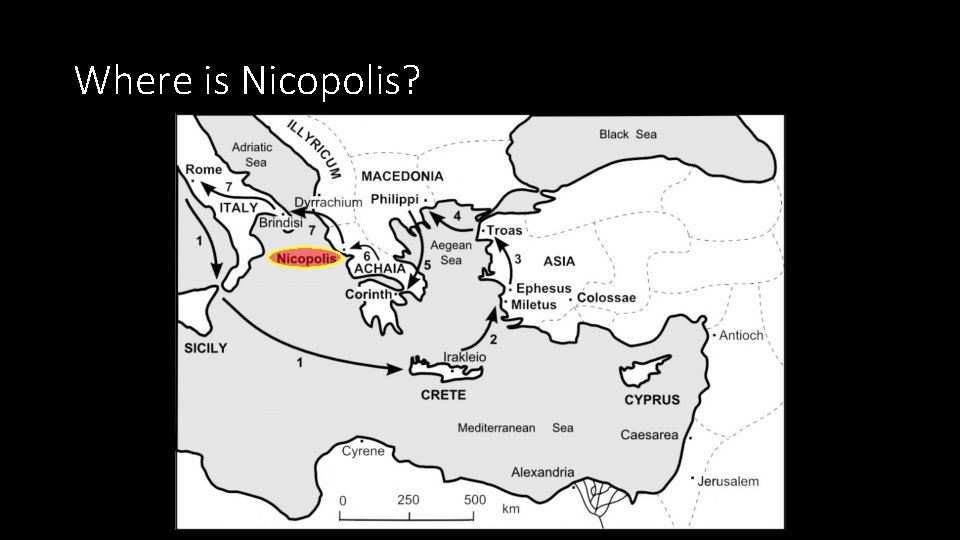
Where is Nicopolis?
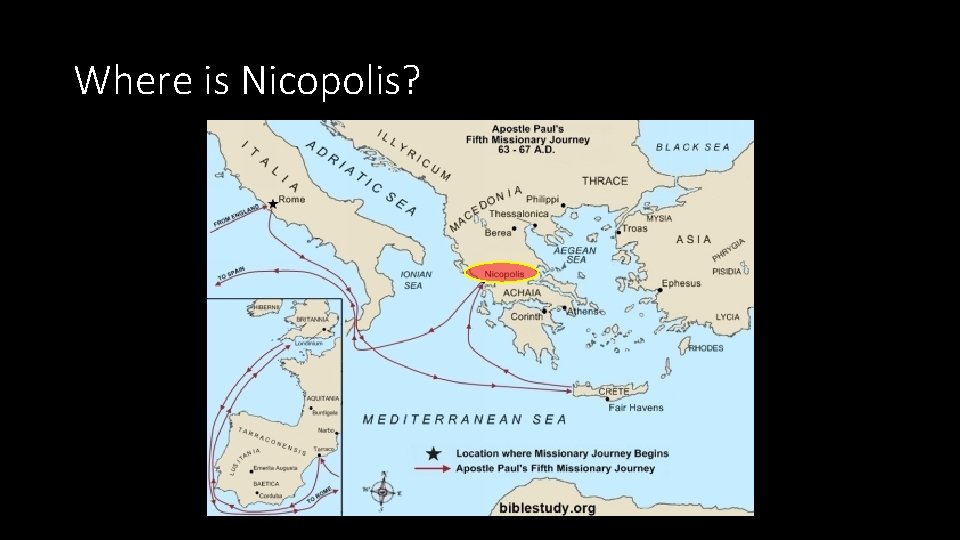
Where is Nicopolis?
Theory: Two Roman Imprisonments • Specific mention of additional travels • 1 Tim. 1: 3, “As I urged you when I went into Macedonia, stay there in Ephesus so that you may command certain people…” • Acts 20, heading to Rome via Jerusalem (through arrest), but going through Macedonia multiple times • Also vs. 13 -38, speaking authoritatively to the elders from Ephesus • (Not so sure about this one. Could Paul be referring to a trip before even going to Rome? ) • Titus 3: 12, “As soon as I send Artemas or Tychicus to you, do your best to come to me at Nicopolis, because I have decided to winter there. ” • Paul is neither in Rome nor imprisoned • 2 Tim. 4: 20, “Erastus stayed in Corinth, and I left Trophimus sick in Miletus. ” • This implies being in both Corinth and Miletus after the letter of 1 Timothy (Acts 28)

Where is Miletus?
Theory: Two Roman Imprisonments • Philippians: a thank-you note for sending money • If this was while Paul was renting a house, such a gift would make sense
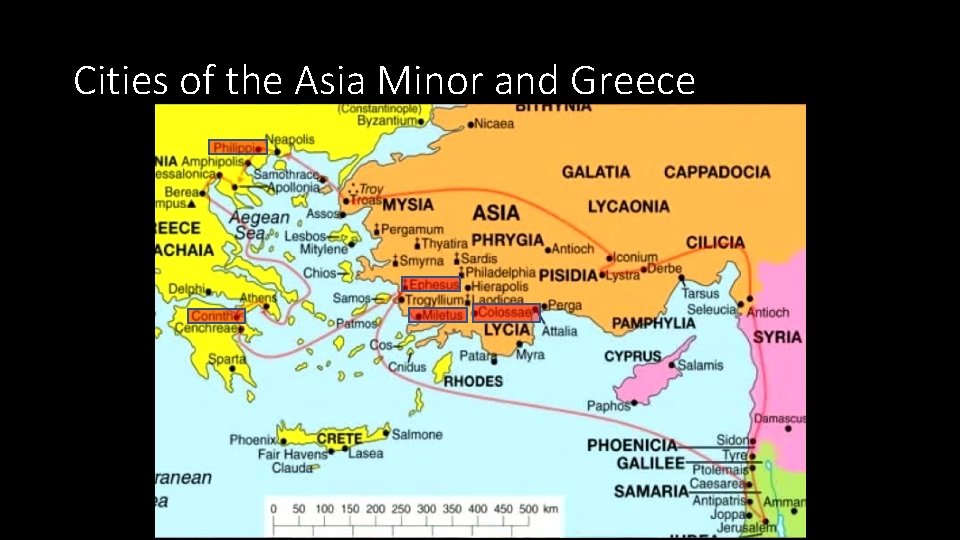
Cities of the Asia Minor and Greece
Theory: Two Roman Imprisonments • Philippians: a thank-you note for sending money • If this was while Paul was renting a house, such a gift would make sense • Note in Philippians 2: 24 after saying he would send Timothy to them: • “And I am confident in the Lord that I myself will come soon. ” • Interesting points in Philemon • Written immediately after initially meeting Onesimus • Vs. 12, “I am sending him—who is my very heart—back to you. ” • Paul’s mindset, vs. 22, “And one thing more: Prepare a guest room for me, because I hope to be restored to you in answer to your prayers. ”
Theory: Two Roman Imprisonments • The nature of Paul’s imprisonment is different in 2 Timothy • 2 Tim. 2: 8 -9, “Remember Jesus Christ, raised from the dead, descended from David. This is my gospel, for which I am suffering even to the point of being chained like a criminal. ” • Paul’s mindset, 2 Tim. 4: 6 -8, “For I am already being poured out like a drink offering, and the time for my departure is near. I have fought the good fight, I have finished the race, I have kept the faith. Now there is in store for me the crown of righteousness, which the Lord, the righteous Judge, will award to me on that day—and not only to me, but also to all who have longed for his appearing. ” • No more traveling, 2 Tim. 4: 9, “Do your best to come to me quickly. ”
Theory: Two Roman Imprisonments • Pro’s for this theory: • Definitely two different mindsets • Unrecorded travels are clearly mentioned • Con’s for this theory: • The traditional theory would incorporate different mindsets (i. e. , degradation of conditions) • All of this is circumstantial evidence • Why wouldn’t Luke (who dies in 84 AD) have included Paul’s release in Acts? • Just because Paul intended to do something, does that mean it actually happened? • Why does it matter? • Understanding Paul’s situation and purpose when writing to Titus • Based on how they knew one another
Who is Titus to Paul? • Long-time “associate pastor” • Galatians 2: 1, “Then after fourteen years, I went up again to Jerusalem, this time with Barnabas. I took Titus along also. ” • 2 Cor. 8: 23, “As for Titus, he is my partner and co-worker among you…” • Nature of their relationship • 2 Cor. 2: 13, “I still had no peace of mind, because I did not find my brother Titus there. ” • Titus 1: 4, “To Titus, my true son in our common faith: Grace and peace from God the Father and Christ Jesus our Savior. ”
What is the point of this letter? • Titus 1: 1, “Paul, a servant of God an apostle of Jesus Christ to further the faith of God’s elect and their knowledge of the truth that leads to godliness. ” • What does Paul say is his intention? • Format of this letter: pastoral dissemination • What would we therefore expect from this work? • I. e. , what is the nature of a “pastor? ” • Is this only a message for ministers?
What is the point of this letter? • Titus 1: 2 -3, a servant and apostle “in the hope of eternal life, which God, who does not lie, promised before the beginning of time, and which now at his appointed season he has brought to light through the preaching entrusted to me by the command of God our Savior. ” • Why does Paul emphasize that God doesn’t lie, and this promise was made before the beginning of time? • What is happening in this “appointed season? ” • The point: being a devout and stalwart student of Christ even in difficult circumstances.
For Next Week: • Please read Titus 1. • To consider: • Jesus said we would know a tree by it’s fruit. Do we believe this, and how should we therefore act?
- Slides: 17