
Titration is the slow addition of one solution
- Slides: 17
Titration is the slow addition of one solution of a known concentration (called a titrant) to a known volume of another solution of unknown concentration (called the analyte) until the reaction reaches neutralization. Titration is a technique to determine the concentration of an unknown solution. Acid-Base titrations are usually used to find the amount of a known acidic or basic substance through acid base reactions.
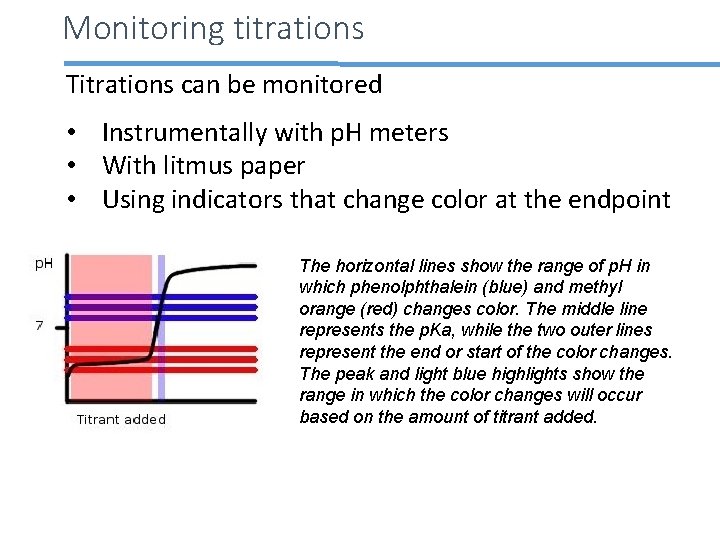
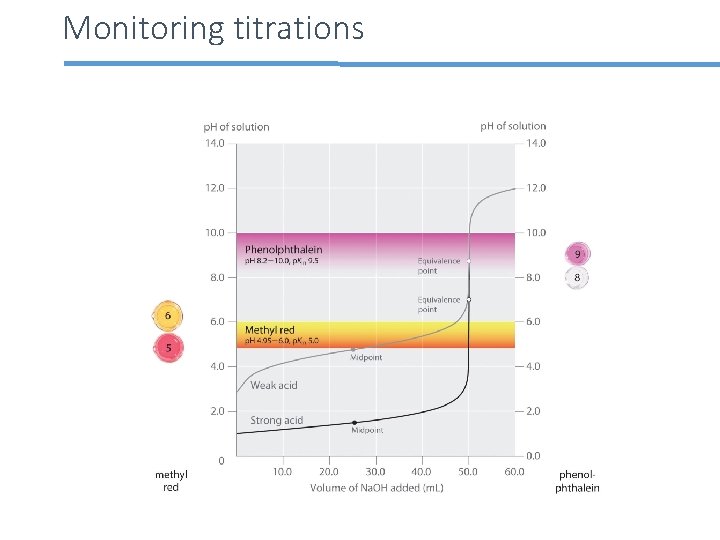
Monitoring titrations Titrations can be monitored • Instrumentally with p. H meters • With litmus paper • Using indicators that change color at the endpoint The horizontal lines show the range of p. H in which phenolphthalein (blue) and methyl orange (red) changes color. The middle line represents the p. Ka, while the two outer lines represent the end or start of the color changes. The peak and light blue highlights show the range in which the color changes will occur based on the amount of titrant added.
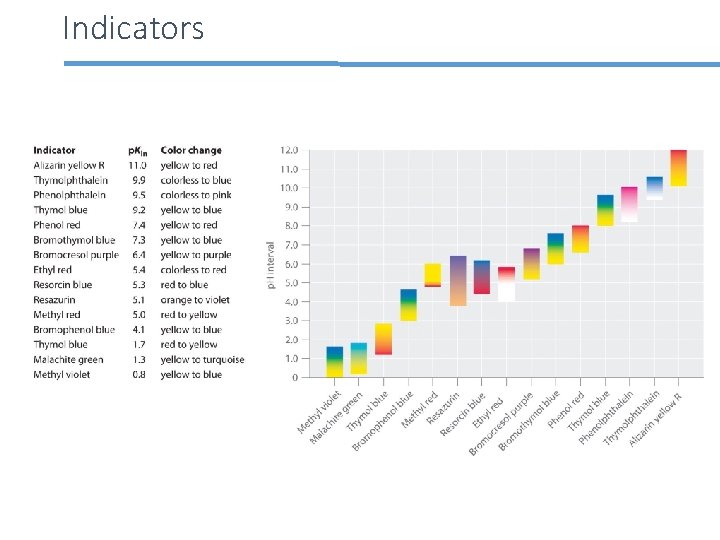
Indicators
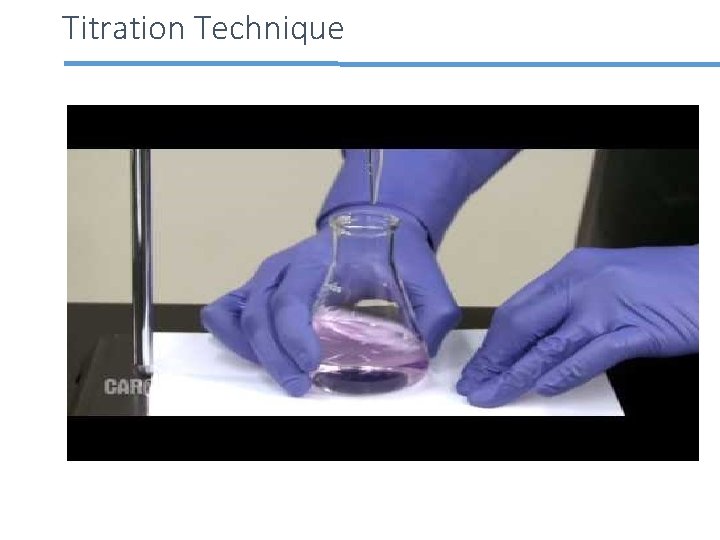
Titration Technique
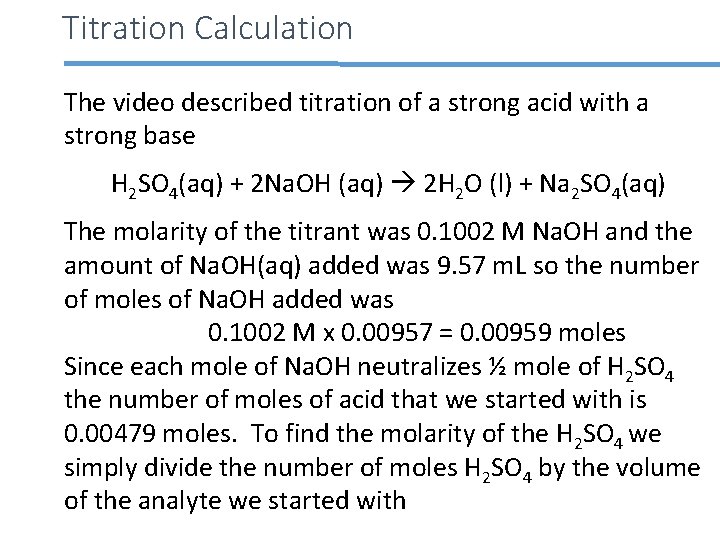
Titration Calculation The video described titration of a strong acid with a strong base H 2 SO 4(aq) + 2 Na. OH (aq) 2 H 2 O (l) + Na 2 SO 4(aq) The molarity of the titrant was 0. 1002 M Na. OH and the amount of Na. OH(aq) added was 9. 57 m. L so the number of moles of Na. OH added was 0. 1002 M x 0. 00957 = 0. 00959 moles Since each mole of Na. OH neutralizes ½ mole of H 2 SO 4 the number of moles of acid that we started with is 0. 00479 moles. To find the molarity of the H 2 SO 4 we simply divide the number of moles H 2 SO 4 by the volume of the analyte we started with
Elements of Titration The standard solution is the solution of known concentration. An accurately measured amount of standard solution is added during titration to the solution of unknown concentration until the equivalence or endpoint is reached. The equivalence point is when the reactants are done reacting. The solution of unknown concentration is otherwise known as the analyte. During titration the titrant is added to the analyte in order to achieve the equivalence point and determine the concentration of the analyte. The equivalence point is the ideal point for the completion of titration. In order to obtain accurate results the equivalence point must be attained precisely and accurately. The solution of known concentration, or titrant, must be added to the solution of unknown concentration, or analyte, very slowly in order to obtain a good result. At the equivalence point the correct amount of standard solution must be added to fully react with the unknown concentration. The end point of a titration indicates once the equivalence point has been reached. It is indicated by some form of indicator which varies depending on what type of titration being done. For example, if a color indicator is used, the solution will change color when the titration is at its end point.
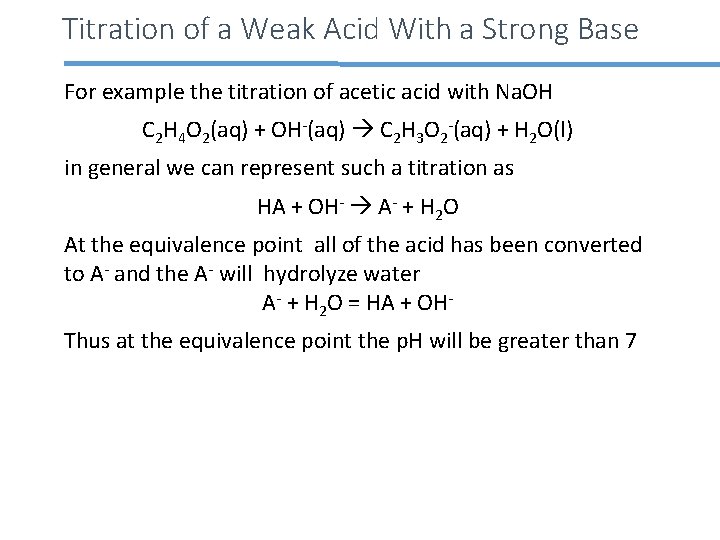
Titration of a Weak Acid With a Strong Base For example the titration of acetic acid with Na. OH C 2 H 4 O 2(aq) + OH-(aq) C 2 H 3 O 2 -(aq) + H 2 O(l) in general we can represent such a titration as HA + OH- A- + H 2 O At the equivalence point all of the acid has been converted to A- and the A- will hydrolyze water A- + H 2 O = HA + OHThus at the equivalence point the p. H will be greater than 7
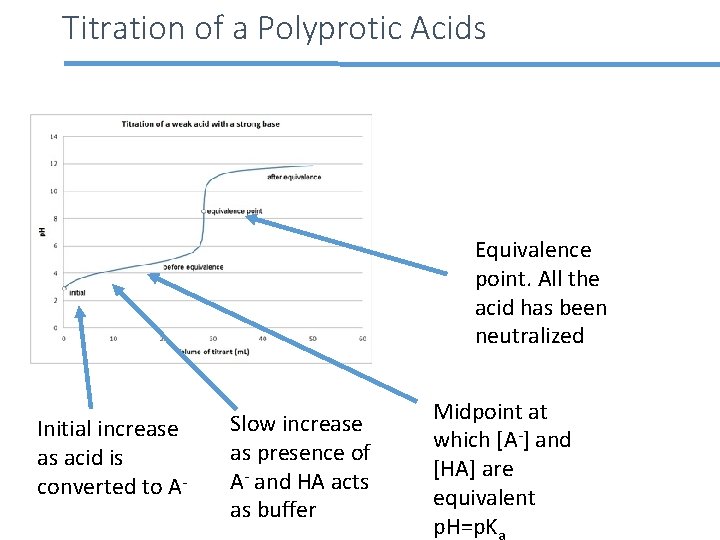
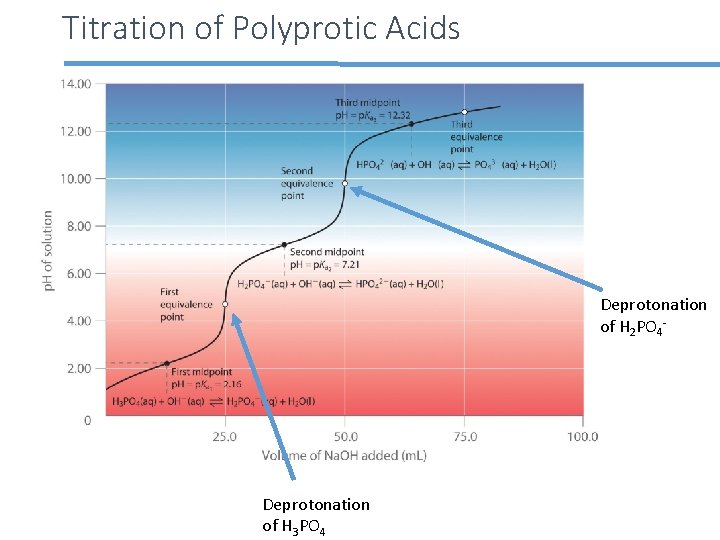
Titration of a Polyprotic Acids Equivalence point. All the acid has been neutralized Initial increase as acid is converted to A- Slow increase as presence of A- and HA acts as buffer Midpoint at which [A-] and [HA] are equivalent p. H=p. Ka
Monitoring titrations
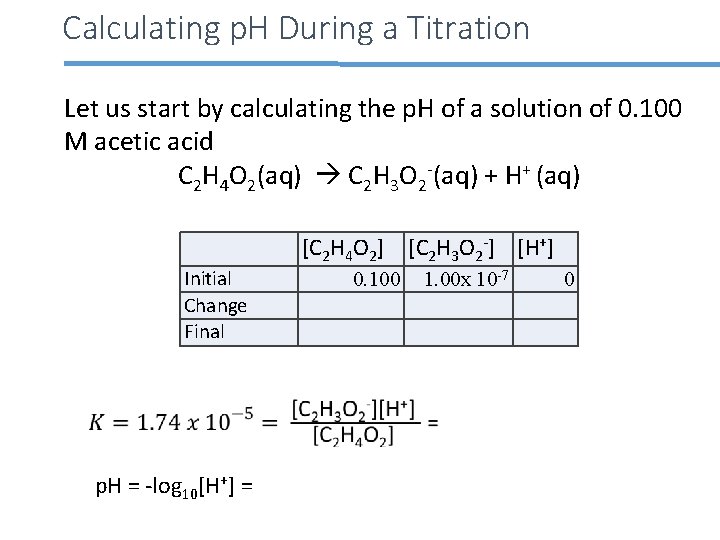
Calculating p. H During a Titration Let us start by calculating the p. H of a solution of 0. 100 M acetic acid C 2 H 4 O 2(aq) C 2 H 3 O 2 -(aq) + H+ (aq) [C 2 H 4 O 2] [C 2 H 3 O 2 -] [H+] Initial Change Final p. H = -log 10[H+] = 0. 100 1. 00 x 10 -7 0
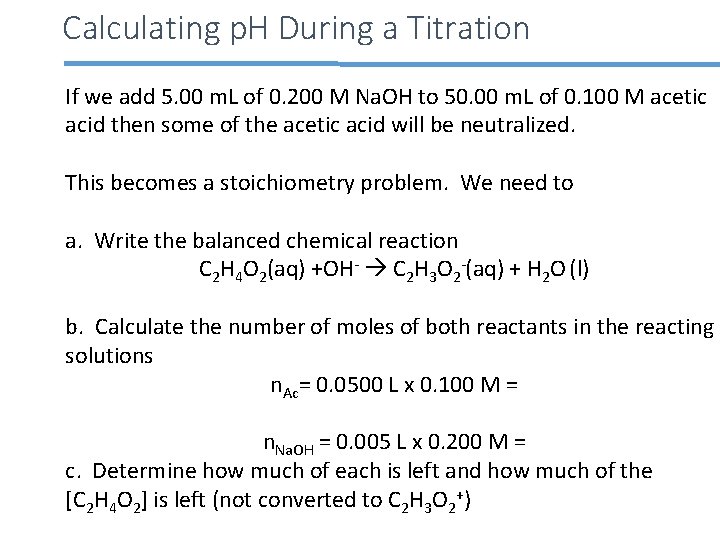
Calculating p. H During a Titration If we add 5. 00 m. L of 0. 200 M Na. OH to 50. 00 m. L of 0. 100 M acetic acid then some of the acetic acid will be neutralized. This becomes a stoichiometry problem. We need to a. Write the balanced chemical reaction C 2 H 4 O 2(aq) +OH- C 2 H 3 O 2 -(aq) + H 2 O (l) b. Calculate the number of moles of both reactants in the reacting solutions n. Ac= 0. 0500 L x 0. 100 M = n. Na. OH = 0. 005 L x 0. 200 M = c. Determine how much of each is left and how much of the [C 2 H 4 O 2] is left (not converted to C 2 H 3 O 2+)
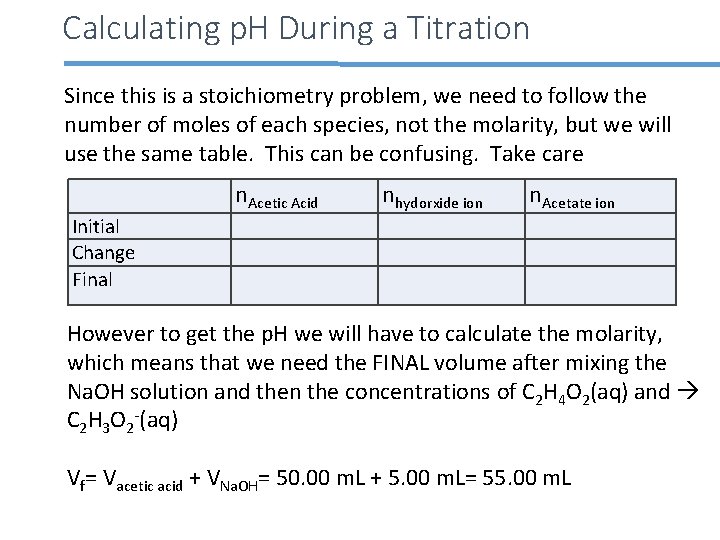
Calculating p. H During a Titration Since this is a stoichiometry problem, we need to follow the number of moles of each species, not the molarity, but we will use the same table. This can be confusing. Take care n. Acetic Acid nhydorxide ion n. Acetate ion Initial Change Final However to get the p. H we will have to calculate the molarity, which means that we need the FINAL volume after mixing the Na. OH solution and then the concentrations of C 2 H 4 O 2(aq) and C 2 H 3 O 2 -(aq) Vf= Vacetic acid + VNa. OH= 50. 00 m. L + 5. 00 m. L= 55. 00 m. L
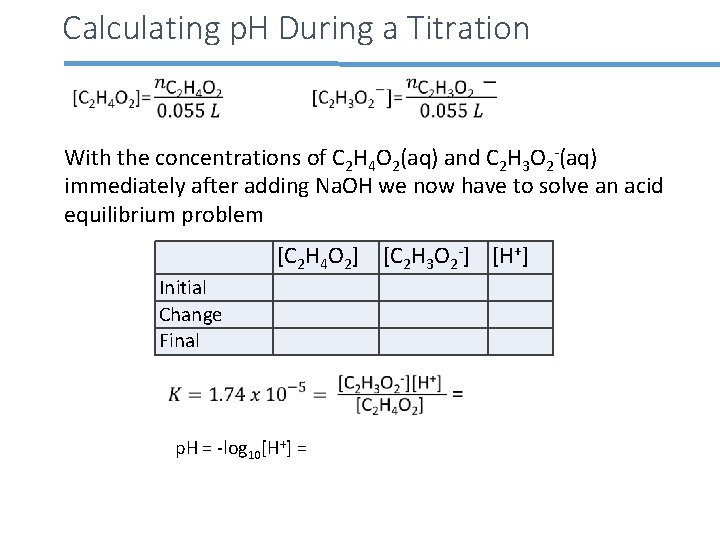
Calculating p. H During a Titration With the concentrations of C 2 H 4 O 2(aq) and C 2 H 3 O 2 -(aq) immediately after adding Na. OH we now have to solve an acid equilibrium problem [C 2 H 4 O 2] [C 2 H 3 O 2 -] [H+] Initial Change Final p. H = -log 10[H+] =
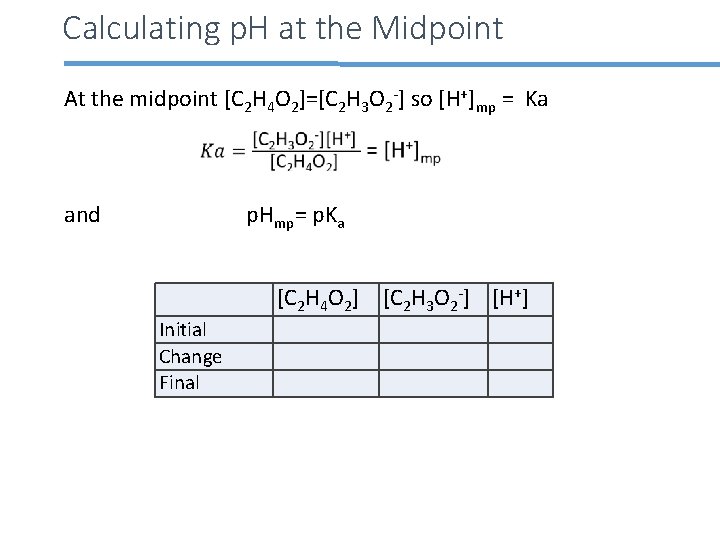
Calculating p. H at the Midpoint At the midpoint [C 2 H 4 O 2]=[C 2 H 3 O 2 -] so [H+]mp = Ka and p. Hmp= p. Ka [C 2 H 4 O 2] [C 2 H 3 O 2 -] [H+] Initial Change Final
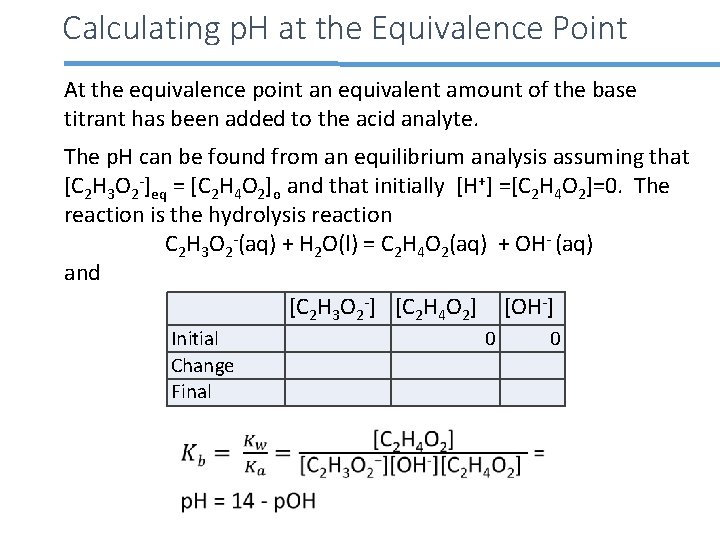
Calculating p. H at the Equivalence Point At the equivalence point an equivalent amount of the base titrant has been added to the acid analyte. The p. H can be found from an equilibrium analysis assuming that [C 2 H 3 O 2 -]eq = [C 2 H 4 O 2]o and that initially [H+] =[C 2 H 4 O 2]=0. The reaction is the hydrolysis reaction C 2 H 3 O 2 -(aq) + H 2 O(l) = C 2 H 4 O 2(aq) + OH- (aq) and [C 2 H 3 O 2 -] [C 2 H 4 O 2] [OH-] Initial Change Final 0 0
Summary A similar analysis holds for the titration of a weak base by a strong acid. Calculation of p. H at all points along the titration curve is a combination of stoichiometric and equilibrium problems
Titration of Polyprotic Acids Deprotonation of H 2 PO 4 - Deprotonation of H 3 PO 4