
Titration curve of amino acids BCH 312 PRACTICAL
![Titration curve of amino acids BCH 312 [PRACTICAL]](https://slidetodoc.com/presentation_image_h2/592ce9fc7b1d0acd7cf2b86c8c0c0f89/image-1.jpg "Titration curve of amino acids BCH 312 [PRACTICAL]")
Titration curve of amino acids BCH 312 [PRACTICAL]
Objective: -To study titration curves of amino acid. -Determine the p. Ka values. -Determine p. I. -Determine buffering regions. -To understand the acid base behaviour of an amino acid.
Titration Curves: Titration Curves are produced by monitoring the p. H of a given volume of a sample solution after successive addition of acid or alkali. The curves are usually plots of p. H against the volume of titrant added (acid or base). Each dissociation group represent one stage in the titration curve.
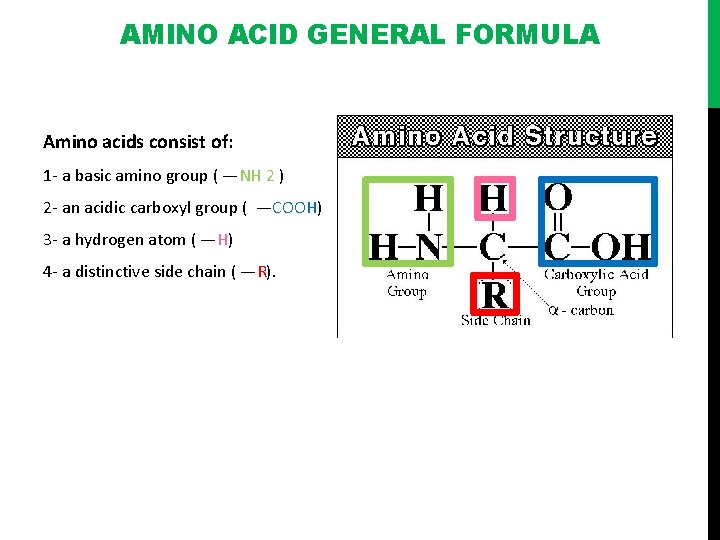
AMINO ACID GENERAL FORMULA Amino acids consist of: 1 - a basic amino group ( —NH 2 ) 2 - an acidic carboxyl group ( —COOH) 3 - a hydrogen atom ( —H) 4 - a distinctive side chain ( —R).
TITRATION OF AMINO ACID: -When an amino acid is dissolved in water it exists predominantly in the isoelectric form. -( a compound that can act as either an acid or a base is known as an amphoteric compound). -Upon titration with acid, it acts as a base (accept a proton). -Upon titration with base, it acts as an acid (donate a proton)
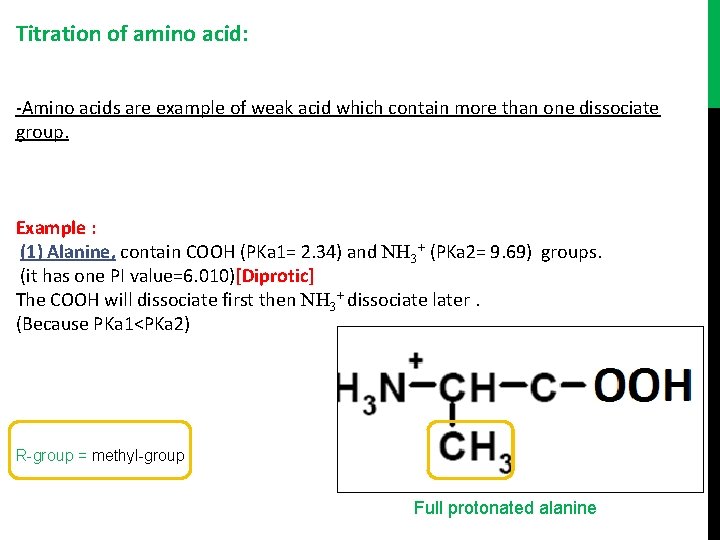
Titration of amino acid: -Amino acids are example of weak acid which contain more than one dissociate group. Example : (1) Alanine, contain COOH (PKa 1= 2. 34) and NH 3+ (PKa 2= 9. 69) groups. (it has one PI value=6. 010)[Diprotic] The COOH will dissociate first then NH 3+ dissociate later. (Because PKa 1<PKa 2) R-group = methyl-group Full protonated alanine
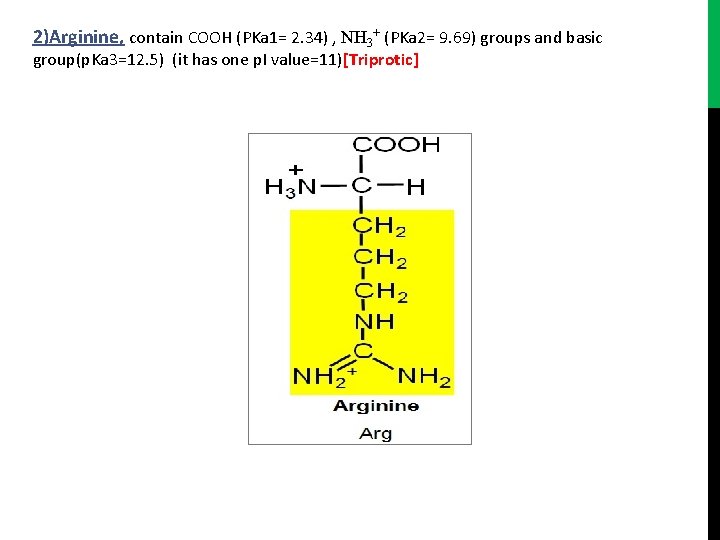
2)Arginine, contain COOH (PKa 1= 2. 34) , NH 3+ (PKa 2= 9. 69) groups and basic group(p. Ka 3=12. 5) (it has one p. I value=11)[Triprotic]
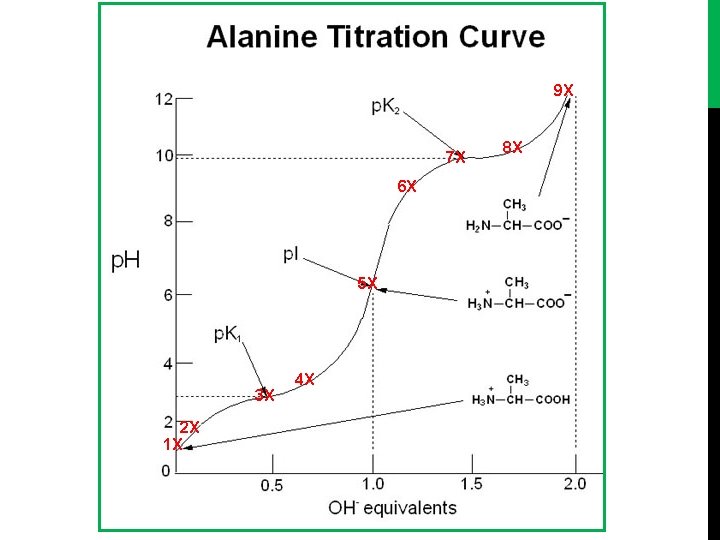
9 X 7 X 6 X 5 X 3 X 2 X 1 X 4 X 8 X
![Titration curve of alanine (or glycine) [diprotenation] [1] starting point: Alanine, is full protonated](http://slidetodoc.com/presentation_image_h2/592ce9fc7b1d0acd7cf2b86c8c0c0f89/image-9.jpg "Titration curve of alanine (or glycine) [diprotenation] [1] starting point: Alanine, is full protonated")
Titration curve of alanine (or glycine) [diprotenation] [1] starting point: Alanine, is full protonated [NH 3+-CH-CH 3 -COOH]. [2] COOH will dissociate first: - [NH 3+-CH-CH 3 -COOH] > [NH 3+-CH-CH 3 -COO-]. - PH<PKa 1. [3] In this point the component of alanine act as buffer: - [NH 3+-CH-CH 3 -COOH] = [NH 3+-CH-CH 3 -COO-]. - PH=PKa 1, [4] In this point: - [NH 3+-CH-CH 3 -COOH] < [NH 3+-CH-CH 3 -COO- ]. -PH > PKa 1
![[5] Isoelectric point: - The COOH full dissociate to COO-. - [NH 3+-CH-CH 3](http://slidetodoc.com/presentation_image_h2/592ce9fc7b1d0acd7cf2b86c8c0c0f89/image-10.jpg "[5] Isoelectric point: - The COOH full dissociate to COO-. - [NH 3+-CH-CH 3")
[5] Isoelectric point: - The COOH full dissociate to COO-. - [NH 3+-CH-CH 3 -COO-]. - The conc. Of negative charge = conc. Of positive charge. - The amino acid present as Zwetter ion (neutral form). - PI (isoelectric point) : PH value at which the net charge of amino acid equal to zero. - PI = (PKa 1 + PKa 2) /2 = (2. 32+9. 96)/2= 6. 01
![[6] The NH 3+ start dissociate , - [NH 3+-CH-CH 3 -COO-] > [NH](http://slidetodoc.com/presentation_image_h2/592ce9fc7b1d0acd7cf2b86c8c0c0f89/image-11.jpg "[6] The NH 3+ start dissociate , - [NH 3+-CH-CH 3 -COO-] > [NH")
[6] The NH 3+ start dissociate , - [NH 3+-CH-CH 3 -COO-] > [NH 2 -CH-CH 3 -COO-] - PH <PKa 2. [7] In this point the component of alanine act as buffer: - [NH 3+-CH-CH 3 -COO-] = [NH 2 -CH-CH 3 -COO-]. - PH=PKa 2. [8] In this point: [NH 3+-CH-CH 3 -COO-] < [NH 2 -CH-CH 3 -COO-]. - PH >PKa 2 [9] End point: - Alanine is full dissociated, [NH 2 -CH-CH 3 -COO-], (the NH 3 group is full dissociate) POH= (Pkb+P[A-])/2 PKb = PKw – PKa 2
![Note in calculation method: The PH calculated by different way : [1] at starting](http://slidetodoc.com/presentation_image_h2/592ce9fc7b1d0acd7cf2b86c8c0c0f89/image-12.jpg "Note in calculation method: The PH calculated by different way : [1] at starting")
Note in calculation method: The PH calculated by different way : [1] at starting point PH= (Pka+ P[HA])/2 [2] At any point within the curve (before or in or after middle titration) PH=Pka+log([A-]/[HA]) [3] At end point POH=(PKb+P[A-])/2 PH=PKw – POH
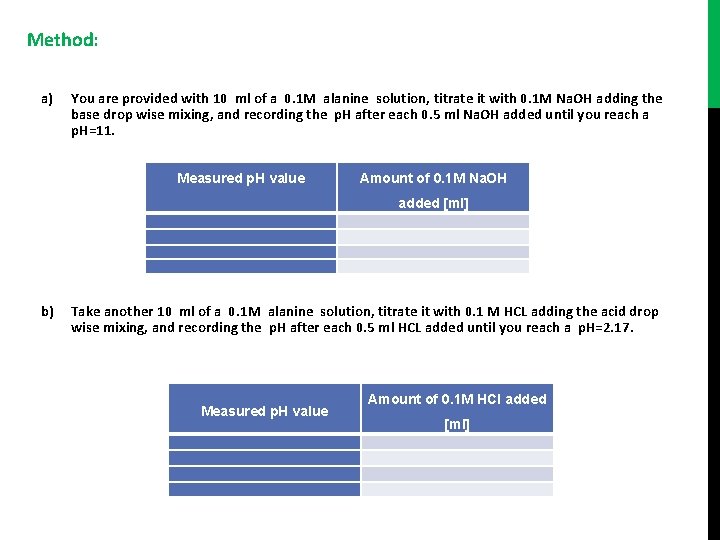
Method: a) You are provided with 10 ml of a 0. 1 M alanine solution, titrate it with 0. 1 M Na. OH adding the base drop wise mixing, and recording the p. H after each 0. 5 ml Na. OH added until you reach a p. H=11. Measured p. H value Amount of 0. 1 M Na. OH added [ml] b) Take another 10 ml of a 0. 1 M alanine solution, titrate it with 0. 1 M HCL adding the acid drop wise mixing, and recording the p. H after each 0. 5 ml HCL added until you reach a p. H=2. 17. Measured p. H value Amount of 0. 1 M HCl added [ml]
![Results: [1] record the titration table and Plot a Curve of p. H versus](http://slidetodoc.com/presentation_image_h2/592ce9fc7b1d0acd7cf2b86c8c0c0f89/image-14.jpg "Results: [1] record the titration table and Plot a Curve of p. H versus")
Results: [1] record the titration table and Plot a Curve of p. H versus ml of OH- added. [2]Calculate the p. H of the alanine solution after the addition of 0 ml, 5 ml, of 0. 2 M Na. OH. And calculate PH after addition of 0. 5 ml , 2 ml of HCL [3] determine the p. Ka of ionizable groups of amino acids [4]Compare your calculated p. H values with those obtained from Curve. [5] determine the PI value from your result.
- Slides: 14