
Title Textiles Working with textile based materials Objectives
Title – Textiles Working with textile based materials Objectives • Understand how textiles and components are available in standard forms and sizes • Be aware of school and commercial based cutting, forming and processing techniques
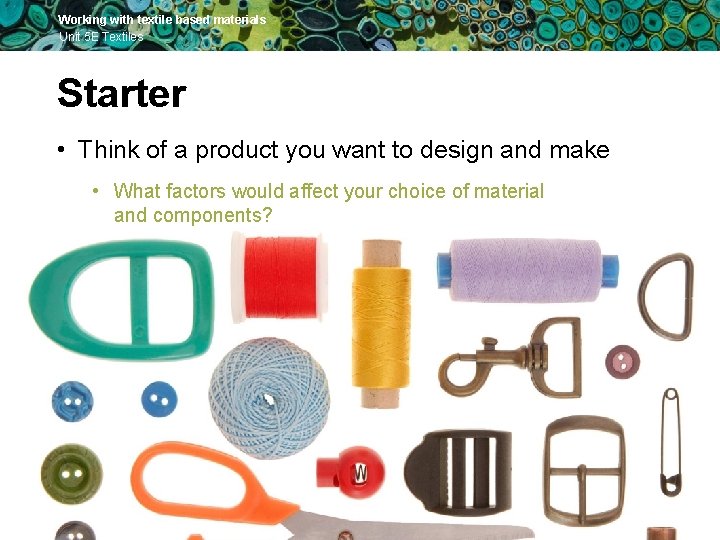
Working with textile based materials Unit 5 E Textiles Starter • Think of a product you want to design and make • What factors would affect your choice of material and components?
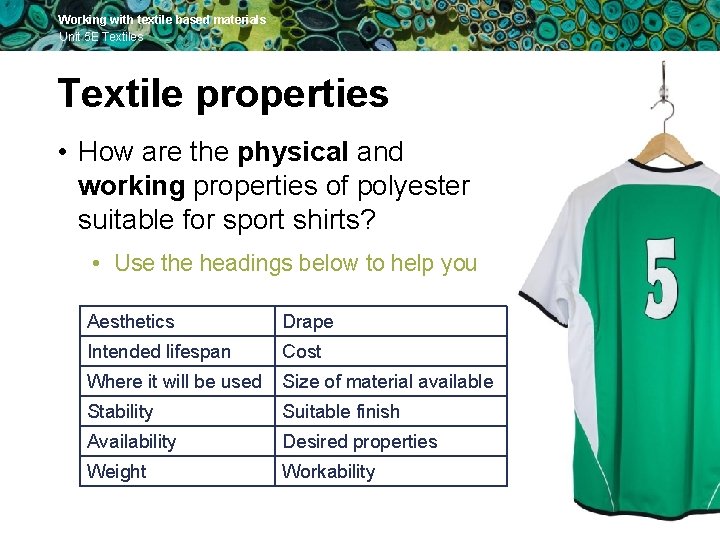
Working with textile based materials Unit 5 E Textiles Textile properties • How are the physical and working properties of polyester suitable for sport shirts? • Use the headings below to help you Aesthetics Drape Intended lifespan Cost Where it will be used Size of material available Stability Suitable finish Availability Desired properties Weight Workability
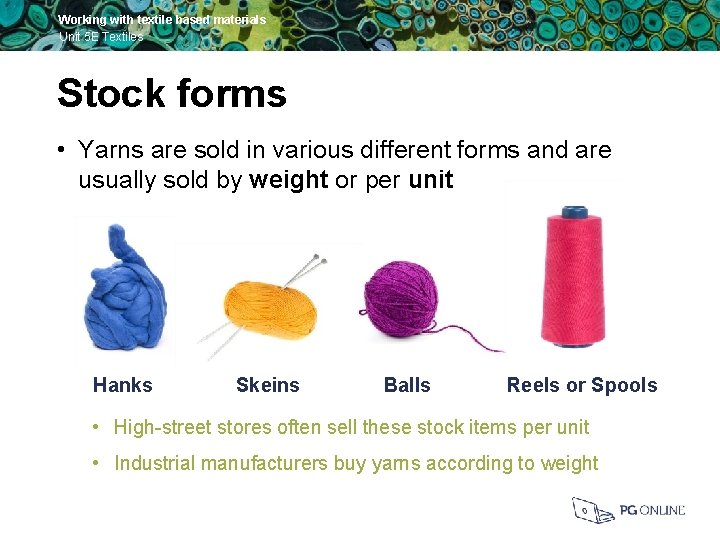
Working with textile based materials Unit 5 E Textiles Stock forms • Yarns are sold in various different forms and are usually sold by weight or per unit Hanks Skeins Balls Reels or Spools • High-street stores often sell these stock items per unit • Industrial manufacturers buy yarns according to weight
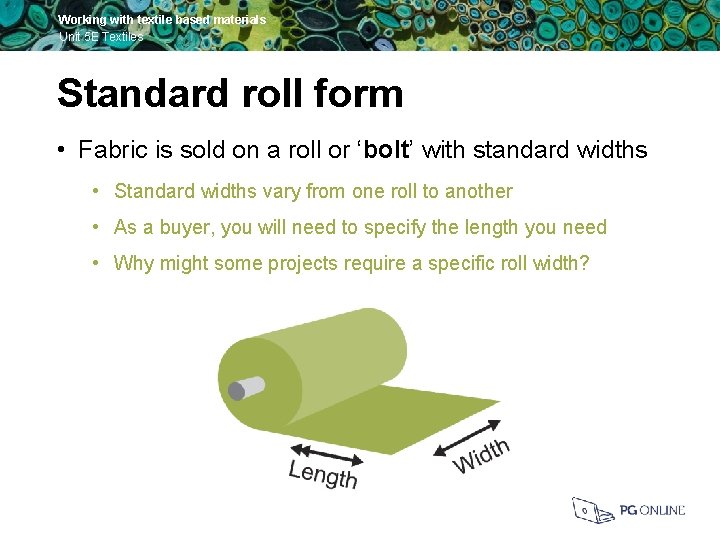
Working with textile based materials Unit 5 E Textiles Standard roll form • Fabric is sold on a roll or ‘bolt’ with standard widths • Standard widths vary from one roll to another • As a buyer, you will need to specify the length you need • Why might some projects require a specific roll width?
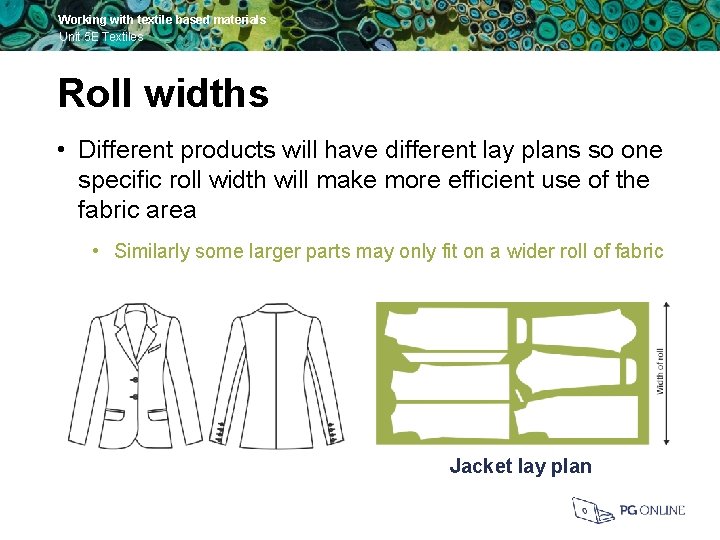
Working with textile based materials Unit 5 E Textiles Roll widths • Different products will have different lay plans so one specific roll width will make more efficient use of the fabric area • Similarly some larger parts may only fit on a wider roll of fabric Jacket lay plan
Working with textile based materials Unit 5 E Textiles Standardisation • What advantages are there to having standard types and sizes of yarn, fabrics and fasteners?
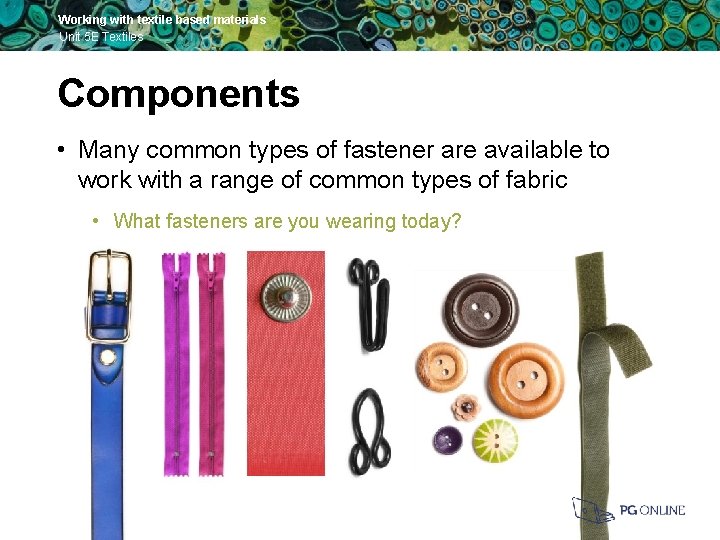
Working with textile based materials Unit 5 E Textiles Components • Many common types of fastener are available to work with a range of common types of fabric • What fasteners are you wearing today?
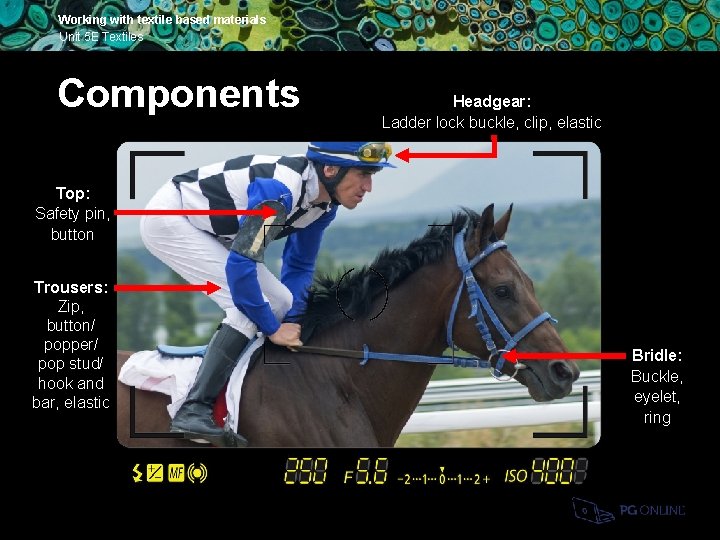
Working with textile based materials Unit 5 E Textiles Components Headgear: Ladder lock buckle, clip, elastic Top: Safety pin, button Trousers: Zip, button/ popper/ pop stud/ hook and bar, elastic Bridle: Buckle, eyelet, ring

Working with textile based materials Unit 5 E Textiles Shaping, processing and machining • How can you change the shape, colour, texture, pattern or structure of a fabric or product? • Suggest ways in which fabric may be processed within school
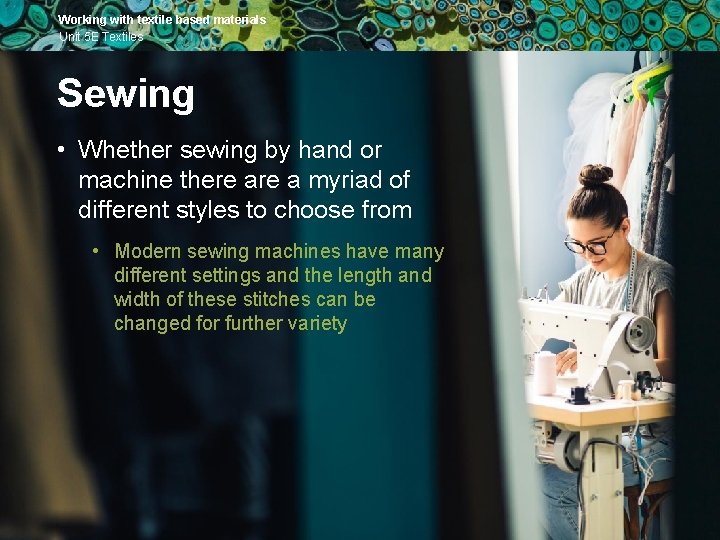
Working with textile based materials Unit 5 E Textiles Sewing • Whether sewing by hand or machine there a myriad of different styles to choose from • Modern sewing machines have many different settings and the length and width of these stitches can be changed for further variety
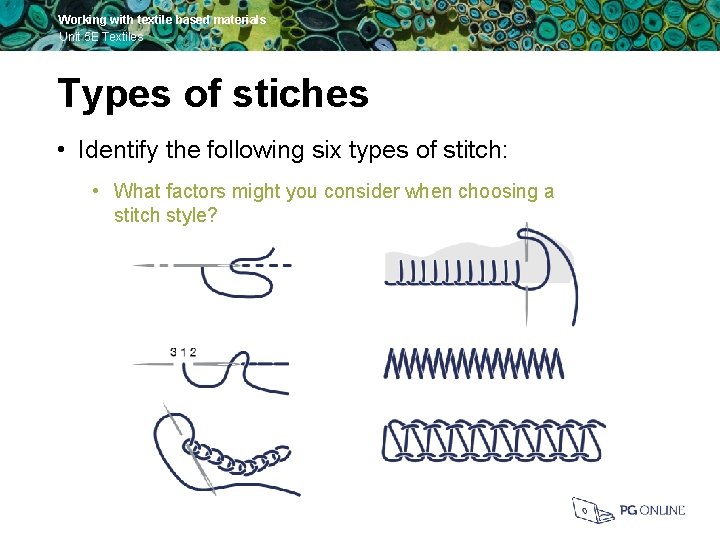
Working with textile based materials Unit 5 E Textiles Types of stiches • Identify the following six types of stitch: • What factors might you consider when choosing a stitch style?
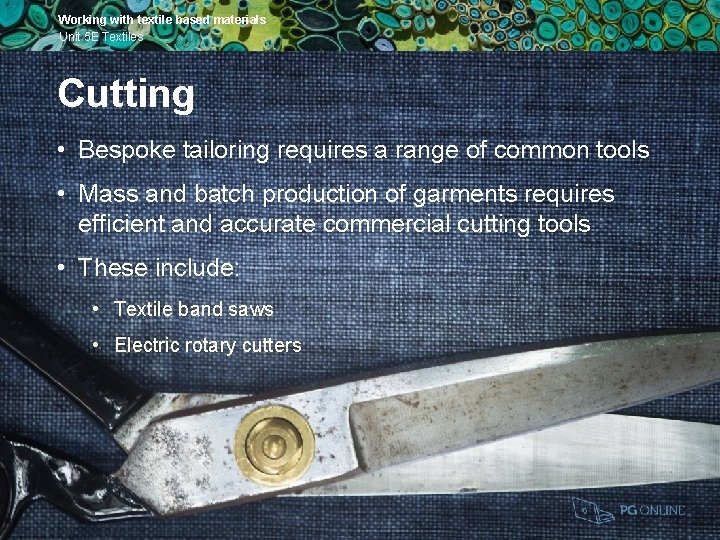
Working with textile based materials Unit 5 E Textiles Cutting • Bespoke tailoring requires a range of common tools • Mass and batch production of garments requires efficient and accurate commercial cutting tools • These include: • Textile band saws • Electric rotary cutters
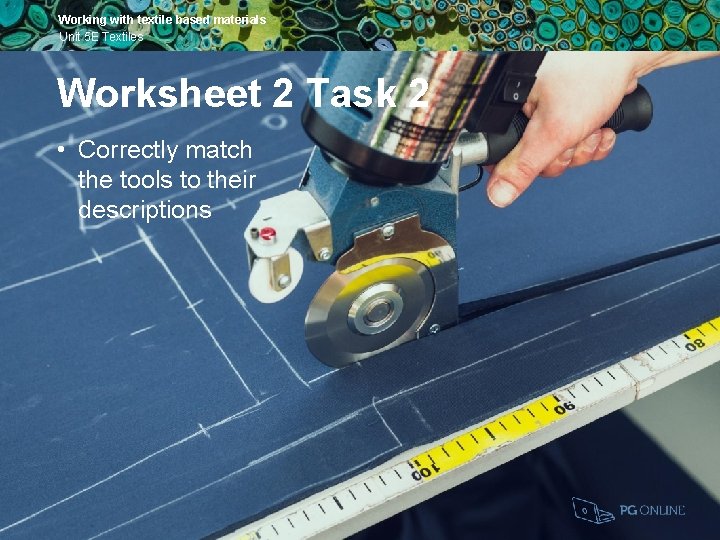
Working with textile based materials Unit 5 E Textiles Worksheet 2 Task 2 • Correctly match the tools to their descriptions
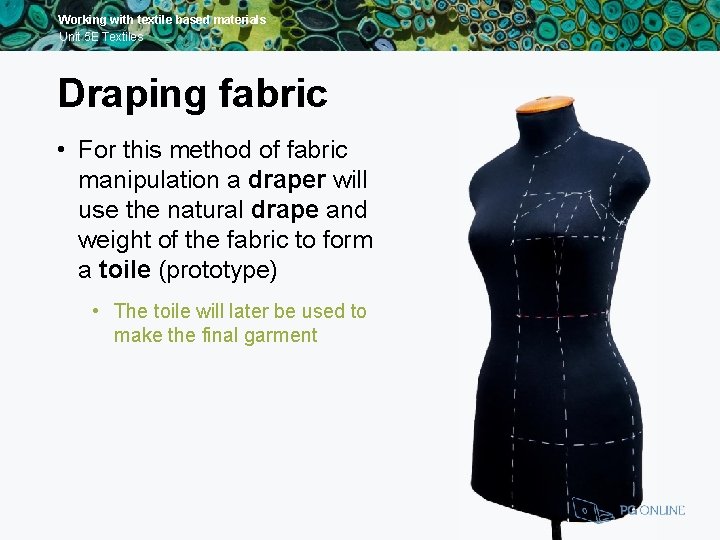
Working with textile based materials Unit 5 E Textiles Draping fabric • For this method of fabric manipulation a draper will use the natural drape and weight of the fabric to form a toile (prototype) • The toile will later be used to make the final garment

Working with textile based materials Unit 5 E Textiles Forming a toile (prototype) • Skilled drapers pin lengths of cloth to a dummy or stand, usually at the shoulder or waist line • They then pin, fold, pleat, gather and tuck the fabric into the correct shape for any given garment • Fabric is often pinned to the stand on the bias • What does bias mean? • What are the benefits of draping?
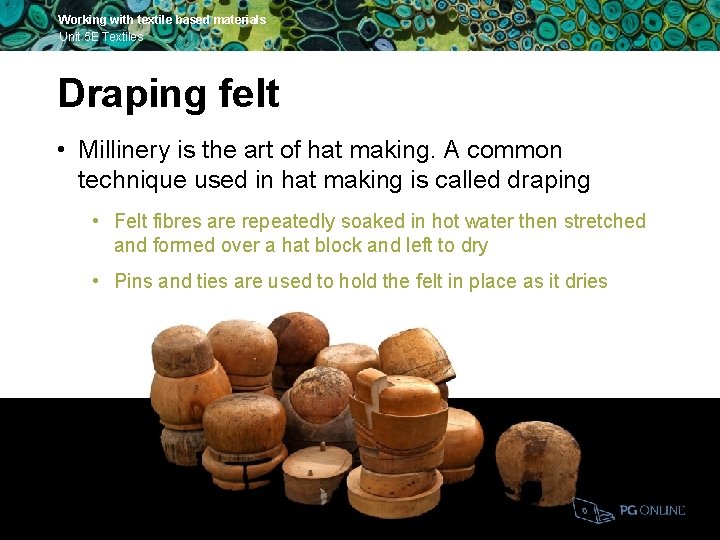
Working with textile based materials Unit 5 E Textiles Draping felt • Millinery is the art of hat making. A common technique used in hat making is called draping • Felt fibres are repeatedly soaked in hot water then stretched and formed over a hat block and left to dry • Pins and ties are used to hold the felt in place as it dries
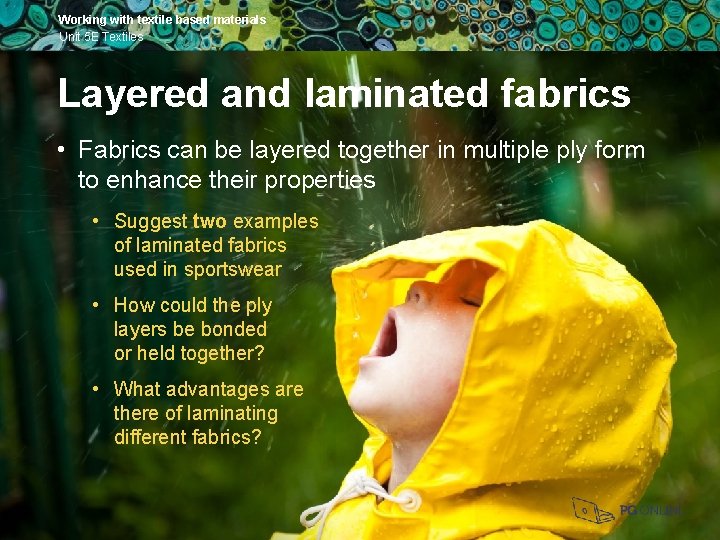
Working with textile based materials Unit 5 E Textiles Layered and laminated fabrics • Fabrics can be layered together in multiple ply form to enhance their properties • Suggest two examples of laminated fabrics used in sportswear • How could the ply layers be bonded or held together? • What advantages are there of laminating different fabrics?
Working with textile based materials Unit 5 E Textiles School-based dyeing • Dyeing fabric will permanently change its colour • Various techniques are used, either by hand or by machine • These include: • Dip dyeing • Tie dyeing • Machine dyeing

Working with textile based materials Unit 5 E Textiles Batik • Melted wax is applied by hand with a tjanting tool or printing blocks • Dye is added by hand to individual sections or to the whole fabric (commonly silk) in a vat • The wax forms an impermeable barrier to resist the dye and is later removed with heat • The process is then repeated to additional colour
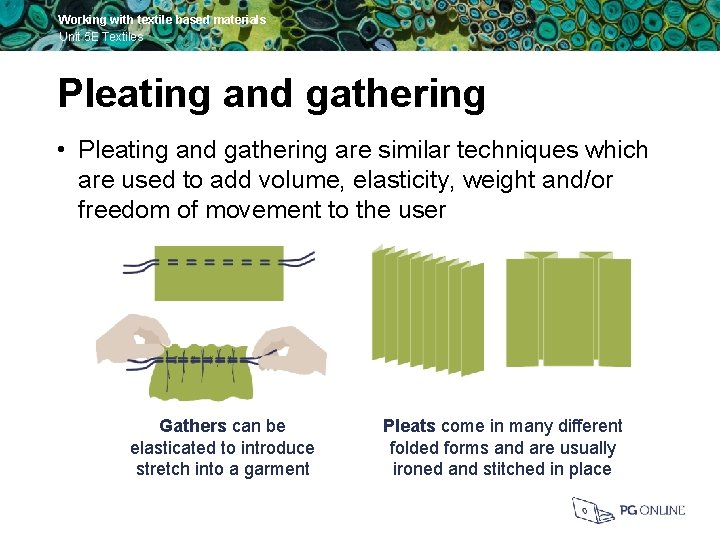
Working with textile based materials Unit 5 E Textiles Pleating and gathering • Pleating and gathering are similar techniques which are used to add volume, elasticity, weight and/or freedom of movement to the user Gathers can be elasticated to introduce stretch into a garment Pleats come in many different folded forms and are usually ironed and stitched in place

Working with textile based materials Unit 5 E Textiles Pleats or gathers? • Identify where pleats or gathers have been used • What are the advantages of each?
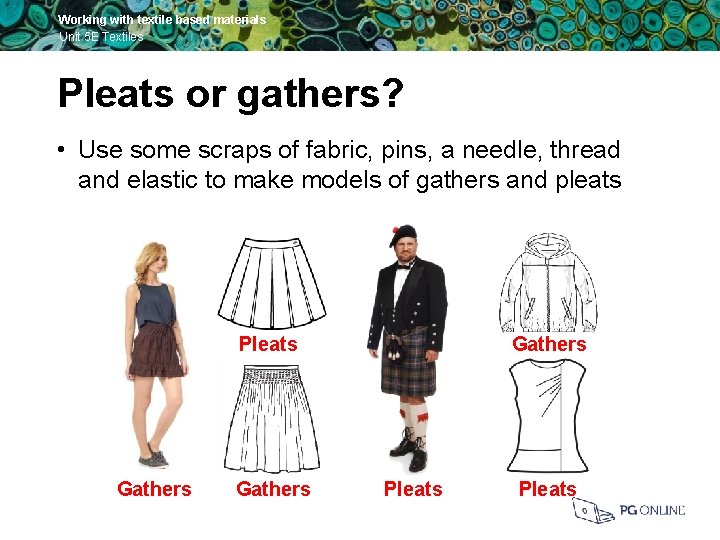
Working with textile based materials Unit 5 E Textiles Pleats or gathers? • Use some scraps of fabric, pins, a needle, thread and elastic to make models of gathers and pleats Pleats Gathers Pleats
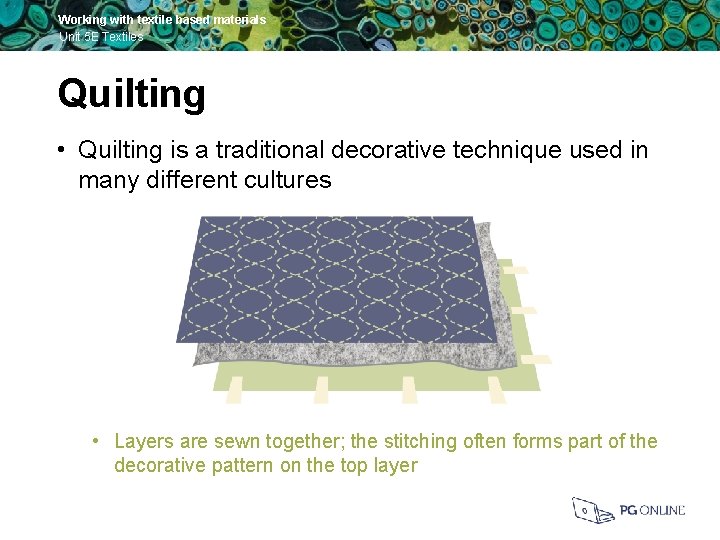
Working with textile based materials Unit 5 E Textiles Quilting • Quilting is a traditional decorative technique used in many different cultures • Layers are sewn together; the stitching often forms part of the decorative pattern on the top layer
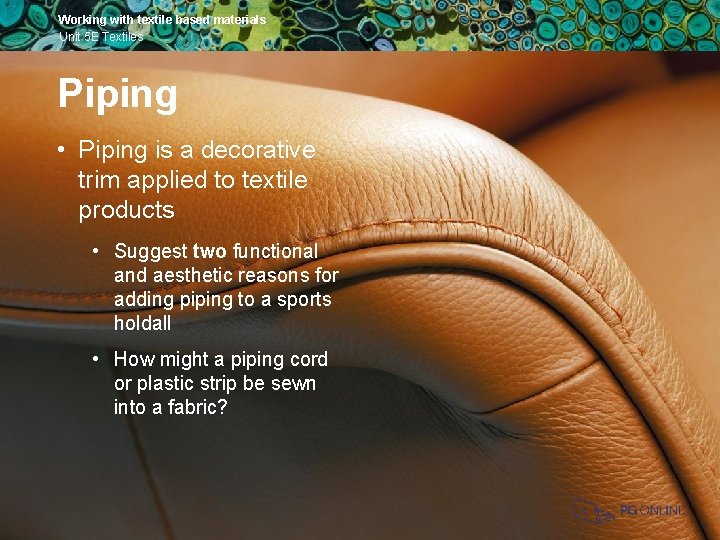
Working with textile based materials Unit 5 E Textiles Piping • Piping is a decorative trim applied to textile products • Suggest two functional and aesthetic reasons for adding piping to a sports holdall • How might a piping cord or plastic strip be sewn into a fabric?
Working with textile based materials Unit 5 E Textiles Piping Topic related videos to watch Commercial Shirt Manufacturing https: //www. youtube. com/watch? v=Htck. GEl 16 r 4 Draping at Christian Dior https: //www. youtube. com/watch? v=s. GULpc. JKbmc
- Slides: 26