
Title Role of Occupational Therapy in the NICU
- Slides: 1
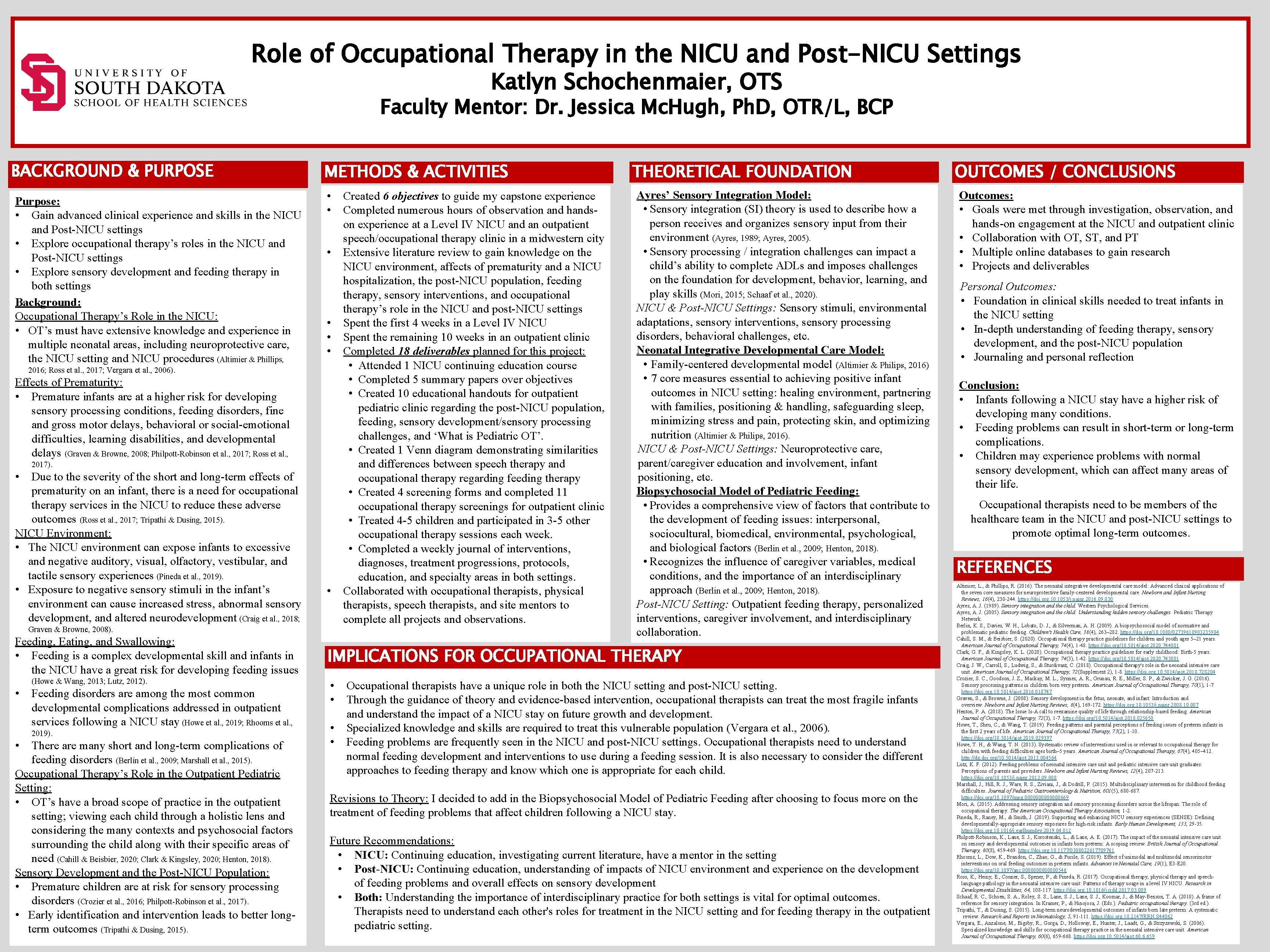
Title Role of Occupational Therapy in the NICU and Post-NICU Settings Katlyn Schochenmaier, OTS Faculty Mentor: Dr. Jessica Mc. Hugh, Ph. D, OTR/L, BCP Student Name, Faculty Mentor Name BACKGROUND & PURPOSE Purpose: • Gain advanced clinical experience and skills in the NICU and Post-NICU settings • Explore occupational therapy’s roles in the NICU and Post-NICU settings • Explore sensory development and feeding therapy in both settings Background: Occupational Therapy’s Role in the NICU: • OT’s must have extensive knowledge and experience in multiple neonatal areas, including neuroprotective care, the NICU setting and NICU procedures (Altimier & Phillips, METHODS & ACTIVITIES • • • 2016; Ross et al. , 2017; Vergara et al. , 2006). Effects of Prematurity: • Premature infants are at a higher risk for developing sensory processing conditions, feeding disorders, fine and gross motor delays, behavioral or social-emotional difficulties, learning disabilities, and developmental delays (Graven & Browne, 2008; Philpott-Robinson et al. , 2017; Ross et al. , 2017). • Due to the severity of the short and long-term effects of prematurity on an infant, there is a need for occupational therapy services in the NICU to reduce these adverse outcomes (Ross et al. , 2017; Tripathi & Dusing, 2015). NICU Environment: • The NICU environment can expose infants to excessive and negative auditory, visual, olfactory, vestibular, and tactile sensory experiences (Pineda et al. , 2019). • Exposure to negative sensory stimuli in the infant’s environment can cause increased stress, abnormal sensory development, and altered neurodevelopment (Craig et al. , 2018; • Graven & Browne, 2008). Feeding, Eating, and Swallowing: • Feeding is a complex developmental skill and infants in the NICU have a great risk for developing feeding issues (Howe & Wang, 2013; Lutz, 2012). • Feeding disorders are among the most common developmental complications addressed in outpatient services following a NICU stay (Howe et al. , 2019; Rhooms et al. , 2019). • There are many short and long-term complications of feeding disorders (Berlin et al. , 2009; Marshall et al. , 2015). Occupational Therapy’s Role in the Outpatient Pediatric Setting: • OT’s have a broad scope of practice in the outpatient setting; viewing each child through a holistic lens and considering the many contexts and psychosocial factors surrounding the child along with their specific areas of need (Cahill & Beisbier, 2020; Clark & Kingsley, 2020; Henton, 2018). Sensory Development and the Post-NICU Population: • Premature children are at risk for sensory processing disorders (Crozier et al. , 2016; Philpott-Robinson et al. , 2017). • Early identification and intervention leads to better longterm outcomes (Tripathi & Dusing, 2015). Created 6 objectives to guide my capstone experience Completed numerous hours of observation and handson experience at a Level IV NICU and an outpatient speech/occupational therapy clinic in a midwestern city Extensive literature review to gain knowledge on the NICU environment, affects of prematurity and a NICU hospitalization, the post-NICU population, feeding therapy, sensory interventions, and occupational therapy’s role in the NICU and post-NICU settings Spent the first 4 weeks in a Level IV NICU Spent the remaining 10 weeks in an outpatient clinic Completed 18 deliverables planned for this project: • Attended 1 NICU continuing education course • Completed 5 summary papers over objectives • Created 10 educational handouts for outpatient pediatric clinic regarding the post-NICU population, feeding, sensory development/sensory processing challenges, and ‘What is Pediatric OT’. • Created 1 Venn diagram demonstrating similarities and differences between speech therapy and occupational therapy regarding feeding therapy • Created 4 screening forms and completed 11 occupational therapy screenings for outpatient clinic • Treated 4 -5 children and participated in 3 -5 other occupational therapy sessions each week. • Completed a weekly journal of interventions, diagnoses, treatment progressions, protocols, education, and specialty areas in both settings. Collaborated with occupational therapists, physical therapists, speech therapists, and site mentors to complete all projects and observations. THEORETICAL FOUNDATION Ayres’ Sensory Integration Model: • Sensory integration (SI) theory is used to describe how a person receives and organizes sensory input from their environment (Ayres, 1989; Ayres, 2005). • Sensory processing / integration challenges can impact a child’s ability to complete ADLs and imposes challenges on the foundation for development, behavior, learning, and play skills (Mori, 2015; Schaaf et al. , 2020). NICU & Post-NICU Settings: Sensory stimuli, environmental adaptations, sensory interventions, sensory processing disorders, behavioral challenges, etc. Neonatal Integrative Developmental Care Model: • Family-centered developmental model (Altimier & Philips, 2016) • 7 core measures essential to achieving positive infant outcomes in NICU setting: healing environment, partnering with families, positioning & handling, safeguarding sleep, minimizing stress and pain, protecting skin, and optimizing nutrition (Altimier & Philips, 2016). NICU & Post-NICU Settings: Neuroprotective care, parent/caregiver education and involvement, infant positioning, etc. Biopsychosocial Model of Pediatric Feeding: • Provides a comprehensive view of factors that contribute to the development of feeding issues: interpersonal, sociocultural, biomedical, environmental, psychological, and biological factors (Berlin et al. , 2009; Henton, 2018). • Recognizes the influence of caregiver variables, medical conditions, and the importance of an interdisciplinary approach (Berlin et al. , 2009; Henton, 2018). Post-NICU Setting: Outpatient feeding therapy, personalized interventions, caregiver involvement, and interdisciplinary collaboration. IMPLICATIONS FOR OCCUPATIONAL THERAPY • • Occupational therapists have a unique role in both the NICU setting and post-NICU setting. Through the guidance of theory and evidence-based intervention, occupational therapists can treat the most fragile infants and understand the impact of a NICU stay on future growth and development. Specialized knowledge and skills are required to treat this vulnerable population (Vergara et al. , 2006). Feeding problems are frequently seen in the NICU and post-NICU settings. Occupational therapists need to understand normal feeding development and interventions to use during a feeding session. It is also necessary to consider the different approaches to feeding therapy and know which one is appropriate for each child. Revisions to Theory: I decided to add in the Biopsychosocial Model of Pediatric Feeding after choosing to focus more on the treatment of feeding problems that affect children following a NICU stay. Future Recommendations: • NICU: Continuing education, investigating current literature, have a mentor in the setting • Post-NICU: Continuing education, understanding of impacts of NICU environment and experience on the development of feeding problems and overall effects on sensory development • Both: Understanding the importance of interdisciplinary practice for both settings is vital for optimal outcomes. Therapists need to understand each other's roles for treatment in the NICU setting and for feeding therapy in the outpatient pediatric setting. OUTCOMES / CONCLUSIONS Outcomes: • Goals were met through investigation, observation, and hands-on engagement at the NICU and outpatient clinic • Collaboration with OT, ST, and PT • Multiple online databases to gain research • Projects and deliverables Personal Outcomes: • Foundation in clinical skills needed to treat infants in the NICU setting • In-depth understanding of feeding therapy, sensory development, and the post-NICU population • Journaling and personal reflection Conclusion: • Infants following a NICU stay have a higher risk of developing many conditions. • Feeding problems can result in short-term or long-term complications. • Children may experience problems with normal sensory development, which can affect many areas of their life. Occupational therapists need to be members of the healthcare team in the NICU and post-NICU settings to promote optimal long-term outcomes. REFERENCES Altimier, L. , & Phillips, R. (2016). The neonatal integrative developmental care model: Advanced clinical applications of the seven core measures for neuroprotective family-centered developmental care. Newborn and Infant Nursing Reviews, 16(4), 230 -244. https: //doi. org. 1053/j. nainr. 2016. 09. 030 Ayres, A. J. (1989). Sensory integration and the child. Western Psychological Services. Ayres, A. J. (2005). Sensory integration and the child: Understanding hidden sensory challenges. Pediatric Therapy Network. Berlin, K. S. , Davies, W. H. , Lobato, D. J. , & Silverman, A. H. (2009). A biopsychosocial model of normative and problematic pediatric feeding. Children's Health Care, 38(4), 263– 282. https: //doi. org/10. 1080/02739610903235984 Cahill, S. M. , & Beisbier, S. (2020). Occupational therapy practice guidelines for children and youth ages 5– 21 years. American Journal of Occupational Therapy, 74(4), 1 -48. https: //doi. org/10. 5014/ajot. 2020. 744001 Clark, G. F. , & Kingsley, K. L. (2020). Occupational therapy practice guidelines for early childhood: Birth-5 years. American Journal of Occupational Therapy, 74(3), 1 -42. https: //doi. org/10. 5014/ajot. 2020. 743001 Craig, J. W. , Carroll, S. , Ludwig, S. , & Sturdivant, C. (2018). Occupational therapy's role in the neonatal intensive care unit. American Journal of Occupational Therapy, 72(Supplement 2), 1 -8. https: //doi. org. 10. 5014/ajot. 2018. 72 S 204 Crozier, S. C. , Goodson, J. Z. , Mackay, M. L. , Synnes, A. R. , Grunau, R. E. , Miller, S. P. , & Zwicker, J. G. (2016). Sensory processing patterns in children born very preterm. American Journal of Occupational Therapy, 70(1), 1 -7. https: //doi. org. 10. 5014/ajot. 2016. 018747 Graven, S. , & Browne, J. (2008). Sensory development in the fetus, neonate, and infant: Introduction and overview. Newborn and Infant Nursing Reviews, 8(4), 169 -172. https: //doi. org. 1053/j. nainr. 2008. 10. 007 Henton, P. A. (2018). The Issue Is-A call to reexamine quality of life through relationship-based feeding. American Journal of Occupational Therapy, 72(3), 1 -7. https: //doi. org/10. 5014/ajot. 2018. 025650 Howe, T. , Sheu, C. , & Wang, T. (2019). Feeding patterns and parental perceptions of feeding issues of preterm infants in the first 2 years of life. American Journal of Occupational Therapy, 73(2), 1 -10. https: //doi. org/10. 5014/ajot. 2019. 029397 Howe, T. H. , & Wang, T. N. (2013). Systematic review of interventions used in or relevant to occupational therapy for children with feeding difficulties ages birth– 5 years. American Journal of Occupational Therapy, 67(4), 405– 412. http: //dx. doi. org/10. 5014/ajot. 2013. 004564 Lutz, K. F. (2012). Feeding problems of neonatal intensive care unit and pediatric intensive care unit graduates: Perceptions of parents and providers. Newborn and Infant Nursing Reviews, 12(4), 207 -213. https: //doi. org/10. 1053/j. nainr. 2012. 09. 008 Marshall, J. , Hill, R. J. , Ware, R. S. , Ziviani, J. , & Dodrill, P. (2015). Multidisciplinary intervention for childhood feeding difficulties. Journal of Pediatric Gastroenterology & Nutrition, 601(5), 680 -687. https: //doi. org/10. 1097/mpg. 0000000669 Mori, A. (2015). Addressing sensory integration and sensory processing disorders across the lifespan: The role of occupational therapy. The American Occupational Therapy Association, 1 -2. Pineda, R. , Raney, M. , & Smith, J. (2019). Supporting and enhancing NICU sensory experiences (SENSE): Defining developmentally-appropriate sensory exposures for high-risk infants. Early Human Development, 133, 29 -35. https: //doi. org. 1016/j. earlhumdev. 2019. 04. 012 Philpott-Robinson, K. , Lane, S. J. , Korostenski, L. , & Lane, A. E. (2017). The impact of the neonatal intensive care unit on sensory and developmental outcomes in infants born preterm: A scoping review. British Journal of Occupational Therapy, 80(8), 459 -469. https: //doi. org. 10. 1177/0308022617709761 Rhooms, L. , Dow, K. , Brandon, C. , Zhao, G. , & Fucile, S. (2019). Effect of unimodal and multimodal sensorimotor interventions on oral feeding outcomes in preterm infants. Advances in Neonatal Care, 19(1), E 3 -E 20. https: //doi. org/10. 1097/anc. 0000000546 Ross, K. , Heiny, E. , Conner, S. , Spener, P. , & Pineda, R. (2017). Occupational therapy, physical therapy and speechlanguage pathology in the neonatal intensive care unit: Patterns of therapy usage in a level IV NICU. Research in Developmental Disabilities, 64, 108 -117. https: //doi. org. 1016/j. ridd. 2017. 03. 009 Schaaf, R. C. , Schoen, S. A. , Roley, S. S. , Lane, S. J. , Koomar, J. , & May-Benson, T. A. (2010). A frame of reference for sensory integration. In Kramer, P. , & Hinojosa, J. (Eds. ). Pediatric occupational therapy. (3 rd ed. ). Tripathi, T. , & Dusing, S. (2015). Long-term neurodevelopmental outcomes of infants born late preterm: A systematic review. Research and Reports in Neonatology, 5, 91 -111. https: //doi. org. 10. 2147/RRN. S 44062 Vergara, E. , Anzalone, M. , Bigsby, R. , Gorga, D. , Holloway, E. , Hunter, J. , Laadt, G. , & Strzyzewski, S. (2006). Specialized knowledge and skills for occupational therapy practice in the neonatal intensive care unit. American Journal of Occupational Therapy, 60(6), 659 -668. https: //doi. org. 10. 5014/ajot. 60. 6. 659