
TITLE My job today is to convinceremind you

TITLE
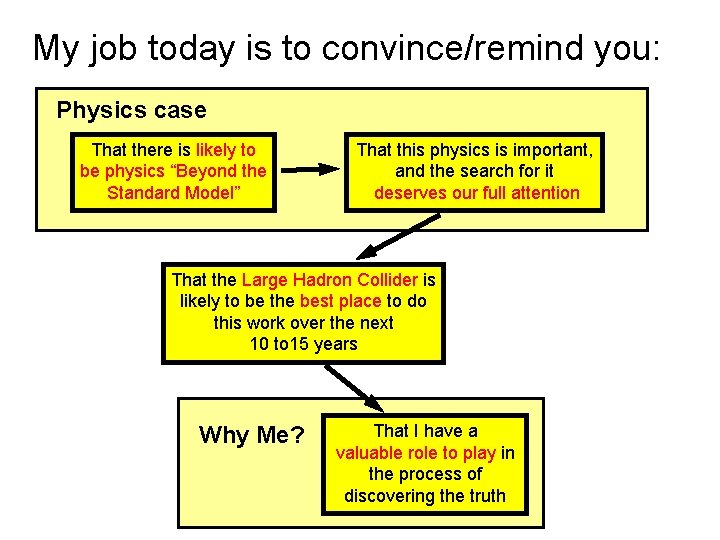
My job today is to convince/remind you: Physics case That there is likely to be physics “Beyond the Standard Model” That this physics is important, and the search for it deserves our full attention That the Large Hadron Collider is likely to be the best place to do this work over the next 10 to 15 years Why Me? That I have a valuable role to play in the process of discovering the truth
Large Hadron Collider and ATLAS in 1 minute
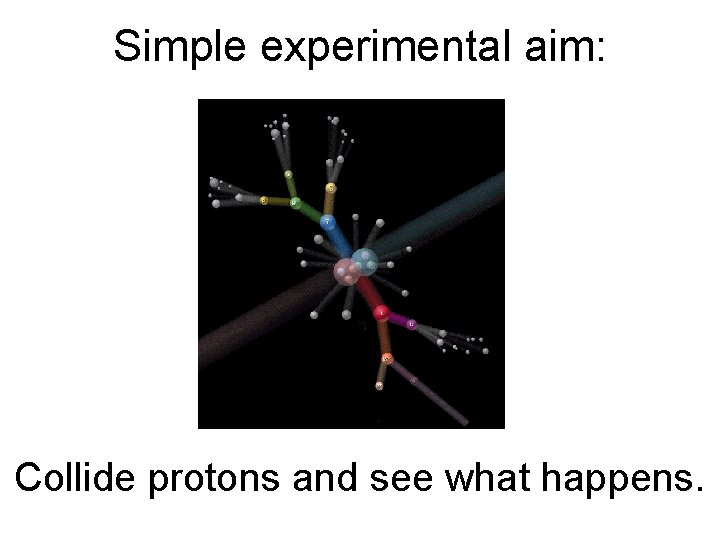
Simple experimental aim: Collide protons and see what happens.
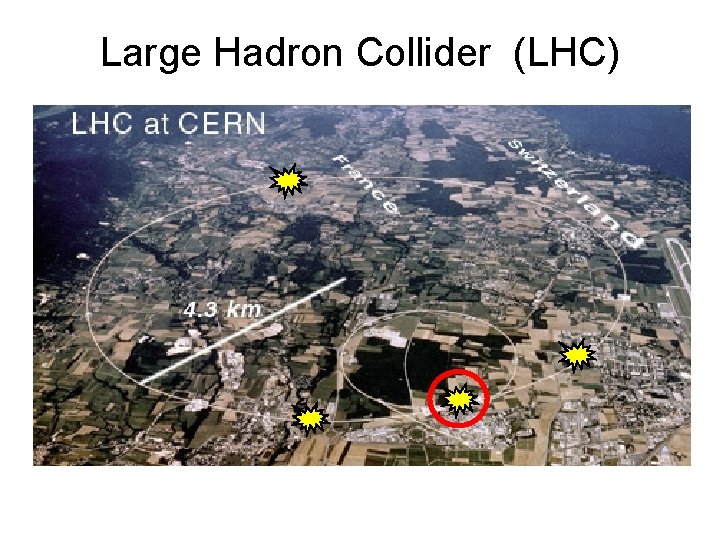
Large Hadron Collider (LHC)
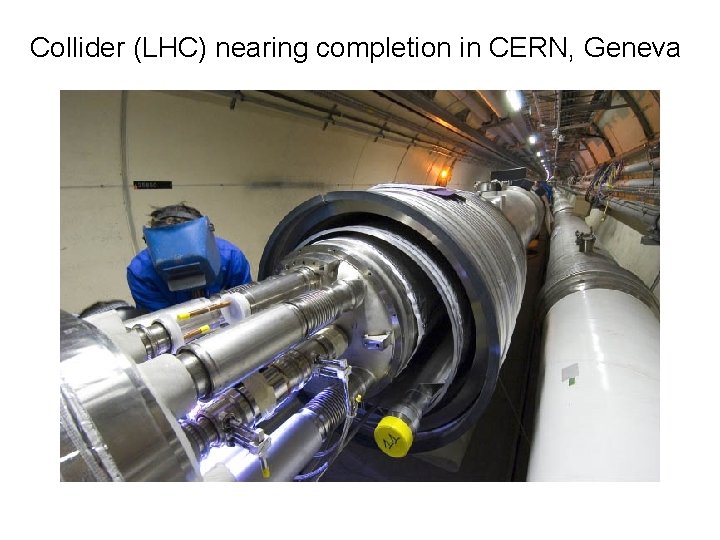
Collider (LHC) nearing completion in CERN, Geneva
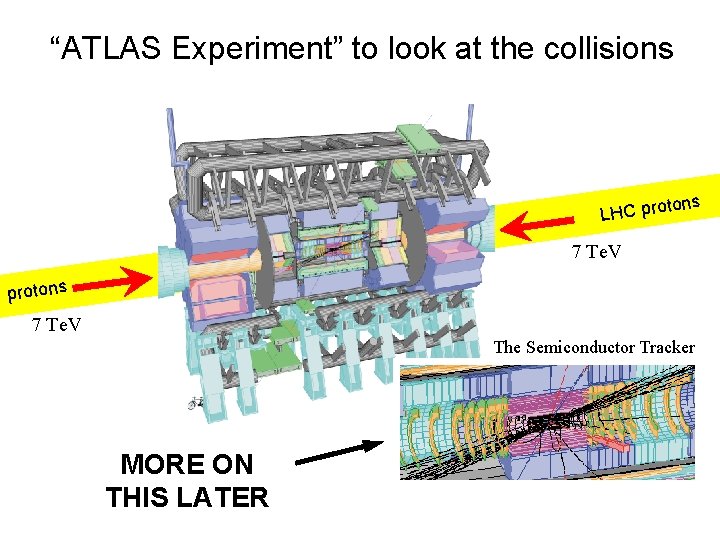
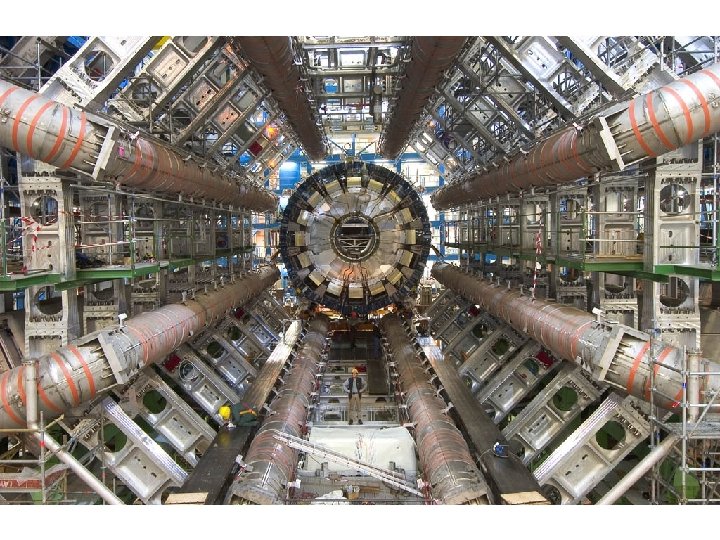
“ATLAS Experiment” to look at the collisions tons LHC pro 7 Te. V protons 7 Te. V The Semiconductor Tracker MORE ON THIS LATER
Note about “the brief” • Talk about: – “Your vision for your future research programme at Cambridge” • In context of the LHC we have – predictable items • Make the detector work • Commissioning – understand MET resolution, jet energy scale, alignment – unpredictable items • What new physics may nature hold? • What will we see of it? • How will we measure it? MANY UNKNOWNS ADAPTABILITY IS THE KEY
Physics Case • Why Physics beyond the Standard Model?
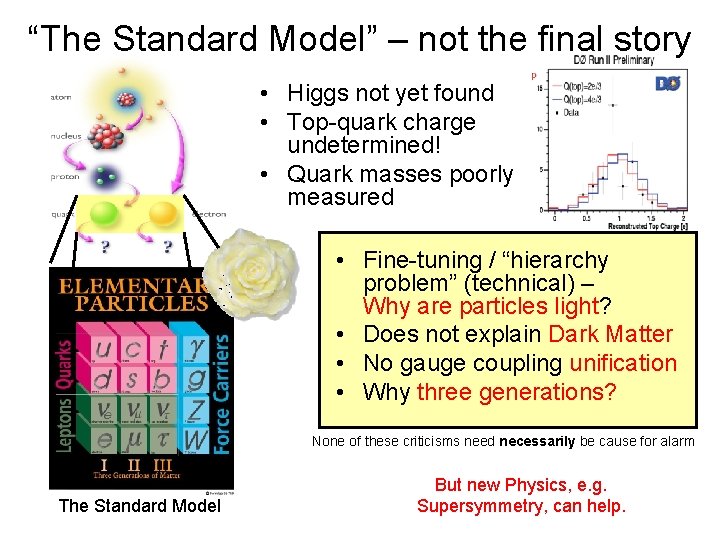
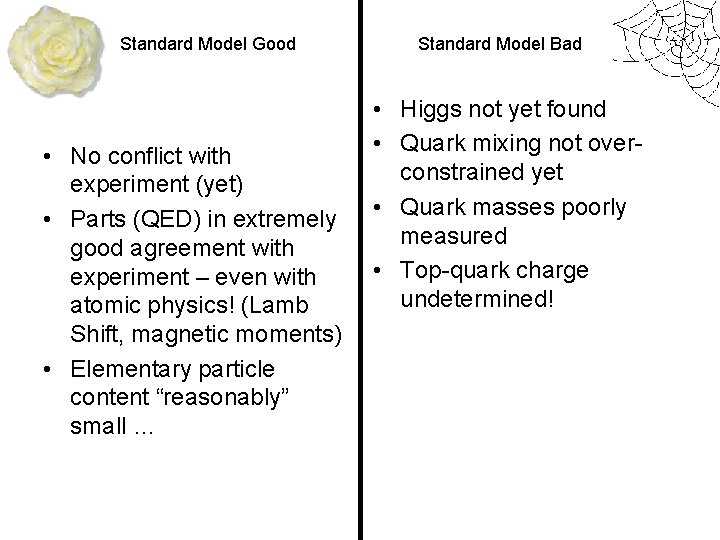
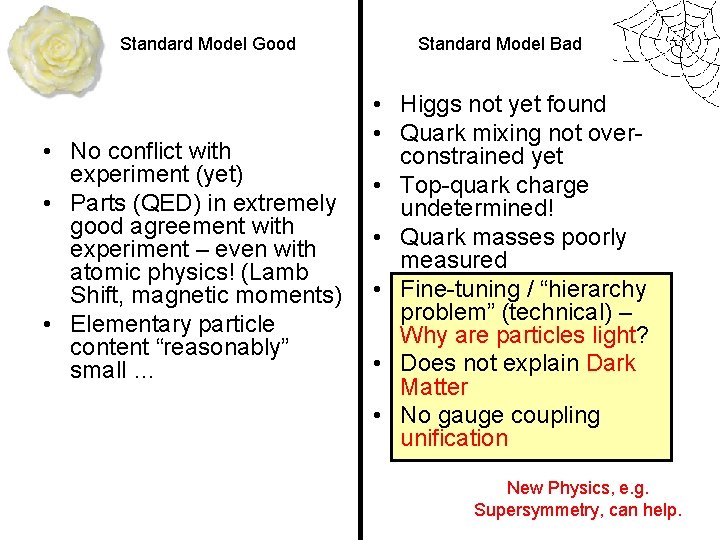
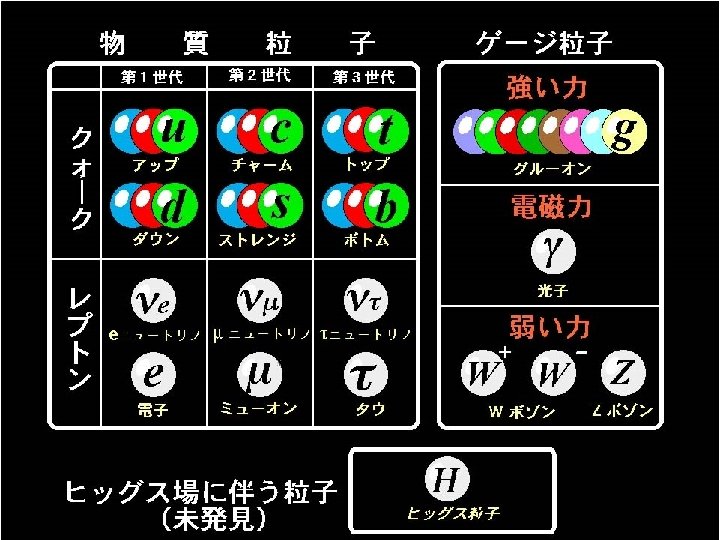
“The Standard Model” – not the final story • Higgs not yet found • Top-quark charge undetermined! • Quark masses poorly measured • Fine-tuning / “hierarchy problem” (technical) – Why are particles light? • Does not explain Dark Matter • No gauge coupling unification • Why three generations? None of these criticisms need necessarily be cause for alarm The Standard Model But new Physics, e. g. Supersymmetry, can help.
Possibilities for new physics … • Supersymmetry? – – – Minimal Non-minimal R-parity violating or conserving Gauge mediated Gravity mediated • Extra Dimensional Models – Large (particles trapped on “brane”) – Universal (particles everywhere) – With/without small black holes • “Littlest” Higgs ? • ….

There’s a strange “guarantee” … • Something new will be found at the LHC – If the Higgs Boson exists • It will be found! – If the Higgs Boson doesn’t exist • Cross-section for W-boson scattering will be observed to deviate from Standard Model • Strategic “gamble” – Anticipate large – Look for everything – Do not concentrate on Higgs
What I Contribute Ana
High Energy Physics for the 21 st Century Step one: into the unknown Christopher Lester
Standard Model Good • No conflict with experiment (yet) • Parts (QED) in extremely good agreement with experiment – even with atomic physics! (Lamb Shift, magnetic moments) • Elementary particle content “reasonably” small … Standard Model Bad • Higgs not yet found • Quark mixing not overconstrained yet • Quark masses poorly measured • Top-quark charge undetermined!
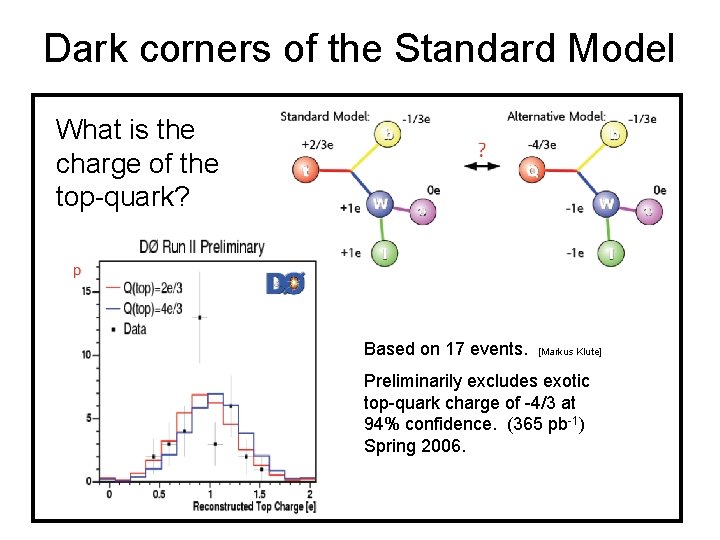
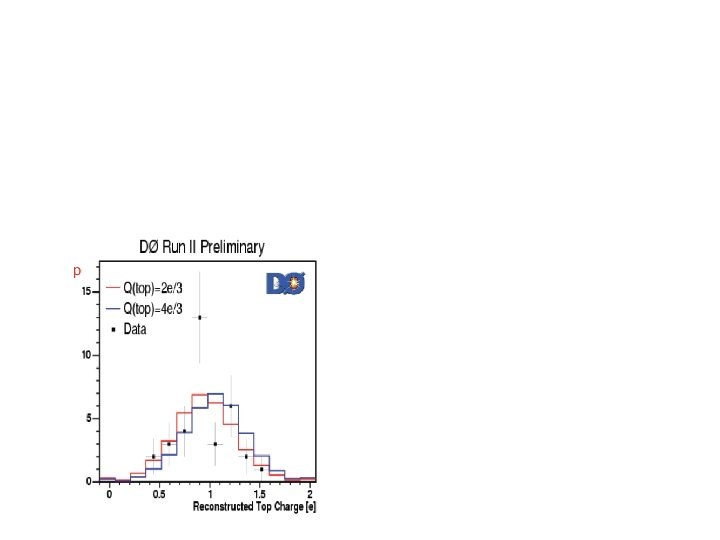
Dark corners of the Standard Model What is the charge of the top-quark? Based on 17 events. [Markus Klute] Preliminarily excludes exotic top-quark charge of -4/3 at 94% confidence. (365 pb-1) Spring 2006.
Standard Model Good • No conflict with experiment (yet) • Parts (QED) in extremely good agreement with experiment – even with atomic physics! (Lamb Shift, magnetic moments) • Elementary particle content “reasonably” small … Standard Model Bad • Higgs not yet found • Quark mixing not overconstrained yet • Top-quark charge undetermined! • Quark masses poorly measured • Fine-tuning / “hierarchy problem” (technical) – Why are particles light? • Does not explain Dark Matter • No gauge coupling unification New Physics, e. g. Supersymmetry, can help.
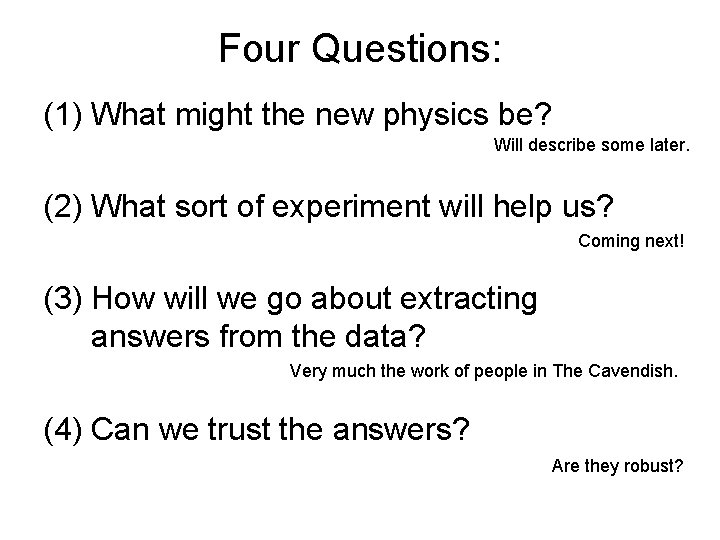
Four Questions: (1) What might the new physics be? Will describe some later. (2) What sort of experiment will help us? Coming next! (3) How will we go about extracting answers from the data? Very much the work of people in The Cavendish. (4) Can we trust the answers? Are they robust?
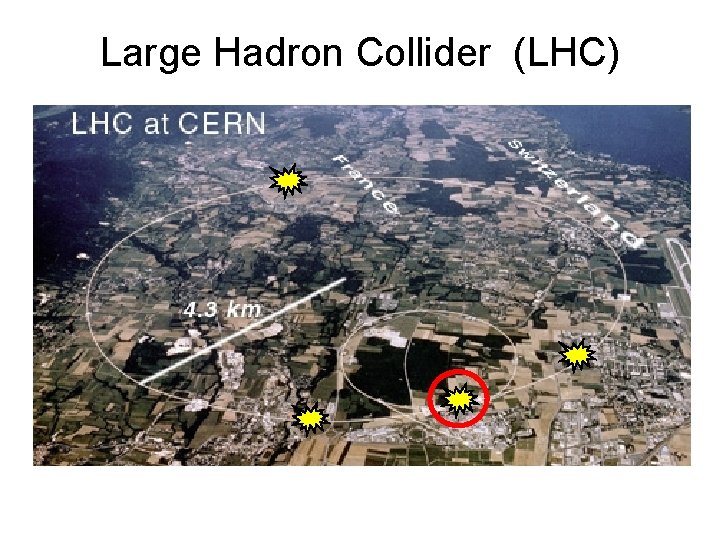
Large Hadron Collider (LHC)
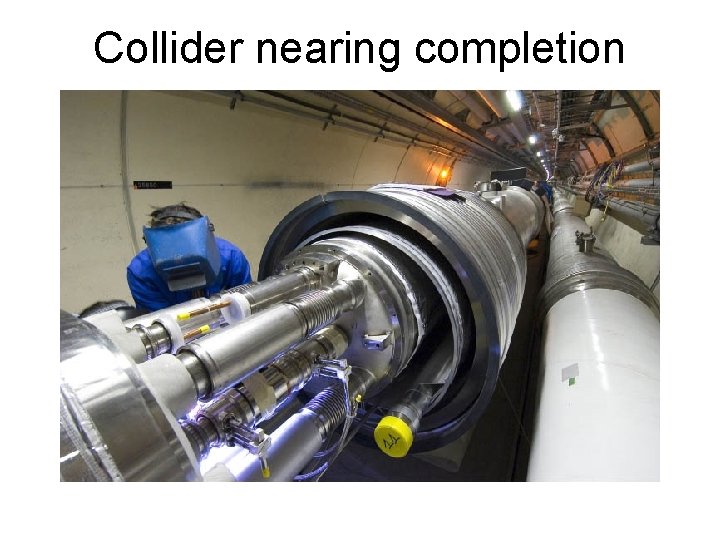
Collider nearing completion
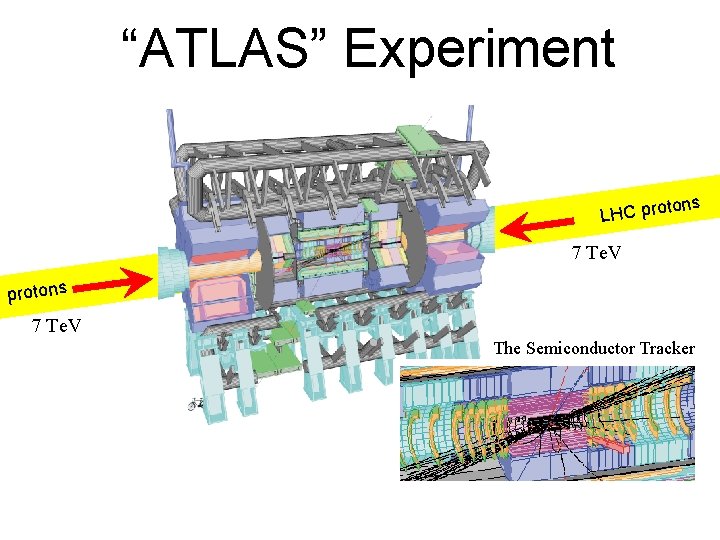
“ATLAS” Experiment tons LHC pro 7 Te. V protons 7 Te. V The Semiconductor Tracker
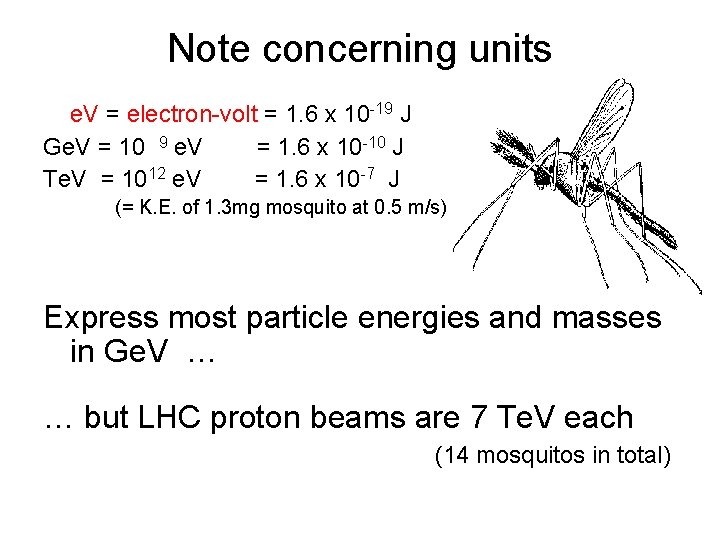
Note concerning units e. V = electron-volt = 1. 6 x 10 -19 J Ge. V = 10 9 e. V = 1. 6 x 10 -10 J Te. V = 1012 e. V = 1. 6 x 10 -7 J (= K. E. of 1. 3 mg mosquito at 0. 5 m/s) Express most particle energies and masses in Ge. V … … but LHC proton beams are 7 Te. V each (14 mosquitos in total)
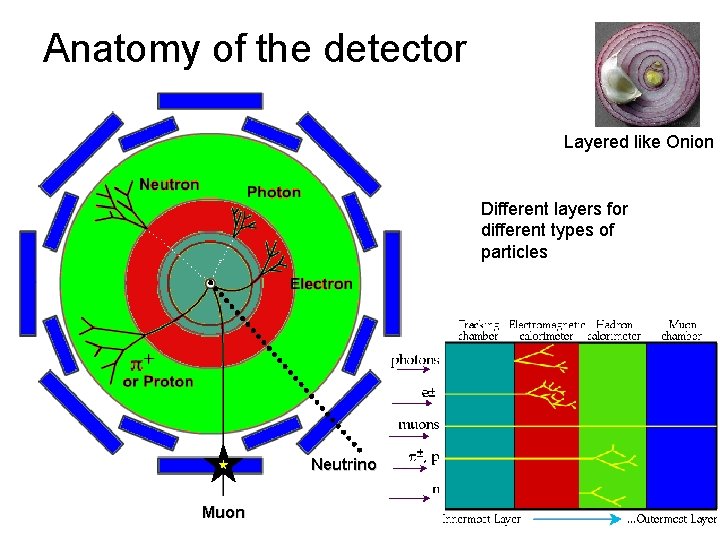
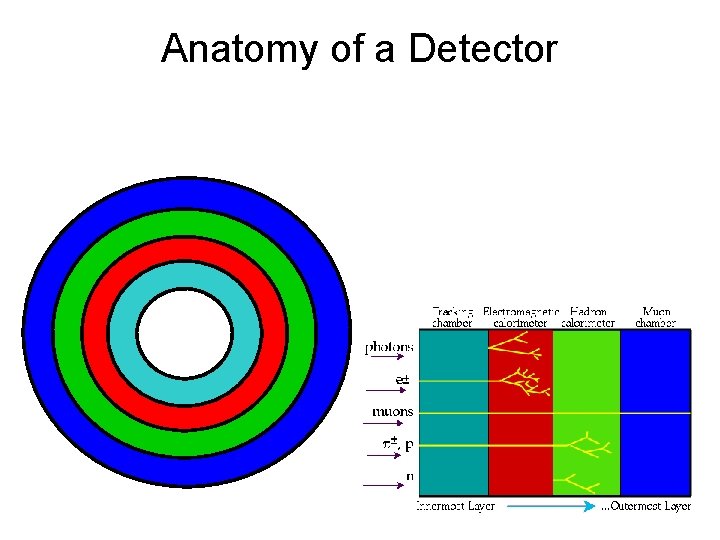
Anatomy of the detector Layered like Onion Different layers for different types of particles Neutrino Muon
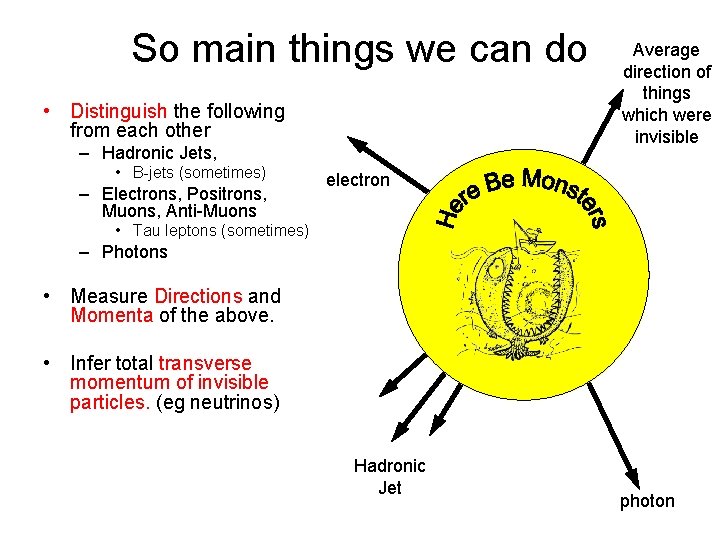
So main things we can do • Distinguish the following from each other – Hadronic Jets, • B-jets (sometimes) – Electrons, Positrons, Muons, Anti-Muons Average direction of things which were invisible electron • Tau leptons (sometimes) – Photons • Measure Directions and Momenta of the above. • Infer total transverse momentum of invisible particles. (eg neutrinos) Hadronic Jet photon
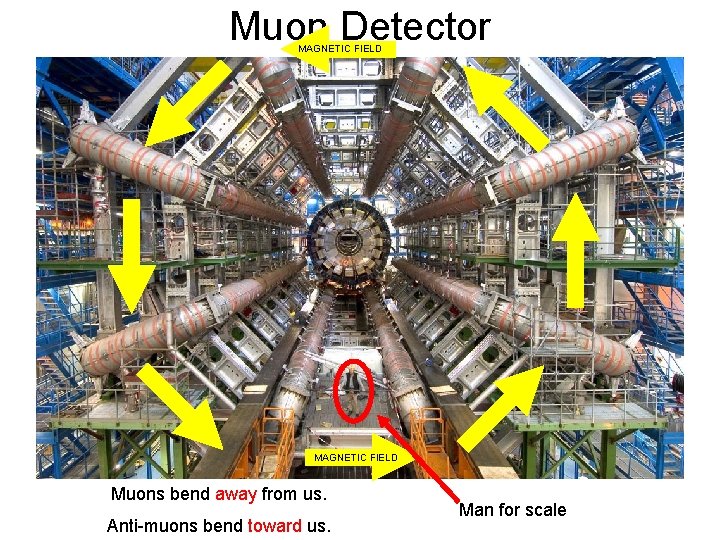
Muon Detector MAGNETIC FIELD Muons bend away from us. Anti-muons bend toward us. Man for scale
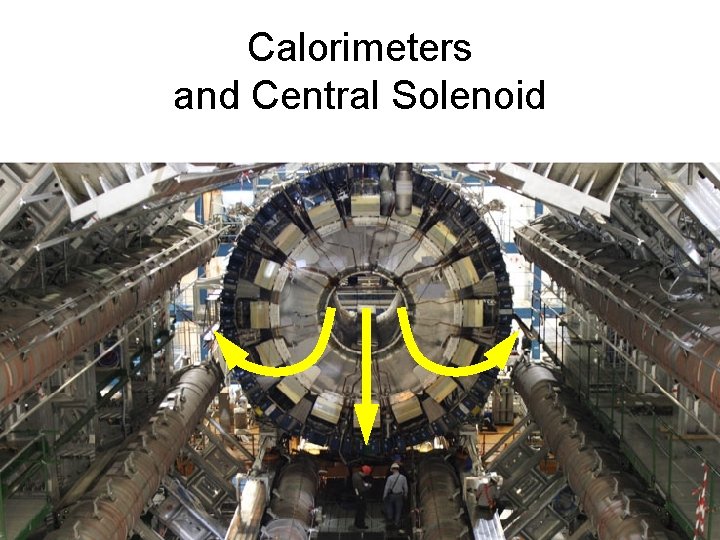
Calorimeters and Central Solenoid
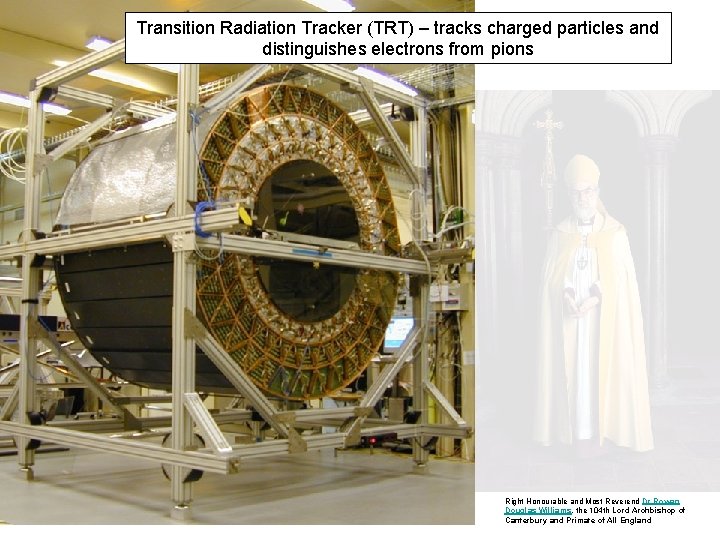
Transition Radiation Tracker (TRT) – tracks charged particles and distinguishes electrons from pions Right Honourable and Most Reverend Dr Rowan Douglas Williams, the 104 th Lord Archbishop of Canterbury and Primate of All England
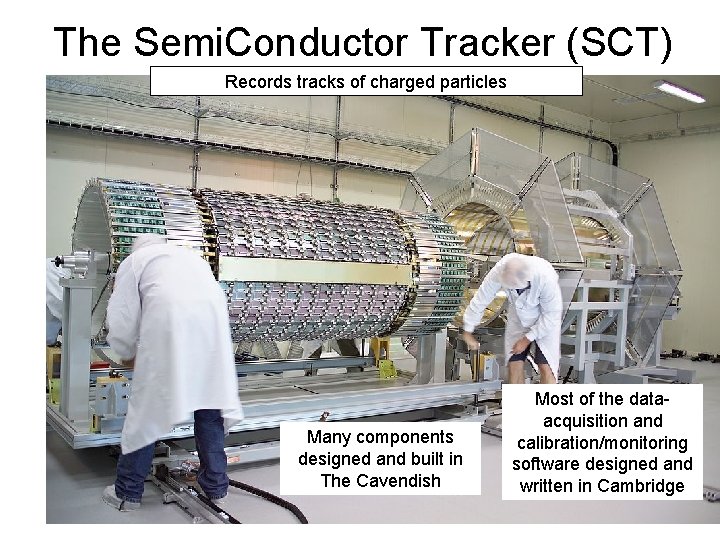
The Semi. Conductor Tracker (SCT) Records tracks of charged particles Many components designed and built in The Cavendish Most of the dataacquisition and calibration/monitoring software designed and written in Cambridge
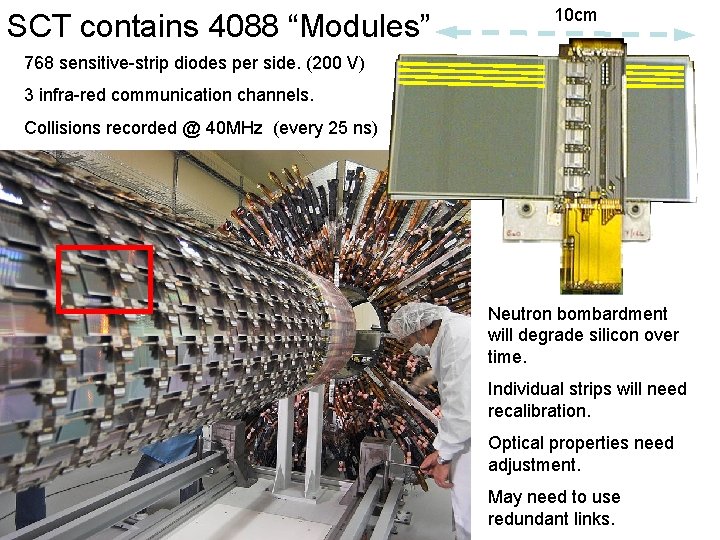
SCT contains 4088 “Modules” 10 cm 768 sensitive-strip diodes per side. (200 V) 3 infra-red communication channels. Collisions recorded @ 40 MHz (every 25 ns) Neutron bombardment will degrade silicon over time. Individual strips will need recalibration. Optical properties need adjustment. May need to use redundant links.
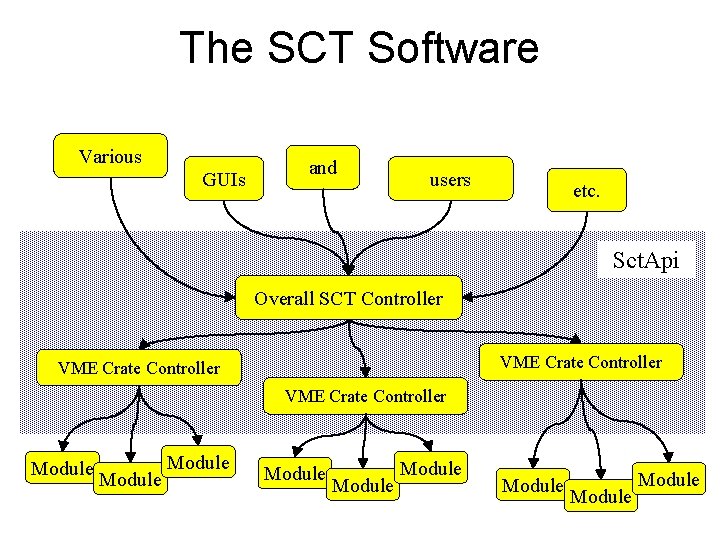
SCT Data Acquisition Software • Present size: – 350, 000 lines of code – ~6 developers • Much still to be done: – Have managed to control 500 modules at once • only 1/8 th of final number • “multi-crate” development - parallelisation – Needs to become usable by non-experts – Needs to recover from anomalies automatically
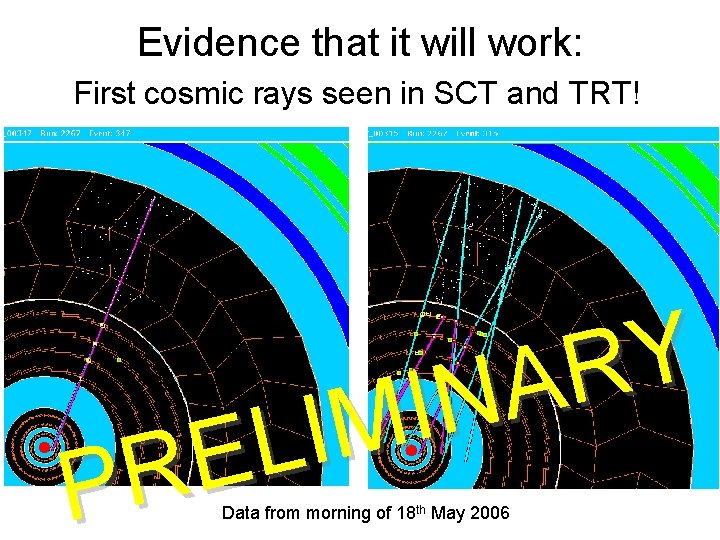
Evidence that it will work: First cosmic rays seen in SCT and TRT! Y R A N I M I L E R P Data from morning of 18 th May 2006
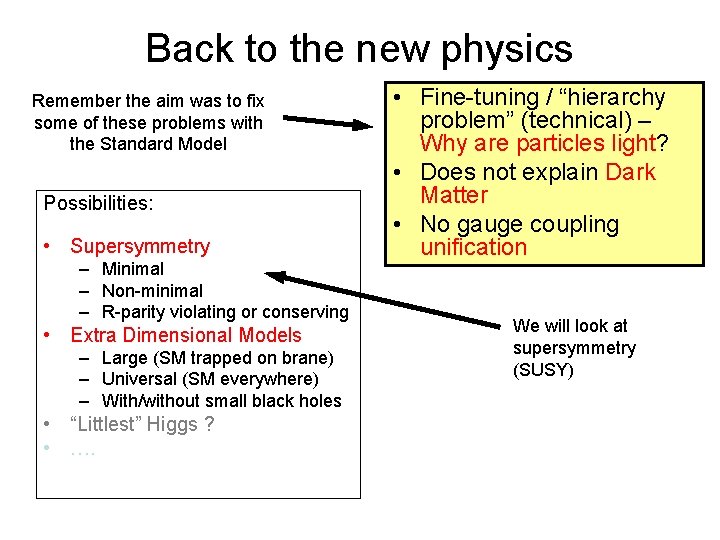
Back to the new physics Remember the aim was to fix some of these problems with the Standard Model Possibilities: • Supersymmetry – Minimal – Non-minimal – R-parity violating or conserving • Extra Dimensional Models – Large (SM trapped on brane) – Universal (SM everywhere) – With/without small black holes • “Littlest” Higgs ? • …. • Fine-tuning / “hierarchy problem” (technical) – Why are particles light? • Does not explain Dark Matter • No gauge coupling unification We will look at supersymmetry (SUSY)
Supersymmetry! CAUTION! • It may exist • It may not • First look for deviations from Standard Model! Gamble: IF DEVIATIONS ARE SEEN: • Old techniques won’t work • New physics not simple • Can new techniques in SUSY but can apply them elsewhere. Experiment must lead theory.
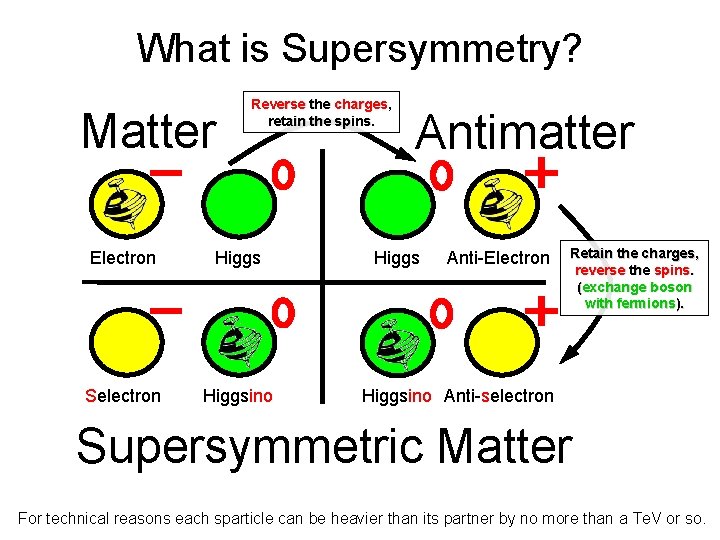
What is Supersymmetry? Matter Reverse the charges, retain the spins. Electron Higgs Selectron Higgsino Antimatter Higgs Anti-Electron Retain the charges, reverse the spins. (exchange boson with fermions). Higgsino Anti-selectron Supersymmetric Matter For technical reasons each sparticle can be heavier than its partner by no more than a Te. V or so.
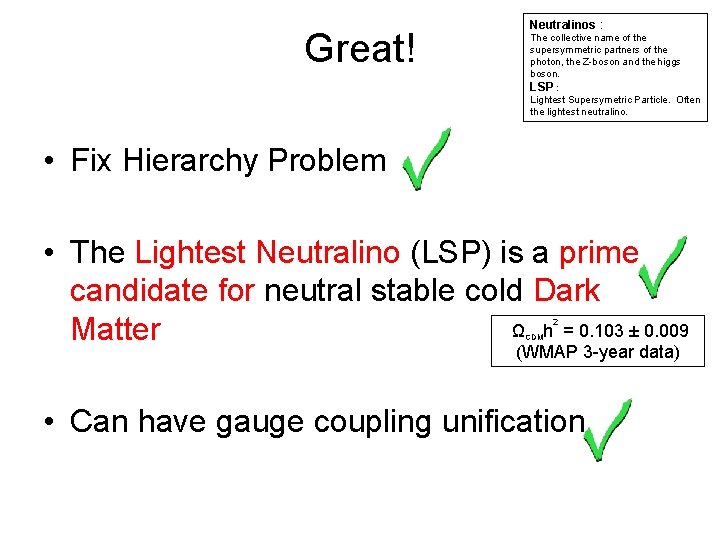
Great! Neutralinos : The collective name of the supersymmetric partners of the photon, the Z-boson and the higgs boson. LSP : Lightest Supersymetric Particle. Often the lightest neutralino. • Fix Hierarchy Problem • The Lightest Neutralino (LSP) is a prime candidate for neutral stable cold Dark Ω h = 0. 103 ± 0. 009 Matter 2 CDM (WMAP 3 -year data) • Can have gauge coupling unification
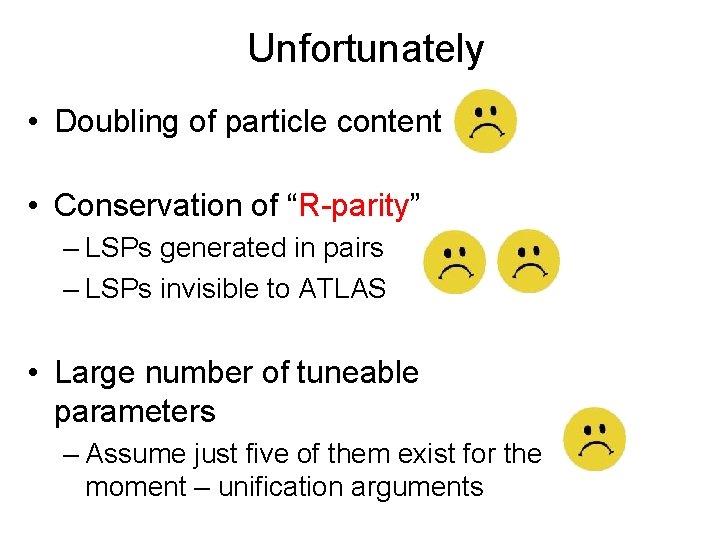
Unfortunately • Doubling of particle content • Conservation of “R-parity” – LSPs generated in pairs – LSPs invisible to ATLAS • Large number of tuneable parameters – Assume just five of them exist for the moment – unification arguments
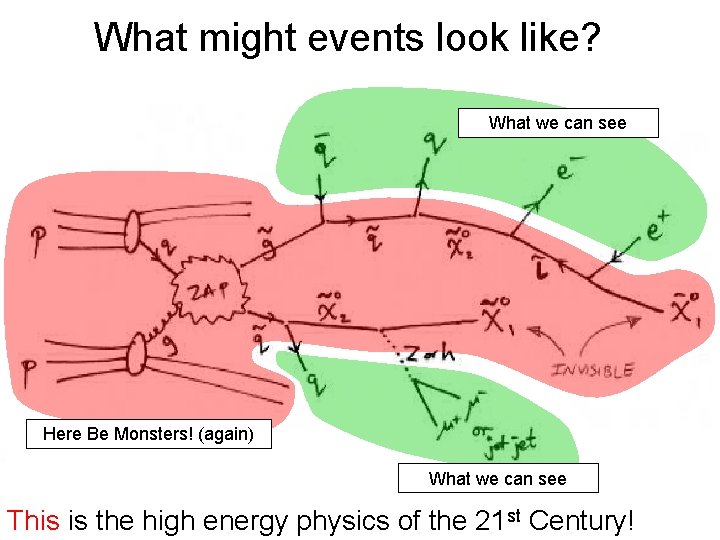
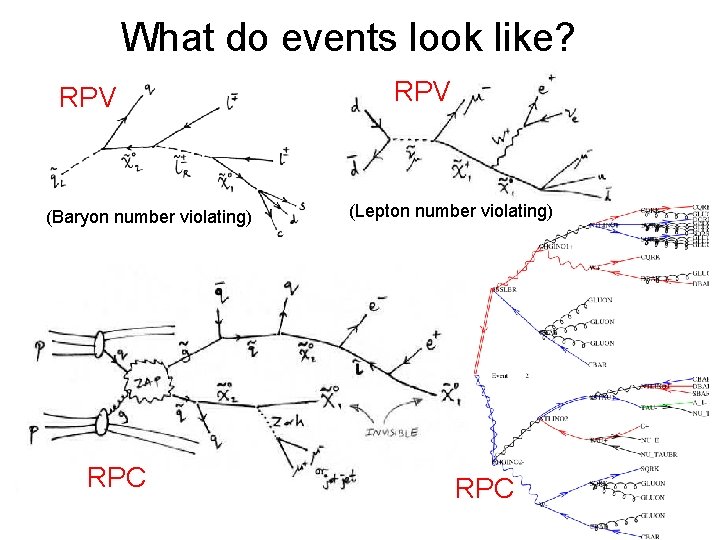
What might events look like? What we can see Here Be Monsters! (again) What we can see This is the high energy physics of the 21 st Century!
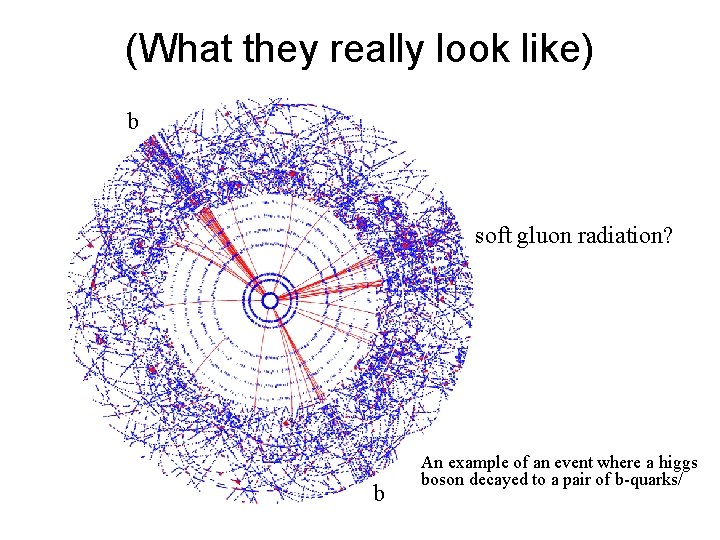
(What they really look like) b soft gluon radiation? b An example of an event where a higgs boson decayed to a pair of b-quarks/
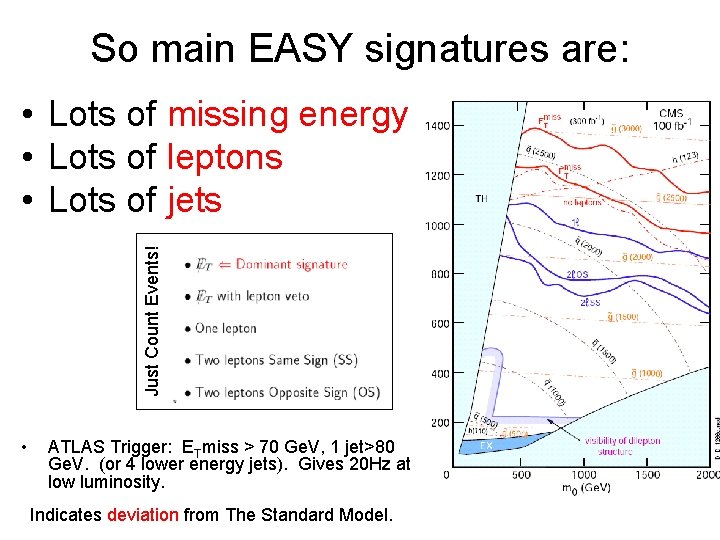
So main EASY signatures are: Just Count Events! • Lots of missing energy • Lots of leptons • Lots of jets • ATLAS Trigger: ETmiss > 70 Ge. V, 1 jet>80 Ge. V. (or 4 lower energy jets). Gives 20 Hz at low luminosity. Indicates deviation from The Standard Model.
• Papers for RAE ? – Multidimensional likelihood maps – String inspired susy models – MT 2 and friends • Courses – No need to revise: • Mathematics (all) • Computational Physics
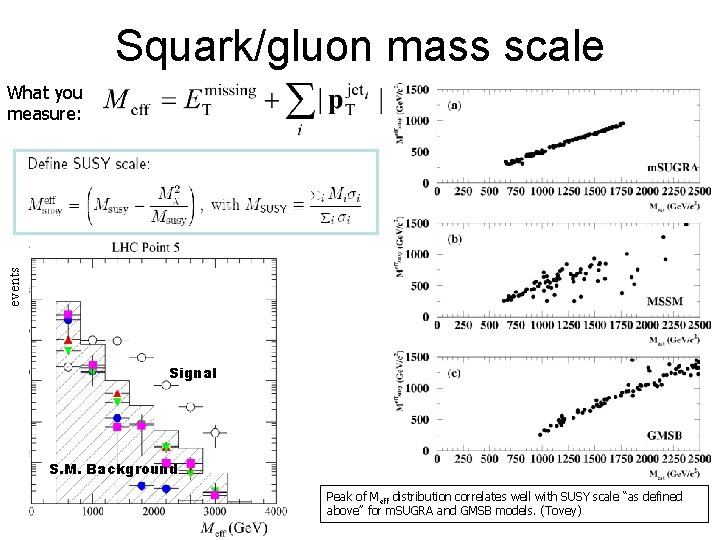
Squark/gluon mass scale events What you measure: Signal S. M. Background Peak of Meff distribution correlates well with SUSY scale “as defined above” for m. SUGRA and GMSB models. (Tovey)
The real test comes when you want to measure individual masses etc.
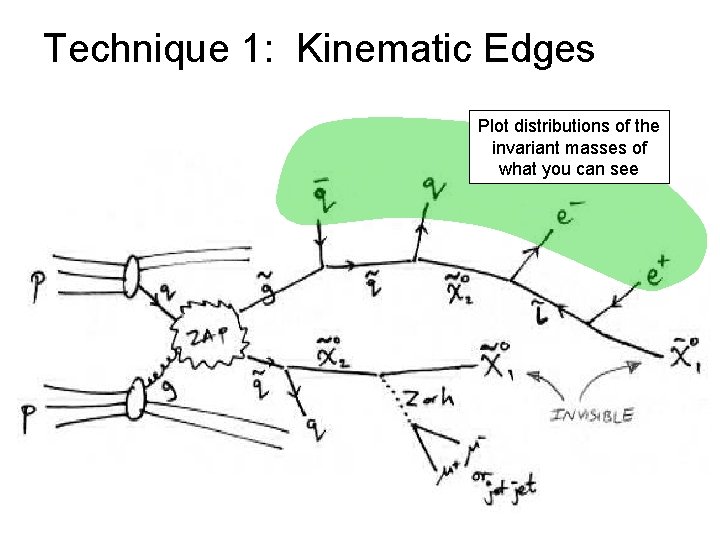
Technique 1: Kinematic Edges Plot distributions of the invariant masses of what you can see
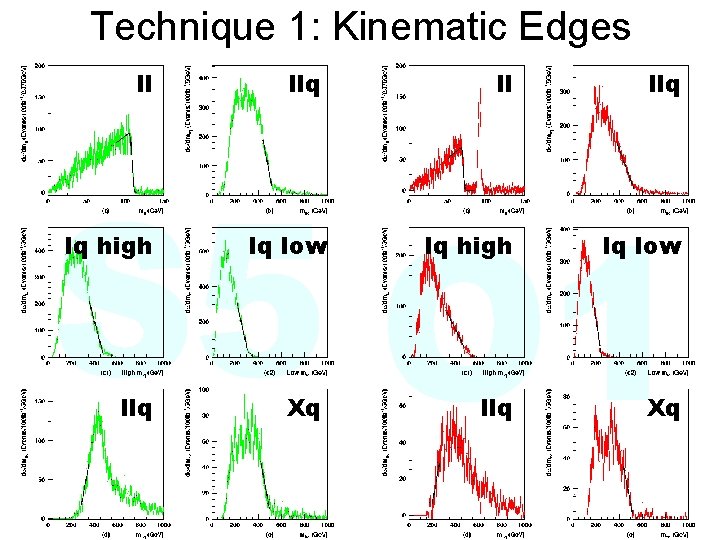
Technique 1: Kinematic Edges ll llq lq high lq low llq Xq
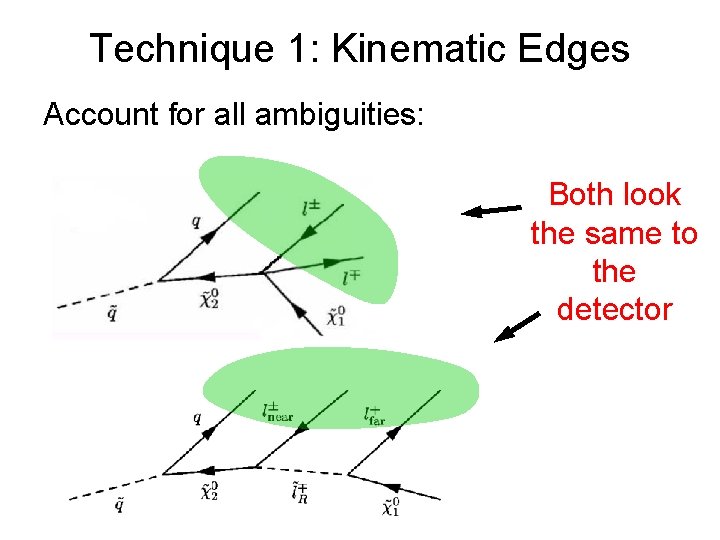
Technique 1: Kinematic Edges Account for all ambiguities: Both look the same to the detector
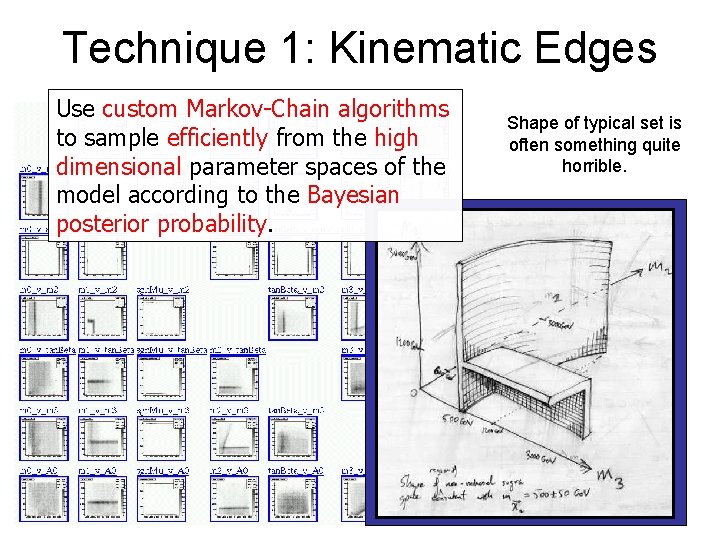
Technique 1: Kinematic Edges Use custom Markov-Chain algorithms to sample efficiently from the high dimensional parameter spaces of the model according to the Bayesian posterior probability. Shape of typical set is often something quite horrible.
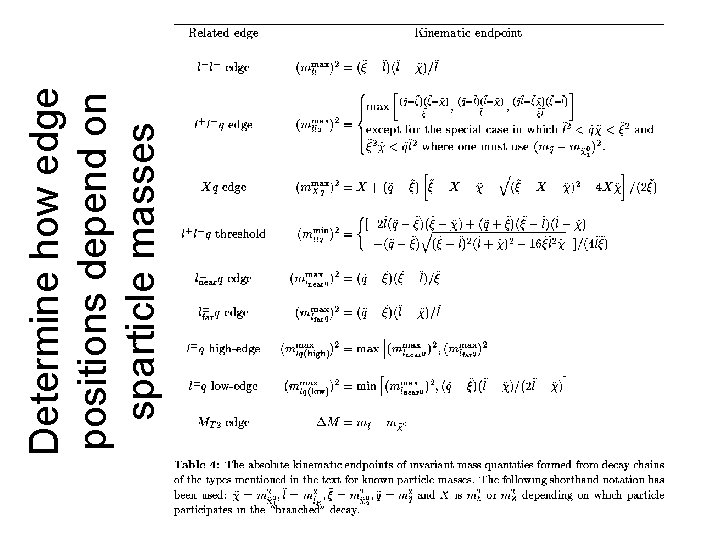
Determine how edge positions depend on sparticle masses
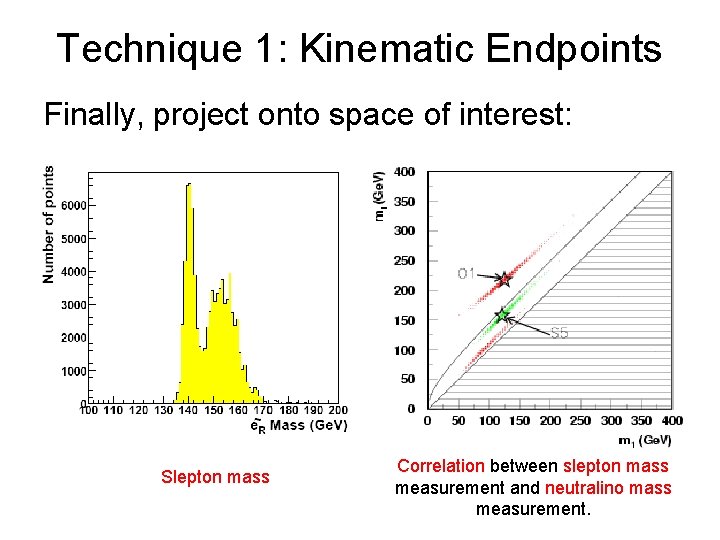
Technique 1: Kinematic Endpoints Finally, project onto space of interest: Slepton mass Correlation between slepton mass measurement and neutralino mass measurement.
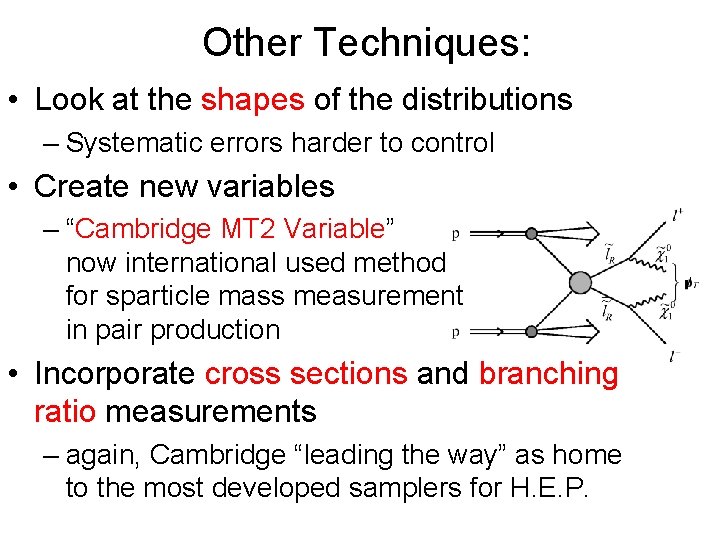
Other Techniques: • Look at the shapes of the distributions – Systematic errors harder to control • Create new variables – “Cambridge MT 2 Variable” now international used method for sparticle mass measurement in pair production • Incorporate cross sections and branching ratio measurements – again, Cambridge “leading the way” as home to the most developed samplers for H. E. P.
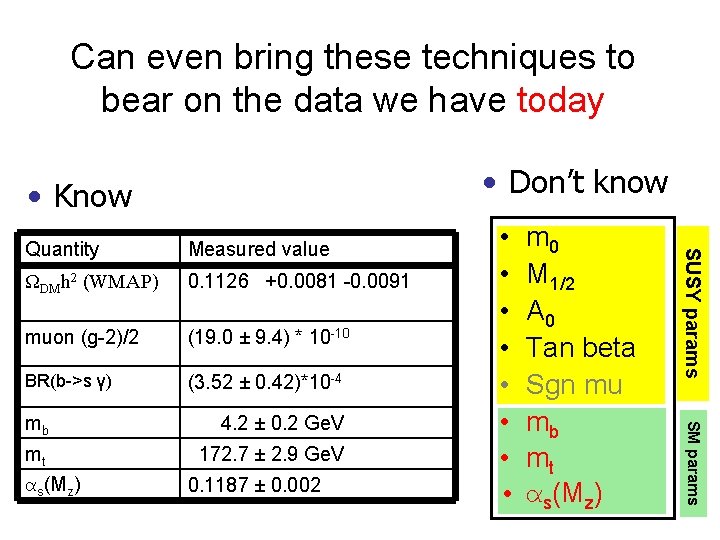
Can even bring these techniques to bear on the data we have today • Don’t know • Know Measured value ΩDMh 2 (WMAP) 0. 1126 +0. 0081 -0. 0091 muon (g-2)/2 (19. 0 ± 9. 4) * 10 -10 BR(b->s γ) (3. 52 ± 0. 42)*10 -4 mt αs(Mz) 4. 2 ± 0. 2 Ge. V 172. 7 ± 2. 9 Ge. V 0. 1187 ± 0. 002 m 0 M 1/2 A 0 Tan beta Sgn mu mb mt αs(Mz) SM params mb • • SUSY params Quantity
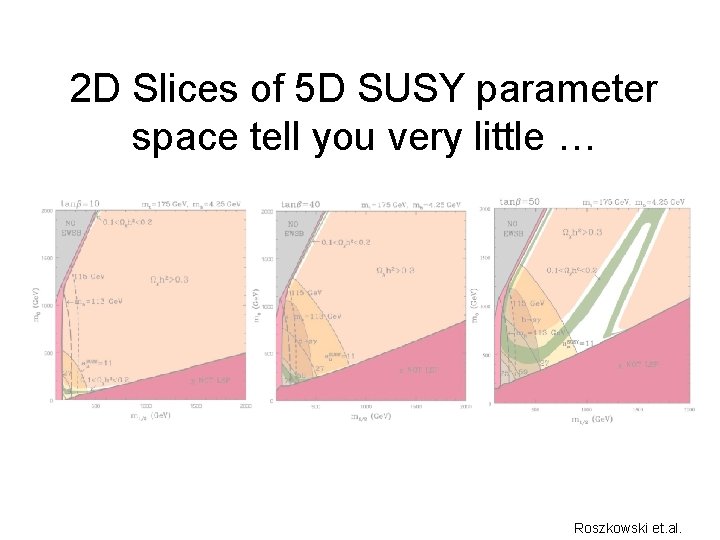
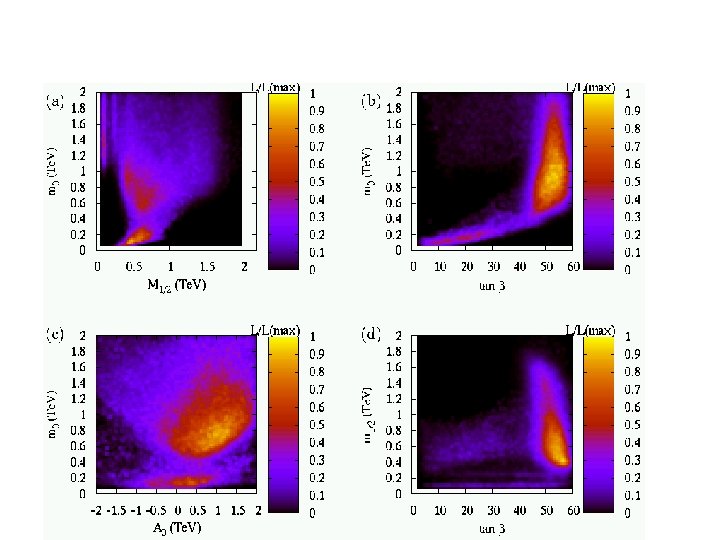
2 D Slices of 5 D SUSY parameter space tell you very little … Roszkowski et. al.
Even worse news: Standard Model errors are very important!
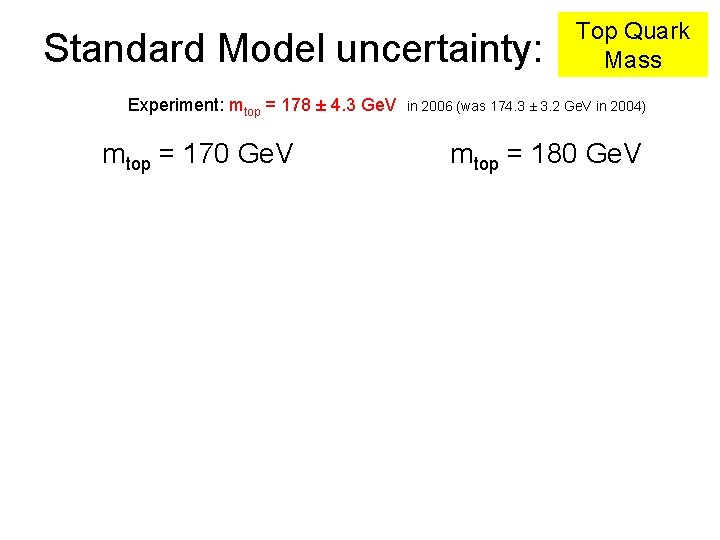
Standard Model uncertainty: Experiment: mtop = 178 ± 4. 3 Ge. V mtop = 170 Ge. V Top Quark Mass in 2006 (was 174. 3 ± 3. 2 Ge. V in 2004) mtop = 180 Ge. V
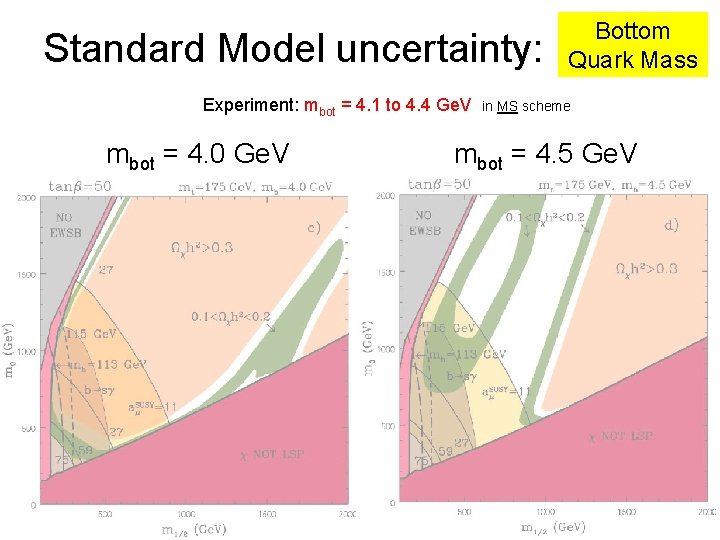
Standard Model uncertainty: Experiment: mbot = 4. 1 to 4. 4 Ge. V mbot = 4. 0 Ge. V Bottom Quark Mass in MS scheme mbot = 4. 5 Ge. V
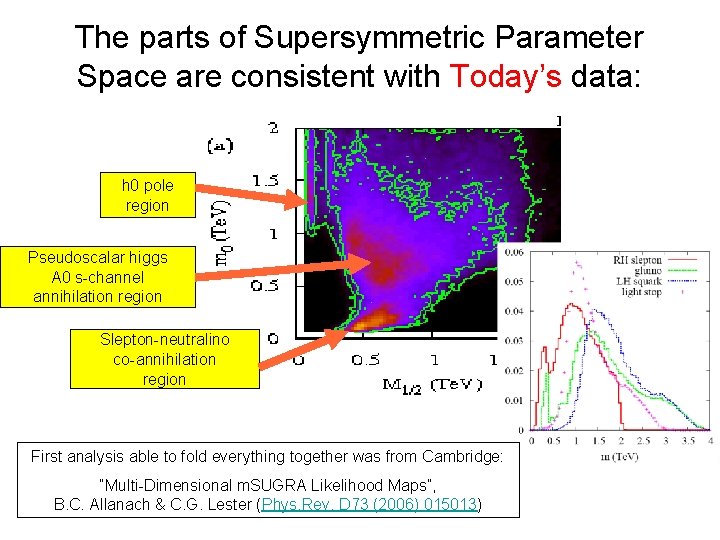
The parts of Supersymmetric Parameter Space are consistent with Today’s data: h 0 pole region Pseudoscalar higgs A 0 s-channel annihilation region Slepton-neutralino co-annihilation region First analysis able to fold everything together was from Cambridge: “Multi-Dimensional m. SUGRA Likelihood Maps”, B. C. Allanach & C. G. Lester (Phys. Rev. D 73 (2006) 015013)
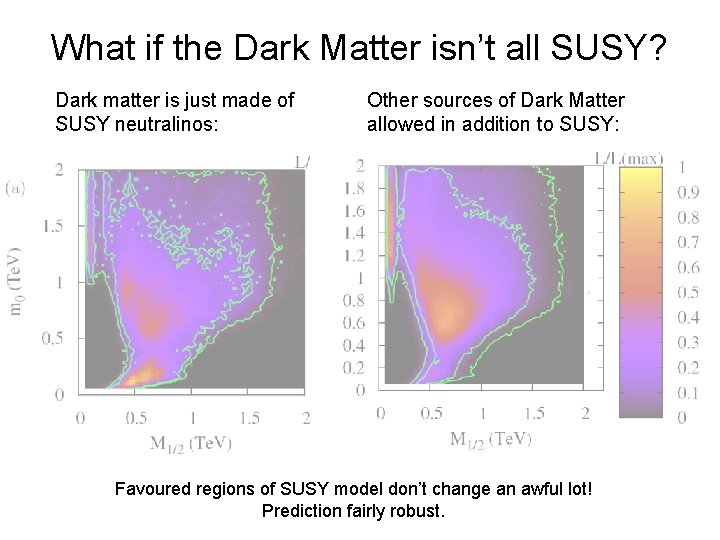
What if the Dark Matter isn’t all SUSY? Dark matter is just made of SUSY neutralinos: Other sources of Dark Matter allowed in addition to SUSY: Favoured regions of SUSY model don’t change an awful lot! Prediction fairly robust.
Future plans • The whole programme is about the future. • If we knew what the experiment will tell us we wouldn’t need to build it. Experiment must lead. • In short term, must continue to integrate further with CERN physics analysis teams. – Analysis will be in collaboration • In 10 years the SCT will have been radiation damaged beyond repair, and the LHC may be upgraded. – Need to start work on “SCT version 2” long before 10 year lifetime of “version 1” is reached – LHC luminosity upgrade will place more demands on tracking systems • Cavendish HEP group in ideal position to play leading role in that endeavour. • Must strive to draw maximum inference from LHC data! R. I. P. S. C. T. 2017
Conclusions • Expect new particles, new physics and other discoveries at the LHC • May include a Dark Matter candidate ? • Many competing physical theories: – Supersymmetry is one possibility – There are many others: • (UED, Large Extra Dimensions, Littlest Higgs …) • An example experimental technique was presented in the context of Supersymmetry – Kinematic endpoints and other measurements + care + efficient sampling from Posterior Distribution on parameter space – Supersymmetry may not be what nature has chosen! • Techniques will be applicable to any theory with large particle content and Dark Matter candidate – and to others too • Many more things I would like to have shown you: – How to measure particle spins and distinguish SUSY from UED etc ….
The End, and the ATLAS Collaboration Cambridge Office Christopher Lester 2006
Spare slides
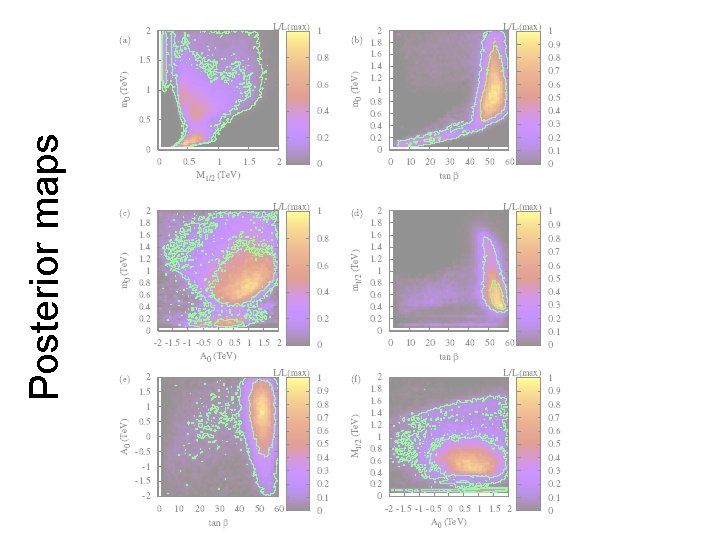
Posterior maps
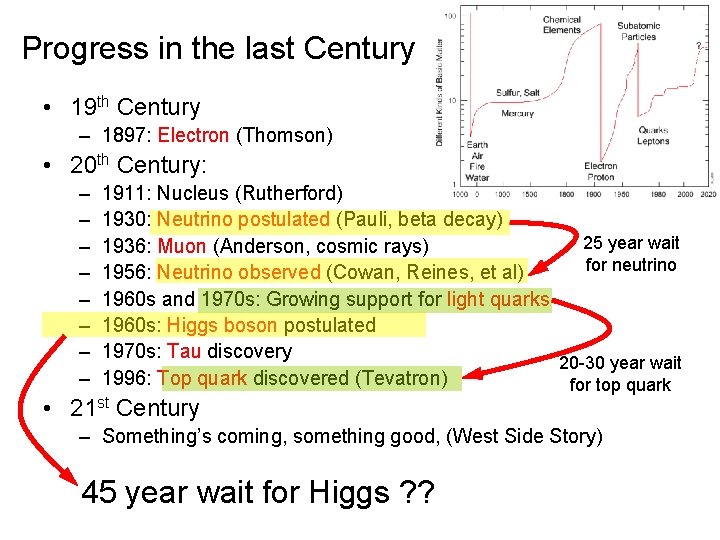
Progress in the last Century • 19 th Century – 1897: Electron (Thomson) • 20 th Century: – – – – 1911: Nucleus (Rutherford) 1930: Neutrino postulated (Pauli, beta decay) 25 year wait 1936: Muon (Anderson, cosmic rays) for neutrino 1956: Neutrino observed (Cowan, Reines, et al) 1960 s and 1970 s: Growing support for light quarks 1960 s: Higgs boson postulated 1970 s: Tau discovery 20 -30 year wait 1996: Top quark discovered (Tevatron) for top quark • 21 st Century – Something’s coming, something good, (West Side Story) 45 year wait for Higgs ? ?
Anatomy of a Detector
ATLAS blind data challenge • Didn’t discover anything that wasn’t there.
What do events look like? RPV (Baryon number violating) RPC RPV (Lepton number violating) RPC
The SCT Software Various GUIs and users etc. Sct. Api Overall SCT Controller VME Crate Controller Module Module Module
- Slides: 71