
Title IX Massachusetts School Personnel Administrators October 27

Title IX Massachusetts School Personnel Administrators October 27, 2017 Presented by: Felicia Vasudevan, Esq. © 2017 Murphy, Hesse, Toomey & Lehane LLP. All Rights Reserved. 1
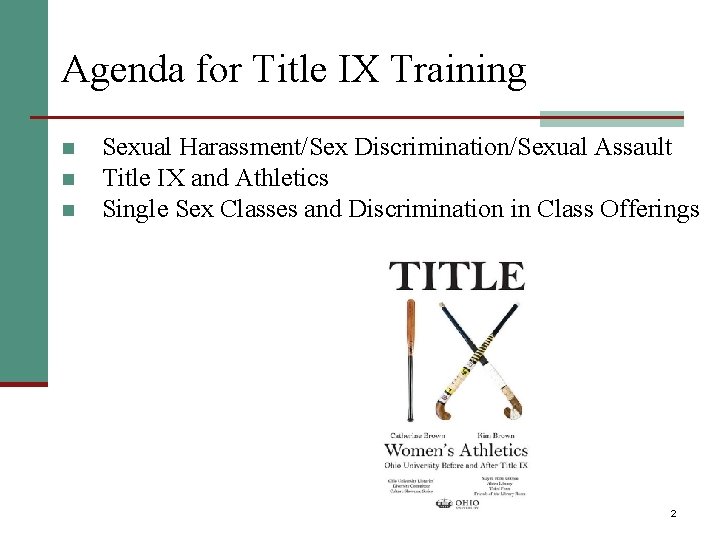
Agenda for Title IX Training Sexual Harassment/Sex Discrimination/Sexual Assault Title IX and Athletics Single Sex Classes and Discrimination in Class Offerings 2
Agenda for Title IX Training Sexual Harassment/Sex Discrimination/Sexual Assault Title IX and Athletics Single Sex Classes and Discrimination in Class Offerings 3
Overview of Title IX of the Education Amendments of 1972 A federal civil rights law that prohibits discrimination on the basis of sex in schools. All public and private elementary and secondary schools receiving Federal funds must comply with Title IX. Under Title IX, discrimination on the basis of sex can include sexual harassment or sexual violence, such as rape, sexual assault, sexual battery and sexual coercion. © 2017 Murphy, Hesse, Toomey & Lehane LLP. All Rights Reserved. 4
Title IX – Applies to Employees The Supreme Court in North Haven Bd. of Ed. V. Bell, has concluded that Title IX’s broad directive that “no person” may be discriminated against includes employees. North Haven Bd. of Ed. V. Bell, 456 U. S. 512, 531 (1982). In Le. Goff v. Trustees of Boston Univ. , 23 F. Supp. 2 d. 120, 126 (D. Mass 1998), the Court relied on the implementing regulations of Title IX to find that Title IX applies to both employment termination and rehiring. The plaintiff in Le. Goff, was a former Coach. © 2017 Murphy, Hesse, Toomey & Lehane LLP. All Rights Reserved. 5
Title IX – Harassment/Sexual Assault/Misconduct United States Department of Education’s Office for Civil Rights (“OCR”) enforces for students/third parties and EEOC and MCAD enforce for employees. On September 22, 2017, the United States Department of Education’s Office for Civil Rights (“OCR”) issued a Dear Colleague Letter and Question and Answer document on complaints of sexual misconduct and violence. New guidance withdraws prior guidance from OCR in 2011 and 2014 and significantly changes how to address Title IX complaints of sexual misconduct and violence. 6
Definition of Sexual Harassment Behavior meets the definition of sexual harassment when: submission to such conduct is made either explicitly or implicitly a term or condition of an educational benefit; or submission to or rejection of such sexually related conduct is used as a basis for decisions affecting the victim’s education; or such conduct has the purpose or effect of unreasonably interfering with the victim’s school performance or creating an intimidating or offensive educational environment. © 2017 Murphy, Hesse, Toomey & Lehane LLP. All Rights Reserved. 7
Examples of sexually harassing conduct - Sexually explicit graffiti, posters or calendars. - Vulgar and offensive sexually related epithets. - Abusive language, posting drawings of sexually explicit behavior and incidents of indecent exposure by students/employees. - Vulgarity which interferes with educational performance. - Leering. - “Cornering”. - Unconsented touching, particularly touching of genitals, breasts, buttocks – however, even running fingers through hair or an arm around the shoulder can be sexually harassing conduct. - Conduct which is threatening or puts the victim in fear for his/her safety when the motivation for such conduct is the person’s sex. © 2017 Murphy, Hesse, Toomey & Lehane LLP. All Rights Reserved.
Interplay between laws Sexual harassment/discrimination includes conduct based on gender identity and sexual orientation. There is no definition of “sex” in the law or regulations. Sexual Harassment must be treated as separate and distinct from “bullying. ” Harassment does not have to include intent to harm, be directed at a specific target, or involve repeated incidents. Harassment of students in any form or for any reason is prohibited. Retaliation against an individual who brings a harassment complaint or cooperated in a complaint is 9 prohibited. © 2017 Murphy, Hesse, Toomey & Lehane LLP. All Rights Reserved.
Obligation on Schools Responsible for addressing incidents about which it knows or reasonably should have known. School district is responsible to act even if the misconduct is covered by an anti‐bullying policy, and regardless of whether an individual has complained, asked the school to take action, or identified the harassment as a form of discrimination. The label for the incident does not determine how the school has to respond. If reported as bullying, will be investigated under both bullying and harassment. 10
Reports of Sexual Harassment/Discrimination - District staff must report possible incidents of discrimination or harassment to the school principal. - District staff should report incidents or complaints even if received orally. - Anonymous tips may be relied upon to initiate an investigation. - A school district should avoid taking disciplinary action based on an anonymous tip alone, without corroborating evidence. © 2017 Murphy, Hesse, Toomey & Lehane LLP. All Rights Reserved. 11
Report of Misconduct – Type of Report It is important to respond to all complaints. The school district should not wait to act or delay in acting. Even if the school thinks the complaint is meritless, it is better to do a short investigation and write up the findings, then do nothing. Reasonable efforts should be made to reduce a verbal complaint to writing, preferably in the complainant’s own handwriting or words. Having the complaint in writing will help to refresh a complainant’s memory later, prevent the school district from being accused of bad faith if the complainant refuses to cooperate at a later point, and ensure that the complainant testifies. For students, especially younger students, it may not be possible for them to write the complaint. In that case, the administrator should put into writing what the student is saying. Attempt to have complaints be as factually accurate and complete as possible. If a school official is placing the verbal complaint in writing, it is important to avoid conclusions or opinions that are not justified. The complaint may eventually be disclosed, so it is critical that it be appropriate.
Investigating Title IX Complaints The school system is obligated to investigate each incident of harassing conduct even if the student’s claim does not reflect conduct which is so severe, pervasive and objectively offensive that it bars the victim’s access to an educational opportunity or benefit. Previously, school districts were required to provide interim measures to the alleged victim, upon receipt of a complaint of sexual misconduct or violence, pending the outcome of the investigation. Interim measures, include, for example, counseling, extensions of time, escorts, or modifications in schedules. Now, school districts must provide interim measures to both the alleged victim and the alleged aggressor, during the pendency of an investigation and any interim measures provided should not favor one party over another. © 2017 Murphy, Hesse, Toomey & Lehane LLP. All Rights Reserved. 13
Investigating Title IX Complaints OCR further prohibits school districts from issuing orders restricting either the alleged victim or alleged aggressor from discussing the investigation or allegations with others. OCR requires school districts upon opening an investigation to provide written notice to the alleged aggressor of the allegations, including the identity of the parties involved, the policies violated, the precise conduct allegedly constituting the violation, and the date and location of the incident. The school district must provide the alleged aggressor sufficient time to respond before any initial interview. OCR further requires school districts to provide written notice of any interview to the alleged aggressor and victim, with sufficient time for those individuals to prepare for the interview. 14
Investigating Title IX Complaints Previously, school districts could not use informal resolution, such as mediation, for complaints of sexual misconduct and violence. Now, school districts can utilize informal resolution, if they believe that it is appropriate and all parties agree to voluntarily participate. Before, OCR required school districts to use a preponderance of the evidence standard, which means more likely than not. Now, school districts can use a preponderance of the evidence standard or a clear and convincing evidence standard. Clear and convincing evidence requires that the investigating official have a firm belief that it is highly probable that the factual contentions of the claim are true. If a school district would like to move to a clear and convincing standard, it must use that standard for all complaints of student misconduct. 15
Investigating Title IX Complaint Title IX Officer or Principal’s designee will conduct an investigation. Investigation must allow for complainant, subject of the complaint, the alleged harasser, and any other appropriate party to provide relevant information. The investigator should attempt to acquire written statements. The same investigator should be present at all interviews and be responsible for the ultimate findings. 16
Investigating Title IX Complaint It is important to act promptly in investigating, before memories fade. Ask each person if they know of anyone that would have information on the complaint. The first step would be to interview the complainant and/or alleged victim and to collect documents or evidence that may not be available later, such as emails, computer files, or videos that self-delete. Next, the investigator should interview individuals who may not be available later, whose willingness to cooperate may diminish, who were eyewitnesses or may have extensive information. A principal or designee is permitted to interview students at school about matters that arise out of the school process without prior permission from a parent. © 2017 Murphy, Hesse, Toomey & Lehane LLP. All Rights Reserved. 17
Investigating Title IX Complaint Then, the investigator should interview those with less extensive information, which is relevant, but not critical, and hostile witnesses. Interview the accused individual last, especially because the disclosure of the investigation could cause other witnesses to not want to talk or evidence to disappear. If it is appropriate, the investigator should consult with a school social worker or psychologist. © 2017 Murphy, Hesse, Toomey & Lehane LLP. All Rights Reserved. 18
Investigating Title IX Complaint The investigator should advise the witnesses of the degree to which the information can be kept confidential. The investigator should take notes and notify interviewees that notes will be taken. The notes should include observations of the individual’s behavior, such as if he or she is uncooperative, evasive or seems untruthful. Do not ask leading questions. © 2017 Murphy, Hesse, Toomey & Lehane LLP. All Rights Reserved. 19
Investigating Title IX Complaint School district must continue investigation even if law enforcement investigation is occurring. Promptly after receiving complaint, complete investigation. The timeline used to be sixty days. Schools must disclose to the complainant information about the sanction imposed on the perpetrator when the sanction directly relates to the harassed student. This includes an order that the harasser stay away from the harassed student © 2017 Murphy, Hesse, Toomey & Lehane LLP. All Rights Reserved. 20
Title IX Investigation OCR requires school districts to provide the investigation report in advance of any decision on culpability and provide the alleged victim and alleged perpetrator an opportunity to respond. Finally, previously, school districts had to offer appeal rights, to the extent that they were offered, to the alleged victims and the alleged aggressors. Now, school districts can limit any appeal rights offered to solely the alleged aggressors. 21
Title IX of the Education Amendments of 1972 – Sexual Harassment School may provide training or other interventions not only for the perpetrators, but also for the larger school community, to ensure that all students, their families, and school staff can recognize harassment if it recurs and know how to respond. School should take steps to stop further harassment and prevent any retaliation against the person who made the complaint (or was the subject of the harassment) or against those who provided information as witnesses. © 2017 Murphy, Hesse, Toomey & Lehane LLP. All Rights Reserved. 22
Case Example Dover School Board of Broward County, Slip Op. 09 -10394 (11 th Cir. 2010) - A student stated a valid claim for teacheron-student sexual harassment under Title IX since the high school principal had actual notice of prior complaints by two students of sexual harassment by the teacher. In this case, the student claimed that the teacher had sexually harassed her. In view of the prior knowledge of the principal, and his failure to take any action, the court determined that the principal was potentially liable. © 2017 Murphy, Hesse, Toomey & Lehane LLP. All Rights Reserved. 23
Case Example Sanders v. Brown, 2007 W. L. 4322569 (4 th Cir. 2007) – A former student’s lawsuit against a principal was dismissed. A former student had claimed to be the subject of sexual abuse by a gym teacher while she had been a student. The court determined that the principal had taken appropriate action when she had reported two previous complaint against the teacher to protective services and the police department. The police department and protective services had reached the conclusion that the complaints were not credible. After the student had left the school, further incidents had occurred and the teacher was ultimately fired for his conduct. © 2017 Murphy, Hesse, Toomey & Lehane LLP. All Rights Reserved. 24
Case Example Seiwert v. Spencer-Owen Community School Corporation, 497 F. Supp. 2 d 947 (S. D. Ind. 2007) – A court refused to dismiss a lawsuit brought by parents of a student who was victimized and threatened by his classmates because of the perception that he was gay. The bullying and threats included multiple death threats as well as a physical attack on the way home from the school bus. Evidence that students were not disciplined for their conduct was enough for the court to find that there was sufficient evidence to go to a jury on the issue of deliberate indifference. © 2017 Murphy, Hesse, Toomey & Lehane LLP. All Rights Reserved. 25
Think-Pair-Share Four months ago, Michelle filed an EEOC complaint alleging her supervisor discriminated against her based on her pregnancy. After filing the of the complaint, she began to feel alienated; her coworkers started limiting their contact with her; and she believed she was not receiving any prime assignments. This week she received her performance evaluation which rated her as satisfactory. In the past 3 years, her rating has been twice at the highly effective level, and once at the outstanding level. Her supervisor’s justification for rating – Michelle was not performing work expected of employees at her level, and that she was not working well within the team. What should happen?
Think-Pair-Share Two students make fun of a student for being a lesbian. The students mimic sexual positions of the other student. The child keeps on responding to the others that she is not a lesbian. The mother complains to the principal that these students are bullying her child. What should happen? A third grader inappropriately touches a first grader on the school bus. What should happen? © 2017 Murphy, Hesse, Toomey & Lehane LLP. All Rights Reserved. 27
Agenda for Title IX Training Sexual Harassment/Sex Discrimination/Sexual Assault Title IX and Athletics Single Sex Classes and Discrimination in Class Offerings 28
Equal Opportunity in School Athletics The question is whether the District provides boys and girls an equal opportunity to participate in its high school interscholastic athletics program by effectively accommodating the athletic interests and abilities of members of both sexes. Standard from Cohen v. Brown University, 101 F. 3 d 155 (1 st Cir. 1996): Schools must recognize, organize, maintain, and proportionately fund both male and female teams; Schools must allow females to try-out/participate in traditionally all-male teams; and Schools must provide equity of facilities and equipment. OCR examines: the provision of equipment and supplies, the provision of locker rooms and practice and competitive facilities, the provision of medical and training facilities and services, the provision of support services, and the scheduling of games and practice times.
Equal Opportunity in School Athletics Case Example: Attorney Gen. v. Massachusetts Interscholastic Athletic Ass'n, Inc. , 378 Mass. 342 (1979): MIAA defended its rule that no boy could play on a girls’ team, although girls could play on boys’ teams (if no girls’ team was available in the sport). MIAA argued the rule was justified by biological-based distinctions, safety of players, and preservation of girls’ sports from being inundated by male players. Massachusetts’ Supreme Judicial Court determined the MIAA rule was a violation of the state’s equal rights amendment (with references to Title IX).
Equal Opportunity in School Athletics OCR states that there is compliance if any of these three are achieved: the athletic participation opportunities for boys and girls are provided in numbers substantially proportionate to their respective enrollments; or there is a showing by the institution of a history and continuing practice of program expansion which is demonstrably responsive to the developing interests and abilities of the underrepresented sex; or it is demonstrated that the interests and abilities of the underrepresented sex have been fully and effectively accommodated by the present program. © 2017 Murphy, Hesse, Toomey & Lehane LLP. All Rights Reserved. 31
First Prong: Athletic Participation Opportunities Consider actual athletes, not unfilled slots. Exact proportionality is not required, but there is no magic number. Substantial proportionality if number of additional participants required for exact proportionality would be sufficient so sustain a viable team. © 2017 Murphy, Hesse, Toomey & Lehane LLP. All Rights Reserved. 32
Equal Opportunity in School Athletics Indianapolis Public Schools, # 05 -10 -56002 (OCR February 26, 2014) – OCR concluded that the school district did not provide equal opportunity in athletics. The district was only 49. 5% male, but 64. 5% of the participants in athletics were male. The District also did not have a history of adding sports or growing the number of girls participating. None of the schools had a published policy or procedure for requesting the addition of sports or sports levels and none had a plan for program expansion for the underrepresented sex. Furthermore, the district did not provide assessment information, demonstrating that there was not an interest amongst girls in sports not currently offered. © 2017 Murphy, Hesse, Toomey & Lehane LLP. All Rights Reserved. 33
Second Prong: History of Expansion No fixed intervals to add participation opportunities. The focus is on whether expansion is responsive to developing needs of females. Demonstrate continuing program expansion as warranted by developing interests and abilities. © 2017 Murphy, Hesse, Toomey & Lehane LLP. All Rights Reserved. 34
Equal Opportunity in School Athletics Jim Ned Consolidated Independent School District, # 06 -14 -1331 (OCR 2014) – OCR concluded that the school district discriminated against female athletes by discouraging them from participating in multiple sports. Female volleyball and basketball teams practiced at the same time during the in-school PE/athletics class period during the fall semester. Consequently, female dual-sport athletes were required, without choice, to exclusively participate in basketball practice during the class period three out of five practice days a week. This basketball practice requirement was in effect despite volleyball being the in-season sport and basketball being in the pre-season stage. No other sport had the issue. Boys who played both basketball and football (“male dual-sport athletes”) were not required to practice basketball during the athletic class period while football was the in-season sport. © 2017 Murphy, Hesse, Toomey & Lehane LLP. All Rights Reserved. 35
Title IX and Athletics Title IX does not require cutting or reducing teams. OCR will work with schools to achieve compliance. Private donations to athletic programs count towards the equity consideration. © 2013 Murphy, Hesse, Toomey & Lehane LLP. All Rights Reserved. 36
Agenda for Title IX Training Sexual Harassment/Sex Discrimination/Sexual Assault Title IX and Athletics Single Sex Classes and Discrimination in Class Offerings 37
Discrimination in Programs, Grading, Classroom In general, students cannot be barred from certain activities solely on the basis of sex. Case Example: Phillips v. Anderson County Board of Education, 259 F. App'x 842 (6 th Cir. 2008): A female student enrolled in a weightlifting/conditioning class as a high school senior. The principal decided to remove the student from the class, stating concern for potential inappropriate behavior by male students. Specifically, during a television interview, the principal expressed fear “that she may be raped or sexually assaulted. ” Once the school board learned of the principal’s decision, it acted promptly to reinstate the student, and she started attending the weightlifting class again within three days. The student still sued under Title IX, but the Court found the school board was not liable because it had acted quickly to fix the problem.
Single Sex Classes Single Sex classes can be provided for the following: Separation of students by sex within physical education classes for activities which involve bodily contact. Separation of students by sex for classes that deal primarily with human sexuality. Choirs may have requirements based on vocal range or quality that result in members of all one (or predominantly one) sex. Otherwise, single sex classes and activities can be only offered: (1) to improve educational achievement of students, by offering diverse educational opportunities, if substantially related to achieving that objective (“Diversity Objective”); or (2) to meet the particular identified of the students (“Needs Objective”). If single sex classes or activities are offered, a substantially equal coeducational class or extracurricular activity must be offered in the same subject. Substantially equal looks at admission policies, educational benefits provided, qualification of staff, accessibility of facilities and resources of classes. © 2017 Murphy, Hesse, Toomey & Lehane LLP. All Rights Reserved. 39
Single Sex Classes Enrollment in single sex classes must be completely voluntary. There must be an affirmative opt-in to the single sex class or activity. If no affirmative consent is received, the student must be enrolled in the co-educational class. OCR recommends providing pre-enrollment information to ensure informed choice. School district must do periodic evaluation every two years to ensure that there are genuine justifications for the single sex classes and activities. © 2017 Murphy, Hesse, Toomey & Lehane LLP. All Rights Reserved. 40
Questions? © 2017 Murphy, Hesse, Toomey & Lehane LLP. All Rights Reserved. 41

Quincy Boston Springfield Crown Colony Plaza 300 Crown Colony Drive Quincy, MA 02169 75 -101 Federal Street Suite 410 Boston, MA 02210 Tel: (617) 479 -5000 Fax: (617) 479 -6469 Tel: (617) 479 -5000 Fax: (617) 338 -1324 One Monarch Place 1414 Main Street 1310 R Suite 1310 R Springfield, MA 01144 Tel: (888) 841 -4850 Fax: (617) 479 -6469 © 2017 Murphy, Hesse, Toomey & Lehane LLP. All Rights Reserved. 42
- Slides: 42