
Title I 101 Implementing a Title I Program

- Slides: 50
Title I - 101 Implementing a Title I Program to Advance Equity District 30 Date 11 -12 -20 Presenters: Gus Hatzidimitrou and Dragomira Koleva
Topics For Discussion • Overview of Title I • Title I and Every Student Succeeds Act (ESSA) • School Based Planning • Meaningful Title I Parent/Family Engagement and Education • Coordination of Title I Resources and Supports • Assessing Progress of the Comprehensive Education Plan (CEP) 2
What Is the Goal of Title I? The goal of Title I is to ensure that all children have a fair, equal, and significant opportunity to obtain a high-quality education and reach, at a minimum, proficiency on challenging state academic achievement standards and state academic assessments. Source: www. ed. gov Simply stated, Title I is all about improving student achievement! 3
Title I and Every Student Succeeds Act (ESSA) • ESSA replaced NCLB and the ESEA waiver. • Key components of Title I are maintained under ESSA. • ESSA gives more flexibility and empowers New York State to define the educational standards for districts and schools. • As ESSA is implemented, changes and/or clarifications to the Title I requirements will be shared with school communities and posted online. 4
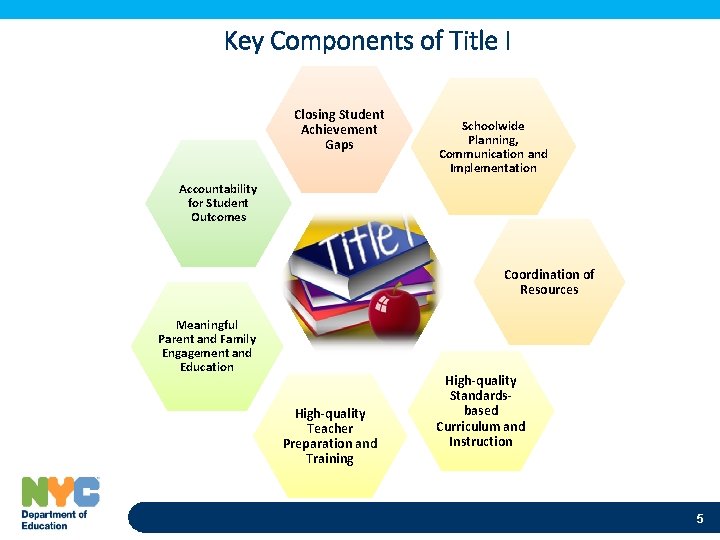
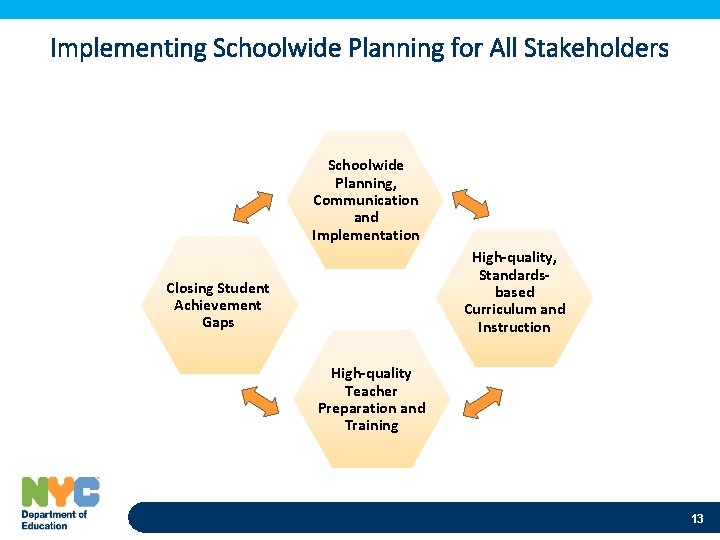
Key Components of Title I Closing Student Achievement Gaps Schoolwide Planning, Communication and Implementation Accountability for Student Outcomes Coordination of Resources Meaningful Parent and Family Engagement and Education High-quality Teacher Preparation and Training High-quality Standardsbased Curriculum and Instruction 5
Schoolwide Planning, Communication and Implementation 6
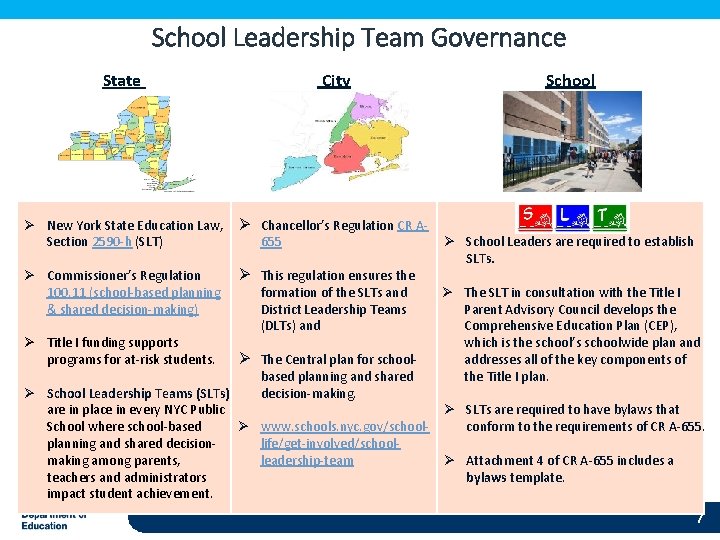
School Leadership Team Governance State City Ø New York State Education Law, Ø Chancellor’s Regulation CR ASection 2590 -h (SLT) 655 Ø Commissioner’s Regulation 100. 11 (school-based planning & shared decision-making) Ø Title I funding supports programs for at-risk students. Ø This regulation ensures the formation of the SLTs and District Leadership Teams (DLTs) and Ø The Central plan for schoolbased planning and shared decision-making. School Ø School Leaders are required to establish SLTs. Ø The SLT in consultation with the Title I Parent Advisory Council develops the Comprehensive Education Plan (CEP), which is the school’s schoolwide plan and addresses all of the key components of the Title I plan. Ø School Leadership Teams (SLTs) are in place in every NYC Public Ø SLTs are required to have bylaws that School where school-based Ø www. schools. nyc. gov/schoolconform to the requirements of CR A-655. planning and shared decisionlife/get-involved/schoolmaking among parents, leadership-team Ø Attachment 4 of CR A-655 includes a teachers and administrators bylaws template. impact student achievement. 7
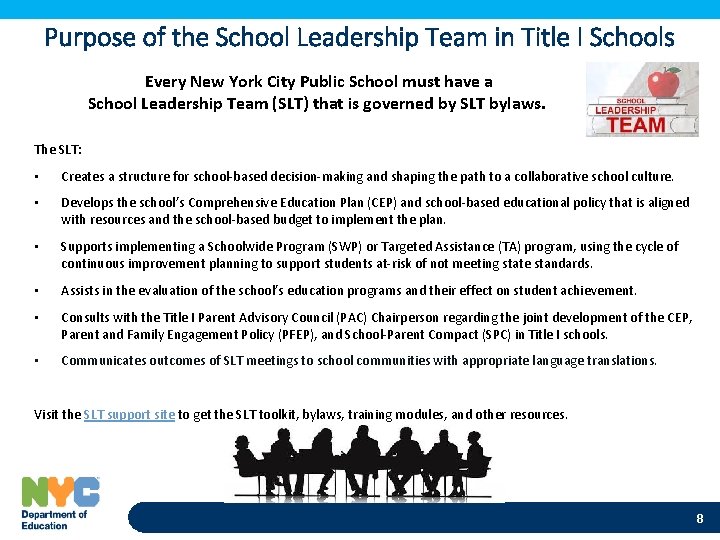
Purpose of the School Leadership Team in Title I Schools Every New York City Public School must have a School Leadership Team (SLT) that is governed by SLT bylaws. The SLT: • Creates a structure for school-based decision-making and shaping the path to a collaborative school culture. • Develops the school’s Comprehensive Education Plan (CEP) and school-based educational policy that is aligned with resources and the school-based budget to implement the plan. • Supports implementing a Schoolwide Program (SWP) or Targeted Assistance (TA) program, using the cycle of continuous improvement planning to support students at-risk of not meeting state standards. • Assists in the evaluation of the school’s education programs and their effect on student achievement. • Consults with the Title I Parent Advisory Council (PAC) Chairperson regarding the joint development of the CEP, Parent and Family Engagement Policy (PFEP), and School-Parent Compact (SPC) in Title I schools. • Communicates outcomes of SLT meetings to school communities with appropriate language translations. Visit the SLT support site to get the SLT toolkit, bylaws, training modules, and other resources. 8
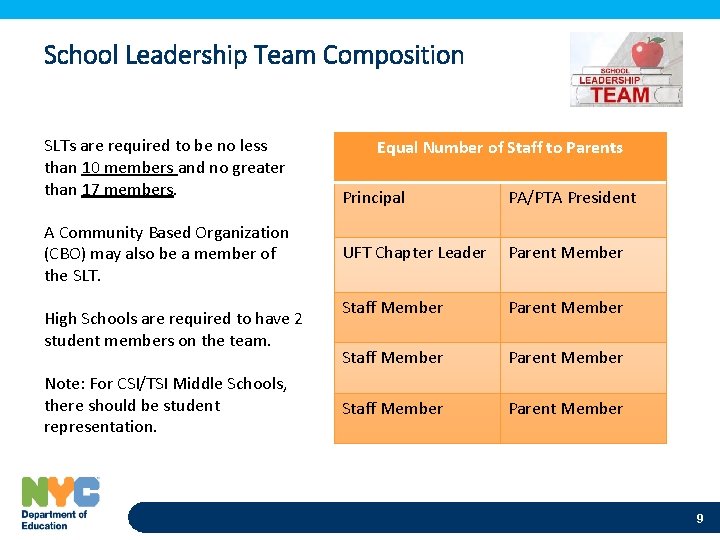
School Leadership Team Composition SLTs are required to be no less than 10 members and no greater than 17 members. A Community Based Organization (CBO) may also be a member of the SLT. High Schools are required to have 2 student members on the team. Note: For CSI/TSI Middle Schools, there should be student representation. Equal Number of Staff to Parents Principal PA/PTA President UFT Chapter Leader Parent Member Staff Member Parent Member 9
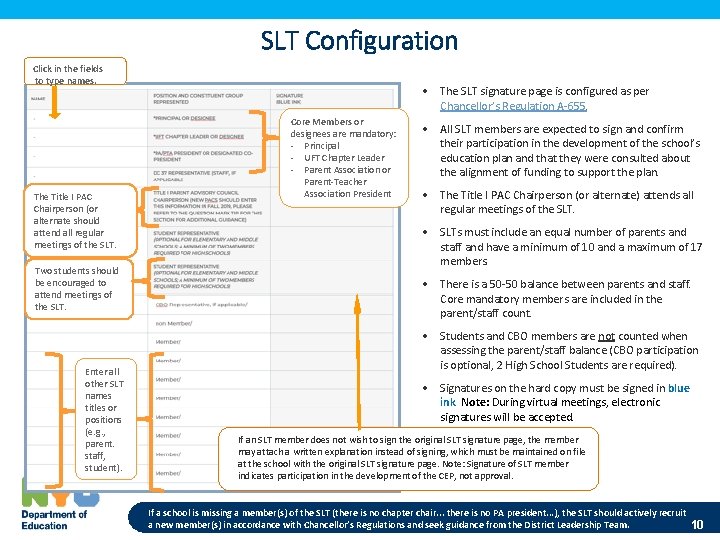
SLT Configuration Click in the fields to type names. The Title I PAC Chairperson (or alternate should attend all regular meetings of the SLT. Two students should be encouraged to attend meetings of the SLT. Enter all other SLT names titles or positions (e. g. , parent. staff, student). • The SLT signature page is configured as per Chancellor’s Regulation A-655. Core Members or designees are mandatory: - Principal - UFT Chapter Leader - Parent Association or Parent-Teacher Association President • All SLT members are expected to sign and confirm their participation in the development of the school’s education plan and that they were consulted about the alignment of funding to support the plan. • The Title I PAC Chairperson (or alternate) attends all regular meetings of the SLT. • SLTs must include an equal number of parents and staff and have a minimum of 10 and a maximum of 17 members. • There is a 50 -50 balance between parents and staff. Core mandatory members are included in the parent/staff count. • Students and CBO members are not counted when assessing the parent/staff balance (CBO participation is optional, 2 High School Students are required). • Signatures on the hard copy must be signed in blue ink. Note: During virtual meetings, electronic signatures will be accepted. If an SLT member does not wish to sign the original SLT signature page, the member may attach a written explanation instead of signing, which must be maintained on file at the school with the original SLT signature page. Note: Signature of SLT member indicates participation in the development of the CEP, not approval. If a school is missing a member(s) of the SLT (there is no chapter chair. . . there is no PA president. . . ), the SLT should actively recruit a new member(s) in accordance with Chancellor’s Regulations and seek guidance from the District Leadership Team. 10
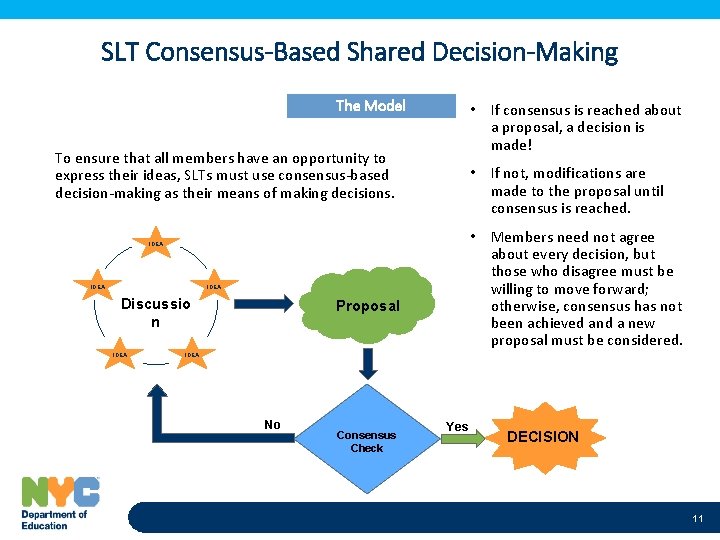
SLT Consensus-Based Shared Decision-Making The Model • If consensus is reached about a proposal, a decision is made! To ensure that all members have an opportunity to express their ideas, SLTs must use consensus-based decision-making as their means of making decisions. • If not, modifications are made to the proposal until consensus is reached. • Members need not agree about every decision, but those who disagree must be willing to move forward; otherwise, consensus has not been achieved and a new proposal must be considered. IDEA Discussio n IDEA Proposal IDEA No Consensus Check Yes DECISION 11 11
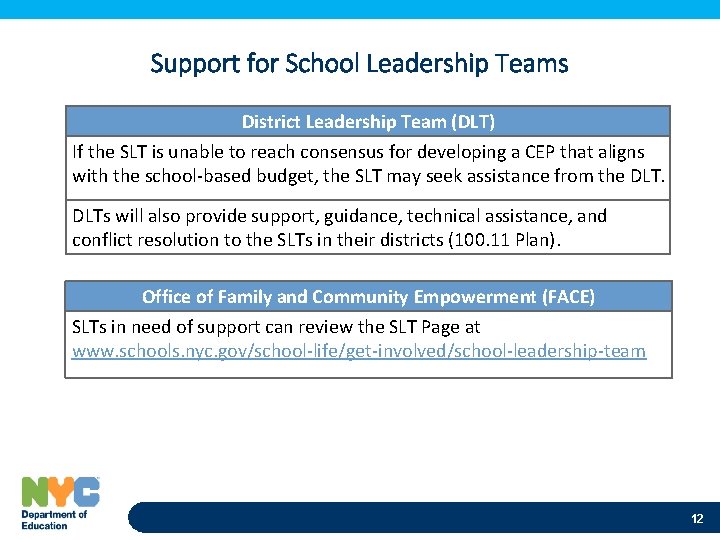
Support for School Leadership Teams District Leadership Team (DLT) If the SLT is unable to reach consensus for developing a CEP that aligns with the school-based budget, the SLT may seek assistance from the DLTs will also provide support, guidance, technical assistance, and conflict resolution to the SLTs in their districts (100. 11 Plan). Office of Family and Community Empowerment (FACE) SLTs in need of support can review the SLT Page at www. schools. nyc. gov/school-life/get-involved/school-leadership-team 12
Implementing Schoolwide Planning for All Stakeholders Schoolwide Planning, Communication and Implementation High-quality, Standardsbased Curriculum and Instruction Closing Student Achievement Gaps High-quality Teacher Preparation and Training 13
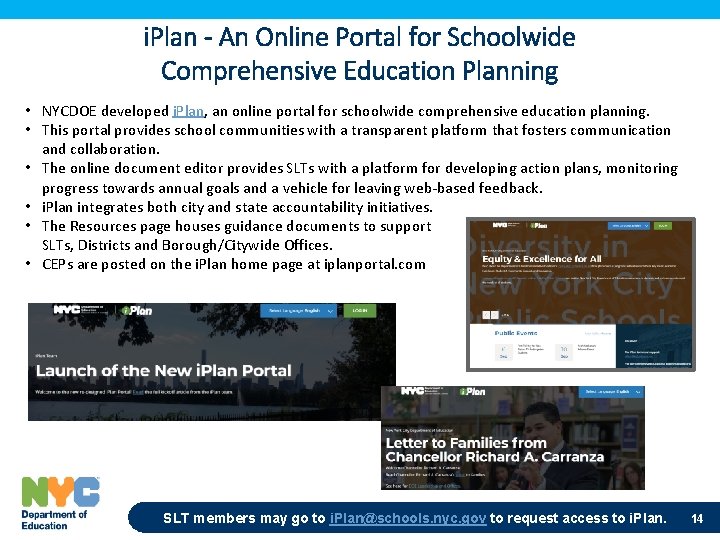
i. Plan - An Online Portal for Schoolwide Comprehensive Education Planning • NYCDOE developed i. Plan, an online portal for schoolwide comprehensive education planning. • This portal provides school communities with a transparent platform that fosters communication and collaboration. • The online document editor provides SLTs with a platform for developing action plans, monitoring progress towards annual goals and a vehicle for leaving web-based feedback. • i. Plan integrates both city and state accountability initiatives. • The Resources page houses guidance documents to support SLTs, Districts and Borough/Citywide Offices. • CEPs are posted on the i. Plan home page at iplanportal. com SLT members may go to i. Plan@schools. nyc. gov to request access to i. Plan. 14
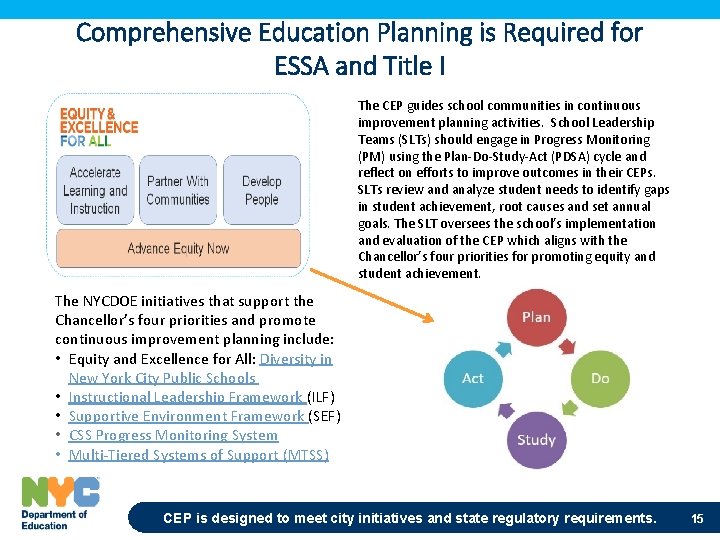
Comprehensive Education Planning is Required for ESSA and Title I The CEP guides school communities in continuous improvement planning activities. School Leadership Teams (SLTs) should engage in Progress Monitoring (PM) using the Plan-Do-Study-Act (PDSA) cycle and reflect on efforts to improve outcomes in their CEPs. SLTs review and analyze student needs to identify gaps in student achievement, root causes and set annual goals. The SLT oversees the school’s implementation and evaluation of the CEP which aligns with the Chancellor’s four priorities for promoting equity and student achievement. The NYCDOE initiatives that support the Chancellor’s four priorities and promote continuous improvement planning include: • Equity and Excellence for All: Diversity in New York City Public Schools • Instructional Leadership Framework (ILF) • Supportive Environment Framework (SEF) • CSS Progress Monitoring System • Multi-Tiered Systems of Support (MTSS) CEP is designed to meet city initiatives and state regulatory requirements. 15
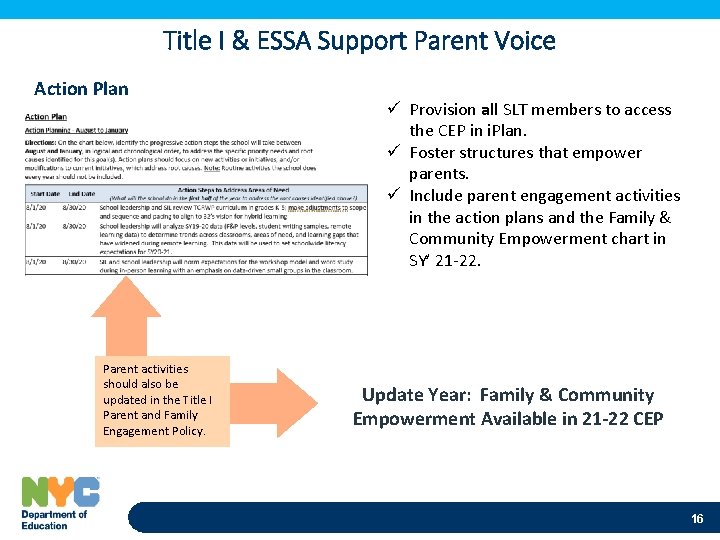
Title I & ESSA Support Parent Voice Action Plan Parent activities should also be updated in the Title I Parent and Family Engagement Policy. ü Provision all SLT members to access the CEP in i. Plan. ü Foster structures that empower parents. ü Include parent engagement activities in the action plans and the Family & Community Empowerment chart in SY’ 21 -22. Update Year: Family & Community Empowerment Available in 21 -22 CEP 16
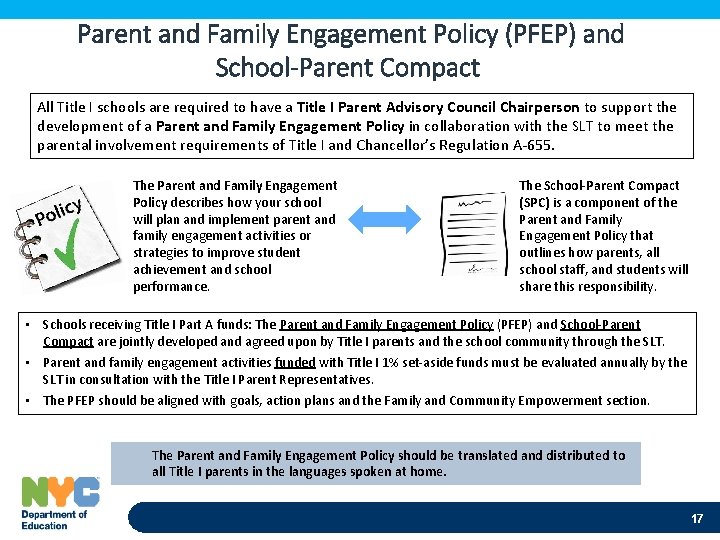
Parent and Family Engagement Policy (PFEP) and School-Parent Compact All Title I schools are required to have a Title I Parent Advisory Council Chairperson to support the development of a Parent and Family Engagement Policy in collaboration with the SLT to meet the parental involvement requirements of Title I and Chancellor’s Regulation A-655. The Parent and Family Engagement Policy describes how your school will plan and implement parent and family engagement activities or strategies to improve student achievement and school performance. The School-Parent Compact (SPC) is a component of the Parent and Family Engagement Policy that outlines how parents, all school staff, and students will share this responsibility. • Schools receiving Title I Part A funds: The Parent and Family Engagement Policy (PFEP) and School-Parent Compact are jointly developed and agreed upon by Title I parents and the school community through the SLT. • Parent and family engagement activities funded with Title I 1% set-aside funds must be evaluated annually by the SLT in consultation with the Title I Parent Representatives. • The PFEP should be aligned with goals, action plans and the Family and Community Empowerment section. The Parent and Family Engagement Policy should be translated and distributed to all Title I parents in the languages spoken at home. 17
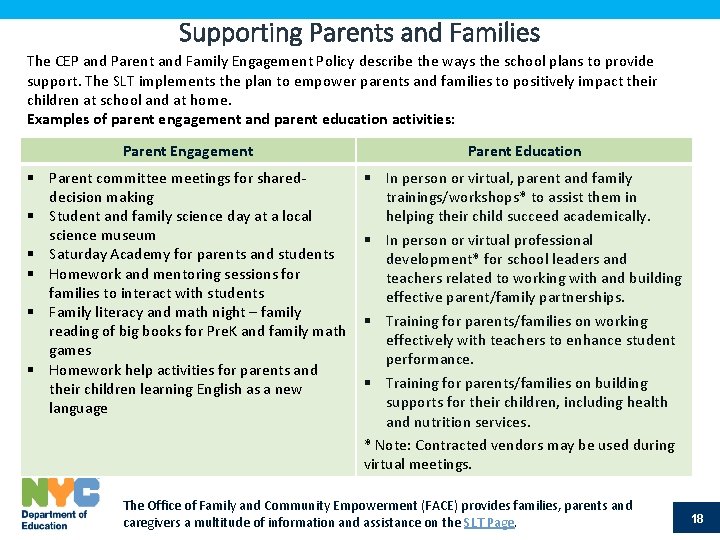
Supporting Parents and Families The CEP and Parent and Family Engagement Policy describe the ways the school plans to provide support. The SLT implements the plan to empower parents and families to positively impact their children at school and at home. Examples of parent engagement and parent education activities: Parent Engagement Parent Education § Parent committee meetings for shareddecision making § Student and family science day at a local science museum § Saturday Academy for parents and students § Homework and mentoring sessions for families to interact with students § Family literacy and math night – family reading of big books for Pre. K and family math games § Homework help activities for parents and their children learning English as a new language § In person or virtual, parent and family trainings/workshops* to assist them in helping their child succeed academically. § In person or virtual professional development* for school leaders and teachers related to working with and building effective parent/family partnerships. § Training for parents/families on working effectively with teachers to enhance student performance. § Training for parents/families on building supports for their children, including health and nutrition services. * Note: Contracted vendors may be used during virtual meetings. The Office of Family and Community Empowerment (FACE) provides families, parents and caregivers a multitude of information and assistance on the SLT Page. 18
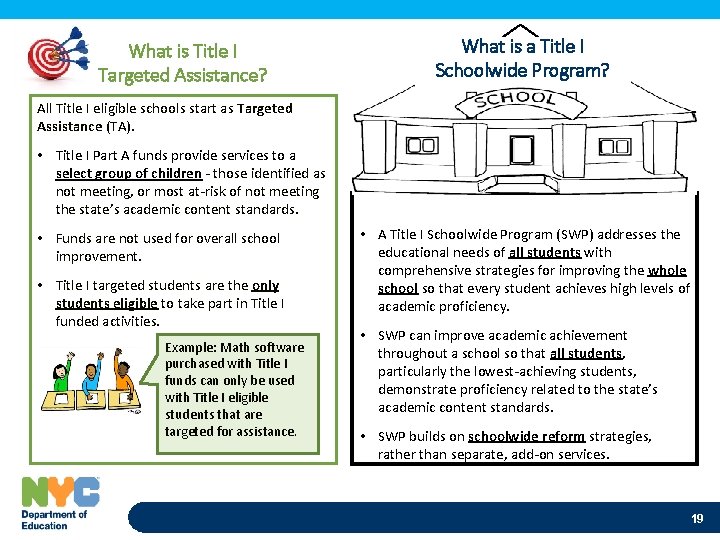
What is a Title I Schoolwide Program? What is Title I Targeted Assistance? All Title I eligible schools start as Targeted Assistance (TA). • Title I Part A funds provide services to a select group of children - those identified as not meeting, or most at-risk of not meeting the state’s academic content standards. • Funds are not used for overall school improvement. • Title I targeted students are the only students eligible to take part in Title I funded activities. Example: Math software purchased with Title I funds can only be used with Title I eligible students that are targeted for assistance. • A Title I Schoolwide Program (SWP) addresses the educational needs of all students with comprehensive strategies for improving the whole school so that every student achieves high levels of academic proficiency. • SWP can improve academic achievement throughout a school so that all students, particularly the lowest-achieving students, demonstrate proficiency related to the state’s academic content standards. • SWP builds on schoolwide reform strategies, rather than separate, add-on services. 19
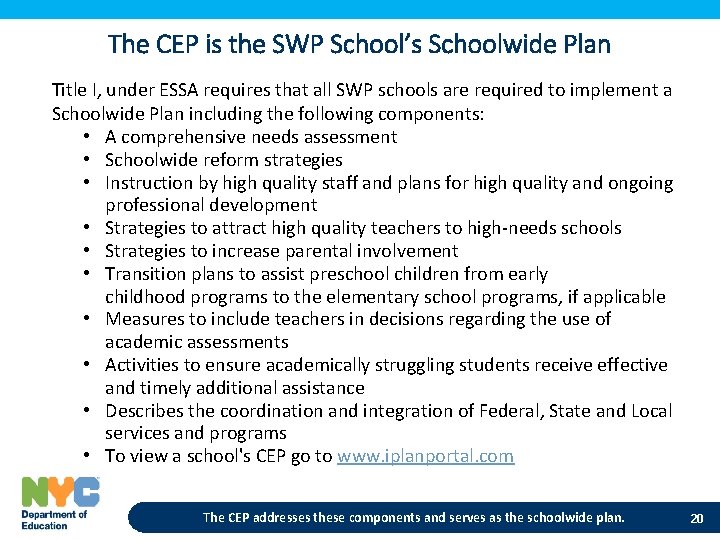
The CEP is the SWP School’s Schoolwide Plan Title I, under ESSA requires that all SWP schools are required to implement a Schoolwide Plan including the following components: • A comprehensive needs assessment • Schoolwide reform strategies • Instruction by high quality staff and plans for high quality and ongoing professional development • Strategies to attract high quality teachers to high-needs schools • Strategies to increase parental involvement • Transition plans to assist preschool children from early childhood programs to the elementary school programs, if applicable • Measures to include teachers in decisions regarding the use of academic assessments • Activities to ensure academically struggling students receive effective and timely additional assistance • Describes the coordination and integration of Federal, State and Local services and programs • To view a school's CEP go to www. iplanportal. com The CEP addresses these components and serves as the schoolwide plan. 20
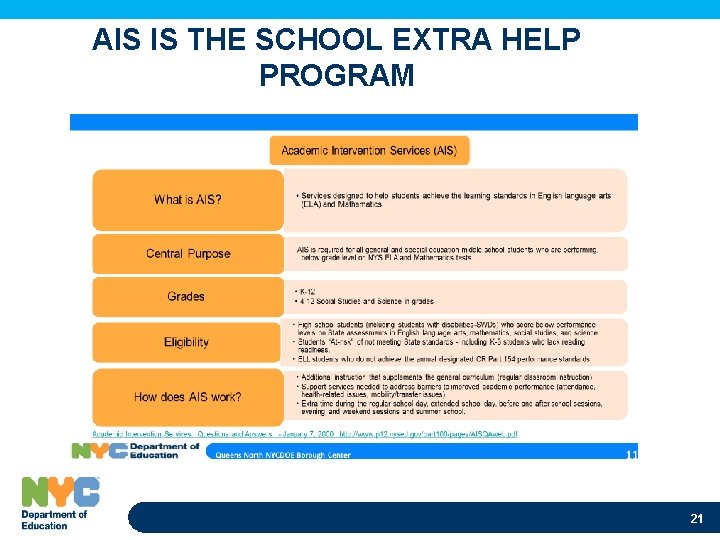
AIS IS THE SCHOOL EXTRA HELP PROGRAM 21
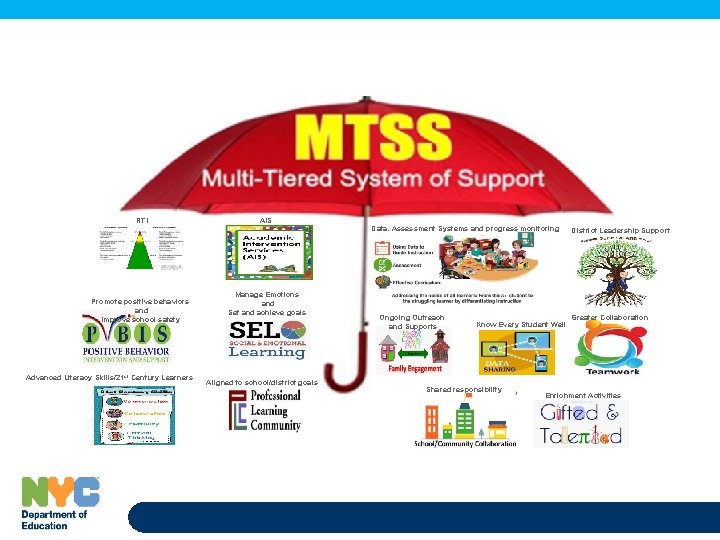
What lives under the MTSS comprehensive umbrella framework? RTI Promote positive behaviors and Improve school safety Advanced Literacy Skills/21 st Century Learners AIS Manage Emotions and Set and achieve goals Aligned to school/district goals Data, Assessment Systems and progress monitoring Ongoing Outreach and Supports Know Every Student Well Shared responsibility District Leadership Support Greater Collaboration Enrichment Activities
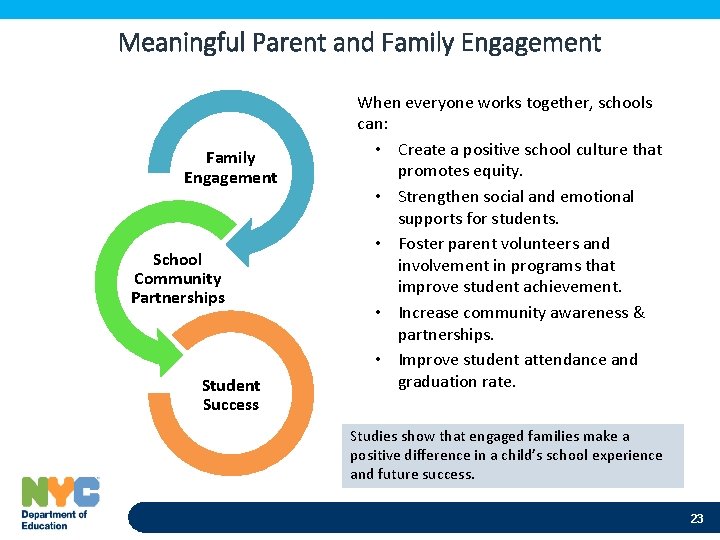
Meaningful Parent and Family Engagement School Community Partnerships Student Success When everyone works together, schools can: • Create a positive school culture that promotes equity. • Strengthen social and emotional supports for students. • Foster parent volunteers and involvement in programs that improve student achievement. • Increase community awareness & partnerships. • Improve student attendance and graduation rate. Studies show that engaged families make a positive difference in a child’s school experience and future success. 23
Title I Parent and Family Engagement All schools should engage parents and families in meaningful ways through the: • School Leadership Team (SLT) • Parent Association (PA) & TITLE I PAC • Parent-Teacher Association (PTA) Additionally, at a minimum, all Title I schools are required to include and engage parents in the decision-making process regarding the Title I education program by: ü Establishing a school Title I Parent Advisory Council (PAC) inclusive of a Title I PAC Chairperson. ü Involving the Title I PAC in the joint review, planning, and improvement of the Comprehensive Education Plan, Parent and Family Engagement Policy, and School-Parent Compact. ü Consulting with Title I PAC members regarding the use of Title I parent and family engagement set-aside (a minimum of 1% of the school's Title I allocation) to support the school’s education program in the CEP. ü Conducting an Annual Title I Parent meeting to inform parents and families of the school’s Title I program implementation and requirements as well as New York State Education Department’s accountability status, if applicable. For more information, review the 2020 -21 PROTOCOLS & TIMELINE FOR TITLE I PARENT AND FAMILY ENGAGEMENT. 24
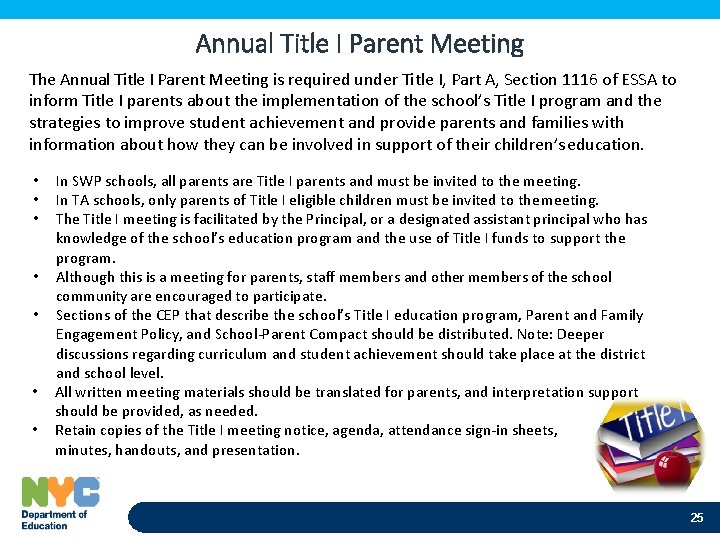
Annual Title I Parent Meeting The Annual Title I Parent Meeting is required under Title I, Part A, Section 1116 of ESSA to inform Title I parents about the implementation of the school’s Title I program and the strategies to improve student achievement and provide parents and families with information about how they can be involved in support of their children’s education. In SWP schools, all parents are Title I parents and must be invited to the meeting. In TA schools, only parents of Title I eligible children must be invited to the meeting. The Title I meeting is facilitated by the Principal, or a designated assistant principal who has knowledge of the school’s education program and the use of Title I funds to support the program. • Although this is a meeting for parents, staff members and other members of the school community are encouraged to participate. • Sections of the CEP that describe the school’s Title I education program, Parent and Family Engagement Policy, and School-Parent Compact should be distributed. Note: Deeper discussions regarding curriculum and student achievement should take place at the district and school level. • All written meeting materials should be translated for parents, and interpretation support should be provided, as needed. • Retain copies of the Title I meeting notice, agenda, attendance sign-in sheets, minutes, handouts, and presentation. • • • 25
Role of the Title I Parent Advisory Council (PAC) • Title I PAC is a consultative and representative body that involves and engages all Title I parents of participating students in the Title I program. • The Title I PAC Chairperson will represent the PAC and participate with the SLT in the joint review, planning, and improvement of the school’s Title I program (CEP), and the development, revision and review of the parent and family engagement policy. • The size of the Title I PAC is a school-based decision; it should include Title I parents and Title I parents of students in various grades, and English language learners and students with IEPs. • Responsibility of the Title I PAC is to ensure effective involvement of all Title I parents to support the partnership between other school community stakeholders (SLT, etc. ). • Title I PAC informs Title I parents on Title I issues and assures that the views/opinions of the school’s Title I parents are conveyed to the SLT. 26
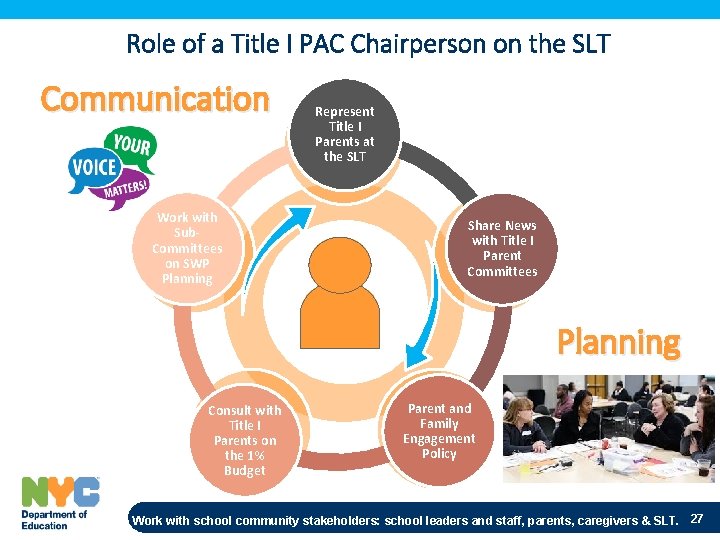
Role of a Title I PAC Chairperson on the SLT Communication Work with Sub. Committees on SWP Planning Represent Title I Parents at the SLT Share News with Title I Parent Committees Title I Parent Representative Planning Consult with Title I Parents on the 1% Budget Parent and Family Engagement Policy Work with school community stakeholders: school leaders and staff, parents, caregivers & SLT. 27
Election of Title I PAC Chairperson and Alternate • The PA/PTA President is NOT eligible to serve as an officer on the Title I Parent Advisory Council • The PA/PTA President or his/her designee (who is not seeking office) facilitates the meeting to elect the Title I PAC Chairperson and Alternate • The Principal (or a member of his/her staff) may not facilitate the election meeting but must be present to: verify individual voter eligibility as a parent of a Title I student enrolled in the school; observe the election process; and document that established procedures have been followed. • During the meeting, after the Title I PAC is established, the PA/PTA President facilitates the election of the Title I PAC Chairperson and Alternate Chairperson as follows: o The PA/PTA reads the roles and responsibilities of the Chairperson and Alternate. o The PA/PTA President invites PAC members to indicate their interest in serving as a candidate for Chairperson or Alternate. o Each candidate will be given 2 minutes to speak to the Title I parents who are present at the meeting. o Election of the PAC Chairperson will be conducted: § Candidate names for the Chairperson will be placed on a standard ballot form by the PA/PTA President and distributed to all Title I parents who are present at the meeting. § The votes are counted and tallied by the PA/PTA President and observed by the Principal (or a member of his/her staff). § The candidate with the most votes will be elected as Title I PAC Chairperson. To learn more on virtual Title I PAC Elections, download Virtual Elections Guidance for PA/PTA/Preside nts Council Note: Download the 2020 -21 PROTOCOLS & TIMELINE FOR TITLE I PARENT AND FAMILY ENGAGEMENT for details on Title I PAC and electing the I PAC Alternate. 28
Role of a District Title I Parent Advisory Council (DPAC) • Help to ensure effective involvement of all parents of Title I participating children (including high schools within the given district’s geographical boundaries) and to support the partnership between other district and borough community stakeholders (district/ borough administration and staff, parents and caregivers, District Leadership Team). • To involve parents of Title I participating students in an organized and timely manner with the planning, review and implementation of Title I programs and the joint development of the District Parent and Family Engagement Policy, District 100. 11 Plan, and District Comprehensive Education Plan (DCEP). • To recruit parents of Title I participating students for involvement in professional development opportunities, meetings, conferences and other related activities designed to enhance the role of parents in supporting the education of their children and advancing their own educational needs. • To provide information to parents of Title I participating students regarding Title I issues, and in consultation with other parents to bring questions, concerns, and ideas regarding Title I related issues to the attention of district and borough staff, administration, other district, borough and community stakeholders. 29
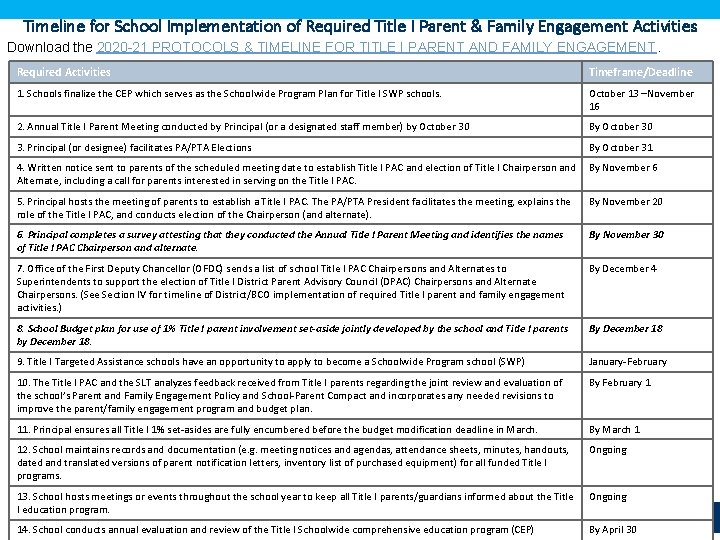
Timeline for School Implementation of Required Title I Parent & Family Engagement Activities Download the 2020 -21 PROTOCOLS & TIMELINE FOR TITLE I PARENT AND FAMILY ENGAGEMENT. Required Activities Timeframe/Deadline 1. Schools finalize the CEP which serves as the Schoolwide Program Plan for Title I SWP schools. October 13 –November 16 2. Annual Title I Parent Meeting conducted by Principal (or a designated staff member) by October 30 By October 30 3. Principal (or designee) facilitates PA/PTA Elections By October 31 4. Written notice sent to parents of the scheduled meeting date to establish Title I PAC and election of Title I Chairperson and By November 6 Alternate, including a call for parents interested in serving on the Title I PAC. 5. Principal hosts the meeting of parents to establish a Title I PAC. The PA/PTA President facilitates the meeting, explains the role of the Title I PAC, and conducts election of the Chairperson (and alternate). By November 20 6. Principal completes a survey attesting that they conducted the Annual Title I Parent Meeting and identifies the names of Title I PAC Chairperson and alternate. By November 30 7. Office of the First Deputy Chancellor (OFDC) sends a list of school Title I PAC Chairpersons and Alternates to Superintendents to support the election of Title I District Parent Advisory Council (DPAC) Chairpersons and Alternate Chairpersons. (See Section IV for timeline of District/BCO implementation of required Title I parent and family engagement activities. ) By December 4 8. School Budget plan for use of 1% Title I parent involvement set-aside jointly developed by the school and Title I parents by December 18. By December 18 9. Title I Targeted Assistance schools have an opportunity to apply to become a Schoolwide Program school (SWP) January-February 10. The Title I PAC and the SLT analyzes feedback received from Title I parents regarding the joint review and evaluation of the school’s Parent and Family Engagement Policy and School-Parent Compact and incorporates any needed revisions to improve the parent/family engagement program and budget plan. By February 1 11. Principal ensures all Title I 1% set-asides are fully encumbered before the budget modification deadline in March. By March 1 12. School maintains records and documentation (e. g. meeting notices and agendas, attendance sheets, minutes, handouts, dated and translated versions of parent notification letters, inventory list of purchased equipment) for all funded Title I programs. Ongoing 13. School hosts meetings or events throughout the school year to keep all Title I parents/guardians informed about the Title I education program. Ongoing 14. School conducts annual evaluation and review of the Title I Schoolwide comprehensive education program (CEP) By April 30 30
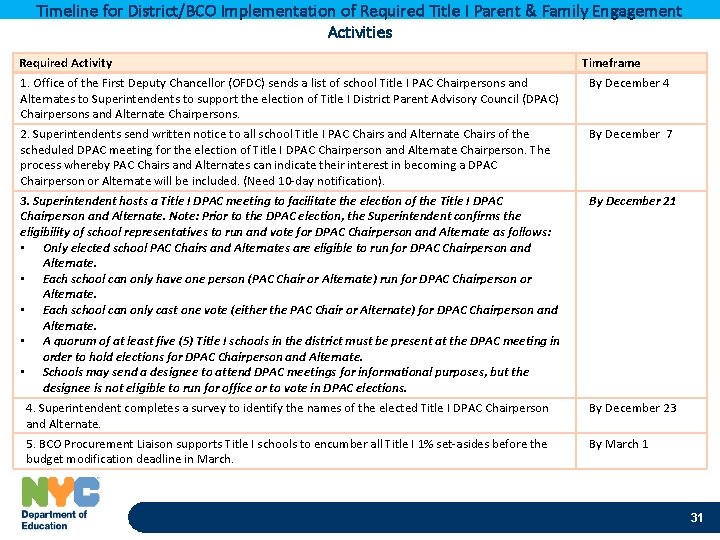
Timeline for District/BCO Implementation of Required Title I Parent & Family Engagement Activities Required Activity Timeframe 1. Office of the First Deputy Chancellor (OFDC) sends a list of school Title I PAC Chairpersons and Alternates to Superintendents to support the election of Title I District Parent Advisory Council (DPAC) Chairpersons and Alternate Chairpersons. By December 4 2. Superintendents send written notice to all school Title I PAC Chairs and Alternate Chairs of the scheduled DPAC meeting for the election of Title I DPAC Chairperson and Alternate Chairperson. The process whereby PAC Chairs and Alternates can indicate their interest in becoming a DPAC Chairperson or Alternate will be included. (Need 10 -day notification). By December 7 3. Superintendent hosts a Title I DPAC meeting to facilitate the election of the Title I DPAC Chairperson and Alternate. Note: Prior to the DPAC election, the Superintendent confirms the eligibility of school representatives to run and vote for DPAC Chairperson and Alternate as follows: • Only elected school PAC Chairs and Alternates are eligible to run for DPAC Chairperson and Alternate. • Each school can only have one person (PAC Chair or Alternate) run for DPAC Chairperson or Alternate. • Each school can only cast one vote (either the PAC Chair or Alternate) for DPAC Chairperson and Alternate. • A quorum of at least five (5) Title I schools in the district must be present at the DPAC meeting in order to hold elections for DPAC Chairperson and Alternate. • Schools may send a designee to attend DPAC meetings for informational purposes, but the designee is not eligible to run for office or to vote in DPAC elections. By December 21 4. Superintendent completes a survey to identify the names of the elected Title I DPAC Chairperson and Alternate. By December 23 5. BCO Procurement Liaison supports Title I schools to encumber all Title I 1% set-asides before the budget modification deadline in March. By March 1 31
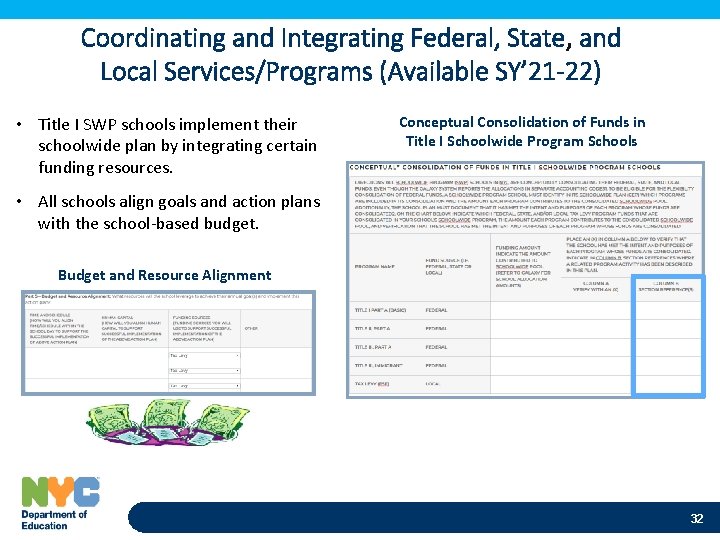
Coordinating and Integrating Federal, State, and Local Services/Programs (Available SY’ 21 -22) • Title I SWP schools implement their schoolwide plan by integrating certain funding resources. Conceptual Consolidation of Funds in Title I Schoolwide Program Schools • All schools align goals and action plans with the school-based budget. Budget and Resource Alignment 32
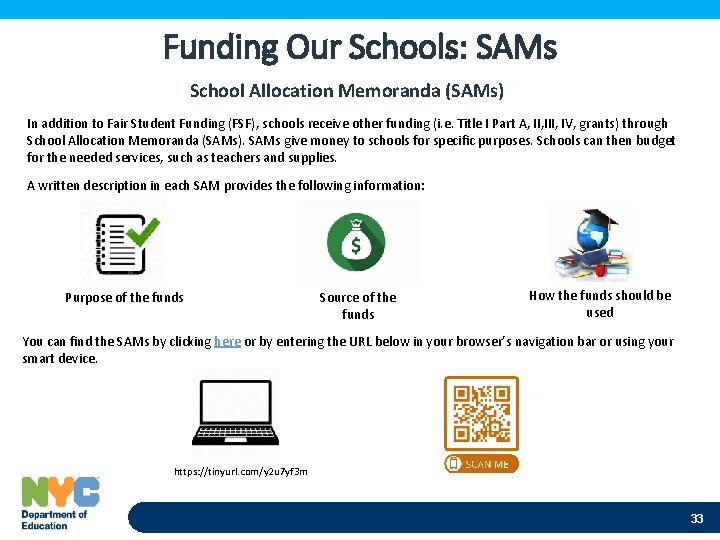
Funding Our Schools: SAMs School Allocation Memoranda (SAMs) In addition to Fair Student Funding (FSF), schools receive other funding (i. e. Title I Part A, III, IV, grants) through School Allocation Memoranda (SAMs). SAMs give money to schools for specific purposes. Schools can then budget for the needed services, such as teachers and supplies. A written description in each SAM provides the following information: Purpose of the funds Source of the funds How the funds should be used You can find the SAMs by clicking here or by entering the URL below in your browser’s navigation bar or using your smart device. https: //tinyurl. com/y 2 u 7 yf 3 m 33
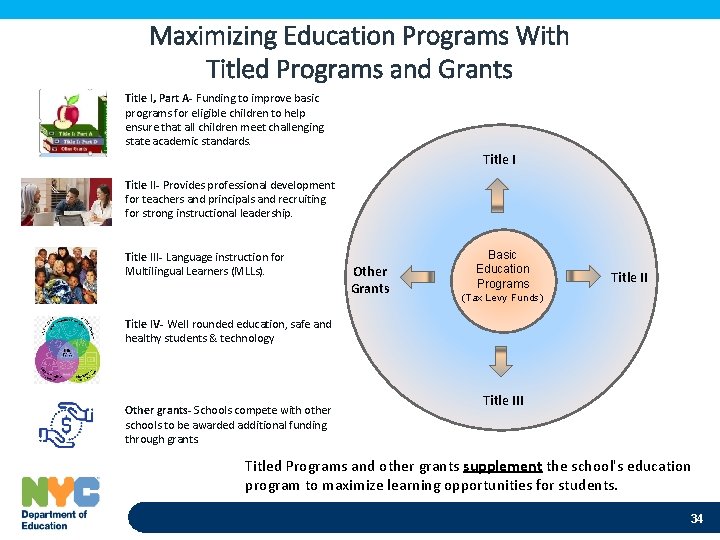
Maximizing Education Programs With Titled Programs and Grants Title I, Part A- Funding to improve basic programs for eligible children to help ensure that all children meet challenging state academic standards. Title II- Provides professional development for teachers and principals and recruiting for strong instructional leadership. Title III- Language instruction for Multilingual Learners (MLLs). Other Grants Basic Education Programs Title II (Tax Levy Funds) Title IV- Well rounded education, safe and healthy students & technology Other grants- Schools compete with other schools to be awarded additional funding through grants. Title III Titled Programs and other grants supplement the school's education program to maximize learning opportunities for students. 34
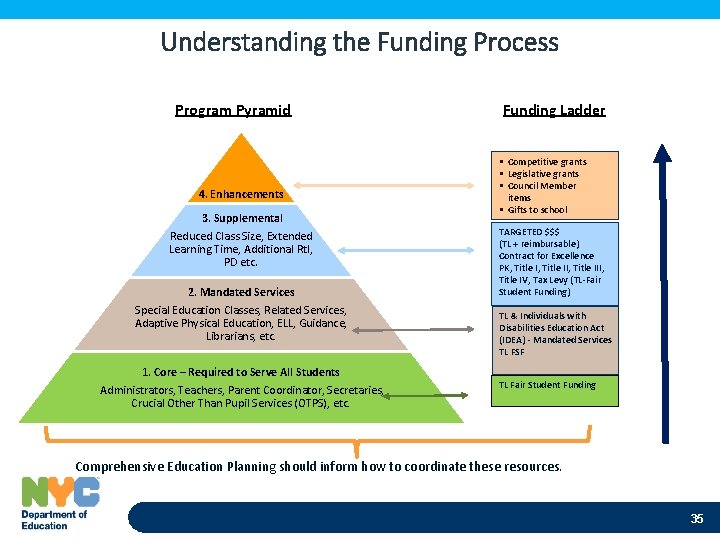
Understanding the Funding Process Program Pyramid 4. Enhancements 3. Supplemental Reduced Class Size, Extended Learning Time, Additional Rt. I, PD etc. 2. Mandated Services Special Education Classes, Related Services, Adaptive Physical Education, ELL, Guidance, Librarians, etc. 1. Core – Required to Serve All Students Administrators, Teachers, Parent Coordinator, Secretaries, Crucial Other Than Pupil Services (OTPS), etc. Funding Ladder • Competitive grants • Legislative grants • Council Member items • Gifts to school TARGETED $$$ (TL + reimbursable) Contract for Excellence PK, Title II, Title III, Title IV, Tax Levy (TL-Fair Student Funding) TL & Individuals with Disabilities Education Act (IDEA) - Mandated Services TL FSF TL Fair Student Funding Comprehensive Education Planning should inform how to coordinate these resources. 35
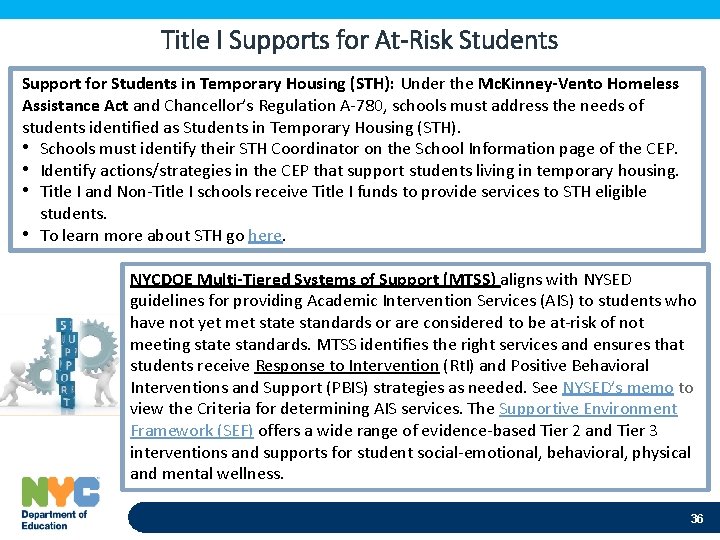
Title I Supports for At-Risk Students Support for Students in Temporary Housing (STH): Under the Mc. Kinney-Vento Homeless Assistance Act and Chancellor’s Regulation A-780, schools must address the needs of students identified as Students in Temporary Housing (STH). • Schools must identify their STH Coordinator on the School Information page of the CEP. • Identify actions/strategies in the CEP that support students living in temporary housing. • Title I and Non-Title I schools receive Title I funds to provide services to STH eligible students. • To learn more about STH go here. NYCDOE Multi-Tiered Systems of Support (MTSS) aligns with NYSED guidelines for providing Academic Intervention Services (AIS) to students who have not yet met state standards or are considered to be at-risk of not meeting state standards. MTSS identifies the right services and ensures that students receive Response to Intervention (Rt. I) and Positive Behavioral Interventions and Support (PBIS) strategies as needed. See NYSED’s memo to view the Criteria for determining AIS services. The Supportive Environment Framework (SEF) offers a wide range of evidence-based Tier 2 and Tier 3 interventions and supports for student social-emotional, behavioral, physical and mental wellness. 36
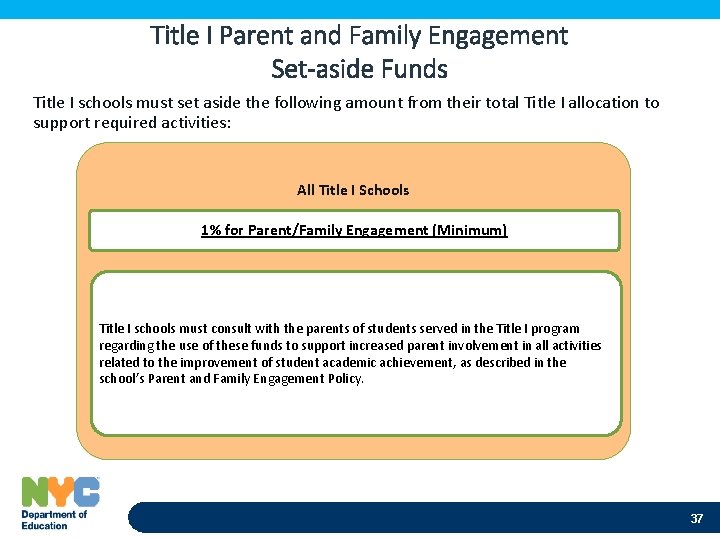
Title I Parent and Family Engagement Set-aside Funds Title I schools must set aside the following amount from their total Title I allocation to support required activities: All Title I Schools 1% for Parent/Family Engagement (Minimum) Title I schools must consult with the parents of students served in the Title I program regarding the use of these funds to support increased parent involvement in all activities related to the improvement of student academic achievement, as described in the school’s Parent and Family Engagement Policy. 37
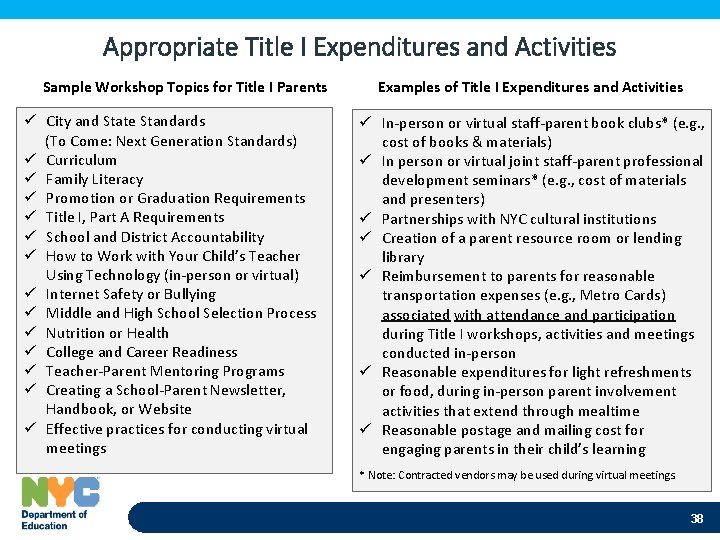
Appropriate Title I Expenditures and Activities Sample Workshop Topics for Title I Parents ü City and State Standards (To Come: Next Generation Standards) ü Curriculum ü Family Literacy ü Promotion or Graduation Requirements ü Title I, Part A Requirements ü School and District Accountability ü How to Work with Your Child’s Teacher Using Technology (in-person or virtual) ü Internet Safety or Bullying ü Middle and High School Selection Process ü Nutrition or Health ü College and Career Readiness ü Teacher-Parent Mentoring Programs ü Creating a School-Parent Newsletter, Handbook, or Website ü Effective practices for conducting virtual meetings Examples of Title I Expenditures and Activities ü In-person or virtual staff-parent book clubs* (e. g. , cost of books & materials) ü In person or virtual joint staff-parent professional development seminars* (e. g. , cost of materials and presenters) ü Partnerships with NYC cultural institutions ü Creation of a parent resource room or lending library ü Reimbursement to parents for reasonable transportation expenses (e. g. , Metro Cards) associated with attendance and participation during Title I workshops, activities and meetings conducted in-person ü Reasonable expenditures for light refreshments or food, during in-person parent involvement activities that extend through mealtime ü Reasonable postage and mailing cost for engaging parents in their child’s learning * Note: Contracted vendors may be used during virtual meetings. 38
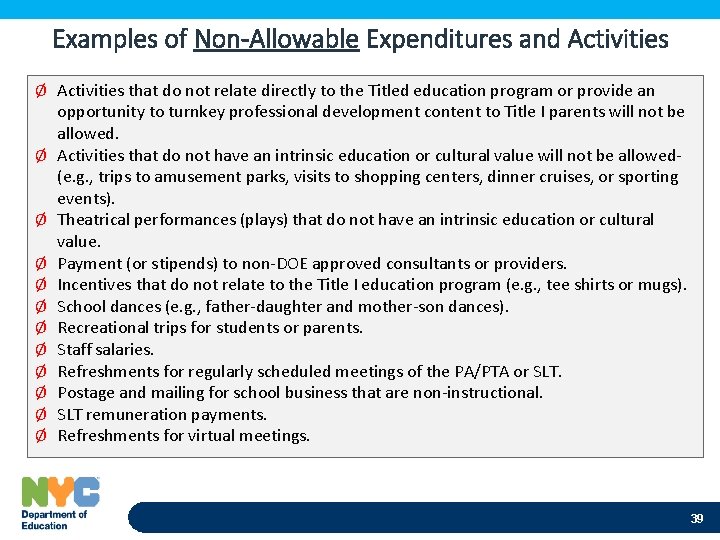
Examples of Non-Allowable Expenditures and Activities Ø Activities that do not relate directly to the Titled education program or provide an opportunity to turnkey professional development content to Title I parents will not be allowed. Ø Activities that do not have an intrinsic education or cultural value will not be allowed(e. g. , trips to amusement parks, visits to shopping centers, dinner cruises, or sporting events). Ø Theatrical performances (plays) that do not have an intrinsic education or cultural value. Ø Payment (or stipends) to non-DOE approved consultants or providers. Ø Incentives that do not relate to the Title I education program (e. g. , tee shirts or mugs). Ø School dances (e. g. , father-daughter and mother-son dances). Ø Recreational trips for students or parents. Ø Staff salaries. Ø Refreshments for regularly scheduled meetings of the PA/PTA or SLT. Ø Postage and mailing for school business that are non-instructional. Ø SLT remuneration payments. Ø Refreshments for virtual meetings. 39
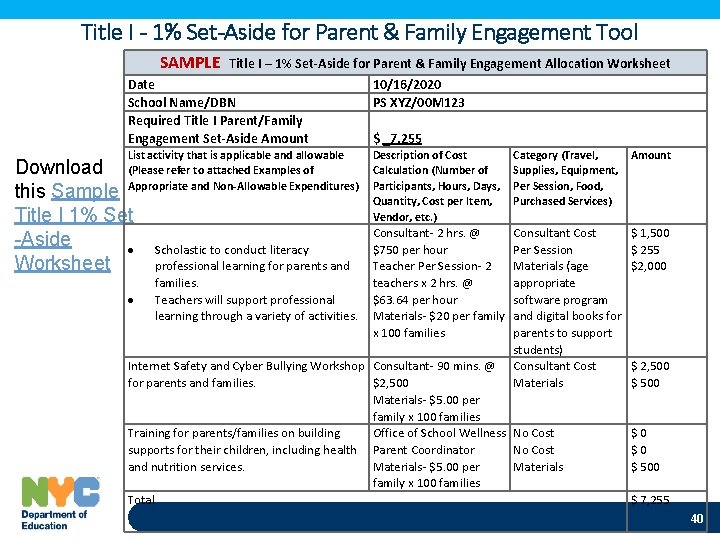
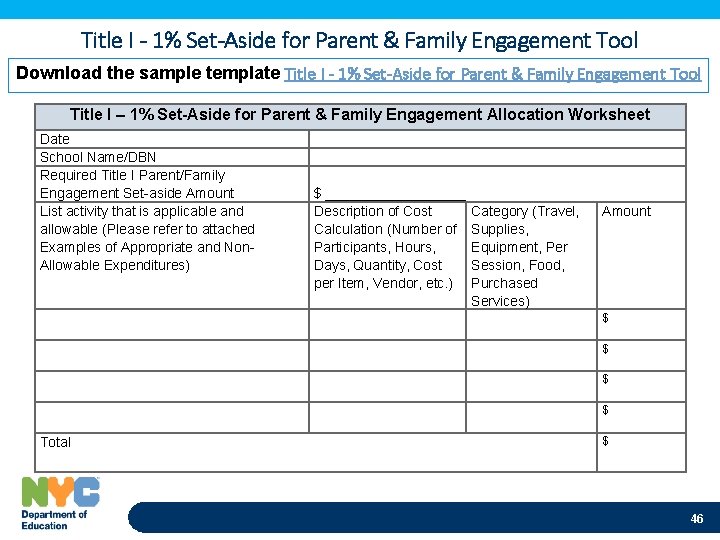
Title I - 1% Set-Aside for Parent & Family Engagement Tool SAMPLE Title I – 1% Set-Aside for Parent & Family Engagement Allocation Worksheet Date School Name/DBN Required Title I Parent/Family Engagement Set-Aside Amount 10/16/2020 PS XYZ/00 M 123 $ _7, 255 List activity that is applicable and allowable (Please refer to attached Examples of Appropriate and Non-Allowable Expenditures) Description of Cost Calculation (Number of Participants, Hours, Days, Quantity, Cost per Item, Vendor, etc. ) Category (Travel, Amount Supplies, Equipment, Per Session, Food, Purchased Services) Consultant- 2 hrs. @ $750 per hour Teacher Per Session- 2 teachers x 2 hrs. @ $63. 64 per hour Materials- $20 per family x 100 families Consultant Cost Per Session Materials (age appropriate software program and digital books for parents to support students) Consultant Cost Materials Download this Sample Title I 1% Set -Aside Worksheet Scholastic to conduct literacy professional learning for parents and families. Teachers will support professional learning through a variety of activities. Internet Safety and Cyber Bullying Workshop Consultant- 90 mins. @ for parents and families. $2, 500 Materials- $5. 00 per family x 100 families Training for parents/families on building Office of School Wellness No Cost supports for their children, including health Parent Coordinator No Cost and nutrition services. Materials- $5. 00 per Materials family x 100 families Total $ 1, 500 $ 255 $2, 000 $ 2, 500 $ 0 $ 500 $ 7, 255 40
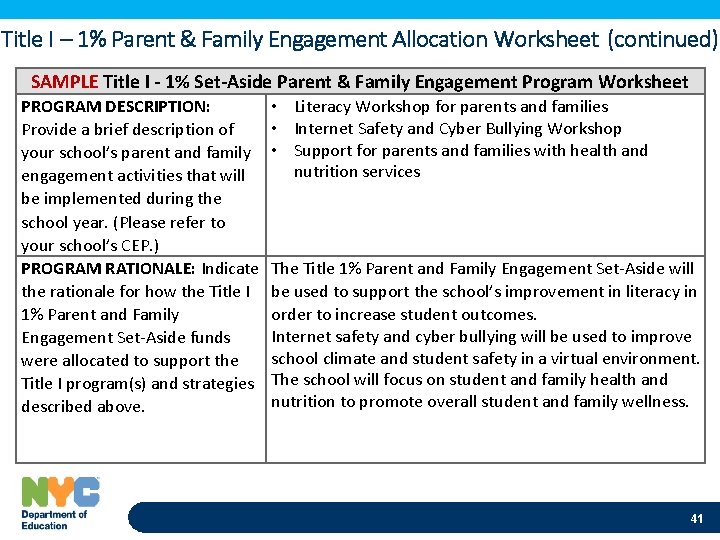
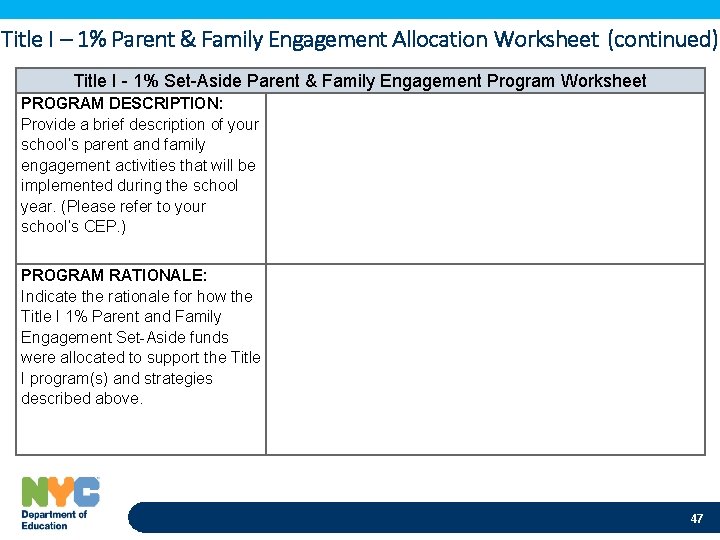
Title I – 1% Parent & Family Engagement Allocation Worksheet (continued) SAMPLE Title I - 1% Set-Aside Parent & Family Engagement Program Worksheet PROGRAM DESCRIPTION: Provide a brief description of your school’s parent and family engagement activities that will be implemented during the school year. (Please refer to your school’s CEP. ) PROGRAM RATIONALE: Indicate the rationale for how the Title I 1% Parent and Family Engagement Set-Aside funds were allocated to support the Title I program(s) and strategies described above. • Literacy Workshop for parents and families • Internet Safety and Cyber Bullying Workshop • Support for parents and families with health and nutrition services The Title 1% Parent and Family Engagement Set-Aside will be used to support the school’s improvement in literacy in order to increase student outcomes. Internet safety and cyber bullying will be used to improve school climate and student safety in a virtual environment. The school will focus on student and family health and nutrition to promote overall student and family wellness. 41
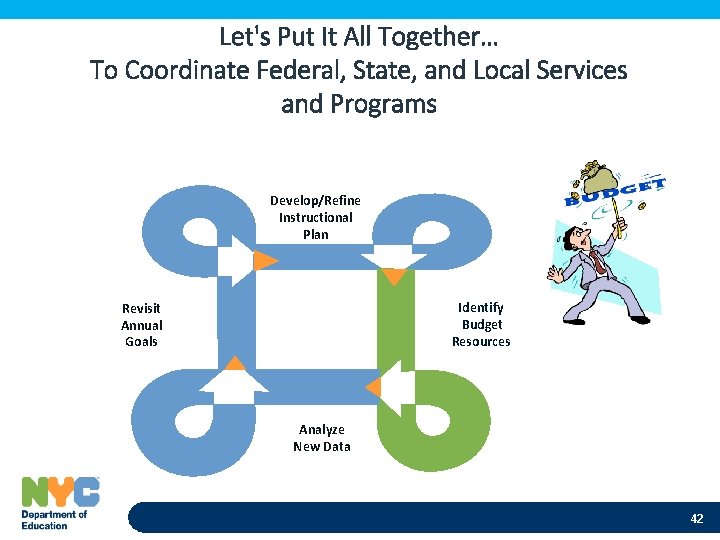
Let's Put It All Together… To Coordinate Federal, State, and Local Services and Programs Develop/Refine Instructional Plan Identify Budget Resources Revisit Annual Goals Analyze New Data 42
Assessing the Progress of Title I Programs Accountability for Student Outcomes 43
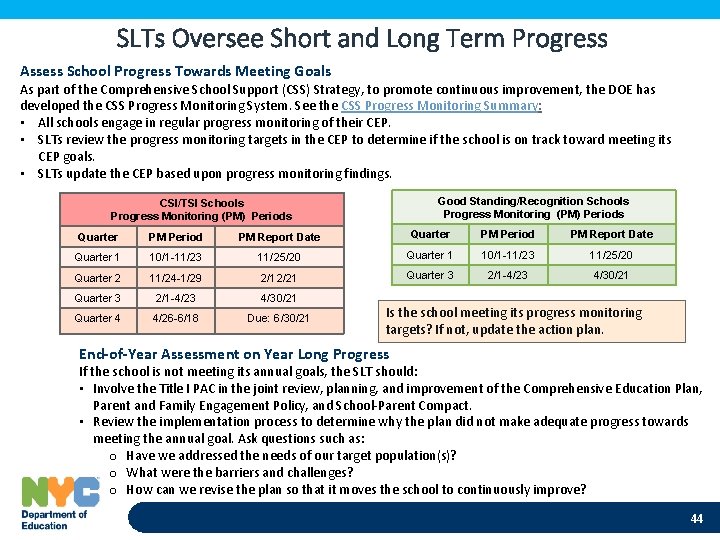
SLTs Oversee Short and Long Term Progress Assess School Progress Towards Meeting Goals As part of the Comprehensive School Support (CSS) Strategy, to promote continuous improvement, the DOE has developed the CSS Progress Monitoring System. See the CSS Progress Monitoring Summary: • All schools engage in regular progress monitoring of their CEP. • SLTs review the progress monitoring targets in the CEP to determine if the school is on track toward meeting its CEP goals. • SLTs update the CEP based upon progress monitoring findings. Good Standing/Recognition Schools Progress Monitoring (PM) Periods CSI/TSI Schools Progress Monitoring (PM) Periods Quarter PM Period PM Report Date Quarter 1 10/1 -11/23 11/25/20 Quarter 2 11/24 -1/29 2/12/21 Quarter 3 2/1 -4/23 4/30/21 Quarter 4 4/26 -6/18 Due: 6/30/21 Is the school meeting its progress monitoring targets? If not, update the action plan. End-of-Year Assessment on Year Long Progress If the school is not meeting its annual goals, the SLT should: • Involve the Title I PAC in the joint review, planning, and improvement of the Comprehensive Education Plan, Parent and Family Engagement Policy, and School-Parent Compact. • Review the implementation process to determine why the plan did not make adequate progress towards meeting the annual goal. Ask questions such as: o Have we addressed the needs of our target population(s)? o What were the barriers and challenges? o How can we revise the plan so that it moves the school to continuously improve? 44
Title I Resources HANDOUTS 45
Title I - 1% Set-Aside for Parent & Family Engagement Tool Download the sample template Title I - 1% Set-Aside for Parent & Family Engagement Tool Title I – 1% Set-Aside for Parent & Family Engagement Allocation Worksheet Date School Name/DBN Required Title I Parent/Family Engagement Set-aside Amount List activity that is applicable and allowable (Please refer to attached Examples of Appropriate and Non. Allowable Expenditures) $ _________ Description of Cost Category (Travel, Calculation (Number of Supplies, Participants, Hours, Equipment, Per Days, Quantity, Cost Session, Food, per Item, Vendor, etc. ) Purchased Services) $ $ Total Amount $ 46
Title I – 1% Parent & Family Engagement Allocation Worksheet (continued) Title I - 1% Set-Aside Parent & Family Engagement Program Worksheet PROGRAM DESCRIPTION: Provide a brief description of your school’s parent and family engagement activities that will be implemented during the school year. (Please refer to your school’s CEP. ) PROGRAM RATIONALE: Indicate the rationale for how the Title I 1% Parent and Family Engagement Set-Aside funds were allocated to support the Title I program(s) and strategies described above. 47
Contact Information For technical assistance with i. Plan, contact iplan@schools. nyc. gov. For questions on Title I, reach out to the DSFP assigned by your BCO/Superintendent or email OSFEP@schools. nyc. gov. 48
Questions & Answers 49
We appreciate your attendance and participation! 50