
TITLE Hughes policeman doll study 15 December 2021
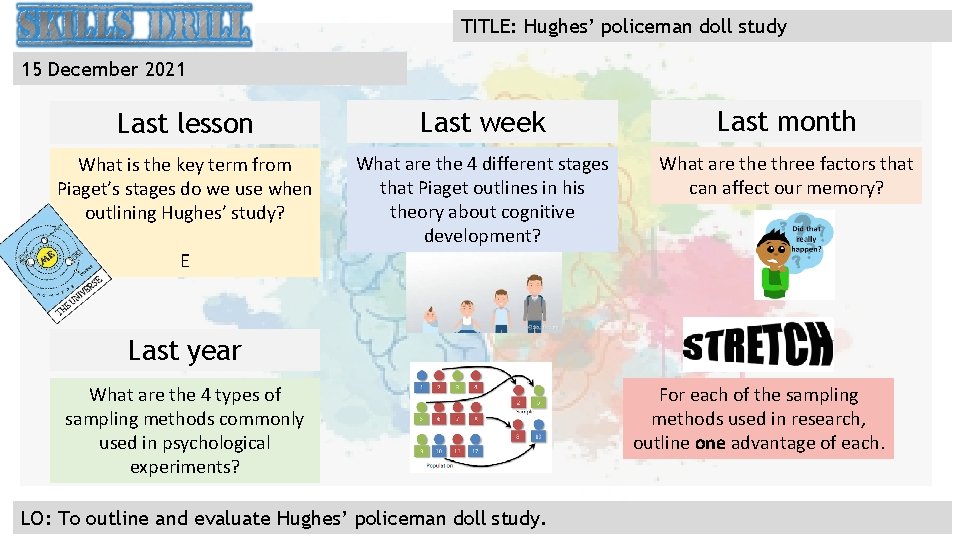
TITLE: Hughes’ policeman doll study 15 December 2021 Last lesson Last week Last month What is the key term from Piaget’s stages do we use when outlining Hughes’ study? What are the 4 different stages that Piaget outlines in his theory about cognitive development? What are three factors that can affect our memory? E Last year What are the 4 types of sampling methods commonly used in psychological experiments? LO: To outline and evaluate Hughes’ policeman doll study. For each of the sampling methods used in research, outline one advantage of each.
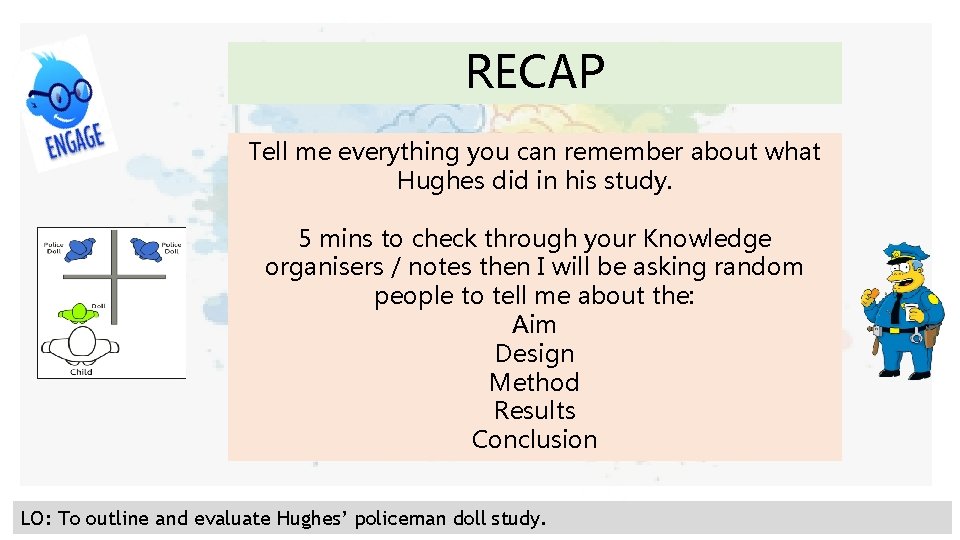
RECAP Tell me everything you can remember about what Hughes did in his study. 5 mins to check through your Knowledge organisers / notes then I will be asking random people to tell me about the: Aim Design Method Results Conclusion LO: To outline and evaluate Hughes’ policeman doll study.
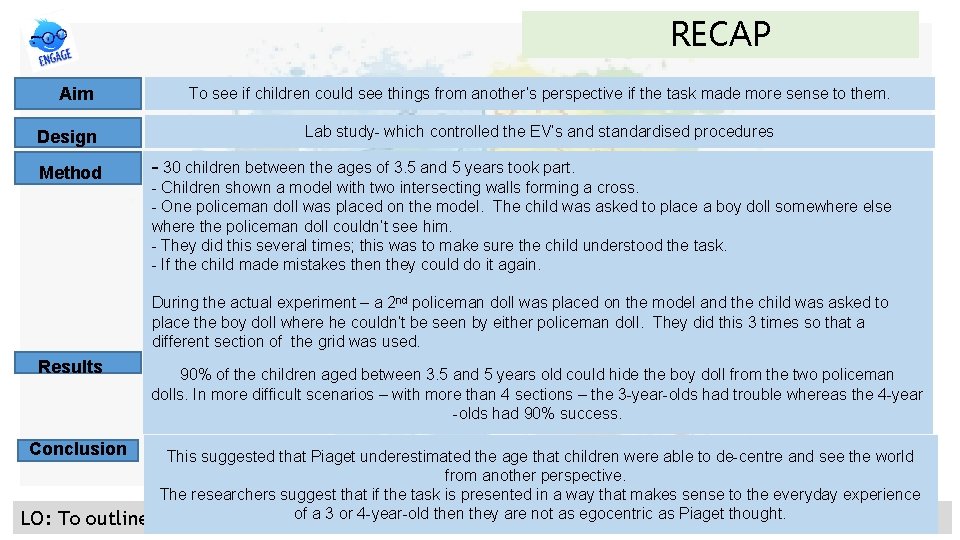
RECAP Aim Design Method To see if children could see things from another’s perspective if the task made more sense to them. Lab study- which controlled the EV’s and standardised procedures - 30 children between the ages of 3. 5 and 5 years took part. - Children shown a model with two intersecting walls forming a cross. - One policeman doll was placed on the model. The child was asked to place a boy doll somewhere else where the policeman doll couldn’t see him. - They did this several times; this was to make sure the child understood the task. - If the child made mistakes then they could do it again. During the actual experiment – a 2 nd policeman doll was placed on the model and the child was asked to place the boy doll where he couldn’t be seen by either policeman doll. They did this 3 times so that a different section of the grid was used. Results Conclusion LO: To outline 90% of the children aged between 3. 5 and 5 years old could hide the boy doll from the two policeman dolls. In more difficult scenarios – with more than 4 sections – the 3 -year-olds had trouble whereas the 4 -year -olds had 90% success. This suggested that Piaget underestimated the age that children were able to de-centre and see the world from another perspective. The researchers suggest that if the task is presented in a way that makes sense to the everyday experience of a 3 or policeman 4 -year-old then theystudy. are not as egocentric as Piaget thought. and evaluate Hughes’ doll
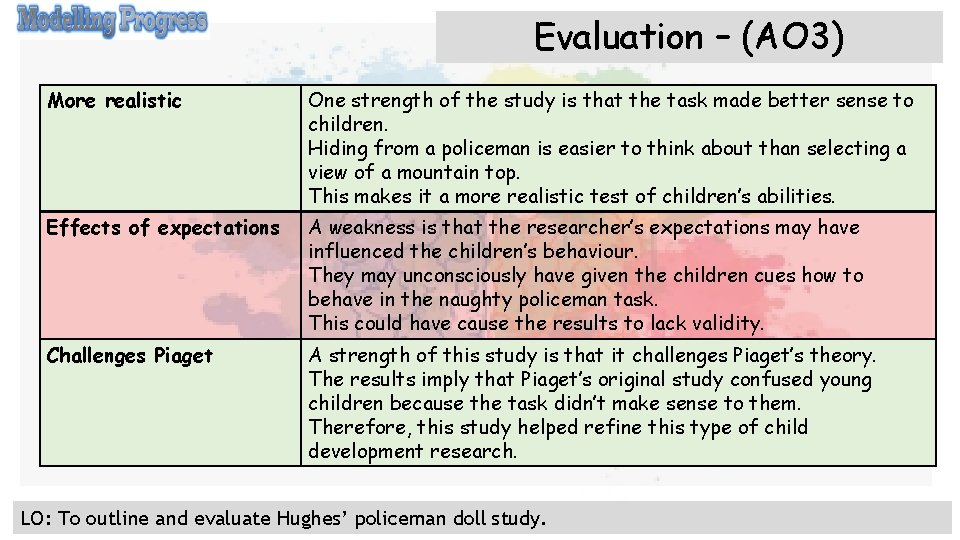
Evaluation – (AO 3) More realistic One strength of the study is that the task made better sense to children. Hiding from a policeman is easier to think about than selecting a view of a mountain top. This makes it a more realistic test of children’s abilities. Effects of expectations A weakness is that the researcher’s expectations may have influenced the children’s behaviour. They may unconsciously have given the children cues how to behave in the naughty policeman task. This could have cause the results to lack validity. Challenges Piaget A strength of this study is that it challenges Piaget’s theory. The results imply that Piaget’s original study confused young children because the task didn’t make sense to them. Therefore, this study helped refine this type of child development research. LO: To outline and evaluate Hughes’ policeman doll study.
9 mark question Steps for success! Paragraph 1 – Aim and method Paragraph 2 – Results and conclusion Paragraph 3 – Evaluation – more realistic Paragraph 4 – Evaluation – Effects of expectations Paragraph 5 – Evaluation – Challenges Piaget. Outline and evaluate Hughes’ policeman doll study. (9 marks) You have 25 mins to complete this task, you MUST email me your responses when you are finished so that I can give you some feedback. LO: To outline and evaluate Hughes’ policeman doll study.
Q 1. At about 7 years, egocentrism is replace by: a. b. c. d. The ability to decentre Conservation by number Conservation by volume The ability to assimilate. LO: To outline and evaluate Hughes’ policeman doll study.
Q 1. At about 7 years, egocentrism is replace by: a. b. c. d. The ability to decentre Conservation by number Conservation by volume The ability to assimilate. LO: To outline and evaluate Hughes’ policeman doll study.
Q 2. In Hughes’ study, what proportion of children could place the doll where two policeman could not ‘see’ him? a. b. c. d. 90% 80% 70% 60%. LO: To outline and evaluate Hughes’ policeman doll study.
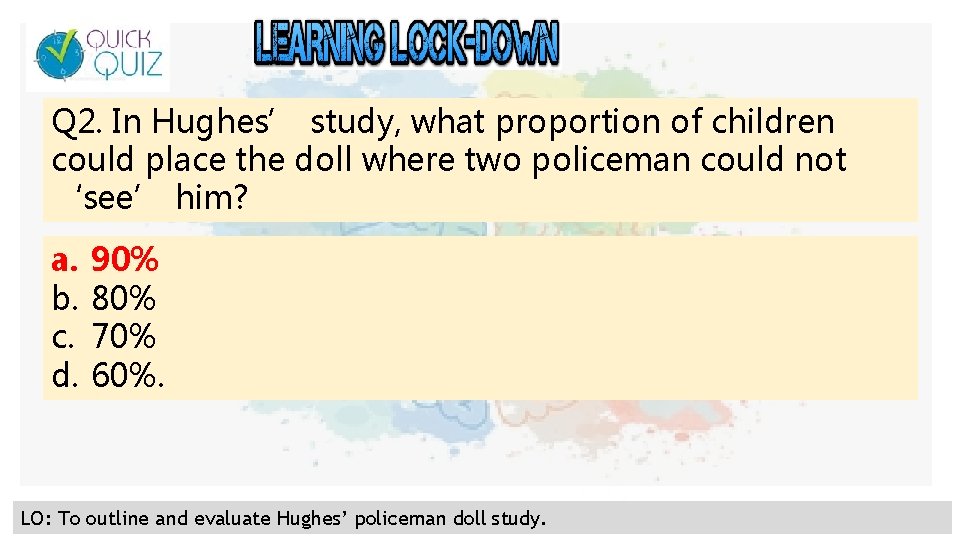
Q 2. In Hughes’ study, what proportion of children could place the doll where two policeman could not ‘see’ him? a. b. c. d. 90% 80% 70% 60%. LO: To outline and evaluate Hughes’ policeman doll study.
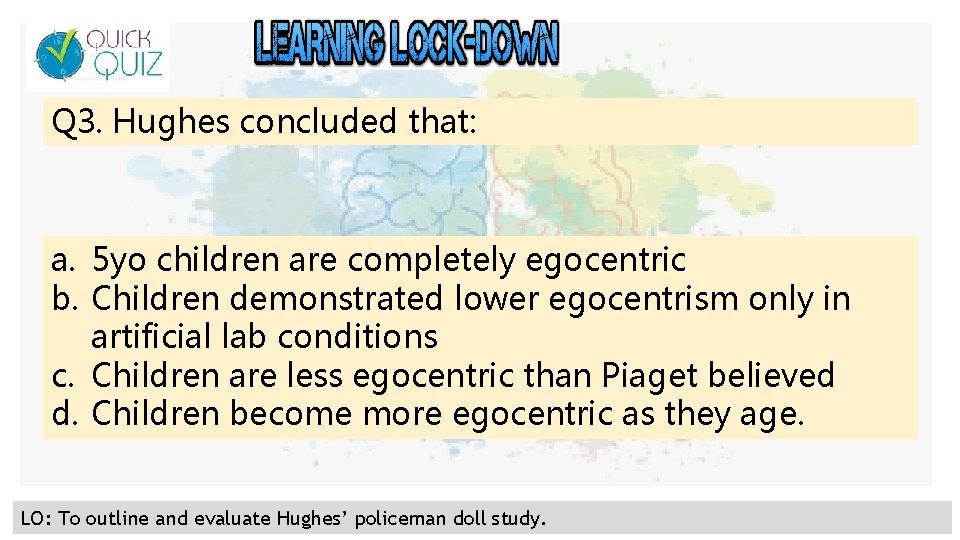
Q 3. Hughes concluded that: a. 5 yo children are completely egocentric b. Children demonstrated lower egocentrism only in artificial lab conditions c. Children are less egocentric than Piaget believed d. Children become more egocentric as they age. LO: To outline and evaluate Hughes’ policeman doll study.
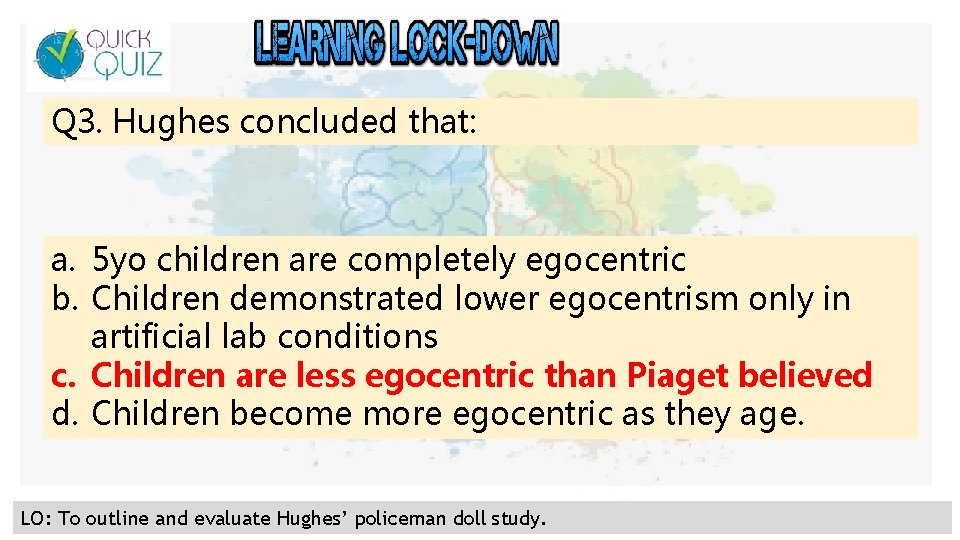
Q 3. Hughes concluded that: a. 5 yo children are completely egocentric b. Children demonstrated lower egocentrism only in artificial lab conditions c. Children are less egocentric than Piaget believed d. Children become more egocentric as they age. LO: To outline and evaluate Hughes’ policeman doll study.
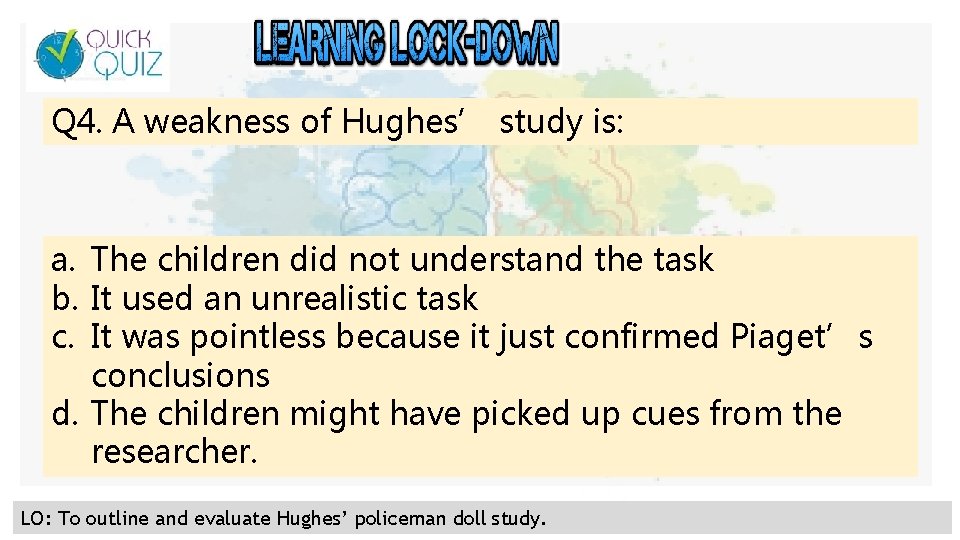
Q 4. A weakness of Hughes’ study is: a. The children did not understand the task b. It used an unrealistic task c. It was pointless because it just confirmed Piaget’s conclusions d. The children might have picked up cues from the researcher. LO: To outline and evaluate Hughes’ policeman doll study.
Q 4. A weakness of Hughes’ study is: a. The children did not understand the task b. It used an unrealistic task c. It was pointless because it just confirmed Piaget’s conclusions d. The children might have picked up cues from the researcher. LO: To outline and evaluate Hughes’ policeman doll study.
Q 5. Choosing every nth name from a list is: a. b. c. d. A systematic sample A random sample An opportunity sample A stratified sample. LO: To outline and evaluate Hughes’ policeman doll study.
Q 5. Choosing every nth name from a list is: a. b. c. d. A systematic sample A random sample An opportunity sample A stratified sample. LO: To outline and evaluate Hughes’ policeman doll study.
NEXT LESSON – Knowledge organiser quiz – Hughes’ study. LO: To outline and evaluate Hughes’ policeman doll study.
- Slides: 16