
Title Global Atmospheric Circulation Week 1 Home Learning
Title: Global Atmospheric Circulation Week 1 Home Learning
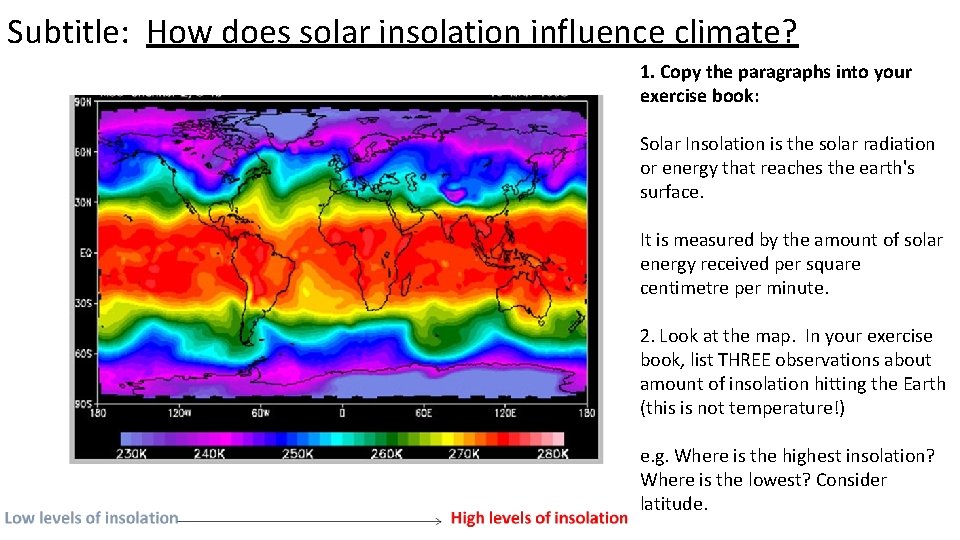
Subtitle: How does solar insolation influence climate? 1. Copy the paragraphs into your exercise book: Solar Insolation is the solar radiation or energy that reaches the earth's surface. It is measured by the amount of solar energy received per square centimetre per minute. 2. Look at the map. In your exercise book, list THREE observations about amount of insolation hitting the Earth (this is not temperature!) e. g. Where is the highest insolation? Where is the lowest? Consider latitude.
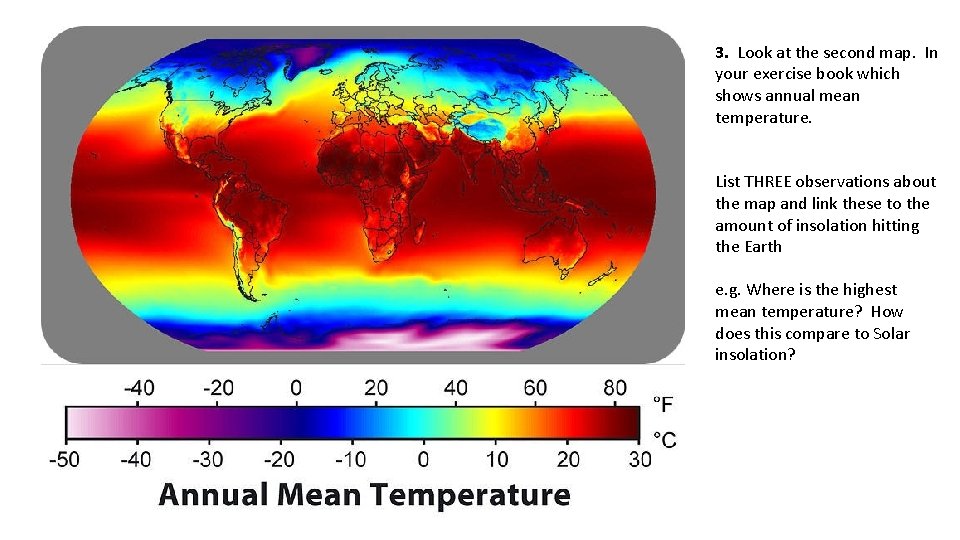
3. Look at the second map. In your exercise book which shows annual mean temperature. List THREE observations about the map and link these to the amount of insolation hitting the Earth e. g. Where is the highest mean temperature? How does this compare to Solar insolation?
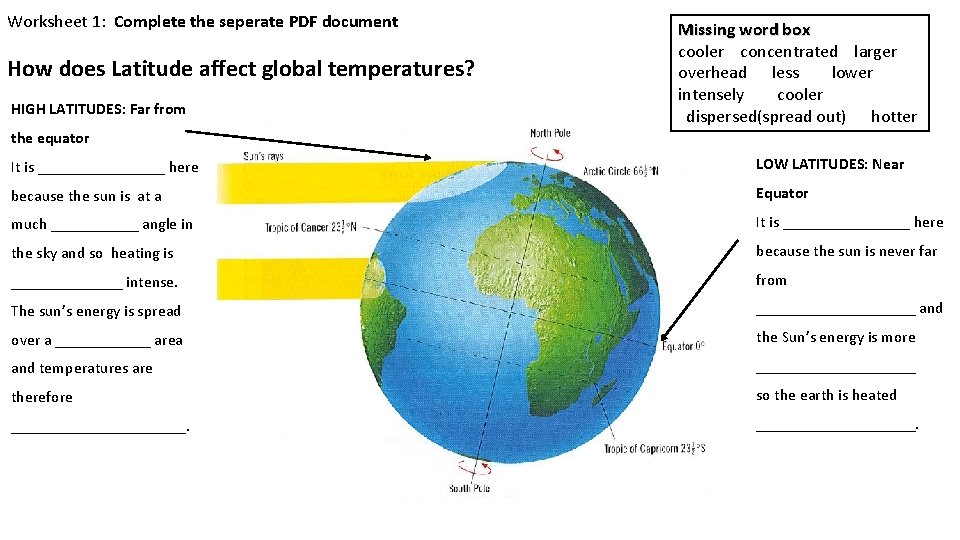
Worksheet 1: Complete the seperate PDF document How does Latitude affect global temperatures? HIGH LATITUDES: Far from Missing word box cooler concentrated larger overhead less lower intensely cooler dispersed(spread out) hotter the equator It is ________ here LOW LATITUDES: Near because the sun is at a Equator much ______ angle in It is ________ here the sky and so heating is because the sun is never far _______ intense. from The sun’s energy is spread __________ and over a ______ area the Sun’s energy is more and temperatures are __________ therefore so the earth is heated ___________.
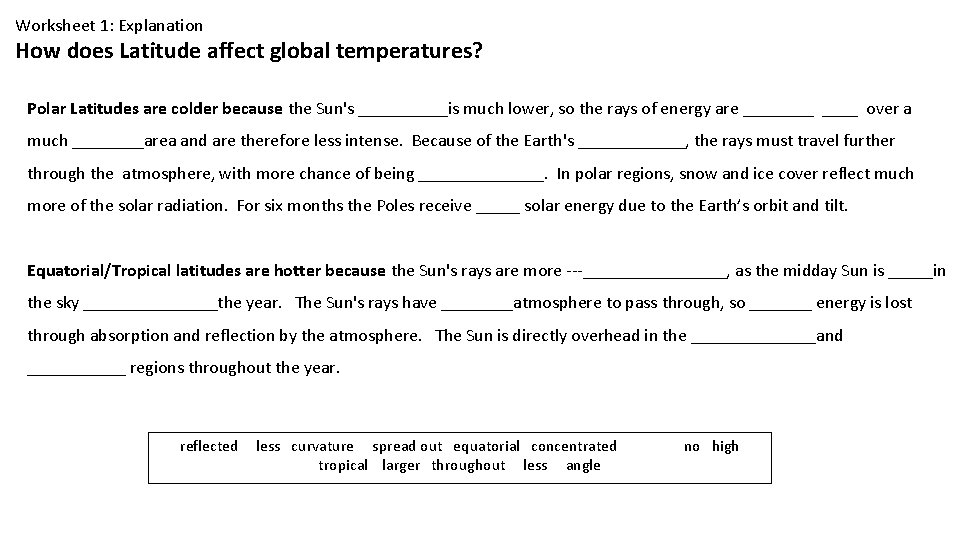
Worksheet 1: Explanation How does Latitude affect global temperatures? Polar Latitudes are colder because the Sun's _____is much lower, so the rays of energy are ____ over a much ____area and are therefore less intense. Because of the Earth's ______, the rays must travel further through the atmosphere, with more chance of being _______. In polar regions, snow and ice cover reflect much more of the solar radiation. For six months the Poles receive _____ solar energy due to the Earth’s orbit and tilt. Equatorial/Tropical latitudes are hotter because the Sun's rays are more ________, as the midday Sun is _____in the sky ________the year. The Sun's rays have ____atmosphere to pass through, so _______ energy is lost through absorption and reflection by the atmosphere. The Sun is directly overhead in the _______and ______ regions throughout the year. reflected less curvature spread out equatorial concentrated tropical larger throughout less angle no high
Global Atmospheric Circulation 1. Read the extract from the GCSE textbook: Week 1 Global Atmospheric Circulation. 2. Copy the sentences below: Globally, there areas of heat surplus and deficit. Surplus: A lot of heat e. g. Equator Deficit: A lack of heat e. g. Poles. Heat is transferred from the Equator to the Poles using convection cells where warm air rises and cold air sinks. (Recap: Look at your notes from the start of the Living World module)
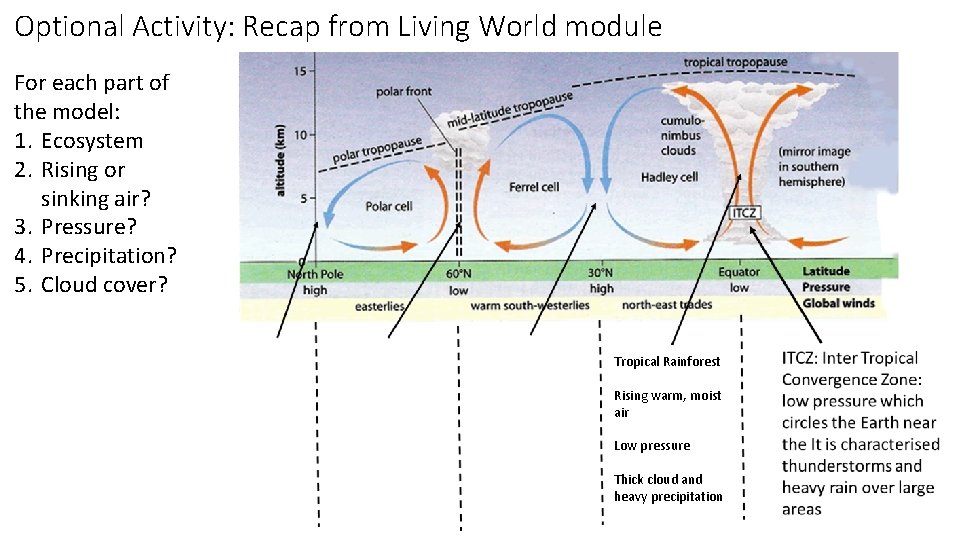
Optional Activity: Recap from Living World module For each part of the model: 1. Ecosystem 2. Rising or sinking air? 3. Pressure? 4. Precipitation? 5. Cloud cover? Tropical Rainforest Rising warm, moist air Low pressure Thick cloud and heavy precipitation
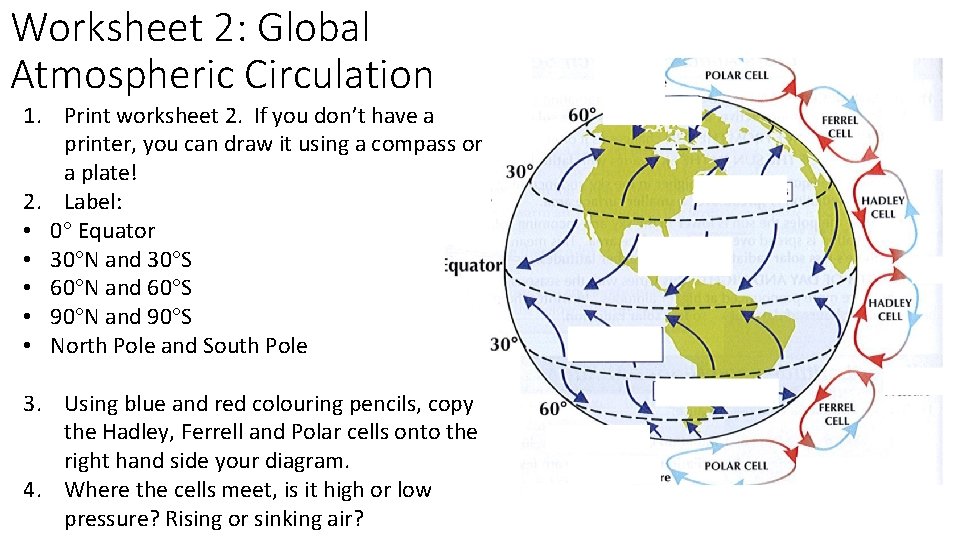
Worksheet 2: Global Atmospheric Circulation 1. Print worksheet 2. If you don’t have a printer, you can draw it using a compass or a plate! 2. Label: • 0 Equator • 30 N and 30 S • 60 N and 60 S • 90 N and 90 S • North Pole and South Pole 3. Using blue and red colouring pencils, copy the Hadley, Ferrell and Polar cells onto the right hand side your diagram. 4. Where the cells meet, is it high or low pressure? Rising or sinking air?
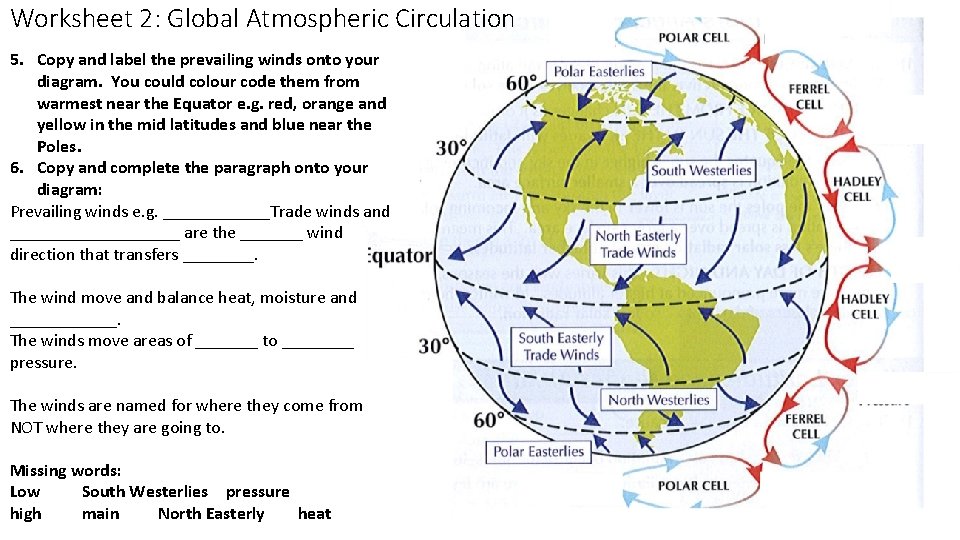
Worksheet 2: Global Atmospheric Circulation 5. Copy and label the prevailing winds onto your diagram. You could colour code them from warmest near the Equator e. g. red, orange and yellow in the mid latitudes and blue near the Poles. 6. Copy and complete the paragraph onto your diagram: Prevailing winds e. g. ______Trade winds and __________ are the _______ wind direction that transfers ____. The wind move and balance heat, moisture and ______. The winds move areas of _______ to ____ pressure. The winds are named for where they come from NOT where they are going to. Missing words: Low South Westerlies pressure high main North Easterly heat
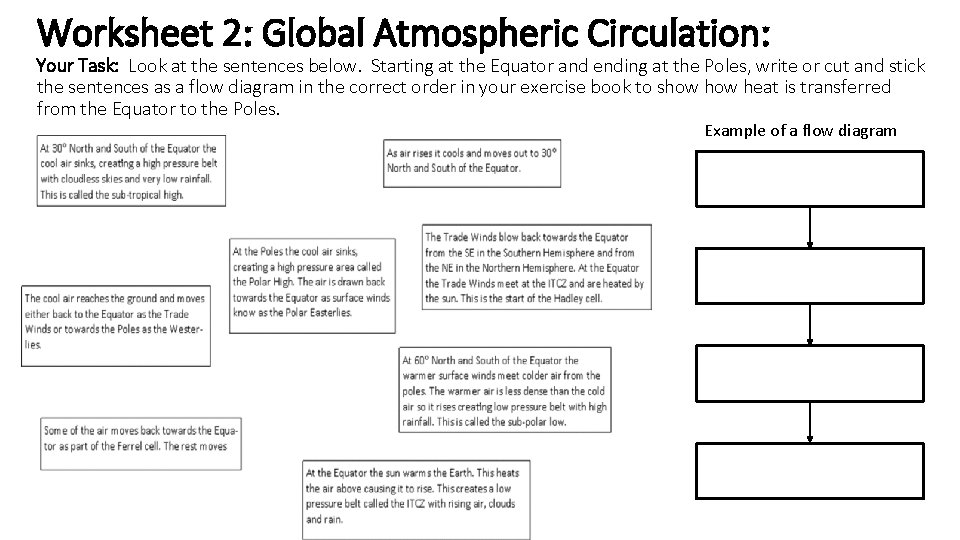
Worksheet 2: Global Atmospheric Circulation: Your Task: Look at the sentences below. Starting at the Equator and ending at the Poles, write or cut and stick the sentences as a flow diagram in the correct order in your exercise book to show heat is transferred from the Equator to the Poles. Example of a flow diagram
- Slides: 10