
Title 190 610 National Environmental Compliance Handbook Definitions

Title 190 - 610 National Environmental Compliance Handbook, Definitions National Environmental Policy Act (NEPA). —The National Environmental Policy Act of 1970 that requires Federal agencies to consider the effects of proposed Federal actions on the environment. This act established the requirement that Federal agencies prepare a detailed statement of environmental impacts for major Federal actions significantly affecting the human environment and make this information available to the public.

Title 190 - 610 National Environmental Compliance Handbook, Definitions Action. —All activities or programs of any kind authorized, funded, or carried out, in whole or in part, by Federal agencies in the United States or upon the high seas (Joint Counterpart Endangered Species Act Section 7 Consultation, 50 CFR Section 402. 02).

Title 190 - 610 National Environmental Compliance Handbook, Definitions Federal Action (NEPA application). —Actions that are subject to Federal (NRCS) control and responsibility (e. g. , those that are financed, funded, assisted, conducted, regulated, or approved by NRCS) (see “Action, ” above). These actions do not include situations in which NRCS is only providing technical assistance because NRCS cannot control what the client ultimately does with that assistance and situations where NRCS is making a technical determination (such as Farm Bill HEL or wetland conservation determinations) not associated with the planning process.
Title 180 -600 National Planning Procedures Handbook 600. 41 Integrating NEPA into the Planning Process A. NEPA requirements will be incorporated into all steps and activities of the planning process as applicable and will not be considered as a separate process or requirement.
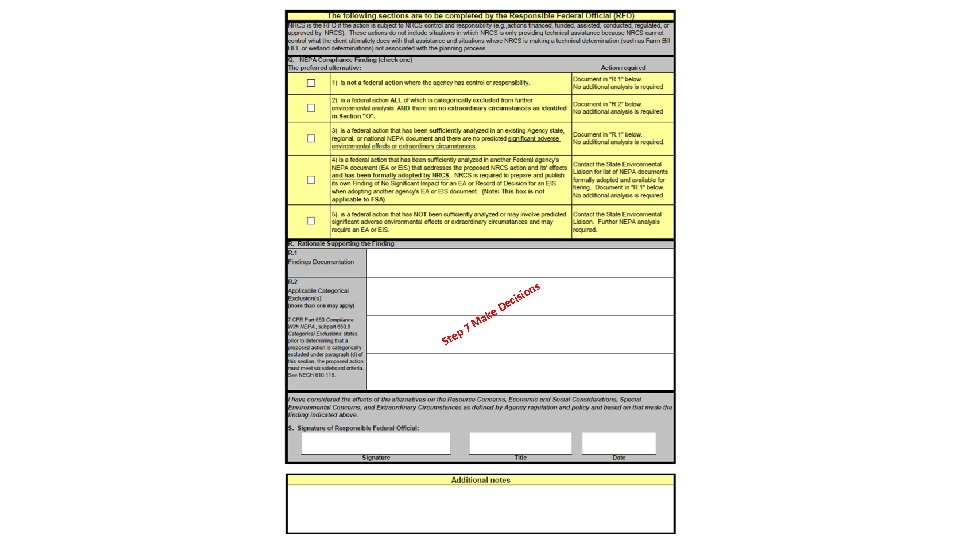
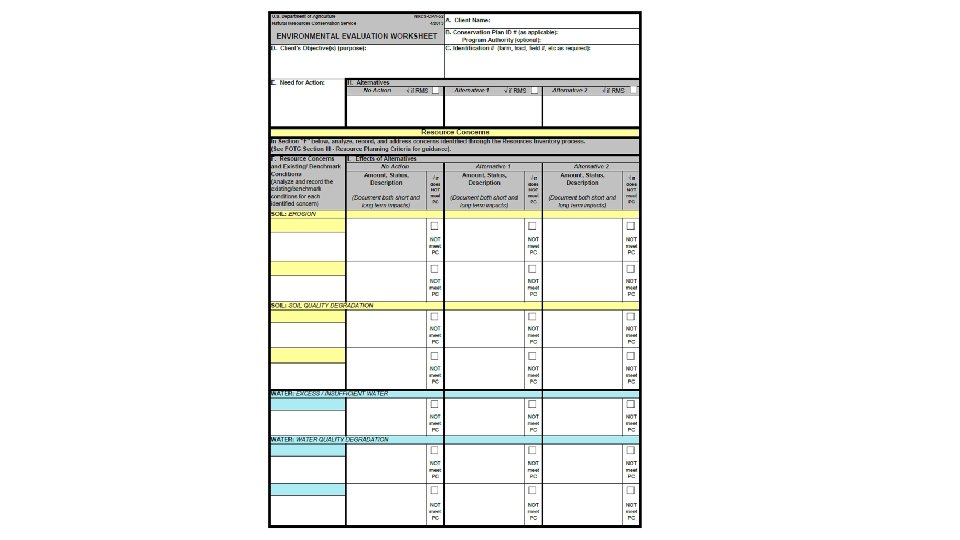
Title 190 – NECH 610. 41 Framework for Compliance (3) Field Offices NRCS field offices must conduct an EE to determine the potential effects of alternative solutions to resource problems for all planning activities and document the results of the evaluation on Form NRCSCPA-52. Important aspects of this protocol involve an evaluation of the significance of impacts, a review of extraordinary circumstances for categorical exclusions, and the appropriate NEPA finding by the responsible Federal official (RFO).

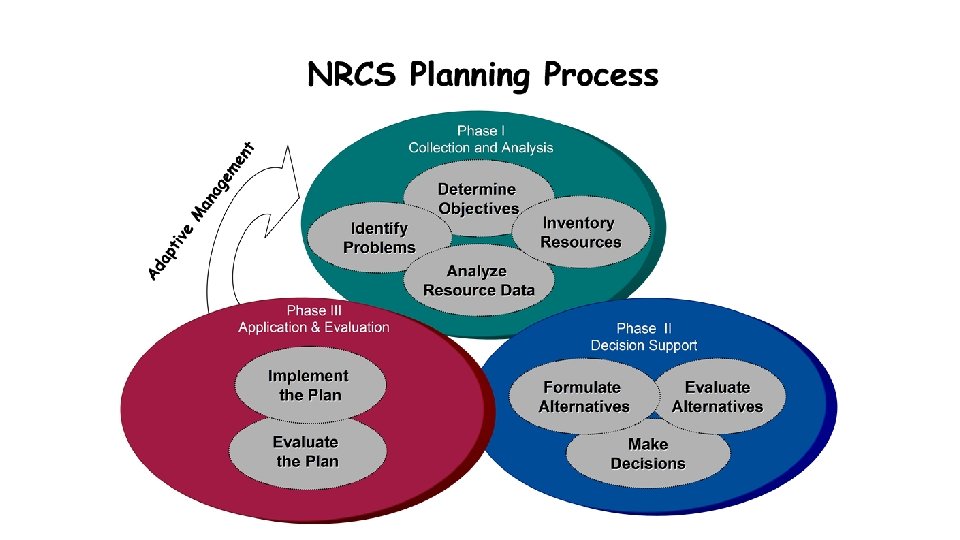
NEPA & Conservation Planning NEPA 1. Purpose of the Action 2. Need to be Met 3. Affected Environment 4. Alternatives 5. Environmental Consequences 6. Finding 7. Mitigation & Monitoring 8. List of Consultation 9. Public Participation NRCS Planning Process 1. Determine Objectives 2. ID Problems & Opportunities 3. Inventory & Analyze Resources 4. Formulate Alternatives 5. Evaluate Alternatives 6. Make Decisions 7. Implement & Evaluate 8. CPA 52 9. Client Participation or Public Participation Plan (Area wide Planning)
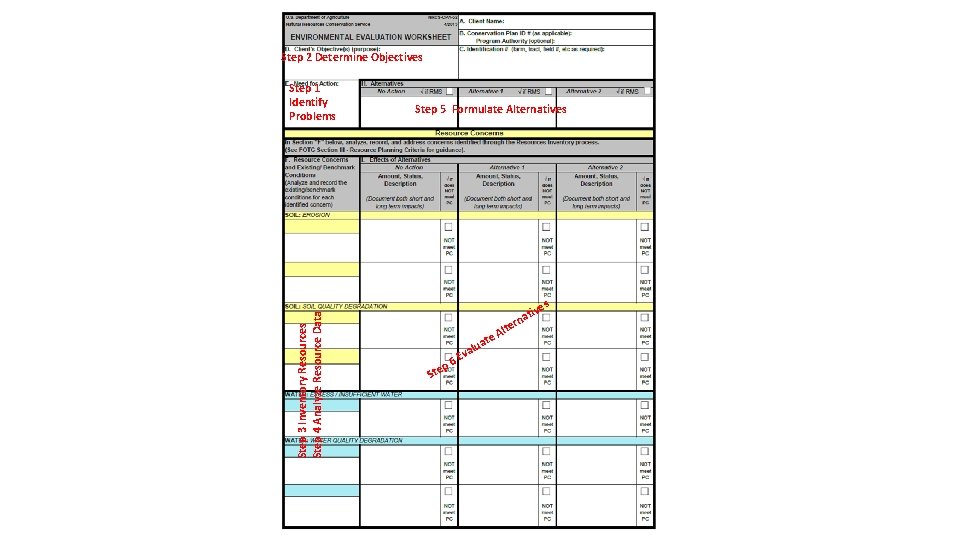
Step 2 Determine Objectives Step 3 Inventory Resources Step 4 Analyze Resource Data Step 1 Identify Problems Step 5 Formulate Alternatives lte ti rna lu A ate p Ste va 6 E s ve
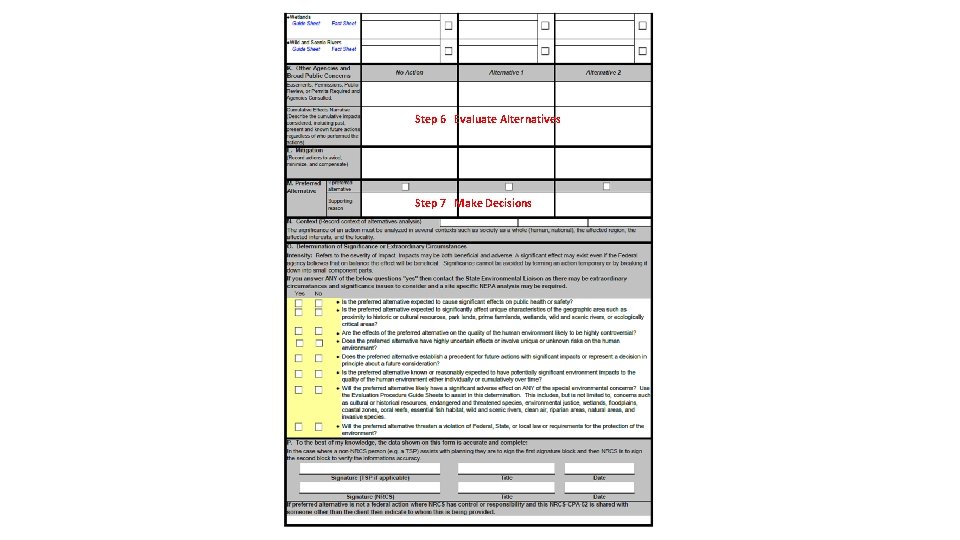
Step 6 Evaluate Alternatives Step 7 Make Decisions
ns e. D p 7 Ste k Ma sio eci
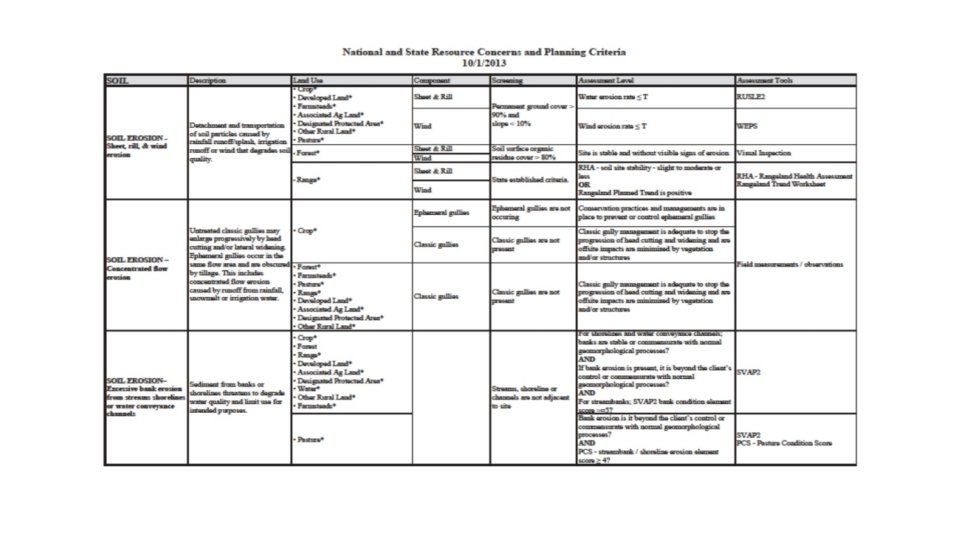
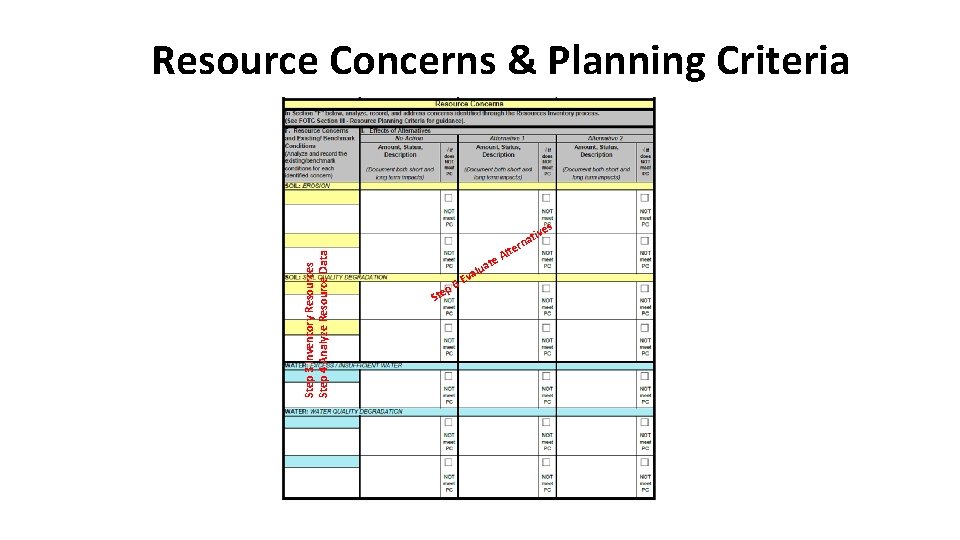
Step 3 Inventory Resources Step 4 Analyze Resource Data Resource Concerns & Planning Criteria va te lua Ste E p 6 Alt v ati n r e es
Objectives Objective = Desired Future Condition • Objectives. —Objectives are quantitative or qualitative statements of desired future conditions as determined by the client. Examples: • To reduce soil loss from cropland to maintain USDA program compliance (T or 2 T). • To lower stream water temperature for fish habitat (X degrees). • To improve tree species diversity and composition for wildlife. (HSI) • To develop scrub shrub habitat for NECT. Can an objective be defined without describing benchmark condition?
Need For Action What is the problem? What is the cause of the problem? Why does this matter? Because of “X”, there is a need to “Y” X = the Symptom/Problem/Resource Concern Y = The underlying cause/what needs to change To get to Y ask Why? (like a 3 year old) Then Ask: So What?
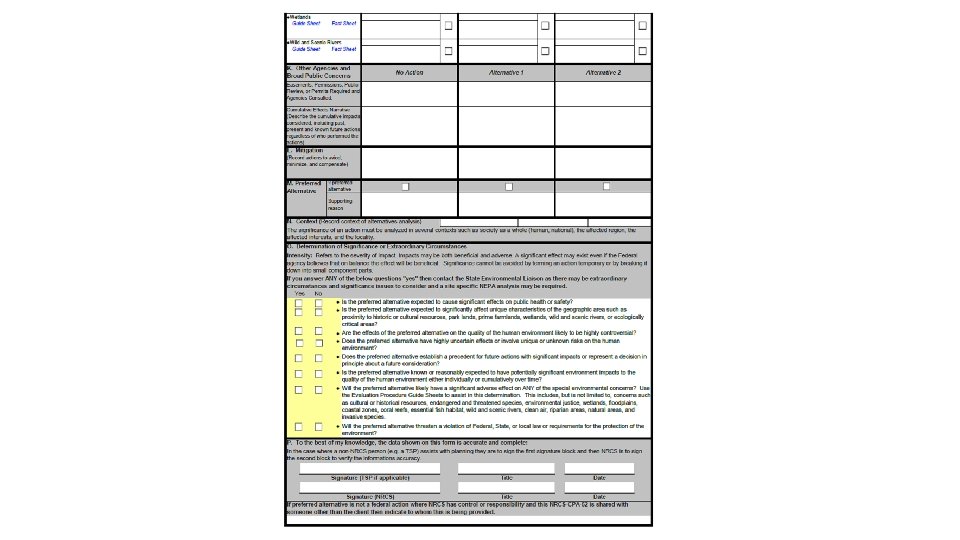
NPPH 600. 41 E. As a result of the EE process, the conclusions (“findings”) that may be reached include any of the following: (1) There is no Federal action, as defined by NEPA, subject to NRCS Federal regulations occurring that requires a NEPA document (see 190 -NECH, Subpart D, Section 610. 43, “The National Environmental Policy Act”). (2) The action is a Federal action that is categorically excluded with no extraordinary circumstances present so no further documentation is needed (see 190 -NECH, Subpart D, Section 610. 46, “The National Environmental Policy Act”). (3) There is an existing NRCS State, Tribal , Territorial, regional, or national programmatic NEPA document that has sufficiently analyzed the particular Federal action and there are no predicted significant adverse effects or extraordinary circumstances (see 190 -NECH, Subpart F, Section 610. 81, “NEPA Tools for Efficiency”). Title 180 – National Planning Procedures Handbook (180 -VI-NPPH, Amend. 5, January 2013) 600 -E. 5 (4) Another Federal agency’s NEPA document (EA or EIS) has been formally adopted by NRCS that sufficiently analyzes the specific action (see 190 -NECH, Subpart F, Section 610. 83, “NEPA Tools for Efficiency”). (5) The proposed action is a Federal action that has not been sufficiently analyzed or may involve predicted significant adverse environmental effects or extraordinary circumstances and may require an EA or EIS.
Endangered Species Act Endangered Species Any species which is in danger of extinction throughout all or a significant portion of its range Threatened Species Any species that is likely to become an endangered species within the foreseeable future throughout all or a significant portion of its range
What Is the Purpose of the Endangered Species Act? • To provide a program for the conservation of such endangered species and threatened species • To provide a means whereby the ecosystems upon which endangered species and threatened species depend may be conserved • To take such steps as may be appropriate to achieve the purposes of the treaties and conventions set forth in subsection (a) of this section 19
What’s Prohibited? “Take” of listed species To harass, harm, pursue, hunt, shoot, wound, kill trap, capture, or collect, or to attempt to engage in any such conduct “Harm” to listed species or their habitats (further defined by regulation) to include significant habitat modification or degradation which actually kills or injures fish or wildlife by significantly impairing essential behavioral patterns, including breeding, spawning, rearing, migrating, feeding, or sheltering 20
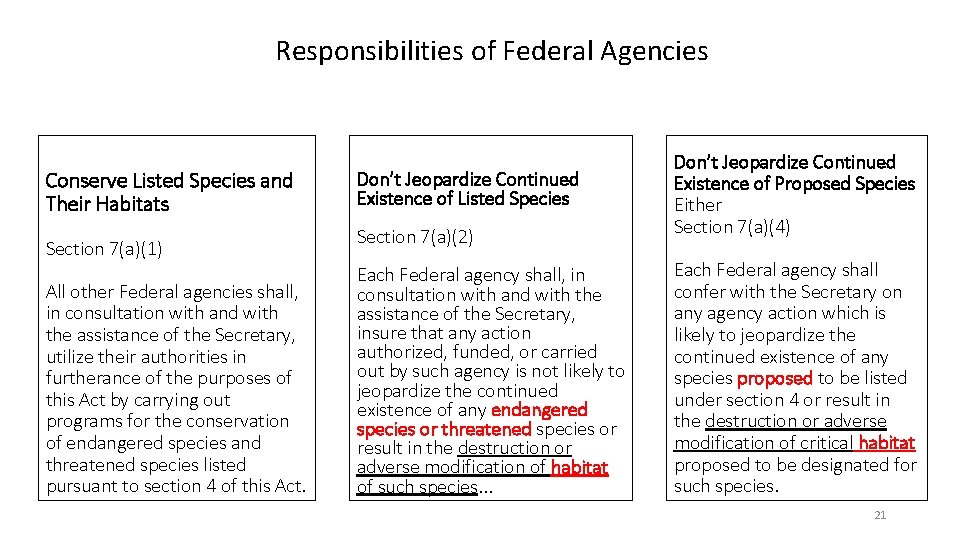
Responsibilities of Federal Agencies Conserve Listed Species and Their Habitats Section 7(a)(1) All other Federal agencies shall, in consultation with and with the assistance of the Secretary, utilize their authorities in furtherance of the purposes of this Act by carrying out programs for the conservation of endangered species and threatened species listed pursuant to section 4 of this Act. Don’t Jeopardize Continued Existence of Listed Species Section 7(a)(2) Each Federal agency shall, in consultation with and with the assistance of the Secretary, insure that any action authorized, funded, or carried out by such agency is not likely to jeopardize the continued existence of any endangered species or threatened species or result in the destruction or adverse modification of habitat of such species. . . Don’t Jeopardize Continued Existence of Proposed Species Either Section 7(a)(4) Each Federal agency shall confer with the Secretary on any agency action which is likely to jeopardize the continued existence of any species proposed to be listed under section 4 or result in the destruction or adverse modification of critical habitat proposed to be designated for such species. 21
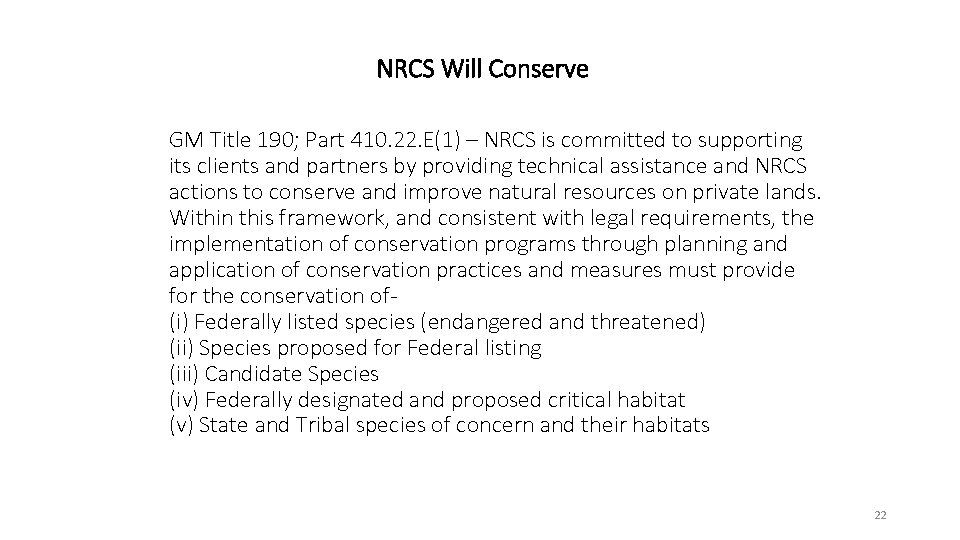
NRCS Will Conserve GM Title 190; Part 410. 22. E(1) – NRCS is committed to supporting its clients and partners by providing technical assistance and NRCS actions to conserve and improve natural resources on private lands. Within this framework, and consistent with legal requirements, the implementation of conservation programs through planning and application of conservation practices and measures must provide for the conservation of(i) Federally listed species (endangered and threatened) (ii) Species proposed for Federal listing (iii) Candidate Species (iv) Federally designated and proposed critical habitat (v) State and Tribal species of concern and their habitats 22
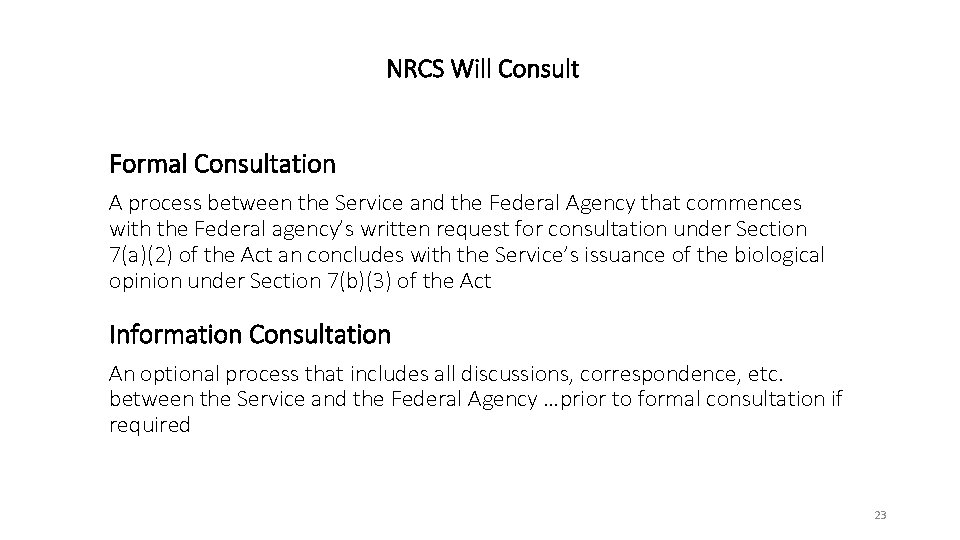
NRCS Will Consult Formal Consultation A process between the Service and the Federal Agency that commences with the Federal agency’s written request for consultation under Section 7(a)(2) of the Act an concludes with the Service’s issuance of the biological opinion under Section 7(b)(3) of the Act Information Consultation An optional process that includes all discussions, correspondence, etc. between the Service and the Federal Agency …prior to formal consultation if required 23
NRCS Will Document Describe how the action may affect each protected resource – CPA 52 24
- Slides: 24