
Titanium and titanium alloys Josef Strsk Lecture 2
- Slides: 25
Titanium and titanium alloys Josef Stráský
Lecture 2: Fundamentals of Ti alloys – Polymorphism • • Alpha phase Beta phase – Pure titanium – Titanium alloys • • • a alloys a + b alloys – Phase transformation β α – w-phase – Hardening mechanisms in Ti • Hardening of α+β alloys • Hardening of metastable β alloys
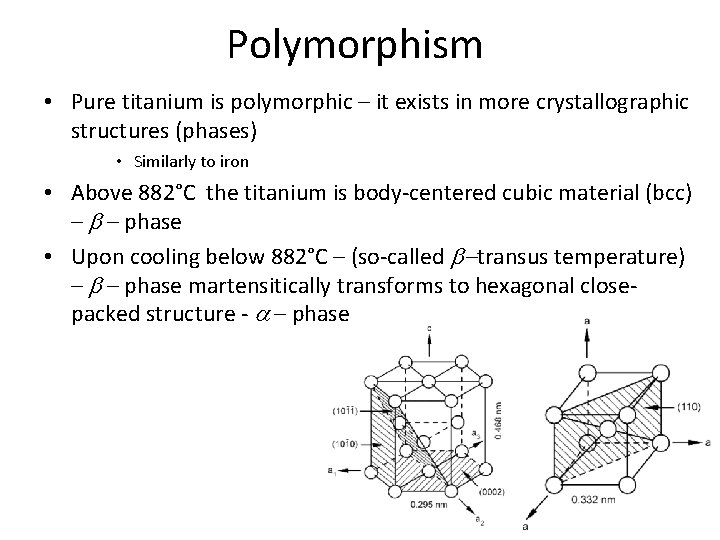
Polymorphism • Pure titanium is polymorphic – it exists in more crystallographic structures (phases) • Similarly to iron • Above 882°C the titanium is body-centered cubic material (bcc) – b – phase • Upon cooling below 882°C – (so-called b-transus temperature) – b – phase martensitically transforms to hexagonal closepacked structure - a – phase
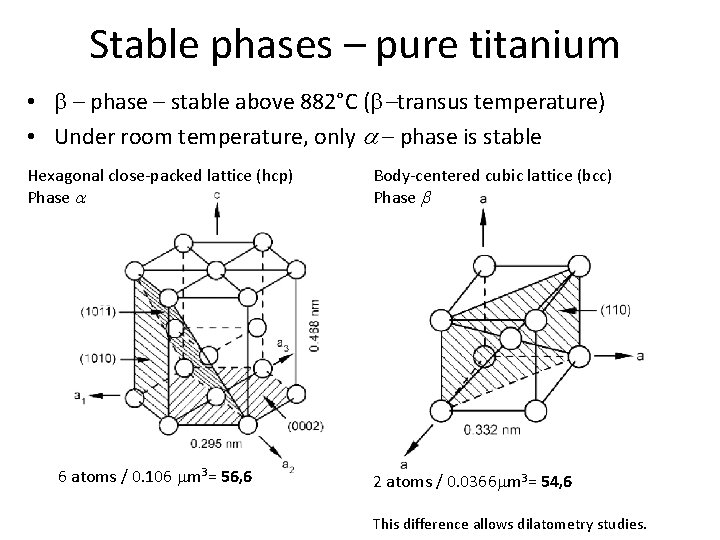
Stable phases – pure titanium • b – phase – stable above 882°C (b-transus temperature) • Under room temperature, only a – phase is stable Hexagonal close-packed lattice (hcp) Phase a 6 atoms / 0. 106 mm 3= 56, 6 Body-centered cubic lattice (bcc) Phase b 2 atoms / 0. 0366 mm 3= 54, 6 This difference allows dilatometry studies.
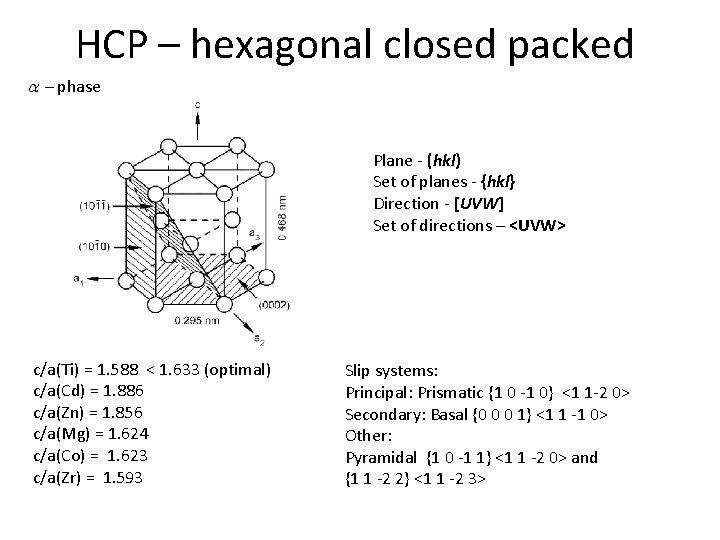
HCP – hexagonal closed packed a - phase Plane - (hkl) Set of planes - {hkl} Direction - [UVW] Set of directions – <UVW> c/a(Ti) = 1. 588 < 1. 633 (optimal) c/a(Cd) = 1. 886 c/a(Zn) = 1. 856 c/a(Mg) = 1. 624 c/a(Co) = 1. 623 c/a(Zr) = 1. 593 Slip systems: Principal: Prismatic {1 0 -1 0} <1 1 -2 0> Secondary: Basal {0 0 0 1} <1 1 -1 0> Other: Pyramidal {1 0 -1 1} <1 1 -2 0> and {1 1 -2 2} <1 1 -2 3>
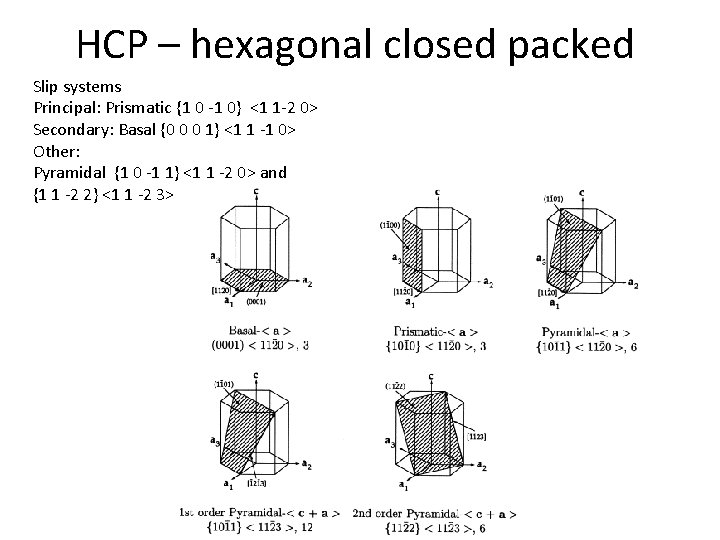
HCP – hexagonal closed packed Slip systems Principal: Prismatic {1 0 -1 0} <1 1 -2 0> Secondary: Basal {0 0 0 1} <1 1 -1 0> Other: Pyramidal {1 0 -1 1} <1 1 -2 0> and {1 1 -2 2} <1 1 -2 3>
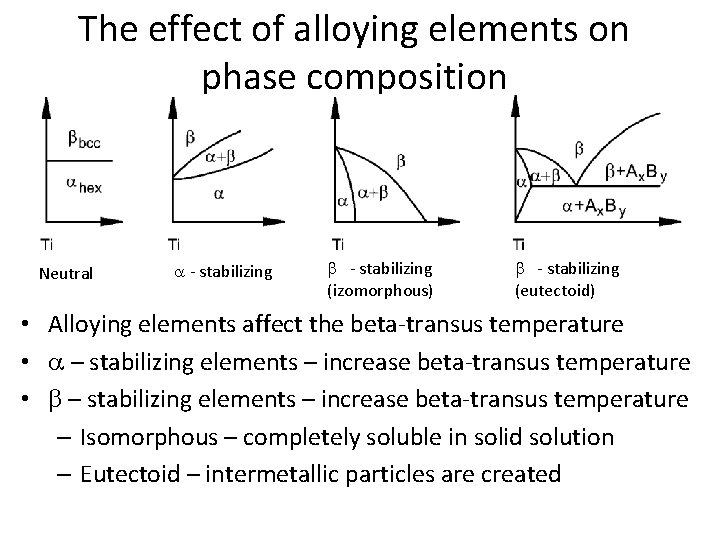
The effect of alloying elements on phase composition Neutral a - stabilizing b - stabilizing (izomorphous) b - stabilizing (eutectoid) • Alloying elements affect the beta-transus temperature • a – stabilizing elements – increase beta-transus temperature • b – stabilizing elements – increase beta-transus temperature – Isomorphous – completely soluble in solid solution – Eutectoid – intermetallic particles are created
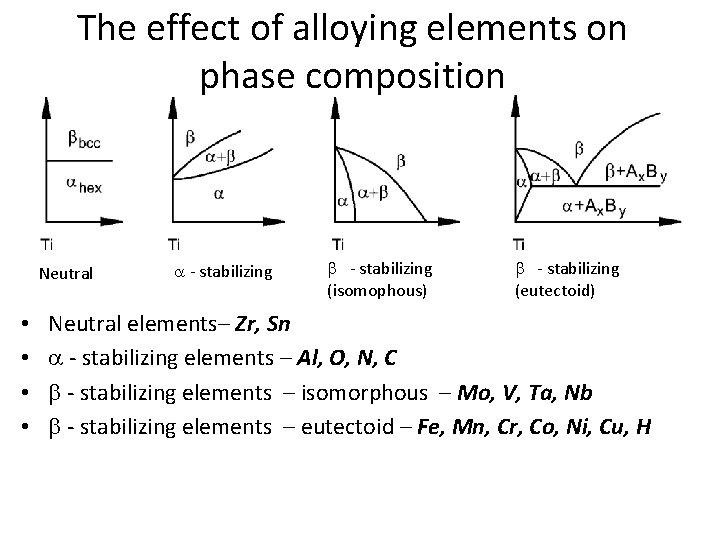
The effect of alloying elements on phase composition Neutral • • a - stabilizing b - stabilizing (isomophous) b - stabilizing (eutectoid) Neutral elements– Zr, Sn a - stabilizing elements – Al, O, N, C b - stabilizing elements – isomorphous – Mo, V, Ta, Nb b - stabilizing elements – eutectoid – Fe, Mn, Cr, Co, Ni, Cu, H
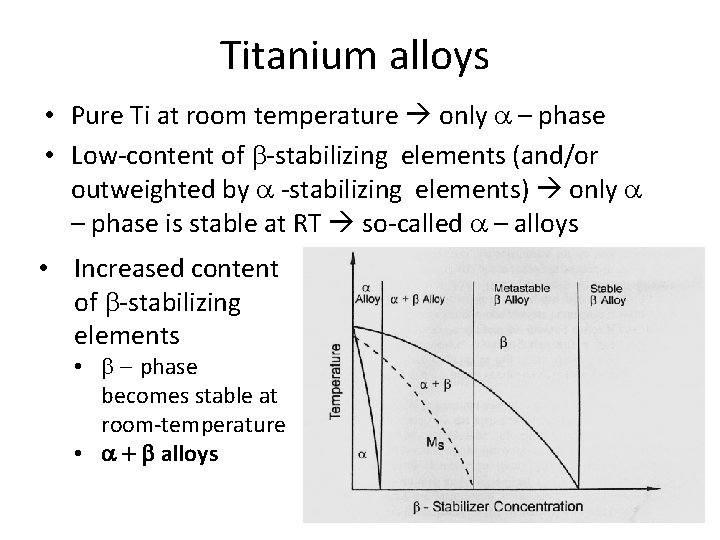
Titanium alloys • Pure Ti at room temperature only a – phase • Low-content of b-stabilizing elements (and/or outweighted by a -stabilizing elements) only a – phase is stable at RT so-called a – alloys • Increased content of b-stabilizing elements • b - phase becomes stable at room-temperature • a + b alloys
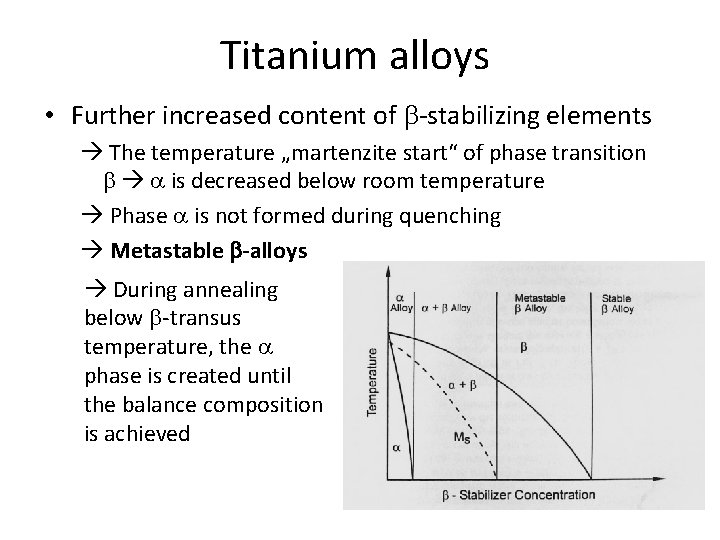
Titanium alloys • Further increased content of b-stabilizing elements The temperature „martenzite start“ of phase transition b a is decreased below room temperature Phase a is not formed during quenching Metastable b-alloys During annealing below b-transus temperature, the a phase is created until the balance composition is achieved
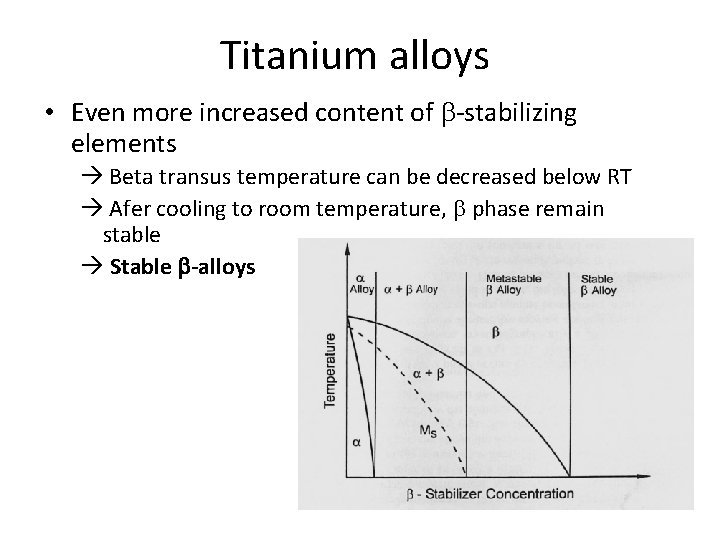
Titanium alloys • Even more increased content of b-stabilizing elements Beta transus temperature can be decreased below RT Afer cooling to room temperature, b phase remain stable Stable b-alloys
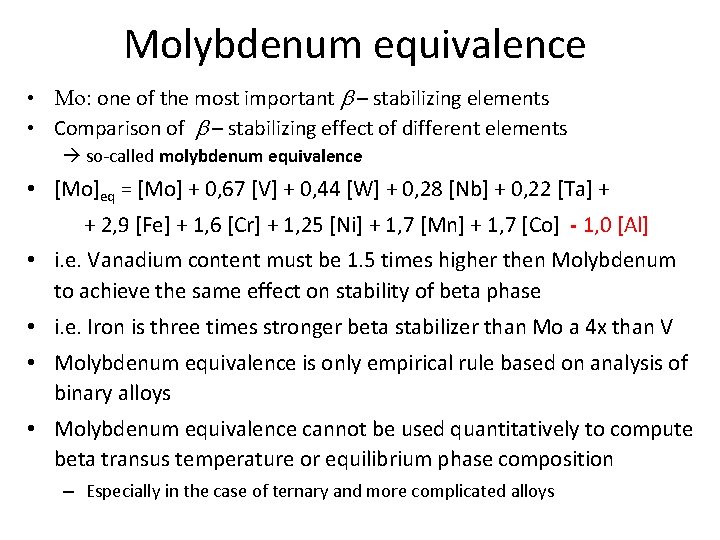
Molybdenum equivalence • Mo: one of the most important b – stabilizing elements • Comparison of b – stabilizing effect of different elements so-called molybdenum equivalence • [Mo]eq = [Mo] + 0, 67 [V] + 0, 44 [W] + 0, 28 [Nb] + 0, 22 [Ta] + + 2, 9 [Fe] + 1, 6 [Cr] + 1, 25 [Ni] + 1, 7 [Mn] + 1, 7 [Co] - 1, 0 [Al] • i. e. Vanadium content must be 1. 5 times higher then Molybdenum to achieve the same effect on stability of beta phase • i. e. Iron is three times stronger beta stabilizer than Mo a 4 x than V • Molybdenum equivalence is only empirical rule based on analysis of binary alloys • Molybdenum equivalence cannot be used quantitatively to compute beta transus temperature or equilibrium phase composition – Especially in the case of ternary and more complicated alloys
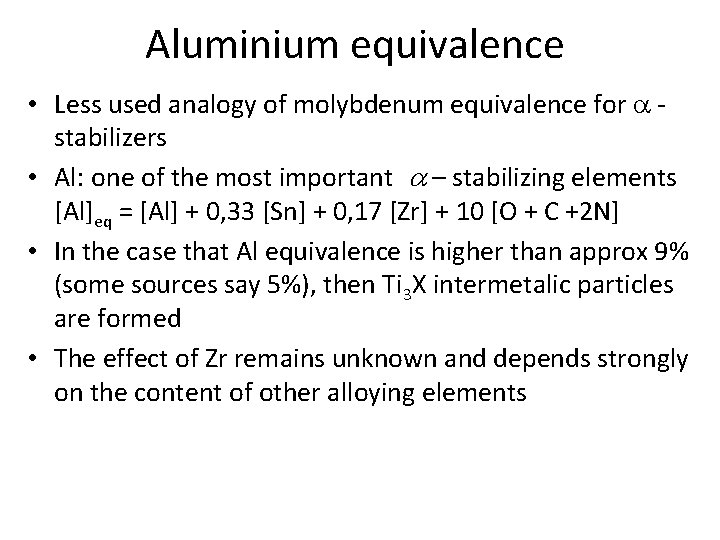
Aluminium equivalence • Less used analogy of molybdenum equivalence for a stabilizers • Al: one of the most important a – stabilizing elements [Al]eq = [Al] + 0, 33 [Sn] + 0, 17 [Zr] + 10 [O + C +2 N] • In the case that Al equivalence is higher than approx 9% (some sources say 5%), then Ti 3 X intermetalic particles are formed • The effect of Zr remains unknown and depends strongly on the content of other alloying elements
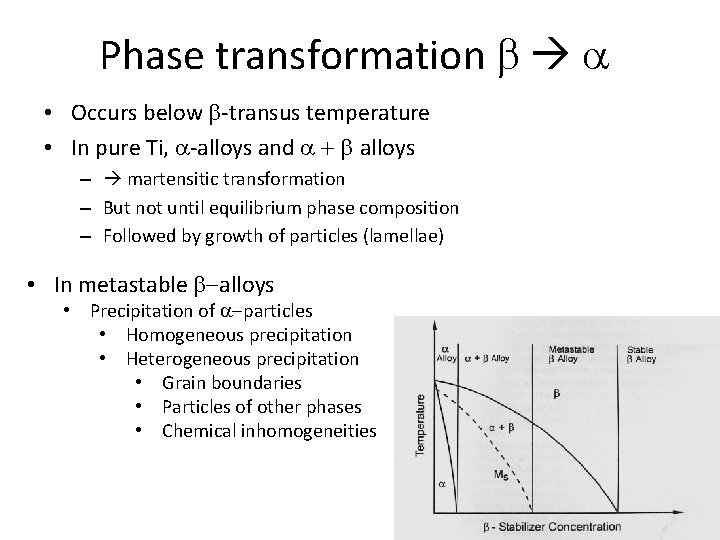
Phase transformation b a • Occurs below b-transus temperature • In pure Ti, a-alloys and a + b alloys – martensitic transformation – But not until equilibrium phase composition – Followed by growth of particles (lamellae) • In metastable b-alloys • Precipitation of a-particles • Homogeneous precipitation • Heterogeneous precipitation • Grain boundaries • Particles of other phases • Chemical inhomogeneities
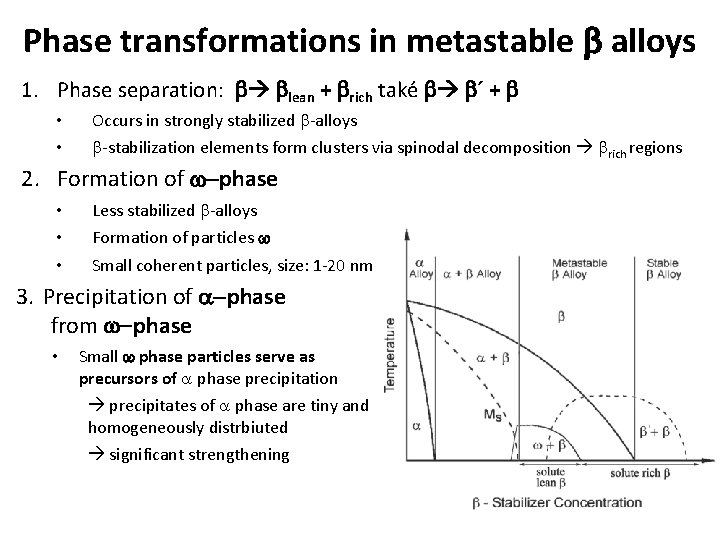
Phase transformations in metastable b alloys 1. Phase separation: b blean + brich také b b´ + b • • Occurs in strongly stabilized b-alloys b-stabilization elements form clusters via spinodal decomposition brich regions 2. Formation of w-phase • • • Less stabilized b-alloys Formation of particles w Small coherent particles, size: 1 -20 nm 3. Precipitation of a-phase from w-phase • Small w phase particles serve as precursors of a phase precipitation precipitates of a phase are tiny and homogeneously distrbiuted significant strengthening
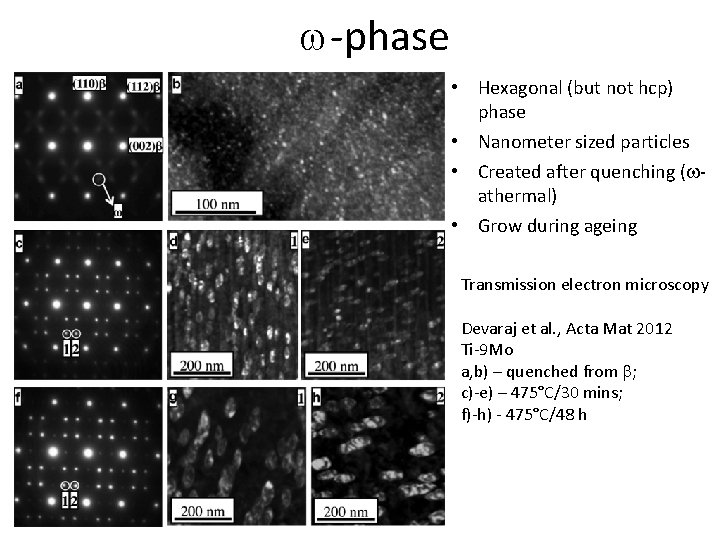
w-phase • Hexagonal (but not hcp) phase • Nanometer sized particles • Created after quenching (wathermal) • Grow during ageing Transmission electron microscopy Devaraj et al. , Acta Mat 2012 Ti-9 Mo a, b) – quenched from b; c)-e) – 475°C/30 mins; f)-h) - 475°C/48 h
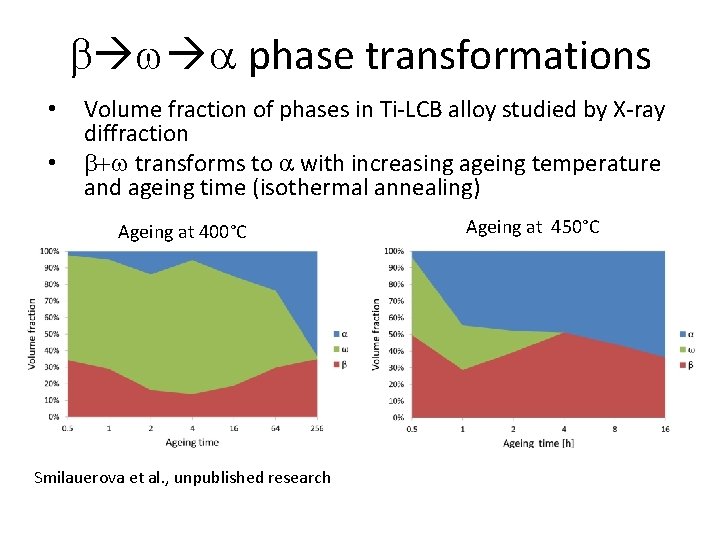
b w a phase transformations • • Volume fraction of phases in Ti-LCB alloy studied by X-ray diffraction b+w transforms to a with increasing ageing temperature and ageing time (isothermal annealing) Ageing at 400°C Smilauerova et al. , unpublished research Ageing at 450°C
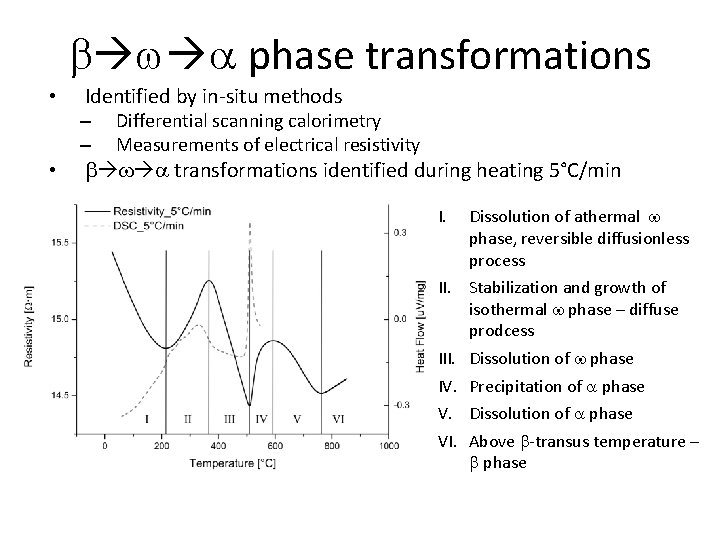
b w a phase transformations • Identified by in-situ methods – – • Differential scanning calorimetry Measurements of electrical resistivity b w a transformations identified during heating 5°C/min I. Dissolution of athermal w phase, reversible diffusionless process II. Stabilization and growth of isothermal w phase – diffuse prodcess III. Dissolution of w phase IV. Precipitation of a phase V. Dissolution of a phase VI. Above b-transus temperature – b phase
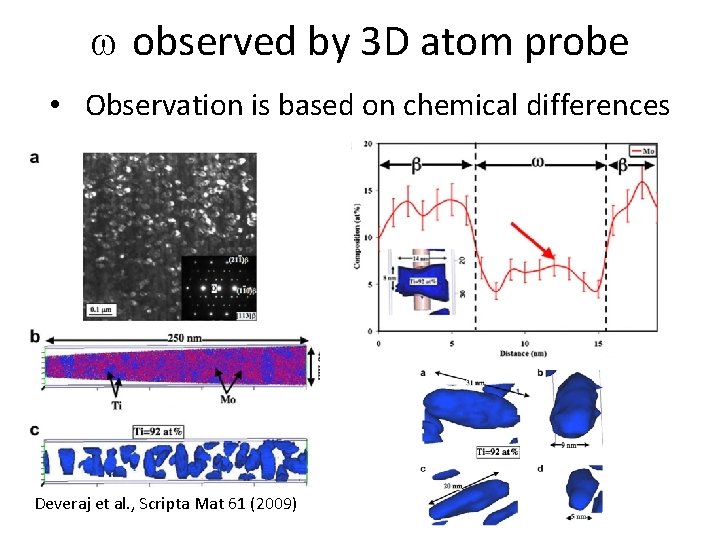
w observed by 3 D atom probe • Observation is based on chemical differences Deveraj et al. , Scripta Mat 61 (2009)
Hardening of Titanium 1. Inerstitial oxygen atoms – – – If oxygen content in pure Ti is increased from 0. 18 to 0. 4 wt. % the strength is increased from 180 MPa to 480 MPa (!) Typical oxygen content in commercial Ti alloys is 0. 08 – 0. 20 hm. % Higher oxygen content often causes embrittelment Positions of oxygen atoms are correlated to vacancies • positron annihilation spectroscopy study 2. Solid solution strengthening – a-stabilizing substitutional elements (Al, Sn) strengthen a-phase (Ti-5 Al-2. 5 Sn 800 MPa) – Some fully soluble b-stabilizing elements strengthen b-phase (Mo, Fe, Ta), others have negligible effect (Nb) – Size of the atoms and electron structure is decisive for this effect • Some atoms serve as obstacles for dislocation motion
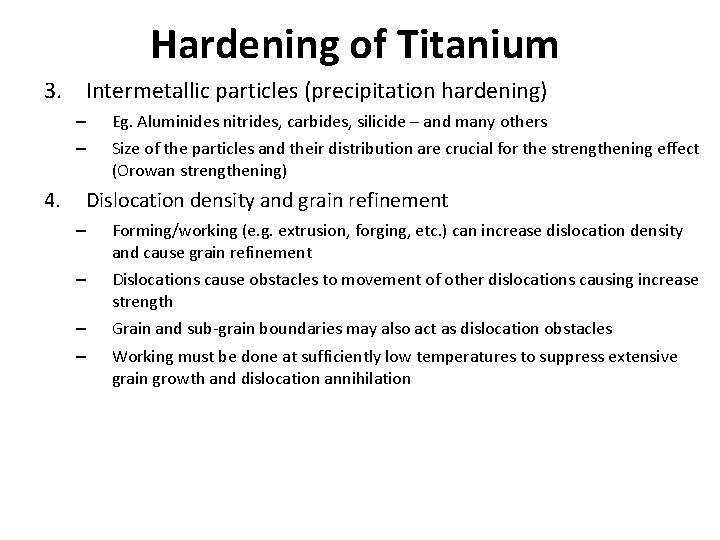
Hardening of Titanium 3. Intermetallic particles (precipitation hardening) – – 4. Eg. Aluminides nitrides, carbides, silicide – and many others Size of the particles and their distribution are crucial for the strengthening effect (Orowan strengthening) Dislocation density and grain refinement – Forming/working (e. g. extrusion, forging, etc. ) can increase dislocation density and cause grain refinement – Dislocations cause obstacles to movement of other dislocations causing increase strength – – Grain and sub-grain boundaries may also act as dislocation obstacles Working must be done at sufficiently low temperatures to suppress extensive grain growth and dislocation annihilation
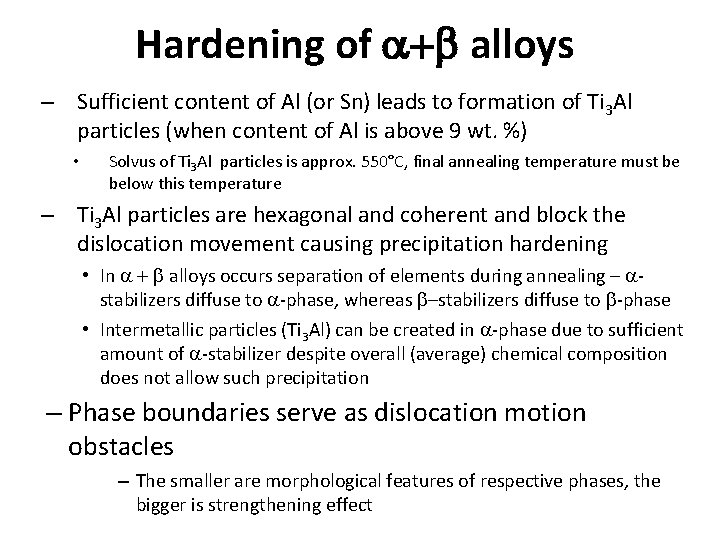
Hardening of a+b alloys – Sufficient content of Al (or Sn) leads to formation of Ti 3 Al particles (when content of Al is above 9 wt. %) • Solvus of Ti 3 Al particles is approx. 550°C, final annealing temperature must be below this temperature – Ti 3 Al particles are hexagonal and coherent and block the dislocation movement causing precipitation hardening • In a + b alloys occurs separation of elements during annealing – astabilizers diffuse to a-phase, whereas b–stabilizers diffuse to b-phase • Intermetallic particles (Ti 3 Al) can be created in a-phase due to sufficient amount of a-stabilizer despite overall (average) chemical composition does not allow such precipitation – Phase boundaries serve as dislocation motion obstacles – The smaller are morphological features of respective phases, the bigger is strengthening effect
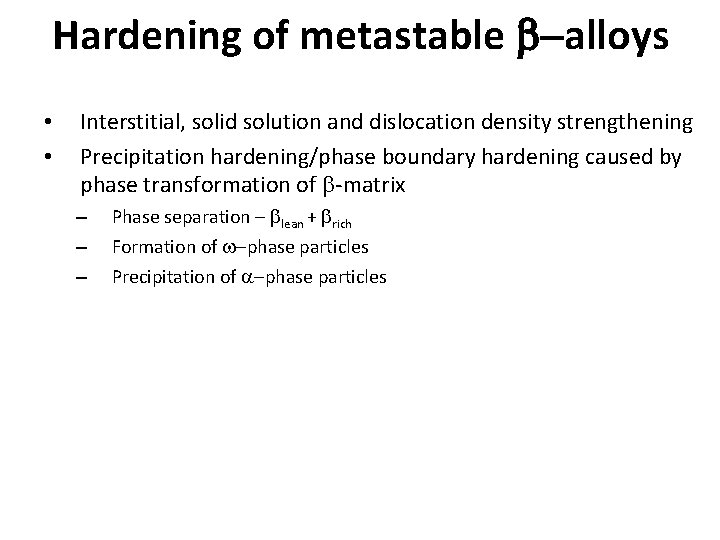
Hardening of metastable b-alloys • • Interstitial, solid solution and dislocation density strengthening Precipitation hardening/phase boundary hardening caused by phase transformation of b-matrix – – – Phase separation – blean + brich Formation of w-phase particles Precipitation of a-phase particles
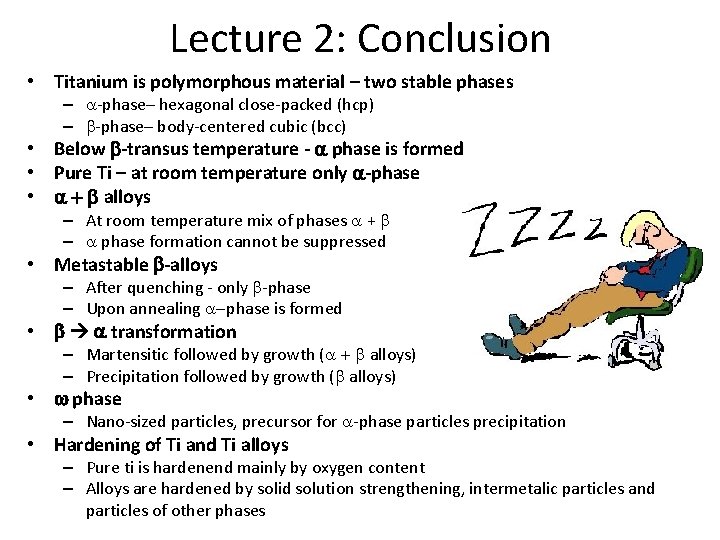
Lecture 2: Conclusion • Titanium is polymorphous material – two stable phases – a-phase– hexagonal close-packed (hcp) – b-phase– body-centered cubic (bcc) • Below b-transus temperature - a phase is formed • Pure Ti – at room temperature only a-phase • a + b alloys – At room temperature mix of phases a + b – a phase formation cannot be suppressed • Metastable b-alloys – After quenching - only b-phase – Upon annealing a-phase is formed • b a transformation – Martensitic followed by growth (a + b alloys) – Precipitation followed by growth (b alloys) • w phase – Nano-sized particles, precursor for a-phase particles precipitation • Hardening of Ti and Ti alloys – Pure ti is hardenend mainly by oxygen content – Alloys are hardened by solid solution strengthening, intermetalic particles and particles of other phases
Titanium and titanium alloys Josef Stráský Thank you! Project FRVŠ 559/2013 is gratefully acknowledged for providing financial support.