
Titanium and titanium alloys Josef Strsk Lecture 1
- Slides: 26
Titanium and titanium alloys Josef Stráský
Lecture 1 Titanium: properties and applications – – – – Titanium as element History Titanium in nature Isolation of titanium from minerals Industrial production Principal properties Applications
Titanium as element
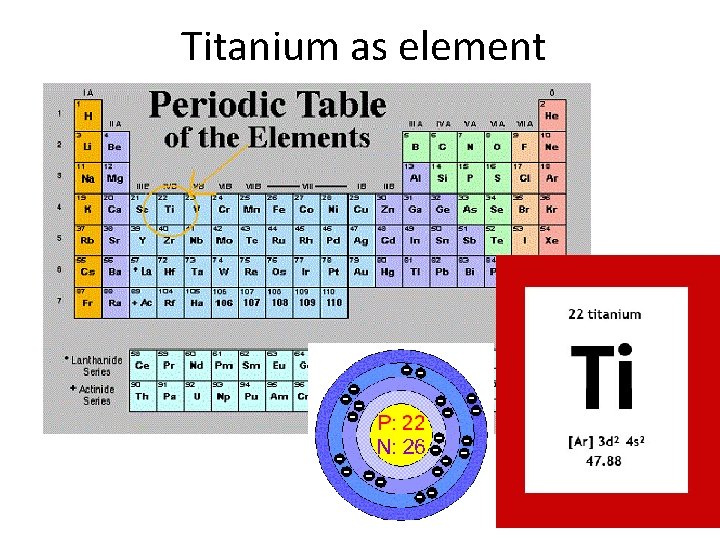
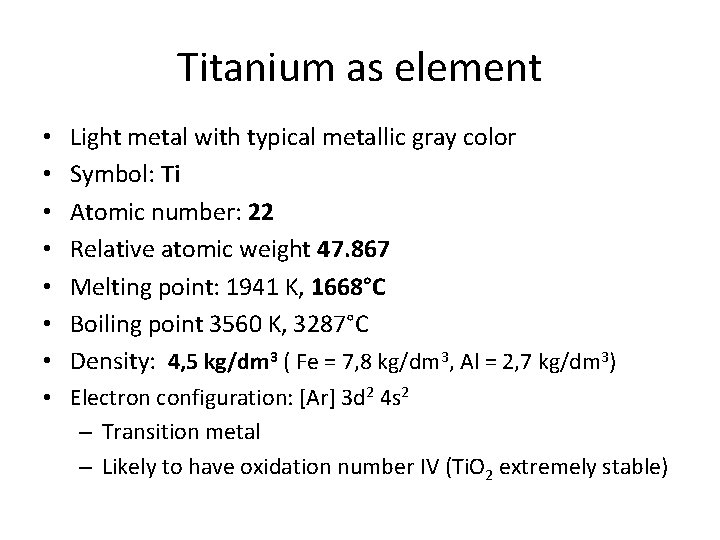
Titanium as element • • Light metal with typical metallic gray color Symbol: Ti Atomic number: 22 Relative atomic weight 47. 867 Melting point: 1941 K, 1668°C Boiling point 3560 K, 3287°C Density: 4, 5 kg/dm 3 ( Fe = 7, 8 kg/dm 3, Al = 2, 7 kg/dm 3) • Electron configuration: [Ar] 3 d 2 4 s 2 – Transition metal – Likely to have oxidation number IV (Ti. O 2 extremely stable)
Some history • 1791 – Titanium discovered by English chemist William Gregor in mineral Ilmenite (Fe. Ti. O 3) • 1795 – Impossible to isolate Ti from minerals therefore called by Martin Klaproth in honor of Titans – gods of Ancient Greek mythology • 1910 (!) – finally isolated by heating titanium tetrachloride (Ti. Cl 4) • WWII – first applications – parts of military aircrafts • 1950 s – still the most used alloy Ti-6 Al-4 V developed in Soviet Union, however very soon produced also in USA • 1950 s – 60 s onward of applications in military and civilian aircraft industry and in space programme • 60 s – now development and production of new alloys in USA, Russia and Japan • 90 s – now - massive production in China
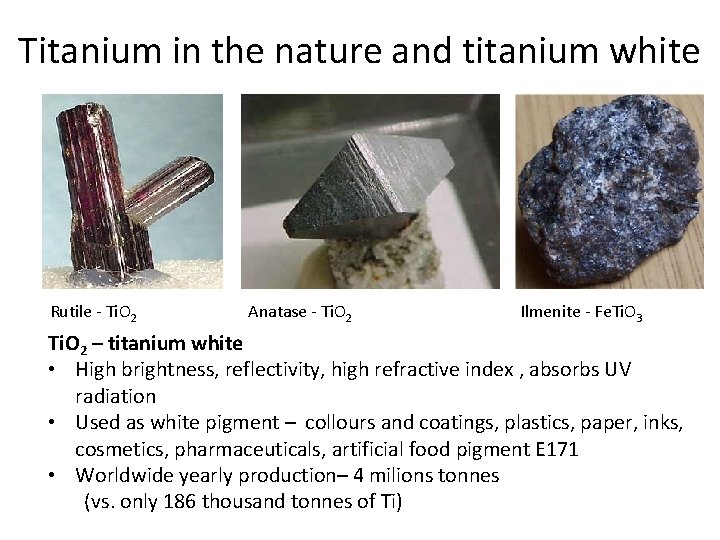
Titanium in the nature and titanium white Rutile - Ti. O 2 Anatase - Ti. O 2 Ilmenite - Fe. Ti. O 3 Ti. O 2 – titanium white • High brightness, reflectivity, high refractive index , absorbs UV radiation • Used as white pigment – collours and coatings, plastics, paper, inks, cosmetics, pharmaceuticals, artificial food pigment E 171 • Worldwide yearly production– 4 milions tonnes (vs. only 186 thousand tonnes of Ti)
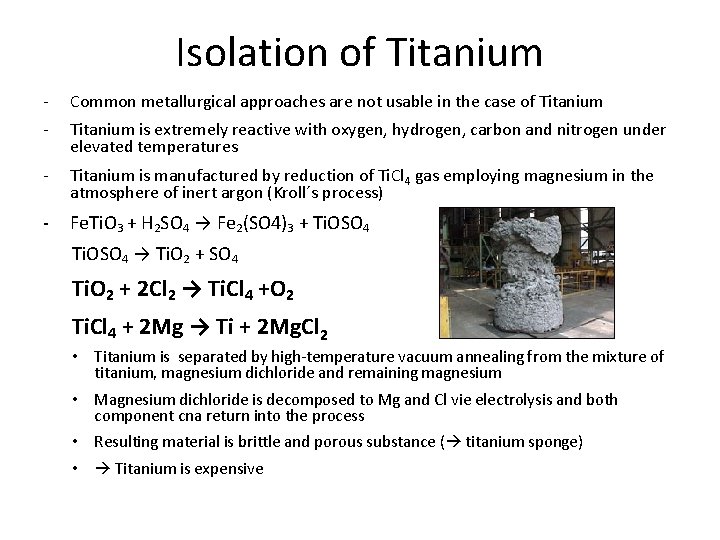
Isolation of Titanium - Common metallurgical approaches are not usable in the case of Titanium - Titanium is extremely reactive with oxygen, hydrogen, carbon and nitrogen under elevated temperatures - Titanium is manufactured by reduction of Ti. Cl 4 gas employing magnesium in the atmosphere of inert argon (Kroll´s process) - Fe. Ti. O 3 + H 2 SO 4 → Fe 2(SO 4)3 + Ti. OSO 4 → Ti. O 2 + SO 4 Ti. O 2 + 2 Cl 2 → Ti. Cl 4 +O 2 Ti. Cl 4 + 2 Mg → Ti + 2 Mg. Cl 2 • Titanium is separated by high-temperature vacuum annealing from the mixture of titanium, magnesium dichloride and remaining magnesium • Magnesium dichloride is decomposed to Mg and Cl vie electrolysis and both component cna return into the process • Resulting material is brittle and porous substance ( titanium sponge) • Titanium is expensive
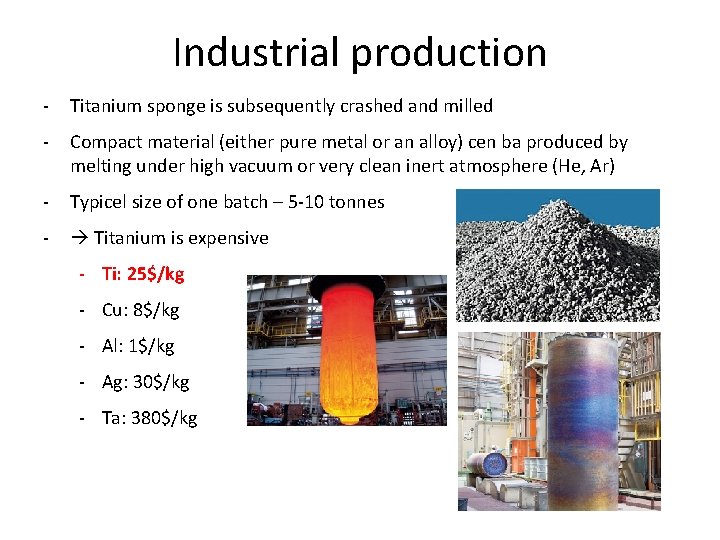
Industrial production - Titanium sponge is subsequently crashed and milled - Compact material (either pure metal or an alloy) cen ba produced by melting under high vacuum or very clean inert atmosphere (He, Ar) - Typicel size of one batch – 5 -10 tonnes - Titanium is expensive - Ti: 25$/kg - Cu: 8$/kg - Al: 1$/kg - Ag: 30$/kg - Ta: 380$/kg
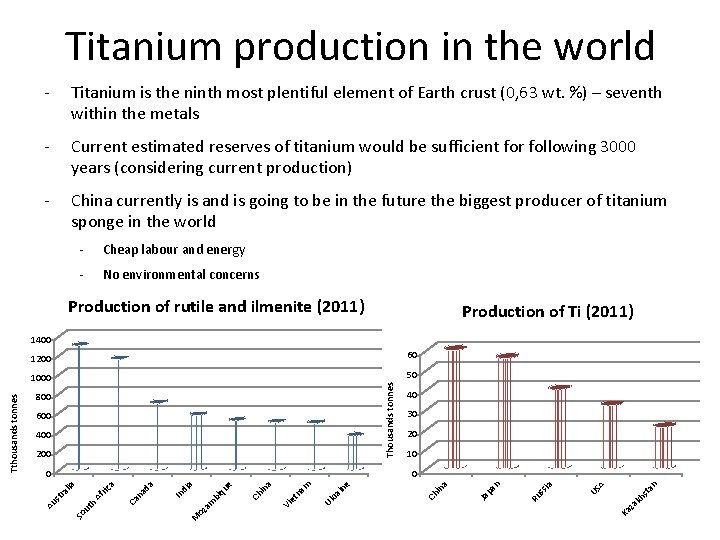
Titanium production in the world - Titanium is the ninth most plentiful element of Earth crust (0, 63 wt. %) – seventh within the metals - Current estimated reserves of titanium would be sufficient for following 3000 years (considering current production) - China currently is and is going to be in the future the biggest producer of titanium sponge in the world - Cheap labour and energy - No environmental concerns Production of rutile and ilmenite (2011) Production of Ti (2011) 60 1000 50 Thousands tonnes 1200 800 600 400 200 40 30 20 10 st a n A kh za ia ss Ru n pa Ja a in Ch e in ra Uk Vi et na m a in Ch US Ka M oz a m bi qu e di a In na Ca ric a So ut h Af ra da 0 lia 0 Au st Tthousands tonnes 1400
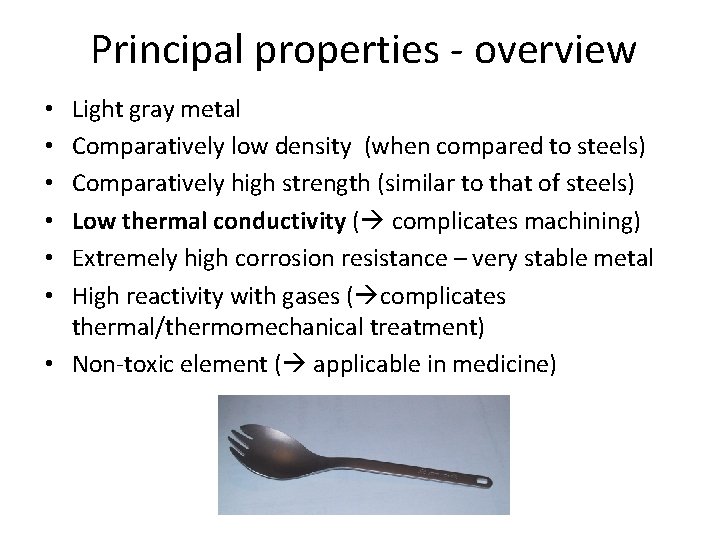
Principal properties - overview Light gray metal Comparatively low density (when compared to steels) Comparatively high strength (similar to that of steels) Low thermal conductivity ( complicates machining) Extremely high corrosion resistance – very stable metal High reactivity with gases ( complicates thermal/thermomechanical treatment) • Non-toxic element ( applicable in medicine) • • •
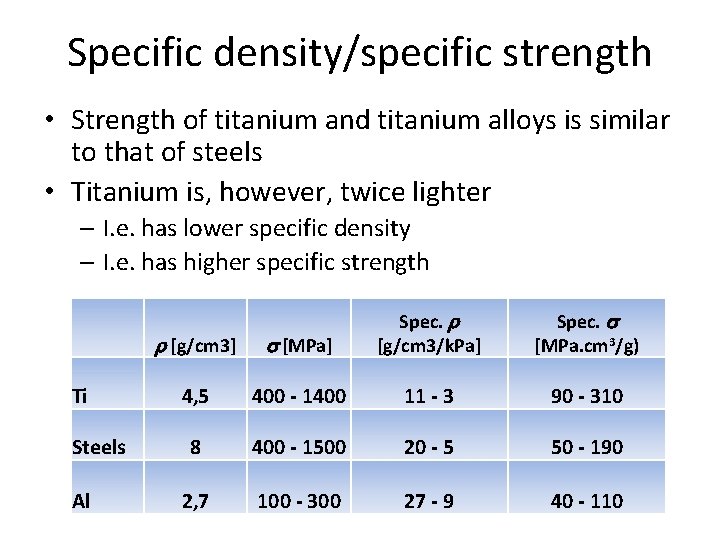
Specific density/specific strength • Strength of titanium and titanium alloys is similar to that of steels • Titanium is, however, twice lighter – I. e. has lower specific density – I. e. has higher specific strength r [g/cm 3] s [MPa] Spec. r [g/cm 3/k. Pa] Ti 4, 5 400 - 1400 11 - 3 90 - 310 8 400 - 1500 20 - 5 50 - 190 2, 7 100 - 300 27 - 9 40 - 110 Steels Al Spec. s [MPa. cm 3/g)
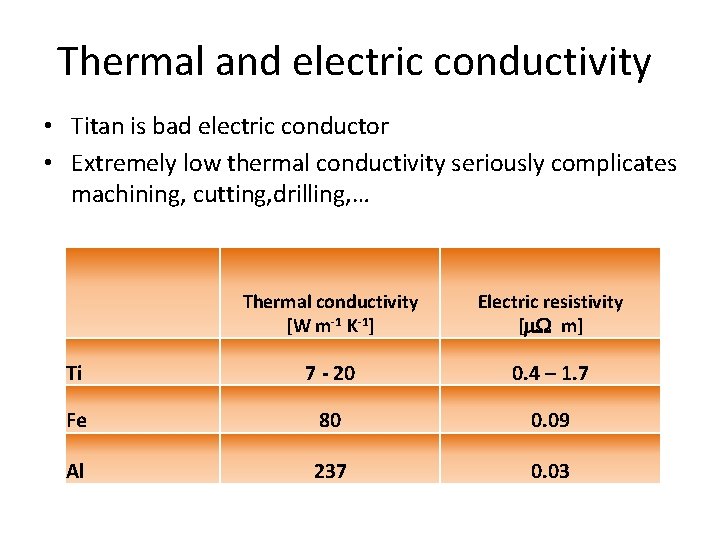
Thermal and electric conductivity • Titan is bad electric conductor • Extremely low thermal conductivity seriously complicates machining, cutting, drilling, … Thermal conductivity [W m-1 K-1] Electric resistivity [m. W m] Ti 7 - 20 0. 4 – 1. 7 Fe 80 0. 09 Al 237 0. 03
Corrosion resistance • Corrosion potential of titanium (-1, 63 V) is similar to that of aluminum, titanium is therefore not considered a noble metal • Excellent corrosion resistance is achieved by perfect passivation by surface layer of Ti. O 2 • Titanium is resistant in long-term to atmospheric conditions, sea water, body fluid or even more aggresive environments • For the same reason, titanium is resisstant to standard etchants – the most utilized etchant is a mixture of nitric and fluoric acids (HF + HNO 3) – HF – increases the etching rate and HNO 3 decreases (stabilizes) the etching rate – be careful both acids are being consumed during the etching and etching rate may suddenly rise • In biological environment (body fluid), titanium behaves as inert, non-toxic material
Main applications - overview • Aerospace industry - jet engines, aircraft construction – Why? – High specific density • Pipes – chemical and petrochemical industry, … – Why? – Unaltered corrosion resistance • Part of deep-sea oil wells – Why? – Low specific density, excelent corrosion resistance • Medicine – orthopaedic implants, fixing devices – Why? – Non-toxicity, high strength • Sporting goods – golf clubs, tennis rackets, bicycles – Why? – High strength accompanied by relatively low elastic modulus • Jewellery, architecture, outdoor equipment
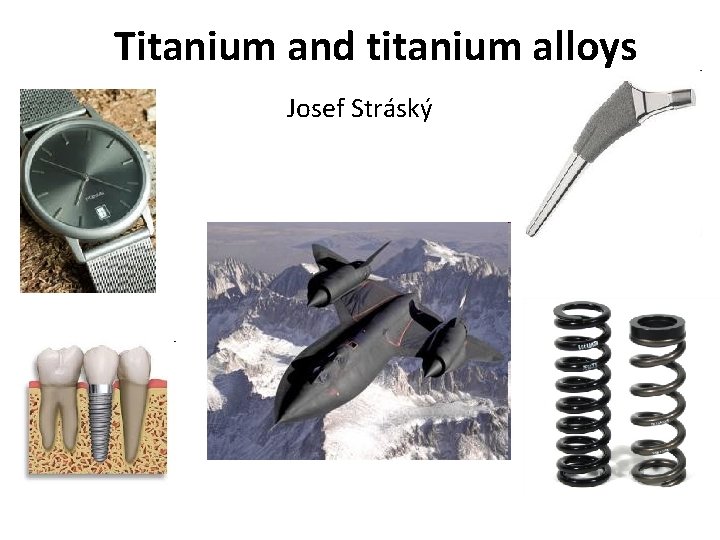
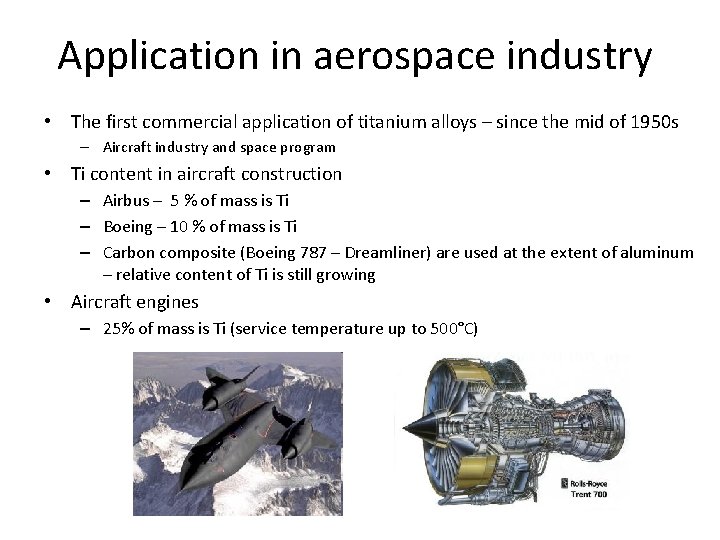
Application in aerospace industry • The first commercial application of titanium alloys – since the mid of 1950 s – Aircraft industry and space program • Ti content in aircraft construction – Airbus – 5 % of mass is Ti – Boeing – 10 % of mass is Ti – Carbon composite (Boeing 787 – Dreamliner) are used at the extent of aluminum – relative content of Ti is still growing • Aircraft engines – 25% of mass is Ti (service temperature up to 500°C)
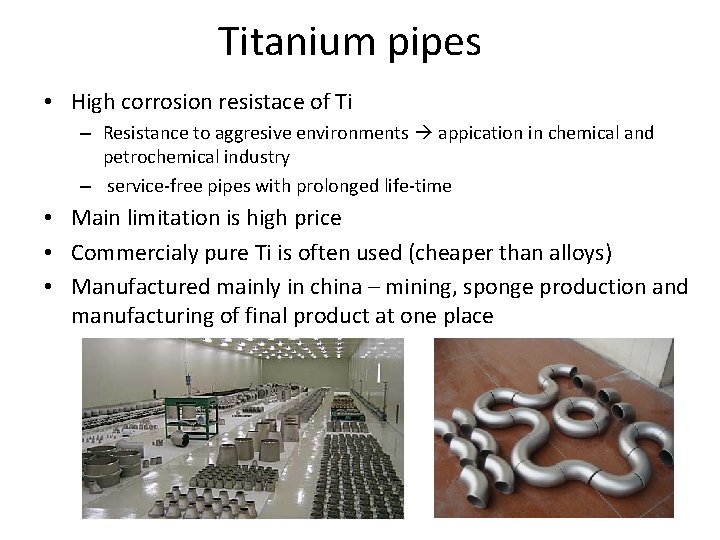
Titanium pipes • High corrosion resistace of Ti – Resistance to aggresive environments appication in chemical and petrochemical industry – service-free pipes with prolonged life-time • Main limitation is high price • Commercialy pure Ti is often used (cheaper than alloys) • Manufactured mainly in china – mining, sponge production and manufacturing of final product at one place
Deep-sea oil wells • Deep-sea oil wells – available only thanks to Ti • Low specific density is the key advantage (note that effect of low density is even pronounced when immersed to the water) • High corrosion resistance to sea water • Drilling device itself cannot be made of Ti– low thermal conductivity • Recent exploration of sub-ice lake in Antarctica – titanium drilling machine
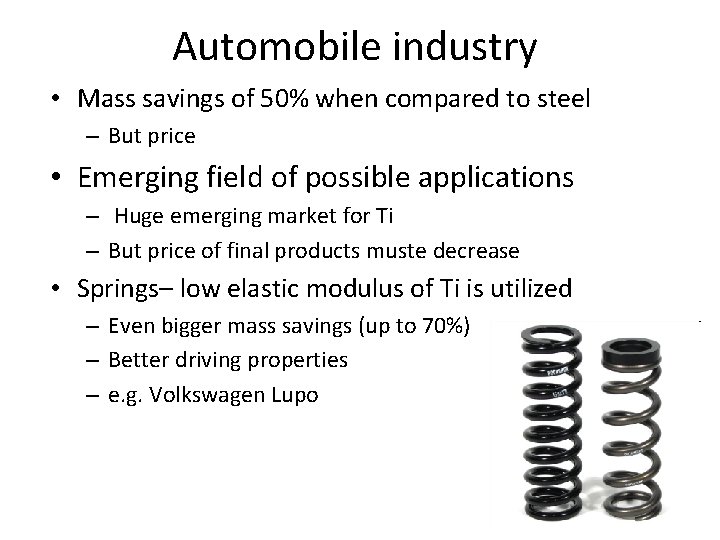
Automobile industry • Mass savings of 50% when compared to steel – But price • Emerging field of possible applications – Huge emerging market for Ti – But price of final products muste decrease • Springs– low elastic modulus of Ti is utilized – Even bigger mass savings (up to 70%) – Better driving properties – e. g. Volkswagen Lupo
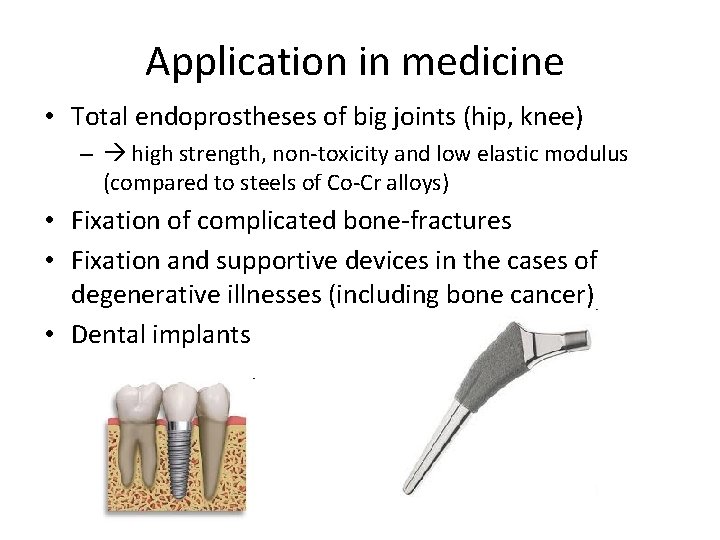
Application in medicine • Total endoprostheses of big joints (hip, knee) – high strength, non-toxicity and low elastic modulus (compared to steels of Co-Cr alloys) • Fixation of complicated bone-fractures • Fixation and supportive devices in the cases of degenerative illnesses (including bone cancer) • Dental implants
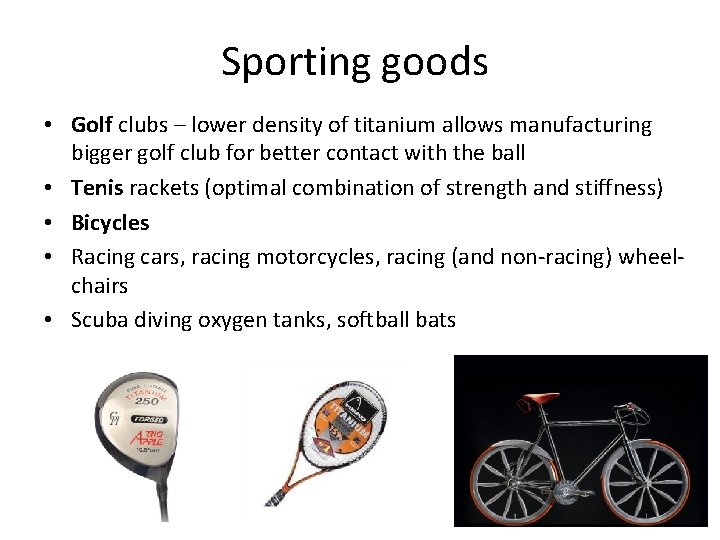
Sporting goods • Golf clubs – lower density of titanium allows manufacturing bigger golf club for better contact with the ball • Tenis rackets (optimal combination of strength and stiffness) • Bicycles • Racing cars, racing motorcycles, racing (and non-racing) wheelchairs • Scuba diving oxygen tanks, softball bats
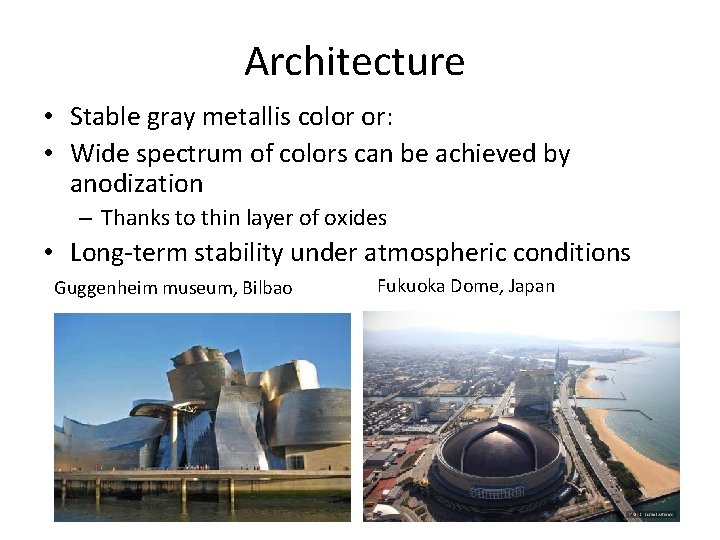
Architecture • Stable gray metallis color or: • Wide spectrum of colors can be achieved by anodization – Thanks to thin layer of oxides • Long-term stability under atmospheric conditions Guggenheim museum, Bilbao Fukuoka Dome, Japan
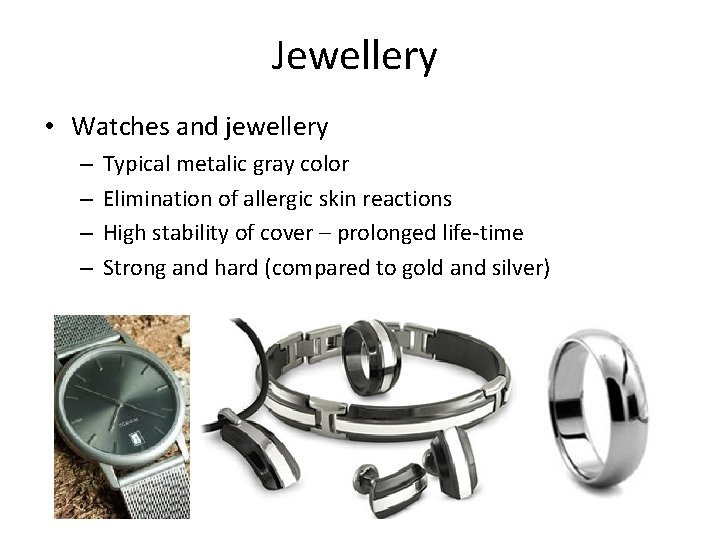
Jewellery • Watches and jewellery – – Typical metalic gray color Elimination of allergic skin reactions High stability of cover – prolonged life-time Strong and hard (compared to gold and silver)
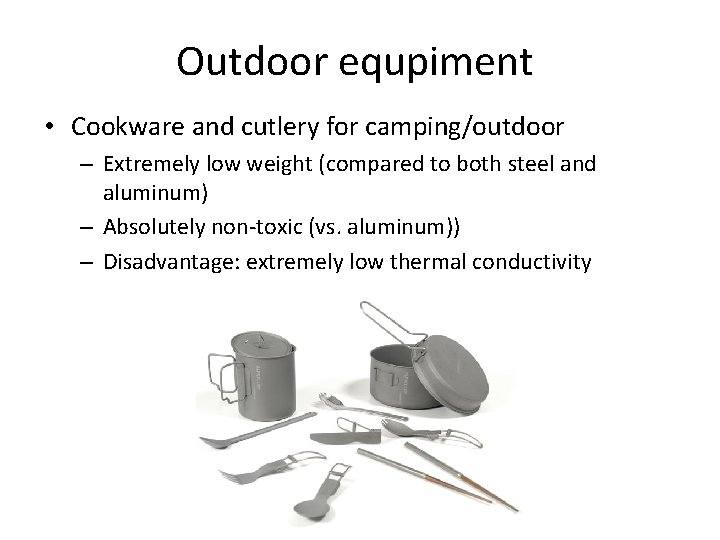
Outdoor equpiment • Cookware and cutlery for camping/outdoor – Extremely low weight (compared to both steel and aluminum) – Absolutely non-toxic (vs. aluminum)) – Disadvantage: extremely low thermal conductivity
Lecture 1: Conclusion • There is plenty of titanium in minerals in the nature • Isolation of titanium is complicated and expensive • Titanium has unique properties – High strength, low density (4. 5 g/cm 3) – Excellent corrosion resistance • Applications – Aerospace industry – Pipes and oil wells – Medicine, sporting goods, jewellery
Titanium and titanium alloys Josef Stráský Thank you!
Titanium and titanium alloys Josef Stráský Thank you! Project FRVŠ 559/2013 is gratefully acknowledged for providing financial support.