
Titanic Science by Cathy AkersJordan Super Science Friday
Titanic Science by Cathy Akers-Jordan Super Science Friday University of Michigan-Flint May 15, 2009 Slide 1
Titanic Facts • Titanic was an ocean liner • Like a cruise ship but also carried mail and cargo • How people crossed the ocean before airplanes • Carried passengers traveling for vacation, business, and immigrants coming to America Slide 2
Titanic Facts • Largest man-made object of its time • Designed to be “practically unsinkable” • People believed it really was unsinkable • Carried 2, 200* people on its only voyage • Over 1, 500 people died when it sank April 15, 1912 • Sinking was a world-wide catastrophe * All passenger numbers are approximate Slide 3
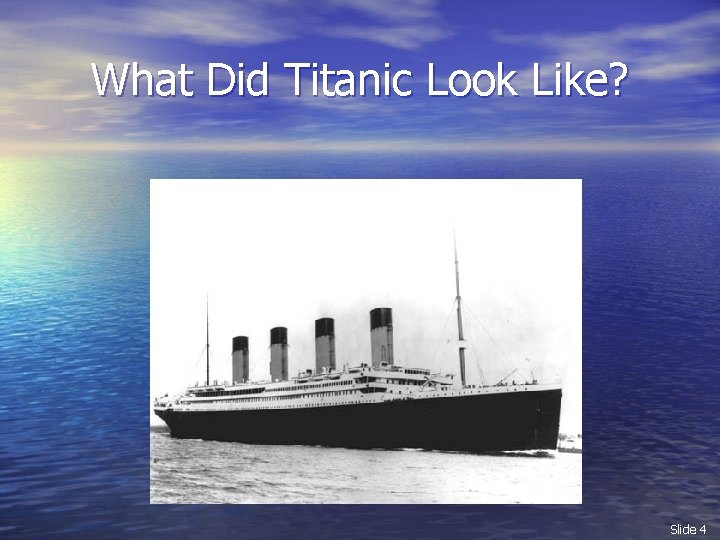
What Did Titanic Look Like? Slide 4
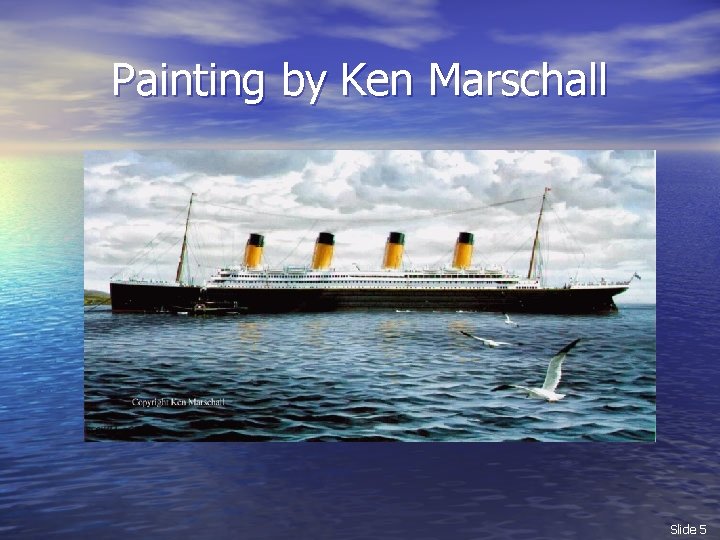
Painting by Ken Marschall Slide 5
How Big Was Titanic? • Length: 882 feet – Almost three football fields! • Height: 110 feet – About as tall as an 11 story building • Width: 96 feet – As wide as a four-lane highway • Weight: 46, 000 tons – More than 23, 000 adult elephants! Slide 6
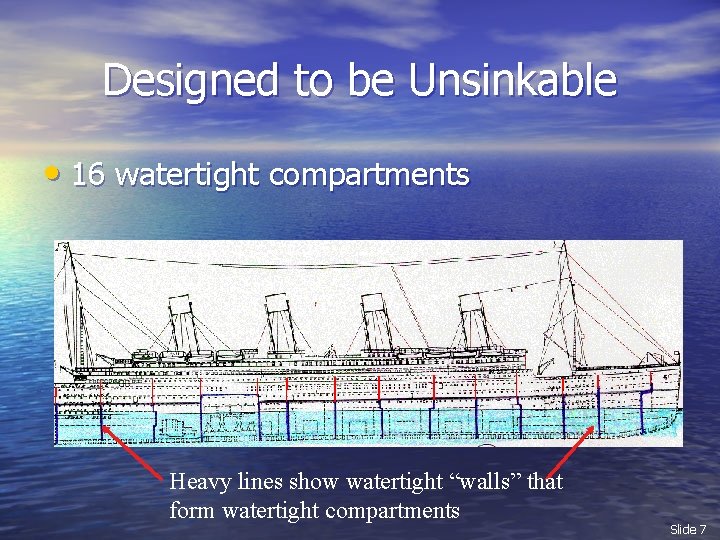
Designed to be Unsinkable • 16 watertight compartments Heavy lines show watertight “walls” that form watertight compartments Slide 7
Why Watertight Compartments Work • If there is an accident only one compartment floods, not the entire ship • Most common kind of accident floods 1 or 2 compartments • Titanic was designed to float with any 4 compartments flooded Slide 8
Titanic Carried • 2, 200 people and 12 dogs • Food and beverages to feed them for a week (including 300 gallons of ice cream!) • Cargo for New York stores (including wine, cheese, and books) • Passenger cargo (including a car) • Over 3, 000 bags of mail and 800 parcel post packages Slide 9
Passenger Luxuries • Indoor toilets, • 2 libraries showers, bath tubs • 4 restaurants • 50 telephones • 2 barber shops • 4 elevators • Gymnasium • Heated indoor • Squash court swimming pool • Darkroom Titanic was build of the finest materials available. It would cost about $400 million to build it today. Slide 10
1 st Class Passengers • Very rich and famous people • Traveling for vacation or business • Today = very rich, movie stars, famous athletes • Titanic carried 324 1 st class passengers – 201 survived • 12 dogs traveled in 1 st class – 3 survived Slide 11
2 nd Class Passengers • Middle class people on vacation • Today = people like us! • Titanic carried 277 2 nd class passengers – 118 survived Slide 12
3 rd Class Passengers • Mostly immigrants moving to America • Today = there is no third class • Titanic carried 708 3 rd class passengers – 181 survived Slide 13
What About the Crew? • 885 crew members – 212 survived • 5 postmen – none survived • 8 musicians – none survived • 2 radio operators – 1 survived Slide 14
Where Did These People Live? • • • Argentina Armenia Australia Austria Belgium Bosnia Bulgaria Canada China Croatia Cuba • • • Denmark Egypt England Finland France Germany Greece Hong Kong India Ireland Italy • • • Japan Lebanon Lithuania Mexico Netherlands Norway Peru Poland Portugal Russia Scotland • • • Slovenia South Africa Spain Sweden Switzerland Syria Thailand Turkey Uruguay USA Wales Slide 15
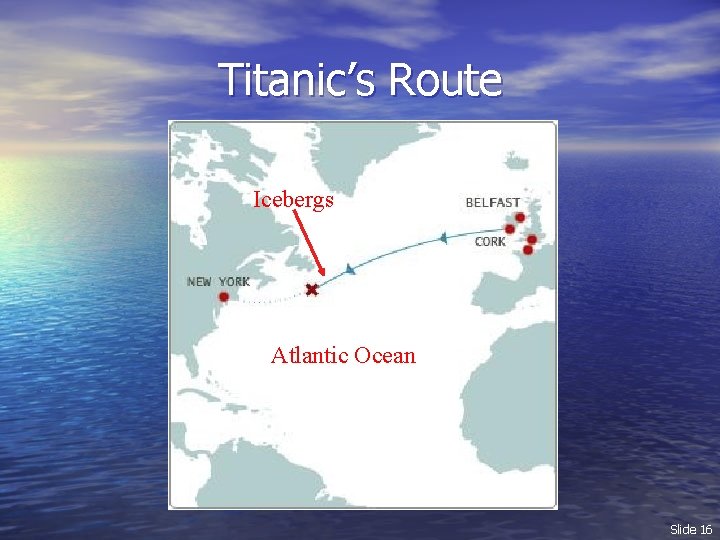
Titanic’s Route Icebergs Atlantic Ocean Slide 16
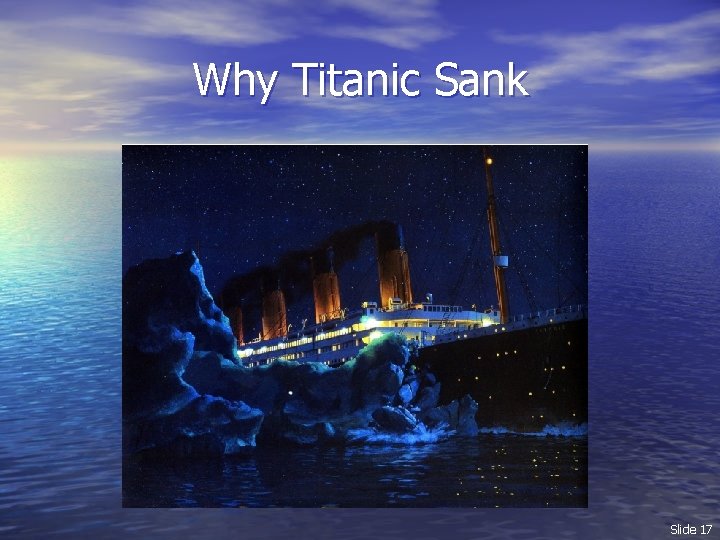
Why Titanic Sank Slide 17
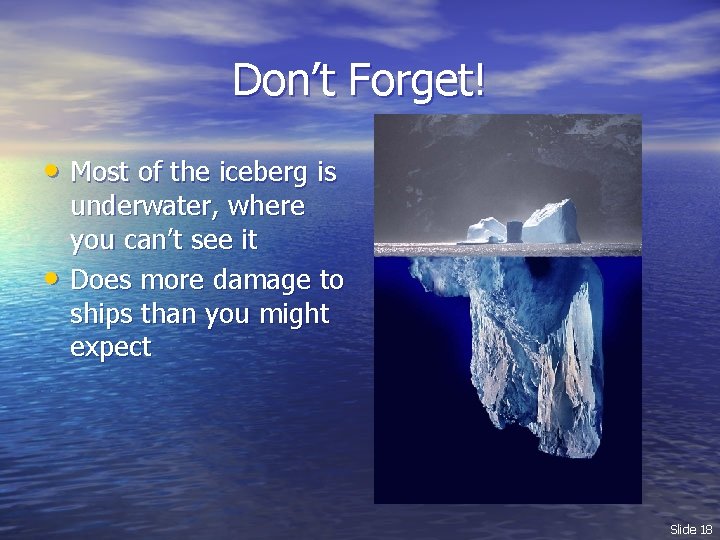
Don’t Forget! • Most of the iceberg is • underwater, where you can’t see it Does more damage to ships than you might expect Slide 18
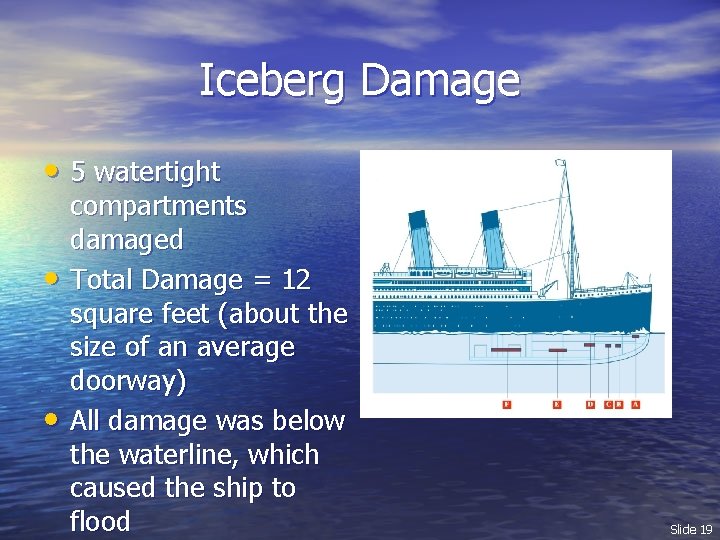
Iceberg Damage • 5 watertight • • compartments damaged Total Damage = 12 square feet (about the size of an average doorway) All damage was below the waterline, which caused the ship to flood Slide 19
Why People Died • Not enough lifeboats – Titanic had 20, more than legally required but not enough for everyone on board – Not all lifeboats were full because passengers didn’t believe Titanic would sink • Cold water – 28 degrees = hypothermia • No help nearby – Rescue ships arrived about two hours after Titanic sank Slide 20
Hypothermia • Body temperature lower than 96 degrees leads to irregular heartbeat and death • Body temperature drops 25 times faster in cold water than in the air Slide 21
More on Hypothermia • When the water is 32 degrees (freezing) – Most people will be exhausted or unconscious in about 15 minutes – Most people will die in 15 to 45 minutes • The water that night was 28 degrees • Each of Titanic’s victims died a slow, painful, and terrifying death Slide 22
Lost: The Goodwin Family Frederick and Augusta Goodwin and 5 of their children: Harold, William, Jesse, Lillian, and Charles. Baby Sidney (age 2) not pictured. Slide 23
The Goodwins • 3 rd class • Emigrating from England to America • No one knows what happened to them • None of their bodies were recovered Slide 24
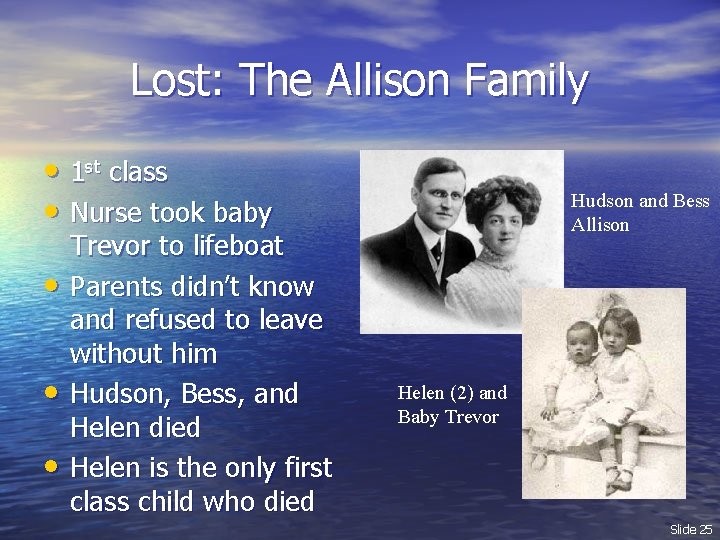
Lost: The Allison Family • 1 st class • Nurse took baby • • • Trevor to lifeboat Parents didn’t know and refused to leave without him Hudson, Bess, and Helen died Helen is the only first class child who died Hudson and Bess Allison Helen (2) and Baby Trevor Slide 25
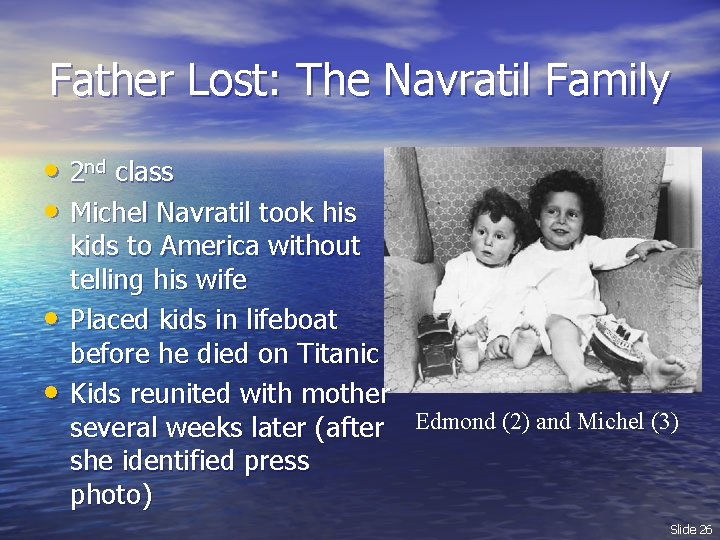
Father Lost: The Navratil Family • 2 nd class • Michel Navratil took his • • kids to America without telling his wife Placed kids in lifeboat before he died on Titanic Kids reunited with mother several weeks later (after Edmond (2) and Michel (3) she identified press photo) Slide 26
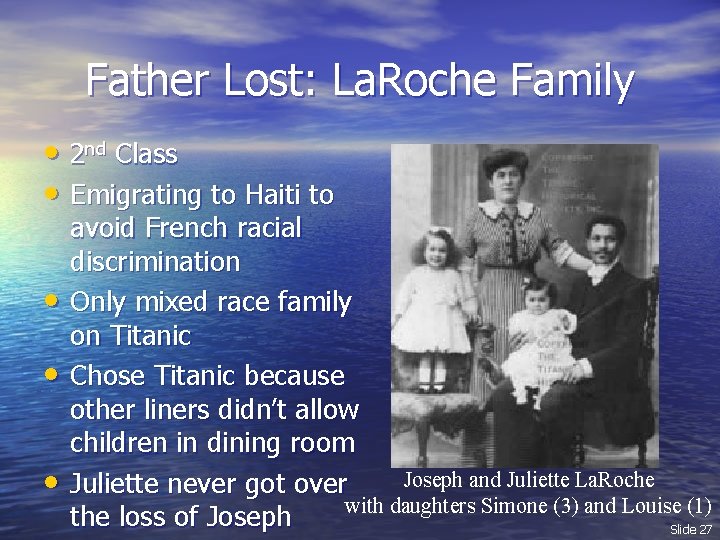
Father Lost: La. Roche Family • 2 nd Class • Emigrating to Haiti to • • • avoid French racial discrimination Only mixed race family on Titanic Chose Titanic because other liners didn’t allow children in dining room Joseph and Juliette La. Roche Juliette never got over with daughters Simone (3) and Louise (1) the loss of Joseph Slide 27
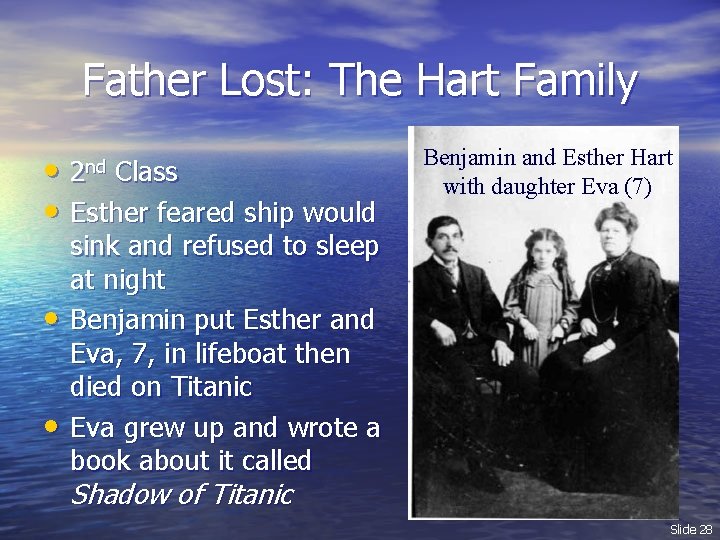
Father Lost: The Hart Family • Class • Esther feared ship would 2 nd • • Benjamin and Esther Hart with daughter Eva (7) sink and refused to sleep at night Benjamin put Esther and Eva, 7, in lifeboat then died on Titanic Eva grew up and wrote a book about it called Shadow of Titanic Slide 28
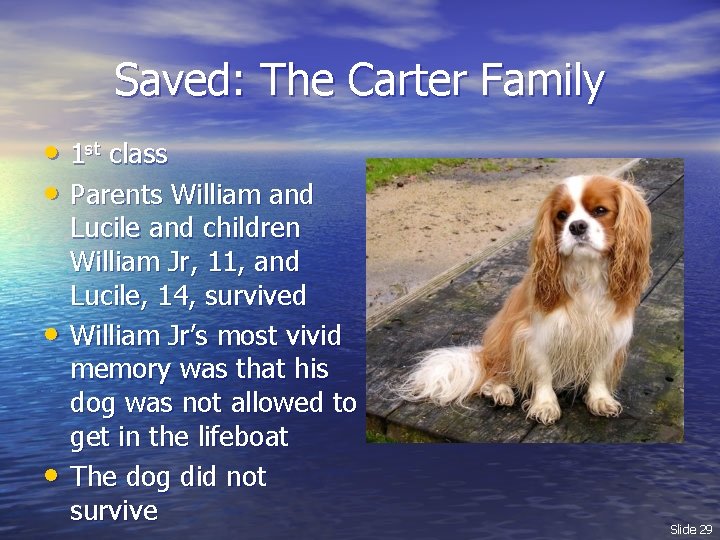
Saved: The Carter Family • 1 st class • Parents William and • • Lucile and children William Jr, 11, and Lucile, 14, survived William Jr’s most vivid memory was that his dog was not allowed to get in the lifeboat The dog did not survive Slide 29
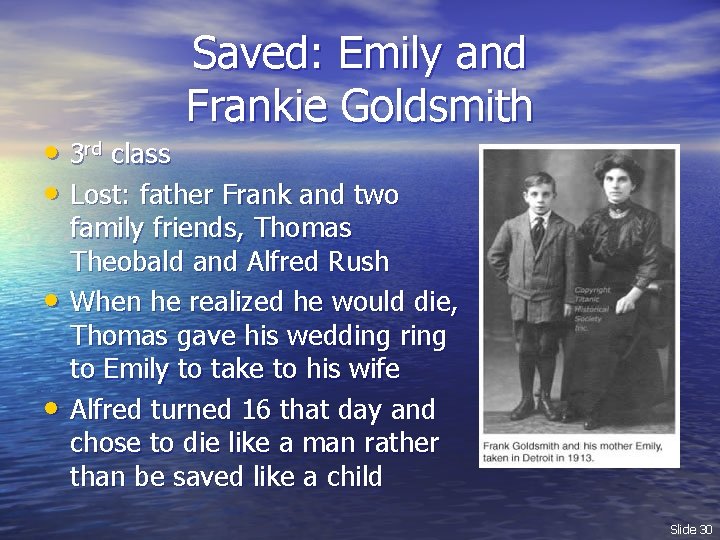
Saved: Emily and Frankie Goldsmith • 3 rd class • Lost: father Frank and two • • family friends, Thomas Theobald and Alfred Rush When he realized he would die, Thomas gave his wedding ring to Emily to take to his wife Alfred turned 16 that day and chose to die like a man rather than be saved like a child Slide 30
Frankie Goldsmith • On Titanic, Frankie, 9, played with 4 other English-speaking third class boys – He was the only one who survived • Settled in Detroit near Tiger Stadium – Each time the crowd cheered Frankie remembered the sounds of people dying in the freezing water and calling for help • Frankie grew up and wrote a book about his experience called Echoes in the Night Slide 31
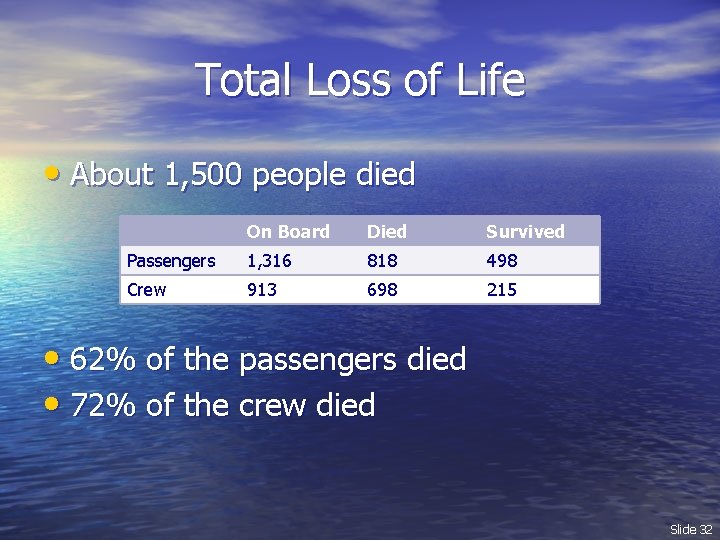
Total Loss of Life • About 1, 500 people died On Board Died Survived Passengers 1, 316 818 498 Crew 913 698 215 • 62% of the passengers died • 72% of the crew died Slide 32
Total Loss of Life • Only one-third of the people on Titanic survived (which means 2 of every 3 people died) • If the 20 lifeboats had been full, half might have survived Slide 33
What If? • Actually, the loss of life could have been much worse • Titanic could carry up to 3, 295 people – If so, it would have taken 63 lifeboats to save everyone • Fortunately, only about 2, 200 people were aboard Slide 34
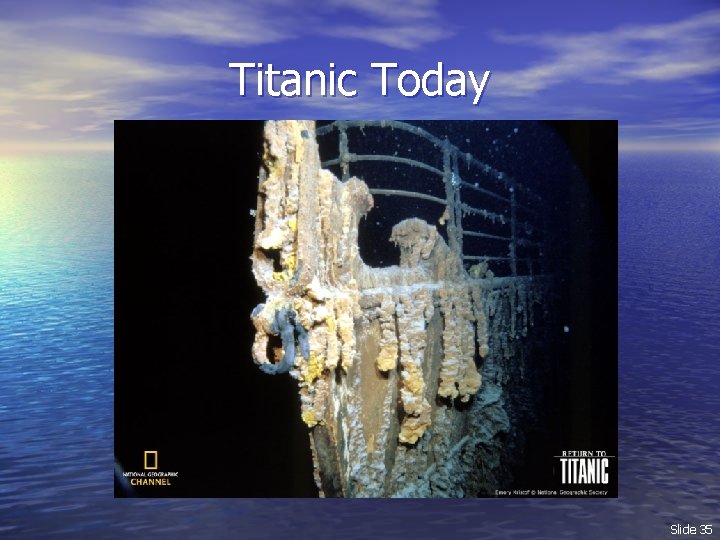
Titanic Today Slide 35
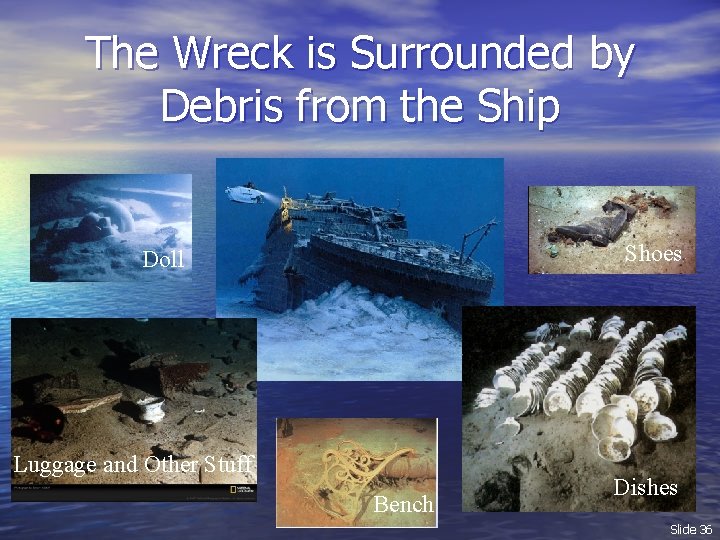
The Wreck is Surrounded by Debris from the Ship Shoes Doll Luggage and Other Stuff Bench Dishes Slide 36
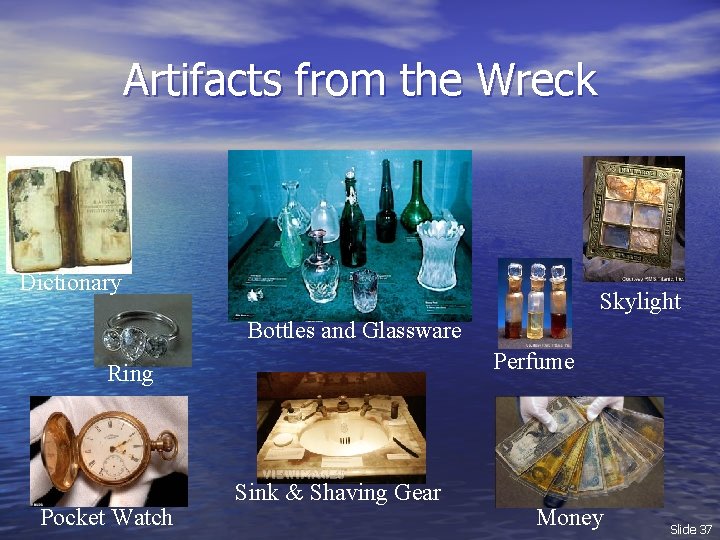
Artifacts from the Wreck Dictionary Skylight Bottles and Glassware Perfume Ring Pocket Watch Sink & Shaving Gear Money Slide 37
What Can We Learn From the Wreck? • How the ship broke up and why • Which parts of the ship are preserved, which are not, and why • How steel structure reacts to prolonged water damage Slide 38
What Can We Learn From the Artifacts? • How to restore and save items salvaged from ship wrecks – Artifacts made of many different materials: leather, silver, glass, paper, etc. • Artifacts remind us of the people who died and the importance of preventing shipwrecks Slide 39
Any Questions? Slide 40
- Slides: 40