
TITAN SDR ENABLIA THE HF BAND Why is

TITAN SDR ENABLIA
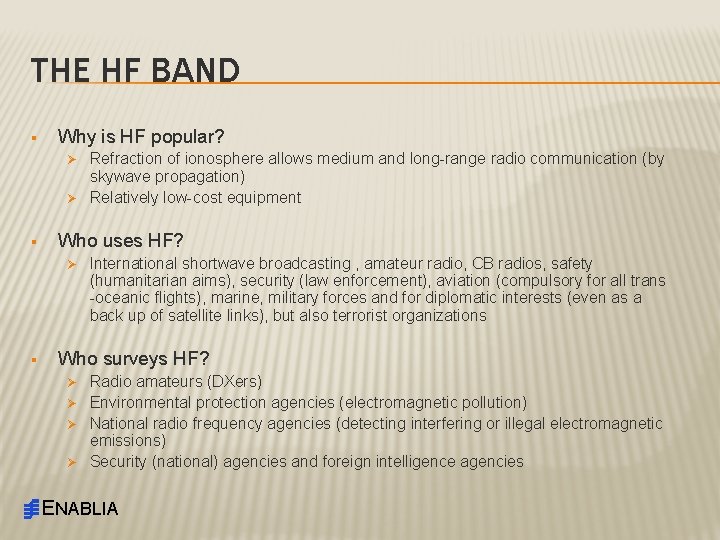
THE HF BAND § Why is HF popular? Ø Ø § Who uses HF? Ø § Refraction of ionosphere allows medium and long-range radio communication (by skywave propagation) Relatively low-cost equipment International shortwave broadcasting , amateur radio, CB radios, safety (humanitarian aims), security (law enforcement), aviation (compulsory for all trans -oceanic flights), marine, military forces and for diplomatic interests (even as a back up of satellite links), but also terrorist organizations Who surveys HF? Ø Ø Radio amateurs (DXers) Environmental protection agencies (electromagnetic pollution) National radio frequency agencies (detecting interfering or illegal electromagnetic emissions) Security (national) agencies and foreign intelligence agencies ENABLIA
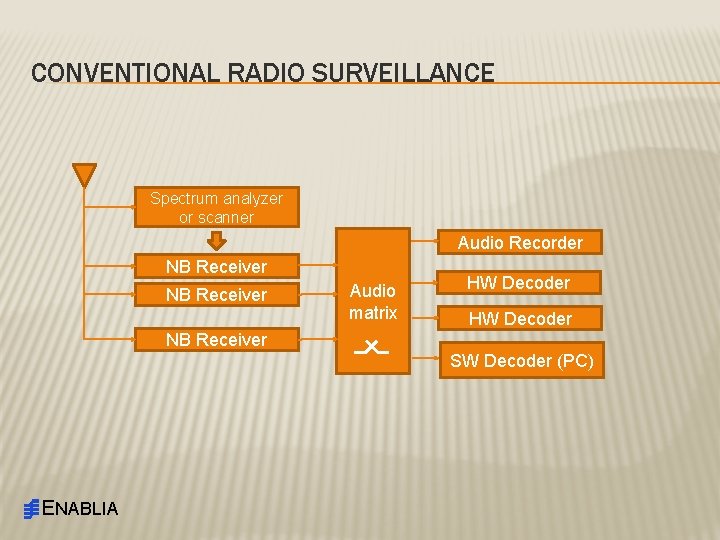
CONVENTIONAL RADIO SURVEILLANCE Spectrum analyzer or scanner Audio Recorder NB Receiver Audio matrix HW Decoder NB Receiver SW Decoder (PC) ENABLIA
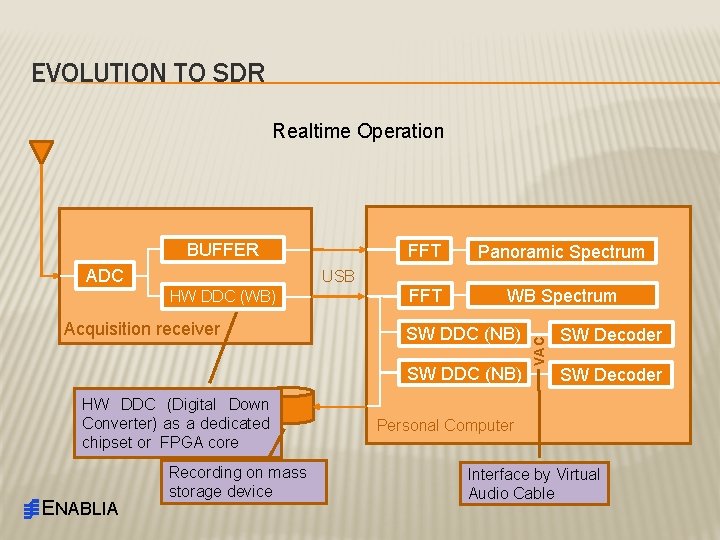
EVOLUTION TO SDR Realtime Operation BUFFER ADC FFT Panoramic Spectrum FFT WB Spectrum HW DDC (WB) Acquisition receiver SW DDC (NB) HW DDC (Digital Down Converter) as a dedicated chipset or FPGA core ENABLIA Recording on mass storage device VAC USB SW Decoder Personal Computer Interface by Virtual Audio Cable
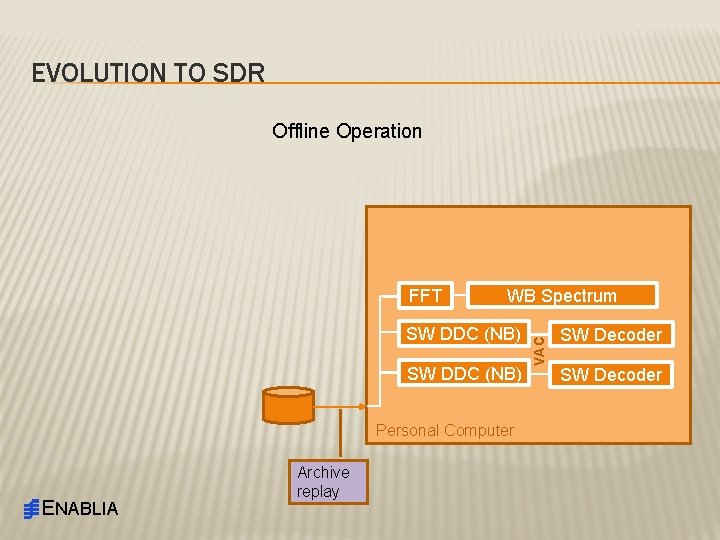
EVOLUTION TO SDR Offline Operation WB Spectrum SW DDC (NB) Personal Computer ENABLIA Archive replay VAC FFT SW Decoder
LIMITATIONS OF CLASSIC SDR RECEIVERS § Maximum number of NB channels significantly limited by CPU Ø Ø § Spectral zoom strongly impacts CPU Ø Ø § SW implementation of DDCs is computationally expensive (especially for WB channels with large bandwidths) Decoding /NB recording practically limited to about three channels in parallel Smallest resolution bandwidths require large size FFTs, rising CPU load considerably (FFT bins outside the displayed frequency span are discarded) Performance not independent on frequency span Just one WB channel Ø Need for partitioning of acquisition bandwidth (into more WB channels), to survey more spectral portions in parallel ENABLIA
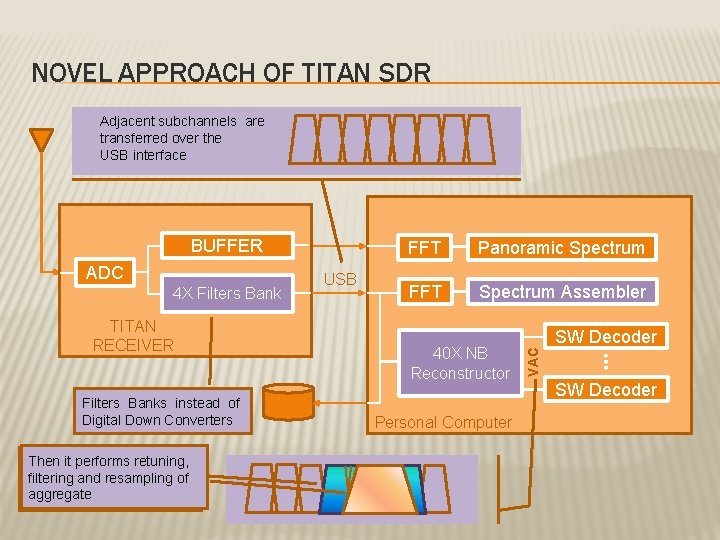
NOVEL APPROACH OF TITAN SDR Adjacent subchannels are transferred over the USB interface ADC 4 X Filters Bank TITAN RECEIVER Filters Banks instead of Digital Down Converters Then NB it performs retuning, Each Reconstructor filtering andadjacent resampling of aggregates aggregate subchannels USB FFT Panoramic Spectrum FFT Spectrum Assembler 40 X NB Reconstructor Personal Computer SW Decoder VAC BUFFER SW Decoder
THE NEW SIGNAL PROCESSING FEATURES § Filters Banks on FPGA instead of WB DDCs Ø Ø § Spectrum assembler Ø Ø § WB channels are provided to PC as a collection of subchannels Filters Banks perform pass-band filtering AND decimation, which both downconverts and preserves throughput over the USB interface WB Spectrum is obtained by composing individual subchannels spectra (exploiting the power complementarity feature of filters responses) While zooming, just needed subchannels spectra are evaluated, thus saving CPU NB Reconstructors instead of NB DDCs Ø Ø NB channels are obtained by aggregating subchannels, retuning (digital rotation), filtering and resampling Processing is at low sampling rates, resulting in a reduced impact on CPU (with respect to SW DDCs ) and allowing for many parallel NB channels ENABLIA
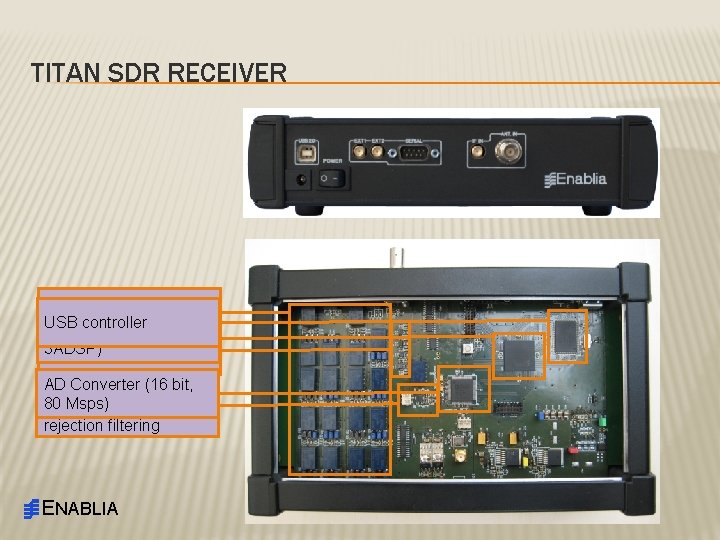
TITAN SDR RECEIVER 16 Preselectors USB FPGAcontroller (Xilinx Spartan 3 ADSP) Anti-aliasing lowpass AD Converter (16 bit, Unbal/Balanced, 80 Msps) amplification and noise rejection filtering ENABLIA
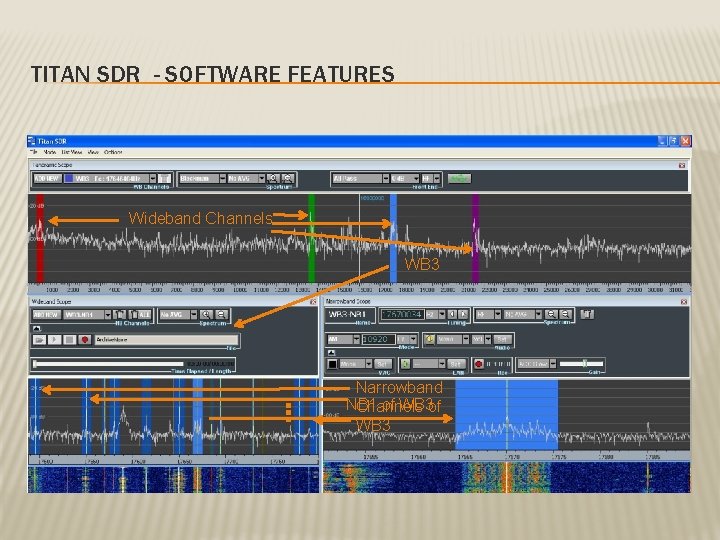
TITAN SDR - SOFTWARE FEATURES Wideband Channels WB 3 Narrowband NB 1 of WB 3 of Channels WB 3
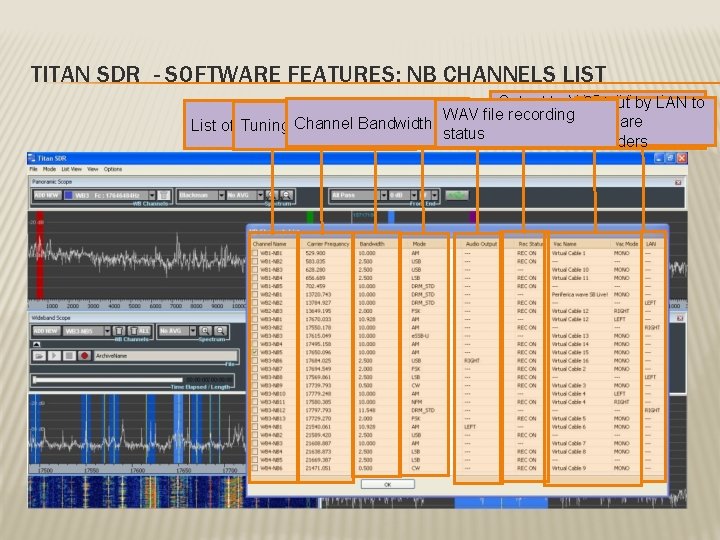
TITAN SDR - SOFTWARE FEATURES: NB CHANNELS LIST Output to VACs (Virtual Output by LAN to WAV file. Audio recording or additonal software Channel Bandwidth Demodulation modes Audio card output Cables) List of NB Channels Tuning frequency status audio cards decoders
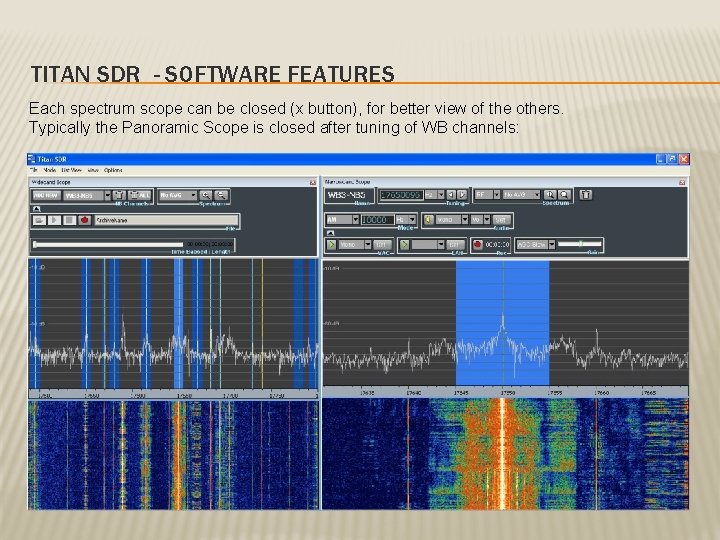
TITAN SDR - SOFTWARE FEATURES Each spectrum scope can be closed (x button), for better view of the others. Typically the Panoramic Scope is closed after tuning of WB channels:
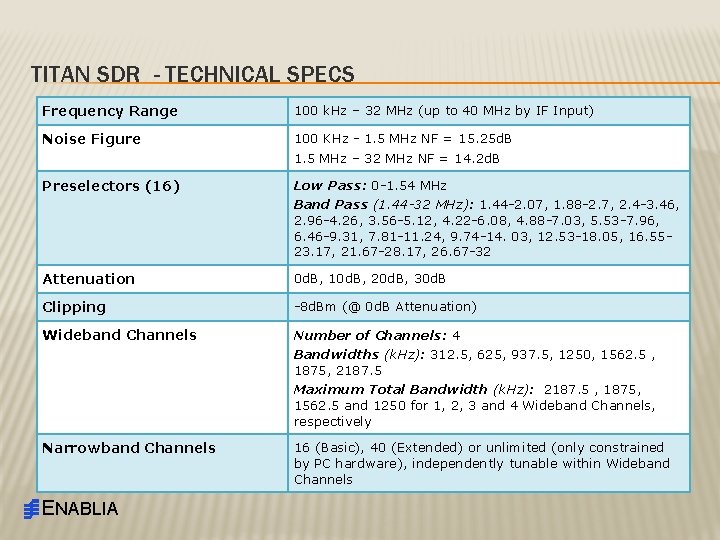
TITAN SDR - TECHNICAL SPECS Frequency Range 100 k. Hz – 32 MHz (up to 40 MHz by IF Input) Noise Figure 100 KHz - 1. 5 MHz NF = 15. 25 d. B 1. 5 MHz – 32 MHz NF = 14. 2 d. B Preselectors (16) Low Pass: 0 -1. 54 MHz Band Pass (1. 44 -32 MHz): 1. 44 -2. 07, 1. 88 -2. 7, 2. 4 -3. 46, 2. 96 -4. 26, 3. 56 -5. 12, 4. 22 -6. 08, 4. 88 -7. 03, 5. 53 -7. 96, 6. 46 -9. 31, 7. 81 -11. 24, 9. 74 -14. 03, 12. 53 -18. 05, 16. 5523. 17, 21. 67 -28. 17, 26. 67 -32 Attenuation 0 d. B, 10 d. B, 20 d. B, 30 d. B Clipping -8 d. Bm (@ 0 d. B Attenuation) Wideband Channels Number of Channels: 4 Bandwidths (k. Hz): 312. 5, 625, 937. 5, 1250, 1562. 5 , 1875, 2187. 5 Maximum Total Bandwidth (k. Hz): 2187. 5 , 1875, 1562. 5 and 1250 for 1, 2, 3 and 4 Wideband Channels, respectively Narrowband Channels ENABLIA 16 (Basic), 40 (Extended) or unlimited (only constrained by PC hardware), independently tunable within Wideband Channels
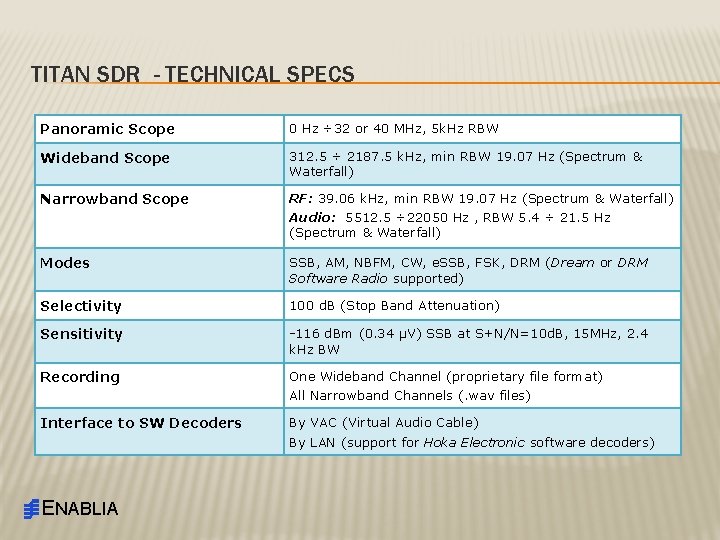
TITAN SDR - TECHNICAL SPECS Panoramic Scope 0 Hz ÷ 32 or 40 MHz, 5 k. Hz RBW Wideband Scope 312. 5 ÷ 2187. 5 k. Hz, min RBW 19. 07 Hz (Spectrum & Waterfall) Narrowband Scope RF: 39. 06 k. Hz, min RBW 19. 07 Hz (Spectrum & Waterfall) Audio: 5512. 5 ÷ 22050 Hz , RBW 5. 4 ÷ 21. 5 Hz (Spectrum & Waterfall) Modes SSB, AM, NBFM, CW, e. SSB, FSK, DRM (Dream or DRM Software Radio supported) Selectivity 100 d. B (Stop Band Attenuation) Sensitivity -116 d. Bm (0. 34 µV) SSB at S+N/N=10 d. B, 15 MHz, 2. 4 k. Hz BW Recording One Wideband Channel (proprietary file format) All Narrowband Channels (. wav files) Interface to SW Decoders By VAC (Virtual Audio Cable) By LAN (support for Hoka Electronic software decoders) ENABLIA
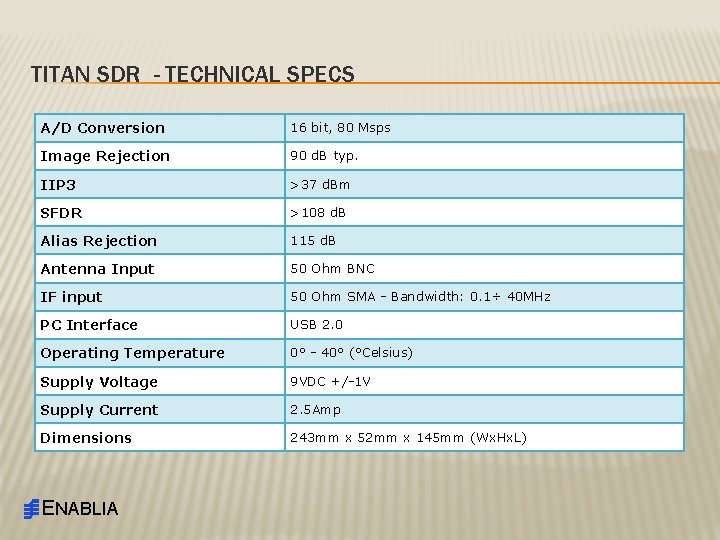
TITAN SDR - TECHNICAL SPECS A/D Conversion 16 bit, 80 Msps Image Rejection 90 d. B typ. IIP 3 >37 d. Bm SFDR >108 d. B Alias Rejection 115 d. B Antenna Input 50 Ohm BNC IF input 50 Ohm SMA - Bandwidth: 0. 1÷ 40 MHz PC Interface USB 2. 0 Operating Temperature 0° - 40° (°Celsius) Supply Voltage 9 VDC +/-1 V Supply Current 2. 5 Amp Dimensions 243 mm x 52 mm x 145 mm (Wx. Hx. L) ENABLIA
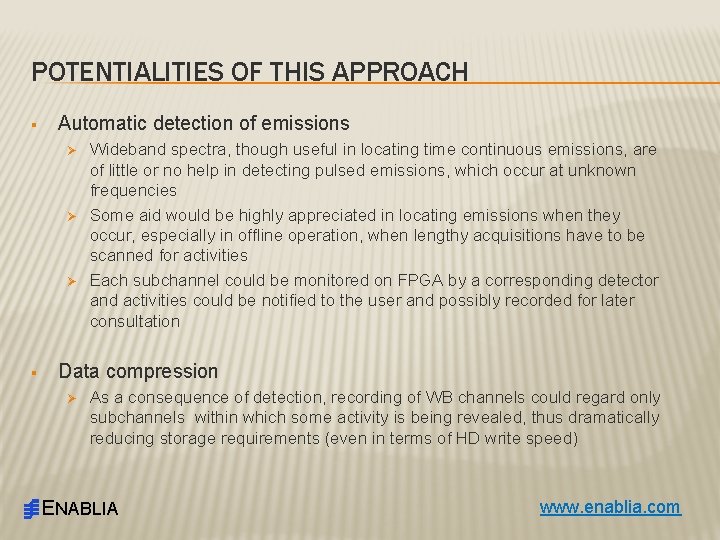
POTENTIALITIES OF THIS APPROACH § Automatic detection of emissions Ø Ø Ø § Wideband spectra, though useful in locating time continuous emissions, are of little or no help in detecting pulsed emissions, which occur at unknown frequencies Some aid would be highly appreciated in locating emissions when they occur, especially in offline operation, when lengthy acquisitions have to be scanned for activities Each subchannel could be monitored on FPGA by a corresponding detector and activities could be notified to the user and possibly recorded for later consultation Data compression Ø As a consequence of detection, recording of WB channels could regard only subchannels within which some activity is being revealed, thus dramatically reducing storage requirements (even in terms of HD write speed) ENABLIA www. enablia. com
- Slides: 16