
Titan Bumblebee A 1 kg LanderLaunched UAV Concept
Titan Bumblebee : A 1 kg Lander-Launched UAV Concept Ralph D. Lorenz Space Department, Johns Hopkins University Applied Physics Laboratory, 11100 Johns Hopkins Road, Laurel, MD 20723, USA (Ralph. lorenz@jhuapl. edu) http: //www. lpl. arizona. edu/~rlorenz Journal of the British Interplanetary Society, April 2008 Proposal Submitted to ASTEP 2008 Solicitation
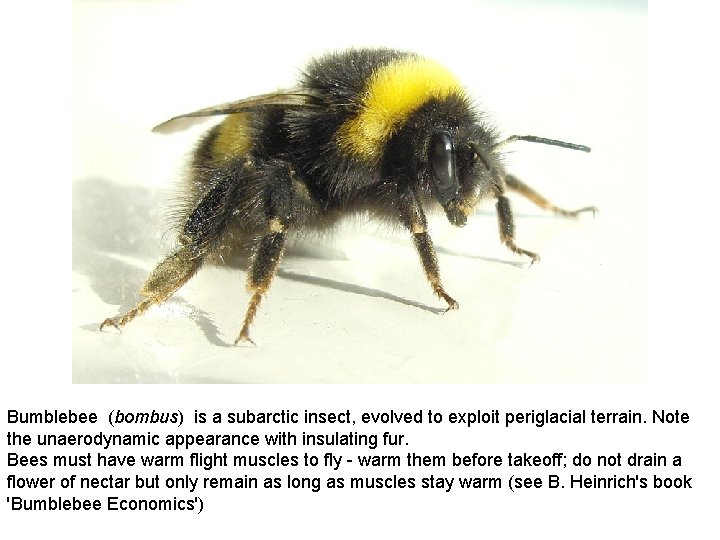
Bumblebee (bombus) is a subarctic insect, evolved to exploit periglacial terrain. Note the unaerodynamic appearance with insulating fur. Bees must have warm flight muscles to fly - warm them before takeoff; do not drain a flower of nectar but only remain as long as muscles stay warm (see B. Heinrich's book 'Bumblebee Economics')
ADVANCED EXPLORATION VEHICLES TEND NOT TO FLY AS STANDALONE PLANETARY MISSIONS Why Risks not well understood. Risk aversion argues to fly what is known Science opportunities not well understood, so science pull is not strong (remedy by seed science funds? ) DS-2 Mars Microprobes - piggyback on Mars Polar Lander VEGA Balloons - piggyback on Halley Flyby/Venus Lander Sojourner Rover - piggyback on Pathfinder lander PLUTO Mole - piggyback on Beagle Lander
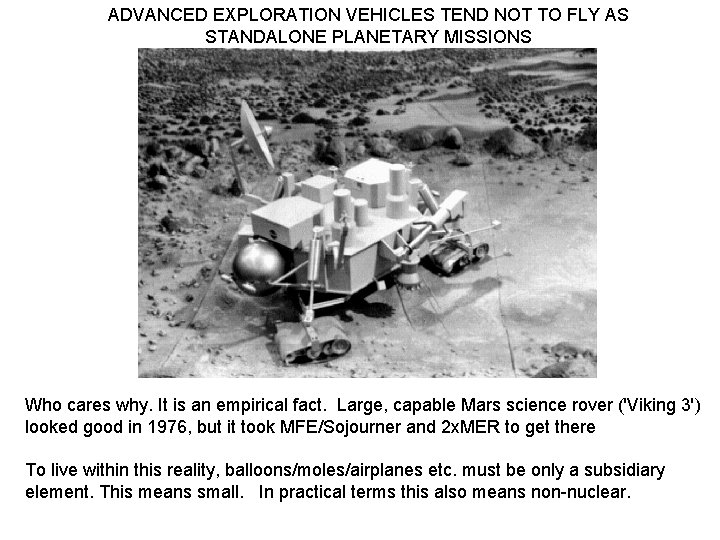
ADVANCED EXPLORATION VEHICLES TEND NOT TO FLY AS STANDALONE PLANETARY MISSIONS Who cares why. It is an empirical fact. Large, capable Mars science rover ('Viking 3') looked good in 1976, but it took MFE/Sojourner and 2 x. MER to get there To live within this reality, balloons/moles/airplanes etc. must be only a subsidiary element. This means small. In practical terms this also means non-nuclear.
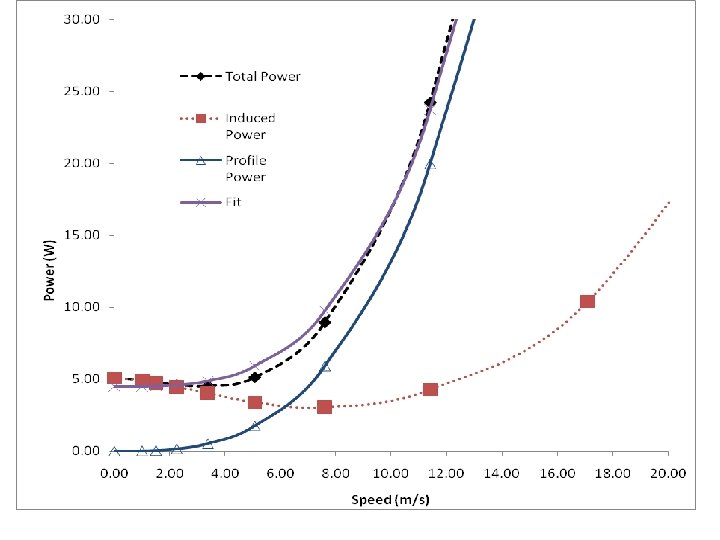
Explore the minimum useful Titan airplane. Start with 1 kg (we will soon see smaller doesn’t make much sense) 3 Convergent Factors : Primary batteries (e. g. Li. SOCl 2, per Huygens, Galileo) have specific energy of ~400 W-hr/kg. If we allocate half of our 1 kg to batteries, we have ~200 W-hr (720 k. J) This means 200 W for 1 hour, or 50 W for 4 hours, 10 W for 20 hours. But vehicle must stay warm. 1 kg equipment pod with density of ~1000 kg/m 3 has an area of 400 cm 2. If we have a 0. 5 cm thick layer of foam insulation (Basotect, as on Huygens k=0. 02 Wm-1 K-1) then with DT~200 K required in 94 K environment, we lose ~30 W. If near-surface winds are ~0. 5 -1 m/s, we need to fly at several m/s to penetrate. Empirical scaling relationships suggest flight power P~10. 9 m 0. 8 V 0. 9(g/ge). For 1 kg at 10 m/s in Titan gravity (g/ge=1/7) this means ~15 W. So, 4 -6 hour flight seems possible.
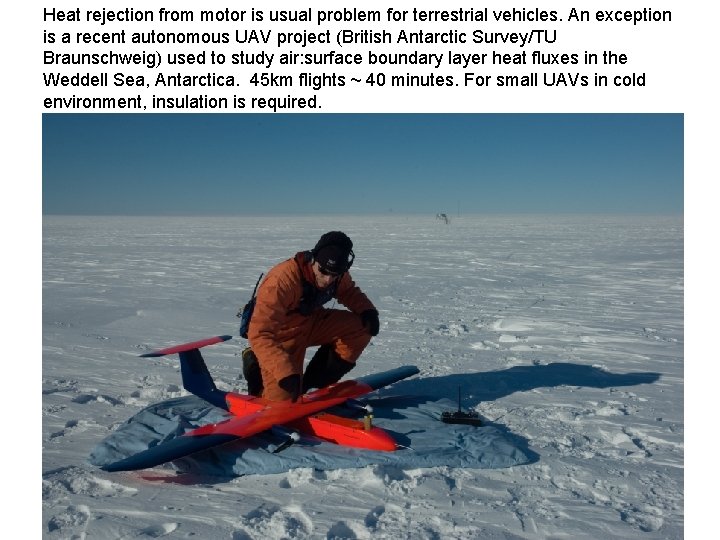
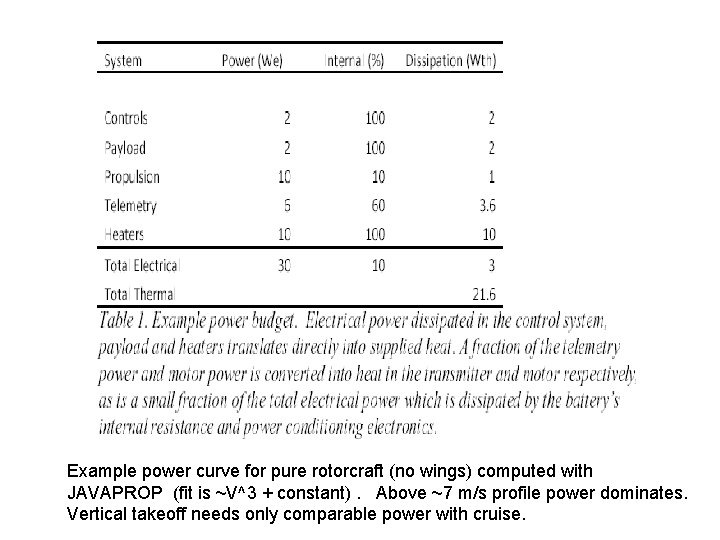
Heat rejection from motor is usual problem for terrestrial vehicles. An exception is a recent autonomous UAV project (British Antarctic Survey/TU Braunschweig) used to study air: surface boundary layer heat fluxes in the Weddell Sea, Antarctica. 45 km flights ~ 40 minutes. For small UAVs in cold environment, insulation is required.
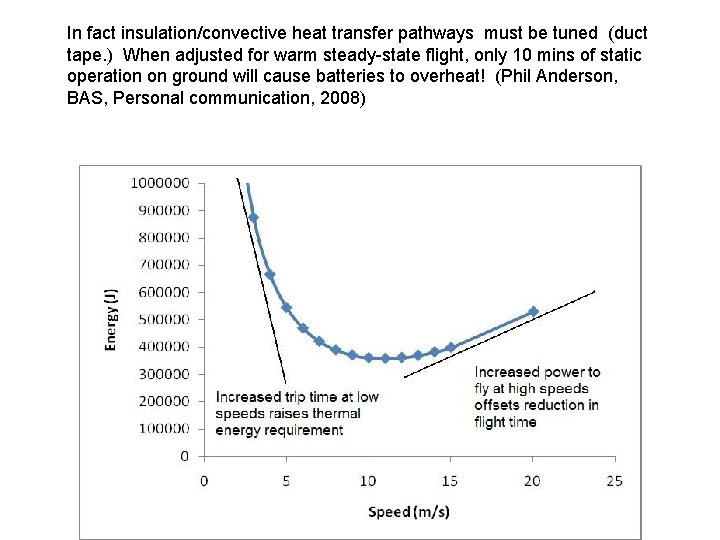
In fact insulation/convective heat transfer pathways must be tuned (duct tape. ) When adjusted for warm steady-state flight, only 10 mins of static operation on ground will cause batteries to overheat! (Phil Anderson, BAS, Personal communication, 2008)
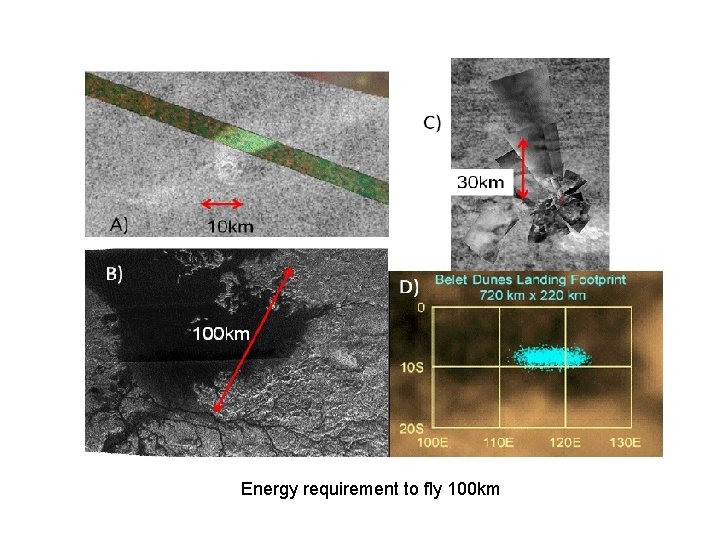
Energy requirement to fly 100 km

Need to communicate via lander (and use lander as beacon for navigation? ) Horizon distance at Titan for altitudes of 0. 1, 1, and 2 km altitude is 22, 71 and 101 km away. So we can fly at low altitudes for some tens of km, perhaps 100 km away and remain in line-of-sight (ignores multipath, terrain blocking, refraction) Lander delivery ellipse is ~70 x 240 km 1 -sigma, so to fly 100 km would be useful (gives good probability of reaching given point in the ellipse) At 10 m/s, cover 100 km in 3 hours. RF power for 'video' rate telemetry is ~few to ten W (DC). Flying at 1 km, see a swath ~1 km wide. With 1 m/pix, then 100 x 1 km long swath, or 10^8 1 x 1 m pixels. In other words, some GB of potentially useful data. Comparable with mosaic from a panoramic camera. (Not worth acquiring more data than this unless have clever data selection or a very good downlink capability. . ? )
Example power curve for pure rotorcraft (no wings) computed with JAVAPROP (fit is ~V^3 + constant). Above ~7 m/s profile power dominates. Vertical takeoff needs only comparable power with cruise.
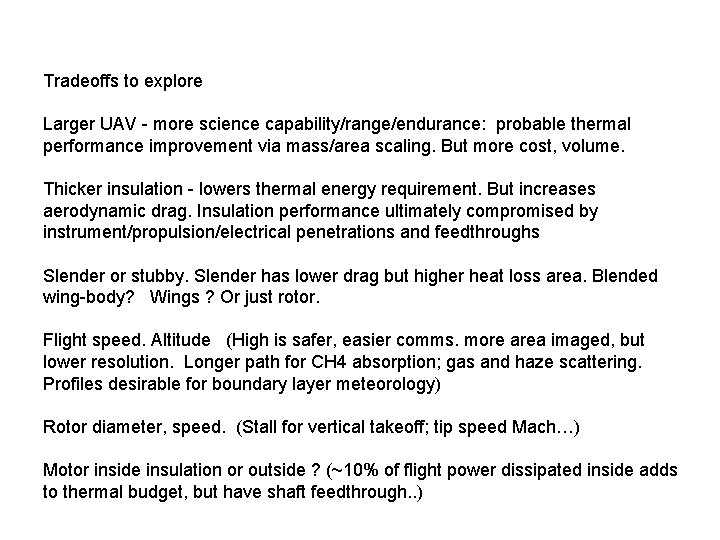
Tradeoffs to explore Larger UAV - more science capability/range/endurance: probable thermal performance improvement via mass/area scaling. But more cost, volume. Thicker insulation - lowers thermal energy requirement. But increases aerodynamic drag. Insulation performance ultimately compromised by instrument/propulsion/electrical penetrations and feedthroughs Slender or stubby. Slender has lower drag but higher heat loss area. Blended wing-body? Wings ? Or just rotor. Flight speed. Altitude (High is safer, easier comms. more area imaged, but lower resolution. Longer path for CH 4 absorption; gas and haze scattering. Profiles desirable for boundary layer meteorology) Rotor diameter, speed. (Stall for vertical takeoff; tip speed Mach…) Motor inside insulation or outside ? (~10% of flight power dissipated inside adds to thermal budget, but have shaft feedthrough. . )
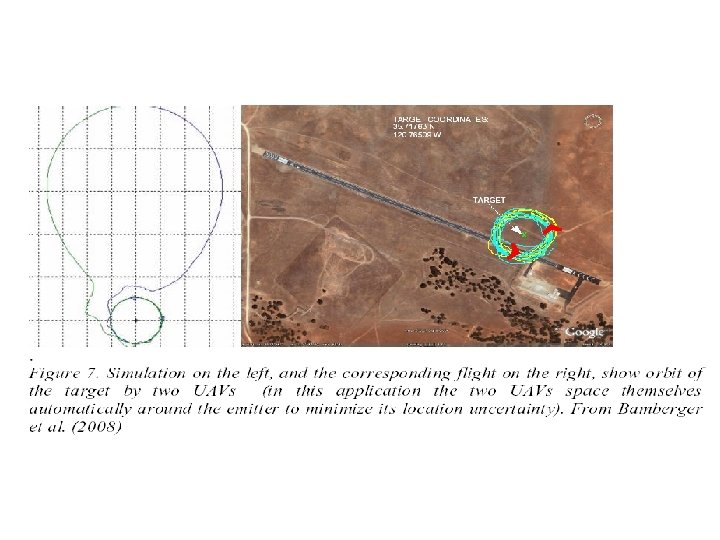
Guidance Must fly in daytime (illumination for imaging, plus sun position as a heading reference - remember no GPS, no magnetic field) Pressure altimeter. Pitot airspeed. More robust to incorporate additional heading/position reference - use lander as a beacon. UAV antenna systems for emitter location are in use. (Some less robust but conceivable possibilities - Groundspeed via optical odometry? Inertial guidance? Radar ? Sonar? ) Payload Nominally Side-looking camera plus meteorology ( heavier variant could consider spectrometer, UV-fluorescence etc. for astrobiology survey of cryolava flows etc. )
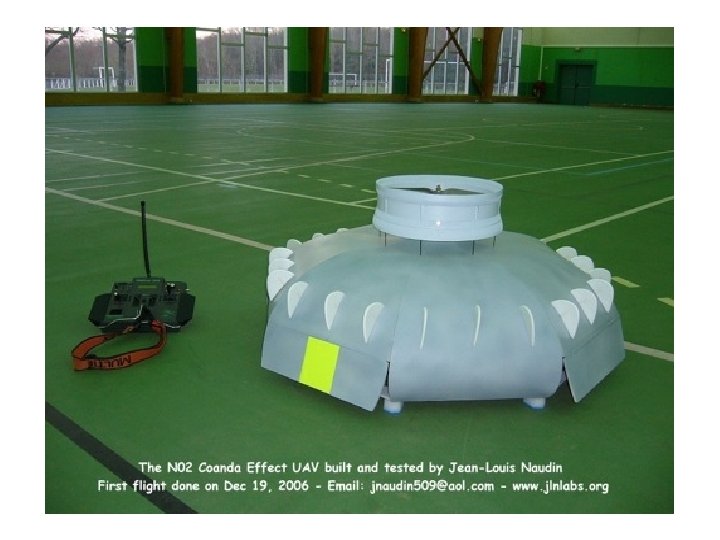
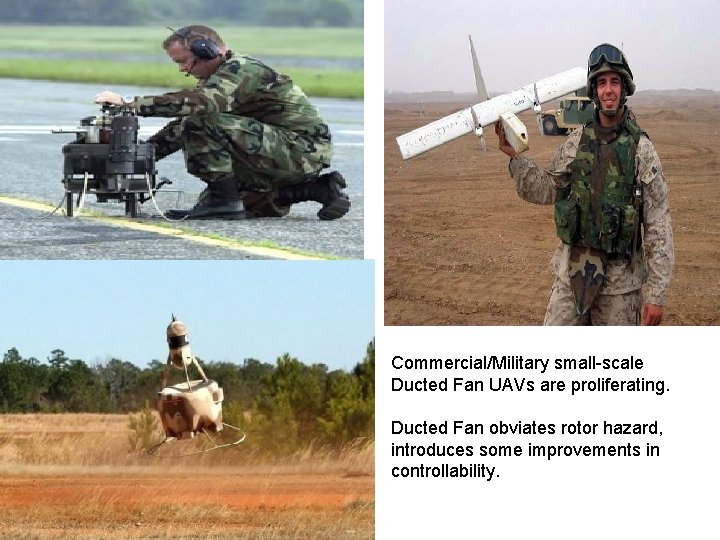
Commercial/Military small-scale Ducted Fan UAVs are proliferating. Ducted Fan obviates rotor hazard, introduces some improvements in controllability.
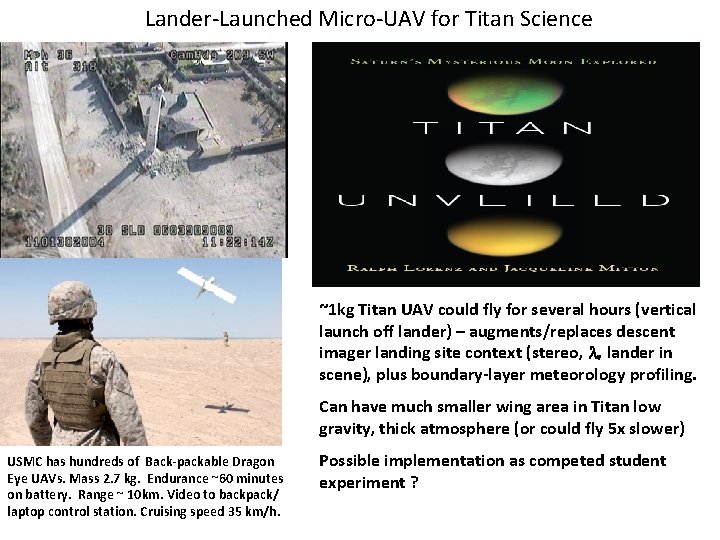
Lander-Launched Micro-UAV for Titan Science ~1 kg Titan UAV could fly for several hours (vertical launch off lander) – augments/replaces descent imager landing site context (stereo, l, lander in scene), plus boundary-layer meteorology profiling. Can have much smaller wing area in Titan low gravity, thick atmosphere (or could fly 5 x slower) USMC has hundreds of Back-packable Dragon Eye UAVs. Mass 2. 7 kg. Endurance ~60 minutes on battery. Range ~ 10 km. Video to backpack/ laptop control station. Cruising speed 35 km/h. Possible implementation as competed student experiment ?

- Slides: 19