
Tissues Chapter 3 Tissues a group or mass

- Slides: 28
Tissues Chapter 3 Tissues- a group or mass of similar cells working together to perform certain common functions
There are 4 major types of tissue 1. Epithelial 2. Connective 3. Muscle 4. Nervous
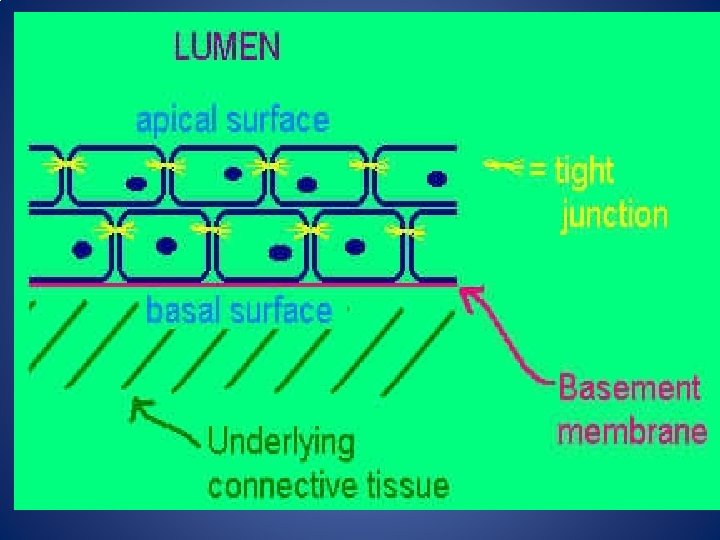
1. Epithelial Tissue • General characteristics: - Found throughout the body, covers all body surfaces both inside and out. - Main glandular tissue - Attached to underlying connective tissue by non cellular nonliving basement membrane. - no blood supply - Cells reproduce rapidly (rapid healing) - Cells tightly packed together
• • Protection Secretion Absorption Excretion Functions:
• types of epithelial tissue- categorized based on the shape of the cells and the layers of cells Shape of cells • Squamous: flattened • Cuboidal: cube shaped • Columnar: columns
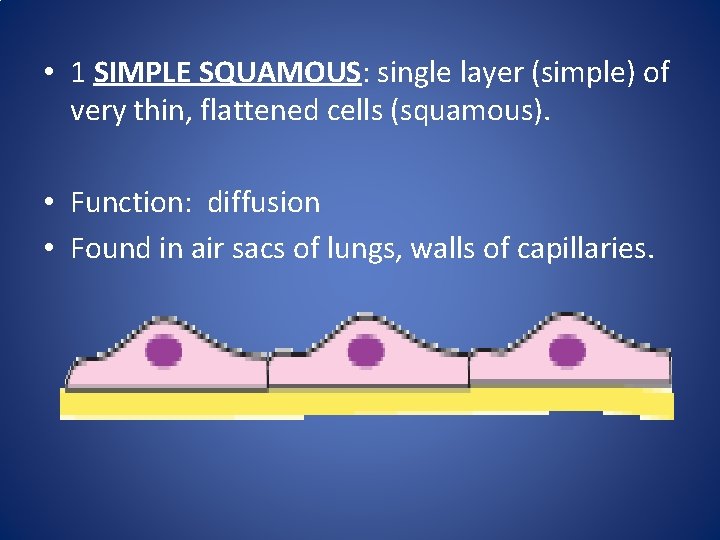
• 1 SIMPLE SQUAMOUS: single layer (simple) of very thin, flattened cells (squamous). • Function: diffusion • Found in air sacs of lungs, walls of capillaries.
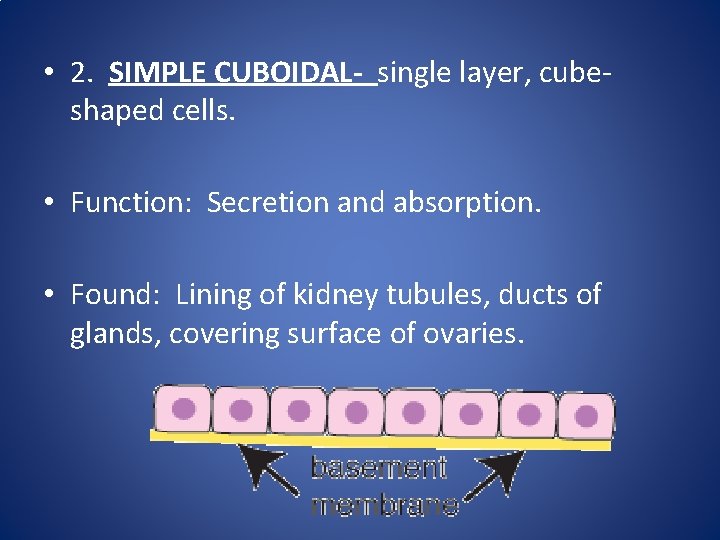
• 2. SIMPLE CUBOIDAL- single layer, cubeshaped cells. • Function: Secretion and absorption. • Found: Lining of kidney tubules, ducts of glands, covering surface of ovaries.
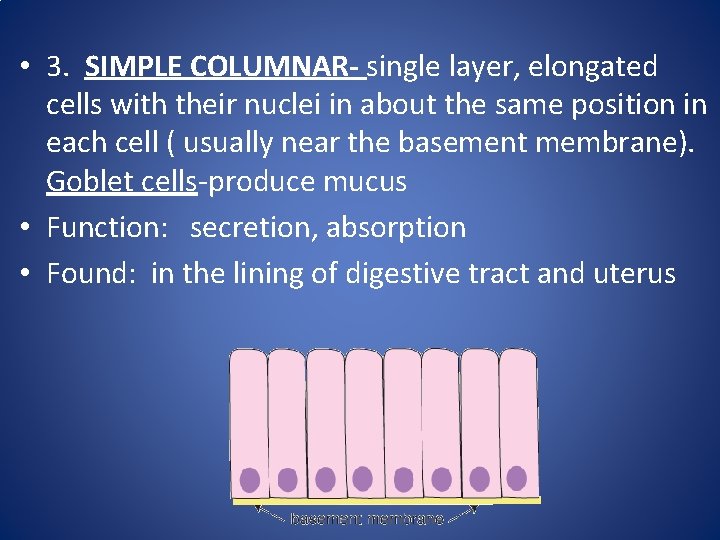
• 3. SIMPLE COLUMNAR- single layer, elongated cells with their nuclei in about the same position in each cell ( usually near the basement membrane). Goblet cells-produce mucus • Function: secretion, absorption • Found: in the lining of digestive tract and uterus
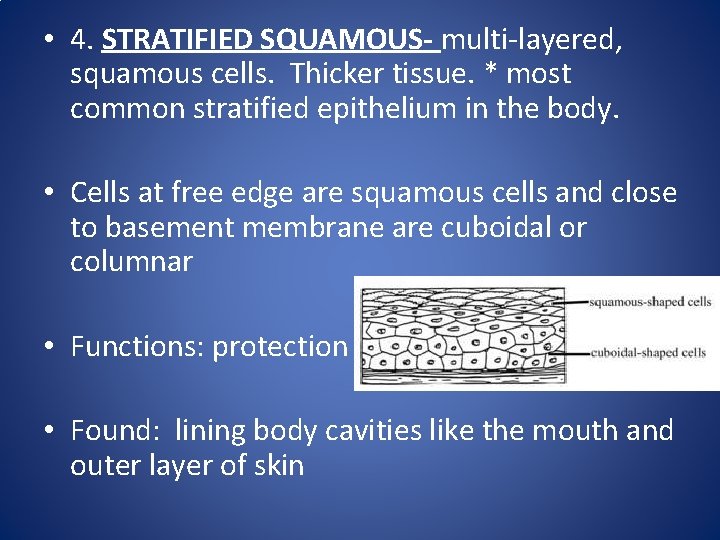
• 4. STRATIFIED SQUAMOUS- multi-layered, squamous cells. Thicker tissue. * most common stratified epithelium in the body. • Cells at free edge are squamous cells and close to basement membrane are cuboidal or columnar • Functions: protection • Found: lining body cavities like the mouth and outer layer of skin
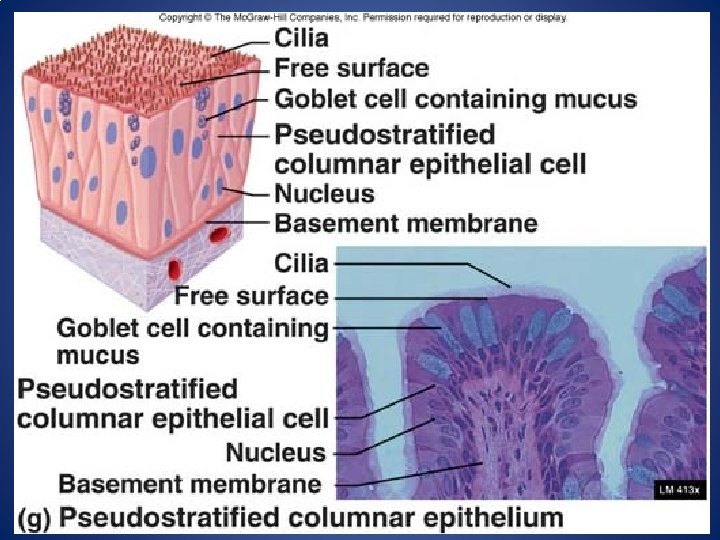
• 5. PSEUDOSTRATIFIED COLUMNAR- appear “stratified” but really a single layer with nuclei at various levels giving the appearance of layered cells. Usually ciliated. Contains goblet cells. • Function: secretion and cilia-aided movement • Location: lining air passages like the trachea and tubes of the reproductive system.
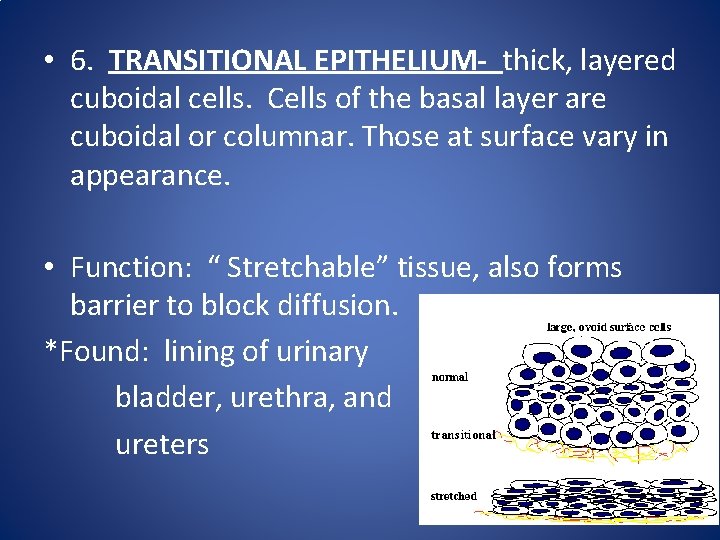
• 6. TRANSITIONAL EPITHELIUM- thick, layered cuboidal cells. Cells of the basal layer are cuboidal or columnar. Those at surface vary in appearance. • Function: “ Stretchable” tissue, also forms barrier to block diffusion. *Found: lining of urinary bladder, urethra, and ureters
Glandular Epithelium • Glands: secretes substances for use in the body. • Two major glands develop from epithelial sheets. • Endocrine Glands: ( ductless) Hormones pass directly into the blood stream. Ex: adrenal gland • Exocrine glands: secretions empty through ducts to the epithelial surface. EX: sweat and oil glands
2. Connective Tissue • General Characteristics: - Most abundant tissue in your body, found throughout - Binds structures together - Provides: support, protection, framework , fills space, - stores fat, produces blood cells, - Made up of a ground substance (fluid, semi-solid) and fibers - good blood supply - Cells can reproduce - fights infection, and - helps repair tissue
Extracellular matrix • 1. : Ground Substance: composed largely of water plus adhesion proteins and large polysaccharide molecules. (gelatinous material). It is transparent, colorless, and fills the spaces between fibers and cells. • 2. Fibers: allow it to be stretched then recoil
Main types of fibers: • Collagenous fibers –thick, made of protein collagen, major structural protein in the body, appear in long parallel bundles. Strong, flexible, but not very elastic, also known as white fibers. (bones, ligaments, tendons. ) • Elastic fibers- micro fibrils in protein elastin, yellow fibers. Not as strong, but very elastic (respiratory and vocal cords)
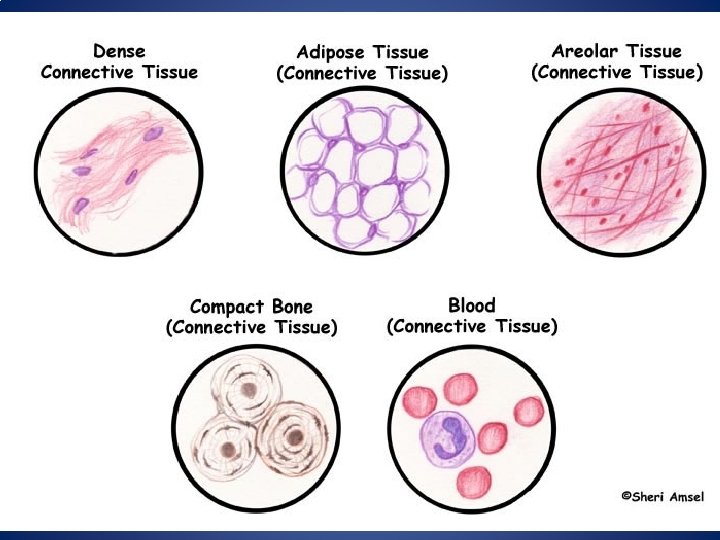
Categories of connective tissue • A. Loose C. T. and Areolar Tissue- binds skin to underlying organs and organs to organs, space between muscles , throughout body. • . Adipose tissue- aka FAT, beneath skin, around kidneys and eyeballs, abdominal membranes. • Function: protective cushion, insulation to preserve body heat, stores energy, cells are called adipocytes.
• B. Fibrous C. T. - dense tissue, closely packed, thick collagenous fibers and fine network of elastic fibers. Few cells, poor blood supply, thus slow healing. • Tendons –connect muscles to bones • Ligaments- connect bones to bones • C. Reticular Connective Tissue: limited to certain sites, consists of network of interwoven reticular fibers. • - spleen, lymph nodes
• CARTILAGE( All cartilage cells are called chondrocytes) • . HYALINE CARTILAGE- very fine white (collagenous) fibers. Most common cartilage. Covers ends of bones and joints, nose, respiratory passages, larynx ( voice box). • . ELASTIC CARTILAGE- more flexible and elastic, external ear and larynx
• . FIBROCARTILAGE – very tough. Large numerous collagenous fibers. Intervertebral disks, menisci • . BONE TISSUE - Osseus tissue. Rigid due to mineral salts. Layers: lamellae, haversian canals, osteocytes. Protect and support • . BLOOD TISSUE: circulates throughout the body. Blood cells surround by nonliving fluid matrix-blood plasma. Carries nutrients, wastes, and respiratory gases.
Muscle Tissue Functions 1. MOVEMENT –– Contraction (shortening) causes movement –– Of the body as a whole when connected to skeleton –– Of materials through the body (blood, food, etc. )
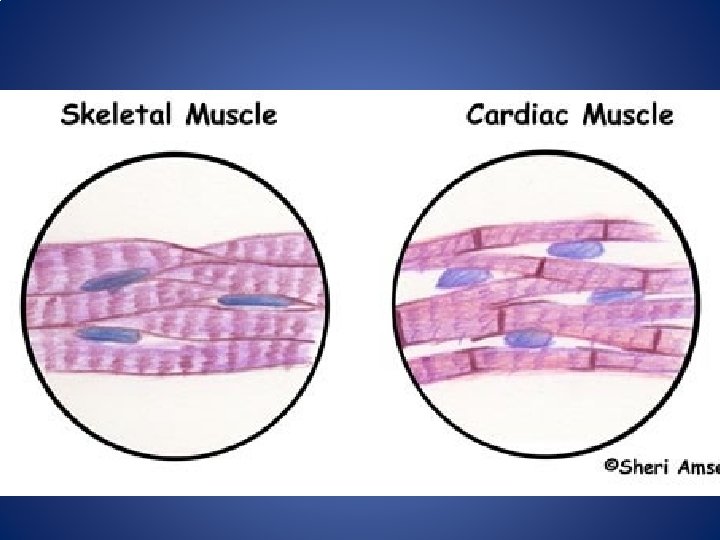
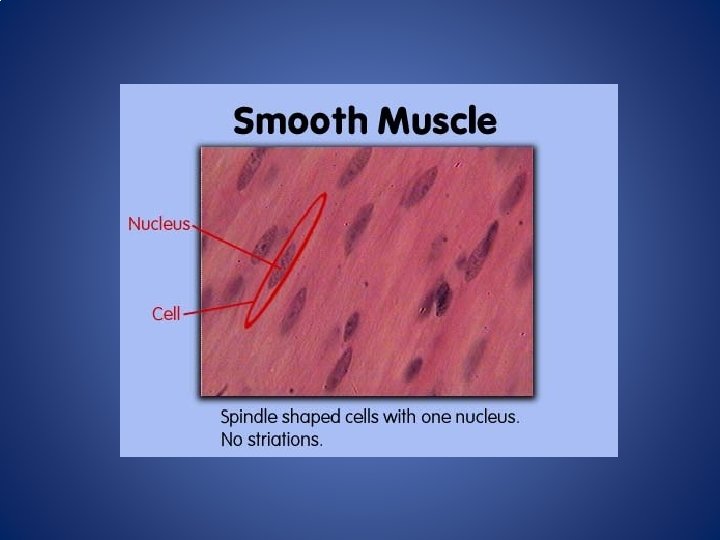
3. MUSCLE TISSUE • A. SKELETAL - skeletal muscles, multinucleated - Voluntary ( striated) - B. SMOOTH- in hollow organs, stomach, no striations , single nuclei - Involuntary - C. CARDIAC- wall of the heart , mononucleate , has striations - involuntary
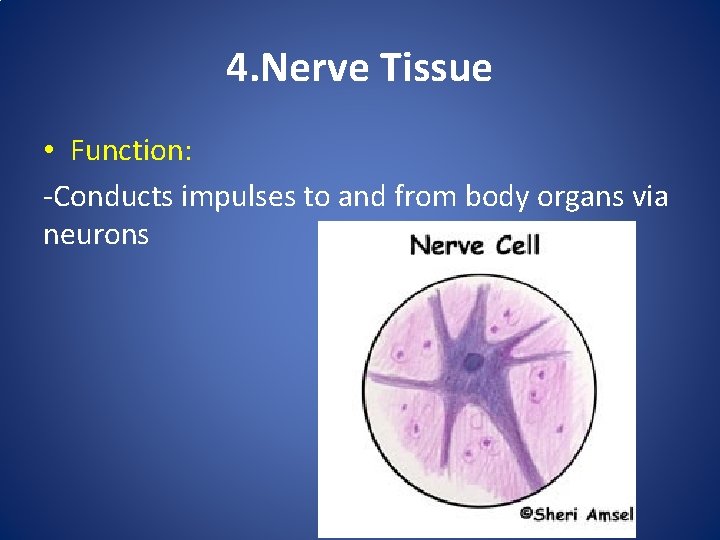
4. Nerve Tissue • Function: -Conducts impulses to and from body organs via neurons
4. NERVE TISSUE • Found in brain , spinal cord, nerves • A. NEURONS- transmit signals • B. NEUROGLIA- protection, support ( supporting structures)