
Tissue sensing by structured illumination in optical diffuse
Tissue sensing by structured illumination in optical diffuse reflectometry D. A. Loginova 1, 2, V. I. Plekhanov 1, I. I. Fiks 1, A. V. Gorshkov 1, 2, E. A. Sergeeva 1 and M. Yu. Kirillin 1 1 Institute of Applied Physics RAS, Nizhny Novgorod, Russia 2 Lobachevsky State University of Nizhny Novgorod, Russia
Introduction Optical diffuse reflectometry (ODR) is a non-invasive method for diagnosing turbid medium based on registration of backward diffuse scattering signal followed by processing to retrieve optical parameters of the studied object. ODR is applied for retrieving biotussue structural composition that may find biomedical application. Employment of spatially modulated illumination patterns is a novel modification of ODR technique. ODR resolution and probing depth depend on the light source configuration. In particular, when employing periodic patterns, probing depth depends on the spatial frequency of the pattern employed[1]. ODR technique allows to retrieve extinction coefficient only, however, spatially modulated illumination helps to determine both absorption and scattering characteristics independently. In this work the comparative analysis of various probing patterns in ODR with spatially modulated illumination was studied and a prototype of an ODR system for probing with the structured illumination was designed. [1]O'Sullivan T. D. , Cerussi A. E. , Cuccia D. J. , Tromberg B. J. J. Biomed. Opt, 17(7), 071311 (2012)
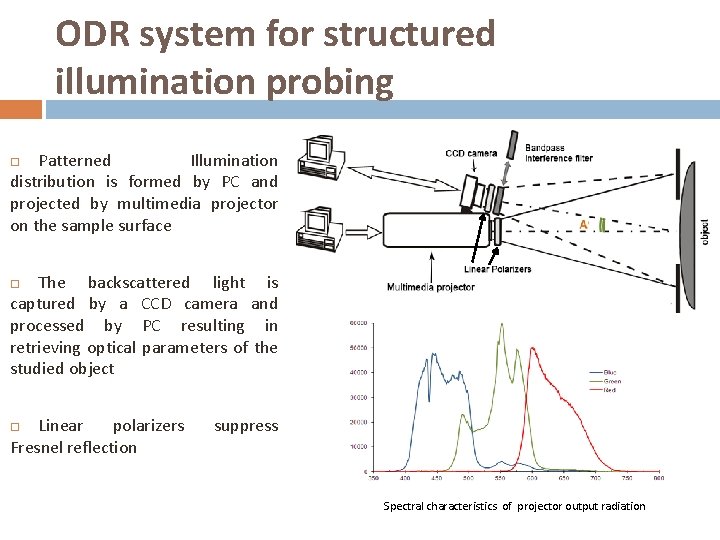
ODR system for structured illumination probing Patterned Illumination distribution is formed by PC and projected by multimedia projector on the sample surface The backscattered light is captured by a CCD camera and processed by PC resulting in retrieving optical parameters of the studied object Linear polarizers Fresnel reflection suppress Spectral characteristics of projector output radiation
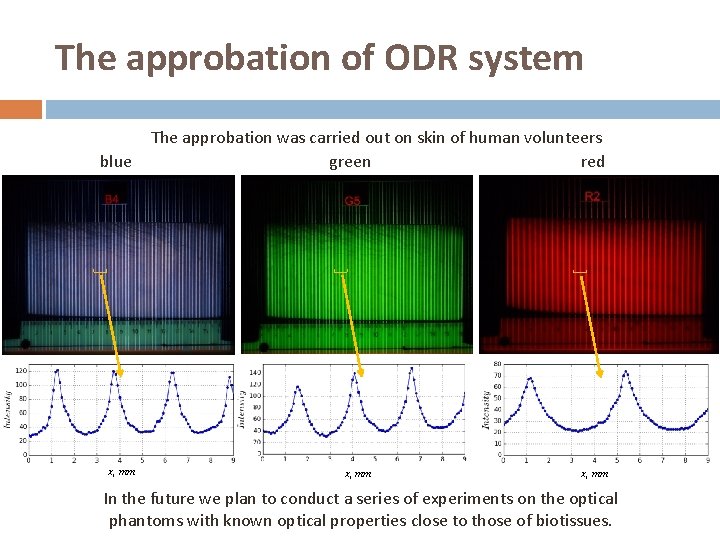
The approbation of ODR system blue x, mm The approbation was carried out on skin of human volunteers green red x, mm In the future we plan to conduct a series of experiments on the optical phantoms with known optical properties close to those of biotissues.
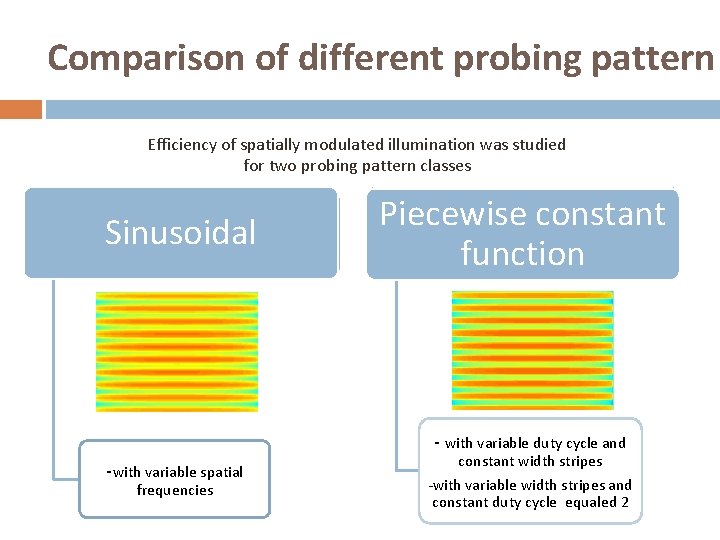
Comparison of different probing pattern Efficiency of spatially modulated illumination was studied for two probing pattern classes Sinusoidal Piecewise constant function - with variable duty cycle and -with variable spatial frequencies constant width stripes -with variable width stripes and constant duty cycle equaled 2
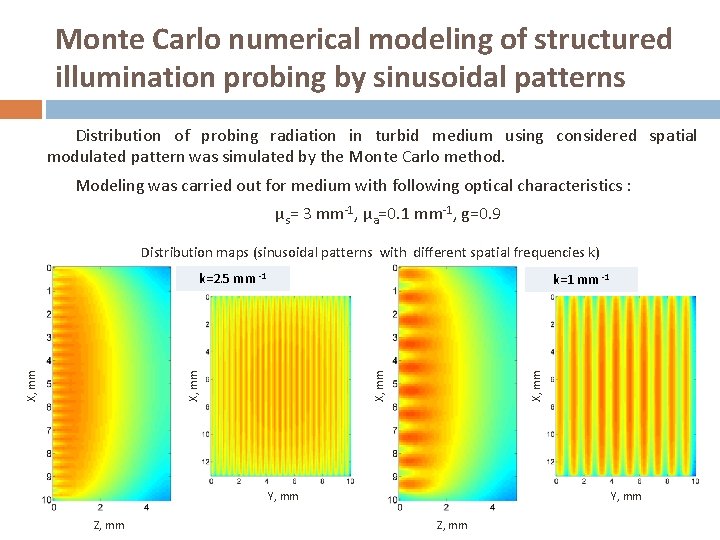
Monte Carlo numerical modeling of structured illumination probing by sinusoidal patterns Distribution of probing radiation in turbid medium using considered spatial modulated pattern was simulated by the Monte Carlo method. Modeling was carried out for medium with following optical characteristics : μs= 3 mm-1, μa=0. 1 mm-1, g=0. 9 Distribution maps (sinusoidal patterns with different spatial frequencies k) X, mm k=1 mm -1 X, mm k=2. 5 mm -1 Y, mm Z, mm
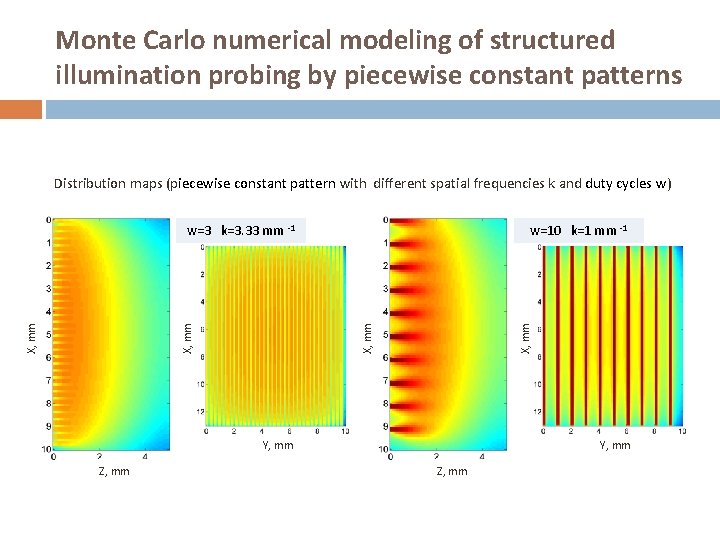
Monte Carlo numerical modeling of structured illumination probing by piecewise constant patterns Distribution maps (piecewise constant pattern with different spatial frequencies k and duty cycles w) X, mm w=10 k=1 mm -1 X, mm w=3 k=3. 33 mm -1 Y, mm Z, mm
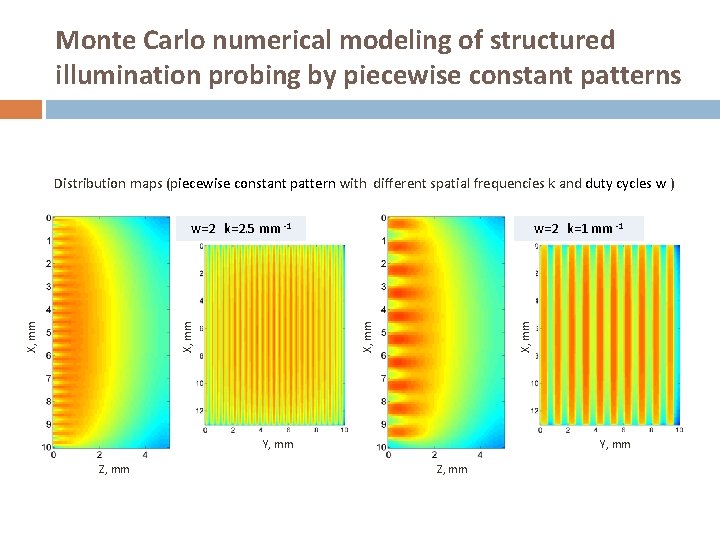
Monte Carlo numerical modeling of structured illumination probing by piecewise constant patterns Distribution maps (piecewise constant pattern with different spatial frequencies k and duty cycles w ) X, mm w=2 k=1 mm -1 X, mm w=2 k=2. 5 mm -1 Y, mm Z, mm
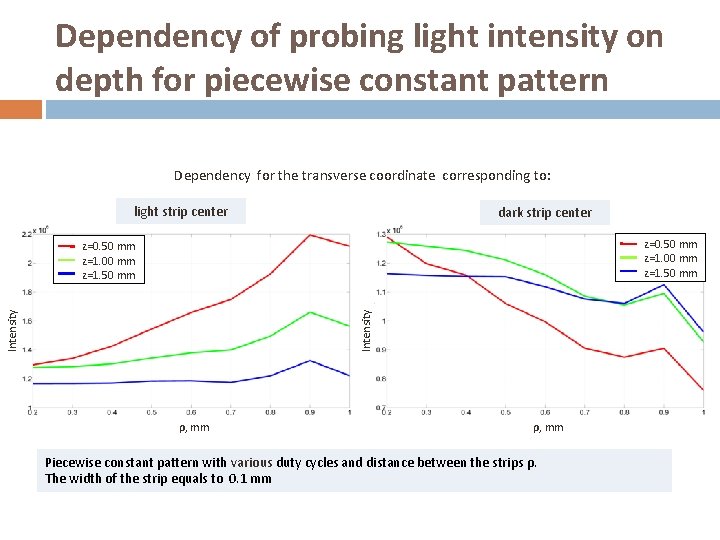
Dependency of probing light intensity on depth for piecewise constant pattern Dependency for the transverse coordinate corresponding to: light strip center dark strip center z=0. 50 mm z=1. 00 mm z=1. 50 mm Intensity z=0. 50 mm z=1. 00 mm z=1. 50 mm ρ, mm Piecewise constant pattern with various duty cycles and distance between the strips ρ. The width of the strip equals to 0. 1 mm
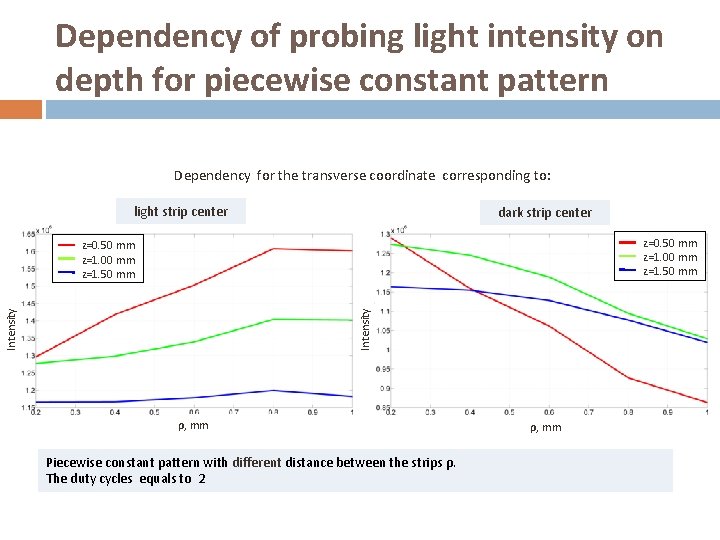
Dependency of probing light intensity on depth for piecewise constant pattern Dependency for the transverse coordinate corresponding to: light strip center dark strip center z=0. 50 mm z=1. 00 mm z=1. 50 mm Intensity z=0. 50 mm z=1. 00 mm z=1. 50 mm ρ, mm Piecewise constant pattern with different distance between the strips ρ. The duty cycles equals to 2 ρ, mm
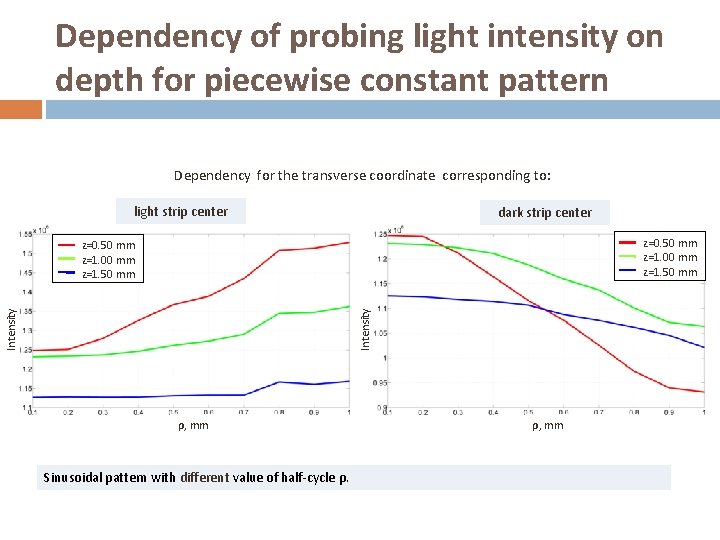
Dependency of probing light intensity on depth for piecewise constant pattern Dependency for the transverse coordinate corresponding to: light strip center dark strip center z=0. 50 mm z=1. 00 mm z=1. 50 mm Intensity z=0. 50 mm z=1. 00 mm z=1. 50 mm ρ, mm Sinusoidal pattern with different value of half-cycle ρ. ρ, mm
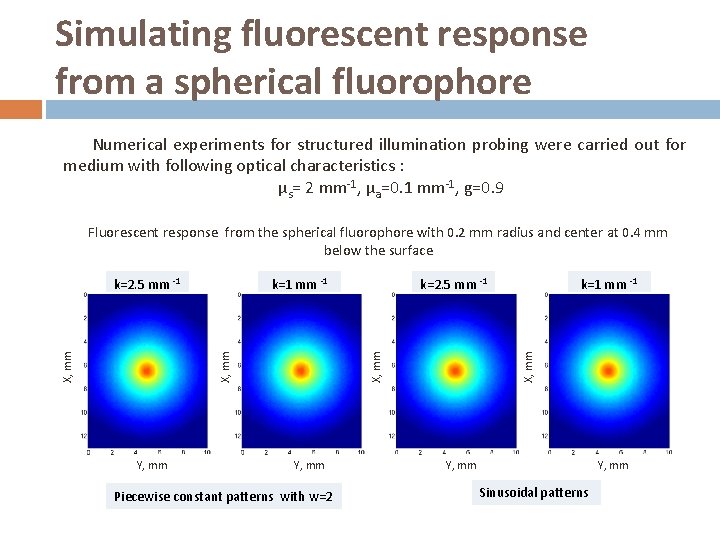
Simulating fluorescent response from a spherical fluorophore Numerical experiments for structured illumination probing were carried out for medium with following optical characteristics : μs= 2 mm-1, μa=0. 1 mm-1, g=0. 9 Fluorescent response from the spherical fluorophore with 0. 2 mm radius and center at 0. 4 mm below the surface Y, mm Piecewise constant patterns with w=2 k=1 mm -1 X, mm k=2. 5 mm -1 X, mm k=1 mm -1 X, mm k=2. 5 mm -1 Y, mm Sinusoidal patterns
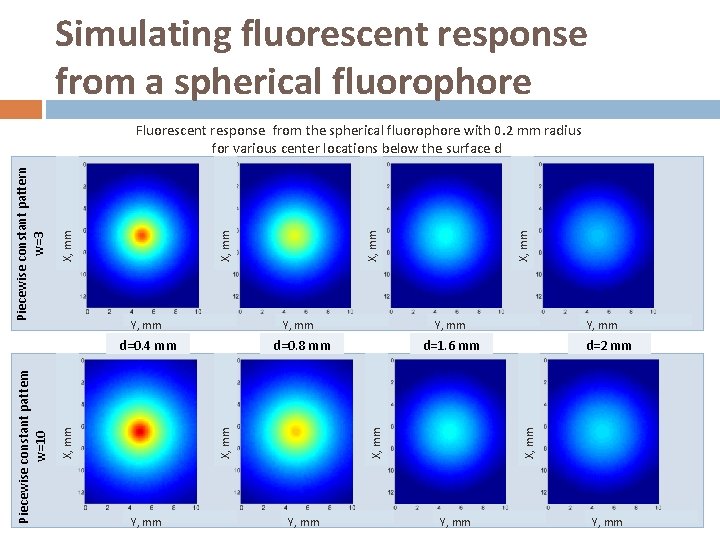
Simulating fluorescent response from a spherical fluorophore Y, mm X, mm Y, mm d=1. 6 mm X, mm d=0. 8 mm X, mm Piecewise constant pattern w=10 d=0. 4 mm Y, mm d=2 mm X, mm Y, mm X, mm Piecewise constant pattern w=3 Fluorescent response from the spherical fluorophore with 0. 2 mm radius for various center locations below the surface d Y, mm
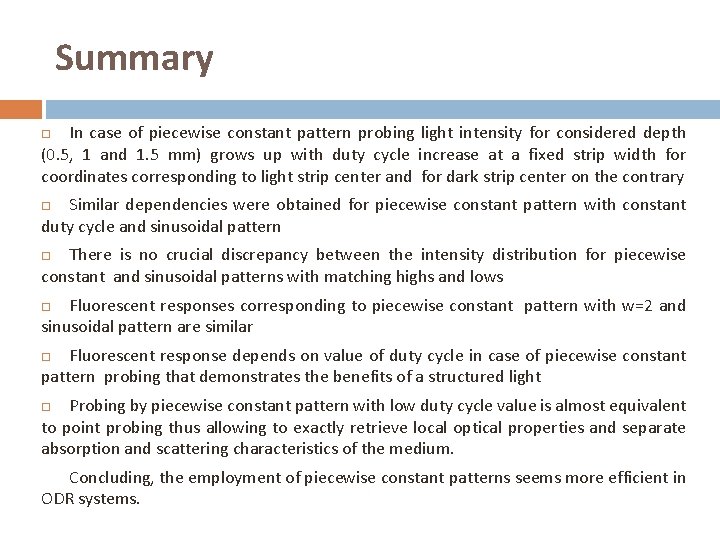
Summary In case of piecewise constant pattern probing light intensity for considered depth (0. 5, 1 and 1. 5 mm) grows up with duty cycle increase at a fixed strip width for coordinates corresponding to light strip center and for dark strip center on the contrary Similar dependencies were obtained for piecewise constant pattern with constant duty cycle and sinusoidal pattern There is no crucial discrepancy between the intensity distribution for piecewise constant and sinusoidal patterns with matching highs and lows Fluorescent responses corresponding to piecewise constant pattern with w=2 and sinusoidal pattern are similar Fluorescent response depends on value of duty cycle in case of piecewise constant pattern probing that demonstrates the benefits of a structured light Probing by piecewise constant pattern with low duty cycle value is almost equivalent to point probing thus allowing to exactly retrieve local optical properties and separate absorption and scattering characteristics of the medium. Concluding, the employment of piecewise constant patterns seems more efficient in ODR systems.

Acknowledgements The study is supported by Russian Foundation for Basic Research (grant No. 15 -02 -04270)
- Slides: 15