
Tissue Response to Injury Healing Process Three Phases
- Slides: 31
Tissue Response to Injury
Healing Process Three Phases Inflammatory response Fibroblastic repair Maturation remodeling phase
Inflammatory response Begins immediately after injury Signs of inflammation Redness (rubor) Swelling (Tumor) Tenderness (dolor) Increase in temperature (Calor) Loss of function (functio laesa)
Inflammation Response Very important to the healing process If does not accomplish what it is supposed to or does not subside healing cant take place First 48 hours after injury
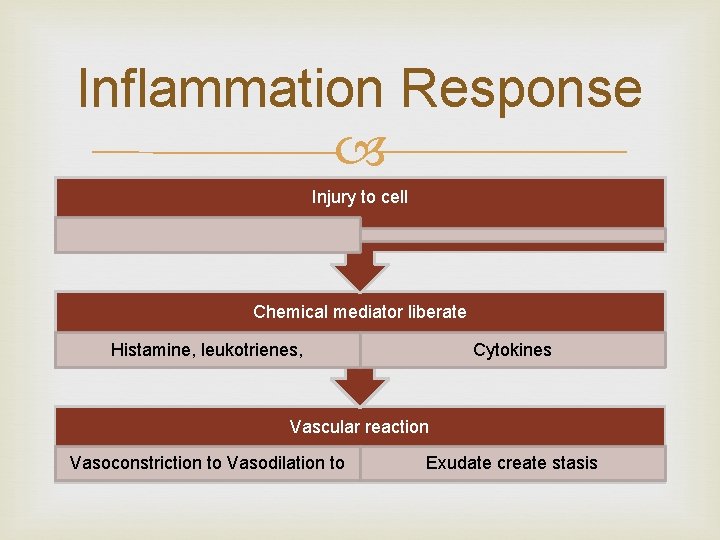
Inflammation response Chemical mediators Histamine- released from the injured mast causes vasodilation and increased cell permeability Leukotrienes and prostaglandins cause margination (leukocytes adhere to cell walls ) Also increase cell permeability and exudate (accumulation of fluid that penetrates through vessel walls into extravascular space)
Inflammation response Chemical Mediators continued Vasodilation and active hyperemia important brings neutrophils (leukocytes) As swelling increases vascular and lymphatic flow decreased
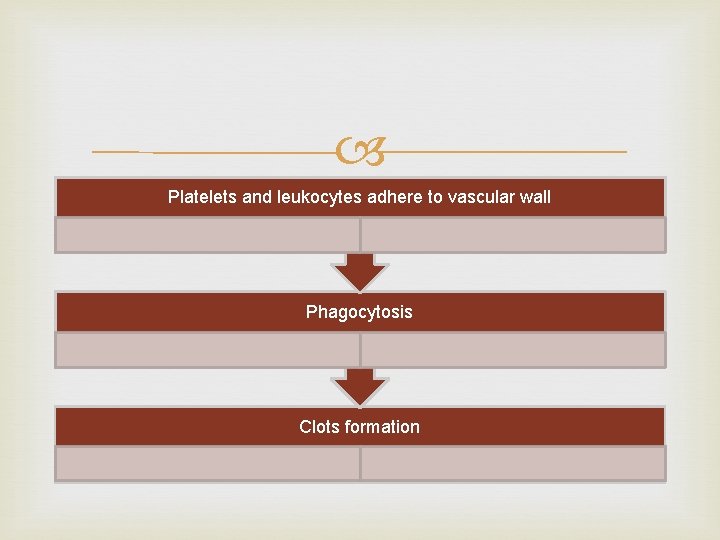
Inflammation response Vascular reaction- immediate response is vasoconstriction causing local anemia in the area. This increase causes leukocytes to slow down and adhere to the injured cells Function of platelets- platelets normally don’t adhere to vascular walls. However, injury exposes collagen and platelets adhere to collagen
Inflammation response Formation of clot- thromboplastin to prothrombin to fibrinogen to insoluble fibrin clot. Begins around 12 hours after injury complete within 48 hours
Chronic Inflammation Occurs when the inflammatory response does not respond sufficiently to eliminate the injuring agent and restore tissue to its normal physiological state This low grade inflammation causes tissue damage to connective tissue, prolonging healing and repair
Inflammation Response Injury to cell Chemical mediator liberate Histamine, leukotrienes, Cytokines Vascular reaction Vasoconstriction to Vasodilation to Exudate create stasis
Platelets and leukocytes adhere to vascular wall Phagocytosis Clots formation
Inflammation response http: //www. youtube. com/watch? v=Un 9 -vubdtm. Y
Inflammation Response Treatment during this phase is RICE.
Treatment during the inflamation phase RICE Rest Ice- 20 mins per hour Compression- Ace wrap Elevations- above the level of the heart
Repair phase Regenerative activity occurs during this stage Fibroplasia- period of scar formation. Begins a few days after injury any last 4 -6 weeks. Granulation tissue breaks down the fibrin clot. Collagen- a strong fibrous protein found in connective tissue
Repair phase The normal sequence of events in the repair phase leads to the formation of minimal scar tissue Occasionally persistent inflammatory response will cause fibroplasia and excessive fibrogensis that lead to irreversible tissue damage
Maturation Remodeling Phase Long term process Purpose of the phase is to realignment or remodeling of collagen fibers that make up scar tissue according to the tensile forces Ongoing breakdown and synthesis of collagen occur with a steady increase in tensile strength Increased stress and strain realign collagen for maximum efficiency Rarely as strong as the normal uninjured tissue
Maturation Remodeling Process Rarely as strong as the normal uninjuried tissue End of three weeks firm strong contracted nonvascular scar exist Complete maturation phase may require several years to be complete
Maturation Remodeling Process As the remodeling phase begins aggressive active range of motion and strengthening exercises should be incorporated Pain dictates the rate of progression If swelling increases need to decrease activity
Factors that impede Healing Extent of injury Edema Hemorrhage Poor vascular supply • Corticosteroids Separation of tissue Muscle spasm Atrophy • Humidity, Climate, oxygen tension • Health, Age and Nutrition • Infection • Hypertrophic scars
Soft tissue Healing Cartilage healing- poor lack of blood supply so no clot Ligament healing first 72 hours loss of blood from damaged vessels. during next 6 weeks new capillary growth begins Initially scar is soft and viscous Over next several months scar continues to mature. Take as long as 12 months Limit immobilization
Soft tissue healing Muscle Healing- Least 6 -8 weeks and considerable amount of patience Tendon Healing- 2 weeks adheres to surrounding tissue. 3 weeks tendon separates tensile strength is not sufficient to permit a strong pull on the tendon for 4 -5 weeks. Nerve healing- can not regenerate once the nerve cell dies. Peripheral nerves can heal be slow process
Soft tissue healing Antinflammatory drugs -NSAIDS- Nonstreroidal antiinflammatory drug Therapeutic Modalities- Ultrasound, electrical stimulation Exercise Rehabiliation
PAIN Cutaneous- sharp, bright and burning Deep somatic pain- pain in tendons, muscles, joints Visceral pain originates from internal organs Psychogenic pain- emotional causes
Pain Referred pain- occurs away for sight Myofascial pain- Trigger points Sclerotomic, Myotomic and dermatomical-
Pain Control Gate control theory- pain is blocked by gate preventing message from getting to the brain.
Pain Gate control theoryhttp: //www. youtube. com/watch? v=Zf. WO 2 wci. IUY
Descending pathway pain control Previous experiences, emotional influences and sensory perception influence the transmission of pain message and thus the perception of pain
Release of B endorphins Stimulate the release of opiate like chemical called endorphin from the hypothalamus and anterior pituitary
Treating pain Therapeutic modalities, medications, massage, acupuncture