
TISSUE PERMANENT TISSUE Lectured by Kartick Chandra Characteristics
TISSUE PERMANENT TISSUE Lectured by Kartick Chandra
Characteristics of permanent tissue: Permanent tissues are derivatives of meristematic tissue. They are mature tissue and the cell have lost the capacity of cell division. Defination: The cells of this tissue have lost their power of division either temporarily or permanently are called permanent tissue.
CHARACTERS OF PERMANENT TISSUE: v Thick or thin walled v Living or dead v With large vacuoles v With well developed mitochondria, plastids, and other cell organells. v Intercellular spaces may be present.
Types of permanent tissue Simple permanent tissue Complex permanent tissue Secretory tissue

Simple permanent tissue is composed of single type of cells which have similar origin, structure and function. Types of simple permanent tissue I. Parenchyma II. Collenchyma III. Sclerenchyma
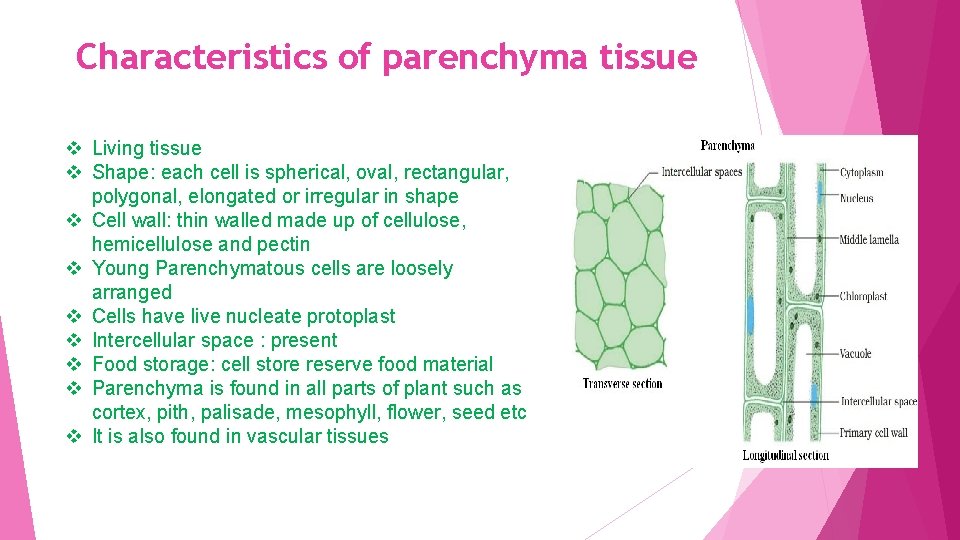
Characteristics of parenchyma tissue v Living tissue v Shape: each cell is spherical, oval, rectangular, polygonal, elongated or irregular in shape v Cell wall: thin walled made up of cellulose, hemicellulose and pectin v Young Parenchymatous cells are loosely arranged v Cells have live nucleate protoplast v Intercellular space : present v Food storage: cell store reserve food material v Parenchyma is found in all parts of plant such as cortex, pith, palisade, mesophyll, flower, seed etc v It is also found in vascular tissues
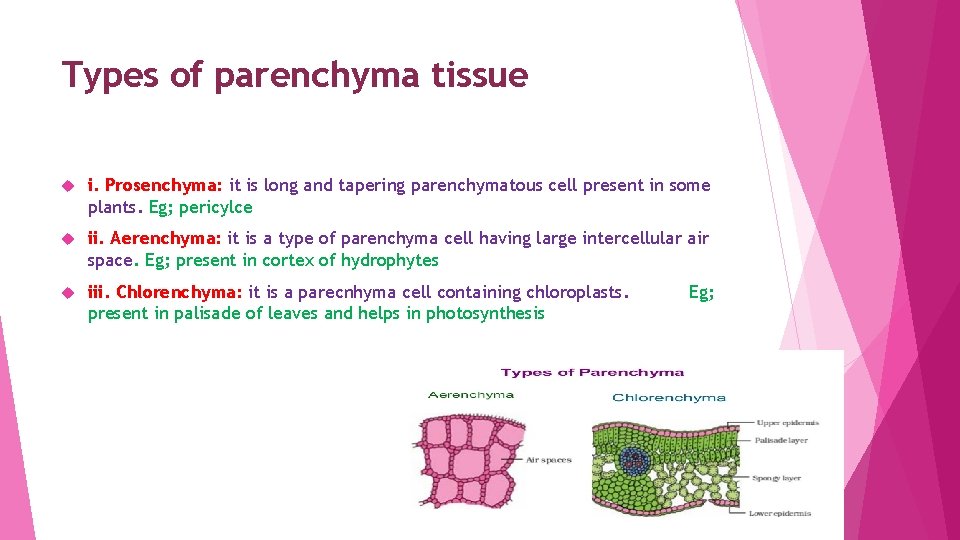
Types of parenchyma tissue i. Prosenchyma: it is long and tapering parenchymatous cell present in some plants. Eg; pericylce ii. Aerenchyma: it is a type of parenchyma cell having large intercellular air space. Eg; present in cortex of hydrophytes iii. Chlorenchyma: it is a parecnhyma cell containing chloroplasts. present in palisade of leaves and helps in photosynthesis Eg;
Function of parenchyma tissue: Photosynthesis: chlorenchyma contains chloroplast which helps in photosynthesis Storage: parenchyma cell stores food in the form of starch, proteins, oils and fats. Buoyancy: helps in floating of aquatic plants due to presence of aerenchyma tissue Secretion: Idioblastic cell secretes resins, latex, tannin, oils etc Transport: parenchyma of xylem and phloem helps in transport of nutrition and water. Mechanical support: Prosenchyma tissue provide mechanical support.

II. Collenchyma Characteristics of collenchyma tissue: Living tissue Shape: each cell is somewhat elongated Cell wall: thick walled due to deposition of hemicellulose and pectin in intercellular space Intercellular space: present or absent Present at the periphery of herbaceous stems, petioles ( Begonia sp. ) and in ribs of some leaves (Nerium sp. ), in the floral parts, fruits and aerial root; may be present just beneath the epidermis.

Types of collenchyma tissue: i. Angular collenchyma: thick cell wall at corner of cell; without intercellular space ii. Lacunar collenchyma: thick wall at boarder of cell; large intercellular space iii. Plate or lamellar collenchyma: thick wall at tangential wall; without intercellular space

Functions of collenchyma tissue Mechanical support: It is living mechanical tissue Photosynthesis: It contain chloroplast and carry out photosynthesis. Serve as storage site for defensive antibacterial compounds.
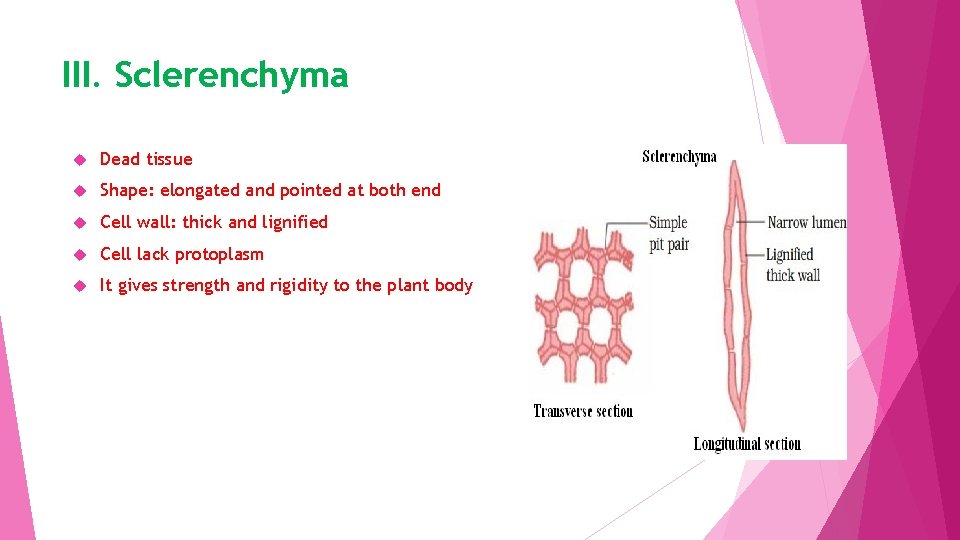
III. Sclerenchyma Dead tissue Shape: elongated and pointed at both end Cell wall: thick and lignified Cell lack protoplasm It gives strength and rigidity to the plant body
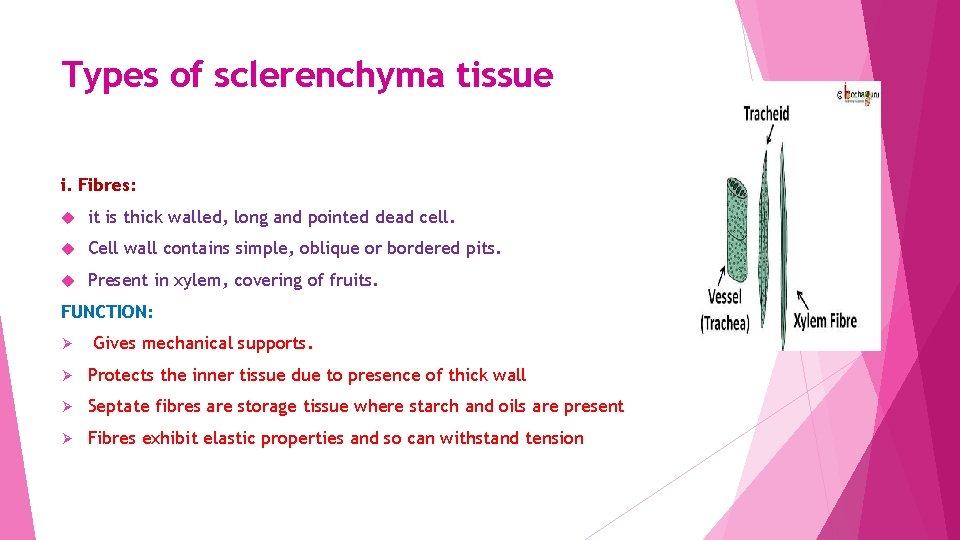
Types of sclerenchyma tissue i. Fibres: it is thick walled, long and pointed dead cell. Cell wall contains simple, oblique or bordered pits. Present in xylem, covering of fruits. FUNCTION: Ø Gives mechanical supports. Ø Protects the inner tissue due to presence of thick wall Ø Septate fibres are storage tissue where starch and oils are present Ø Fibres exhibit elastic properties and so can withstand tension
ii. Sclereids (stone cell): extremely thick walled cell with spherical, oval or dumbbell shape. Cell wall contains simple pits Present in hard part of plants, pulp of fruits Provide local mechanical supports

Function of sclerenchyma tissue Mechanical support: sclerenchyma is made up of dead and lignified cells which provides support to plants. Provides hardness to stony fruits such as nuts, coconut, almond etc
2. Complex permanent tissue is composed of two or more than two types of cells and contribute to a common function. It is also known as vascular tissue
Types of complex tissue: I. Xylem II. Phloem
I. Xylem The function of xylem is to transport water and minerals from the root to the leaves of plants. It also provides support to plants. Xylem is also known as wood Xylem is composed of four types of cells-Tracheids, Vessels, Xylem fibres and Xylem parenchyma.
i. Trachieds: Trachieds are elongated cell with tapering end They are dead cells with lignified cell wall Function: conduction of water and minerals from root to leaves and also provide mechanical support Types: annular, spiral, reticular, sclariform and pitted
ii. Vessels: Vessels are long, cylindrical, tube like dead cells Vessels are main element of xylem for conduction
iii. Xylem fibres: They are sclerenchymatous cell They are dead cells They provide mechanical support
iv. Xylem Parenchyma: They are parenchymatous cell They are living cells Function: storage of food in the form of starch or fat
II. Pholem Phloem is responsible for the conduction or transport of organic food synthesized by the s to different part of plant body. Phloem is also known as bast. Phloem is composed of four types of cells-Sieve tubes, Companion cells, Phloem parenchyma and Bast fibres
i. Sieve tubes They are tube like structure composed of elongated cell arranged by end to end Sieve element or cell lack nucleus Function: transport of organic food from leaves to different parts
ii. Companion cells: They are thin walled, elongated living cells. Each cell contains large nucleus Companion cell are present only in angiosperm Function: support sieve cell in conduction of food.
iii. Phloem parenchyma: They are living parenchymatous cells Function: storage of food in the form of starch or fat. It also store tannin and resins
iv. Bast fibres: They are sclerenchymatous cell. They are dead cells. Function: mechanical supports
3. Secretory tissues are specialized tissue having secretory functions They secretes various types of chemicals.
Types of secretory tissue I. Lactiferous tissues: It is thin walled tubes like tissue which produce latex (milky juice). They are parenchymatous cells Some plants having these tissue are Ficus (Bar, Peepal), Euphorbia (Lalupate), Rubber plant, Papaya, etc.
II. Glandular tissue: This tissue forms glandular structure which secrete or excrete chemical substances. These glands are present on the epidermis Some plant having glandular tissue are Betel plant (mucilage), lemon , orange (oil), Sundew, Venus fly, Pitcher plant etc

- Slides: 31