
Tissue Fluid small artery small vein cells arteriole
- Slides: 10
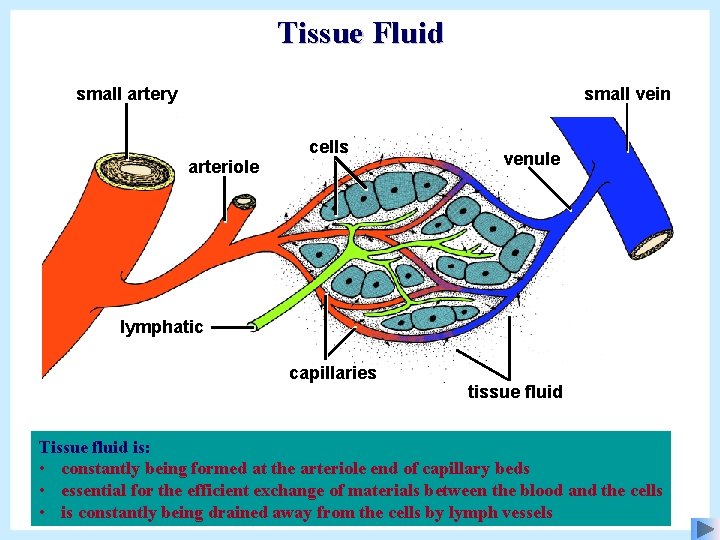
Tissue Fluid small artery small vein cells arteriole venule lymphatic capillaries tissue fluid Tissue fluid is: • constantly being formed at the arteriole end of capillary beds • essential for the efficient exchange of materials between the blood and the cells • is constantly being drained away from the cells by lymph vessels
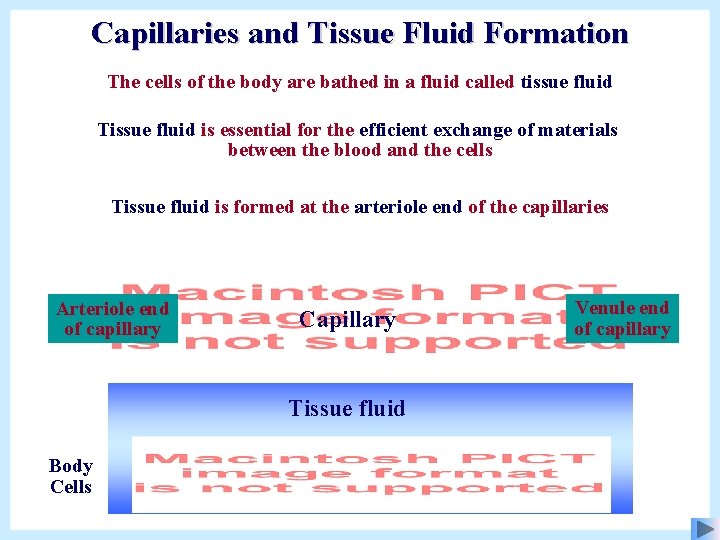
Capillaries and Tissue Fluid Formation The cells of the body are bathed in a fluid called tissue fluid Tissue fluid is essential for the efficient exchange of materials between the blood and the cells Tissue fluid is formed at the arteriole end of the capillaries Arteriole end of capillary Capillary Tissue fluid Body Cells Venule end of capillary
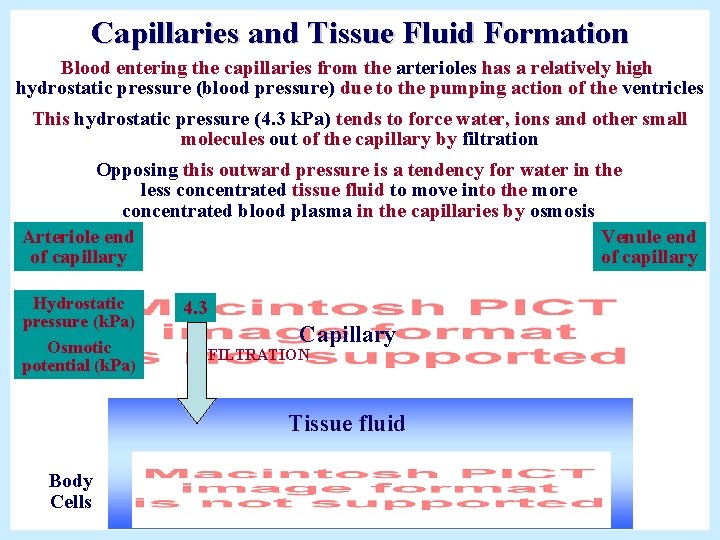
Capillaries and Tissue Fluid Formation Blood entering the capillaries from the arterioles has a relatively high hydrostatic pressure (blood pressure) due to the pumping action of the ventricles This hydrostatic pressure (4. 3 k. Pa) tends to force water, ions and other small molecules out of the capillary by filtration Opposing this outward pressure is a tendency for water in the less concentrated tissue fluid to move into the more concentrated blood plasma in the capillaries by osmosis Arteriole end Venule end of capillary Hydrostatic pressure (k. Pa) Osmotic potential (k. Pa) 4. 3 Capillary FILTRATION Tissue fluid Body Cells
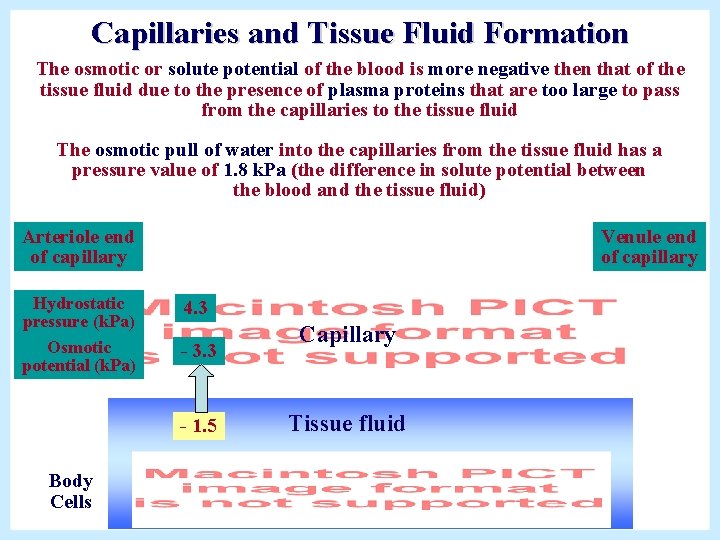
Capillaries and Tissue Fluid Formation The osmotic or solute potential of the blood is more negative then that of the tissue fluid due to the presence of plasma proteins that are too large to pass from the capillaries to the tissue fluid The osmotic pull of water into the capillaries from the tissue fluid has a pressure value of 1. 8 k. Pa (the difference in solute potential between the blood and the tissue fluid) Arteriole end of capillary Hydrostatic pressure (k. Pa) Osmotic potential (k. Pa) Venule end of capillary 4. 3 - 3. 3 - 1. 5 Body Cells Capillary Tissue fluid
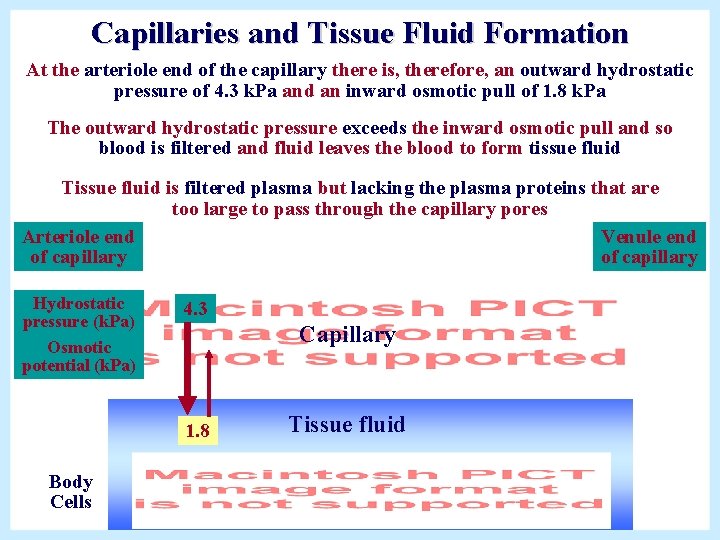
Capillaries and Tissue Fluid Formation At the arteriole end of the capillary there is, therefore, an outward hydrostatic pressure of 4. 3 k. Pa and an inward osmotic pull of 1. 8 k. Pa The outward hydrostatic pressure exceeds the inward osmotic pull and so blood is filtered and fluid leaves the blood to form tissue fluid Tissue fluid is filtered plasma but lacking the plasma proteins that are too large to pass through the capillary pores Arteriole end Venule end of capillary Hydrostatic pressure (k. Pa) Osmotic potential (k. Pa) 4. 3 Capillary 1. 8 Body Cells Tissue fluid
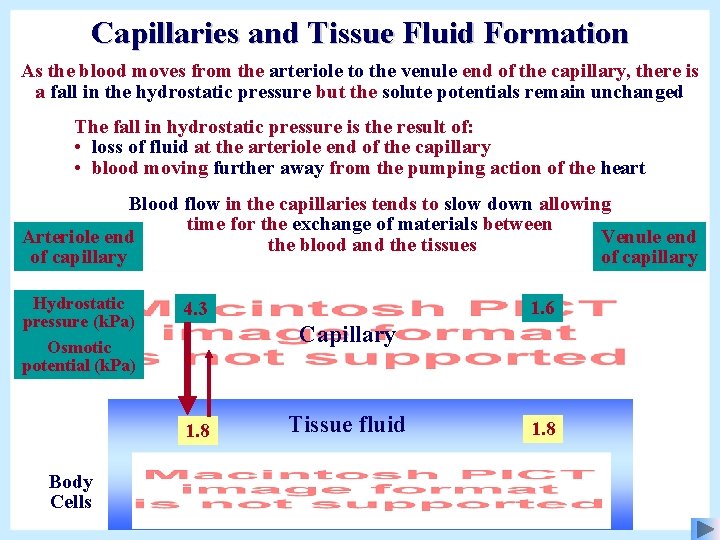
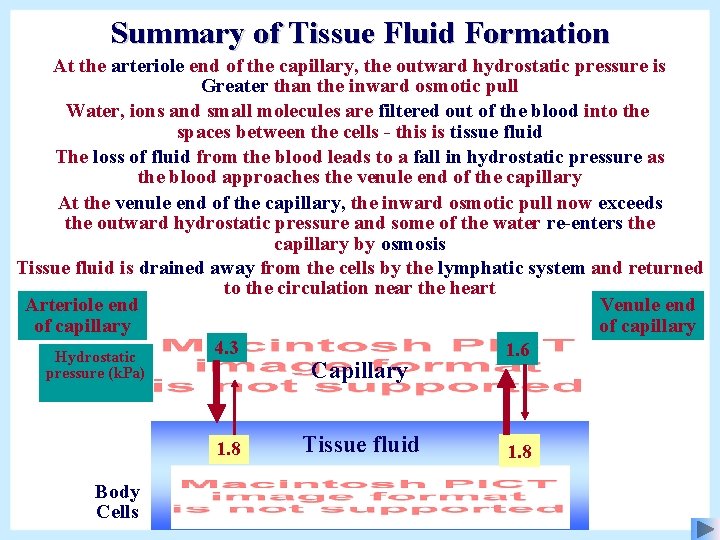
Capillaries and Tissue Fluid Formation As the blood moves from the arteriole to the venule end of the capillary, there is a fall in the hydrostatic pressure but the solute potentials remain unchanged The fall in hydrostatic pressure is the result of: • loss of fluid at the arteriole end of the capillary • blood moving further away from the pumping action of the heart Blood flow in the capillaries tends to slow down allowing time for the exchange of materials between Arteriole end Venule end the blood and the tissues of capillary Hydrostatic pressure (k. Pa) Osmotic potential (k. Pa) Capillary 1. 8 Body Cells 1. 6 4. 3 Tissue fluid 1. 8
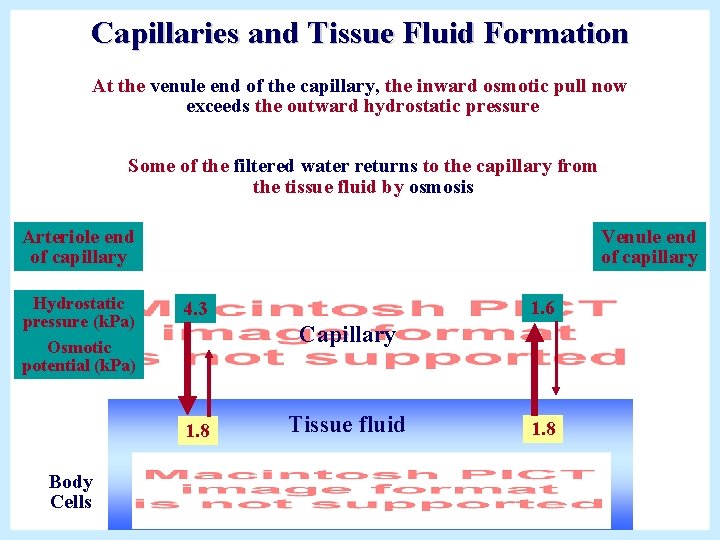
Capillaries and Tissue Fluid Formation At the venule end of the capillary, the inward osmotic pull now exceeds the outward hydrostatic pressure Some of the filtered water returns to the capillary from the tissue fluid by osmosis Arteriole end of capillary Hydrostatic pressure (k. Pa) Osmotic potential (k. Pa) Venule end of capillary Capillary 1. 8 Body Cells 1. 6 4. 3 Tissue fluid 1. 8
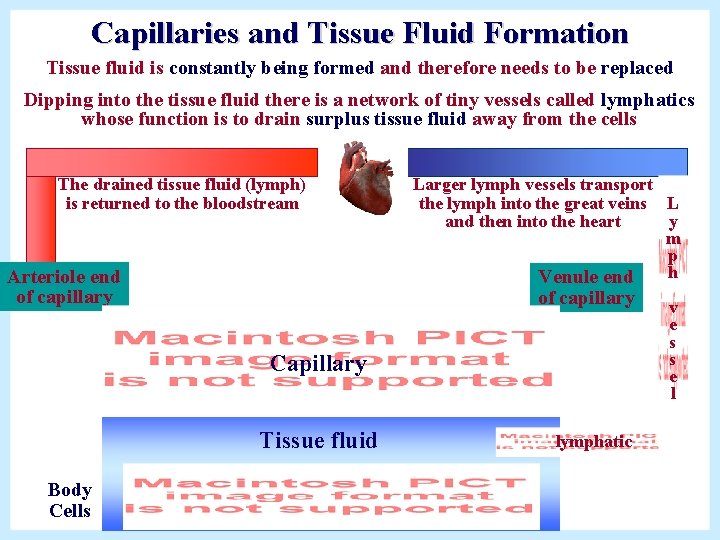
Capillaries and Tissue Fluid Formation Tissue fluid is constantly being formed and therefore needs to be replaced Dipping into the tissue fluid there is a network of tiny vessels called lymphatics whose function is to drain surplus tissue fluid away from the cells Larger lymph vessels transport the lymph into the great veins L y and then into the heart m p h Venule end Arteriole end of capillary Capillary Tissue fluid Body Cells lymphatic v e s s e l
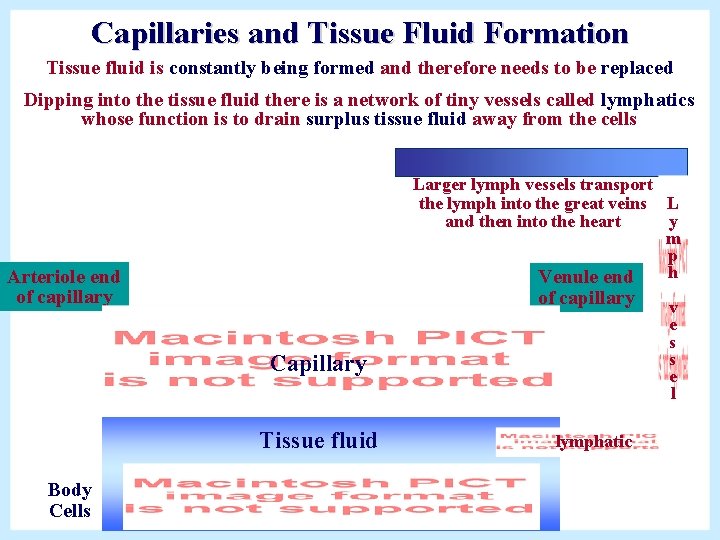
Capillaries and Tissue Fluid Formation Tissue fluid is constantly being formed and therefore needs to be replaced Dipping into the tissue fluid there is a network of tiny vessels called lymphatics whose function is to drain surplus tissue fluid away from the cells The drained tissue fluid (lymph) is returned to the bloodstream Arteriole end of capillary Larger lymph vessels transport the lymph into the great veins L y and then into the heart m p h Venule end of capillary Capillary Tissue fluid Body Cells lymphatic v e s s e l
Summary of Tissue Fluid Formation At the arteriole end of the capillary, the outward hydrostatic pressure is Greater than the inward osmotic pull Water, ions and small molecules are filtered out of the blood into the spaces between the cells - this is tissue fluid The loss of fluid from the blood leads to a fall in hydrostatic pressure as the blood approaches the venule end of the capillary At the venule end of the capillary, the inward osmotic pull now exceeds the outward hydrostatic pressure and some of the water re-enters the capillary by osmosis Tissue fluid is drained away from the cells by the lymphatic system and returned to the circulation near the heart Arteriole end Venule end of capillary 4. 3 1. 6 Hydrostatic Capillary pressure (k. Pa) 1. 8 Body Cells Tissue fluid 1. 8