
Tirgul 7 Review of graphs Graph algorithms BFS
Tirgul 7 • Review of graphs • Graph algorithms: – BFS (next tirgul) – DFS – Properties of DFS – Topological sort
Graph – a definition: • A directed graph, G, is a couple (V, E) such that V is a finite set and E is a subset of V V. The set V is denoted as the vertex set of G and the set E is denoted as the edge set of G. Note that a directed graph may contain self loops (an edge from a vertex to itself). • In an undirected graph, the edges in E are not ordered, in the sense of that an edge is a set {u, v} instead of an ordered couple (u, v).
Some important graph definitions: • Sub-graph: Let G(V, E) be a graph. We say that G’(E’, V’) is a sub-graph of G if V’ V and E’ E V’ V’ • Path: Let u, v be vertices in the graph. A path of length k between u and v is a sequence of vertices, v 0, …, vk, such that v 0=v, vk=u, and for each i {0. . k-1}, (vi, vi+1) E. We say that vi is the predecessor vi+1 on the path • If there is a path from v to u we say that v is an ancestor of u and u is a descendant of v. • Cycle: In a directed graph, a cycle is a path v 0, . . , vk, such that v 0=vk. If the vertices v 1, …, vk are also pair wise disjoint, the cycle is called simple. • In an undirected graph, a (simple) cycle is a path v 0, …, vk such that v 0=vk, k 3 and v 1, …, vk are pair wise disjoint.
more important definitions… • Connected graph: An undirected graph G is said to be connected if for each two vertices u, v in the graph, there is a path between u and v. • Strongly Connected graph: A directed graph G is said to be strongly connected if for each two vertices u, v in the graph, there is a path between u and v. • Tree: A tree is an undirected, connected, a-cyclic graph. • Rooted Tree: A directed graph G is called a rooted tree if there exists s V s. t. for each v V, there is exactly one path between s and v. • Forest: A forest (rooted forest) is a set of disjoint trees (rooted trees).
Graph representations: adjacency lists • One natural way to represent graphs is to use adjacency lists. • For each vertex v there is a linked list of his neighbors. • This representation is good for sparse graphs, since we use only |V| lists and in a sparse graph, each list is short (overall representation size is V+E).
Graph representations: adjacency matrix • Another way to represent a graph in the computer is to use an adjacency matrix. This is a matrix of size |V|, we will denote it by T. The vertices are enumerated, v 1, …, v|V|. Now, Ti, j=1 there is an edge between the vertices vi and vj (vi, vj) E. • If the graph is undirected: Ti, j=1 Tj, i=1 * what is the meaning of T 2, T 3, etc. ? ? ?
Review of graphs • Graphs are a very useful tool in Computer Science. Many problems can be reduced to problems on graphs, and there exists many efficient algorithms that solves graph problems. • Today we will examine a few of these algorithms. • We will focus on the shortest path problem (unweighted graphs) which is a basic routine in many graph related algorithm. We can define: – Shortest path between s and t. – Single source shortest path (shortest path between s and {V}). – All pairs shortest path.
Breadth First Search (BFS) • The Breadth First Search (BFS) is one of the simplest and most useful graph algorithms. • The algorithm systematically explores the edges of G to find all vertices that are reachable from s and computes distances to those vertices. • It also produces a “breadth first tree”, with s being the root. • It is called breadth first search since it expands the frontier between visited and non visited vertices uniformly across the breadth of the frontier.
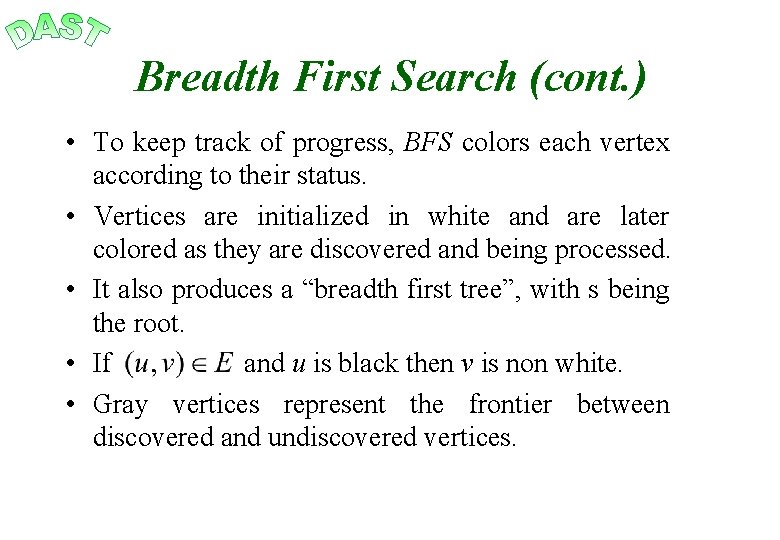
Breadth First Search (cont. ) • To keep track of progress, BFS colors each vertex according to their status. • Vertices are initialized in white and are later colored as they are discovered and being processed. • It also produces a “breadth first tree”, with s being the root. • If and u is black then v is non white. • Gray vertices represent the frontier between discovered and undiscovered vertices.
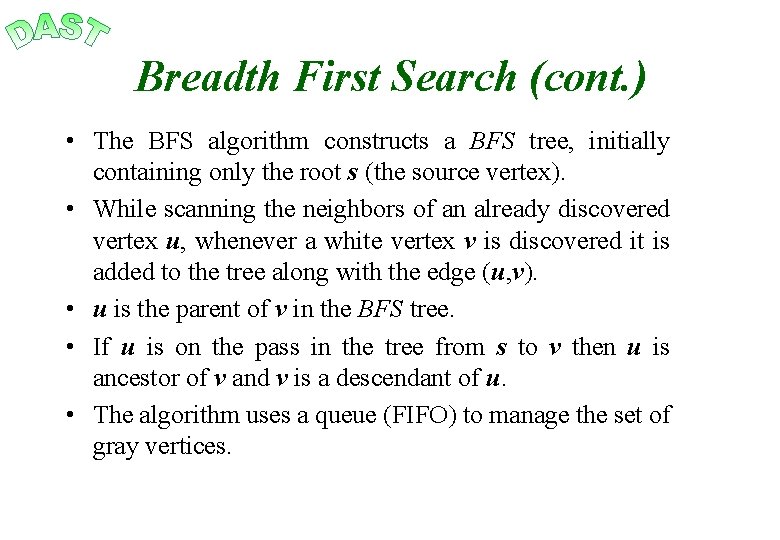
Breadth First Search (cont. ) • The BFS algorithm constructs a BFS tree, initially containing only the root s (the source vertex). • While scanning the neighbors of an already discovered vertex u, whenever a white vertex v is discovered it is added to the tree along with the edge (u, v). • u is the parent of v in the BFS tree. • If u is on the pass in the tree from s to v then u is ancestor of v and v is a descendant of u. • The algorithm uses a queue (FIFO) to manage the set of gray vertices.
![BFS – pseudo code BFS(G, s) //initializing. for each vertex u V[G]{s} { color[u]](http://slidetodoc.com/presentation_image_h2/430c8e46797808f19eb8025915186b08/image-11.jpg "BFS – pseudo code BFS(G, s) //initializing. for each vertex u V[G]{s} { color[u]")
BFS – pseudo code BFS(G, s) //initializing. for each vertex u V[G]{s} { color[u] = white; dist[u] = ∞; parent[u] = NULL; } color[s] = GRAY; dist[s] = 0; parent[s] = NULL; Q <- {s};
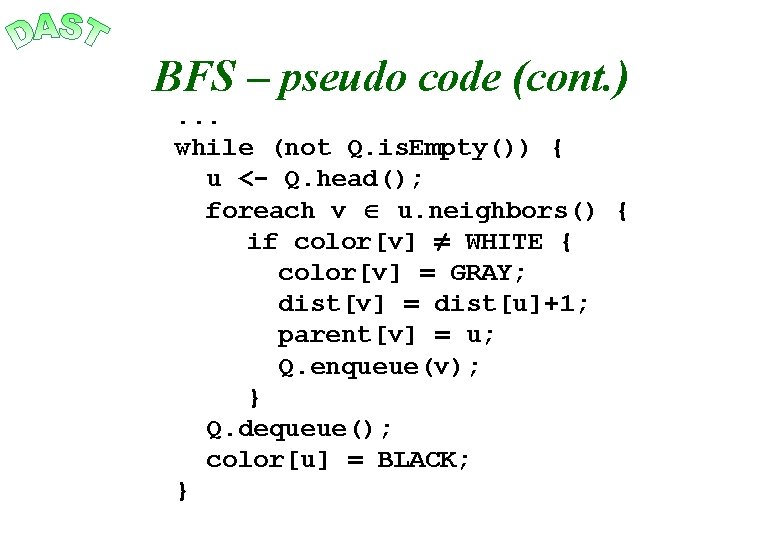
BFS – pseudo code (cont. ). . . while (not Q. is. Empty()) { u <- Q. head(); foreach v u. neighbors() { if color[v] ≠ WHITE { color[v] = GRAY; dist[v] = dist[u]+1; parent[v] = u; Q. enqueue(v); } Q. dequeue(); color[u] = BLACK; }
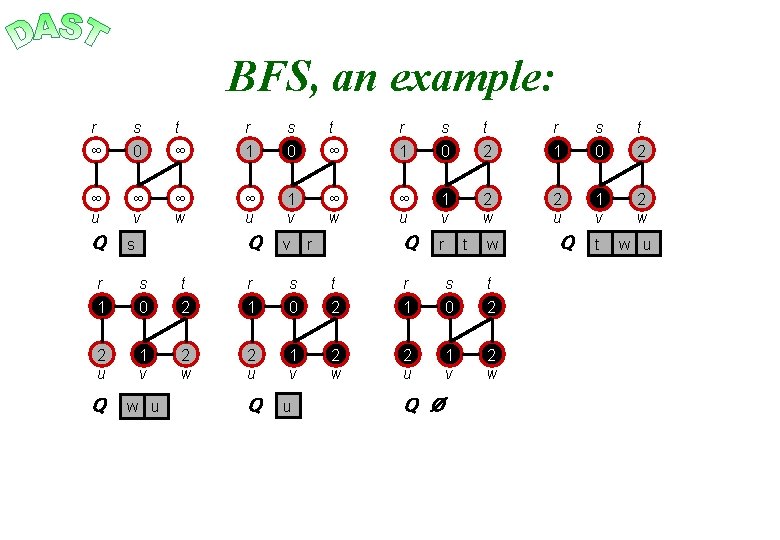
BFS, an example: r s t ∞ 0 ∞ 1 0 2 ∞ u ∞ v ∞ w ∞ u 1 v 2 w 2 u 1 v 2 w Q v Q r t w u Q s r t w r 1 s 0 t 2 2 u 1 v 2 w Q w u Q Ø Q
BFS, properties: • What can we say about time complexity? • Why does it works? (intuition): – We can think as if we have a set of nodes S and for all the nodes in S, the distance is correct (S begins with just s). – At step t, S contains the t closest nodes to s. – At each step, the algorithm adds to S the next closest node to s by finding the closest node to s in S that has neighbors out of S and adding these neighbors to S (greedy algorithm). – The proof of correctness uses the fact that we have already discovered closer nodes and assigned them the correct distance when we discover a new node that is a neighbor of one of them.
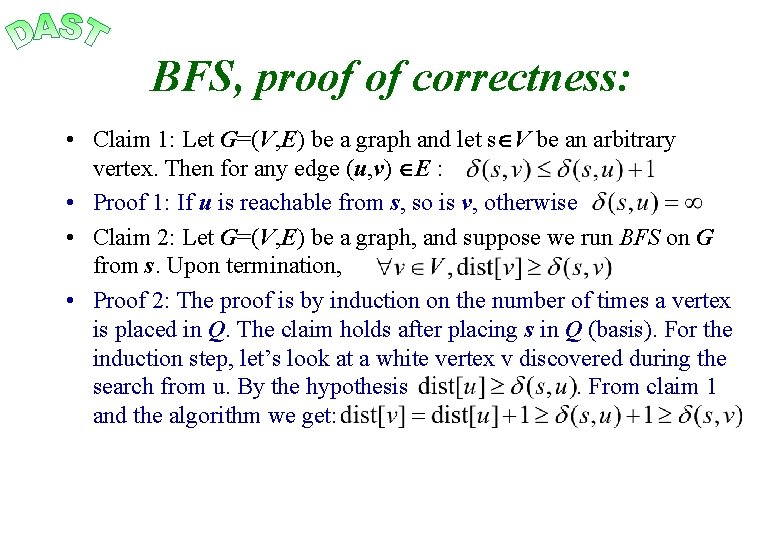
BFS, proof of correctness: • Claim 1: Let G=(V, E) be a graph and let s V be an arbitrary vertex. Then for any edge (u, v) E : • Proof 1: If u is reachable from s, so is v, otherwise • Claim 2: Let G=(V, E) be a graph, and suppose we run BFS on G from s. Upon termination, • Proof 2: The proof is by induction on the number of times a vertex is placed in Q. The claim holds after placing s in Q (basis). For the induction step, let’s look at a white vertex v discovered during the search from u. By the hypothesis. From claim 1 and the algorithm we get:
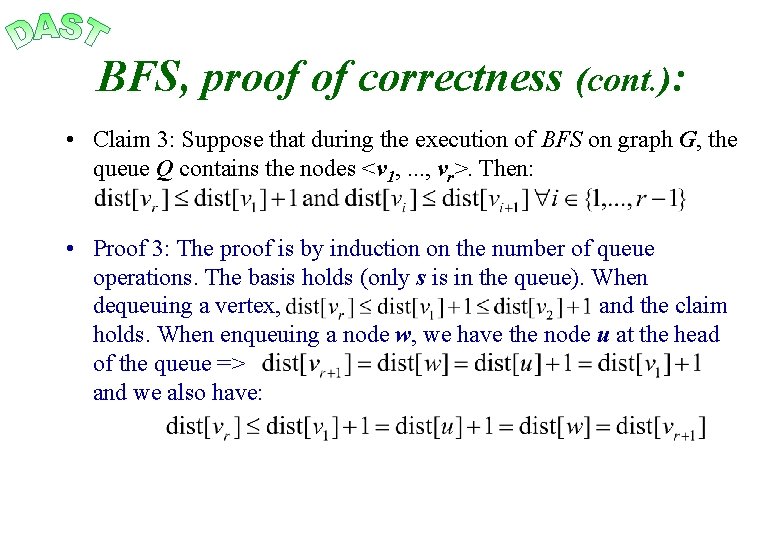
BFS, proof of correctness (cont. ): • Claim 3: Suppose that during the execution of BFS on graph G, the queue Q contains the nodes <v 1, . . . , vr>. Then: • Proof 3: The proof is by induction on the number of queue operations. The basis holds (only s is in the queue). When dequeuing a vertex, and the claim holds. When enqueuing a node w, we have the node u at the head of the queue => and we also have:
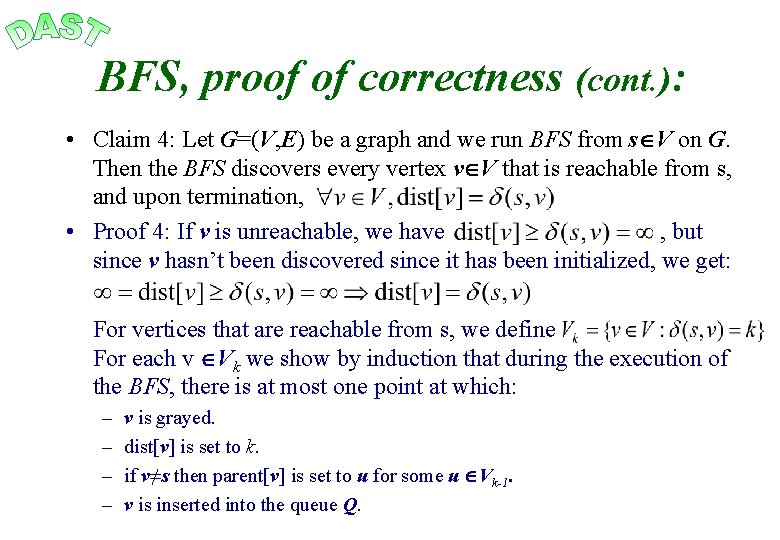
BFS, proof of correctness (cont. ): • Claim 4: Let G=(V, E) be a graph and we run BFS from s V on G. Then the BFS discovers every vertex v V that is reachable from s, and upon termination, • Proof 4: If v is unreachable, we have , but since v hasn’t been discovered since it has been initialized, we get: For vertices that are reachable from s, we define For each v Vk we show by induction that during the execution of the BFS, there is at most one point at which: – – v is grayed. dist[v] is set to k. if v≠s then parent[v] is set to u for some u Vk-1. v is inserted into the queue Q.
BFS, proof of correctness (cont. ): • Proof 4 (cont. ): For k=0, the inductive hypothesis holds (basis). For the inductive step, we first note that Q is never empty during the algorithm execution and that once a vertex v is entered Q, dist[v] and parent[v] never changes. Let us consider an arbitrary vertex v Vk (k > 1). From claim 3 (monotonicity), claim 2 (dist[v] ≥k) and the inductive hypothesis we get that v must be discovered after all vertices in Vk-1 are enqueued (if discovered at all). Since , there is a path of length k from s to v => There is a vertex u Vk-1 such that (u, v) E. Let u be the first such vertex grayed. u will appear as the head of Q, at that time, its neighbors will be scanned and v will be discovered => d[v] = d[u]+1 = k and parent[v] = u.
- Slides: 18