
Tips for the Preparation of a Quality Doctoral

- Slides: 73
Tips for the Preparation of a Quality Doctoral Thesis By K. Mohankumar Director, School of Marine Sciences & Dean, Faculty of Environmental Studies Cochin University of Science and Technology National Workshop on Ensuring Quality in Scientific Research, on January 8, 2015
What is a Ph. D? § A Ph D is globally recognized postgraduate academic degree awarded by Universities and Higher Education Institutes to a candidate who has submitted a Thesis or Dissertation, based on extensive and original research work in their chosen field. A Ph. D. holder should have knowledge, skills, outlook, attitude and understanding to be capable of self-directed scientific work of a quality satisfactory to others in the field.
What Does a Ph. D Signify? Recognition, formulation & resolution of a problem Evaluation of significance of solution Clear written & oral presentation of results Self-directed (original) significant contribution to knowledge Strong sense of scientific integrity and professional standards
What is a Thesis? üA thesis is a written record of the work that has been undertaken by a candidate. üIt constitutes objective evidence of the author’s knowledge and capabilities in the field of interest and is therefore a fair means to gauge them. üAlthough thesis writing may be viewed as an unpleasant obligation on the road to a degree, the discipline it induces may have lifelong benefits
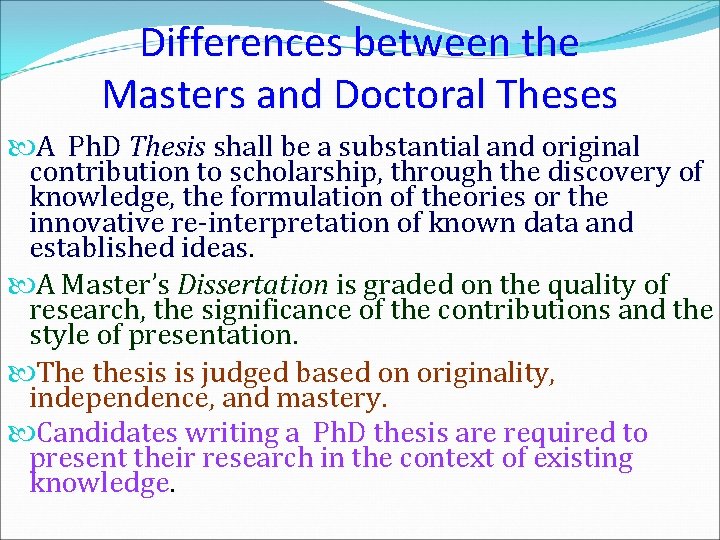
Differences between the Masters and Doctoral Theses A Ph. D Thesis shall be a substantial and original contribution to scholarship, through the discovery of knowledge, the formulation of theories or the innovative re-interpretation of known data and established ideas. A Master’s Dissertation is graded on the quality of research, the significance of the contributions and the style of presentation. The thesis is judged based on originality, independence, and mastery. Candidates writing a Ph. D thesis are required to present their research in the context of existing knowledge.
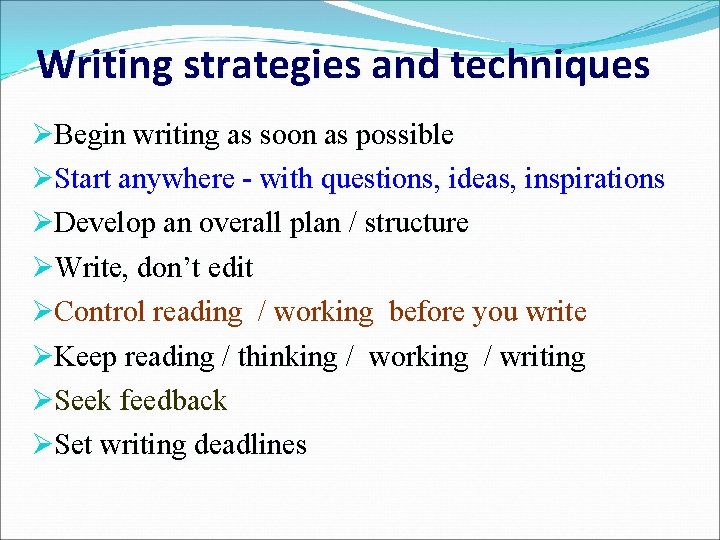
Writing strategies and techniques ØBegin writing as soon as possible ØStart anywhere - with questions, ideas, inspirations ØDevelop an overall plan / structure ØWrite, don’t edit ØControl reading / working before you write ØKeep reading / thinking / working / writing ØSeek feedback ØSet writing deadlines
Writing a Thesis General Advice For most Students, thesis is the longest manuscript they are going to write, so its very length is often the most overwhelming aspect of the task. Yet the task won't overcome you if you adhere to the following advice.
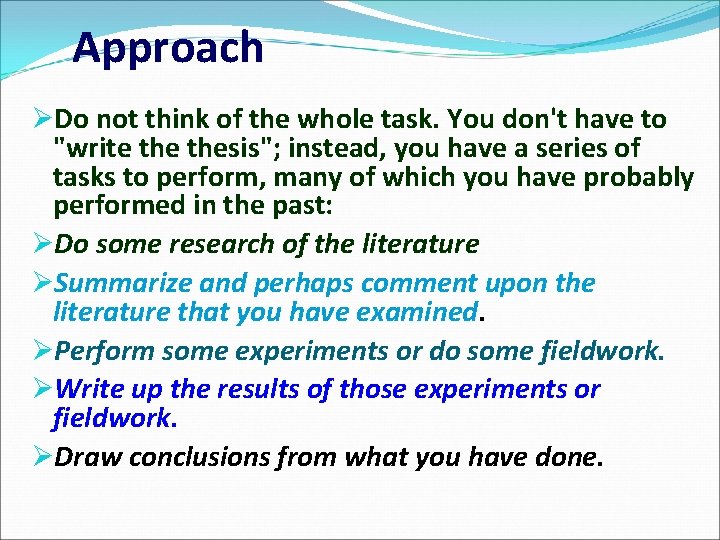
Approach ØDo not think of the whole task. You don't have to "write thesis"; instead, you have a series of tasks to perform, many of which you have probably performed in the past: ØDo some research of the literature ØSummarize and perhaps comment upon the literature that you have examined. ØPerform some experiments or do some fieldwork. ØWrite up the results of those experiments or fieldwork. ØDraw conclusions from what you have done.
Approach (contd. . ) v. See how your results and conclusions fit in with the literature and work in your field. v. Prepare into the format of a Research Article and submit into a suitable Journal for publication. v. Put all these pieces together into a coherent whole, following a format of the University or one that you will find in a Standard journal in your field. v. Edit your document carefully format, spelling, grammar, and mechanics. Seen from this perspective, writing a thesis is merely performing a series of tasks with which you are already familiar.
When to start writing thesis? One typical and costly mistake that thesis writers often make is trying to do all the other (more familiar) tasks first (e. g. , performing experiments, conducting the literature search) before they write a word. This is not a productive approach. Start writing now, even if it is only your random thoughts about what you'd like thesis to prove.
Try to write 15 minutes every day q. This writing may be the extensive notes mentioned above, a description to yourself of the experiment you performed today, or perhaps thoughts about the project as a whole. q. By writing every day you accomplish at least two things: first, you reduce anxiety about WRITING by proving to yourself that you can do it every day; q. Second, much of what you write will probably be, either directly or indirectly, the source of material for your thesis.
How to proceed? Search through the literature, and keep comprehensive notes. Write long notes to yourself about how you think your research will connect to the literature you've read. These notes will do two things: first, they may be a valuable source of information later on in the process; second, they get you writing. In short, any task that you are performing can be written about.
How Long Does it Take to Write a Thesis? Longer than you think. Even after the research itself is all done -- models built, calculations complete -- it is wise to allow at least one complete term for writing thesis. It's not the physical act of typing that takes so long, it's the fact that writing thesis requires the complete organization of your arguments and results. This is also probably the first time that your supervisor has seen the formal expression of concepts that may have been approved previously in an informal manner.
How the Ideas are conveyed to Words? ØStudents for whom English is not the mother tongue may have difficulty in getting ideas across, so that numerous revisions are required. ØAnd, truth be known, supervisors are sometimes not quick at reviewing and returning drafts. ØBottom line: leave yourself enough time. ØA rush job has painful consequences at the Open Defence.
Develop Self Confidence Don't forget that you have written several successful documents before (or you wouldn't be at the stage of writing a thesis). Regardless of what doubts you might have about your particular writing abilities, obviously the faculty have felt that your writing is satisfactory. Look again at earlier documents you've written to remind yourself of your successes.
One final note In deciding what goes where and what to include, you will have to make many judgment calls. There are no cut-and-dried formulas for making these decisions. You have to think carefully about the purpose of your thesis and who will be reading it. Ask your thesis Supervisor and/or other faculty members of the Department for advice on any such issues.
How to organise the Thesis Writing �Create a working timetable (work backwards from the due date) �A study area �Develop a regular work routine �Create an outline of thesis chapters (structure) �Construct a thesis template (formatting) CUSAT
Tips for Thesis Writing Write your thesis from the inside out. Begin with the chapters on your own experimental /analytical/modelling work. You will develop confidence in writing them because you know your own work better than anyone else. Once you have overcome the initial inertia, move on to the other chapters.
Tips for Thesis Writing (Contd. . ) Estimate the time to write your thesis and then multiply it by three to get the correct estimate. Writing at one stretch is very difficult. Do not underestimate the time required for writing a doctoral thesis.
Tentative structuring process v. Have a thesis (main aim) v. Write down all the things you've discovered since you started your thesis, insights, ideas, etc v. Organise these into groups of associated ideas v. Give a heading and sub-headings to each group of ideas v. Ideas should be linked and develop logically
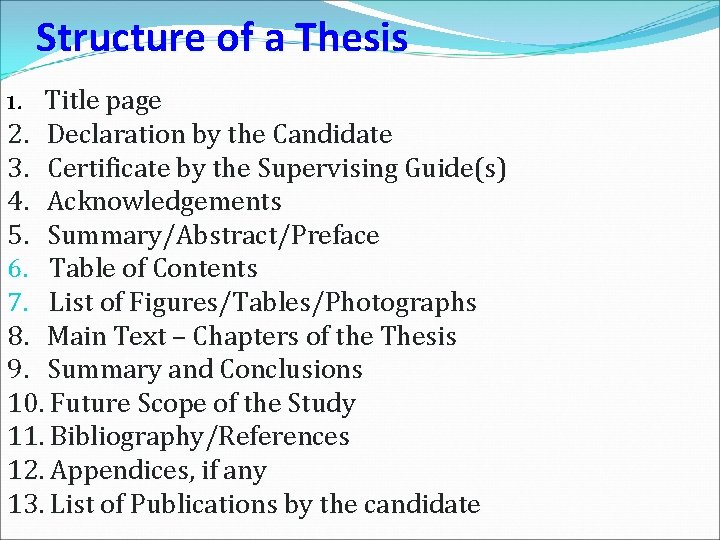
Structure of a Thesis 1. Title page 2. Declaration by the Candidate 3. Certificate by the Supervising Guide(s) 4. Acknowledgements 5. Summary/Abstract/Preface 6. Table of Contents 7. List of Figures/Tables/Photographs 8. Main Text – Chapters of the Thesis 9. Summary and Conclusions 10. Future Scope of the Study 11. Bibliography/References 12. Appendices, if any 13. List of Publications by the candidate
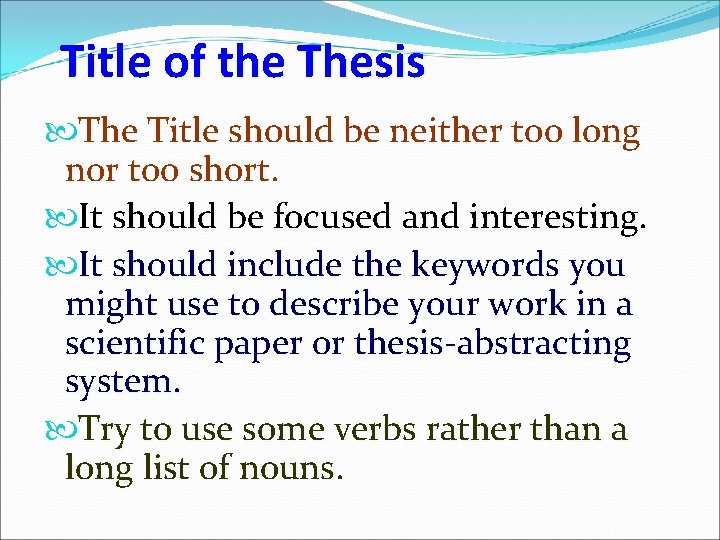
Title of the Thesis The Title should be neither too long nor too short. It should be focused and interesting. It should include the keywords you might use to describe your work in a scientific paper or thesis-abstracting system. Try to use some verbs rather than a long list of nouns.
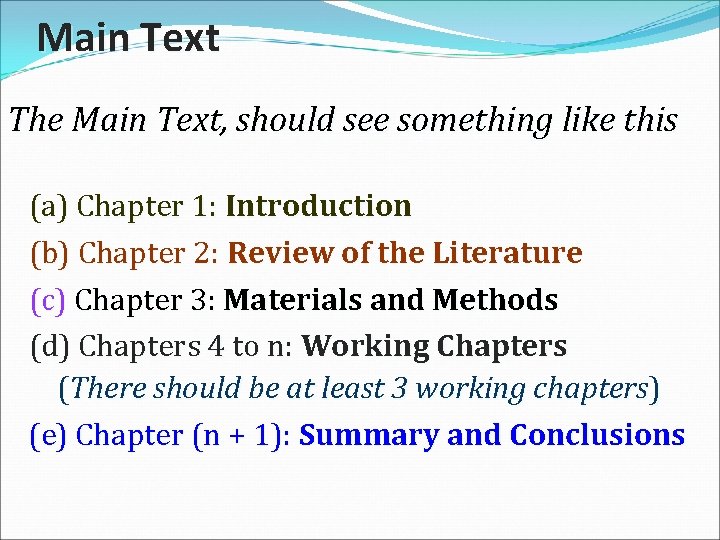
Main Text The Main Text, should see something like this (a) Chapter 1: Introduction (b) Chapter 2: Review of the Literature (c) Chapter 3: Materials and Methods (d) Chapters 4 to n: Working Chapters (There should be at least 3 working chapters) (e) Chapter (n + 1): Summary and Conclusions
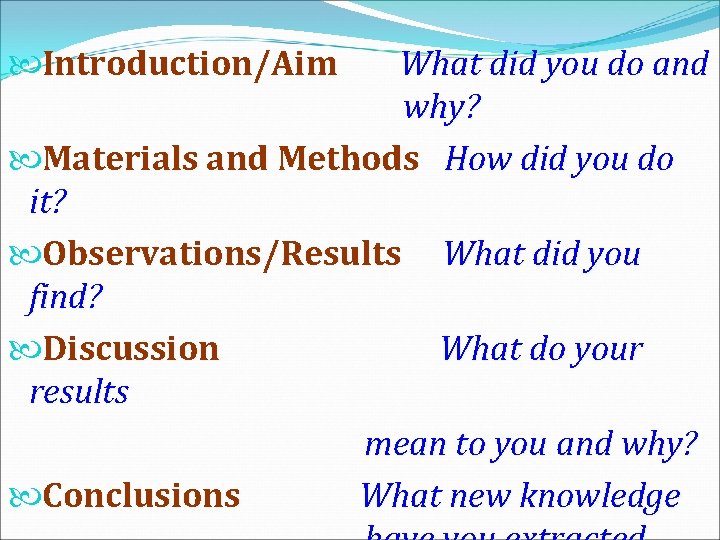
Introduction/Aim What did you do and why? Materials and Methods How did you do it? Observations/Results What did you find? Discussion What do your results mean to you and why? Conclusions What new knowledge
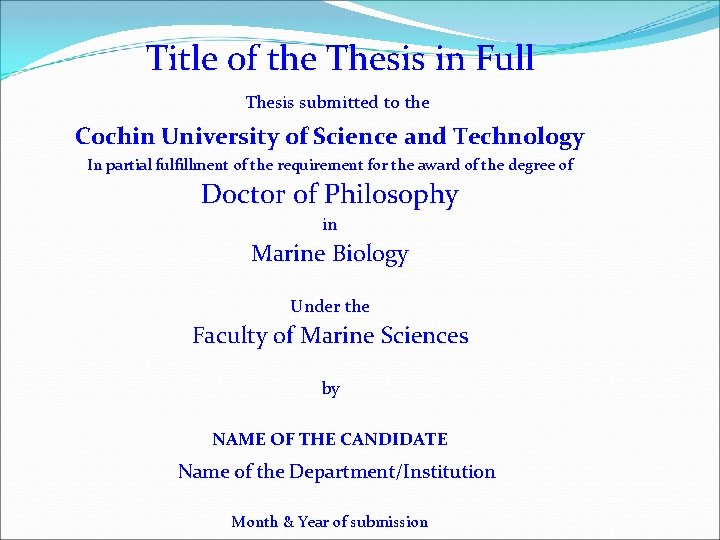
Title of the Thesis in Full Thesis submitted to the Cochin University of Science and Technology In partial fulfillment of the requirement for the award of the degree of Doctor of Philosophy in Marine Biology Under the Faculty of Marine Sciences by NAME OF THE CANDIDATE Name of the Department/Institution Month & Year of submission
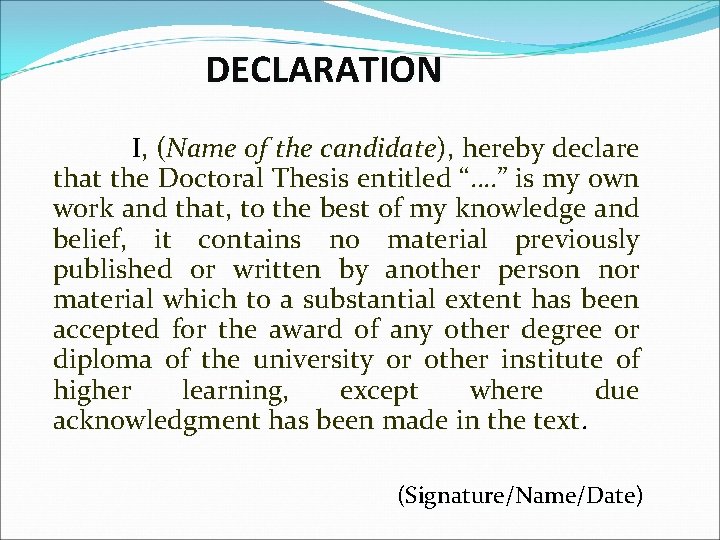
DECLARATION I, (Name of the candidate), hereby declare that the Doctoral Thesis entitled “…. ” is my own work and that, to the best of my knowledge and belief, it contains no material previously published or written by another person nor material which to a substantial extent has been accepted for the award of any other degree or diploma of the university or other institute of higher learning, except where due acknowledgment has been made in the text. (Signature/Name/Date)
CERTIFICATE
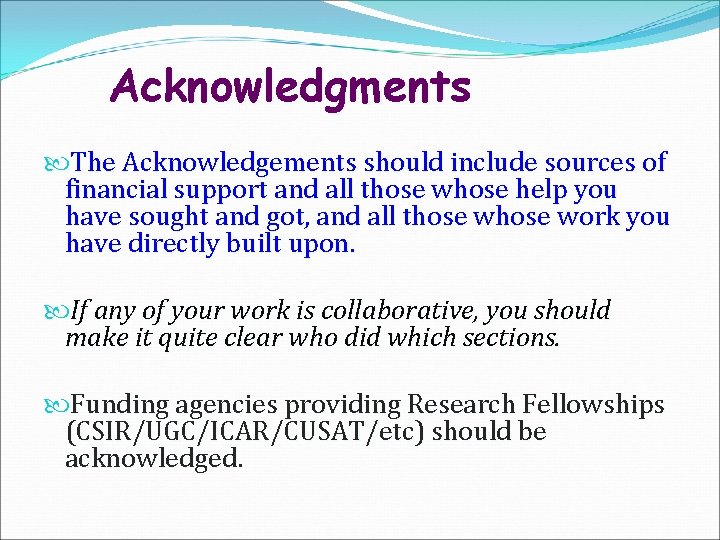
Acknowledgments The Acknowledgements should include sources of financial support and all those whose help you have sought and got, and all those work you have directly built upon. If any of your work is collaborative, you should make it quite clear who did which sections. Funding agencies providing Research Fellowships (CSIR/UGC/ICAR/CUSAT/etc) should be acknowledged.
Table of contents üThe introduction starts on page 1, the earlier pages should have roman numerals. üIt helps to have the subheadings of each chapter, as well as the chapter titles. üRemember that thesis may be used as a reference in the library, so it helps to be able to find things easily.
Abstract/ Preface/ Synopsis An abstract must be self-contained. Usually they do not contain references. Summary or Abstract should be of approximately 300 words. (It should not exceed 700 words. ) The Abstract or summary should summarize the appropriate headings, aims, scope and conclusion of thesis.
Abstract/ Preface/ Synopsis (contd. . ) This part of your Thesis will be the most widely published and most read, because it will be published in Dissertation Abstracts International. It is best written towards the end, but not at the very last minute because you will probably need several drafts. It should be a distillation of thesis: a concise description of the problem(s) addressed, your method of solving it/them, your results and conclusions.
Introduction Chapter What is the topic and why is it important? State the problem(s) as simply as you can. Try to step back mentally and take a broader view of the problem. How does it fit into the broader world of your discipline? Especially in the introduction, do not overestimate the reader's familiarity with your topic. You are writing for researchers in the general area, but not all of them need be specialists in your particular topic. The introduction should be interesting. If you bore the reader here, then you are unlikely to revive his/her interest in the materials and methods section.
Introduction Chapter (Contd. . ) For the first paragraph or two, make the writing style less dry than the scientific norm. Go to the library and read several thesis introductions. Did any make you want to read on? Which ones were boring? This section might go through several drafts to make it read well and logically, while keeping it short. It is a good idea to ask someone who is not a specialist to read it and to comment. Is it an adequate Introduction? Is it easy to follow? Introduction chapter normally writes towards the end of thesis writing. Your introduction should tell where thesis is going, and this may become clearer during the writing.
The Literature Review Where did the problem come from? What is already known about this problem? What other methods have been tried to solve it? v. How many papers? How relevant do they have to be before you include them? v. On the order of a 150 -200 is reasonable, but it will depend on the field. v Latest References and Classical papers are to be included
The Literature Review (contd. . ) The literature review is vital to justify your hypothesis, which must be consistent with what is known. A supporting point: make sure that you do not omit relevant papers by researchers who are like to be your examiners, or by potential employers to whom you might be sending thesis in the next year or two.
Materials and Methods This varies enormously from thesis to thesis, and may be absent in theoretical theses. It should be possible for a competent researcher to reproduce exactly what you have done by following your description. There is a good chance that this test will be applied: sometime after you have left, another researcher will want to do a similar experiment either with your gear, or on a new set-up in a foreign country. Please write for the benefit of that researcher.
Theory When you are reporting theoretical work that is not original, you will usually need to include sufficient material to allow the reader to understand the arguments used and their physical bases. Sometimes you will be able to present theory but should not reproduce two pages of algebra that the reader could find in a standard text. Do not include theory that you are not going to relate to the work you have done.
Theory (Contd. . ) When writing this section, concentrate at least as much on the physical arguments as on the equations. What do the equations mean? What are the important cases? . Think too about the order and style of presentation: the order in which you did the work may not be the clearest presentation. Suspense is not necessary in reporting science: you should tell the reader where you are going before you start.
Working Chapters should contain A brief introduction Experimental procedure/ data and analysis/ methods and materials/ Theory Results Discussion Outcome/Summary/Conclusion
Working Chapters In some theses, the middle chapters are the journal articles of which the student was major author. A thesis is both allowed and expected to have more detail than a journal article. For journal articles, one usually has to reduce the number of figures. In many cases, all of the interesting and relevant data can go in thesis, and not just those which appeared in the journal. Relatively often a researcher requests a thesis in order to obtain more detail about how a study was performed.
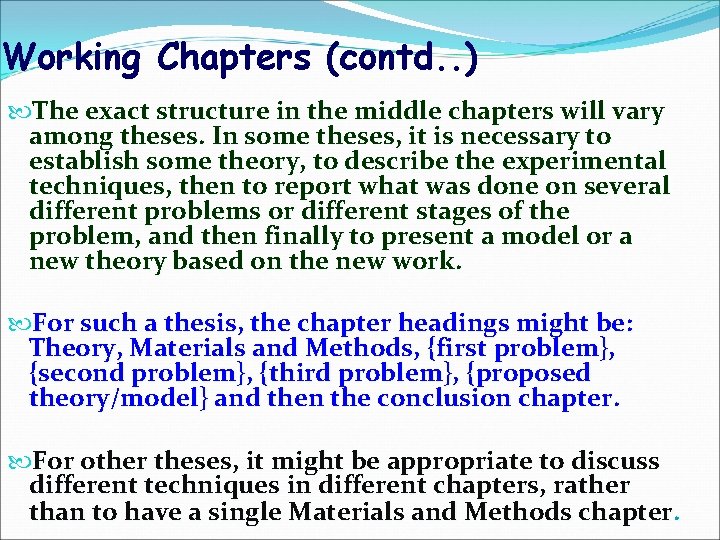
Working Chapters (contd. . ) The exact structure in the middle chapters will vary among theses. In some theses, it is necessary to establish some theory, to describe the experimental techniques, then to report what was done on several different problems or different stages of the problem, and then finally to present a model or a new theory based on the new work. For such a thesis, the chapter headings might be: Theory, Materials and Methods, {first problem}, {second problem}, {third problem}, {proposed theory/model} and then the conclusion chapter. For other theses, it might be appropriate to discuss different techniques in different chapters, rather than to have a single Materials and Methods chapter.
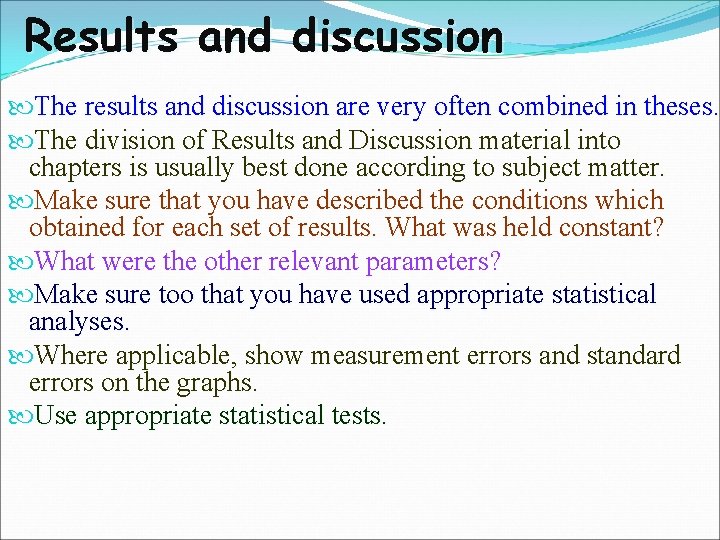
Results and discussion The results and discussion are very often combined in theses. The division of Results and Discussion material into chapters is usually best done according to subject matter. Make sure that you have described the conditions which obtained for each set of results. What was held constant? What were the other relevant parameters? Make sure too that you have used appropriate statistical analyses. Where applicable, show measurement errors and standard errors on the graphs. Use appropriate statistical tests.
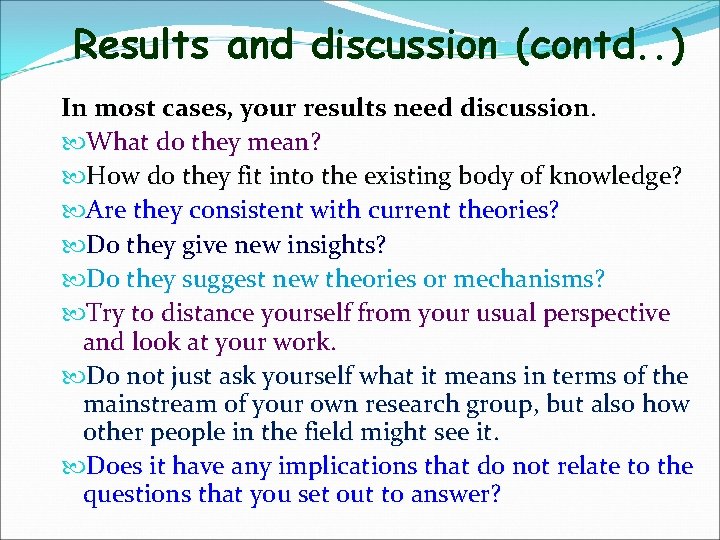
Results and discussion (contd. . ) In most cases, your results need discussion. What do they mean? How do they fit into the existing body of knowledge? Are they consistent with current theories? Do they give new insights? Do they suggest new theories or mechanisms? Try to distance yourself from your usual perspective and look at your work. Do not just ask yourself what it means in terms of the mainstream of your own research group, but also how other people in the field might see it. Does it have any implications that do not relate to the questions that you set out to answer?
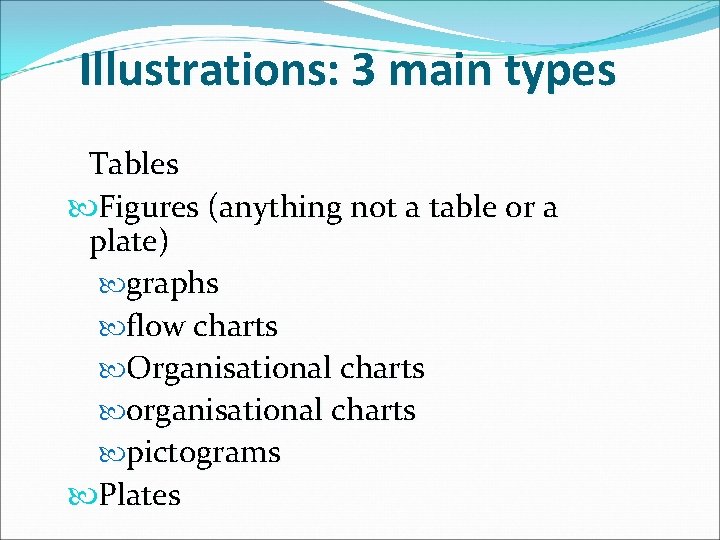
Illustrations: 3 main types Tables Figures (anything not a table or a plate) graphs flow charts Organisational charts organisational charts pictograms Plates
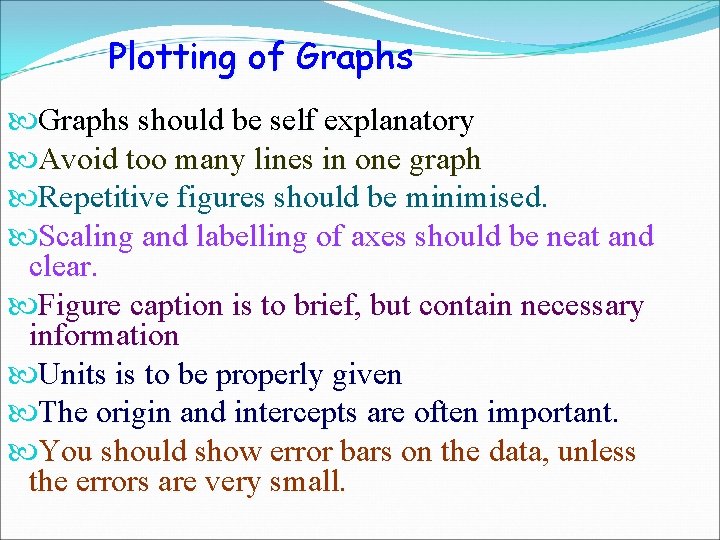
Plotting of Graphs should be self explanatory Avoid too many lines in one graph Repetitive figures should be minimised. Scaling and labelling of axes should be neat and clear. Figure caption is to brief, but contain necessary information Units is to be properly given The origin and intercepts are often important. You should show error bars on the data, unless the errors are very small.
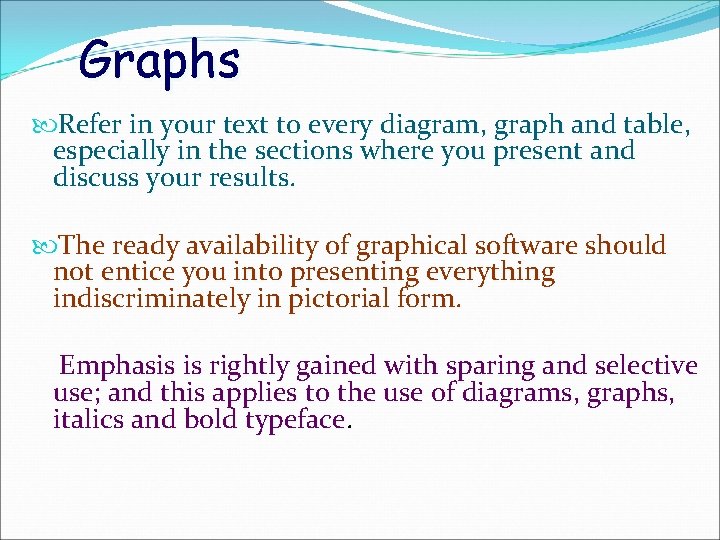
Graphs Refer in your text to every diagram, graph and table, especially in the sections where you present and discuss your results. The ready availability of graphical software should not entice you into presenting everything indiscriminately in pictorial form. Emphasis is rightly gained with sparing and selective use; and this applies to the use of diagrams, graphs, italics and bold typeface.
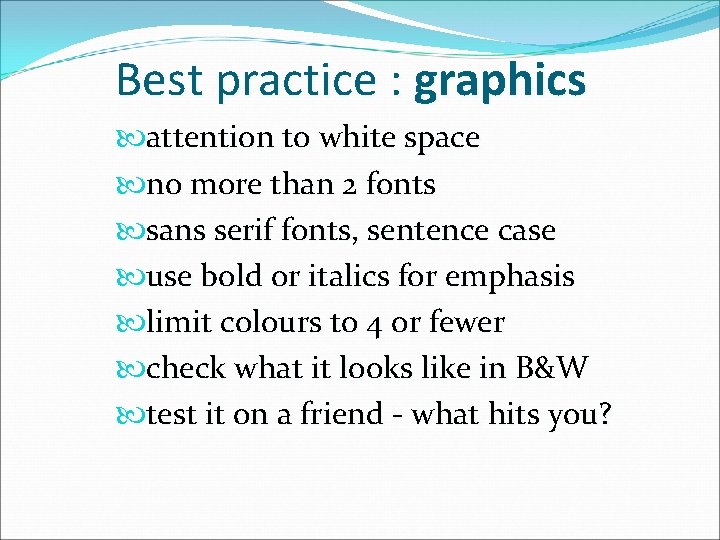
Best practice : graphics attention to white space no more than 2 fonts sans serif fonts, sentence case use bold or italics for emphasis limit colours to 4 or fewer check what it looks like in B&W test it on a friend - what hits you?
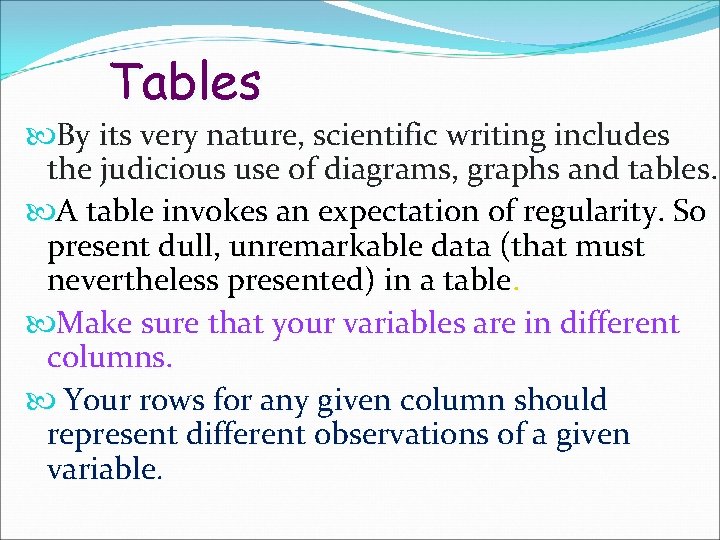
Tables By its very nature, scientific writing includes the judicious use of diagrams, graphs and tables. A table invokes an expectation of regularity. So present dull, unremarkable data (that must nevertheless presented) in a table. Make sure that your variables are in different columns. Your rows for any given column should represent different observations of a given variable.
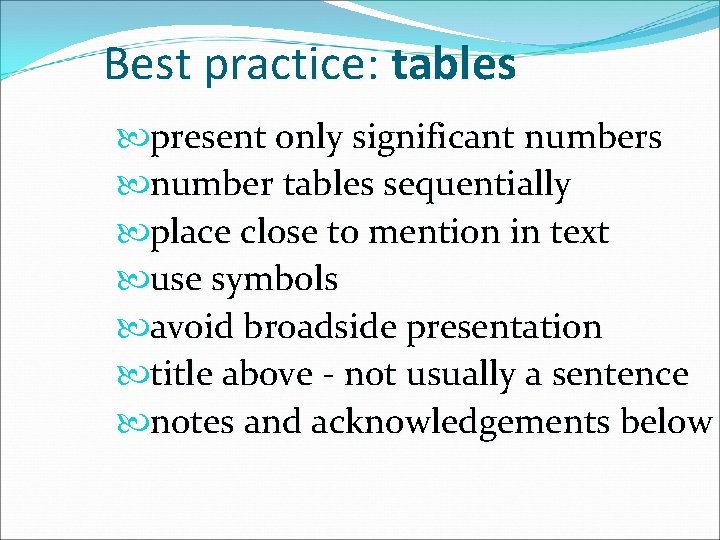
Best practice: practice tables present only significant numbers number tables sequentially place close to mention in text use symbols avoid broadside presentation title above - not usually a sentence notes and acknowledgements below
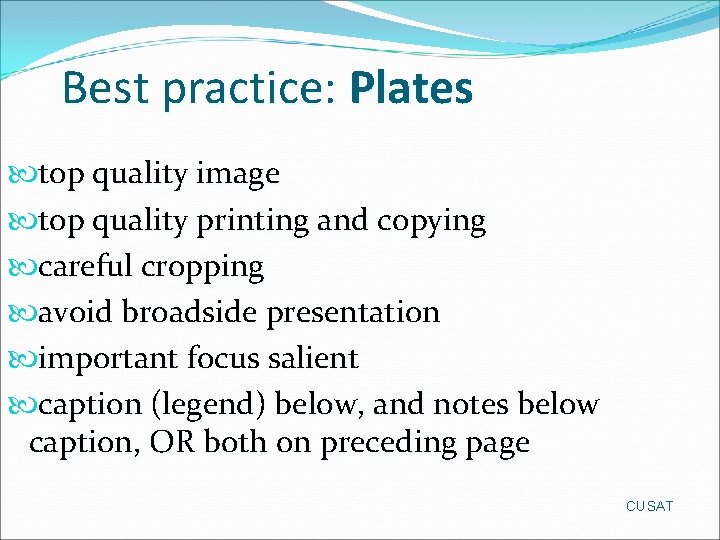
Best practice: Plates top quality image top quality printing and copying careful cropping avoid broadside presentation important focus salient caption (legend) below, and notes below caption, OR both on preceding page CUSAT
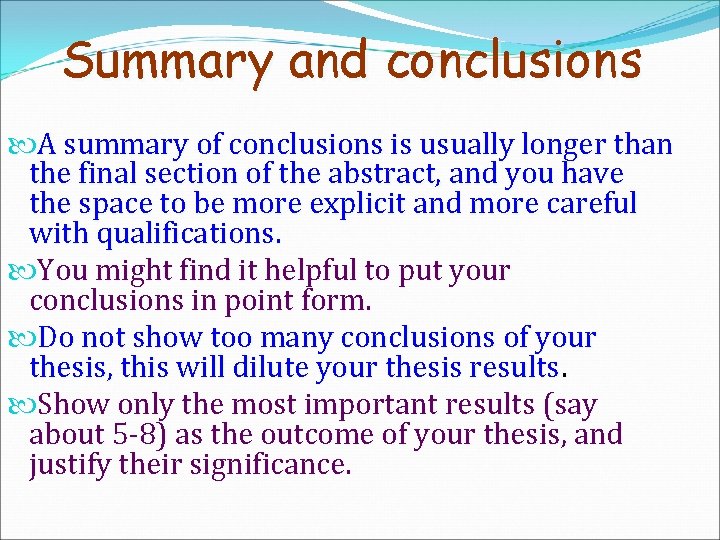
Summary and conclusions A summary of conclusions is usually longer than the final section of the abstract, and you have the space to be more explicit and more careful with qualifications. You might find it helpful to put your conclusions in point form. Do not show too many conclusions of your thesis, this will dilute your thesis results. Show only the most important results (say about 5 -8) as the outcome of your thesis, and justify their significance.
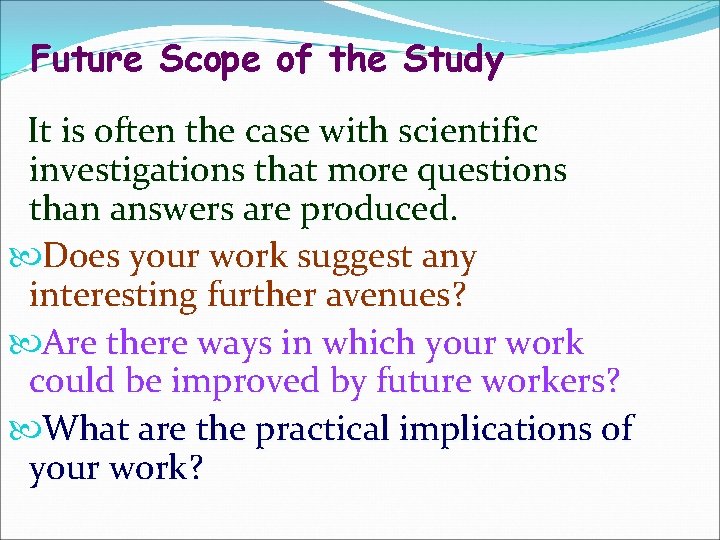
Future Scope of the Study It is often the case with scientific investigations that more questions than answers are produced. Does your work suggest any interesting further avenues? Are there ways in which your work could be improved by future workers? What are the practical implications of your work?
References Organize the list of references alphabetically by author surname. All references given must be referred to in the main body of thesis. To quote an unread paper is misleading and dangerous Note the difference from a Bibliography, which may include works that are not directly referenced in thesis.
Appendix Any material which impedes the smooth development of your presentation, but which is important to justify the results of a thesis. Generally it is material that is of too fundamental a level of detail for inclusion in the main body of thesis, but which should be available for perusal by the examiners to convince them sufficiently. Examples include experimental details, program listings, immense tables of data, lengthy mathematical proofs or derivations, etc. Do not copy textbook material in an Appendix just to give your thesis length or to impress your examiners.
Format • The layout is the packaging for your thesis. • A pleasing font and adequate margins make your thesis visually attractive. • The convention is to choose a font with serifs (e. g. , Times Roman) for the main text and a sans serif font (e. g. , Helvetica) for text inside diagrams. • All figure captions should be in the same font as the main text, preferably at one size smaller
Format (contd. . ) • The regulations governing size of paper, size of margins, etc. , vary with University. Theses should be double or one and a half space typed on A 4 paper with a left hand margin of 4 cm. There should be a 2 cm margin on all other edges. An extra left margin should be allowed for binding thesis. Typing on both sides is not encouraged. Each page of thesis should not start or end with a single line of the text.
TIME REQUIRED FOR THESIS WRITING As a general guideline, allow one to three months for writing up an Master’s thesis and at least six months for a Ph. D thesis. As another rule of thumb, triple your initial estimate to arrive at a more realistic time frame. The task of writing up will not loom large at the end of your project if you have written your thesis in installments. Check the spelling of all words in your thesis, including those in your bibliography,
Points on writing the Ph. D thesis The other bits and pieces like the Appendices may be written as you go along. Think, plan write, revise. Think clearly and write carefully. Clarity, precision and brevity are three watchwords. Leave no gaps in the chain of logic or ideas you express. Avoid excessively lengthy sentences. Develop your own writing style by careful reading and even more careful writing. Polish what you have written by repeated reading Ask your Research Supervisor to critique your thesis draft and amend it accordingly.
Best practice : text use serif font and sentence case 9 -12 point size depending on font 50% of page should be white space check visual appeal — page layout justified (or ragged right) L and R margins — beware binding paper weight and colour don’t overdo any feature CUSAT
Academic writing style ØClear - short clearly structured sentences ØAppropriate and specific vocabulary ØNo repetition, but ideas linked ØObserves academic discourse - rules for each academic discipline ØIs formal - no contractions, slang, colloquialisms etc ØImpersonal -usually third person
Language Style In scientific writing, one should avoid the first person singular pronoun ‘I’. Scientific writing must be in the passive voice. The first person plural pronoun, ‘we’ is used when stating facts, assumptions or previously derived results; in (mathematical) proofs; and especially in textbooks. The use of ‘we’ conveys the impression of a dialogue between writer and reader
Language Style (contd. . ) Tense: Write in the present tense. For example, say ``The system writes a page to the disk and then uses the frame. . . '' instead of ``The system will use the frame after it wrote the page to disk. . . '' Grammar And Logic: Short, simple phrases and words are often better than long ones.
Language Style (contd. . ) The text must be clear. Good grammar and thoughtful writing will make thesis easier to read. Scientific writing has to be a little formal--more formal than this text. Native English speakers should remember that scientific English is an international language. Slang and informal writing will be harder for a non-native speaker to understand.
What to avoid Clusters of nouns. Adjectival clauses (who, whom, whose, which, that, where, when, why) Subordinate clauses at the beginning Nouns instead of the verbs from which they are derived Use of filler verbs Use of imprecise words Use of compound prepositions Multiple negatives Unfamiliar abbreviations and symbols Avoid Self-Assessment (both praise and criticism):
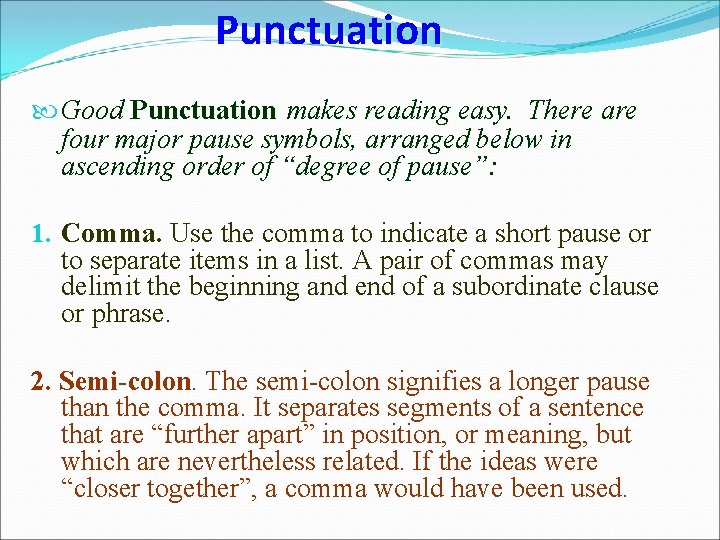
Punctuation Good Punctuation makes reading easy. There are four major pause symbols, arranged below in ascending order of “degree of pause”: 1. Comma. Use the comma to indicate a short pause or to separate items in a list. A pair of commas may delimit the beginning and end of a subordinate clause or phrase. 2. Semi-colon. The semi-colon signifies a longer pause than the comma. It separates segments of a sentence that are “further apart” in position, or meaning, but which are nevertheless related. If the ideas were “closer together”, a comma would have been used.
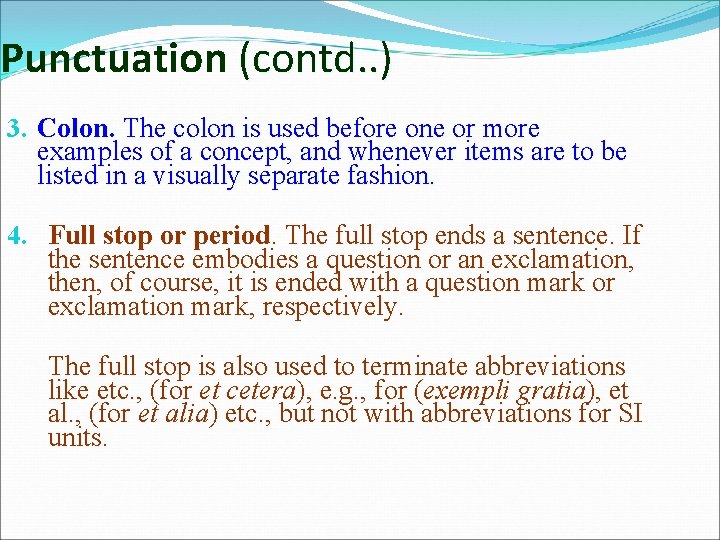
Punctuation (contd. . ) 3. Colon. The colon is used before one or more examples of a concept, and whenever items are to be listed in a visually separate fashion. 4. Full stop or period. The full stop ends a sentence. If the sentence embodies a question or an exclamation, then, of course, it is ended with a question mark or exclamation mark, respectively. The full stop is also used to terminate abbreviations like etc. , (for et cetera), e. g. , for (exempli gratia), et al. , (for et alia) etc. , but not with abbreviations for SI units.
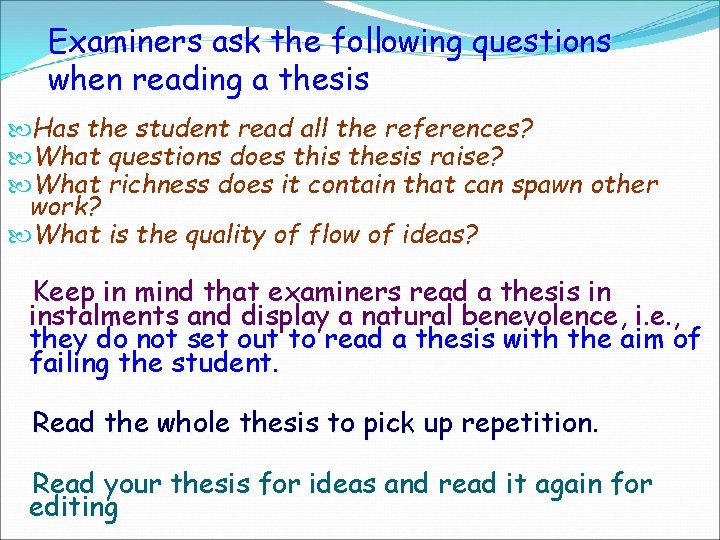
Examiners ask the following questions when reading a thesis Has the student read all the references? What questions does this thesis raise? What richness does it contain that can spawn other work? What is the quality of flow of ideas? Keep in mind that examiners read a thesis in instalments and display a natural benevolence, i. e. , they do not set out to read a thesis with the aim of failing the student. Read the whole thesis to pick up repetition. Read your thesis for ideas and read it again for editing
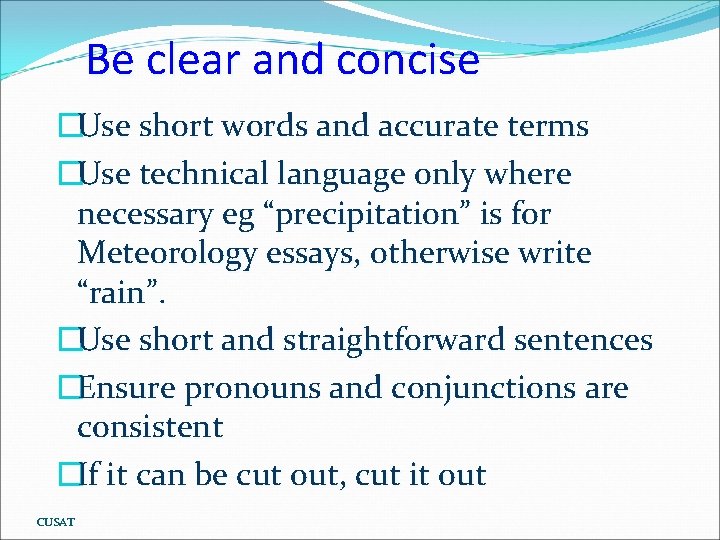
Be clear and concise �Use short words and accurate terms �Use technical language only where necessary eg “precipitation” is for Meteorology essays, otherwise write “rain”. �Use short and straightforward sentences �Ensure pronouns and conjunctions are consistent �If it can be cut out, cut it out CUSAT
Checklist: good scientific writing Objective: evidence driven Accurate : style, referencing, data, Concise: not wordy, balanced, within word limit Clear: point evident Consistent: expression, spelling, grammar Convincing: argument and language Reader friendly
Editing with technology �Re-read carefully where you have been cutting and pasting �Print it out to read it, then annotate the hard copy �Use spelling checkers carefully �Be aware of what grammar checkers require of you �Make use of the Revisions function
Using grammar checkers �Grammar checkers look at every sentence for: verbs sentence length and complexity verb subject agreement passive vs active verbs use of idiomatic phrases, eg, kick the bucket, part and parcel sentence length
Do’s and Don’ts in Science • Do keep records as you go along and date them. • Do systematic work. • Don’t claim precision where it is not justified. • Don’t present a conjecture as a fact. • Don’t plagiarize. • Don’t falsify records or cook up data.