
Tips for Preparing a Technical Paper prepared by
Tips for Preparing a Technical Paper prepared by Prof. Elizabeth De. Bartolo (ME) Copyright © 2006 Rochester Institute of Technology All rights reserved. EDGE™
Workshop Overview • What belongs in a Technical Paper? • • • – Your suggestions – Our suggestions Some general tips Peer review Wrap-up EDGE™
Why a Technical Paper? "You can have brilliant ideas, but if you can't get them across, your brains won't get you anywhere. " • Lee Iacocca, former Chrysler CEO EDGE™
What should be included? Your thoughts… EDGE™
What should be included Our suggestions… • Abstract – Scan to see if this is a paper I want to read or not. A BRIEF summary of the ENTIRE paper. • Background – Why is this work important? Where did they start? • Process – What steps/resources were required to do all this nifty stuff they did? • Results/Discussion – What happened? And what does it all mean? • Conclusions/Recommendations – What worked, what didn’t, and what would they do differently next time? • References and Acknowledgements – Give credit where credit is due! EDGE™
Abstract • • • Should include a summary of the entire paper. Short – often <200 words. Could be both most difficult and most important part of the paper. EDGE™
Background • Provide motivation for the project – why is it important? • Give the reader a frame of reference – what prior work are you using as a starting point? • May take the form of: – – – Literature search Review of prior projects Survey of product benchmarking “Where can I learn more? ” Combination of these EDGE™
Process • • Explanation of theory used in your project Assumptions made Preliminary experiments performed Overview of design process: – – – – Needs Specs Concepts Evaluation Analysis Building Testing EDGE™
Results and Discussion • • • What is your final product? How did you evaluate its success? Does it meet your specifications? Be convincing! • Most conference papers include enough information for the work to be reproduced. EDGE™
Conclusions and Recommendations • Critical evaluation of the successes and failures of your project • If you had to do it all over… – What would you do the same? – What would you do differently? • What future work needs to be done? EDGE™
References and Acknowledgements • ALWAYS cite references! – – – Papers/Technical Reports Books Prior teams Personal discussion Websites (please not Wikipedia!) Software • ALWAYS acknowledge your sponsor and others who made significant contributions to the project. EDGE™
Paper Exchange • Swap papers with another team • Read abstract, paper outline, and any other text/subheadings provided • Things to consider: – Does the abstract contain enough (or too much) information? – Is the abstract concise? – Does the outline make it sound like you’ll get the information you want? – Is the writing easy to understand? EDGE™
Comments What did you think…? EDGE™
The details nobody likes to think about: • These can make your paper very hard or very easy to read! • Figure and Table labels – Consistent style – Explain in text • Formatting Units and Numbers – “lb” vs. “lb. ”, “ 7” vs. “seven”, etc… • Text formatting – White space – Widows and Orphans EDGE™
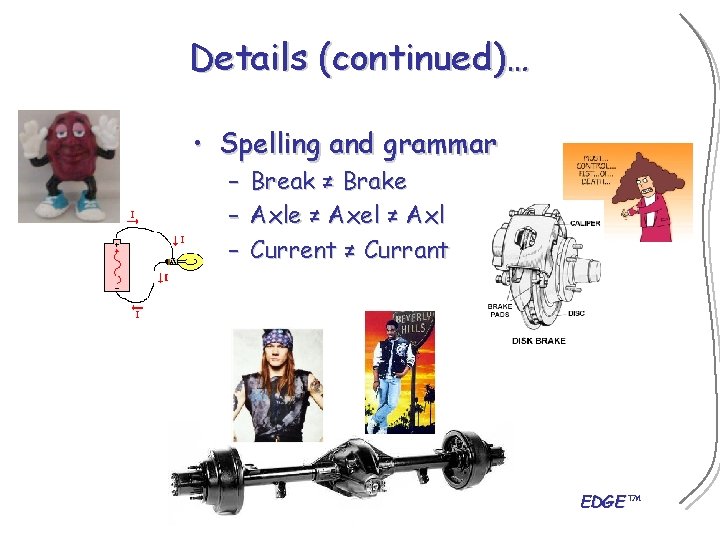
Details (continued)… • Spelling and grammar – – – Break ≠ Brake Axle ≠ Axel ≠ Axl Current ≠ Currant EDGE™
Where to learn more • Wallace Library – Citing References Appropriately: http: //wally. rit. edu/researchguides/citing. html – Publishing Support Center: http: //wally. rit. edu/userservices/pubschol/ • Purdue Online Writing Lab – Links Edge: Resources >> Current Downloads >> Senior Design II EDGE™
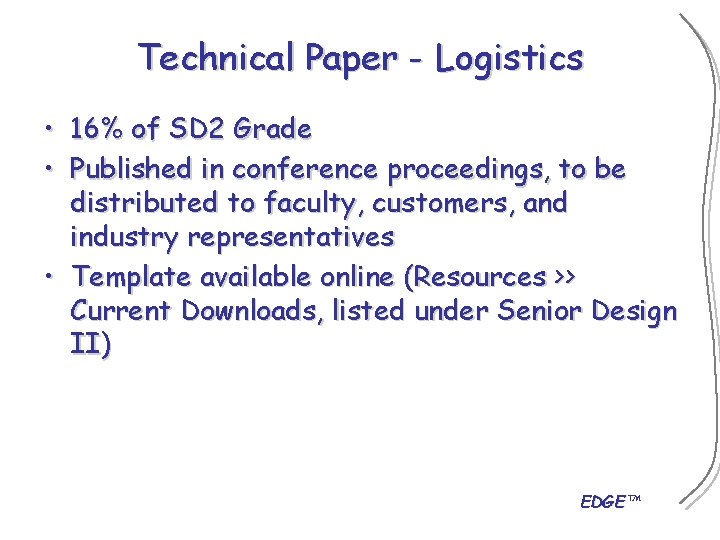
Technical Paper - Logistics • 16% of SD 2 Grade • Published in conference proceedings, to be distributed to faculty, customers, and industry representatives • Template available online (Resources >> Current Downloads, listed under Senior Design II) EDGE™
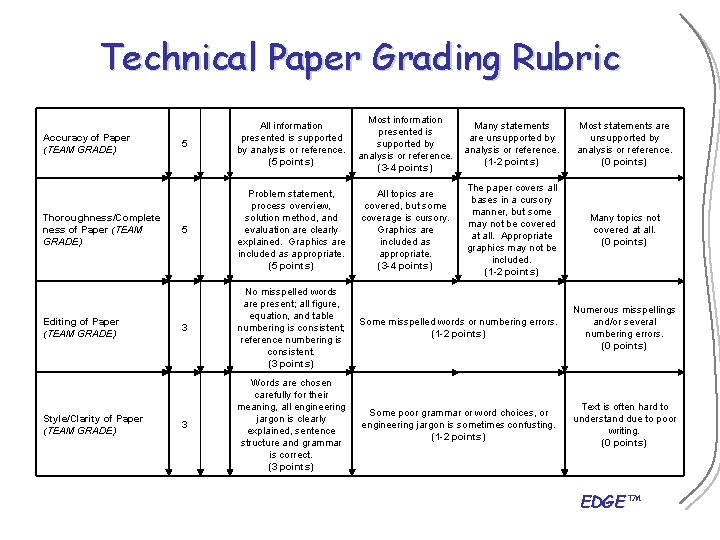
Technical Paper Grading Rubric Accuracy of Paper (TEAM GRADE) Thoroughness/Complete ness of Paper (TEAM GRADE) Editing of Paper (TEAM GRADE) Style/Clarity of Paper (TEAM GRADE) 5 All information presented is supported by analysis or reference. (5 points) Most information presented is supported by analysis or reference. (3 -4 points) Many statements are unsupported by analysis or reference. (1 -2 points) Most statements are unsupported by analysis or reference. (0 points) 5 Problem statement, process overview, solution method, and evaluation are clearly explained. Graphics are included as appropriate. (5 points) All topics are covered, but some coverage is cursory. Graphics are included as appropriate. (3 -4 points) The paper covers all bases in a cursory manner, but some may not be covered at all. Appropriate graphics may not be included. (1 -2 points) Many topics not covered at all. (0 points) 3 No misspelled words are present; all figure, equation, and table numbering is consistent; reference numbering is consistent. (3 points) Some misspelled words or numbering errors. (1 -2 points) Numerous misspellings and/or several numbering errors. (0 points) 3 Words are chosen carefully for their meaning, all engineering jargon is clearly explained, sentence structure and grammar is correct. (3 points) Some poor grammar or word choices, or engineering jargon is sometimes confusting. (1 -2 points) Text is often hard to understand due to poor writing. (0 points) EDGE™
Questions? EDGE™
- Slides: 19