
Tips for creating an inclusive mathematics classroom using
- Slides: 39
Tips for creating an inclusive mathematics classroom using universal design principles Cheryl J. Mc. Allister Southeast Missouri State University NCTM Regional Conference Paducah, KY October 10, 2002 http: //cstl-cst. semo. edu/mcallister
What is inclusion? n According to Vaughn and Schumm (1995) inclusion is “the development of a school-based education model that is student centered and that bases educational placement and service provision on each student’s needs. ”
The mandate for inclusive education n n Federal and state laws School board policy Special interest groups (Council for Exceptional Children) Professional organizations’ position statements (National Council of Teachers of Mathematics, National Association for the Education of Young Children)
Federal and state law Individuals with Disabilities Education Act (IDEA) 1997. n Standardized testing required by states for all students n
NCTM(2000). Principles and standards for school mathematics, p. 12 The equity principle. Excellence in mathematics education requires equity – high expectations and strong support for all students. … Achieving this goal requires raising expectations for students’ learning, developing effective methods of supporting the learning of mathematics by all students, and providing students and teachers with the resources they need.
NCTM(2000). Principles and standards for school mathematics, p. 12 (con’t) All students, regardless of their personal characteristics, backgrounds, or physical challenges, must have opportunities to study – and support to learn - mathematics.
NCTM(2000). Principles and standards for school mathematics, p. 12 (con’t) Equity does not mean that every student should receive identical instruction; instead it demands that reasonable and appropriate accommodations be made as needed to promote access and attainment for all students.
NCTM(2000). Principles and standards for school mathematics, p. 12 -13 (con’t) Technology can assist in achieving equity and must be accessible to all students. n n Help students explore complex problems Computer tutorials Link students in rural communities to advanced classes Voice recognition software (More on this later)
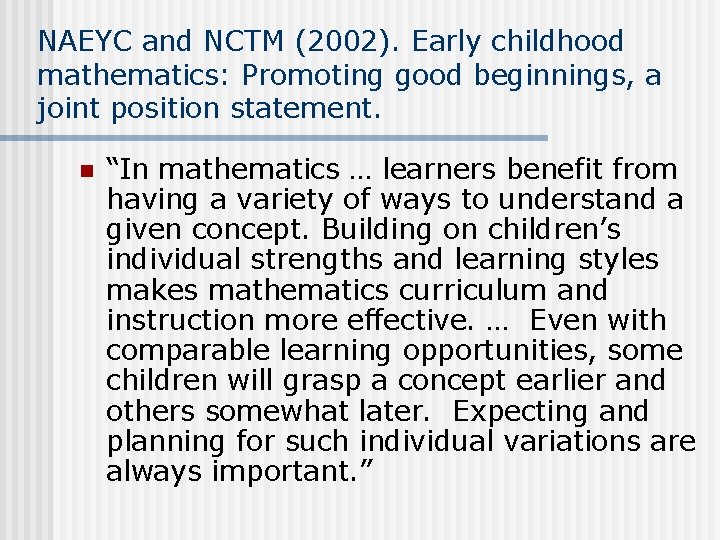
NAEYC and NCTM (2002). Early childhood mathematics: Promoting good beginnings, a joint position statement. n “In mathematics … learners benefit from having a variety of ways to understand a given concept. Building on children’s individual strengths and learning styles makes mathematics curriculum and instruction more effective. … Even with comparable learning opportunities, some children will grasp a concept earlier and others somewhat later. Expecting and planning for such individual variations are always important. ”
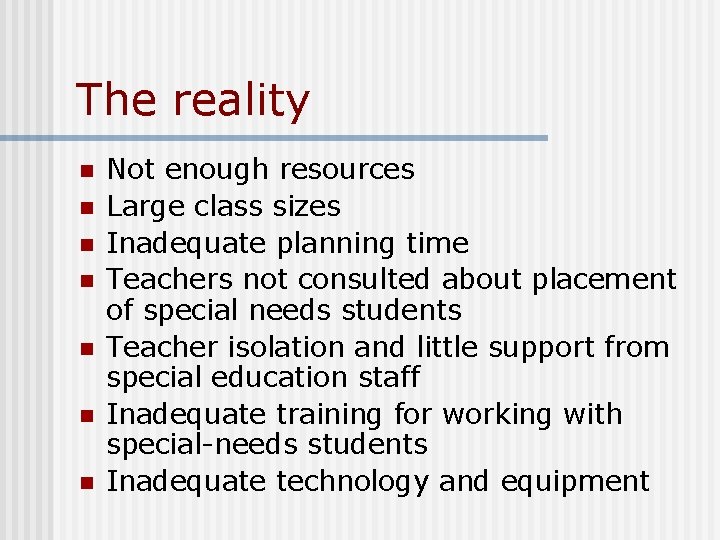
The reality n n n n Not enough resources Large class sizes Inadequate planning time Teachers not consulted about placement of special needs students Teacher isolation and little support from special education staff Inadequate training for working with special-needs students Inadequate technology and equipment
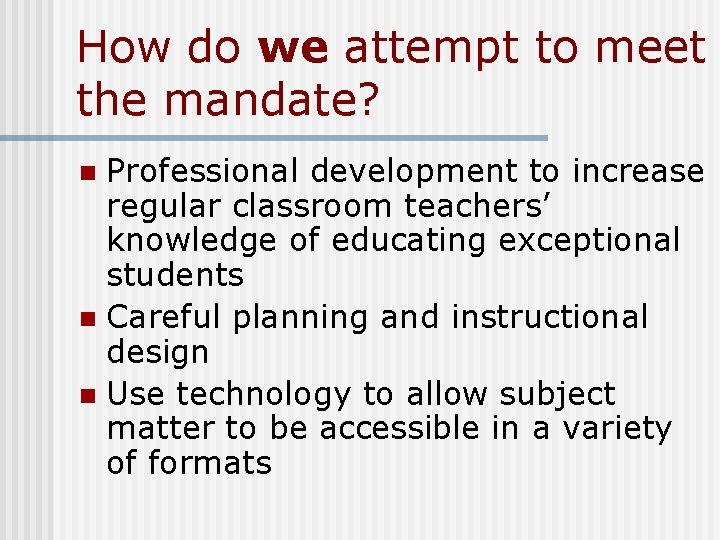
How do we attempt to meet the mandate? Professional development to increase regular classroom teachers’ knowledge of educating exceptional students n Careful planning and instructional design n Use technology to allow subject matter to be accessible in a variety of formats n
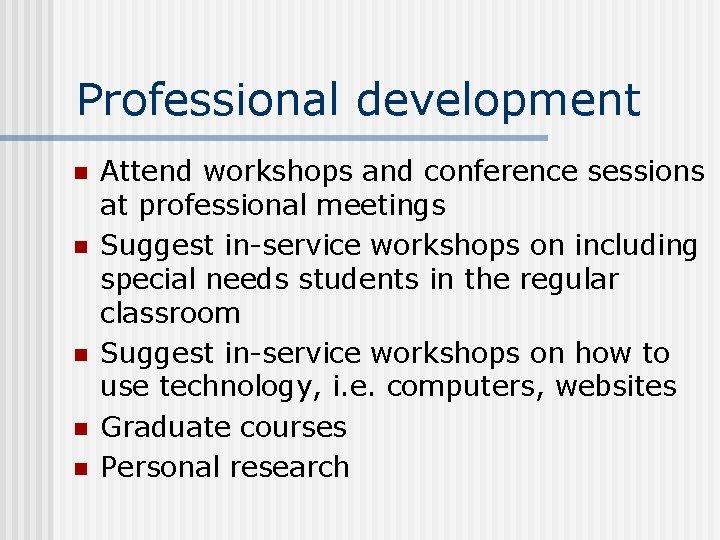
Professional development n n n Attend workshops and conference sessions at professional meetings Suggest in-service workshops on including special needs students in the regular classroom Suggest in-service workshops on how to use technology, i. e. computers, websites Graduate courses Personal research
Background information
What types of students are we talking about? n n n n Students for which English is a second language Students with physical disabilities Students with learning disabilities Gifted students Students with non-traditional learning styles Older adult students All students
Barriers to access n Communication barriers: n n n Learning barriers: n n Language disorders Speech disorders Learning disabilities Non-standard learning styles Attention disorders Mobility barriers: n Extreme physical disabilities
Barriers to access n n Print barriers: n Vision impairments n Reading difficulties • Beginning readers • Learning disabled students • ESL students Aural barriers: n Hearing impairments n ESL students
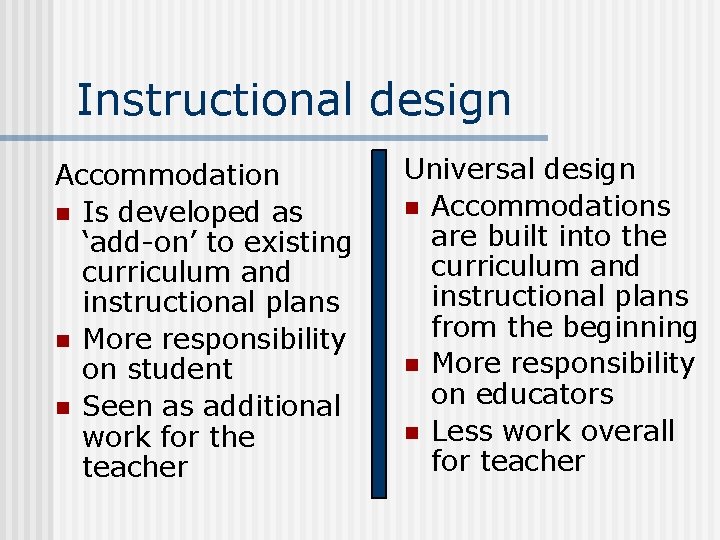
Instructional design Accommodation n Is developed as ‘add-on’ to existing curriculum and instructional plans n More responsibility on student n Seen as additional work for the teacher Universal design n Accommodations are built into the curriculum and instructional plans from the beginning n More responsibility on educators n Less work overall for teacher
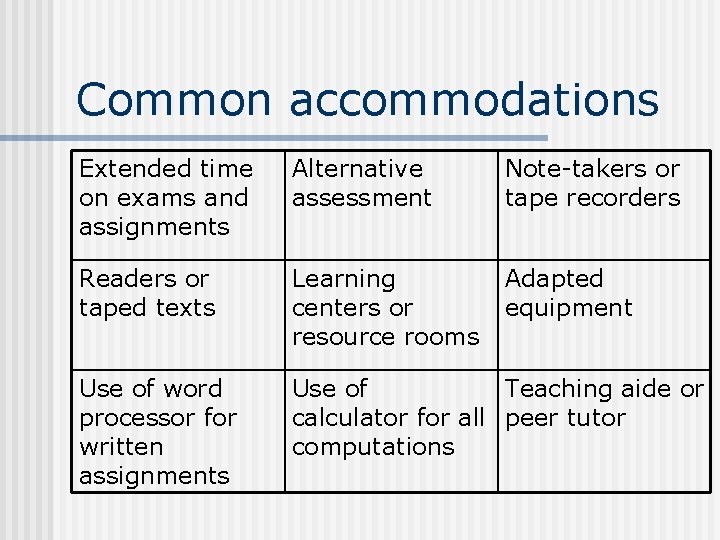
Common accommodations Extended time on exams and assignments Alternative assessment Note-takers or tape recorders Readers or taped texts Learning centers or resource rooms Adapted equipment Use of word processor for written assignments Use of Teaching aide or calculator for all peer tutor computations
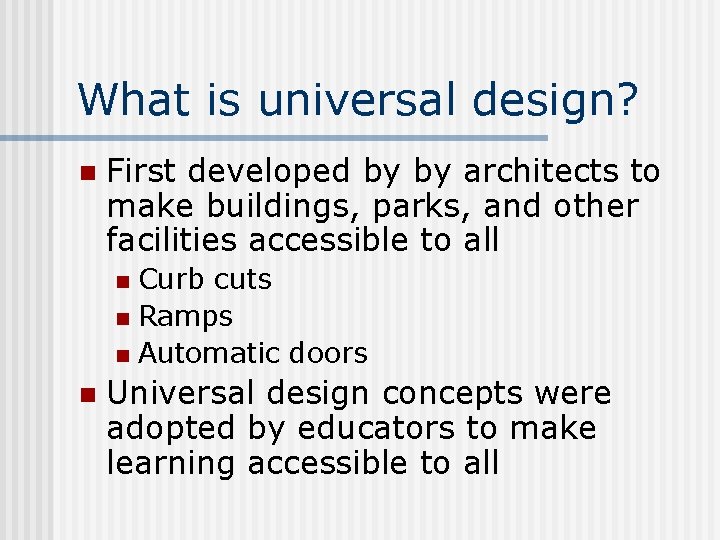
What is universal design? n First developed by by architects to make buildings, parks, and other facilities accessible to all Curb cuts n Ramps n Automatic doors n n Universal design concepts were adopted by educators to make learning accessible to all
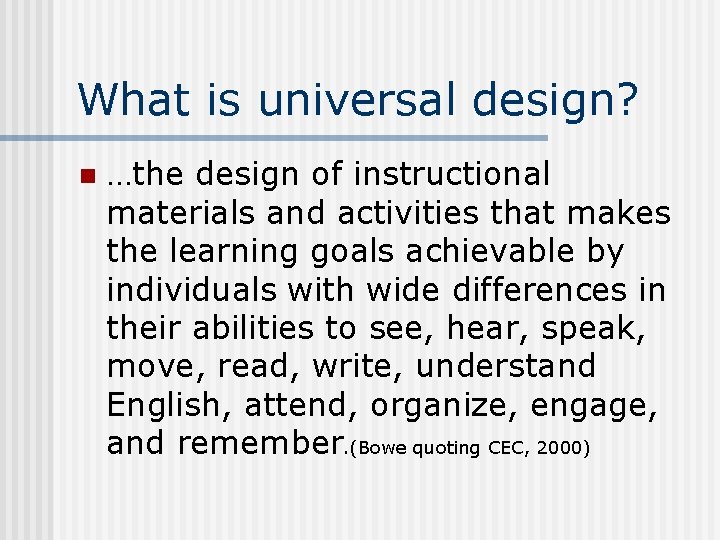
What is universal design? n …the design of instructional materials and activities that makes the learning goals achievable by individuals with wide differences in their abilities to see, hear, speak, move, read, write, understand English, attend, organize, engage, and remember. (Bowe quoting CEC, 2000)
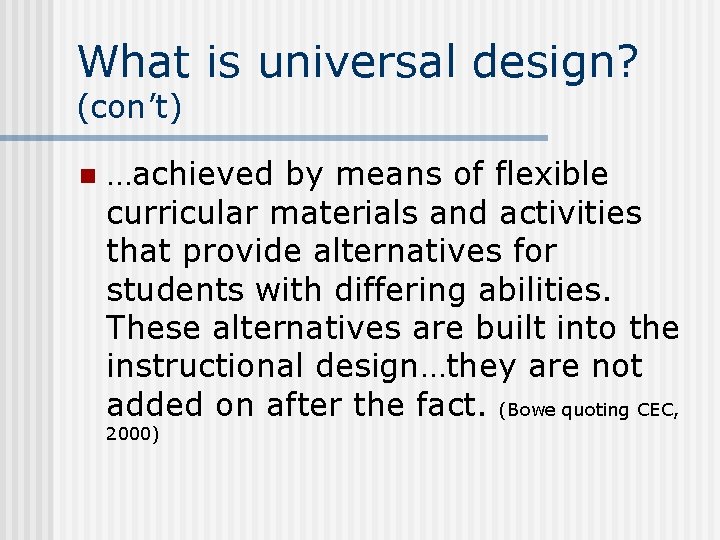
What is universal design? (con’t) n …achieved by means of flexible curricular materials and activities that provide alternatives for students with differing abilities. These alternatives are built into the instructional design…they are not added on after the fact. (Bowe quoting CEC, 2000)
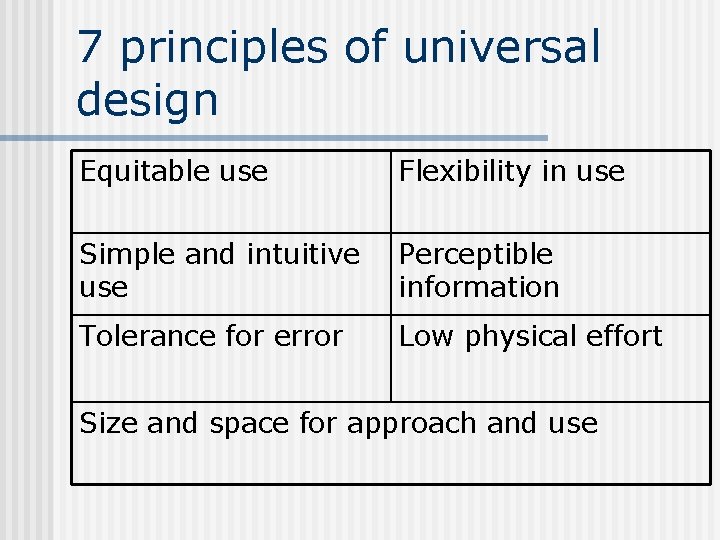
7 principles of universal design Equitable use Flexibility in use Simple and intuitive use Perceptible information Tolerance for error Low physical effort Size and space for approach and use
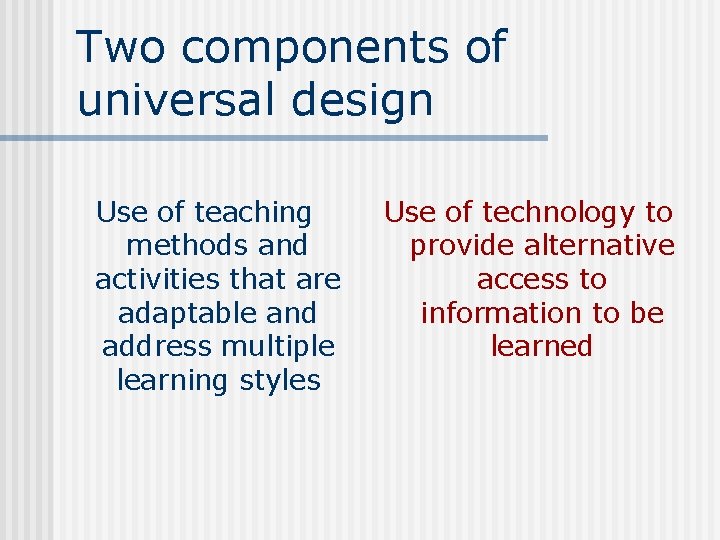
Two components of universal design Use of teaching methods and activities that are adaptable and address multiple learning styles Use of technology to provide alternative access to information to be learned
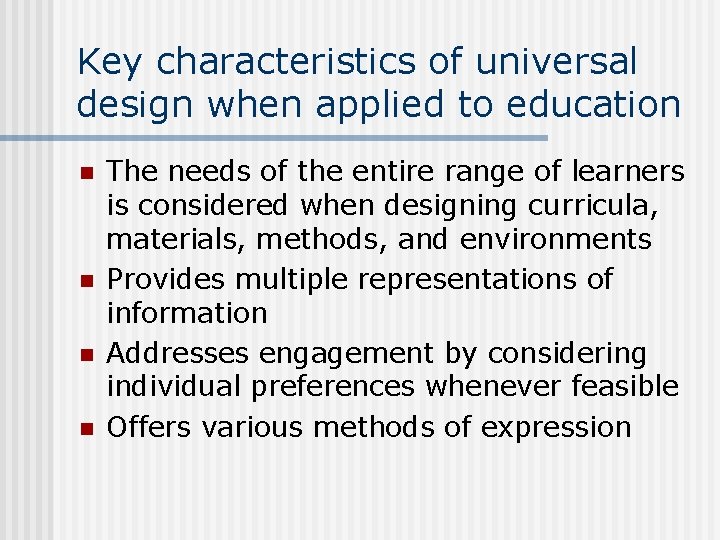
Key characteristics of universal design when applied to education n n The needs of the entire range of learners is considered when designing curricula, materials, methods, and environments Provides multiple representations of information Addresses engagement by considering individual preferences whenever feasible Offers various methods of expression
Key characteristics of universal design when applied to education Includes strategies to engage all 3 brain systems: recognition systems, strategic systems, and affective systems n Offers an array of strategy prompts, hints, or models of expert performance to assist learners n
What about assessment? Universal design principles must also be applied to assessment strategies if a fair and equitable measure of student understanding and learning is to be determined.
Now that we know what theory is… The question is: how do we accomplish all this in our own classrooms?
Tips for regular classroom teachers to create an inclusive environment n Select textbooks and other materials that support and include students who have a wide range of abilities to see, hear, speak, and read.
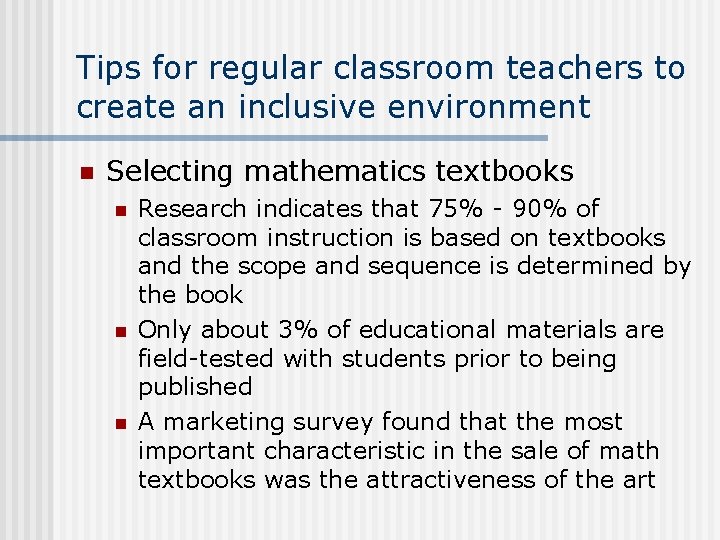
Tips for regular classroom teachers to create an inclusive environment n Selecting mathematics textbooks n n n Research indicates that 75% - 90% of classroom instruction is based on textbooks and the scope and sequence is determined by the book Only about 3% of educational materials are field-tested with students prior to being published A marketing survey found that the most important characteristic in the sale of math textbooks was the attractiveness of the art
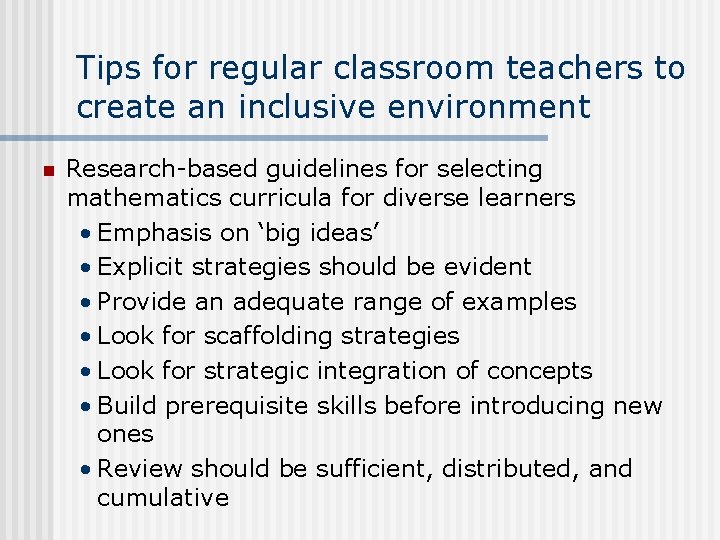
Tips for regular classroom teachers to create an inclusive environment n Research-based guidelines for selecting mathematics curricula for diverse learners • Emphasis on ‘big ideas’ • Explicit strategies should be evident • Provide an adequate range of examples • Look for scaffolding strategies • Look for strategic integration of concepts • Build prerequisite skills before introducing new ones • Review should be sufficient, distributed, and cumulative
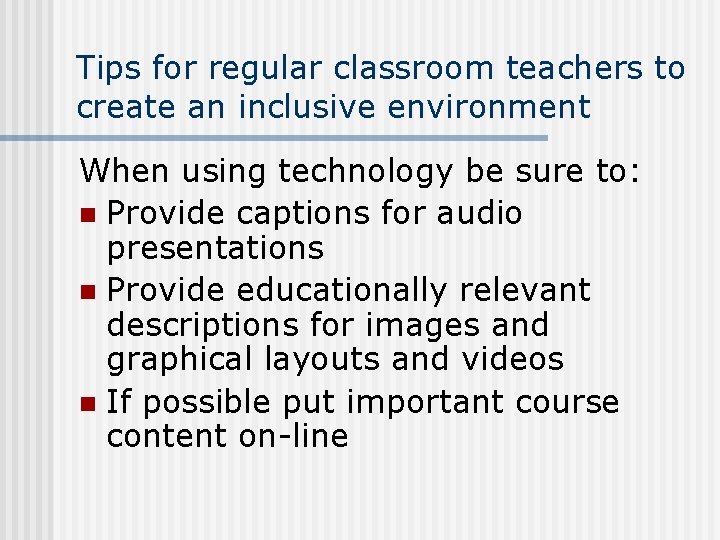
Tips for regular classroom teachers to create an inclusive environment When using technology be sure to: n Provide captions for audio presentations n Provide educationally relevant descriptions for images and graphical layouts and videos n If possible put important course content on-line
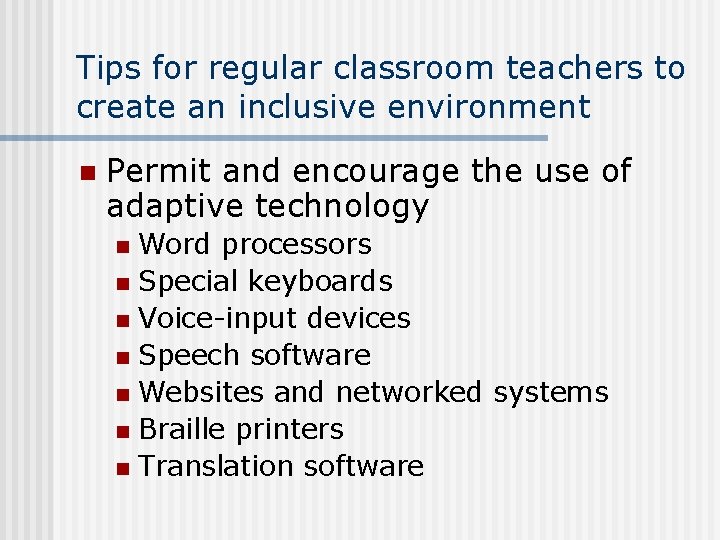
Tips for regular classroom teachers to create an inclusive environment n Permit and encourage the use of adaptive technology Word processors n Special keyboards n Voice-input devices n Speech software n Websites and networked systems n Braille printers n Translation software n
Tips for regular classroom teachers to create an inclusive environment n Low-tech learning aids Sticky notes n Highlighter pens n Calculators n Digital clocks n Tape recorders n Carbon paper note pads n Fanny packs to keep track of personal belongings n
Tips for regular classroom teachers to create an inclusive environment n When teaching provide cognitive supports for content and activities: Provide assessments for background knowledge and skill level n Summarize ‘big ideas’ n Include explicit strategies to make clear the goals and methods of instruction n Provide scaffolding for learning and generalization n Build fluency through practice n
Tips for regular classroom teachers to create an inclusive environment Good teaching tips you already use n Give immediate feedback, clarify instructions, ask for questions, repeat or give additional examples n Relate new topics to already learned topics or real-life examples n Go from concrete to abstract n Use peer mentoring, group discussions, and cooperative learning situations
Tips for regular classroom teachers to create an inclusive environment Make content personal n Develop study guides n Give more frequent, but shorter exams n Consider alternative assessment methods n
Tips for regular classroom teachers to create an inclusive environment n Offer multiple ways for students to interact with and respond to curricula and materials Assignments where students choose method of learning n Assignments where students choose method of demonstrating knowledge n Assignments where review material is individualized to student’s interests or preferred learning style n
Tips for regular classroom teachers to create an inclusive environment Learn about the cultures of your students and reflect on how that will affect them n Develop a close collaboration with the special education staff n Don’t try to change everything at once n
Final thoughts on universal design from Frank Bowe “Universal design in education is based upon the premise that by preparing to meet diverse needs, we will better serve people with no special needs. ” p. 46 “We all need to remember that being among the ‘temporarily able-bodied’ is a short term gift. ” p. 47