
Tips and Tools for Responding to Government Solicitations
- Slides: 48
Tips and Tools for Responding to Government Solicitations Development Session SOAR 2018 Presented by: Dr. Kelly Griendling Senior Project Manager Center of Innovation for Aerospace
THIS SESSION WILL COVER: • What is in a solicitation and how can Georgia’s Resource Organizations help you navigate it? • Focus on the Technical Section • A process for developing a strong technical section • Tips for telling a compelling story
THIS SESSION WILL COVER: • What is in a solicitation and how can Georgia’s Resource Organizations help you navigate it? • Focus on the Technical Section • A process for developing a strong technical section • Tips for telling a compelling story
ONLINE PORTALS • https: //www. grants. gov/ • https: //www. fbo. gov/ • https: //sbir. defensebusiness. org/ • https: //www. sbir. gov/about-sbir • Georgia has created a one stop shop to make searching for contracts and finding partners easier • Visit Georgia Defense Exchange https: //data. georgia. org/defense/
WHAT’S INCLUDED IN A SOLICITATION • Program Description: An executive summary that includes a clear statement of the objectives • Definitions: A glossary of important terms relevant to the solicitations, usually definitions for legal purposes. Note that the same term may have different definitions between organizations or solicitations! • Proposal Fundamentals: The eligibility requirements and any other restrictions that might affect the validity of a submission (classified information guidelines, conflicts of interest, etc) • Submission Requirements: A detailed description of the requirements for submission, including required components, page counts, and submission instructions • Topic Description(s): A description of the topic(s) of interest for the solicitation • Evaluation Criteria: The rubric by which submissions will be evaluated • Contractual Requirements: Expectations around the contractual terms and conditions of the award • Solicitation-specific issues: There will often be issues that are specific to a given solicitation that will be discussed, such as the inclusion of options or commercialization requirements
A NOTE ABOUT SBIR/STTR • Small Business Innovation Research (SBIR) and Small Technology Transfer Innovation Research (STTR) solicitations are a particular niche in the world of government contracting • These are geared toward helping subsidize the R&D costs for small businesses of bringing a product to market • Products should have both a government and commercial end use – this is a case where the government should not be the only end customer • In addition to being graded on how well a submission meets the government’s needs, it will also be graded on the commercialization plan • SBIRs have up to three phases, with the majority of funding being awarded at Phase 2. You must be successful in Phase 1 to be eligible for Phase 2.
GEORGIA RESOURCES FOR PROPOSAL ASSISTANCE • This presentation is going to focus on developing a technical section. For help with other aspects of proposal writing, check out these great courses from our partners. • GTPAC offers a series of free courses on the mechanics of government solicitations - https: //gtpac. ecenterdirect. com/events • ATDC offers a series of SBIR classes • • What is SBIR? – open to the public • SBIR 101 Workshop: Understanding, Planning, and Writing – Educational Members • SBIR Topical Class: Positioning Yourself for NSF SBIR/STTR – Educational Members • SBIR Topical Class: Government as the Customer – Educational Members COIA offers proposal specific assistance to Georgia Aerospace companies looking to submit an SBIR/STTR
THIS SESSION WILL COVER: • What is in a solicitation and how can Georgia’s Resource Organizations help you navigate it? • Focus on the Technical Section • A process for developing a strong technical section • Tips for telling a compelling story
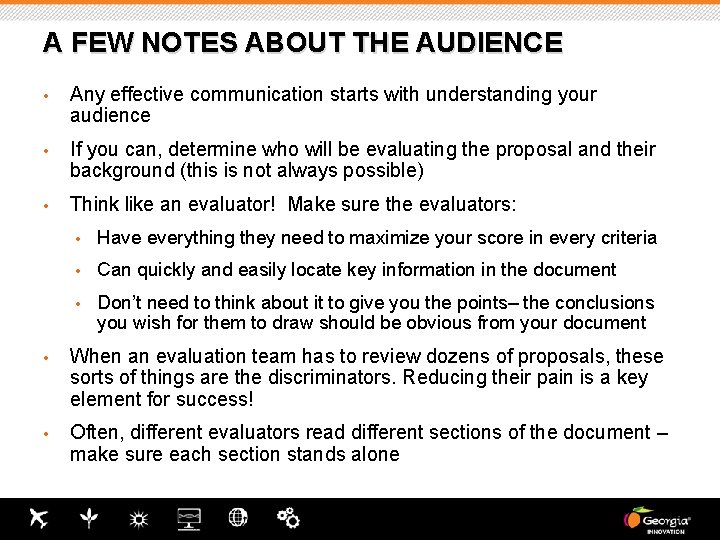
A FEW NOTES ABOUT THE AUDIENCE • Any effective communication starts with understanding your audience • If you can, determine who will be evaluating the proposal and their background (this is not always possible) • Think like an evaluator! Make sure the evaluators: • Have everything they need to maximize your score in every criteria • Can quickly and easily locate key information in the document • Don’t need to think about it to give you the points– the conclusions you wish for them to draw should be obvious from your document • When an evaluation team has to review dozens of proposals, these sorts of things are the discriminators. Reducing their pain is a key element for success! • Often, different evaluators read different sections of the document – make sure each section stands alone
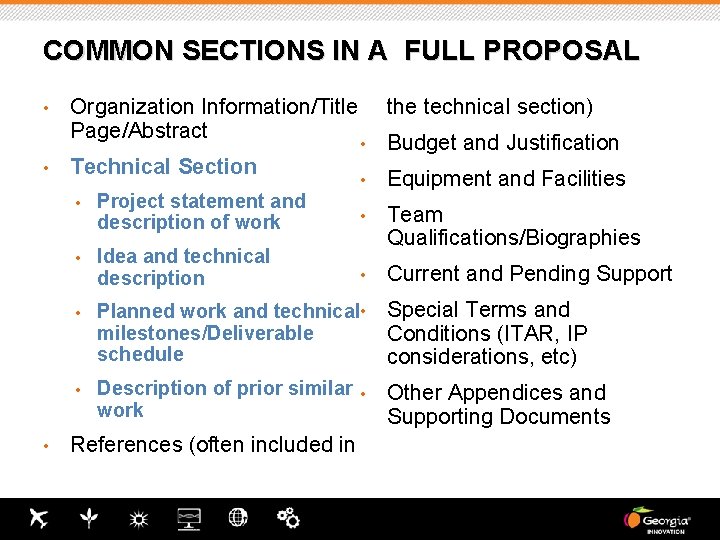
COMMON SECTIONS IN A FULL PROPOSAL • • • Organization Information/Title Page/Abstract Technical Section the technical section) • Budget and Justification • Equipment and Facilities • Project statement and description of work • • Idea and technical description Team Qualifications/Biographies • Current and Pending Support • Planned work and technical • milestones/Deliverable schedule Special Terms and Conditions (ITAR, IP considerations, etc) • Description of prior similar • work Other Appendices and Supporting Documents References (often included in
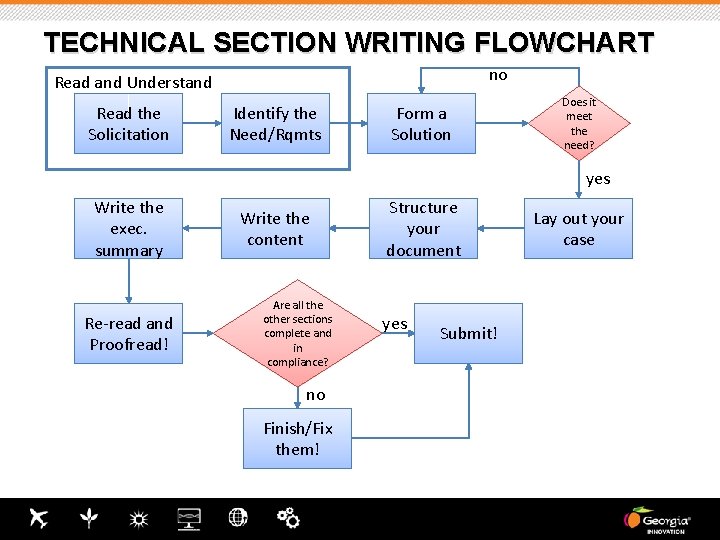
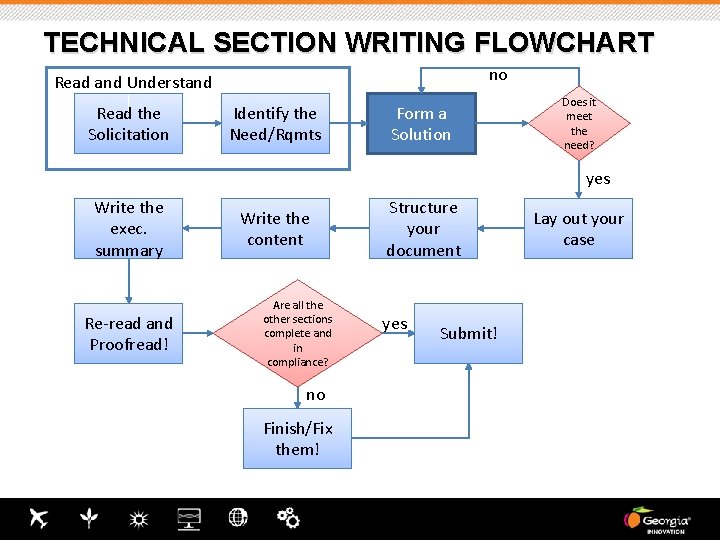
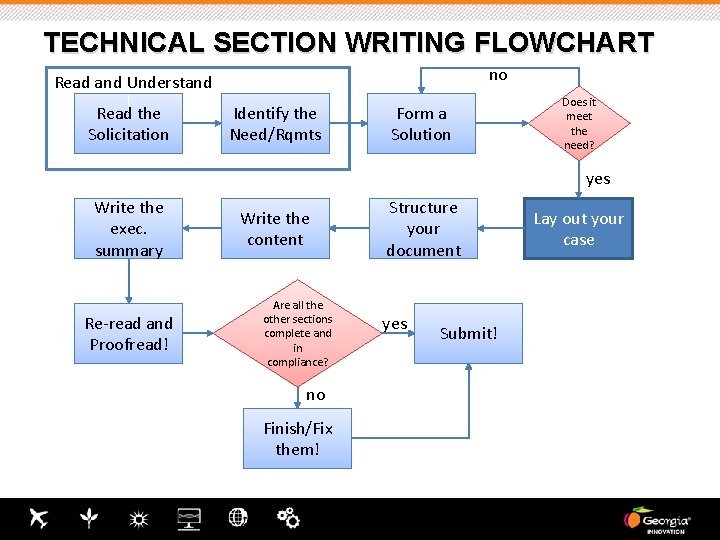
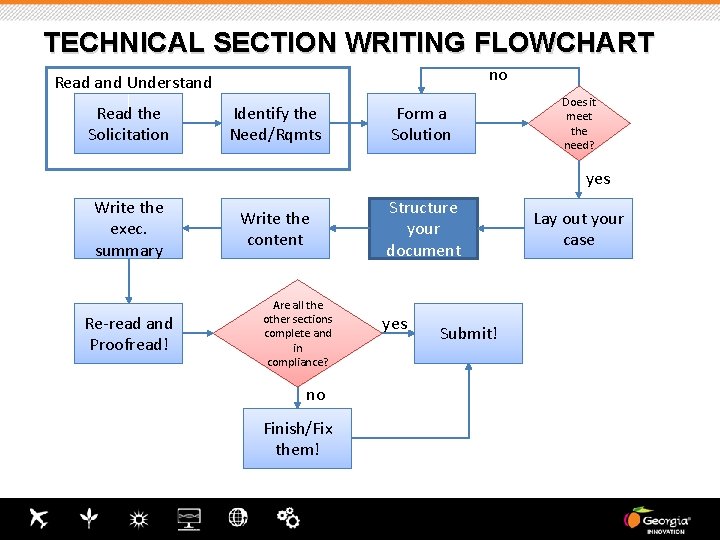
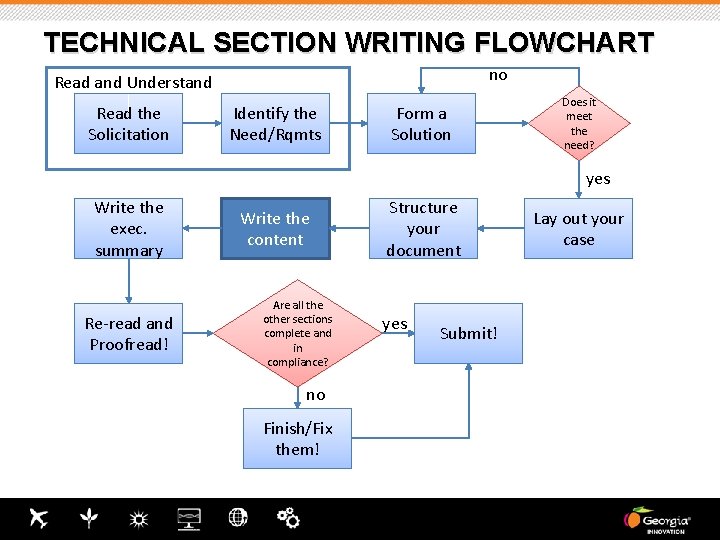
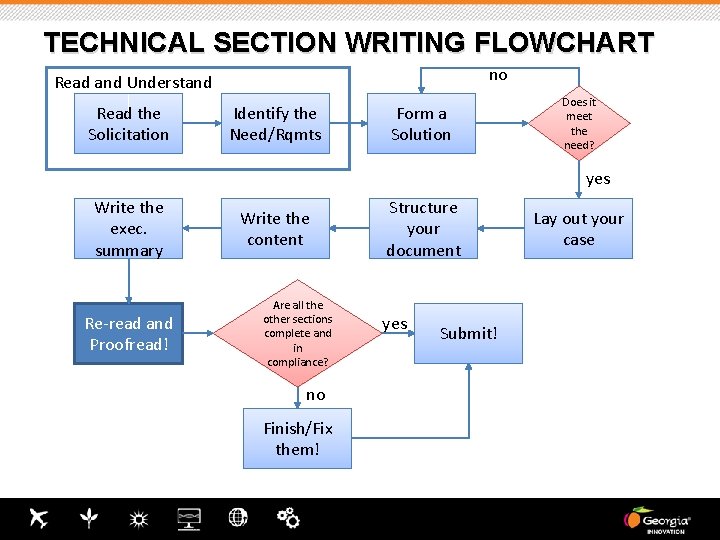
TECHNICAL SECTION WRITING FLOWCHART no Read and Understand Read the Solicitation Identify the Need/Rqmts Form a Solution Does it meet the need? yes Write the exec. summary Re-read and Proofread! Write the content Are all the other sections complete and in compliance? no Finish/Fix them! Structure your document yes Submit! Lay out your case
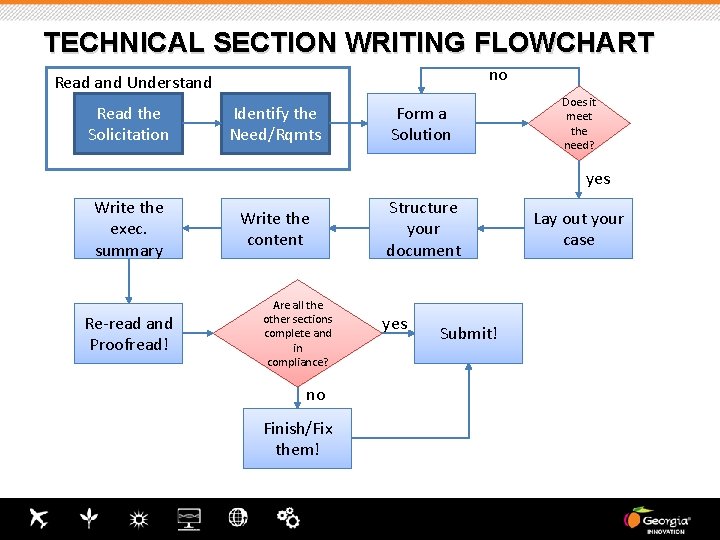
TECHNICAL SECTION WRITING FLOWCHART no Read and Understand Read the Solicitation Identify the Need/Rqmts Form a Solution Does it meet the need? yes Write the exec. summary Re-read and Proofread! Write the content Are all the other sections complete and in compliance? no Finish/Fix them! Structure your document yes Submit! Lay out your case
TECHNICAL SECTION FOCUS: PART 1 – READ AND UNDERSTAND THE SOLICITATION • What is the stated goal of the solicitation in one sentence? • What are the key needs? • What requirements have been identified? • What requirements can you derive from your own research? • The solution you propose should address the needs of the requesting organization
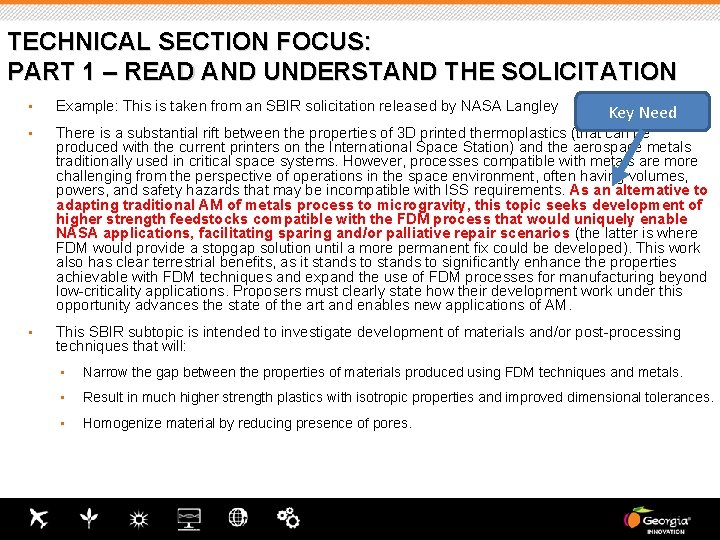
TECHNICAL SECTION FOCUS: PART 1 – READ AND UNDERSTAND THE SOLICITATION • Example: This is taken from an SBIR solicitation released by NASA Langley • There is a substantial rift between the properties of 3 D printed thermoplastics (that can be produced with the current printers on the International Space Station) and the aerospace metals traditionally used in critical space systems. However, processes compatible with metals are more challenging from the perspective of operations in the space environment, often having volumes, powers, and safety hazards that may be incompatible with ISS requirements. As an alternative to adapting traditional AM of metals process to microgravity, this topic seeks development of higher strength feedstocks compatible with the FDM process that would uniquely enable NASA applications, facilitating sparing and/or palliative repair scenarios (the latter is where FDM would provide a stopgap solution until a more permanent fix could be developed). This work also has clear terrestrial benefits, as it stands to significantly enhance the properties achievable with FDM techniques and expand the use of FDM processes for manufacturing beyond low-criticality applications. Proposers must clearly state how their development work under this opportunity advances the state of the art and enables new applications of AM. • This SBIR subtopic is intended to investigate development of materials and/or post-processing techniques that will: Key Need • Narrow the gap between the properties of materials produced using FDM techniques and metals. • Result in much higher strength plastics with isotropic properties and improved dimensional tolerances. • Homogenize material by reducing presence of pores.
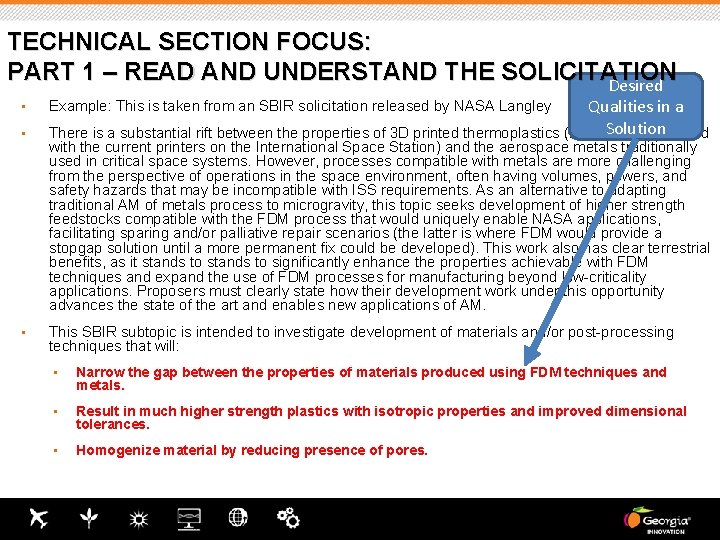
TECHNICAL SECTION FOCUS: PART 1 – READ AND UNDERSTAND THE SOLICITATION Desired • • • Qualities in a Solution There is a substantial rift between the properties of 3 D printed thermoplastics (that can be produced Example: This is taken from an SBIR solicitation released by NASA Langley with the current printers on the International Space Station) and the aerospace metals traditionally used in critical space systems. However, processes compatible with metals are more challenging from the perspective of operations in the space environment, often having volumes, powers, and safety hazards that may be incompatible with ISS requirements. As an alternative to adapting traditional AM of metals process to microgravity, this topic seeks development of higher strength feedstocks compatible with the FDM process that would uniquely enable NASA applications, facilitating sparing and/or palliative repair scenarios (the latter is where FDM would provide a stopgap solution until a more permanent fix could be developed). This work also has clear terrestrial benefits, as it stands to significantly enhance the properties achievable with FDM techniques and expand the use of FDM processes for manufacturing beyond low-criticality applications. Proposers must clearly state how their development work under this opportunity advances the state of the art and enables new applications of AM. This SBIR subtopic is intended to investigate development of materials and/or post-processing techniques that will: • Narrow the gap between the properties of materials produced using FDM techniques and metals. • Result in much higher strength plastics with isotropic properties and improved dimensional tolerances. • Homogenize material by reducing presence of pores.
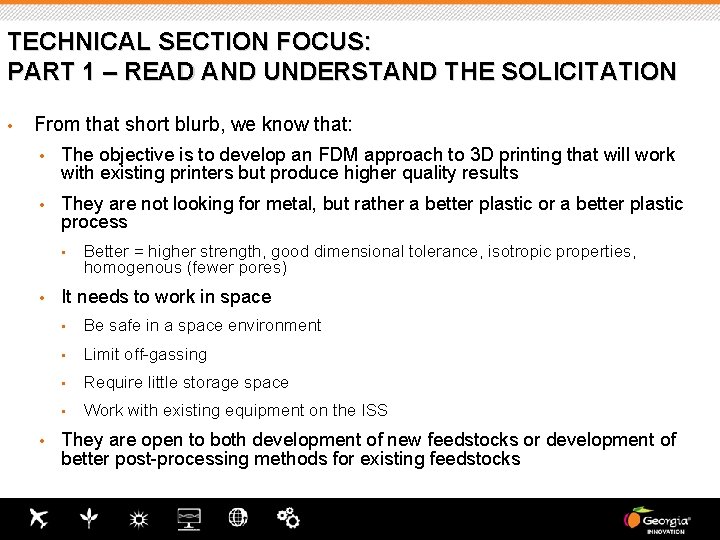
TECHNICAL SECTION FOCUS: PART 1 – READ AND UNDERSTAND THE SOLICITATION • From that short blurb, we know that: • The objective is to develop an FDM approach to 3 D printing that will work with existing printers but produce higher quality results • They are not looking for metal, but rather a better plastic or a better plastic process • • • Better = higher strength, good dimensional tolerance, isotropic properties, homogenous (fewer pores) It needs to work in space • Be safe in a space environment • Limit off-gassing • Require little storage space • Work with existing equipment on the ISS They are open to both development of new feedstocks or development of better post-processing methods for existing feedstocks
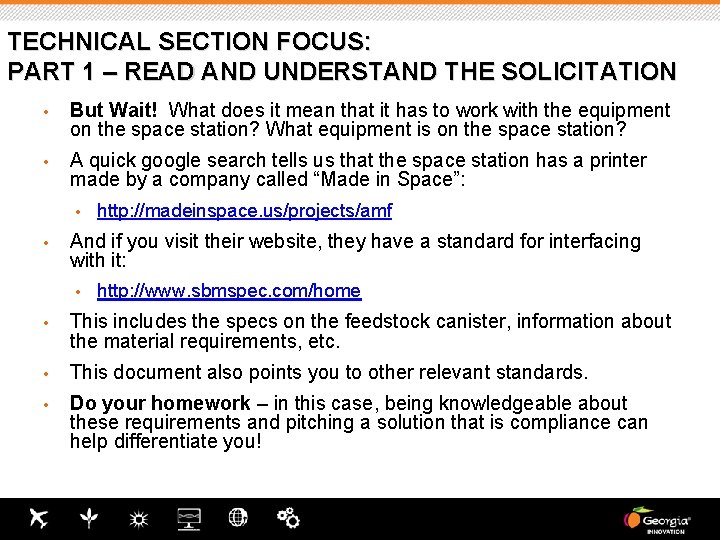
TECHNICAL SECTION FOCUS: PART 1 – READ AND UNDERSTAND THE SOLICITATION • But Wait! What does it mean that it has to work with the equipment on the space station? What equipment is on the space station? • A quick google search tells us that the space station has a printer made by a company called “Made in Space”: • • http: //madeinspace. us/projects/amf And if you visit their website, they have a standard for interfacing with it: • http: //www. sbmspec. com/home • This includes the specs on the feedstock canister, information about the material requirements, etc. • This document also points you to other relevant standards. • Do your homework – in this case, being knowledgeable about these requirements and pitching a solution that is compliance can help differentiate you!
TECHNICAL SECTION WRITING FLOWCHART no Read and Understand Read the Solicitation Identify the Need/Rqmts Form a Solution Does it meet the need? yes Write the exec. summary Re-read and Proofread! Write the content Are all the other sections complete and in compliance? no Finish/Fix them! Structure your document yes Submit! Lay out your case
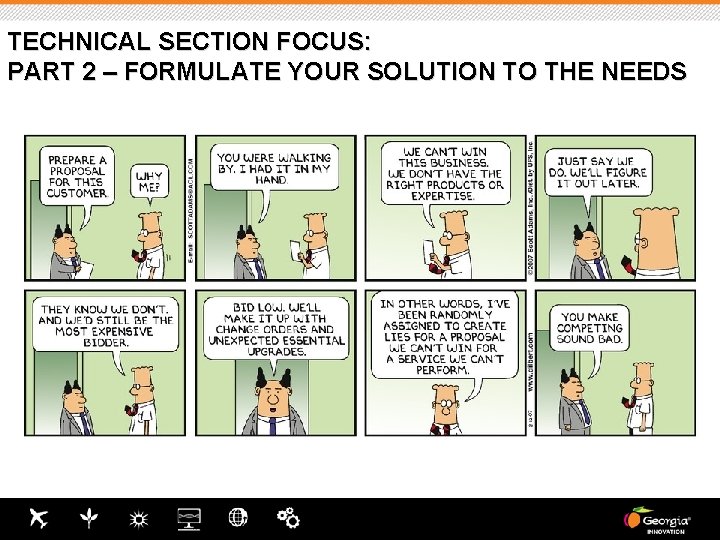
TECHNICAL SECTION FOCUS: PART 2 – FORMULATE YOUR SOLUTION TO THE NEEDS
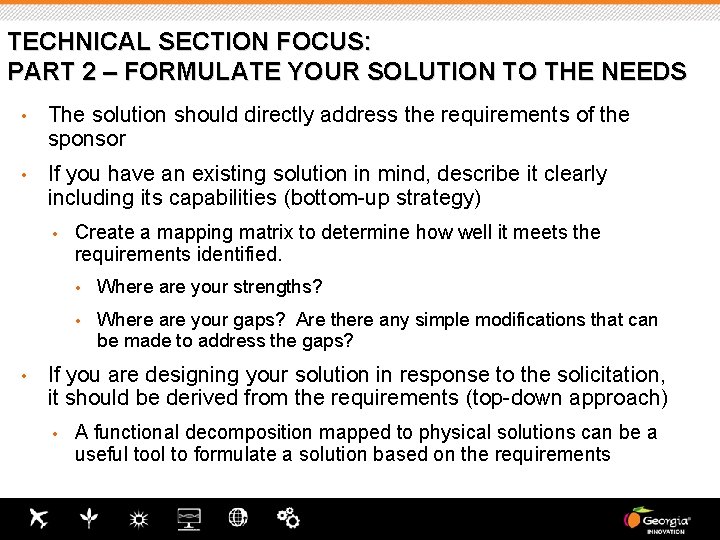
TECHNICAL SECTION FOCUS: PART 2 – FORMULATE YOUR SOLUTION TO THE NEEDS • The solution should directly address the requirements of the sponsor • If you have an existing solution in mind, describe it clearly including its capabilities (bottom-up strategy) • • Create a mapping matrix to determine how well it meets the requirements identified. • Where are your strengths? • Where are your gaps? Are there any simple modifications that can be made to address the gaps? If you are designing your solution in response to the solicitation, it should be derived from the requirements (top-down approach) • A functional decomposition mapped to physical solutions can be a useful tool to formulate a solution based on the requirements
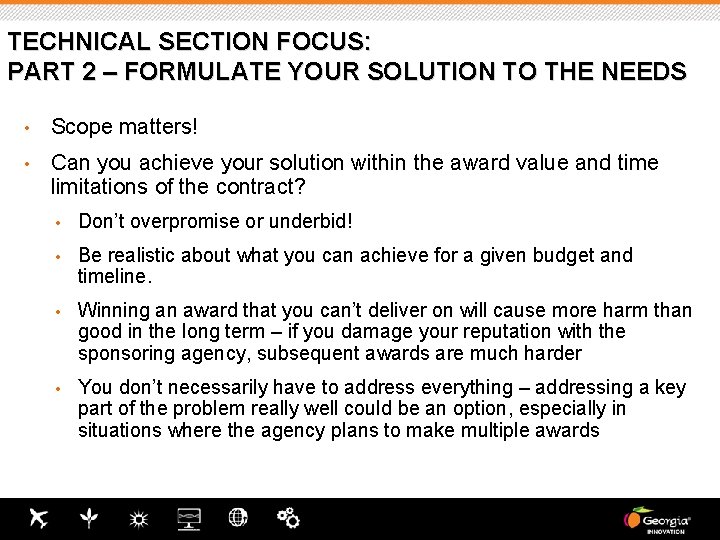
TECHNICAL SECTION FOCUS: PART 2 – FORMULATE YOUR SOLUTION TO THE NEEDS • Scope matters! • Can you achieve your solution within the award value and time limitations of the contract? • Don’t overpromise or underbid! • Be realistic about what you can achieve for a given budget and timeline. • Winning an award that you can’t deliver on will cause more harm than good in the long term – if you damage your reputation with the sponsoring agency, subsequent awards are much harder • You don’t necessarily have to address everything – addressing a key part of the problem really well could be an option, especially in situations where the agency plans to make multiple awards
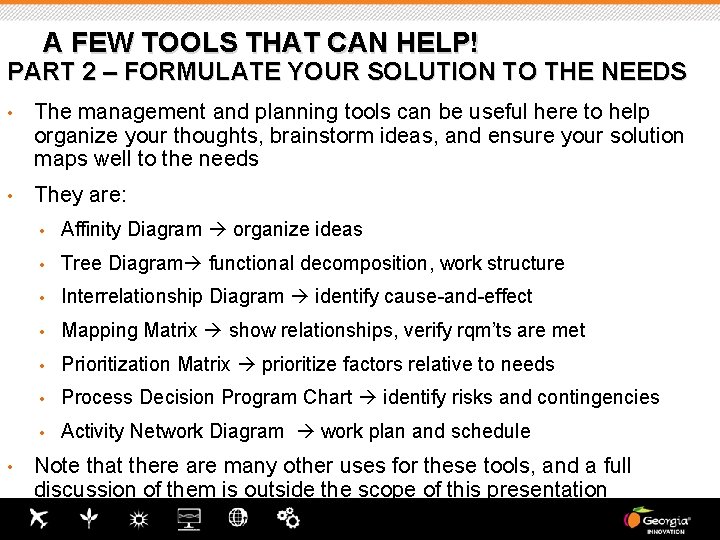
A FEW TOOLS THAT CAN HELP! PART 2 – FORMULATE YOUR SOLUTION TO THE NEEDS • The management and planning tools can be useful here to help organize your thoughts, brainstorm ideas, and ensure your solution maps well to the needs • They are: • • Affinity Diagram organize ideas • Tree Diagram functional decomposition, work structure • Interrelationship Diagram identify cause-and-effect • Mapping Matrix show relationships, verify rqm’ts are met • Prioritization Matrix prioritize factors relative to needs • Process Decision Program Chart identify risks and contingencies • Activity Network Diagram work plan and schedule Note that there are many other uses for these tools, and a full discussion of them is outside the scope of this presentation
TECHNICAL SECTION WRITING FLOWCHART no Read and Understand Read the Solicitation Identify the Need/Rqmts Form a Solution Does it meet the need? yes Write the exec. summary Re-read and Proofread! Write the content Are all the other sections complete and in compliance? no Finish/Fix them! Structure your document yes Submit! Lay out your case
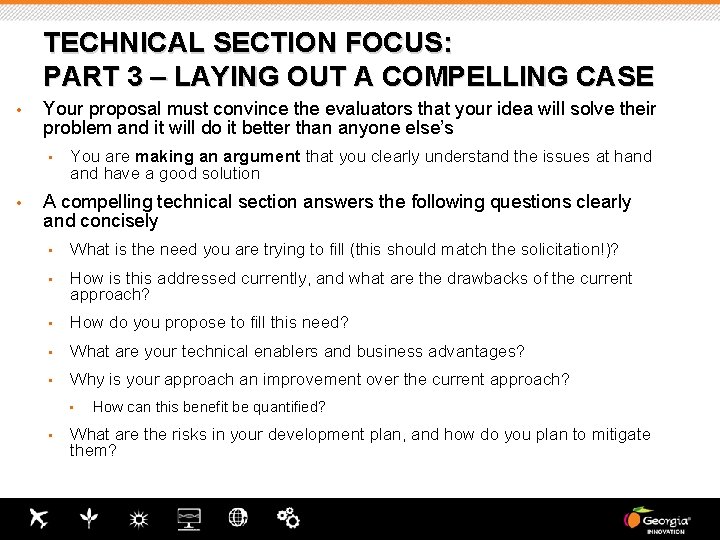
TECHNICAL SECTION FOCUS: PART 3 – LAYING OUT A COMPELLING CASE • Your proposal must convince the evaluators that your idea will solve their problem and it will do it better than anyone else’s • • You are making an argument that you clearly understand the issues at hand have a good solution A compelling technical section answers the following questions clearly and concisely • What is the need you are trying to fill (this should match the solicitation!)? • How is this addressed currently, and what are the drawbacks of the current approach? • How do you propose to fill this need? • What are your technical enablers and business advantages? • Why is your approach an improvement over the current approach? • • How can this benefit be quantified? What are the risks in your development plan, and how do you plan to mitigate them?
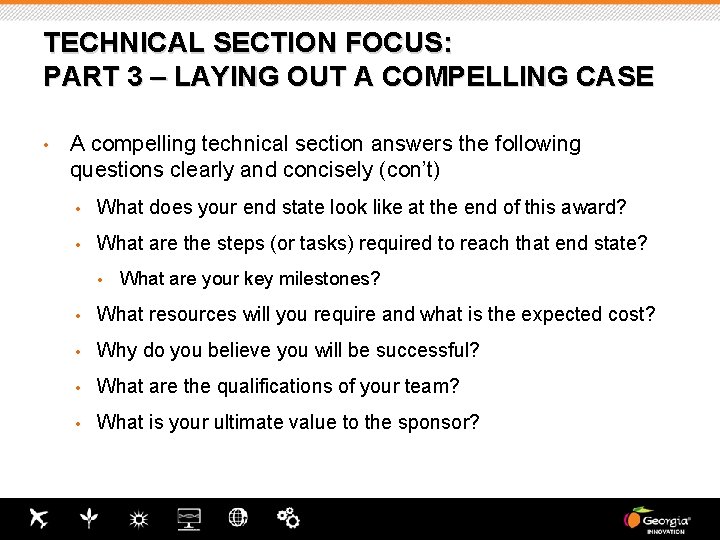
TECHNICAL SECTION FOCUS: PART 3 – LAYING OUT A COMPELLING CASE • A compelling technical section answers the following questions clearly and concisely (con’t) • What does your end state look like at the end of this award? • What are the steps (or tasks) required to reach that end state? • What are your key milestones? • What resources will you require and what is the expected cost? • Why do you believe you will be successful? • What are the qualifications of your team? • What is your ultimate value to the sponsor?
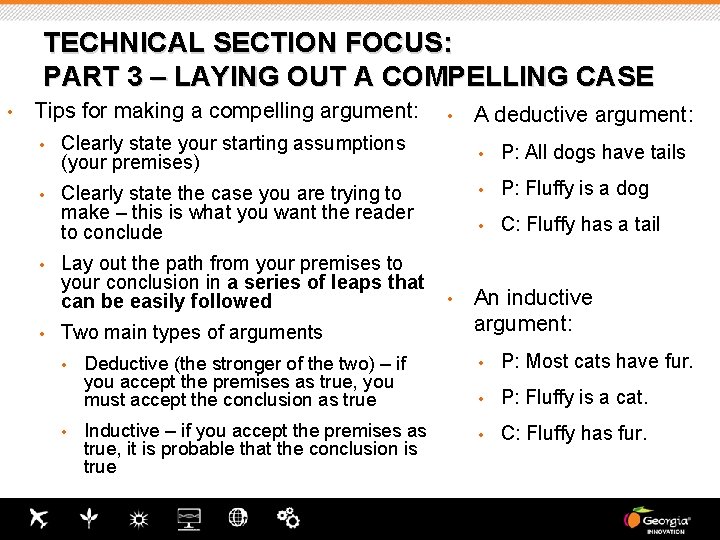
TECHNICAL SECTION FOCUS: PART 3 – LAYING OUT A COMPELLING CASE • Tips for making a compelling argument: • Clearly state your starting assumptions (your premises) • Clearly state the case you are trying to make – this is what you want the reader to conclude • • Lay out the path from your premises to your conclusion in a series of leaps that can be easily followed Two main types of arguments • • A deductive argument: • P: All dogs have tails • P: Fluffy is a dog • C: Fluffy has a tail An inductive argument: Deductive (the stronger of the two) – if you accept the premises as true, you must accept the conclusion as true • P: Most cats have fur. • P: Fluffy is a cat. Inductive – if you accept the premises as true, it is probable that the conclusion is true • C: Fluffy has fur.
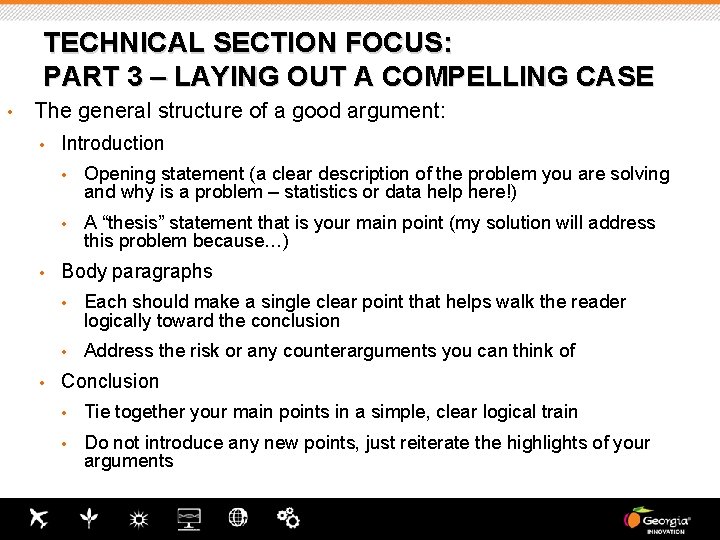
TECHNICAL SECTION FOCUS: PART 3 – LAYING OUT A COMPELLING CASE • The general structure of a good argument: • • • Introduction • Opening statement (a clear description of the problem you are solving and why is a problem – statistics or data help here!) • A “thesis” statement that is your main point (my solution will address this problem because…) Body paragraphs • Each should make a single clear point that helps walk the reader logically toward the conclusion • Address the risk or any counterarguments you can think of Conclusion • Tie together your main points in a simple, clear logical train • Do not introduce any new points, just reiterate the highlights of your arguments
TECHNICAL SECTION WRITING FLOWCHART no Read and Understand Read the Solicitation Identify the Need/Rqmts Form a Solution Does it meet the need? yes Write the exec. summary Re-read and Proofread! Write the content Are all the other sections complete and in compliance? no Finish/Fix them! Structure your document yes Submit! Lay out your case
TECHNICAL SECTION FOCUS: PART 4 – DOCUMENT STRUCTURE • The structure of the document needs to tell a clear story, but it also needs to be in the language of the solicitation • Your document should start with an introduction that clearly states the need and your proposed solutions • Titling section headings to match required solicitation elements (or even better, elements of the evaluation criteria rubric) can make it easier for an evaluator • Finding a balance between a structure that allows your story to flow and a structure that clearly matches back to the solicitation requirements can be tricky, but striking that balance will make life easier for the evaluator • Note that some solicitations require or recommend a document structure – if this is the case, do not deviate! Instead, focus on well-structured content inside the sections.
TECHNICAL SECTION FOCUS: PART 4 – DOCUMENT STRUCTURE • One of my rules of thumb is that the Table of Contents should make a logical flow when read alone. If not, it is likely that the content will also be disjoint • In each section, write a 1 -3 sentence summary of the key point the section is trying to make. • When all of these summaries are read in order, it should give a coherent summary of your document. • Make sure that in the structure, there is a home for the answers to each of the questions in step 3 • Budget how much space you want to spend on each section, keeping in mind the overall page limit and the importance of each section • Also consider the evaluation rubric, and make sure you are giving due space to the highest weighted criteria
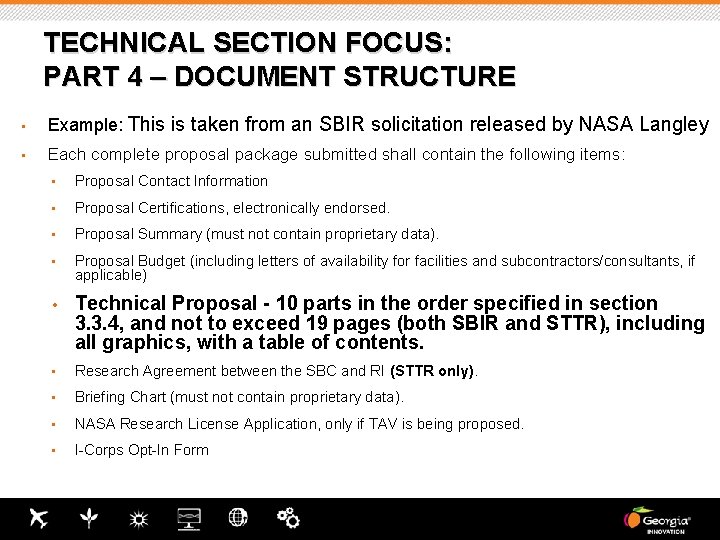
TECHNICAL SECTION FOCUS: PART 4 – DOCUMENT STRUCTURE • Example: This is taken from an SBIR solicitation released by NASA Langley • Each complete proposal package submitted shall contain the following items: • Proposal Contact Information • Proposal Certifications, electronically endorsed. • Proposal Summary (must not contain proprietary data). • Proposal Budget (including letters of availability for facilities and subcontractors/consultants, if applicable) • Technical Proposal - 10 parts in the order specified in section 3. 3. 4, and not to exceed 19 pages (both SBIR and STTR), including all graphics, with a table of contents. • Research Agreement between the SBC and RI (STTR only). • Briefing Chart (must not contain proprietary data). • NASA Research License Application, only if TAV is being proposed. • I-Corps Opt-In Form
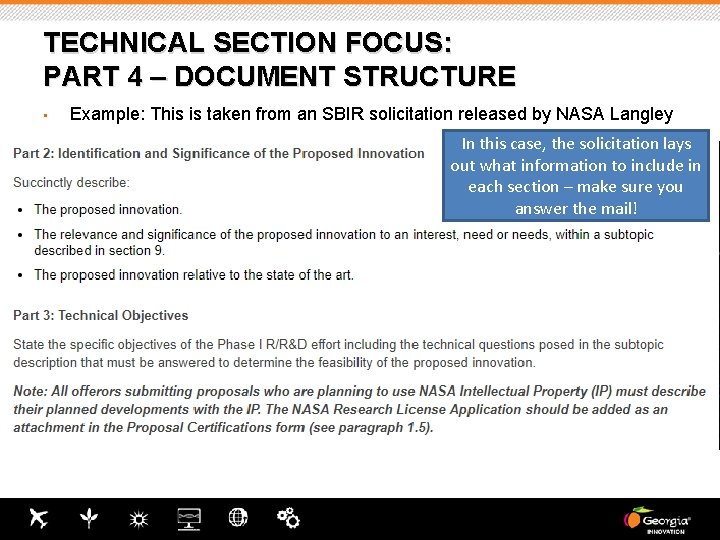
TECHNICAL SECTION FOCUS: PART 4 – DOCUMENT STRUCTURE • Example: This is taken from an SBIR solicitation released by NASA Langley In this case, the solicitation lays out what information to include in each section – make sure you answer the mail!
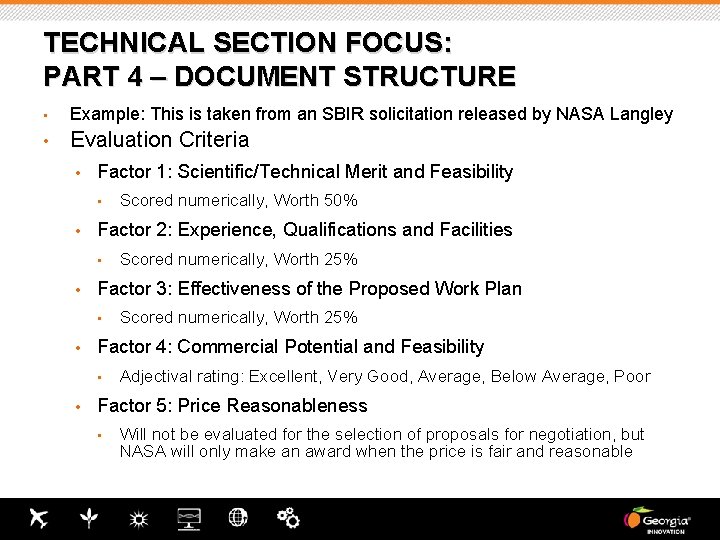
TECHNICAL SECTION FOCUS: PART 4 – DOCUMENT STRUCTURE • Example: This is taken from an SBIR solicitation released by NASA Langley • Evaluation Criteria • Factor 1: Scientific/Technical Merit and Feasibility • • Factor 2: Experience, Qualifications and Facilities • • Scored numerically, Worth 25% Factor 4: Commercial Potential and Feasibility • • Scored numerically, Worth 25% Factor 3: Effectiveness of the Proposed Work Plan • • Scored numerically, Worth 50% Adjectival rating: Excellent, Very Good, Average, Below Average, Poor Factor 5: Price Reasonableness • Will not be evaluated for the selection of proposals for negotiation, but NASA will only make an award when the price is fair and reasonable
TECHNICAL SECTION WRITING FLOWCHART no Read and Understand Read the Solicitation Identify the Need/Rqmts Form a Solution Does it meet the need? yes Write the exec. summary Re-read and Proofread! Write the content Are all the other sections complete and in compliance? no Finish/Fix them! Structure your document yes Submit! Lay out your case
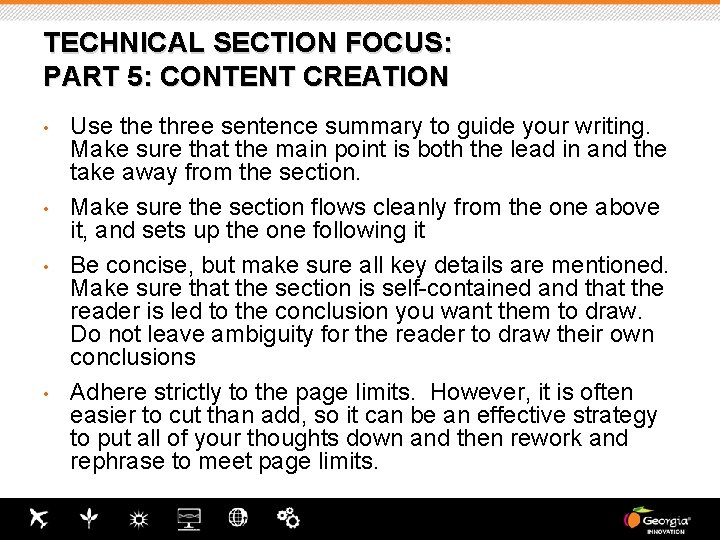
TECHNICAL SECTION FOCUS: PART 5: CONTENT CREATION • • Use three sentence summary to guide your writing. Make sure that the main point is both the lead in and the take away from the section. Make sure the section flows cleanly from the one above it, and sets up the one following it Be concise, but make sure all key details are mentioned. Make sure that the section is self-contained and that the reader is led to the conclusion you want them to draw. Do not leave ambiguity for the reader to draw their own conclusions Adhere strictly to the page limits. However, it is often easier to cut than add, so it can be an effective strategy to put all of your thoughts down and then rework and rephrase to meet page limits.
TECHNICAL SECTION WRITING FLOWCHART no Read and Understand Read the Solicitation Identify the Need/Rqmts Form a Solution Does it meet the need? yes Write the exec. summary Re-read and Proofread! Write the content Are all the other sections complete and in compliance? no Finish/Fix them! Structure your document yes Submit! Lay out your case
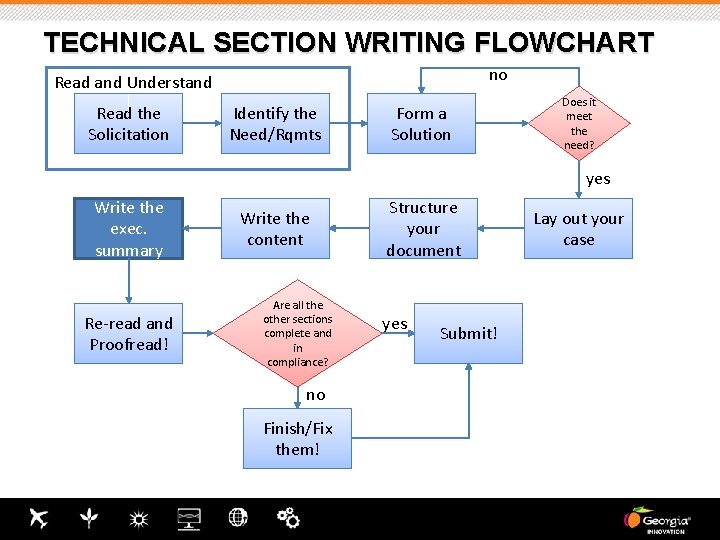
TECHNICAL SECTION FOCUS: PART 6: WRITE THE EXECUTIVE SUMMARY • Write the executive summary last to make sure it is consentient with the rest of the document • Include a clear statement of the need, your solution, and how your solution addresses the need • This is your elevator pitch – make sure it clearly conveys that you understand the need and have a solution to their problem • If possible, have someone who did not contribute to the writing of the document, but who is knowledgeable about the topic read the document and provide feedback
TECHNICAL SECTION WRITING FLOWCHART no Read and Understand Read the Solicitation Identify the Need/Rqmts Form a Solution Does it meet the need? yes Write the exec. summary Re-read and Proofread! Write the content Are all the other sections complete and in compliance? no Finish/Fix them! Structure your document yes Submit! Lay out your case
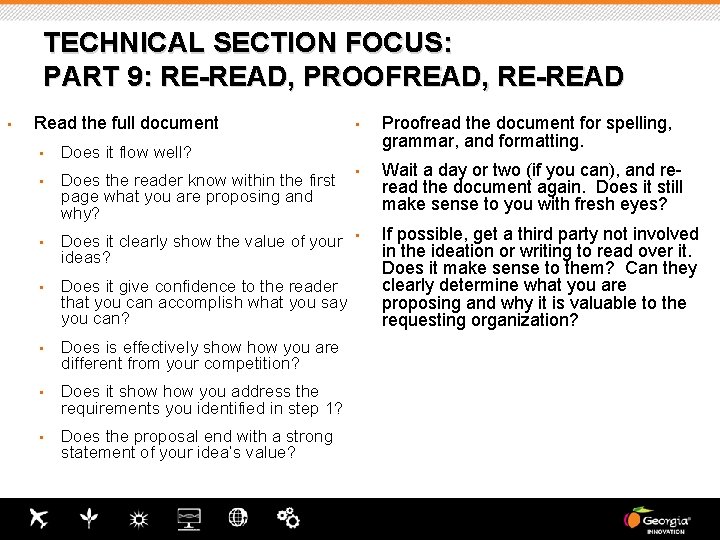
TECHNICAL SECTION FOCUS: PART 9: RE-READ, PROOFREAD, RE-READ • Read the full document • Does it flow well? • Does the reader know within the first page what you are proposing and why? • • Proofread the document for spelling, grammar, and formatting. • Wait a day or two (if you can), and reread the document again. Does it still make sense to you with fresh eyes? Does it clearly show the value of your • ideas? • Does it give confidence to the reader that you can accomplish what you say you can? • Does is effectively show you are different from your competition? • Does it show you address the requirements you identified in step 1? • Does the proposal end with a strong statement of your idea’s value? If possible, get a third party not involved in the ideation or writing to read over it. Does it make sense to them? Can they clearly determine what you are proposing and why it is valuable to the requesting organization?
THIS SESSION WILL COVER: • What is in a solicitation and how can Georgia’s Resource Organizations help you navigate it? • Focus on the Technical Section • A process for developing a strong technical section • Tips for telling a compelling story
TELLING A STORY WITH YOUR PROPOSAL • An effective proposal tells the evaluators a story about the problem you are solving, how you propose to solve it, why your solution is a good one, and why your team is qualified to produce that solution • One of the most challenging parts of writing an effective technical section is balancing the need for a clear demonstration of your technical concept while also ensuring that you are effectively communicating your ideas to a very broad range of potential evaluators • All stories have a beginning, a middle, and an end.
TELLING A STORY WITH YOUR PROPOSAL • Beginning • • Middle • • Clear statement of your understanding of the need, with a clear and concise summary of how you plan to address it. Make sure your takeaway message is clearly stated. Description of your solution, key points of how it works, its strengths with respect to the stated need, your team’s past related successes, and your risk management approach End • A clear reiteration of the need, the solution, and the strengths of the solution at meeting the need. Make sure your takeaway message is clearly stated.
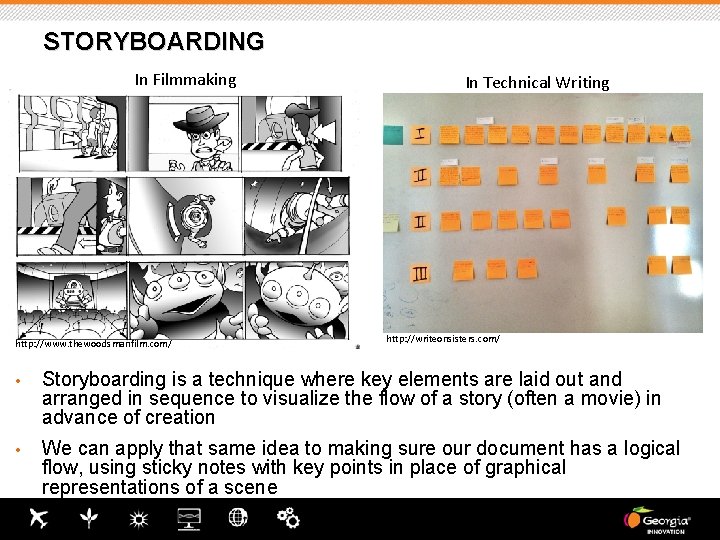
STORYBOARDING In Filmmaking http: //www. thewoodsmanfilm. com/ In Technical Writing http: //writeonsisters. com/ • Storyboarding is a technique where key elements are laid out and arranged in sequence to visualize the flow of a story (often a movie) in advance of creation • We can apply that same idea to making sure our document has a logical flow, using sticky notes with key points in place of graphical representations of a scene
STORYBOARDING • Storyboarding can be an effective technique to make sure that your proposal flows well from one point to the next • Make sure you are leading your reader to each conclusion you want them to reach – give them no choice but to reach the same conclusion you have, do not leave room for speculation or interpretation • Logical leaps can be a death sentence for a proposal, as they create a sense of disorder, and can lead to deep misunderstandings if the reader made a different leap than you intended • Make your case compelling – make sure you are painting a clear picture of problem that demands your solution to solve, and provide your reader with a clear picture of the consequences if the problem is not solved.
STORYBOARDING • Think about what makes a good book – setup the story, provide a source of tension or suspense, and then solve it! • For example (this is completely fictional!): • The Navy is critical to protecting our borders • Without a way to effectively identify and engage small vessel threats, our greatest Naval assets are at risk to be crippled by attacks from militant organizations and pirates, and these types of attacks have been increasing at an alarming rate • Current detection technology allows ships to detect these incoming threats with a very short warning time, making it hard to effectively defend against them • My long-range laser scanning technology allows you to detect small vessels 2 x sooner than current technology, which adds critical seconds to the response window and can increase the success rate by 80%
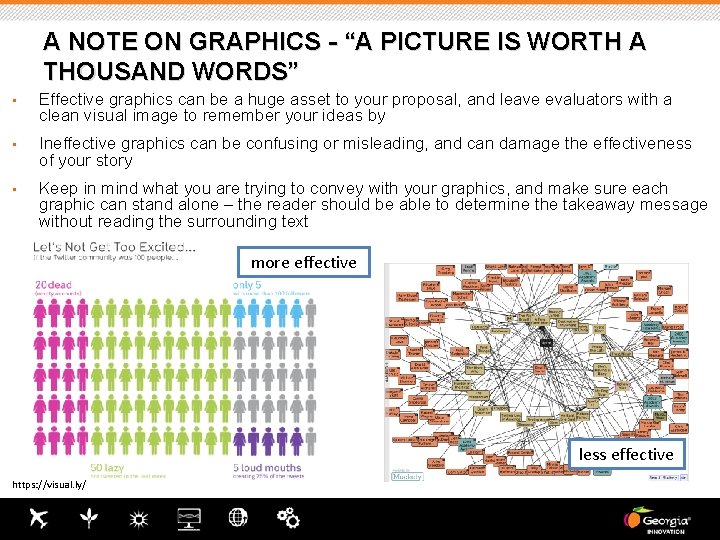
A NOTE ON GRAPHICS - “A PICTURE IS WORTH A THOUSAND WORDS” • Effective graphics can be a huge asset to your proposal, and leave evaluators with a clean visual image to remember your ideas by • Ineffective graphics can be confusing or misleading, and can damage the effectiveness of your story • Keep in mind what you are trying to convey with your graphics, and make sure each graphic can stand alone – the reader should be able to determine the takeaway message without reading the surrounding text more effective less effective https: //visual. ly/
THIS SESSION HAS COVERED: • What is in a solicitation, and how can Georgia’s Resource Organizations help you navigate it? • Focus on the Technical Section • • A process for developing a strong technical section • Tools for requirements to solution brainstorming • Tips for telling a compelling story Feel free to reach out to COIA or Georgia’s small business resource organizations for assistance!
Center of Innovation for Aerospace. georgiainnovation. org Amy Hudnall Director ahudnall@georgia. org 478. 230. 4300 Gary O’Neill Senior Aerospace & Defense Specialist goneill@georgia. org 404/433. 8771 Dr. Kelly Griendling Senior Project Manager kgriendling@georgia. org