
TIP 2 Science Fair RESEARCH AND BIBLIOGRAPHY Science
TIP #2 Science Fair RESEARCH AND BIBLIOGRAPHY
Science Fair Research At this point you should have completed the following with your Science Teacher: 1. Topic approval And working on your… 2. Problem statement. 3. Hypothesis. NOW it’s time to RESEARCH!!
What do I need to research? ? Your research will be related to the topic of your experiment. Look at your problem statement and hypothesis to get ideas. Use key scientific vocabulary to direct your search. Use Scientific Concepts to also direct your search.
Here is an example! PROBLEM STATEMENT How many times does a balloon need to be rubbed to create enough static electricity to stick to a wall? HYPOTHESIS If a balloon is rubbed 10 times then it will stick to a wall.
What do you think should be the research sub-topics? Use the hypothesis and problem statement for Ideas.
What would you research? What is static electricity? What causes the balloon to stick to a wall? Why does the balloon need to be rubbed? Do some materials work better than Others for making static electricity? If so, what are they? How is static electricity Similar to /different from electricity from an electrical outlet?
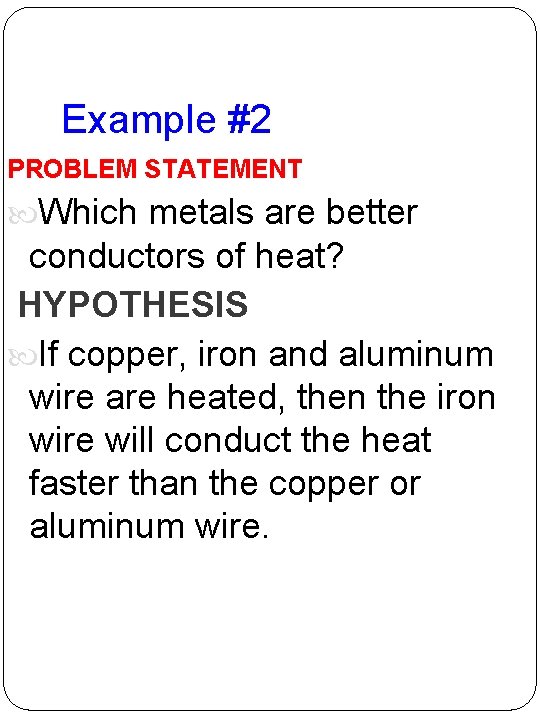
Example #2 PROBLEM STATEMENT Which metals are better conductors of heat? HYPOTHESIS If copper, iron and aluminum wire are heated, then the iron wire will conduct the heat faster than the copper or aluminum wire.
What do you think should be the research sub-topics? Use the hypothesis and problem statement for Ideas.
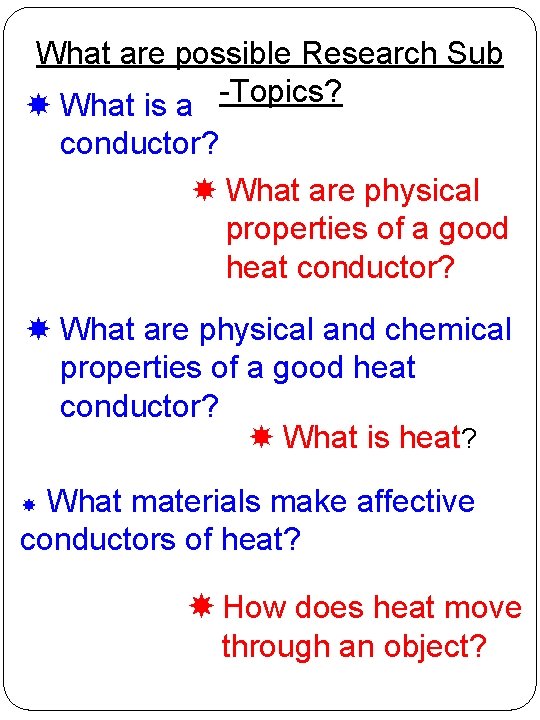
What are possible Research Sub What is a -Topics? conductor? What are physical properties of a good heat conductor? What are physical and chemical properties of a good heat conductor? What is heat? What materials make affective conductors of heat? How does heat move through an object?
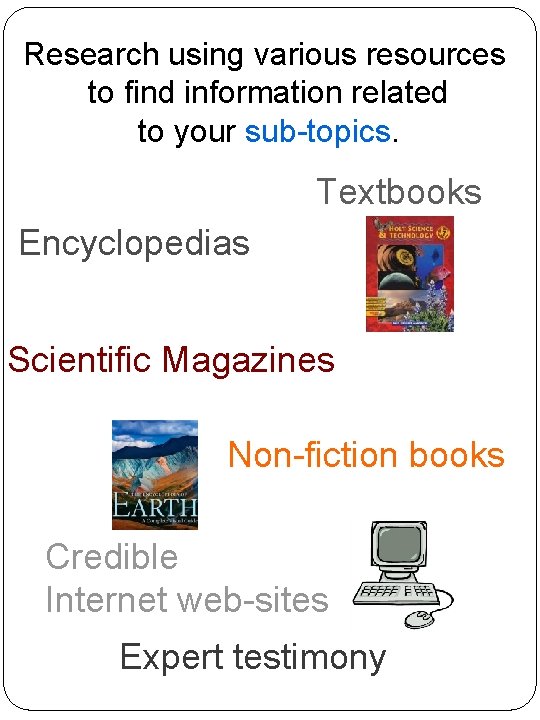
Research using various resources to find information related to your sub-topics. Textbooks Encyclopedias Scientific Magazines Non-fiction books Credible Internet web-sites Expert testimony
Wikipedia may not be used as a source.
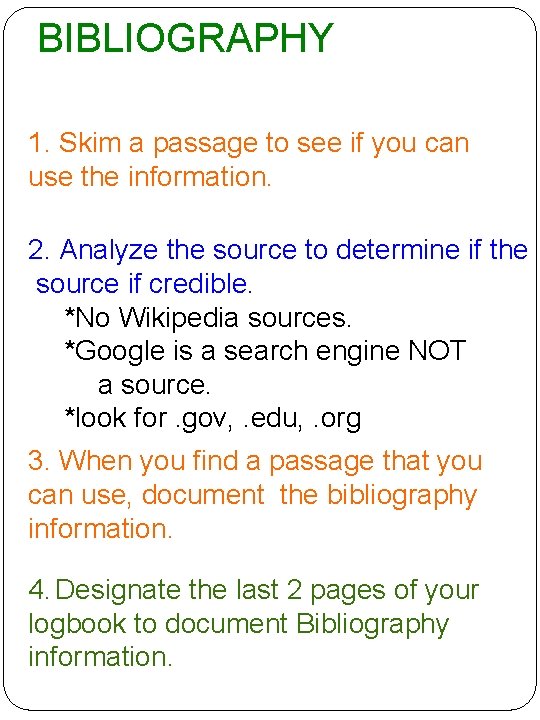
BIBLIOGRAPHY 1. Skim a passage to see if you can use the information. 2. Analyze the source to determine if the source if credible. *No Wikipedia sources. *Google is a search engine NOT a source. *look for. gov, . edu, . org 3. When you find a passage that you can use, document the bibliography information. 4. Designate the last 2 pages of your logbook to document Bibliography information.
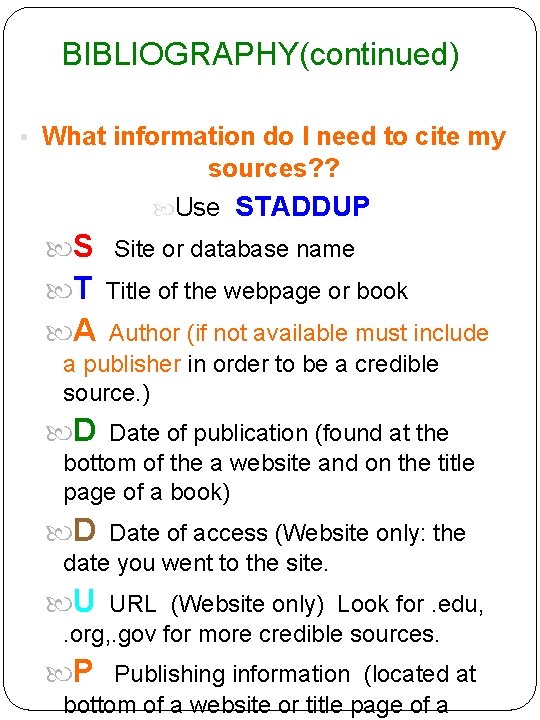
BIBLIOGRAPHY(continued) • What information do I need to cite my sources? ? Use STADDUP S Site or database name T Title of the webpage or book A Author (if not available must include a publisher in order to be a credible source. ) D Date of publication (found at the bottom of the a website and on the title page of a book) D Date of access (Website only: the date you went to the site. U URL (Website only) Look for. edu, . org, . gov for more credible sources. P Publishing information (located at bottom of a website or title page of a
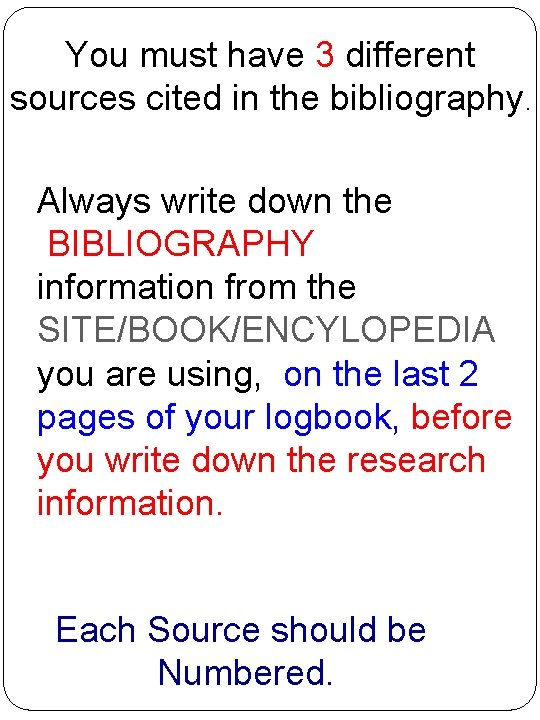
You must have 3 different sources cited in the bibliography. Always write down the BIBLIOGRAPHY information from the SITE/BOOK/ENCYLOPEDIA you are using, on the last 2 pages of your logbook, before you write down the research information. Each Source should be Numbered.
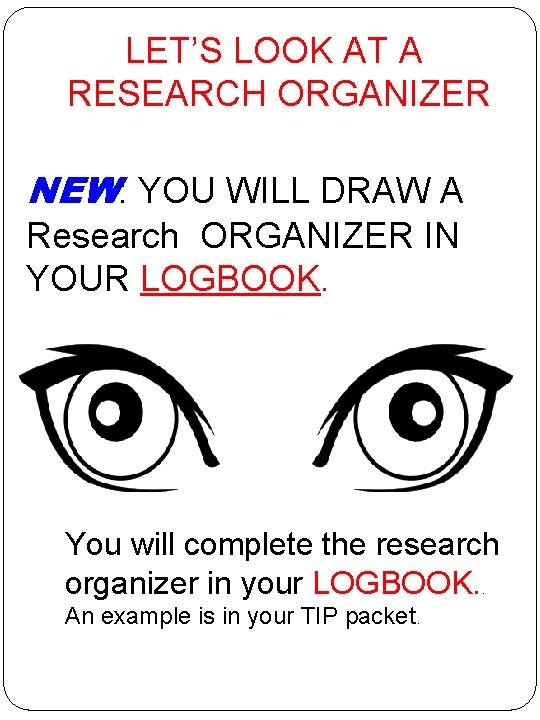
LET’S LOOK AT A RESEARCH ORGANIZER NEW: YOU WILL DRAW A Research ORGANIZER IN YOUR LOGBOOK. You will complete the research organizer in your LOGBOOK. . An example is in your TIP packet.
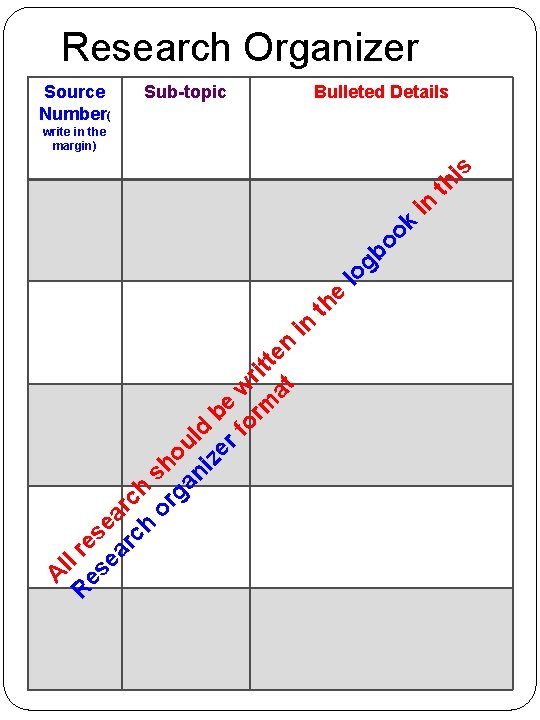
ll R re es s ea ea rc rch h or sh ga ou ni ld ze b rf ew or r m itt at en A in th e lo gb oo k in th is Research Organizer Source Number( Sub-topic Bulleted Details write in the margin)
READ the passage needed for your research. Bullet the details from your research on the Research Organizer draw In your logbook WRITE the information in your own words. This decreases the possibility of plagiarism.
Let’s Look at a Completed Example using the Conductors of Heat Experiment.
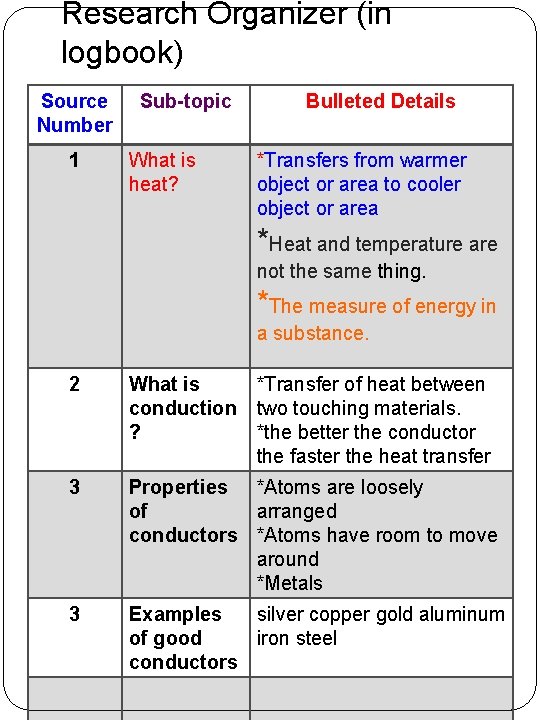
Research Organizer (in logbook) Source Number 1 Sub-topic What is heat? Bulleted Details *Transfers from warmer object or area to cooler object or area *Heat and temperature are not the same thing. *The measure of energy in a substance. 2 What is *Transfer of heat between conduction two touching materials. ? *the better the conductor the faster the heat transfer 3 Properties *Atoms are loosely of arranged conductors *Atoms have room to move around *Metals 3 Examples silver copper gold aluminum of good iron steel conductors
Let’s Look at a Completed Example using the Static Electricity of a Balloon Experiment
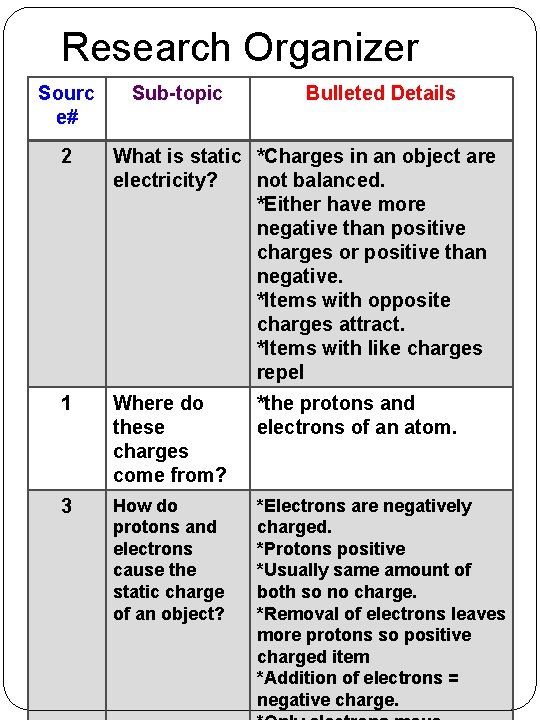
Research Organizer Sourc e# Sub-topic Bulleted Details 2 What is static *Charges in an object are electricity? not balanced. *Either have more negative than positive charges or positive than negative. *Items with opposite charges attract. *Items with like charges repel 1 Where do these charges come from? *the protons and electrons of an atom. 3 How do protons and electrons cause the static charge of an object? *Electrons are negatively charged. *Protons positive *Usually same amount of both so no charge. *Removal of electrons leaves more protons so positive charged item *Addition of electrons = negative charge.
Now you are ready to RESEARCH for your Science Fair Research Report!!!

Let’s Review
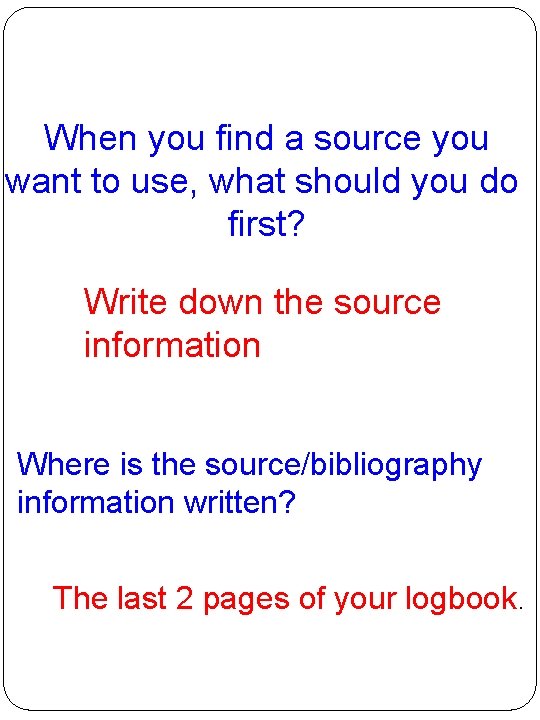
When you find a source you want to use, what should you do first? Write down the source information Where is the source/bibliography information written? The last 2 pages of your logbook.
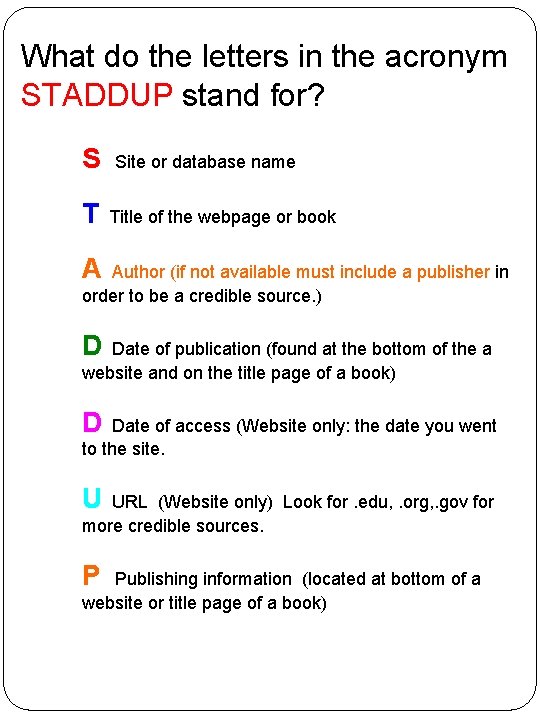
What do the letters in the acronym STADDUP stand for? S T Site or database name Title of the webpage or book A Author (if not available must include a publisher in order to be a credible source. ) D Date of publication (found at the bottom of the a website and on the title page of a book) D Date of access (Website only: the date you went to the site. U URL (Website only) Look for. edu, . org, . gov for more credible sources. P Publishing information (located at bottom of a website or title page of a book)
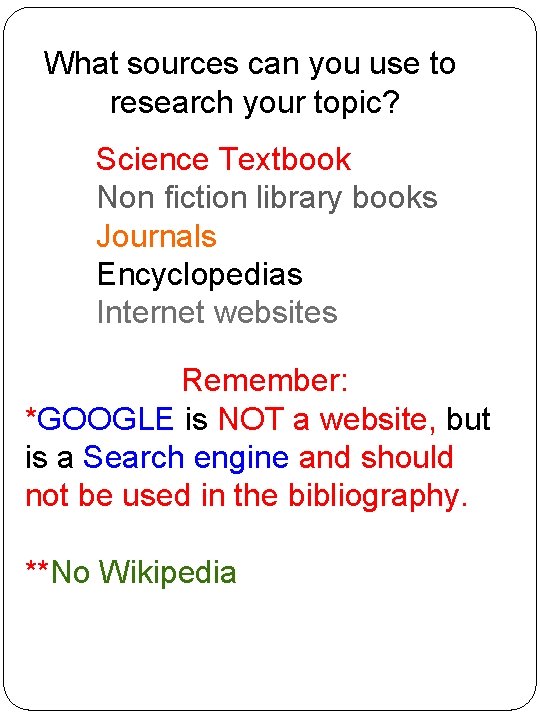
What sources can you use to research your topic? Science Textbook Non fiction library books Journals Encyclopedias Internet websites Remember: *GOOGLE is NOT a website, but is a Search engine and should not be used in the bibliography. **No Wikipedia
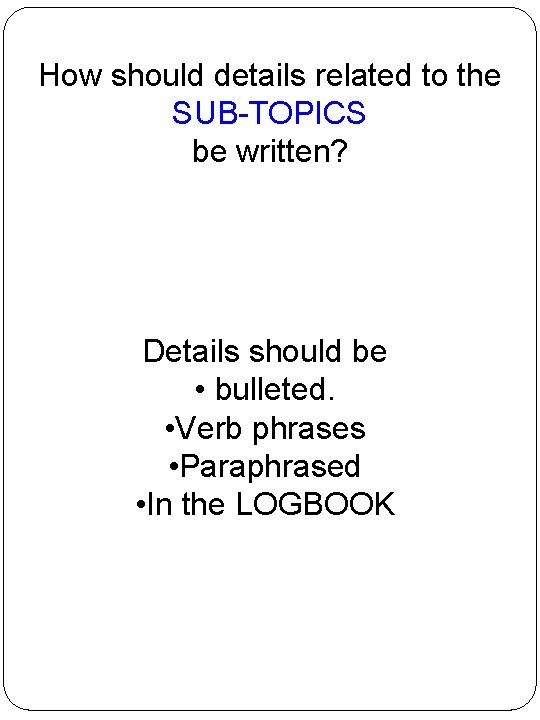
How should details related to the SUB-TOPICS be written? Details should be • bulleted. • Verb phrases • Paraphrased • In the LOGBOOK

HAPPY RESEARCHING!!
- Slides: 28