
Timing of delivery and induction in preeclampsia Matthews
- Slides: 15
Timing of delivery and induction in pre-eclampsia Matthews Mathai Africa Regional Meeting on Interventions for Impact in Essential Maternal and Newborn Care, | Addis Ababa, Feb 21, 2011
Principles of Management l Pre-eclampsia affects both the mother and the fetus l Multisystem disorder l Elevated blood pressure and proteinuria are among the many other findings l Only definitive treatment for pre-eclampsia is the delivery of the baby and the placenta Africa Regional Meeting on Interventions for Impact in Essential Maternal and Newborn Care, | Addis Ababa, Feb 21, 2011
Timing of delivery l Fetal considerations – Prematurity – Stillbirth • Hypoxia • Placental abruption – Newborn asphyxia l Maternal considerations – Worsening of disease • Complications Africa Regional Meeting on Interventions for Impact in Essential Maternal and Newborn Care, | Addis Ababa, Feb 21, 2011
Timing of delivery l Mild or severe disease? – Early delivery with severe disease l Preterm or term? – Delivery more likely if term Africa Regional Meeting on Interventions for Impact in Essential Maternal and Newborn Care, | Addis Ababa, Feb 21, 2011
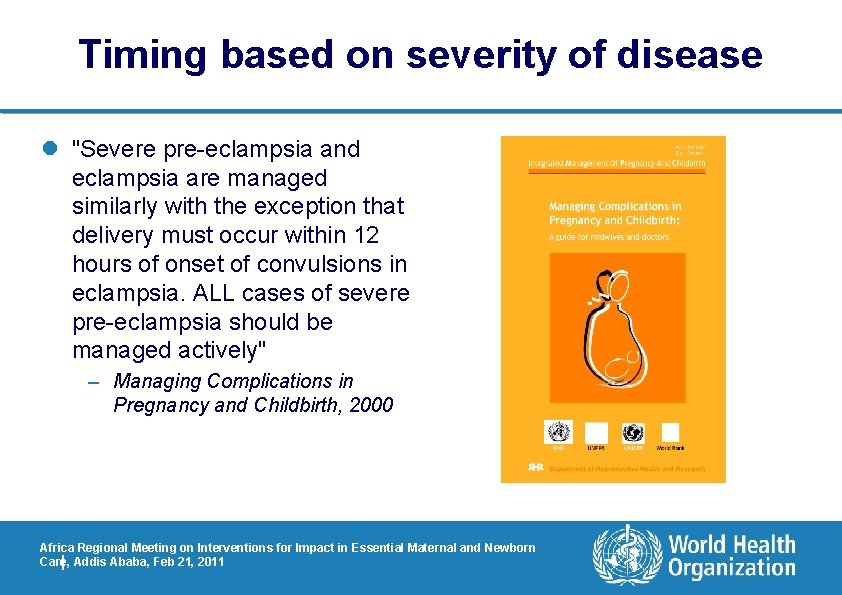
Timing based on severity of disease l "Severe pre-eclampsia and eclampsia are managed similarly with the exception that delivery must occur within 12 hours of onset of convulsions in eclampsia. ALL cases of severe pre-eclampsia should be managed actively" – Managing Complications in Pregnancy and Childbirth, 2000 Africa Regional Meeting on Interventions for Impact in Essential Maternal and Newborn Care, | Addis Ababa, Feb 21, 2011
Expectant care for severe pre-eclampsia before term? l Cochrane review: Churchill & Duley (2002) l Two trials – South Africa & USA; 133 women l Women had 24 -48 h period of stabilization – Steroids, magnesium sulphate and antihypertensives, if necessary – Randomized if eligibility criteria met • Interventionist group – induction/CS • Expectant: delivery at 34 wk or earlier if deterioration Africa Regional Meeting on Interventions for Impact in Essential Maternal and Newborn Care, | Addis Ababa, Feb 21, 2011
Expectant care for severe pre-eclampsia before term? l Insufficient data for reliable conclusions on maternal adverse outcomes, stillbirths and newborn deaths – Eclampsia, renal failure, pulmonary oedema, HELLP syndrome, CS, placental abruption l Interventionist group had – – More HMD RR 2. 3 (95% CI 1. 39 -3. 81) More NEC RR 5. 54 (95% CI 1. 04 -29. 56) More likely to need NICU admission RR 1. 32 (95% CI 1. 3 -1. 55) Less likely to be SGA RR 0. 36 (0. 14 -0. 90) Africa Regional Meeting on Interventions for Impact in Essential Maternal and Newborn Care, | Addis Ababa, Feb 21, 2011
Expectant care for severe pre-eclampsia before term? l Authors' conclusion – "There are insufficient data for any reliable recommendation about which policy of care should be used for women with severe early onset pre-eclampsia. Further large trials are needed. " l Global context for consideration – – Availability of NICU facilities Accessibility Costs of care Long term survival Africa Regional Meeting on Interventions for Impact in Essential Maternal and Newborn Care, | Addis Ababa, Feb 21, 2011
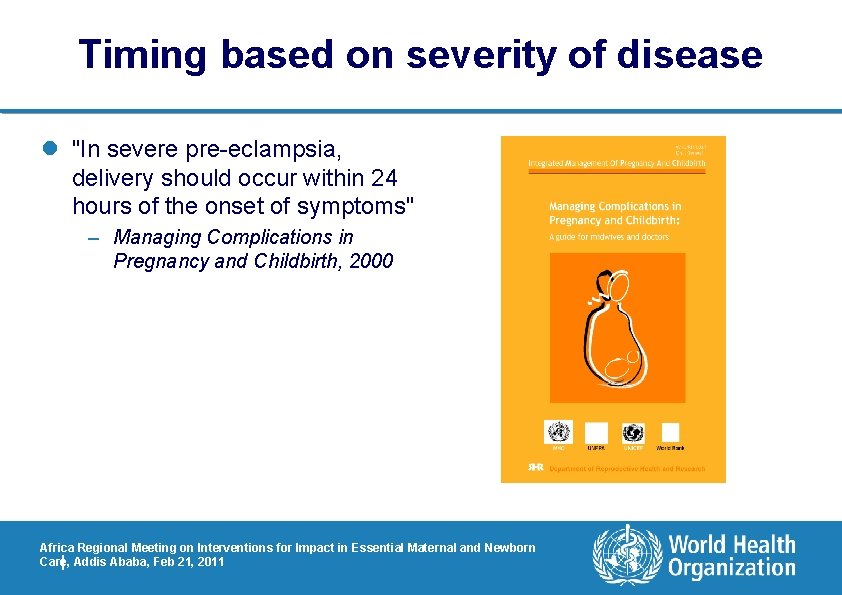
Timing based on severity of disease l "In severe pre-eclampsia, delivery should occur within 24 hours of the onset of symptoms" – Managing Complications in Pregnancy and Childbirth, 2000 Africa Regional Meeting on Interventions for Impact in Essential Maternal and Newborn Care, | Addis Ababa, Feb 21, 2011
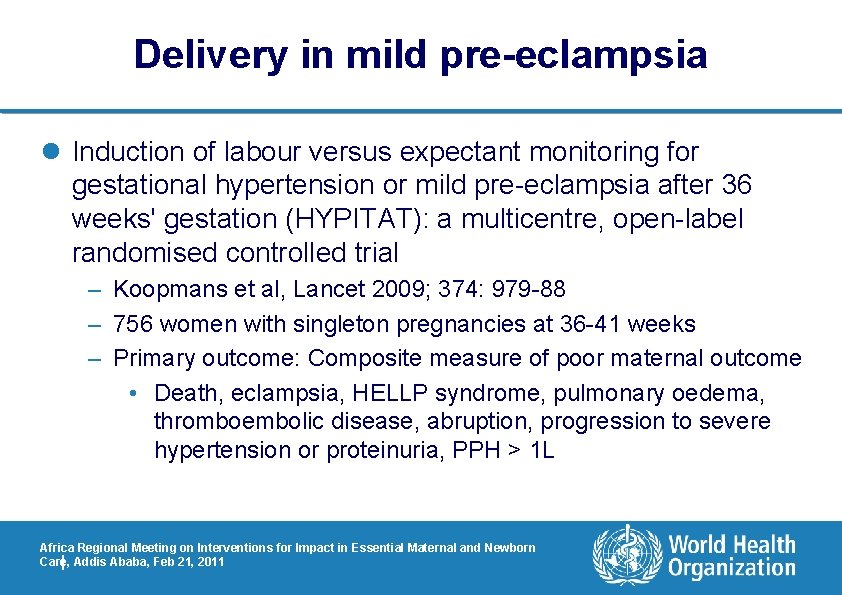
Delivery in mild pre-eclampsia l Induction of labour versus expectant monitoring for gestational hypertension or mild pre-eclampsia after 36 weeks' gestation (HYPITAT): a multicentre, open-label randomised controlled trial – Koopmans et al, Lancet 2009; 374: 979 -88 – 756 women with singleton pregnancies at 36 -41 weeks – Primary outcome: Composite measure of poor maternal outcome • Death, eclampsia, HELLP syndrome, pulmonary oedema, thromboembolic disease, abruption, progression to severe hypertension or proteinuria, PPH > 1 L Africa Regional Meeting on Interventions for Impact in Essential Maternal and Newborn Care, | Addis Ababa, Feb 21, 2011
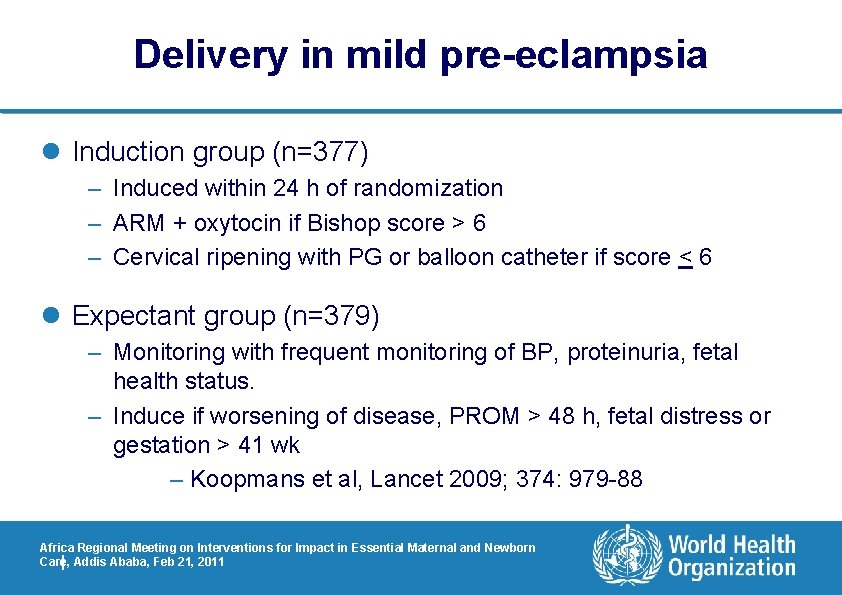
Delivery in mild pre-eclampsia l Induction group (n=377) – Induced within 24 h of randomization – ARM + oxytocin if Bishop score > 6 – Cervical ripening with PG or balloon catheter if score < 6 l Expectant group (n=379) – Monitoring with frequent monitoring of BP, proteinuria, fetal health status. – Induce if worsening of disease, PROM > 48 h, fetal distress or gestation > 41 wk – Koopmans et al, Lancet 2009; 374: 979 -88 Africa Regional Meeting on Interventions for Impact in Essential Maternal and Newborn Care, | Addis Ababa, Feb 21, 2011
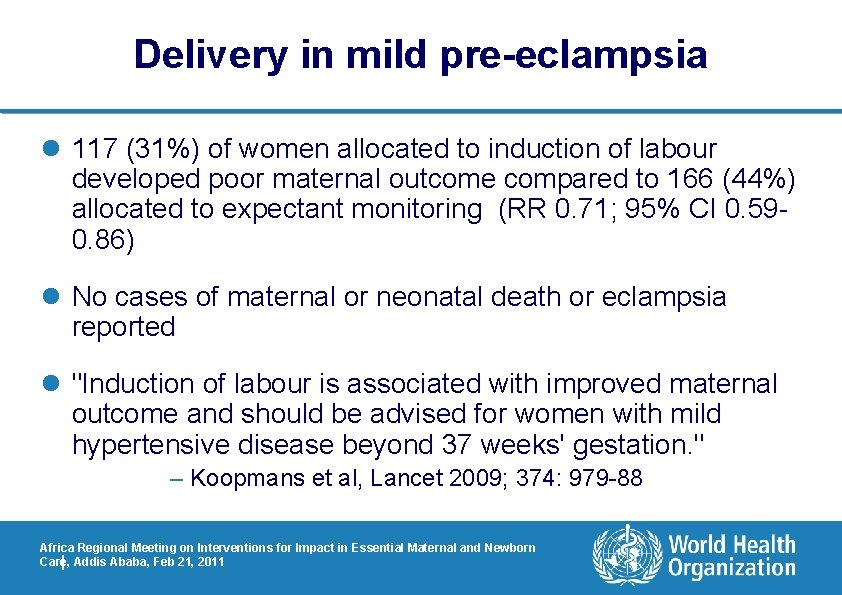
Delivery in mild pre-eclampsia l 117 (31%) of women allocated to induction of labour developed poor maternal outcome compared to 166 (44%) allocated to expectant monitoring (RR 0. 71; 95% CI 0. 590. 86) l No cases of maternal or neonatal death or eclampsia reported l "Induction of labour is associated with improved maternal outcome and should be advised for women with mild hypertensive disease beyond 37 weeks' gestation. " – Koopmans et al, Lancet 2009; 374: 979 -88 Africa Regional Meeting on Interventions for Impact in Essential Maternal and Newborn Care, | Addis Ababa, Feb 21, 2011
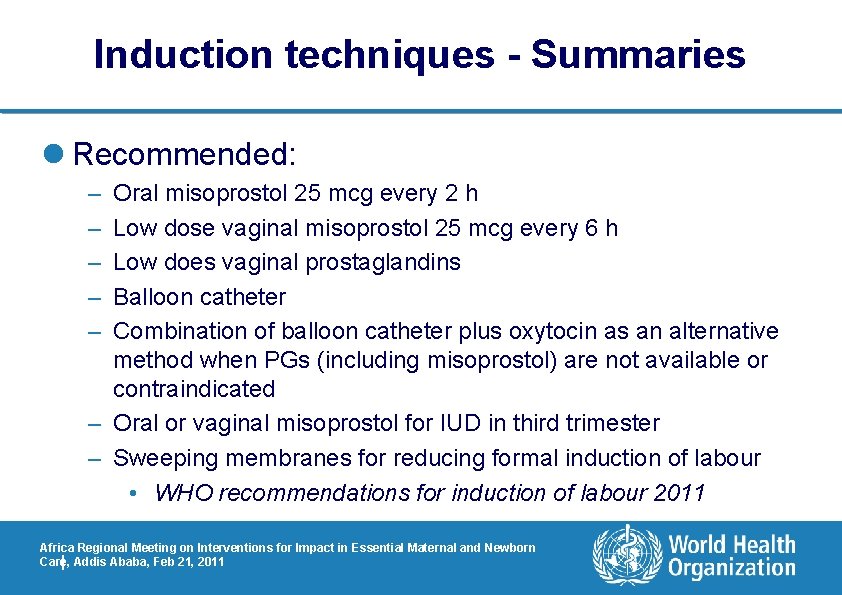
Induction techniques - Summaries l Recommended: – – – Oral misoprostol 25 mcg every 2 h Low dose vaginal misoprostol 25 mcg every 6 h Low does vaginal prostaglandins Balloon catheter Combination of balloon catheter plus oxytocin as an alternative method when PGs (including misoprostol) are not available or contraindicated – Oral or vaginal misoprostol for IUD in third trimester – Sweeping membranes for reducing formal induction of labour • WHO recommendations for induction of labour 2011 Africa Regional Meeting on Interventions for Impact in Essential Maternal and Newborn Care, | Addis Ababa, Feb 21, 2011
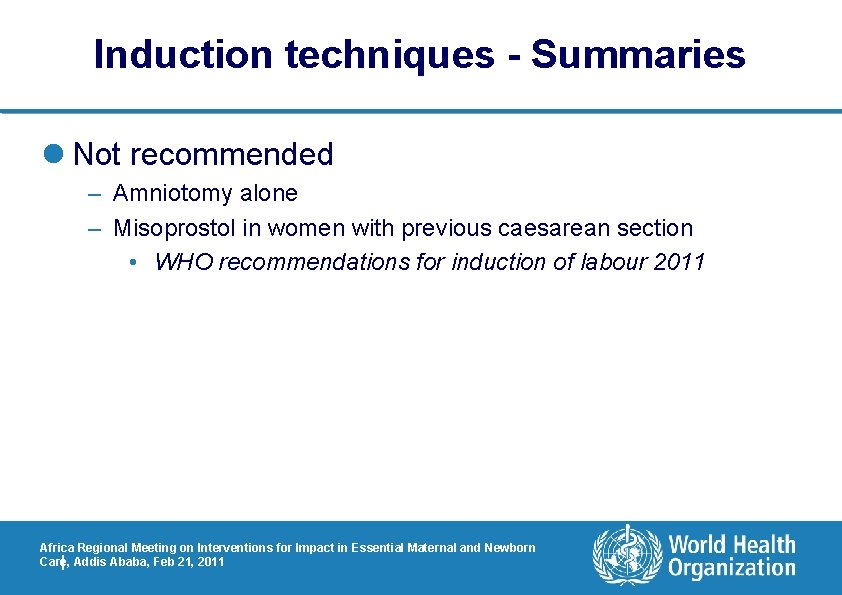
Induction techniques - Summaries l Not recommended – Amniotomy alone – Misoprostol in women with previous caesarean section • WHO recommendations for induction of labour 2011 Africa Regional Meeting on Interventions for Impact in Essential Maternal and Newborn Care, | Addis Ababa, Feb 21, 2011
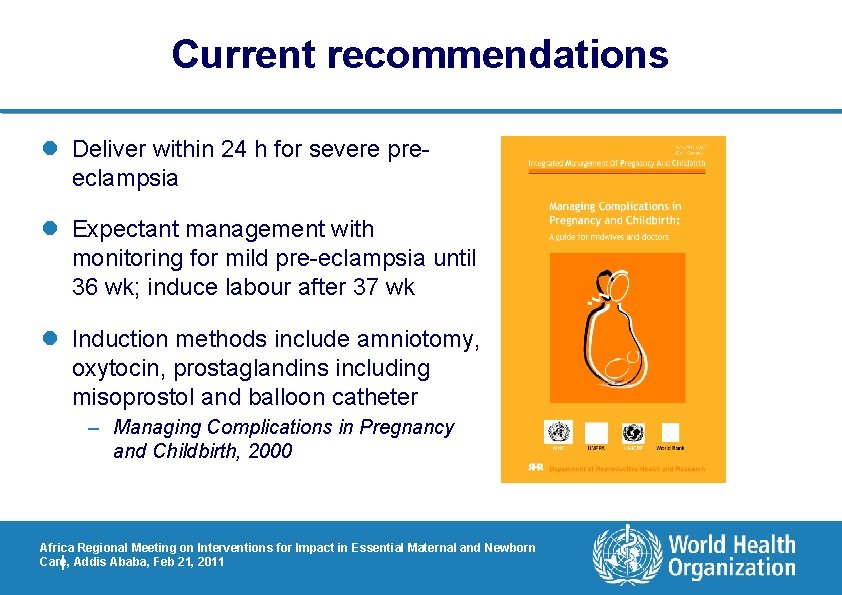
Current recommendations l Deliver within 24 h for severe preeclampsia l Expectant management with monitoring for mild pre-eclampsia until 36 wk; induce labour after 37 wk l Induction methods include amniotomy, oxytocin, prostaglandins including misoprostol and balloon catheter – Managing Complications in Pregnancy and Childbirth, 2000 Africa Regional Meeting on Interventions for Impact in Essential Maternal and Newborn Care, | Addis Ababa, Feb 21, 2011