
Timing for DAQ ISOTDAQ 2018 VIENNA Sophie baroncern
Timing for DAQ ISOTDAQ 2018 – VIENNA Sophie. baron@cern. ch
Outline • A bit of Vocabulary: Time, Synchronization • Timing in the LHC • Timing for Front End Detectors • Timing for Trigger & DAQ • What is a good timing distribution system for LHC detectors? • Current timing distributions systems • New Challenges for Timing distribution in HL-LHC 16/02/2018 ISOTDAQ 2018 - VIENNA - sophie. baron@cern. ch 2
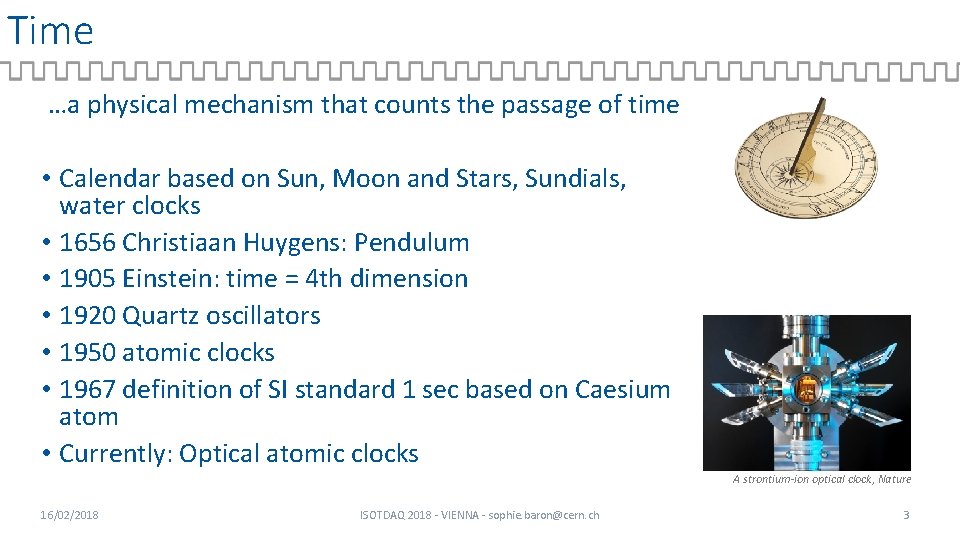
Time …a physical mechanism that counts the passage of time • Calendar based on Sun, Moon and Stars, Sundials, water clocks • 1656 Christiaan Huygens: Pendulum • 1905 Einstein: time = 4 th dimension • 1920 Quartz oscillators • 1950 atomic clocks • 1967 definition of SI standard 1 sec based on Caesium atom • Currently: Optical atomic clocks A strontium-ion optical clock, Nature 16/02/2018 ISOTDAQ 2018 - VIENNA - sophie. baron@cern. ch 3
Time Standards Two widely used time standards: 1. Based on earth rotation • not uniform due to periodic changes and long term drifts • Varies by ~1 sec/year (order < 10 -8) • UT 1 - Universal Time (UT 1) is a measure of the actual rotation of the earth, independent of observing location. Formerly called Greenwich Mean Time (GMT). 2. Based on atomic oscillations (cesium 133) • Currently the closest approximation to a uniform time • Varies ~1 us/year (order < 10 -14) • TAI - International Atomic Time - the primary time standard in the world today. It is the combined input of many clocks around the world • UTC - Coordinated Universal Time - is the time broadcast by WWW and other services by technologies such as the GPS satellites and Network Time Protocol (NTP). http: //www. cv. nrao. edu/~rfisher/Ephemerides/times. html 16/02/2018 ISOTDAQ 2018 - VIENNA - sophie. baron@cern. ch 4
Aligning the time standards • By definition, UTC and TAI have the same rate, but UTC stays close to Mean Solar Time by adding integer numbers of seconds, called leap seconds, from time to keep UT 1 -UTC <0. 9 s (today, UTC – TAI = 37 seconds) • The difference, DUT 1 = UT 1 - UTC is monitored by the International Earth Rotation Service and published weekly in IERS Bulletin A along with predictions for a number of months into the future. http: //www. leapsecond. com/java/gpsclock. htm This is a tentative of ‘synchronization’. Two different clock sources, as precise as they might be, drift one from each other. 16/02/2018 ISOTDAQ 2018 - VIENNA - sophie. baron@cern. ch 5
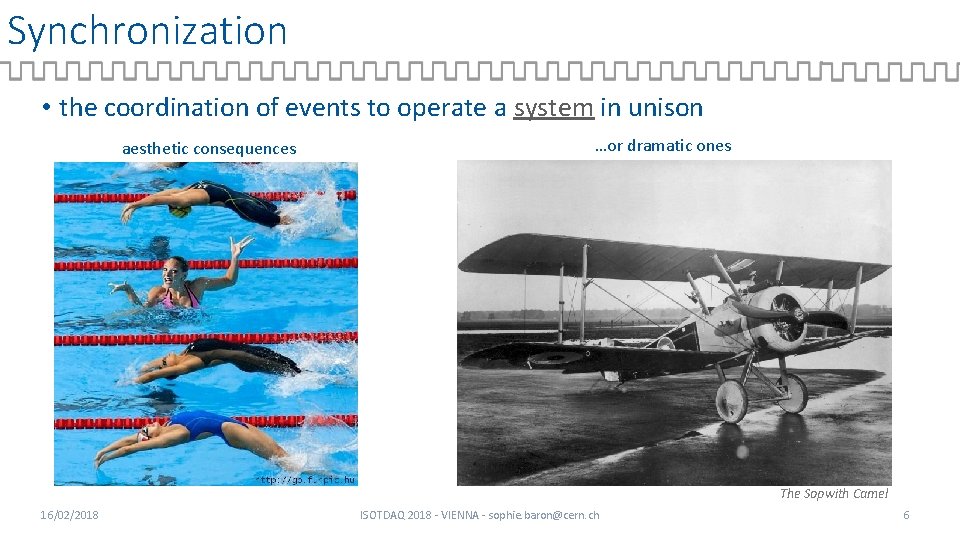
Synchronization • the coordination of events to operate a system in unison aesthetic consequences …or dramatic ones The Sopwith Camel 16/02/2018 ISOTDAQ 2018 - VIENNA - sophie. baron@cern. ch 6
Timing in the LHC 16/02/2018 ISOTDAQ 2018 - VIENNA - sophie. baron@cern. ch 7
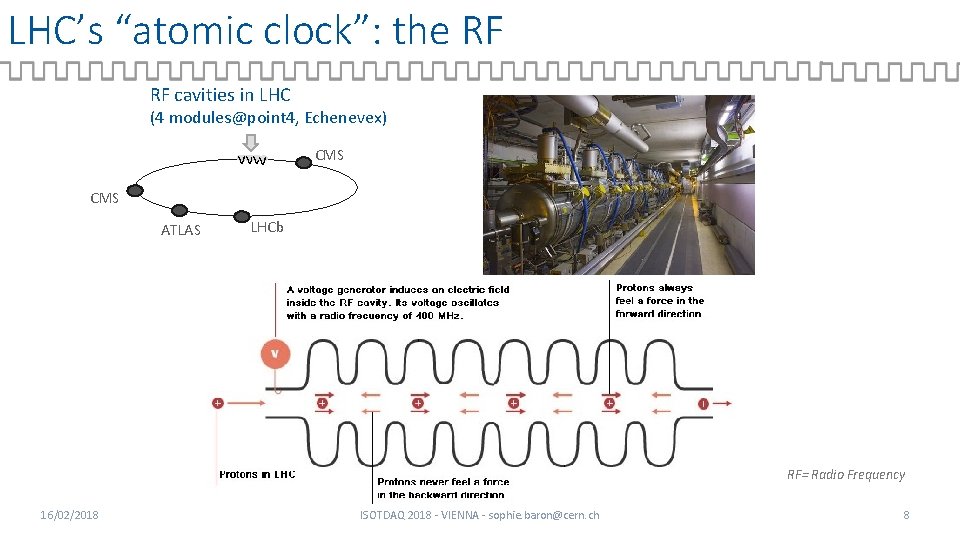
LHC’s “atomic clock”: the RF RF cavities in LHC (4 modules@point 4, Echenevex) vvvv CMS ATLAS LHCb RF= Radio Frequency 16/02/2018 ISOTDAQ 2018 - VIENNA - sophie. baron@cern. ch 8
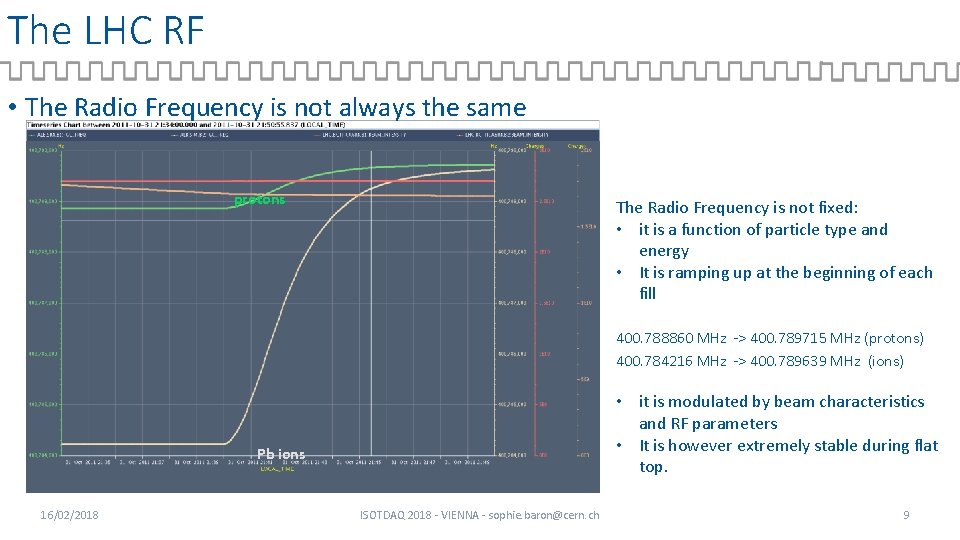
The LHC RF • The Radio Frequency is not always the same protons The Radio Frequency is not fixed: • it is a function of particle type and energy • It is ramping up at the beginning of each fill 400. 788860 MHz -> 400. 789715 MHz (protons) 400. 784216 MHz -> 400. 789639 MHz (ions) • it is modulated by beam characteristics and RF parameters • It is however extremely stable during flat top. Pb ions 16/02/2018 ISOTDAQ 2018 - VIENNA - sophie. baron@cern. ch 9
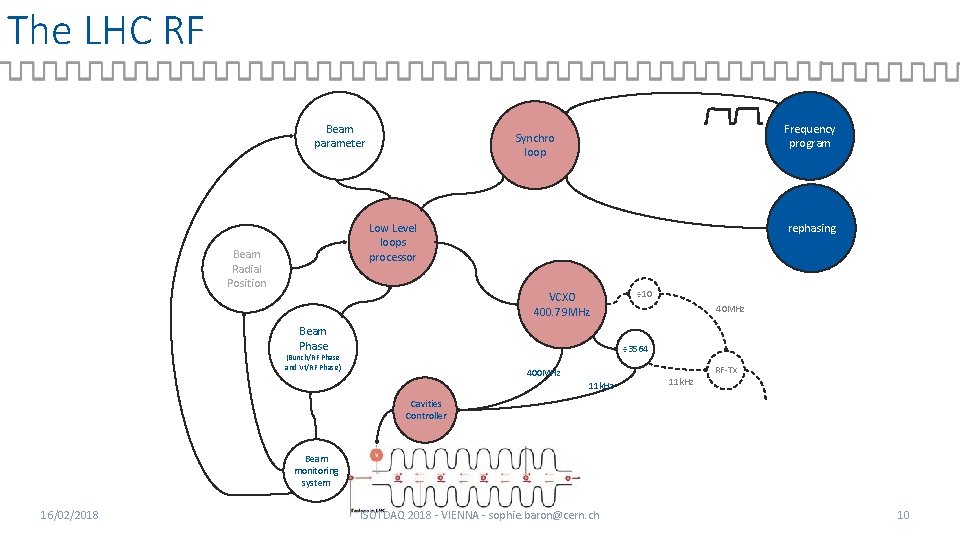
The LHC RF Beam parameter Frequency program Synchro loop Low Level loops processor Beam Radial Position rephasing VCXO 400. 79 MHz Beam Phase ÷ 10 40 MHz ÷ 3564 (Bunch/RF Phase and Vt/RF Phase) 400 MHz 11 k. Hz RF-Tx Cavities Controller Beam monitoring system 16/02/2018 ISOTDAQ 2018 - VIENNA - sophie. baron@cern. ch 10
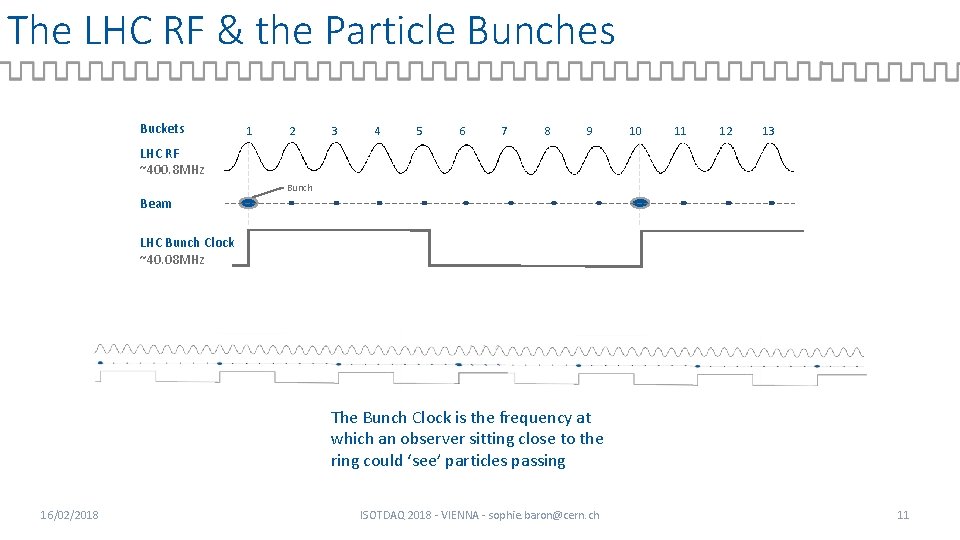
The LHC RF & the Particle Bunches Buckets 1 2 3 4 5 6 7 8 9 10 11 12 13 LHC RF ~400. 8 MHz Bunch Beam LHC Bunch Clock ~40. 08 MHz The Bunch Clock is the frequency at which an observer sitting close to the ring could ‘see’ particles passing 16/02/2018 ISOTDAQ 2018 - VIENNA - sophie. baron@cern. ch 11
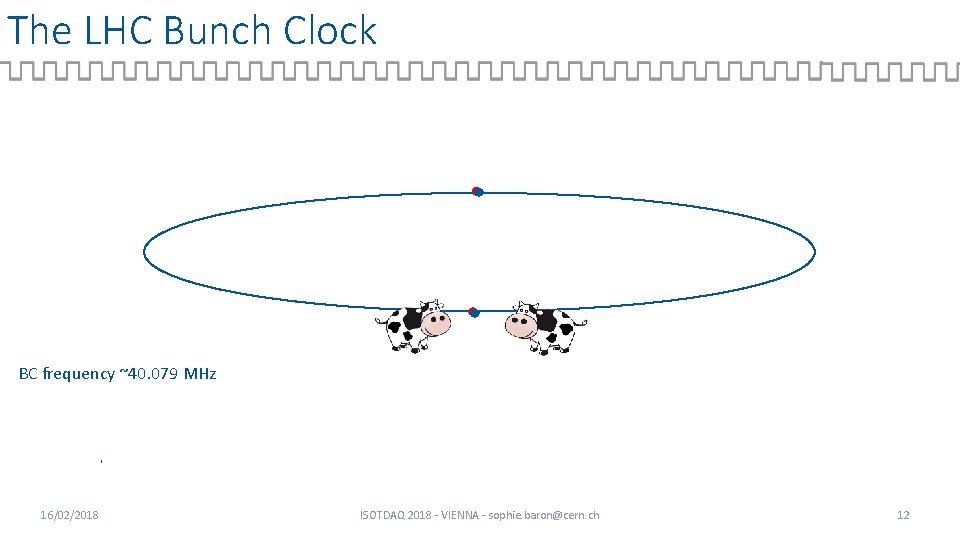
The LHC Bunch Clock BC frequency ~40. 079 MHz 16/02/2018 ISOTDAQ 2018 - VIENNA - sophie. baron@cern. ch 12
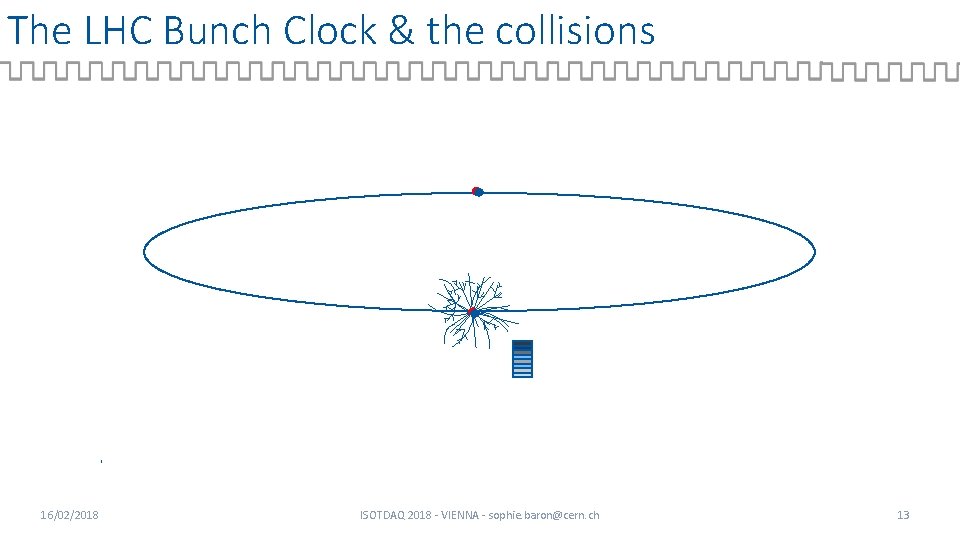
The LHC Bunch Clock & the collisions 16/02/2018 ISOTDAQ 2018 - VIENNA - sophie. baron@cern. ch 13
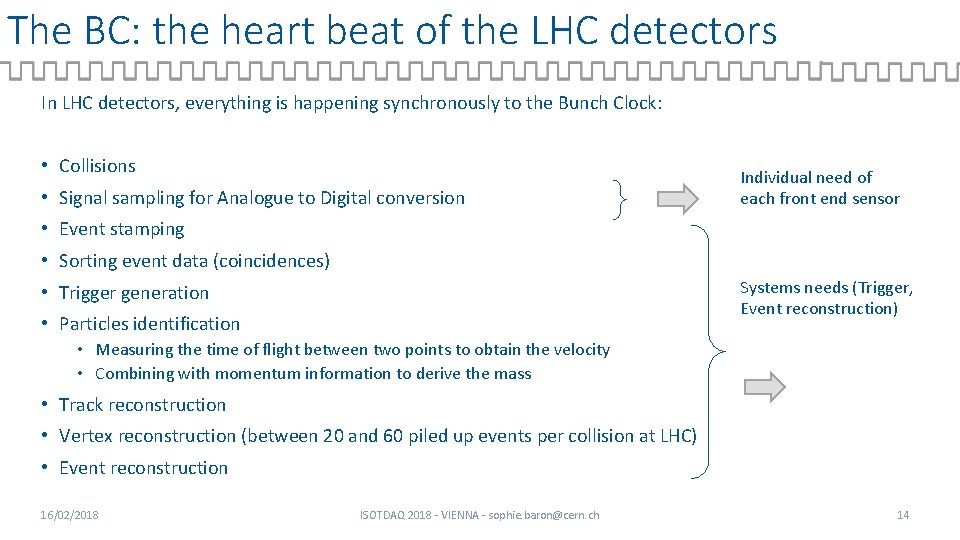
The BC: the heart beat of the LHC detectors In LHC detectors, everything is happening synchronously to the Bunch Clock: • Collisions • Signal sampling for Analogue to Digital conversion Individual need of each front end sensor • Event stamping • Sorting event data (coincidences) Systems needs (Trigger, Event reconstruction) • Trigger generation • Particles identification • Measuring the time of flight between two points to obtain the velocity • Combining with momentum information to derive the mass • Track reconstruction • Vertex reconstruction (between 20 and 60 piled up events per collision at LHC) • Event reconstruction 16/02/2018 ISOTDAQ 2018 - VIENNA - sophie. baron@cern. ch 14
The Bunch Clock (40. 079 MHz) has to be delivered • EVERYWHERE, • ANYTIME, • and with an excellent STABILITY & QUALITY The Orbit signal (a. k. a. revolution frequency) (11. 24 k. Hz) is also needed 16/02/2018 ISOTDAQ 2018 - VIENNA - sophie. baron@cern. ch 15
Timing for … Detector front end electronics Trigger & DAQ 16/02/2018 ISOTDAQ 2018 - VIENNA - sophie. baron@cern. ch 16
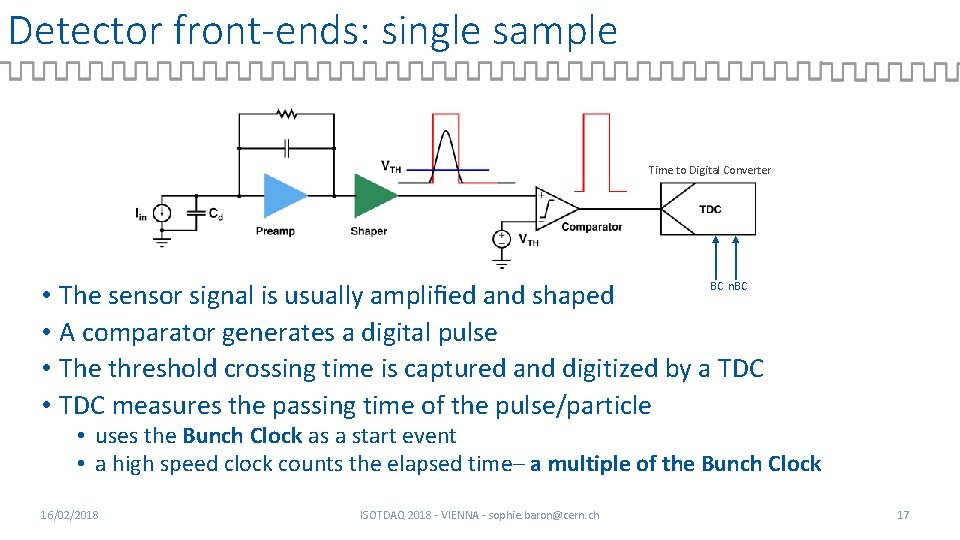
Detector front-ends: single sample Time to Digital Converter BC n. BC • The sensor signal is usually amplified and shaped • A comparator generates a digital pulse • The threshold crossing time is captured and digitized by a TDC • TDC measures the passing time of the pulse/particle • uses the Bunch Clock as a start event • a high speed clock counts the elapsed time– a multiple of the Bunch Clock 16/02/2018 ISOTDAQ 2018 - VIENNA - sophie. baron@cern. ch 17
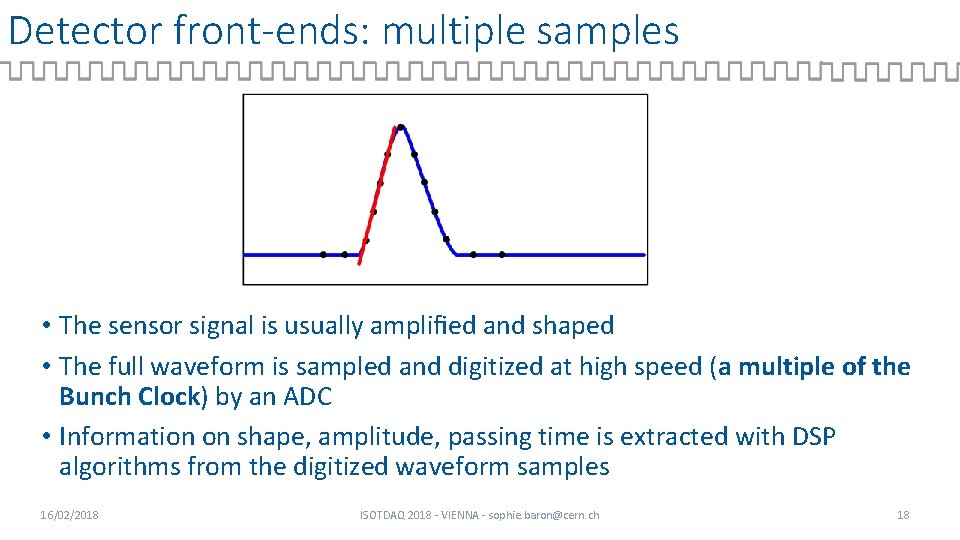
Detector front-ends: multiple samples • The sensor signal is usually amplified and shaped • The full waveform is sampled and digitized at high speed (a multiple of the Bunch Clock) by an ADC • Information on shape, amplitude, passing time is extracted with DSP algorithms from the digitized waveform samples 16/02/2018 ISOTDAQ 2018 - VIENNA - sophie. baron@cern. ch 18
Timing Accuracy • Several factors challenge the accuracy of these systems: • • • Random noise internal to the front-end electronics Signal integrity (substrate noise, PSSR, etc. . ) Pulse amplitude variations Pulse shape variations Random & deterministic noise from the clock distribution system • Irregular sampling clock distorts the signal or gives a wrong passing time information • Multiplying a dirty clock makes things even worse 16/02/2018 ISOTDAQ 2018 - VIENNA - sophie. baron@cern. ch 19
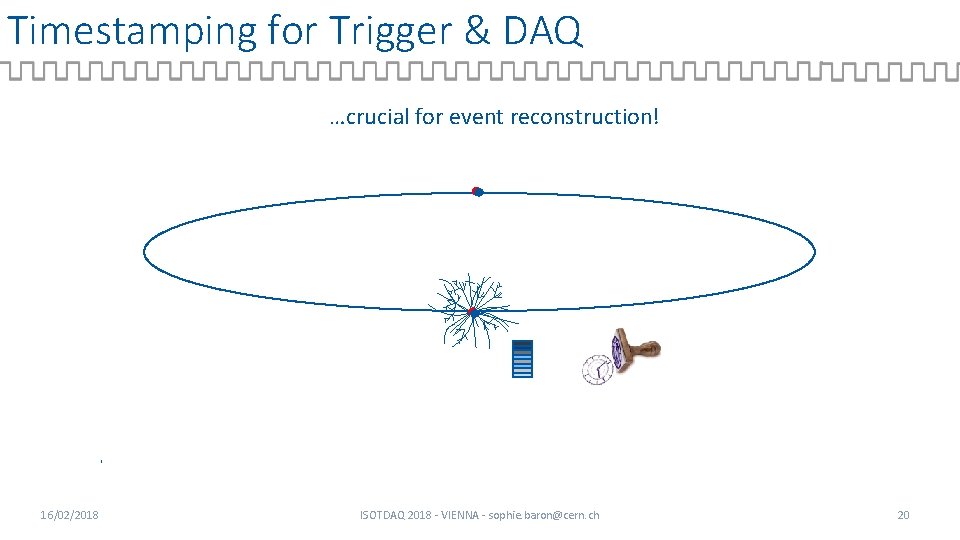
Timestamping for Trigger & DAQ …crucial for event reconstruction! 16/02/2018 ISOTDAQ 2018 - VIENNA - sophie. baron@cern. ch 20
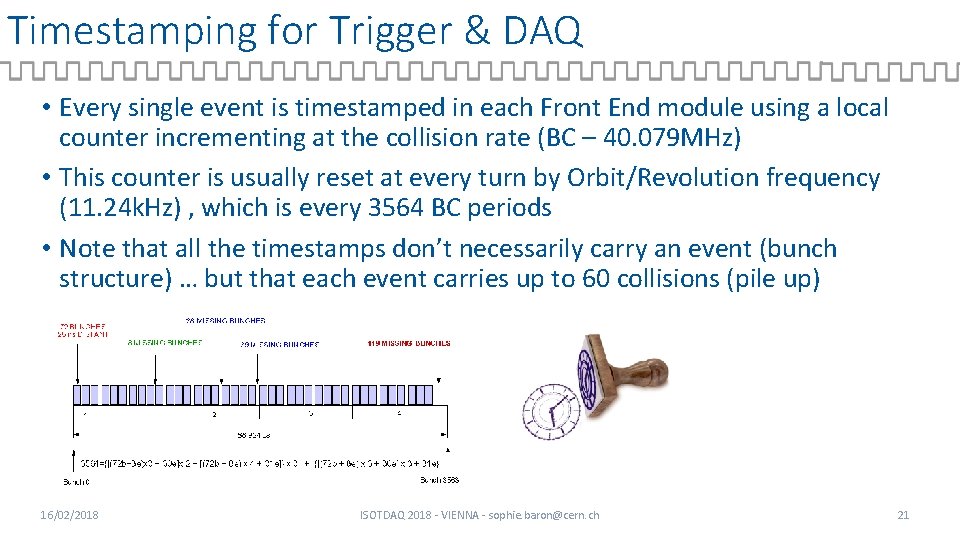
Timestamping for Trigger & DAQ • Every single event is timestamped in each Front End module using a local counter incrementing at the collision rate (BC – 40. 079 MHz) • This counter is usually reset at every turn by Orbit/Revolution frequency (11. 24 k. Hz) , which is every 3564 BC periods • Note that all the timestamps don’t necessarily carry an event (bunch structure) … but that each event carries up to 60 collisions (pile up) 16/02/2018 ISOTDAQ 2018 - VIENNA - sophie. baron@cern. ch 21
Timing distribution … • Timing distribution systems in LHC experiments are in charge of • Distributing the Bunch Clock signal to each node of the detectors • With accurate and stable frequency – for accurate signal shaping • With a fixed phase with respect to the beam/collisions – for proper timestamping • Broadcasting time critical signals to each node of the detectors • Orbit • Trigger • And some other time critical signals …with a low, fixed and deterministic latency 16/02/2018 ISOTDAQ 2018 - VIENNA - sophie. baron@cern. ch 22
What is a good timing distribution? Distribution systems. . Assessing distribution quality … Good clock for … 16/02/2018 ISOTDAQ 2018 - VIENNA - sophie. baron@cern. ch 23
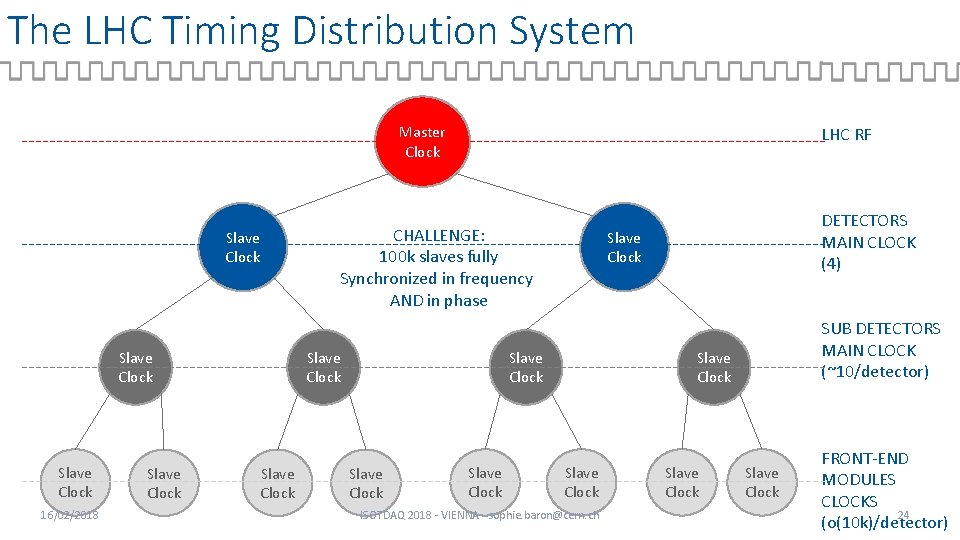
The LHC Timing Distribution System Master Clock Slave Clock 16/02/2018 Slave Clock LHC RF CHALLENGE: 100 k slaves fully Synchronized in frequency AND in phase Slave Clock Slave Clock DETECTORS MAIN CLOCK (4) SUB DETECTORS MAIN CLOCK (~10/detector) Slave Clock ISOTDAQ 2018 - VIENNA - sophie. baron@cern. ch Slave Clock FRONT-END MODULES CLOCKS 24 (o(10 k)/detector)
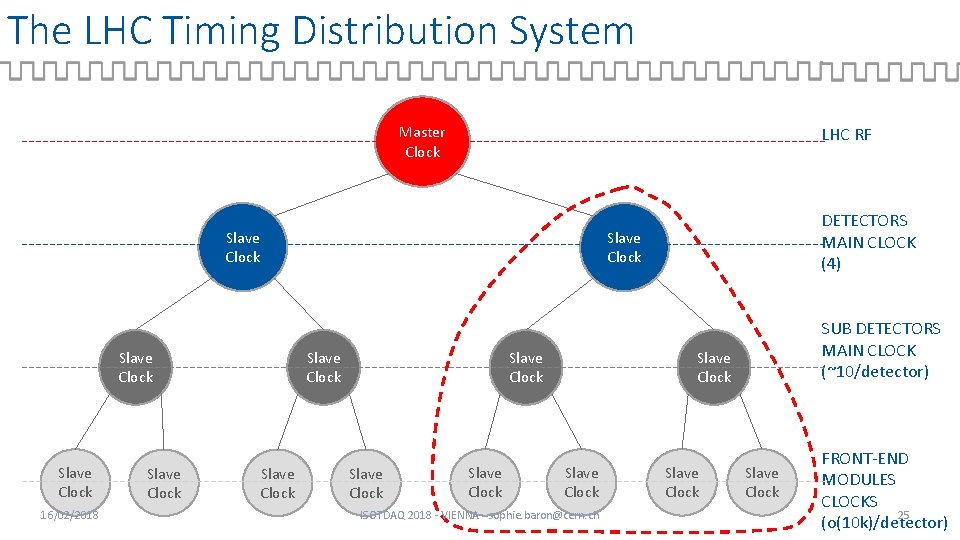
The LHC Timing Distribution System Master Clock LHC RF Slave Clock 16/02/2018 Slave Clock DETECTORS MAIN CLOCK (4) Slave Clock SUB DETECTORS MAIN CLOCK (~10/detector) Slave Clock ISOTDAQ 2018 - VIENNA - sophie. baron@cern. ch Slave Clock FRONT-END MODULES CLOCKS 25 (o(10 k)/detector)
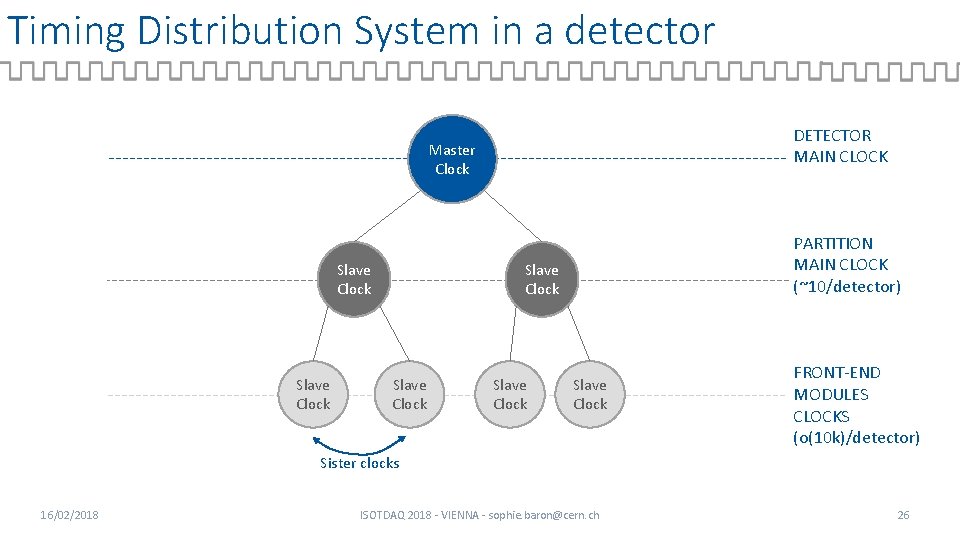
Timing Distribution System in a detector DETECTOR MAIN CLOCK Master Clock Slave Clock PARTITION MAIN CLOCK (~10/detector) Slave Clock FRONT-END MODULES CLOCKS (o(10 k)/detector) Sister clocks 16/02/2018 ISOTDAQ 2018 - VIENNA - sophie. baron@cern. ch 26
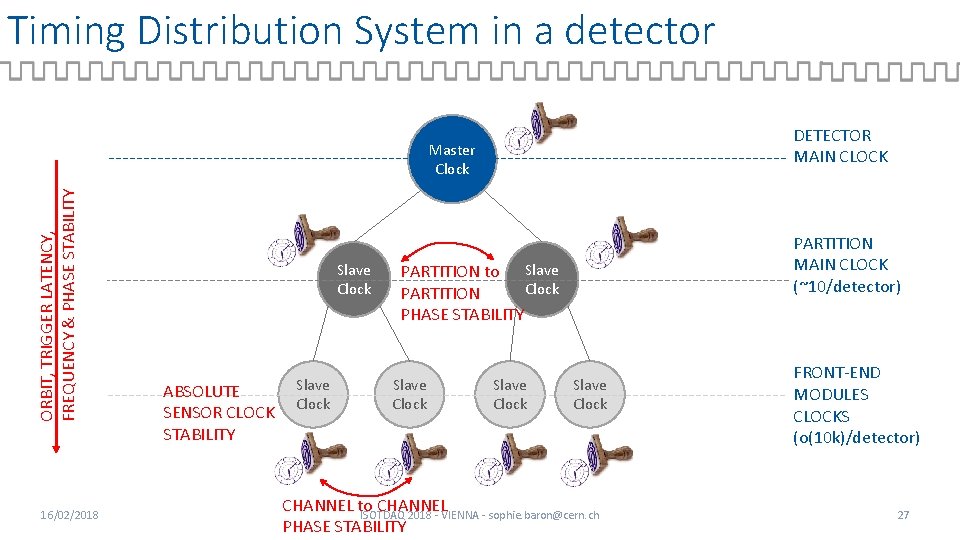
Timing Distribution System in a detector DETECTOR MAIN CLOCK ORBIT, TRIGGER LATENCY, FREQUENCY & PHASE STABILITY Master Clock 16/02/2018 Slave Clock ABSOLUTE SENSOR CLOCK STABILITY Slave Clock PARTITION MAIN CLOCK (~10/detector) PARTITION to Slave Clock PARTITION PHASE STABILITY Slave Clock CHANNEL to CHANNEL ISOTDAQ 2018 - VIENNA - sophie. baron@cern. ch PHASE STABILITY FRONT-END MODULES CLOCKS (o(10 k)/detector) 27
Jitter & Phase Noise How to assess the quality of a clock? • Jitter (in the time domain) • Phase Noise (in the frequency domain) 16/02/2018 ISOTDAQ 2018 - VIENNA - sophie. baron@cern. ch 28
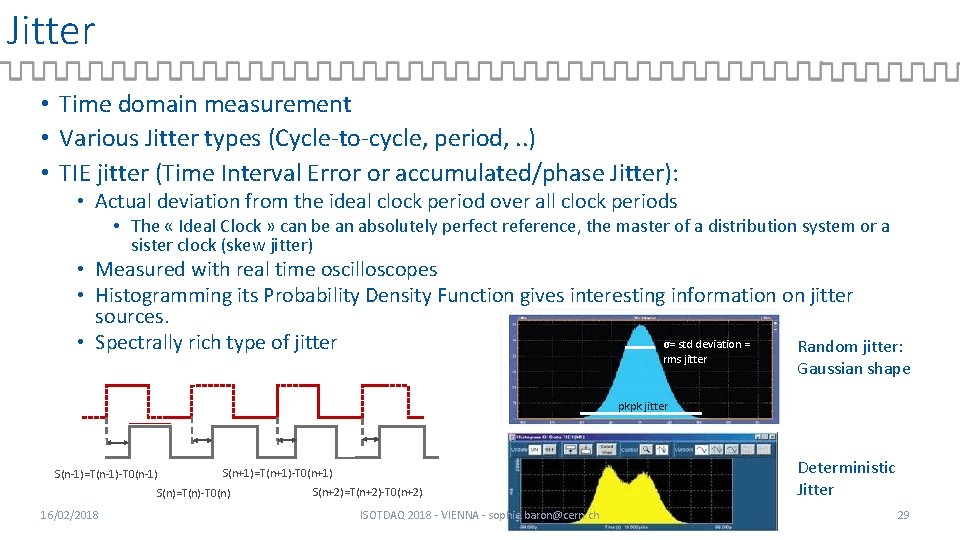
Jitter • Time domain measurement • Various Jitter types (Cycle-to-cycle, period, . . ) • TIE jitter (Time Interval Error or accumulated/phase Jitter): • Actual deviation from the ideal clock period over all clock periods • The « Ideal Clock » can be an absolutely perfect reference, the master of a distribution system or a sister clock (skew jitter) • Measured with real time oscilloscopes • Histogramming its Probability Density Function gives interesting information on jitter sources. σ= std deviation = • Spectrally rich type of jitter Random jitter: rms jitter Gaussian shape pkpk jitter S(n-1)=T(n-1)-T 0(n-1) S(n+1)=T(n+1)-T 0(n+1) S(n)=T(n)-T 0(n) 16/02/2018 S(n+2)=T(n+2)-T 0(n+2) ISOTDAQ 2018 - VIENNA - sophie. baron@cern. ch Deterministic Jitter 29
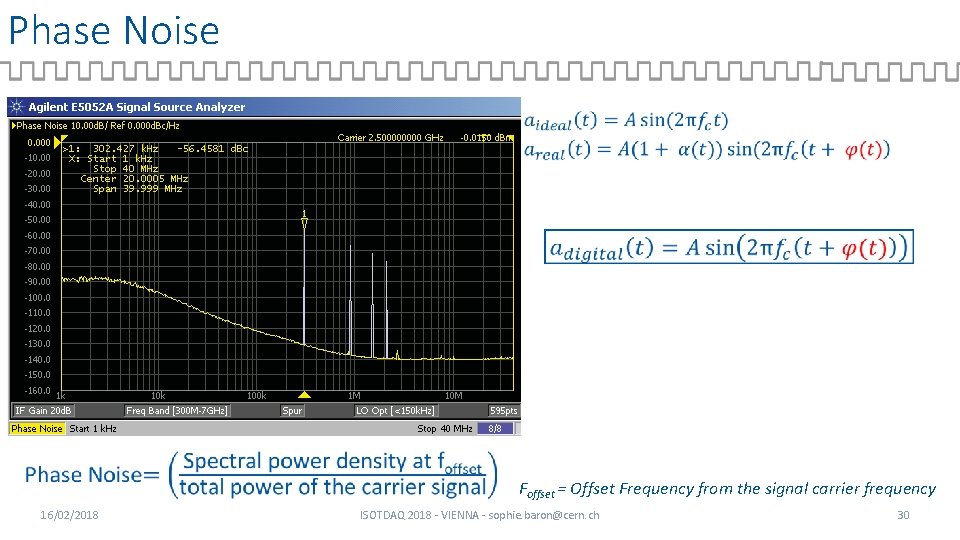
Phase Noise Foffset = Offset Frequency from the signal carrier frequency 16/02/2018 ISOTDAQ 2018 - VIENNA - sophie. baron@cern. ch 30
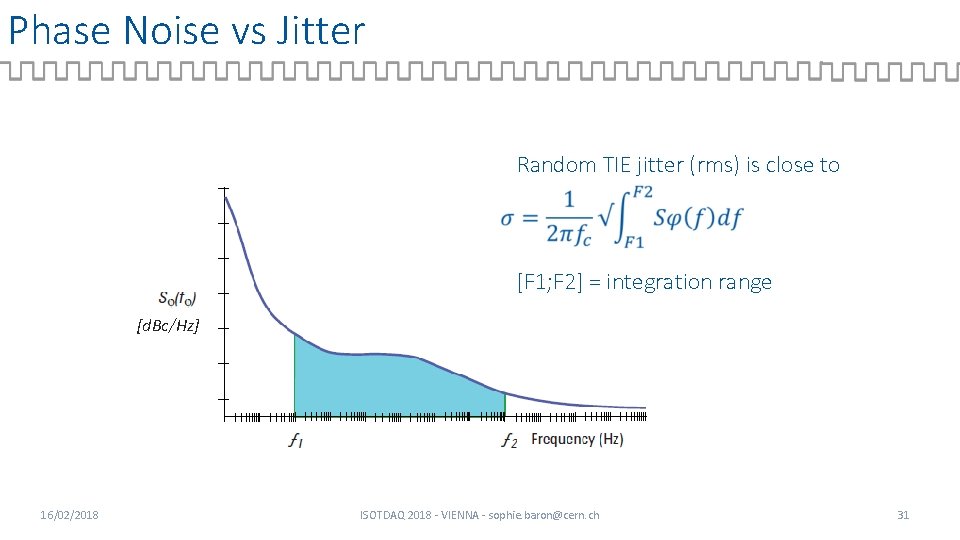
Phase Noise vs Jitter Random TIE jitter (rms) is close to [F 1; F 2] = integration range [d. Bc/Hz] 16/02/2018 ISOTDAQ 2018 - VIENNA - sophie. baron@cern. ch 31
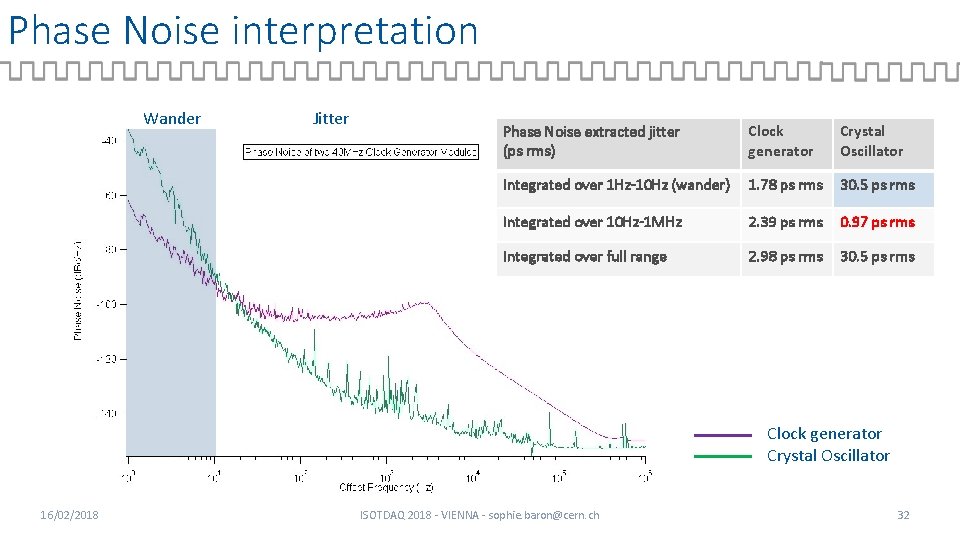
Phase Noise interpretation Wander Jitter Phase Noise extracted jitter (ps rms) Clock generator Crystal Oscillator Integrated over 1 Hz-10 Hz (wander) 1. 78 ps rms 30. 5 ps rms Integrated over 10 Hz-1 MHz 2. 39 ps rms 0. 97 ps rms Integrated over full range 2. 98 ps rms 30. 5 ps rms Clock generator Crystal Oscillator 16/02/2018 ISOTDAQ 2018 - VIENNA - sophie. baron@cern. ch 32
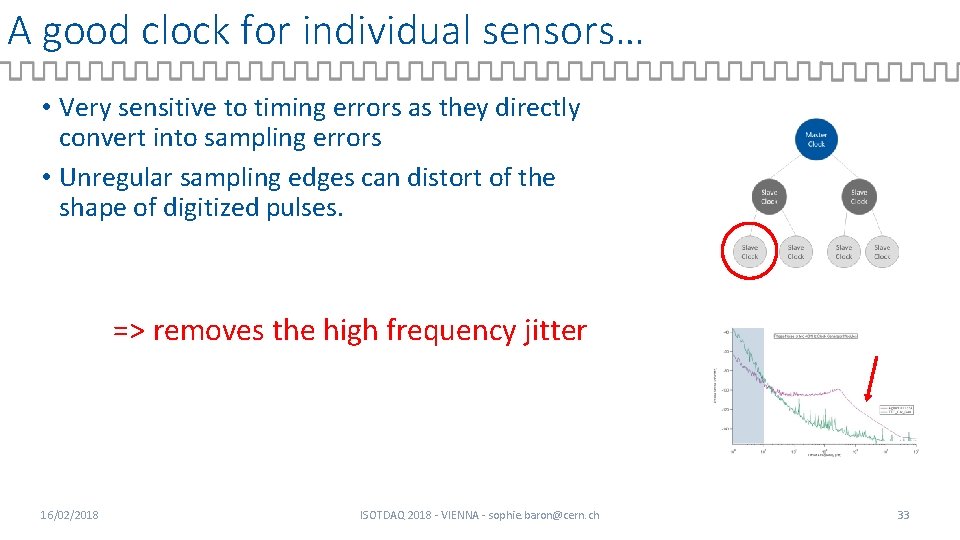
A good clock for individual sensors… • Very sensitive to timing errors as they directly convert into sampling errors • Unregular sampling edges can distort of the shape of digitized pulses. => removes the high frequency jitter 16/02/2018 ISOTDAQ 2018 - VIENNA - sophie. baron@cern. ch 33
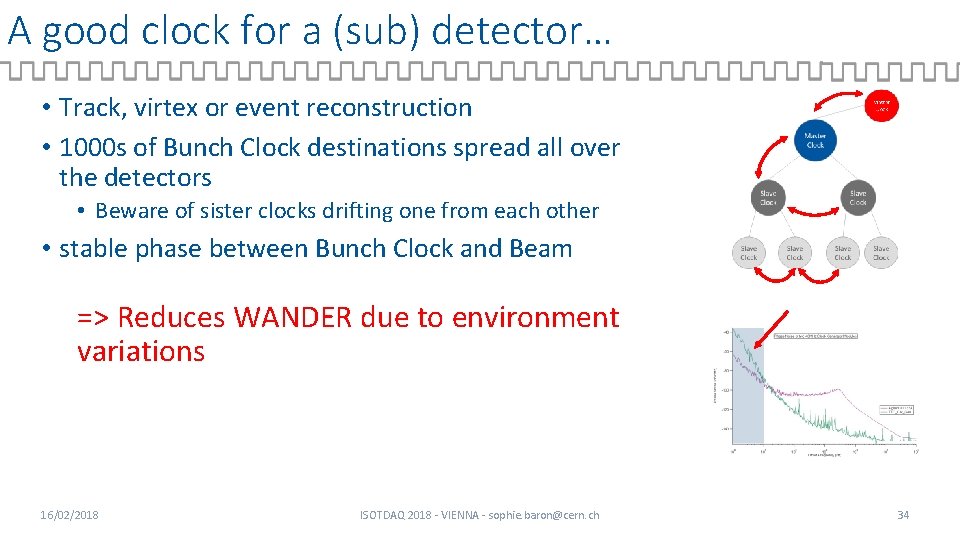
A good clock for a (sub) detector… • Track, virtex or event reconstruction • 1000 s of Bunch Clock destinations spread all over the detectors • Beware of sister clocks drifting one from each other • stable phase between Bunch Clock and Beam => Reduces WANDER due to environment variations 16/02/2018 ISOTDAQ 2018 - VIENNA - sophie. baron@cern. ch 34
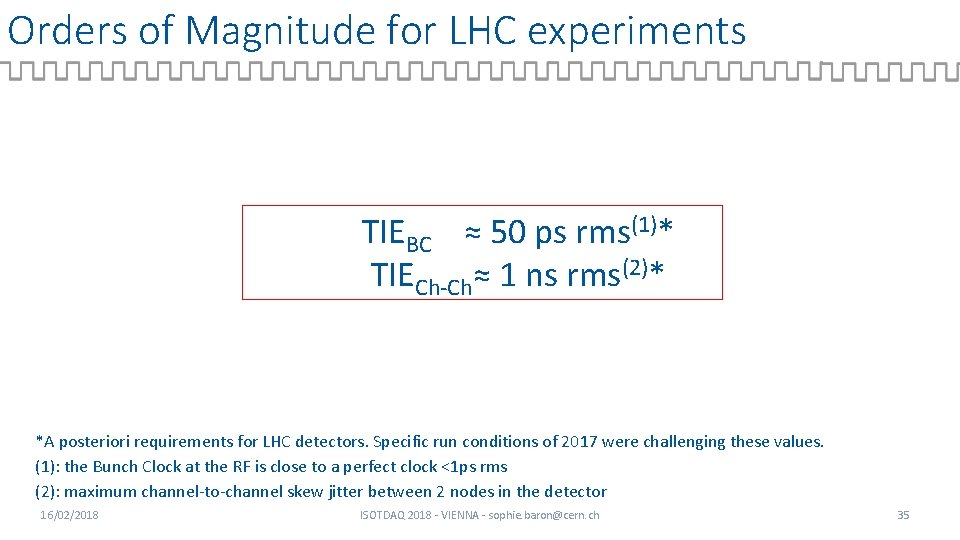
Orders of Magnitude for LHC experiments TIEBC ≈ 50 ps rms(1)* TIECh-Ch≈ 1 ns rms(2)* *A posteriori requirements for LHC detectors. Specific run conditions of 2017 were challenging these values. (1): the Bunch Clock at the RF is close to a perfect clock <1 ps rms (2): maximum channel-to-channel skew jitter between 2 nodes in the detector 16/02/2018 ISOTDAQ 2018 - VIENNA - sophie. baron@cern. ch 35
Current clock distribution systems for LHC experiments Intro Legacy systems – RF Backbone, TTC Systems for LS 2 (2019) – GBT, TTC-PON 16/02/2018 ISOTDAQ 2018 - VIENNA - sophie. baron@cern. ch 36
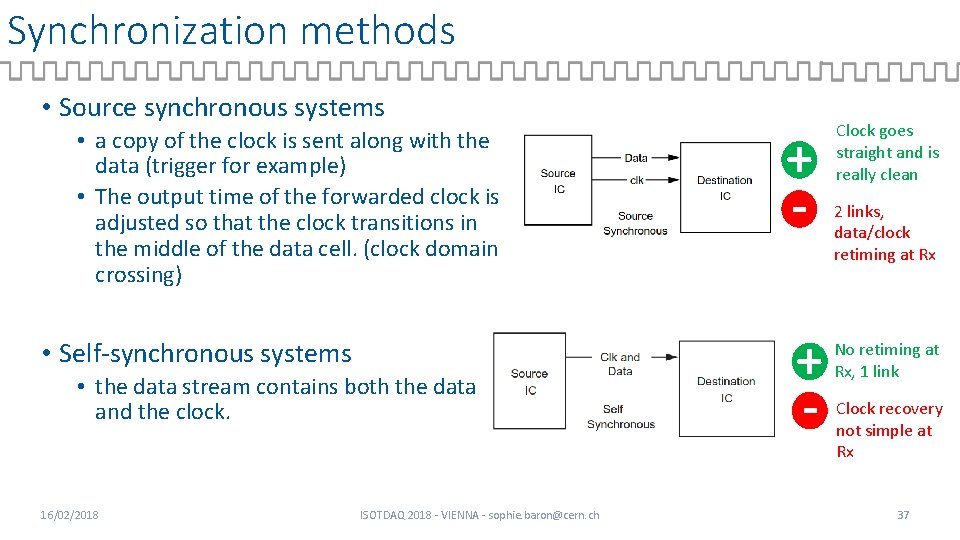
Synchronization methods • Source synchronous systems • a copy of the clock is sent along with the data (trigger for example) • The output time of the forwarded clock is adjusted so that the clock transitions in the middle of the data cell. (clock domain crossing) • Self-synchronous systems • the data stream contains both the data and the clock. 16/02/2018 ISOTDAQ 2018 - VIENNA - sophie. baron@cern. ch + + - Clock goes straight and is really clean 2 links, data/clock retiming at Rx No retiming at Rx, 1 link Clock recovery not simple at Rx 37
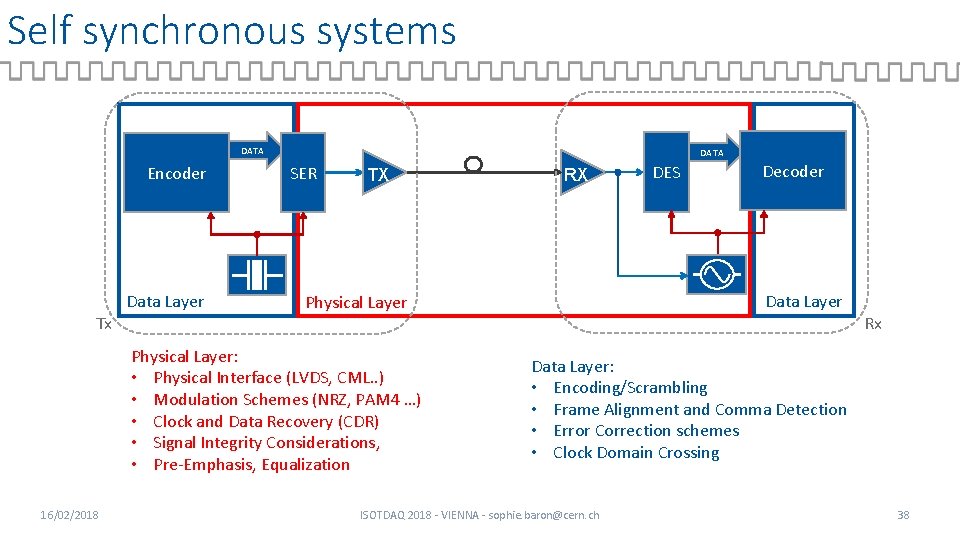
Self synchronous systems DATA Encoder Tx Data Layer DATA SER TX DES Decoder Data Layer Physical Layer: • Physical Interface (LVDS, CML. . ) • Modulation Schemes (NRZ, PAM 4 …) • Clock and Data Recovery (CDR) • Signal Integrity Considerations, • Pre-Emphasis, Equalization 16/02/2018 RX Rx Data Layer: • Encoding/Scrambling • Frame Alignment and Comma Detection • Error Correction schemes • Clock Domain Crossing ISOTDAQ 2018 - VIENNA - sophie. baron@cern. ch 38
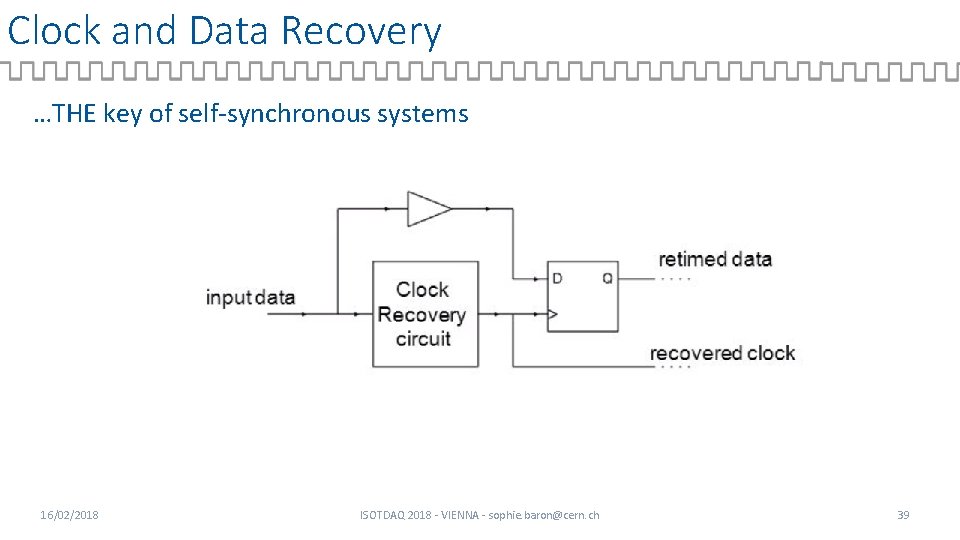
Clock and Data Recovery …THE key of self-synchronous systems 16/02/2018 ISOTDAQ 2018 - VIENNA - sophie. baron@cern. ch 39
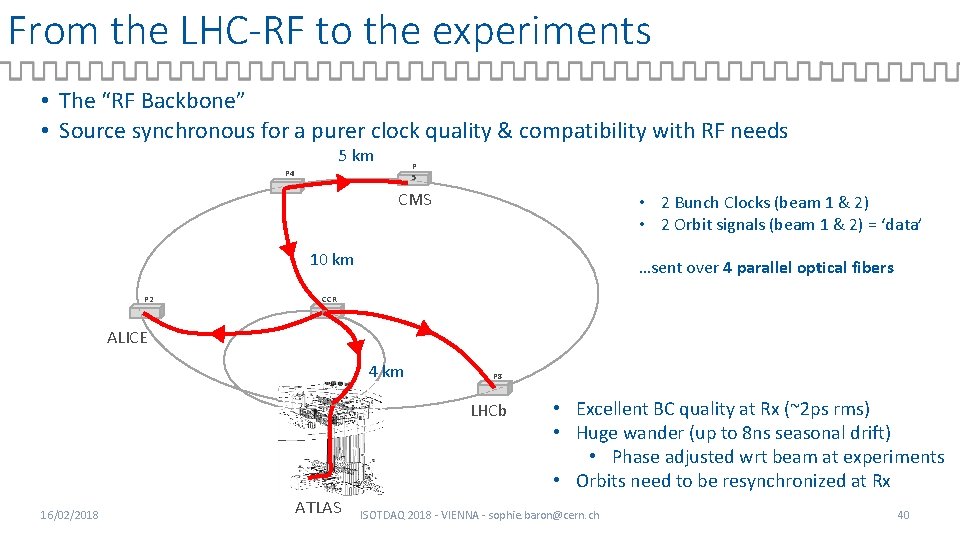
From the LHC-RF to the experiments • The “RF Backbone” • Source synchronous for a purer clock quality & compatibility with RF needs 5 km P 5 P 4 CMS • 2 Bunch Clocks (beam 1 & 2) • 2 Orbit signals (beam 1 & 2) = ‘data’ 10 km P 2 …sent over 4 parallel optical fibers CCR ALICE 4 km P 8 LHCb 16/02/2018 ATLAS • Excellent BC quality at Rx (~2 ps rms) • Huge wander (up to 8 ns seasonal drift) • Phase adjusted wrt beam at experiments • Orbits need to be resynchronized at Rx ISOTDAQ 2018 - VIENNA - sophie. baron@cern. ch 40

And in the experiments… 16/02/2018 ISOTDAQ 2018 - VIENNA - sophie. baron@cern. ch 41
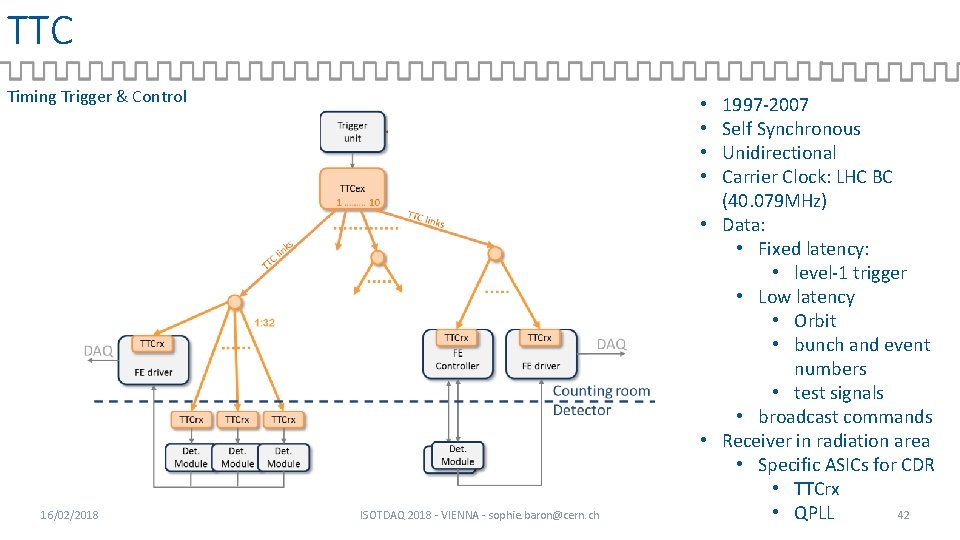
TTC Timing Trigger & Control 16/02/2018 1997 -2007 Self Synchronous Unidirectional Carrier Clock: LHC BC (40. 079 MHz) • Data: • Fixed latency: • level-1 trigger • Low latency • Orbit • bunch and event numbers • test signals • broadcast commands • Receiver in radiation area • Specific ASICs for CDR • TTCrx 42 • QPLL • • ISOTDAQ 2018 - VIENNA - sophie. baron@cern. ch
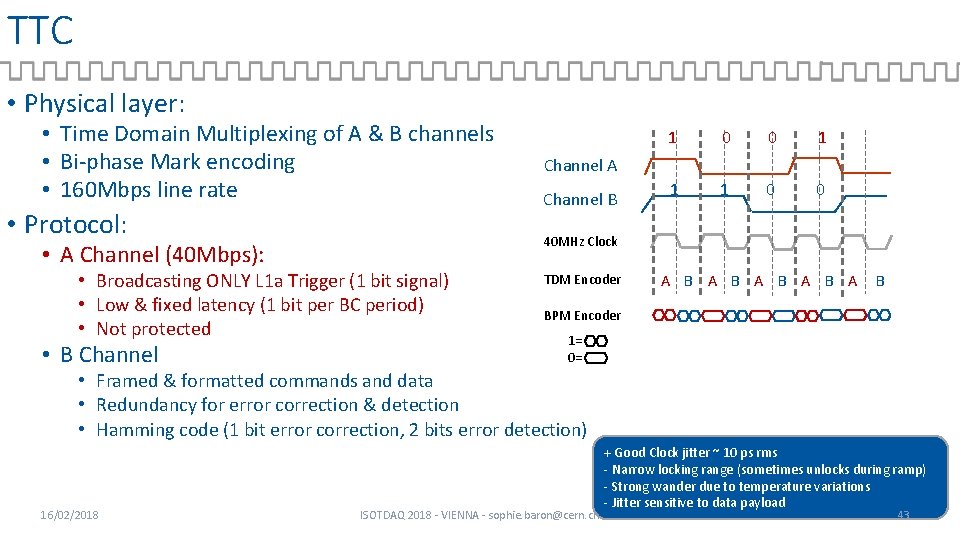
TTC • Physical layer: • Time Domain Multiplexing of A & B channels • Bi-phase Mark encoding • 160 Mbps line rate • Protocol: • A Channel (40 Mbps): Channel A Channel B 1 0 40 MHz Clock • Broadcasting ONLY L 1 a Trigger (1 bit signal) • Low & fixed latency (1 bit per BC period) • Not protected • B Channel 1 0 1 TDM Encoder A B A B BPM Encoder 1= 0= • Framed & formatted commands and data • Redundancy for error correction & detection • Hamming code (1 bit error correction, 2 bits error detection) 16/02/2018 ISOTDAQ 2018 - VIENNA - sophie. baron@cern. ch + Good Clock jitter ~ 10 ps rms - Narrow locking range (sometimes unlocks during ramp) - Strong wander due to temperature variations - Jitter sensitive to data payload 43
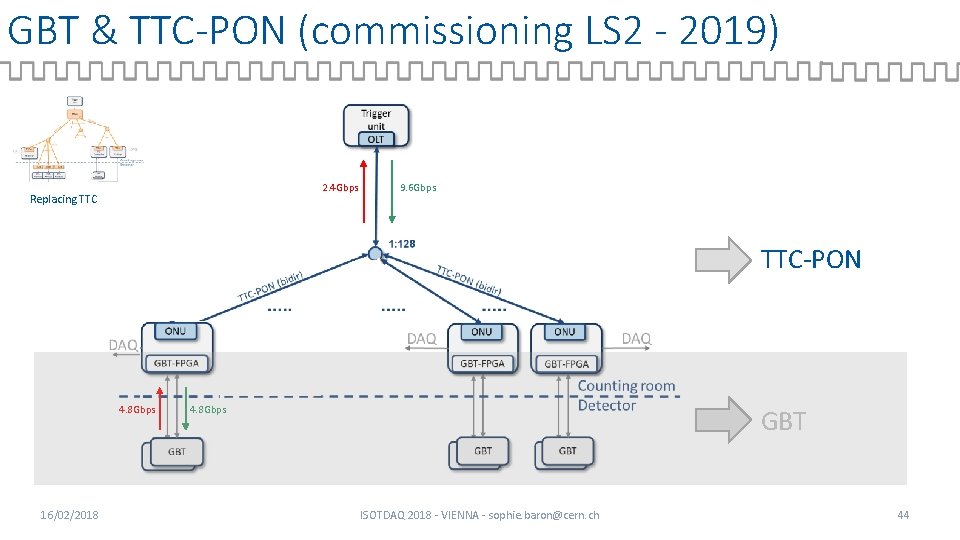
GBT & TTC-PON (commissioning LS 2 - 2019) 2. 4 Gbps Replacing TTC 9. 6 Gbps TTC-PON 4. 8 Gbps 16/02/2018 4. 8 Gbps GBT ISOTDAQ 2018 - VIENNA - sophie. baron@cern. ch 44
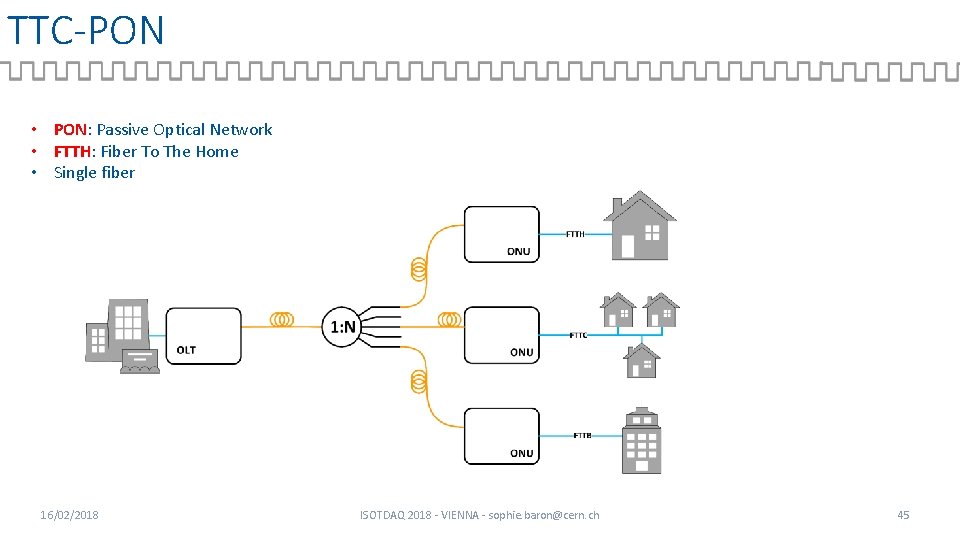
TTC-PON • PON: Passive Optical Network • FTTH: Fiber To The Home • Single fiber 16/02/2018 ISOTDAQ 2018 - VIENNA - sophie. baron@cern. ch 45
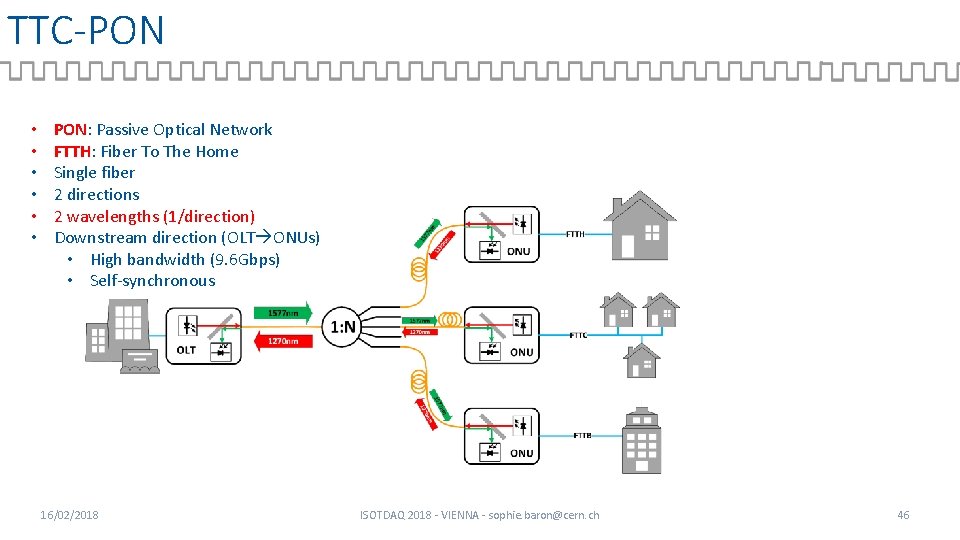
TTC-PON • • • PON: Passive Optical Network FTTH: Fiber To The Home Single fiber 2 directions 2 wavelengths (1/direction) Downstream direction (OLT ONUs) • High bandwidth (9. 6 Gbps) • Self-synchronous 16/02/2018 ISOTDAQ 2018 - VIENNA - sophie. baron@cern. ch 46
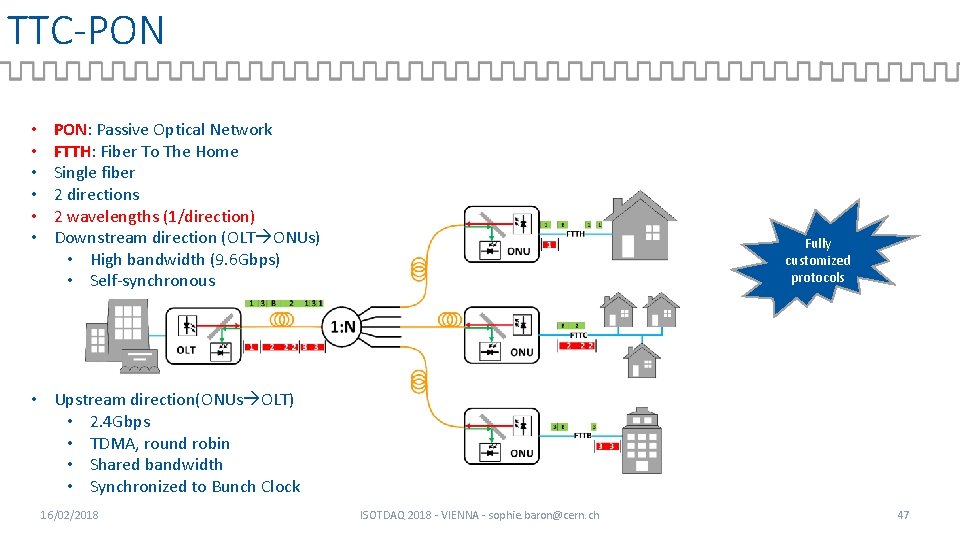
TTC-PON • • • PON: Passive Optical Network FTTH: Fiber To The Home Single fiber 2 directions 2 wavelengths (1/direction) Downstream direction (OLT ONUs) • High bandwidth (9. 6 Gbps) • Self-synchronous Fully customized protocols • Upstream direction(ONUs OLT) • 2. 4 Gbps • TDMA, round robin • Shared bandwidth • Synchronized to Bunch Clock 16/02/2018 ISOTDAQ 2018 - VIENNA - sophie. baron@cern. ch 47

TTC-PON • Deliverables: • XG-PON optical modules (COTS) • Python based control software • Control field reserved in the PON frame • Sophisticated VHDL IP blocks • Implementing PON protocol and system calibration/monitoring tools • Providing fixed and deterministic phase and latency • Both for clock and data • Interfacing easily to GBT-FPGA core • Hardware reference design • Using the Si 5344/45 PLL family to clean recovered clock out of the FPGA • Extremely good and fixed phase! + Super low clock jitter ~ 2 ps rms + Insensitive to payload + limited wander / to temperature variation 16/02/2018 ISOTDAQ 2018 - VIENNA - sophie. baron@cern. ch 48
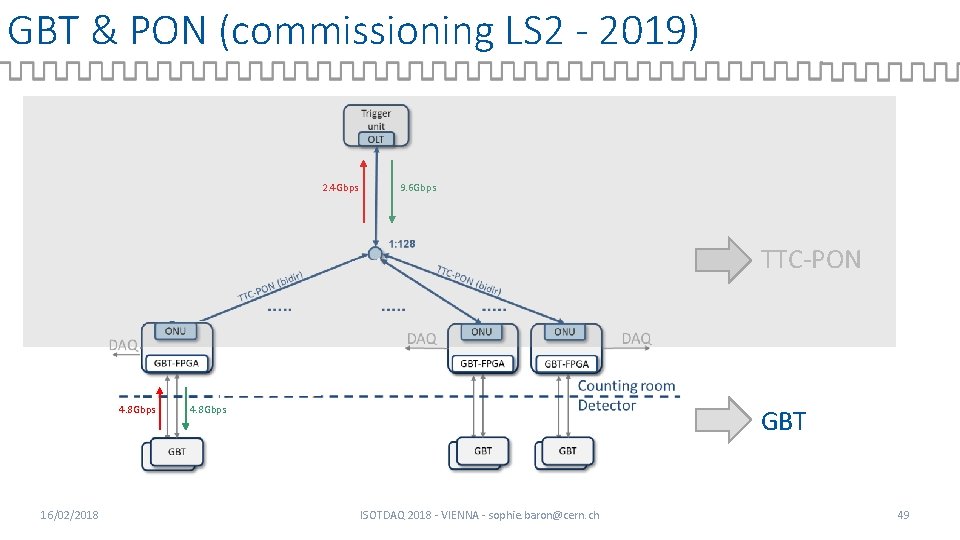
GBT & PON (commissioning LS 2 - 2019) 2. 4 Gbps 9. 6 Gbps TTC-PON 4. 8 Gbps 16/02/2018 4. 8 Gbps GBT ISOTDAQ 2018 - VIENNA - sophie. baron@cern. ch 49
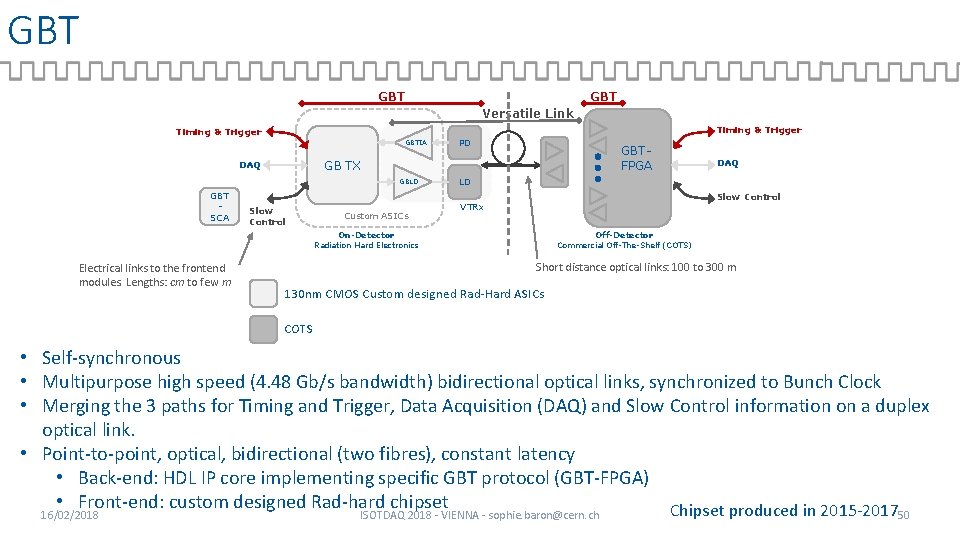
GBT GBT Versatile Link Timing & Trigger GBTIA GBTFPGA GBTX DAQ GBLD GBT SCA PD Slow Control Custom ASICs LD Slow Control VTRx On-Detector Radiation Hard Electronics Electrical links to the frontend modules. Lengths: cm to few m DAQ Off-Detector Commercial Off-The-Shelf (COTS) Short distance optical links: 100 to 300 m 130 nm CMOS Custom designed Rad-Hard ASICs COTS • Self-synchronous • Multipurpose high speed (4. 48 Gb/s bandwidth) bidirectional optical links, synchronized to Bunch Clock • Merging the 3 paths for Timing and Trigger, Data Acquisition (DAQ) and Slow Control information on a duplex optical link. • Point-to-point, optical, bidirectional (two fibres), constant latency • Back-end: HDL IP core implementing specific GBT protocol (GBT-FPGA) • Front-end: custom designed Rad-hard chipset Chipset produced in 2015 -2017 16/02/2018 ISOTDAQ 2018 - VIENNA - sophie. baron@cern. ch 50
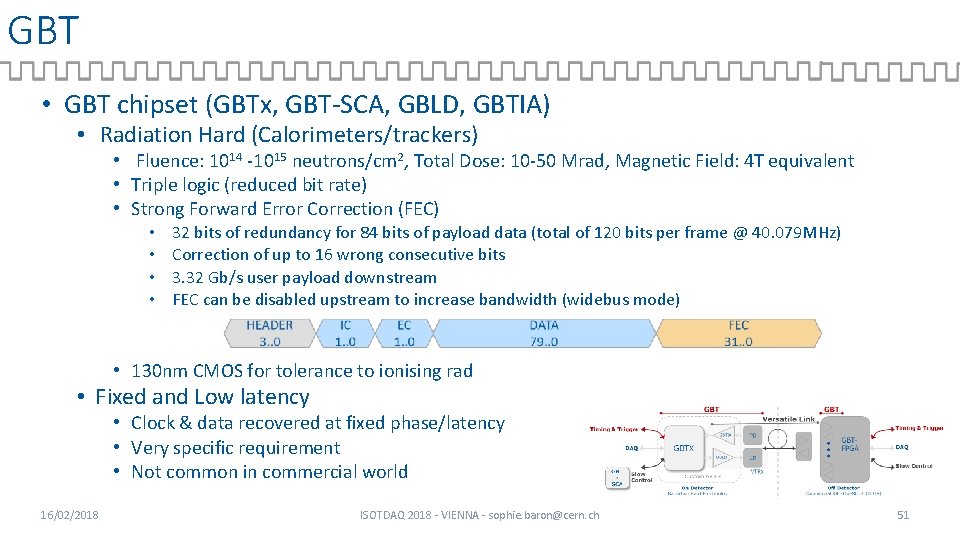
GBT • GBT chipset (GBTx, GBT-SCA, GBLD, GBTIA) • Radiation Hard (Calorimeters/trackers) • Fluence: 1014 -1015 neutrons/cm 2, Total Dose: 10 -50 Mrad, Magnetic Field: 4 T equivalent • Triple logic (reduced bit rate) • Strong Forward Error Correction (FEC) • • 32 bits of redundancy for 84 bits of payload data (total of 120 bits per frame @ 40. 079 MHz) Correction of up to 16 wrong consecutive bits 3. 32 Gb/s user payload downstream FEC can be disabled upstream to increase bandwidth (widebus mode) • 130 nm CMOS for tolerance to ionising rad • Fixed and Low latency • Clock & data recovered at fixed phase/latency • Very specific requirement • Not common in commercial world 16/02/2018 ISOTDAQ 2018 - VIENNA - sophie. baron@cern. ch 51
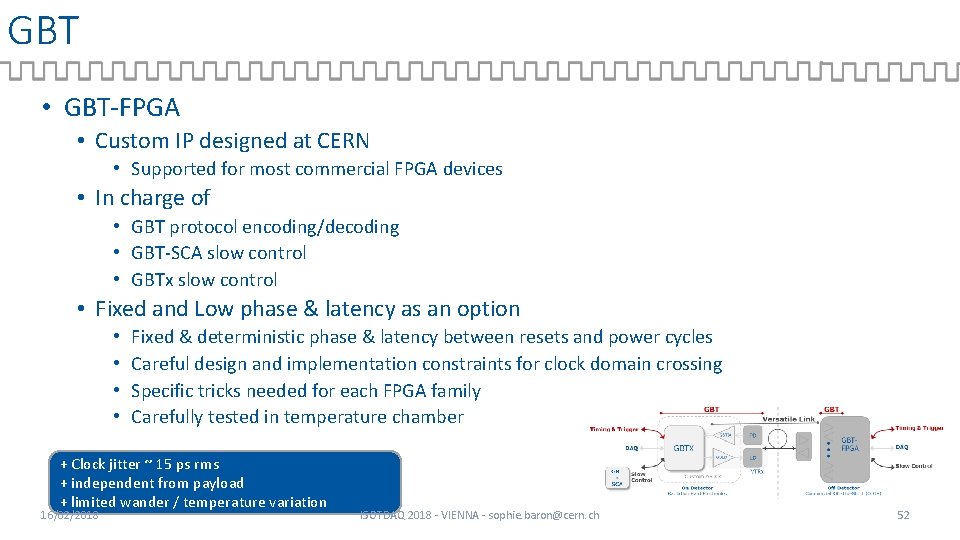
GBT • GBT-FPGA • Custom IP designed at CERN • Supported for most commercial FPGA devices • In charge of • GBT protocol encoding/decoding • GBT-SCA slow control • GBTx slow control • Fixed and Low phase & latency as an option • • Fixed & deterministic phase & latency between resets and power cycles Careful design and implementation constraints for clock domain crossing Specific tricks needed for each FPGA family Carefully tested in temperature chamber + Clock jitter ~ 15 ps rms + independent from payload + limited wander / temperature variation 16/02/2018 ISOTDAQ 2018 - VIENNA - sophie. baron@cern. ch 52
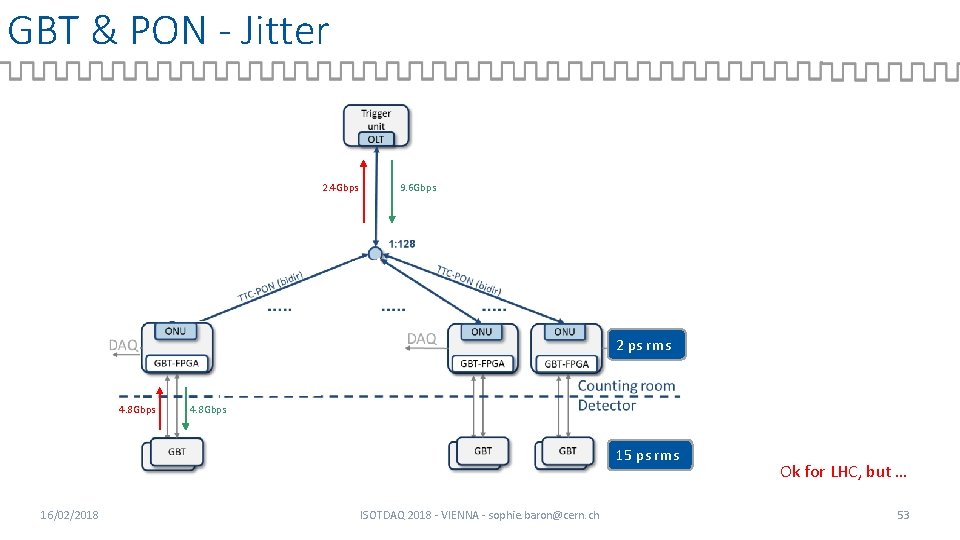
GBT & PON - Jitter 2. 4 Gbps 9. 6 Gbps 2 ps rms 4. 8 Gbps 15 ps rms 16/02/2018 ISOTDAQ 2018 - VIENNA - sophie. baron@cern. ch Ok for LHC, but … 53
Challenges for HL-LHC 16/02/2018 ISOTDAQ 2018 - VIENNA - sophie. baron@cern. ch 54
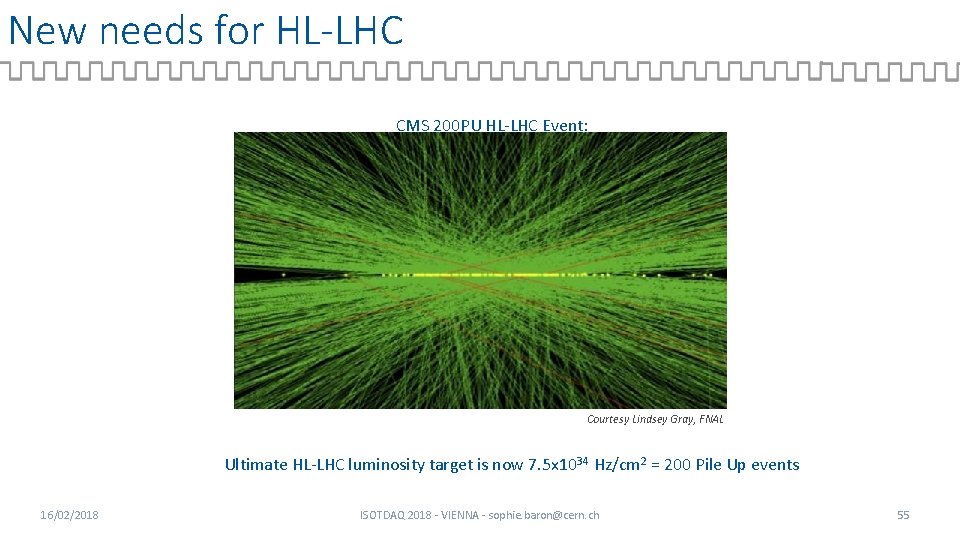
New needs for HL-LHC CMS 200 PU HL-LHC Event: Courtesy Lindsey Gray, FNAL Ultimate HL-LHC luminosity target is now 7. 5 x 1034 Hz/cm 2 = 200 Pile Up events 16/02/2018 ISOTDAQ 2018 - VIENNA - sophie. baron@cern. ch 55
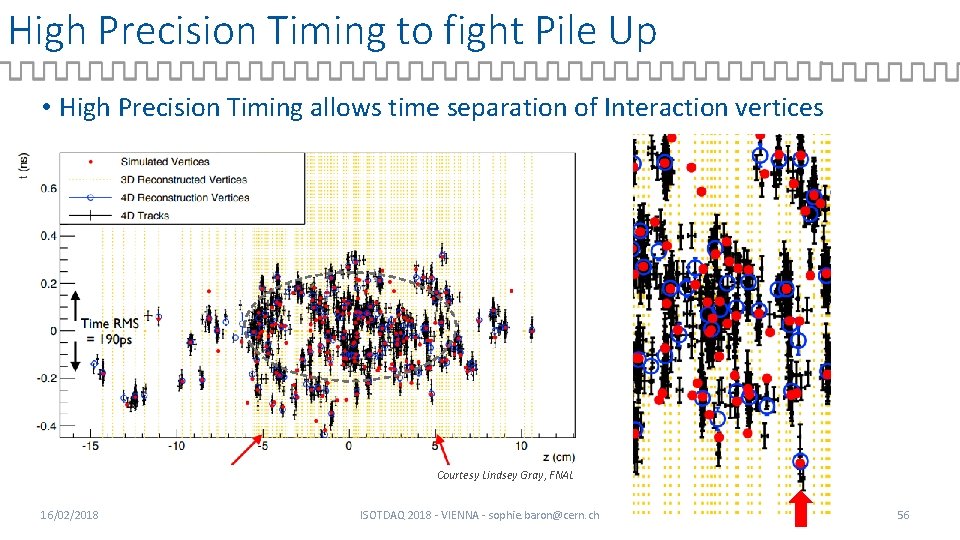
High Precision Timing to fight Pile Up • High Precision Timing allows time separation of Interaction vertices Courtesy Lindsey Gray, FNAL 16/02/2018 ISOTDAQ 2018 - VIENNA - sophie. baron@cern. ch 56
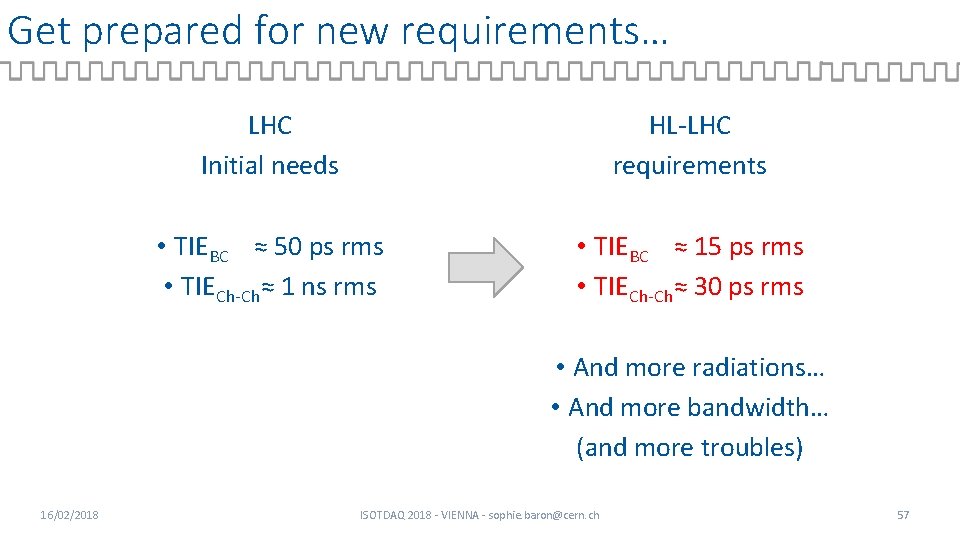
Get prepared for new requirements… LHC Initial needs HL-LHC requirements • TIEBC ≈ 50 ps rms • TIECh-Ch≈ 1 ns rms • TIEBC ≈ 15 ps rms • TIECh-Ch≈ 30 ps rms • And more radiations… • And more bandwidth… (and more troubles) 16/02/2018 ISOTDAQ 2018 - VIENNA - sophie. baron@cern. ch 57
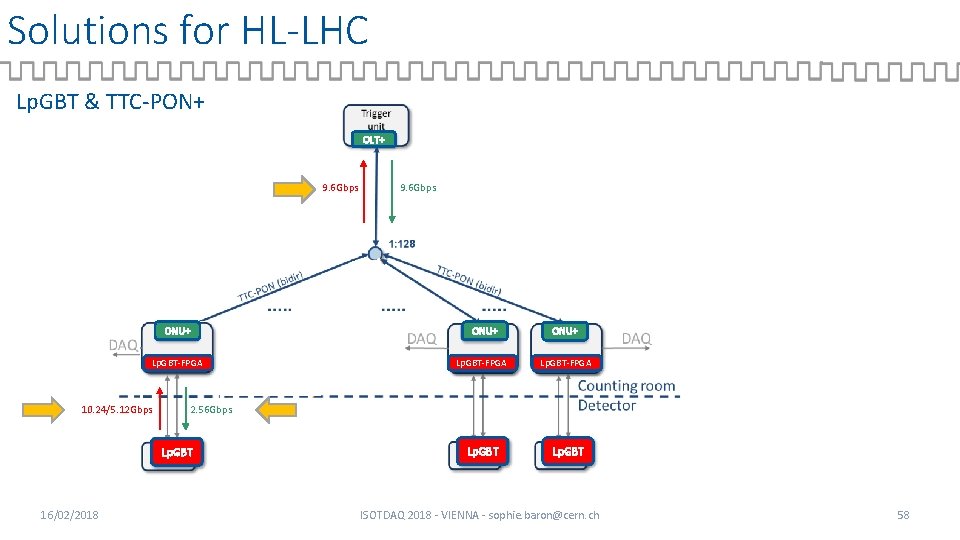
Solutions for HL-LHC Lp. GBT & TTC-PON+ OLT+ 9. 6 Gbps ONU+ Lp. GBT-FPGA 10. 24/5. 12 Gbps ONU+ Lp. GBT-FPGA Lp. GBT 2. 56 Gbps Lp. GBT 16/02/2018 9. 6 Gbps ISOTDAQ 2018 - VIENNA - sophie. baron@cern. ch 58
Lp. GBT • New custom ASIC: submission in March • First proto tape out: Q 3 2018 • Lower Power 500 m. W/750 m. W (5. 12/10. 24 Gbps) • Higher radiation hardness – TID 200 Mrad • Lower jitter <5 ps rms • Higher upstream bandwidth (10. 24 Gbps) • …and much more in the specs! https: //espace. cern. ch/GBT-Project/Lp. GBT/Specifications/Lp. Gbtx. Specifications. pdf 16/02/2018 ISOTDAQ 2018 - VIENNA - sophie. baron@cern. ch 59
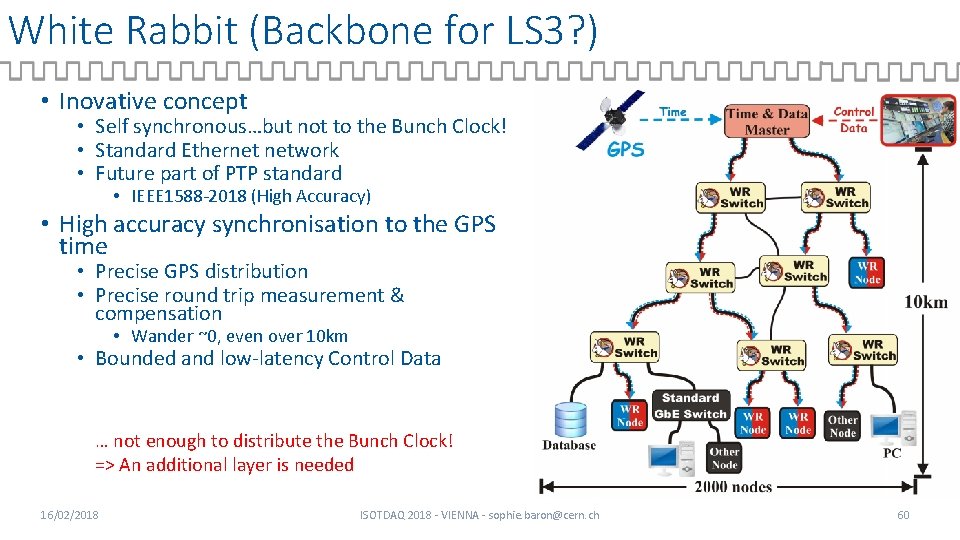
White Rabbit (Backbone for LS 3? ) • Inovative concept • Self synchronous…but not to the Bunch Clock! • Standard Ethernet network • Future part of PTP standard • IEEE 1588 -2018 (High Accuracy) • High accuracy synchronisation to the GPS time • Precise GPS distribution • Precise round trip measurement & compensation • Wander ~0, even over 10 km • Bounded and low-latency Control Data … not enough to distribute the Bunch Clock! => An additional layer is needed 16/02/2018 ISOTDAQ 2018 - VIENNA - sophie. baron@cern. ch 60
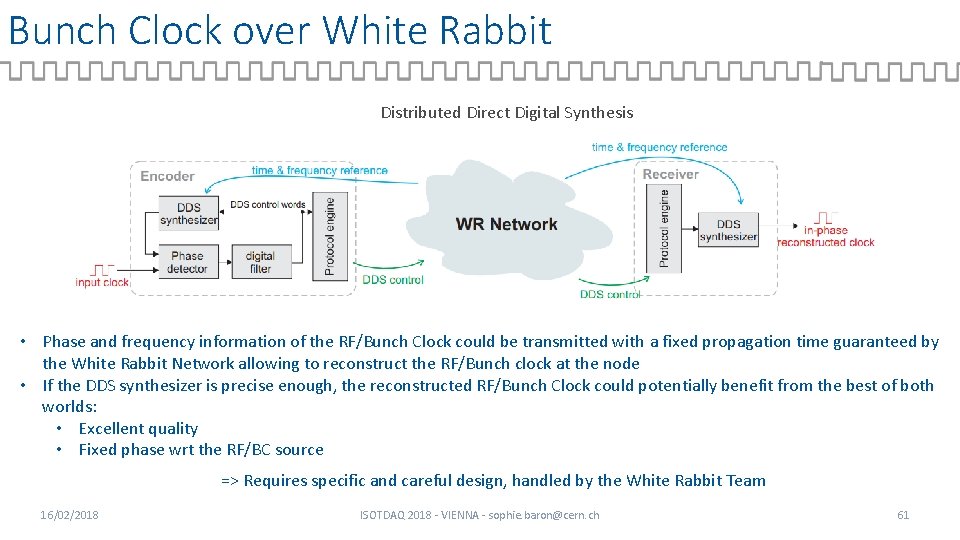
Bunch Clock over White Rabbit Distributed Direct Digital Synthesis • Phase and frequency information of the RF/Bunch Clock could be transmitted with a fixed propagation time guaranteed by the White Rabbit Network allowing to reconstruct the RF/Bunch clock at the node • If the DDS synthesizer is precise enough, the reconstructed RF/Bunch Clock could potentially benefit from the best of both worlds: • Excellent quality • Fixed phase wrt the RF/BC source => Requires specific and careful design, handled by the White Rabbit Team 16/02/2018 ISOTDAQ 2018 - VIENNA - sophie. baron@cern. ch 61
Timing in LHC… …is much more than you thought! 16/02/2018 ISOTDAQ 2018 - VIENNA - sophie. baron@cern. ch 62
Spare slides 16/02/2018 ISOTDAQ 2018 - VIENNA - sophie. baron@cern. ch 63
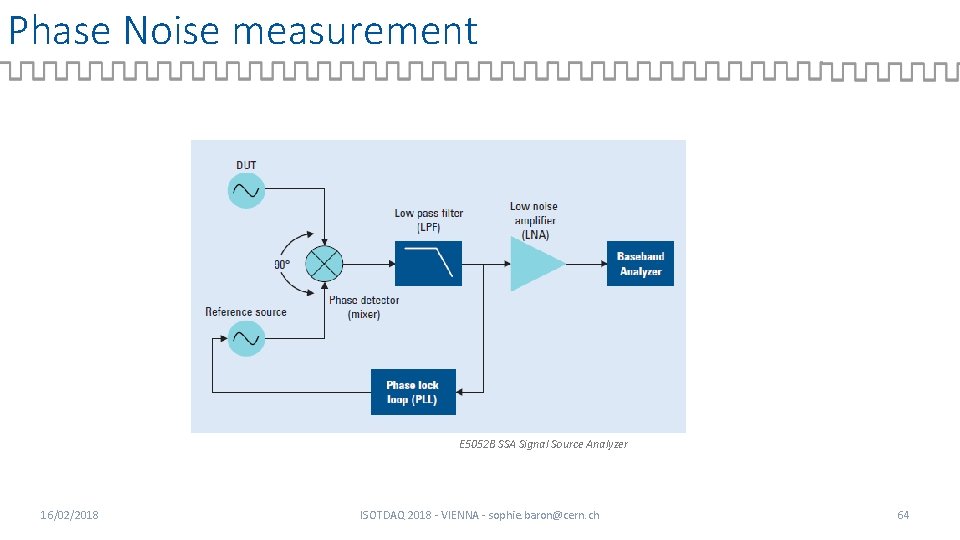
Phase Noise measurement E 5052 B SSA Signal Source Analyzer 16/02/2018 ISOTDAQ 2018 - VIENNA - sophie. baron@cern. ch 64
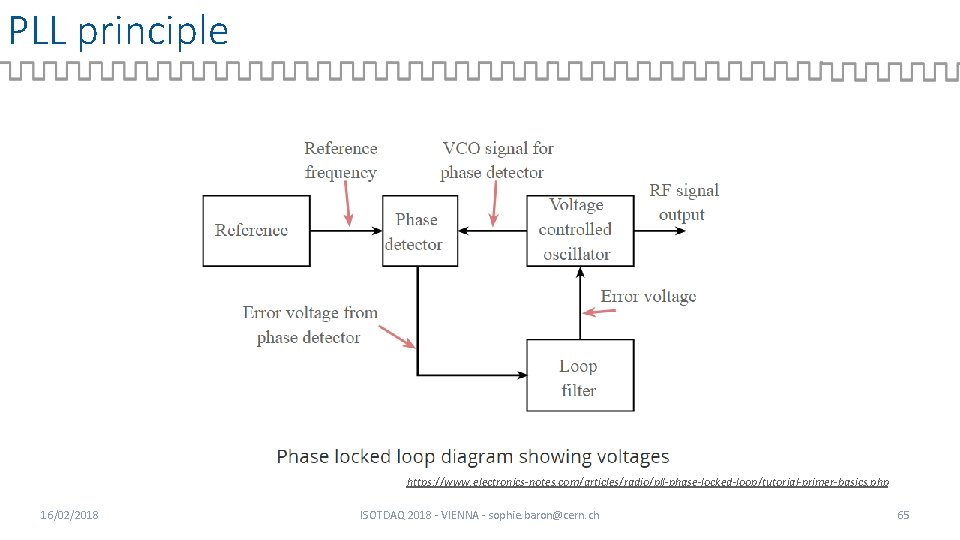
PLL principle https: //www. electronics-notes. com/articles/radio/pll-phase-locked-loop/tutorial-primer-basics. php 16/02/2018 ISOTDAQ 2018 - VIENNA - sophie. baron@cern. ch 65

CDR principle 16/02/2018 ISOTDAQ 2018 - VIENNA - sophie. baron@cern. ch 66
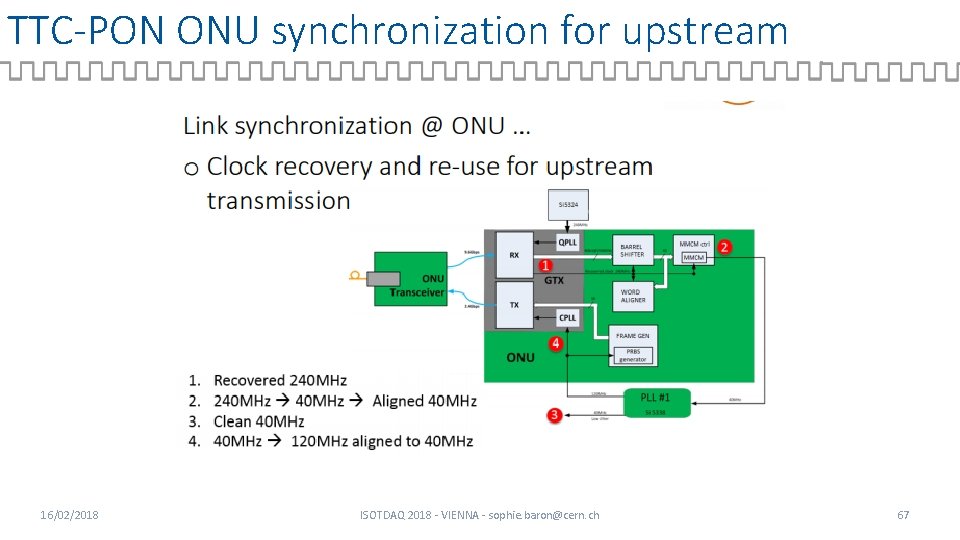
TTC-PON ONU synchronization for upstream 16/02/2018 ISOTDAQ 2018 - VIENNA - sophie. baron@cern. ch 67
- Slides: 67