
Timestamps in Locking Protocols Timestamps used to avoid
- Slides: 7
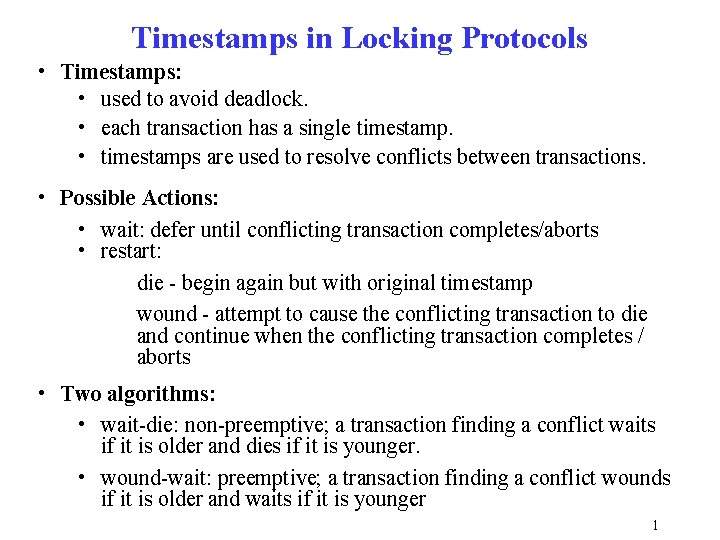
Timestamps in Locking Protocols • Timestamps: • used to avoid deadlock. • each transaction has a single timestamp. • timestamps are used to resolve conflicts between transactions. • Possible Actions: • wait: defer until conflicting transaction completes/aborts • restart: die - begin again but with original timestamp wound - attempt to cause the conflicting transaction to die and continue when the conflicting transaction completes / aborts • Two algorithms: • wait-die: non-preemptive; a transaction finding a conflict waits if it is older and dies if it is younger. • wound-wait: preemptive; a transaction finding a conflict wounds if it is older and waits if it is younger 1
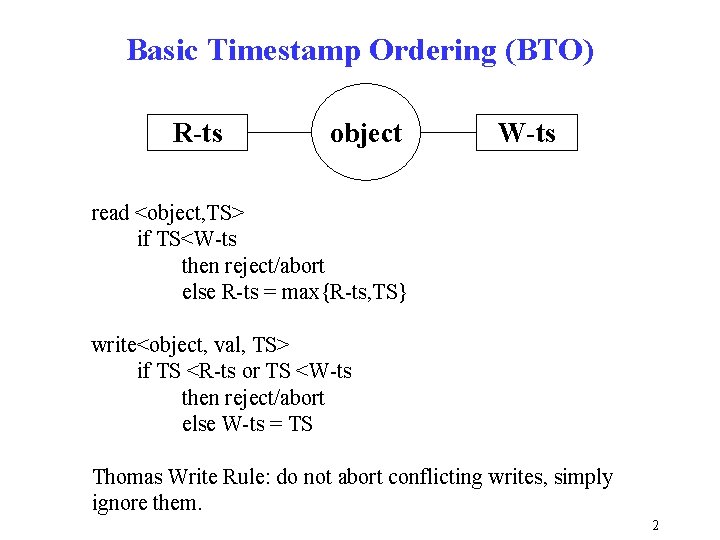
Basic Timestamp Ordering (BTO) R-ts object W-ts read <object, TS> if TS<W-ts then reject/abort else R-ts = max{R-ts, TS} write<object, val, TS> if TS <R-ts or TS <W-ts then reject/abort else W-ts = TS Thomas Write Rule: do not abort conflicting writes, simply ignore them. 2
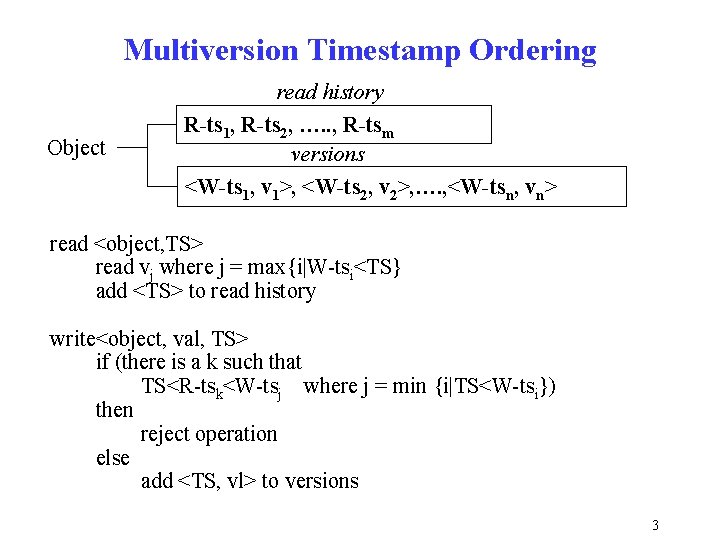
Multiversion Timestamp Ordering read history Object R-ts 1, R-ts 2, …. . , R-tsm versions <W-ts 1, v 1>, <W-ts 2, v 2>, …. , <W-tsn, vn> read <object, TS> read vj where j = max{i|W-tsi<TS} add <TS> to read history write<object, val, TS> if (there is a k such that TS<R-tsk<W-tsj where j = min {i|TS<W-tsi}) then reject operation else add <TS, vl> to versions 3
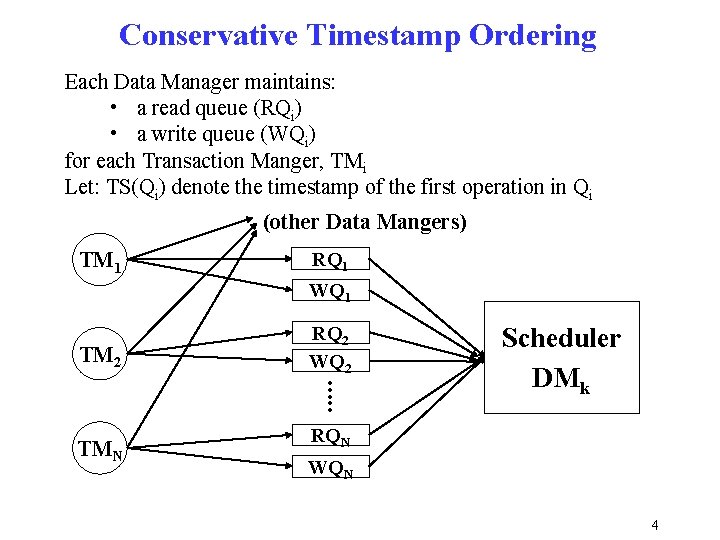
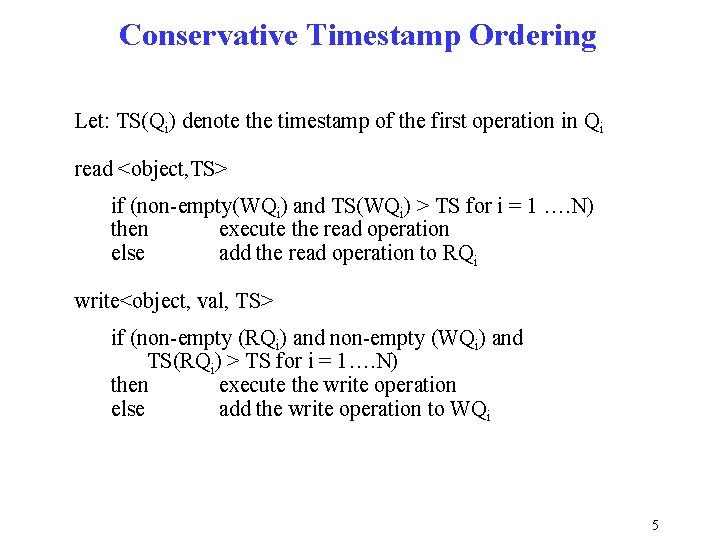
Conservative Timestamp Ordering Each Data Manager maintains: • a read queue (RQi) • a write queue (WQi) for each Transaction Manger, TMi Let: TS(Qi) denote the timestamp of the first operation in Qi (other Data Mangers) TM 1 RQ 1 WQ 1 TM 2 TMN RQ 2 WQ 2 . . . Scheduler DMk RQN WQN 4
Conservative Timestamp Ordering Let: TS(Qi) denote the timestamp of the first operation in Qi read <object, TS> if (non-empty(WQi) and TS(WQi) > TS for i = 1 …. N) then execute the read operation else add the read operation to RQi write<object, val, TS> if (non-empty (RQi) and non-empty (WQi) and TS(RQi) > TS for i = 1…. N) then execute the write operation else add the write operation to WQi 5
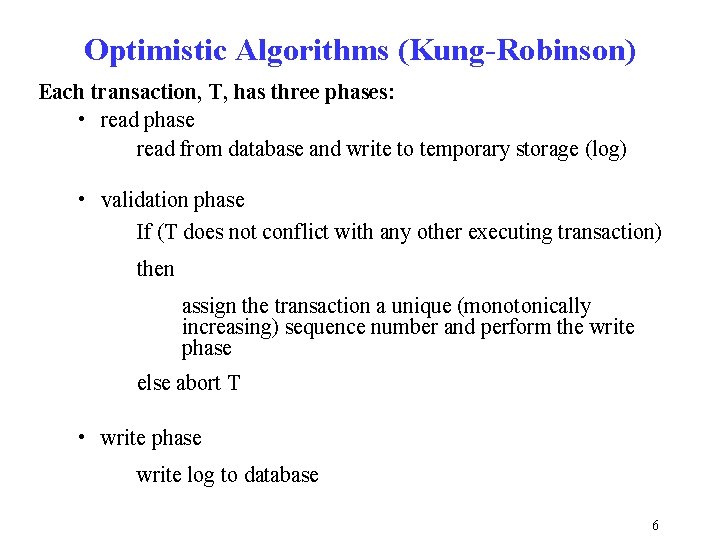
Optimistic Algorithms (Kung-Robinson) Each transaction, T, has three phases: • read phase read from database and write to temporary storage (log) • validation phase If (T does not conflict with any other executing transaction) then assign the transaction a unique (monotonically increasing) sequence number and perform the write phase else abort T • write phase write log to database 6
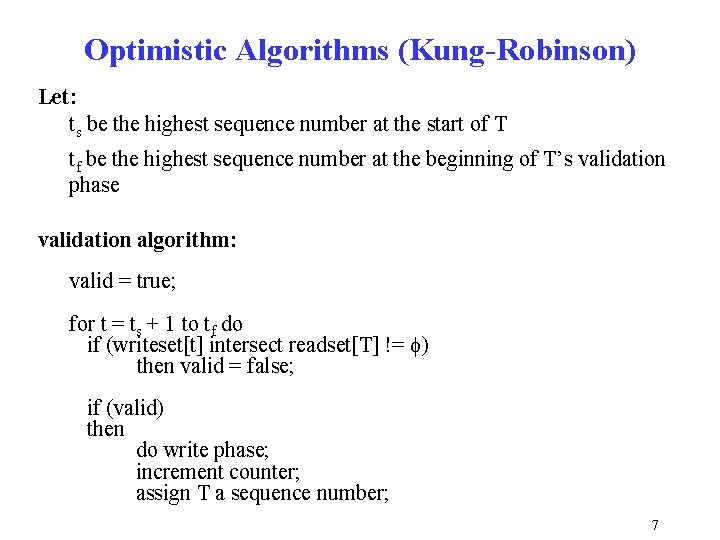
Optimistic Algorithms (Kung-Robinson) Let: ts be the highest sequence number at the start of T tf be the highest sequence number at the beginning of T’s validation phase validation algorithm: valid = true; for t = ts + 1 to tf do if (writeset[t] intersect readset[T] != ) then valid = false; if (valid) then do write phase; increment counter; assign T a sequence number; 7