
Timestamps and Advanced Transactions COMP 3211 Advanced Databases

Timestamps and Advanced Transactions COMP 3211 Advanced Databases Dr Nicholas Gibbins – nmg@ecs. soton. ac. uk 2020 -2021
Overview • Timestamps • Savepoints • Chained transactions • Nested transactions • Sagas 3
Timestamps

Timestamps • An alternative to locks – deadlock cannot occur • Timestamps are unique identifiers for transactions – the transaction start time: TS(T) • For each resource X, there is: • A read timestamp, read-TS(X) • A write timestamp, write-TS(X) • read-TS(X) and write-TS(X) are set to the timestamp of the most recent corresponding transaction that accessed resource X 5

Timestamp Ordering Transactions are ordered based on their timestamps • Schedule is serialisable • Equivalent serial schedule has the transactions in order of their timestamps For each resource accessing by conflicting operations, the order in which the resource is accessed must not violate the serialisability order 6
Basic Timestamp Ordering TS(T) is compared with read-TS(X) and write-TS(X) • Has this item been read or written before transaction T has had an opportunity to read/write? • Ensure that timestamp ordering is not violated If timestamp ordering is violated, transaction is aborted and resubmitted with a new timestamp 7
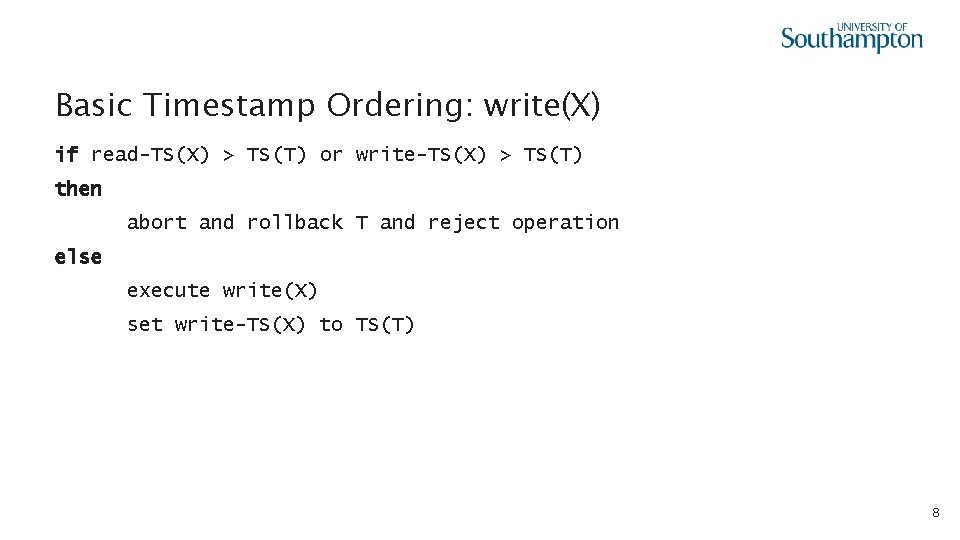
Basic Timestamp Ordering: write(X) if read-TS(X) > TS(T) or write-TS(X) > TS(T) then abort and rollback T and reject operation else execute write(X) set write-TS(X) to TS(T) 8
Basic Timestamp Ordering X time 9
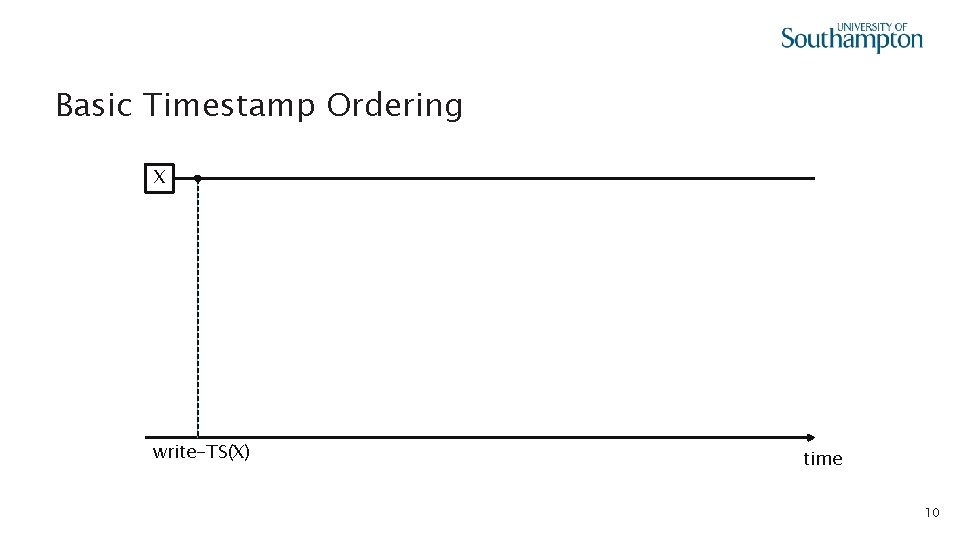
Basic Timestamp Ordering X write-TS(X) time 10
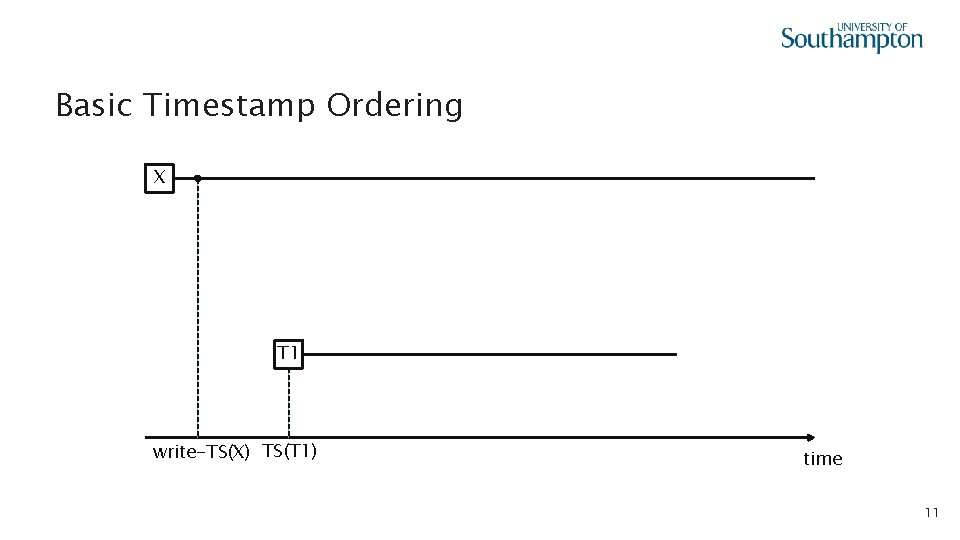
Basic Timestamp Ordering X T 1 write-TS(X) TS(T 1) time 11
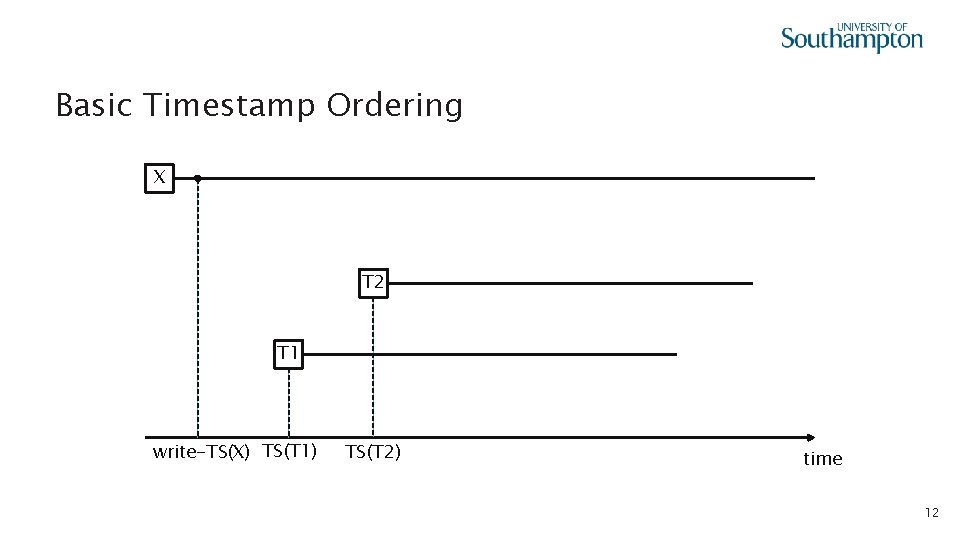
Basic Timestamp Ordering X T 2 T 1 write-TS(X) TS(T 1) TS(T 2) time 12
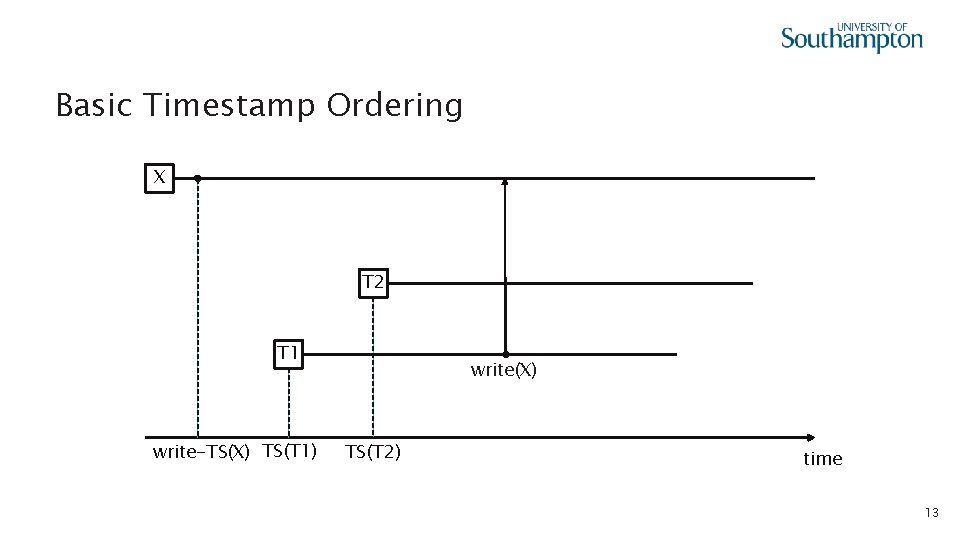
Basic Timestamp Ordering X T 2 T 1 write-TS(X) TS(T 1) write(X) TS(T 2) time 13
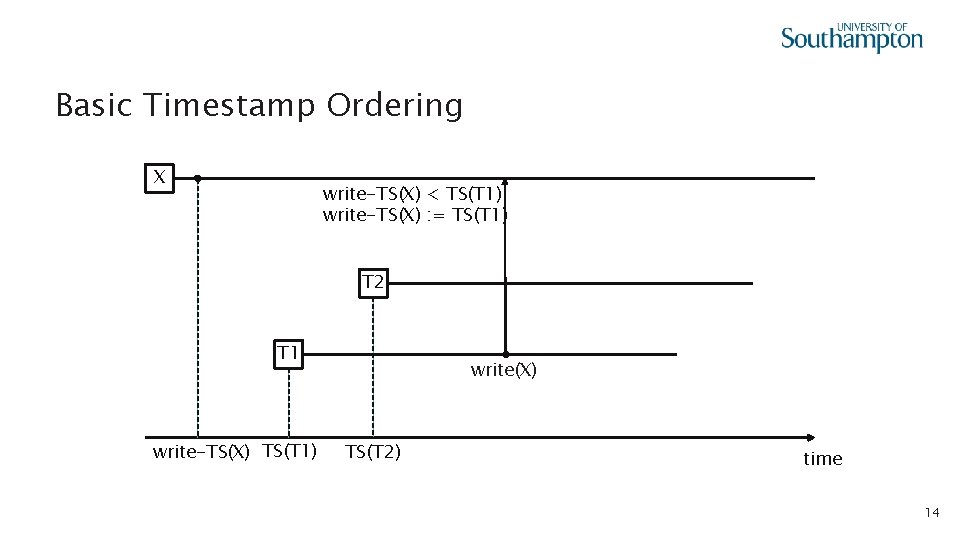
Basic Timestamp Ordering X write-TS(X) < TS(T 1) write-TS(X) : = TS(T 1) T 2 T 1 write-TS(X) TS(T 1) write(X) TS(T 2) time 14
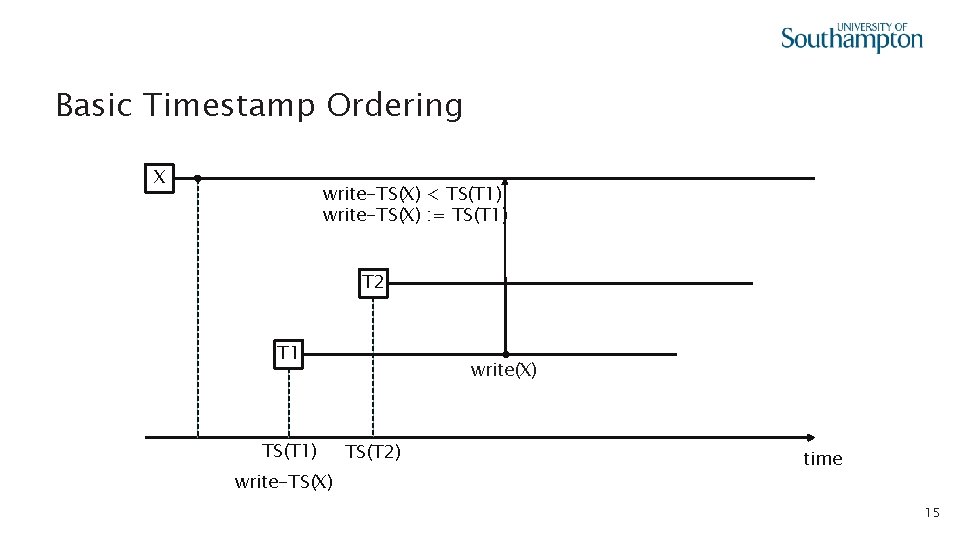
Basic Timestamp Ordering X write-TS(X) < TS(T 1) write-TS(X) : = TS(T 1) T 2 T 1 TS(T 1) write-TS(X) write(X) TS(T 2) time 15
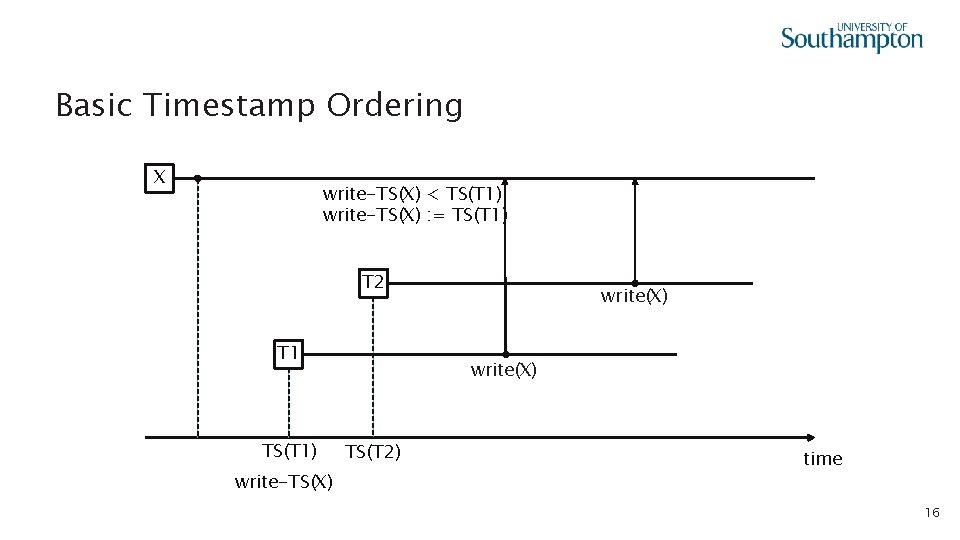
Basic Timestamp Ordering X write-TS(X) < TS(T 1) write-TS(X) : = TS(T 1) T 2 T 1 TS(T 1) write-TS(X) write(X) TS(T 2) time 16
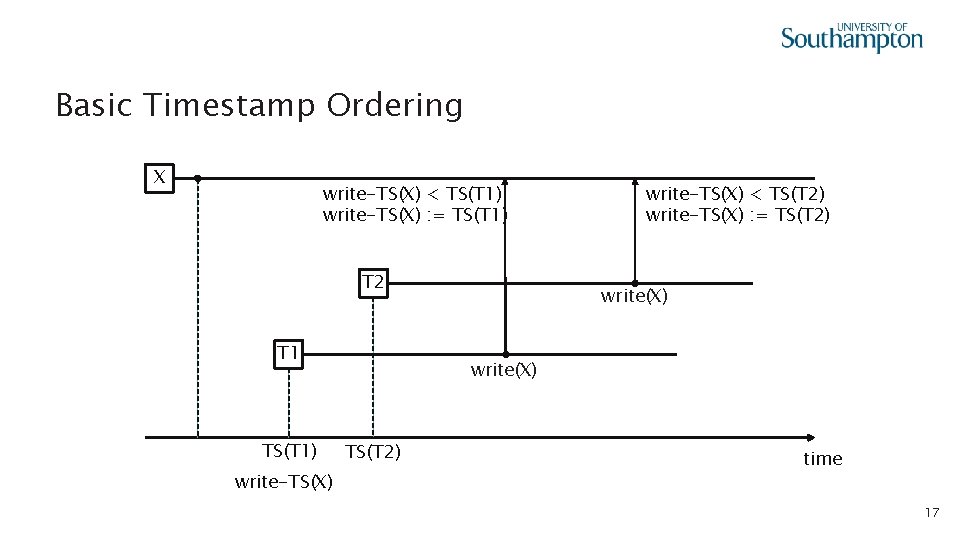
Basic Timestamp Ordering X write-TS(X) < TS(T 1) write-TS(X) : = TS(T 1) T 2 T 1 TS(T 1) write-TS(X) < TS(T 2) write-TS(X) : = TS(T 2) write(X) TS(T 2) time 17
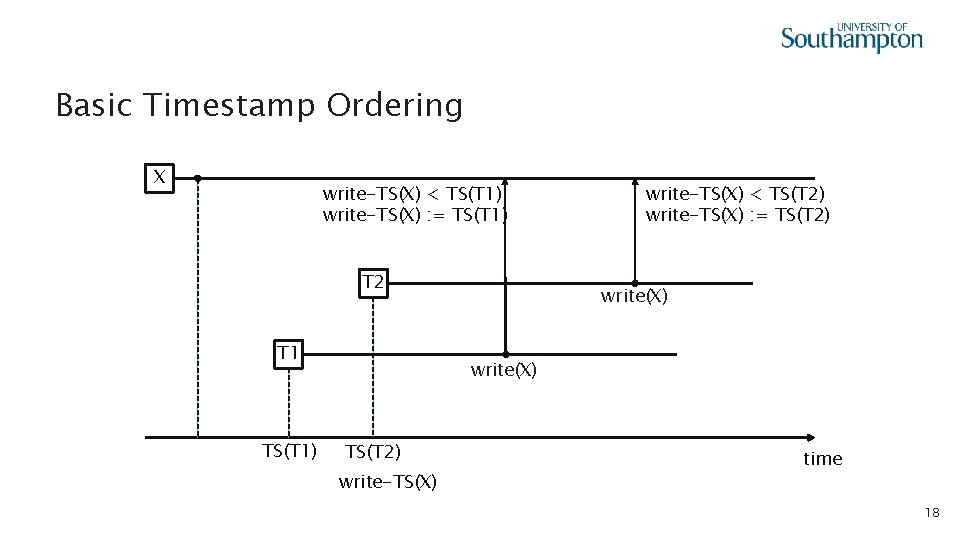
Basic Timestamp Ordering X write-TS(X) < TS(T 1) write-TS(X) : = TS(T 1) T 2 T 1 TS(T 1) write-TS(X) < TS(T 2) write-TS(X) : = TS(T 2) write(X) TS(T 2) write-TS(X) time 18
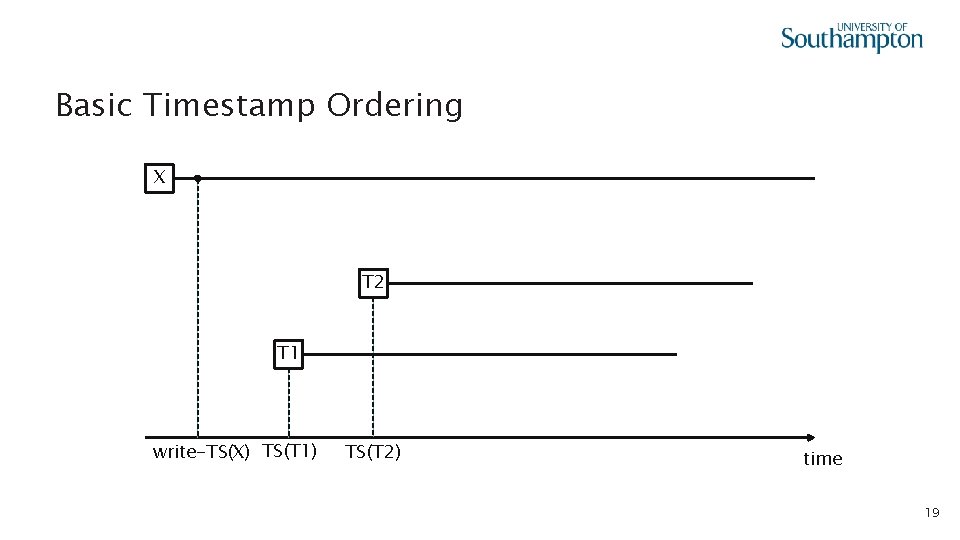
Basic Timestamp Ordering X T 2 T 1 write-TS(X) TS(T 1) TS(T 2) time 19
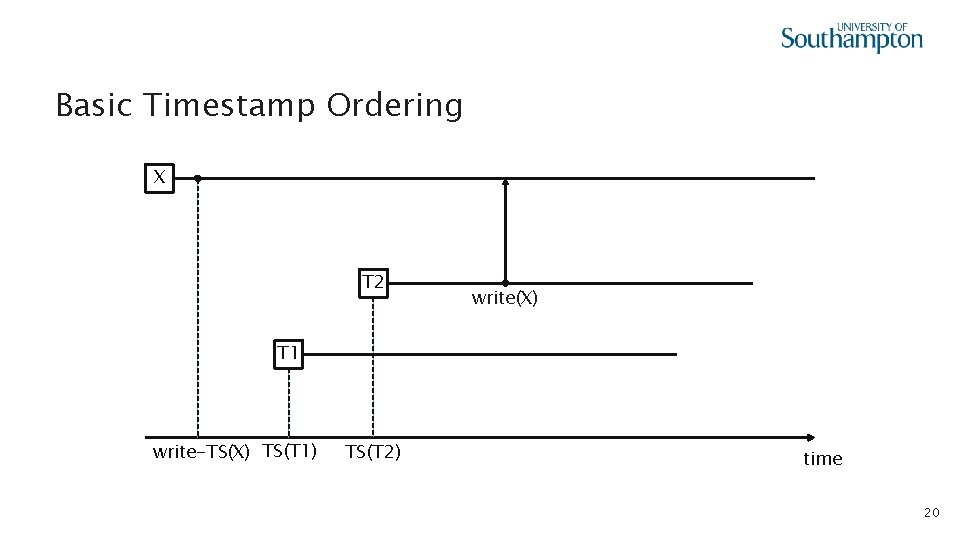
Basic Timestamp Ordering X T 2 write(X) T 1 write-TS(X) TS(T 1) TS(T 2) time 20
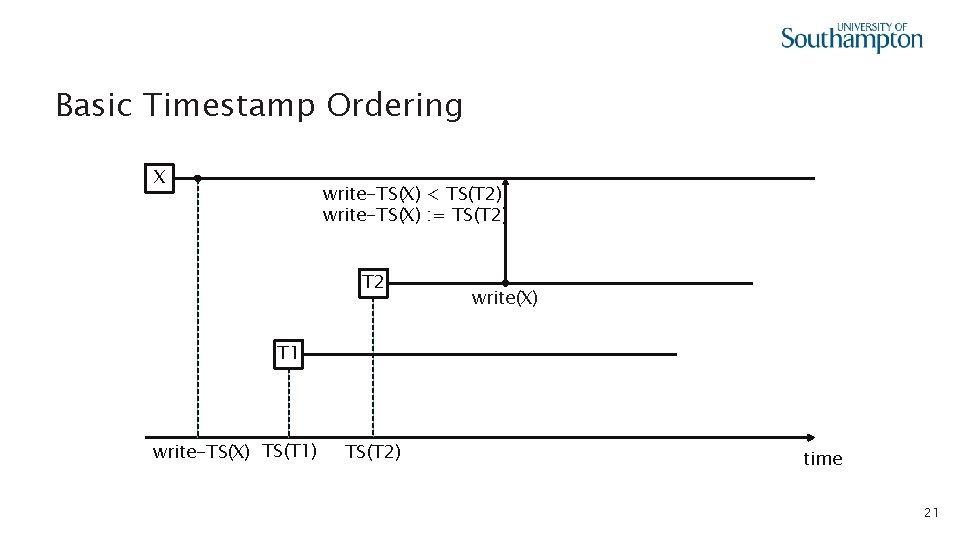
Basic Timestamp Ordering X write-TS(X) < TS(T 2) write-TS(X) : = TS(T 2) T 2 write(X) T 1 write-TS(X) TS(T 1) TS(T 2) time 21
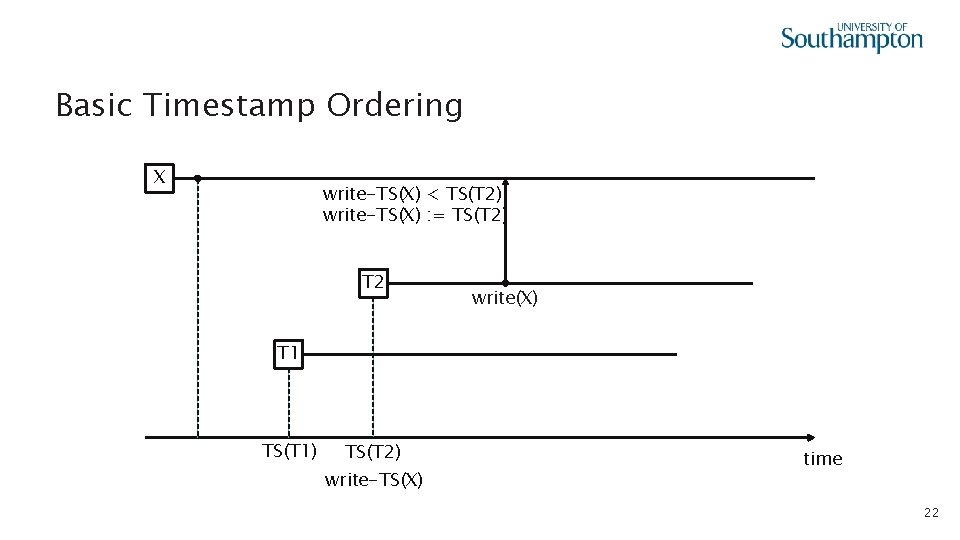
Basic Timestamp Ordering X write-TS(X) < TS(T 2) write-TS(X) : = TS(T 2) T 2 write(X) T 1 TS(T 1) TS(T 2) write-TS(X) time 22
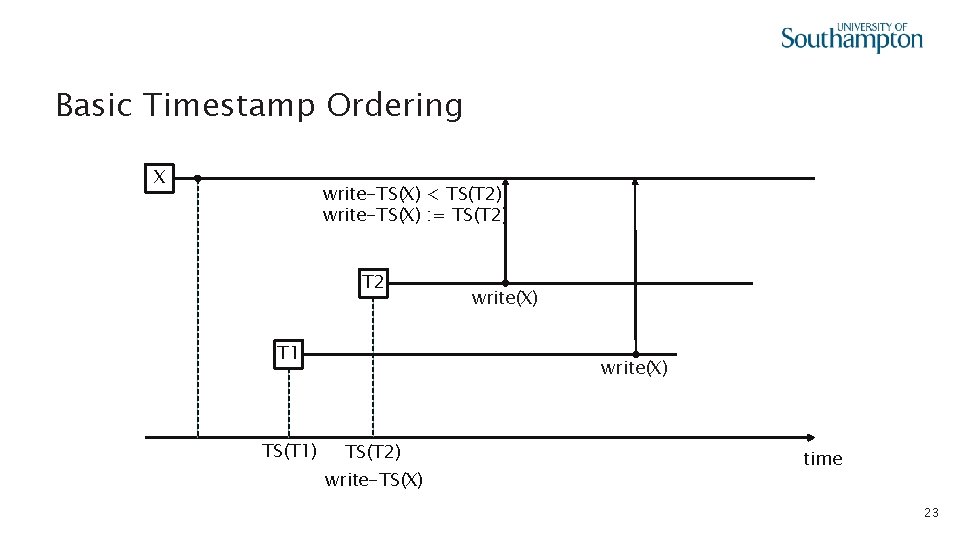
Basic Timestamp Ordering X write-TS(X) < TS(T 2) write-TS(X) : = TS(T 2) T 2 T 1 TS(T 1) write(X) TS(T 2) write-TS(X) time 23
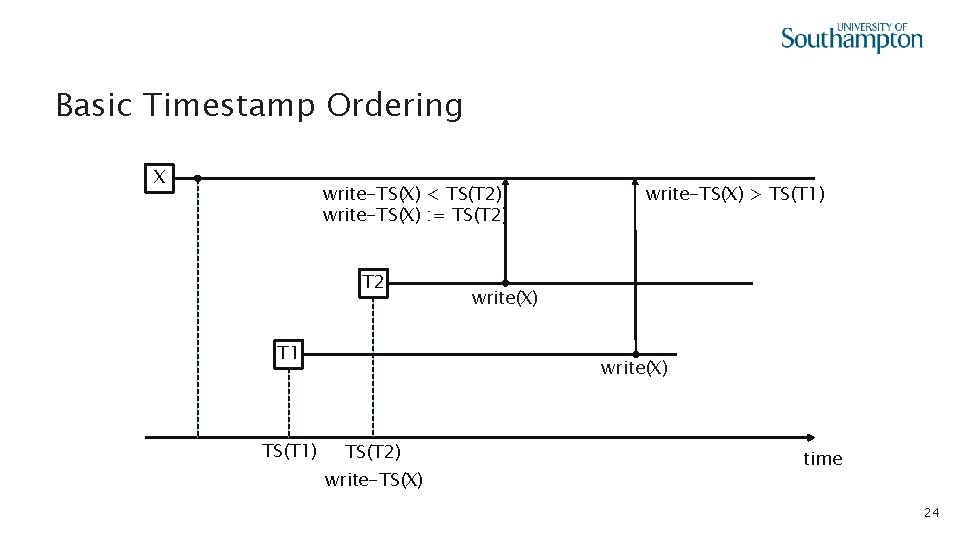
Basic Timestamp Ordering X write-TS(X) < TS(T 2) write-TS(X) : = TS(T 2) T 2 T 1 TS(T 1) write-TS(X) > TS(T 1) write(X) TS(T 2) write-TS(X) time 24
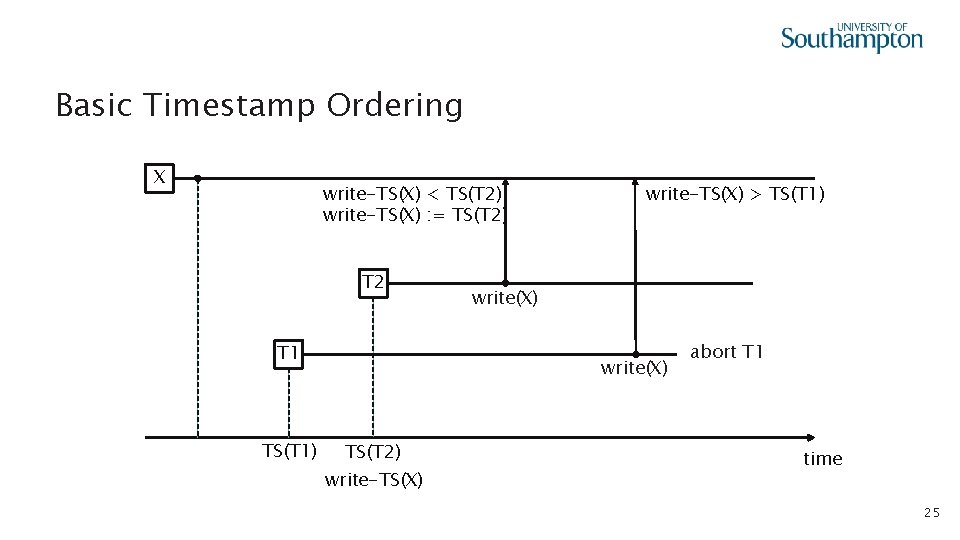
Basic Timestamp Ordering X write-TS(X) < TS(T 2) write-TS(X) : = TS(T 2) T 2 T 1 TS(T 1) write-TS(X) > TS(T 1) write(X) TS(T 2) write-TS(X) abort T 1 time 25
Basic Timestamp Ordering: read(X) if write-TS(X) > TS(T) then abort and rollback T and reject operation else execute read(X) set read-TS(X) to max(TS(T), read-TS(X)) 26
Thomas’s Write Rule • Modification of Basic TO that rejects fewer write operations • Weakens the checks for write (X) so that obsolete write operations are ignored • Does not enforce serialisability 27
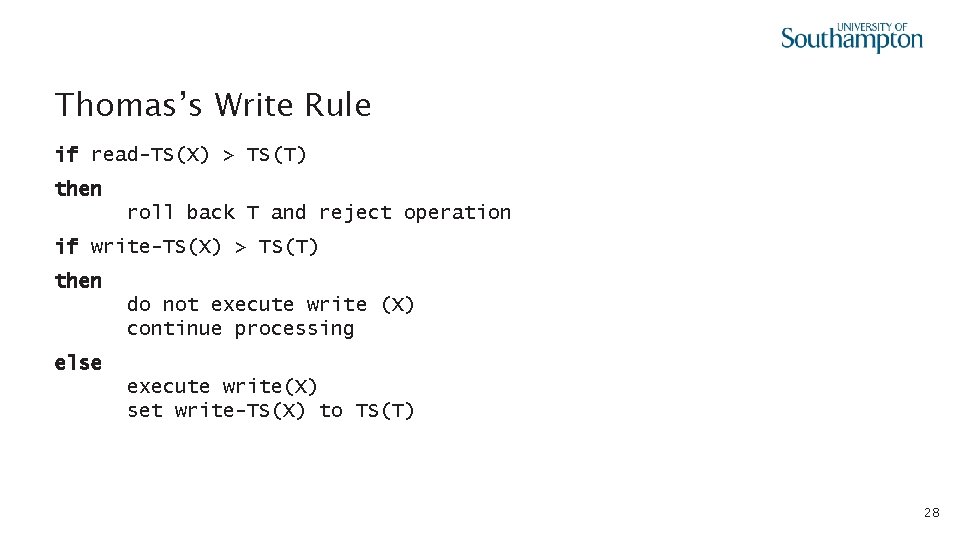
Thomas’s Write Rule if read-TS(X) > TS(T) then roll back T and reject operation if write-TS(X) > TS(T) then do not execute write (X) continue processing else execute write(X) set write-TS(X) to TS(T) 28
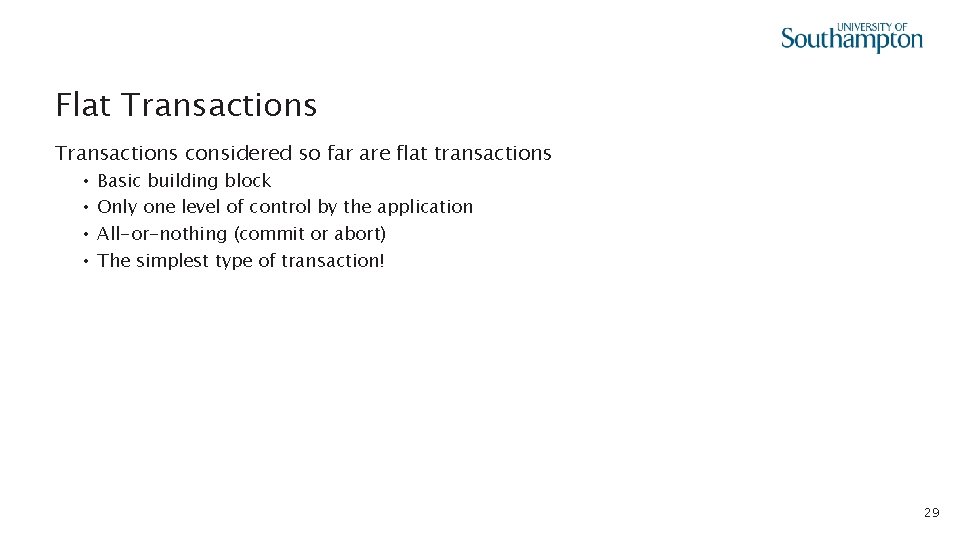
Flat Transactions considered so far are flat transactions • • Basic building block Only one level of control by the application All-or-nothing (commit or abort) The simplest type of transaction! 29
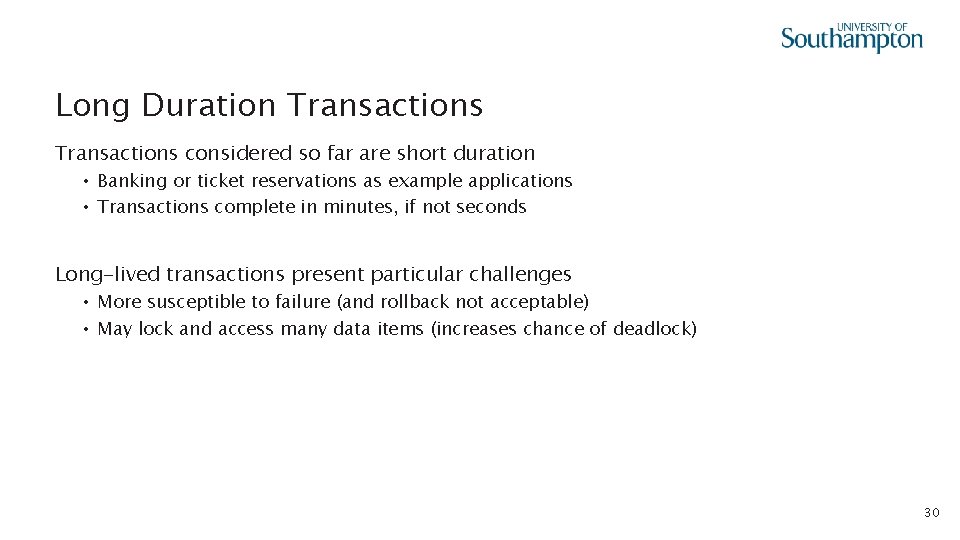
Long Duration Transactions considered so far are short duration • Banking or ticket reservations as example applications • Transactions complete in minutes, if not seconds Long-lived transactions present particular challenges • More susceptible to failure (and rollback not acceptable) • May lock and access many data items (increases chance of deadlock) 30

Savepoints
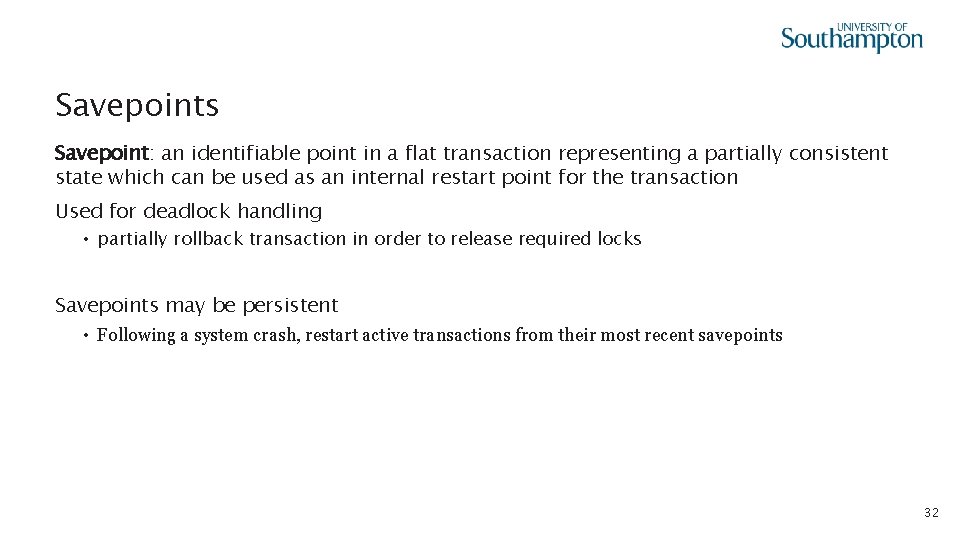
Savepoints Savepoint: an identifiable point in a flat transaction representing a partially consistent state which can be used as an internal restart point for the transaction Used for deadlock handling • partially rollback transaction in order to release required locks Savepoints may be persistent • Following a system crash, restart active transactions from their most recent savepoints 32
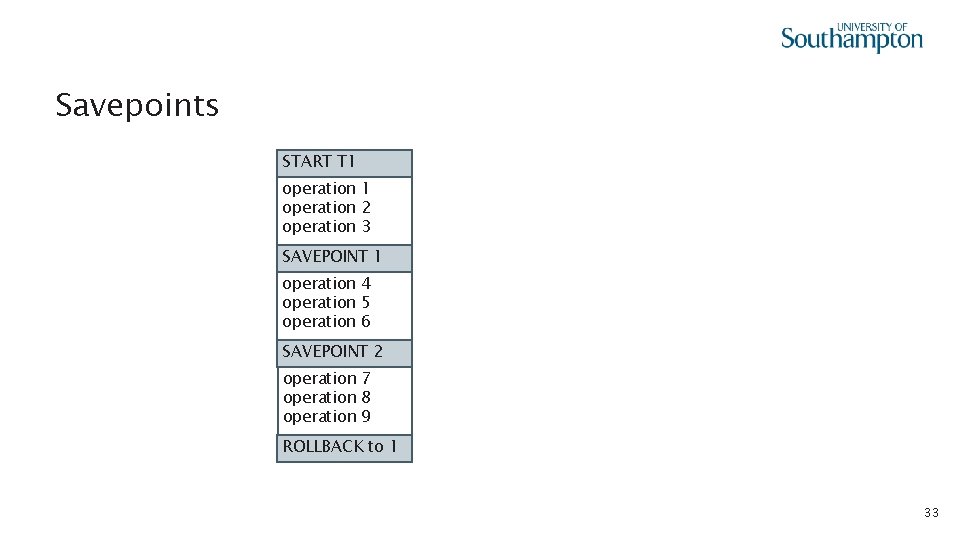
Savepoints START T 1 operation 2 operation 3 SAVEPOINT 1 operation 4 operation 5 operation 6 SAVEPOINT 2 operation 7 operation 8 operation 9 ROLLBACK to 1 33
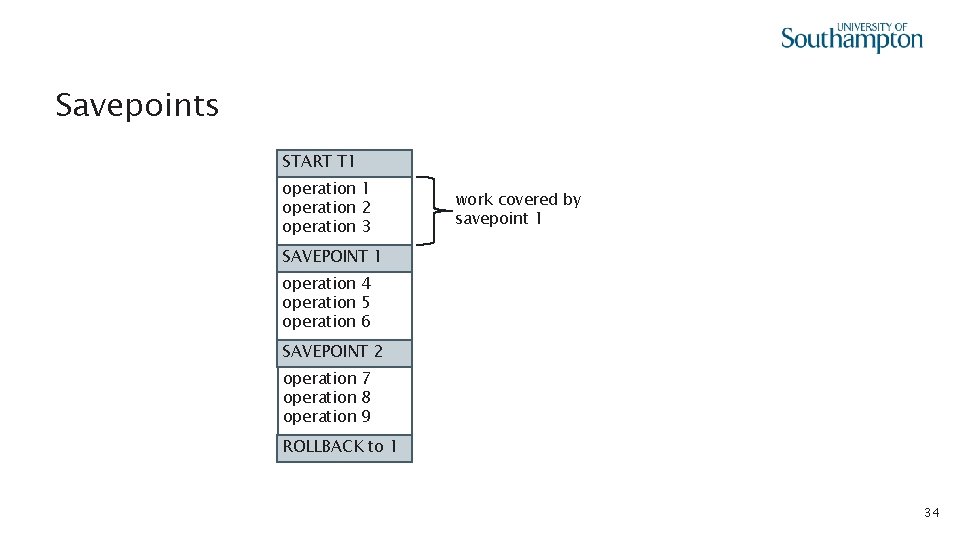
Savepoints START T 1 operation 2 operation 3 work covered by savepoint 1 SAVEPOINT 1 operation 4 operation 5 operation 6 SAVEPOINT 2 operation 7 operation 8 operation 9 ROLLBACK to 1 34
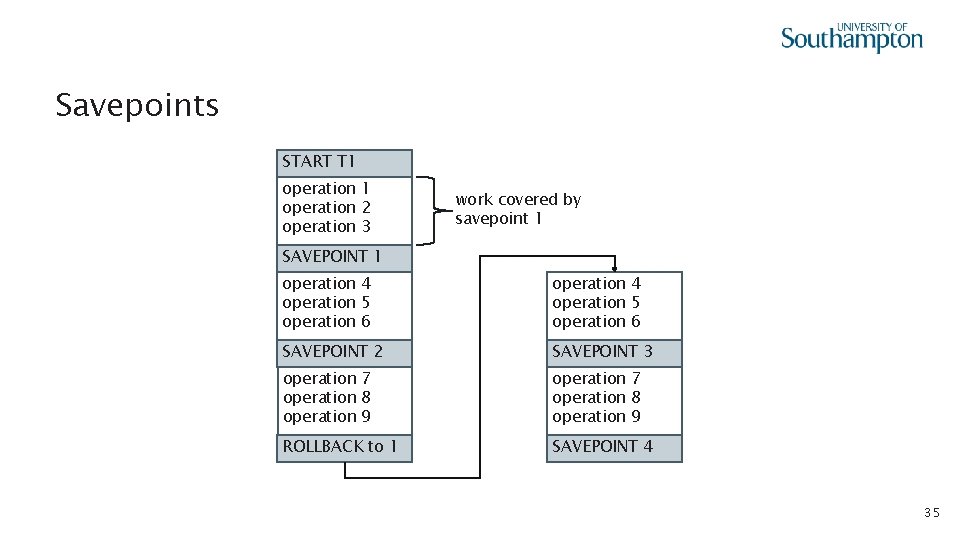
Savepoints START T 1 operation 2 operation 3 work covered by savepoint 1 SAVEPOINT 1 operation 4 operation 5 operation 6 SAVEPOINT 2 SAVEPOINT 3 operation 7 operation 8 operation 9 ROLLBACK to 1 SAVEPOINT 4 35
Chained Transactions
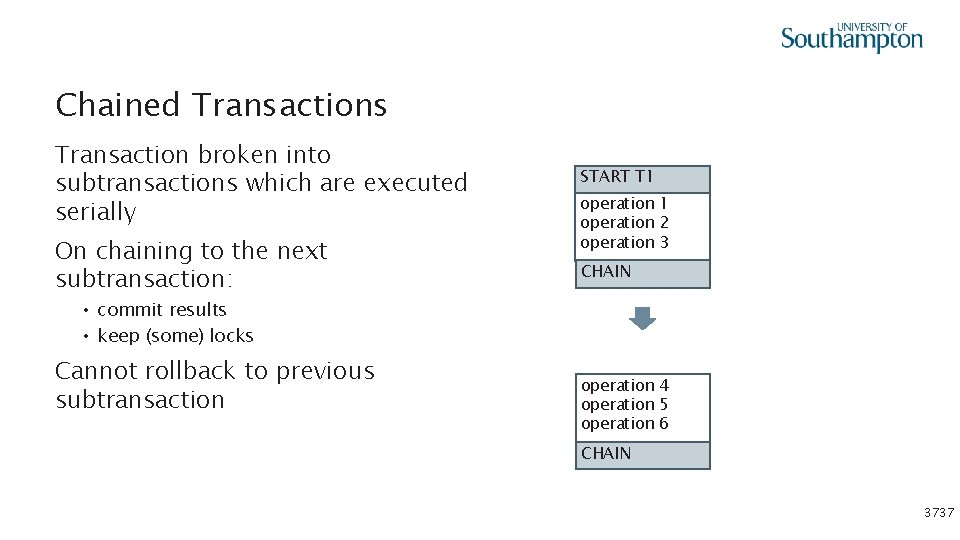
Chained Transactions Transaction broken into subtransactions which are executed serially START T 1 On chaining to the next subtransaction: CHAIN operation 1 operation 2 operation 3 • commit results • keep (some) locks Cannot rollback to previous subtransaction operation 4 operation 5 operation 6 CHAIN 3737
Savepoints versus Chained Transactions • Both allow substructure to be imposed on a long-running application program • Database context is preserved • Cursors are kept • Commit vs Savepoint • Chained - rollback only to previous ‘savepoint’ • Savepoints - can rollback to arbitrary savepoint • Locks • Chained frees unwanted locks 38
Savepoints versus Chained Transactions • Work lost • Savepoints more flexible than flat transactions, as long as the system does not crash • Restart • Chained transactions can restart from most recent commit, as long as no processing context hidden in local programming variables • Both organise work into a sequence of actions 39
Nested Transactions
Nested Transactions Transaction forms a hierarchy of subtransactions (partial order on set of subtransactions) Subtransactions may abort without aborting their parent transaction • May restart subtransaction Three rules for nested transactions: • Commit Rule • Rollback Rule • Visibility Rule 41
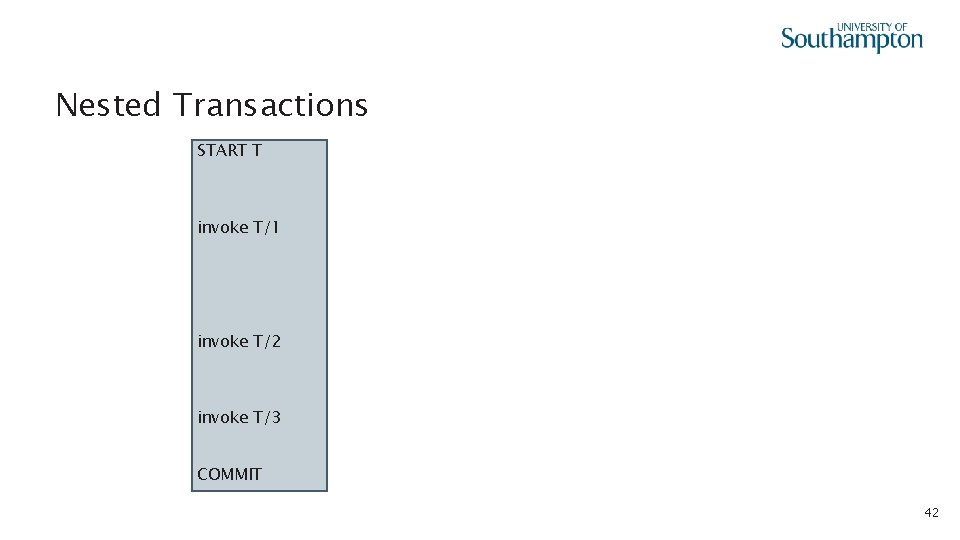
Nested Transactions START T invoke T/1 invoke T/2 invoke T/3 COMMIT 42
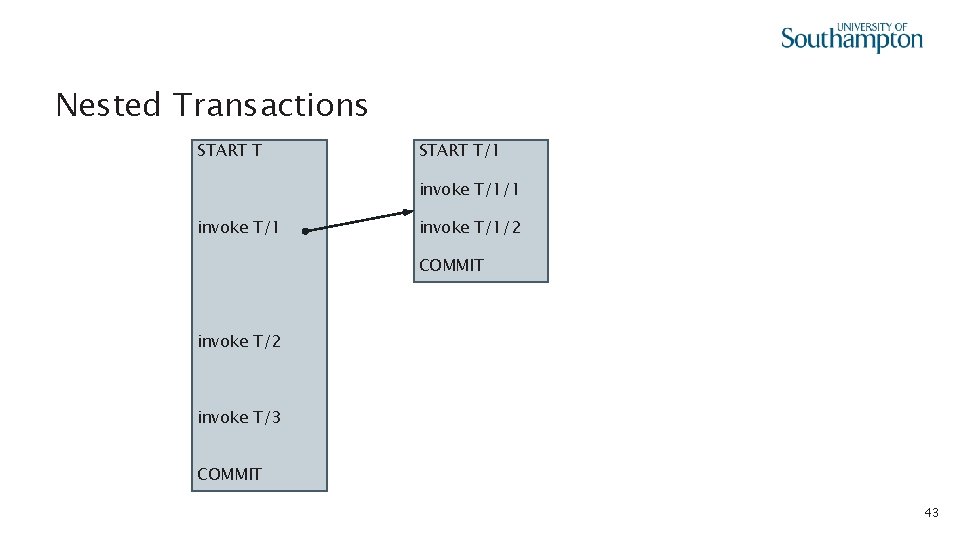
Nested Transactions START T/1 invoke T/1/2 COMMIT invoke T/2 invoke T/3 COMMIT 43
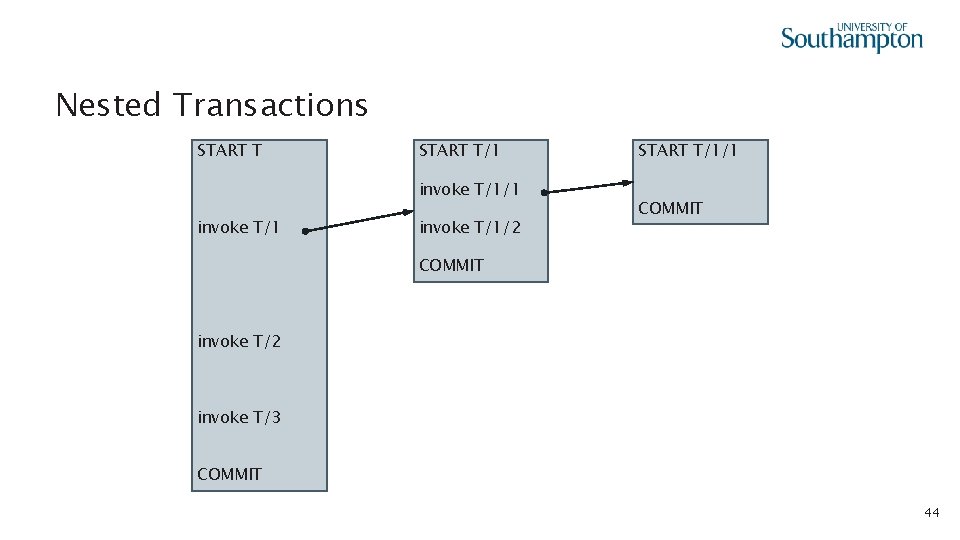
Nested Transactions START T/1 invoke T/1/2 START T/1/1 COMMIT invoke T/2 invoke T/3 COMMIT 44
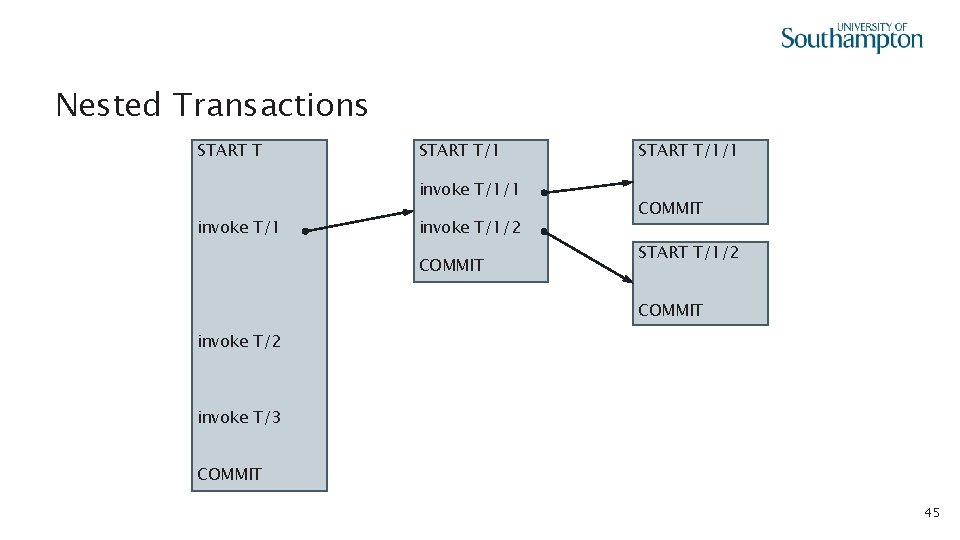
Nested Transactions START T/1 invoke T/1/2 COMMIT START T/1/1 COMMIT START T/1/2 COMMIT invoke T/2 invoke T/3 COMMIT 45
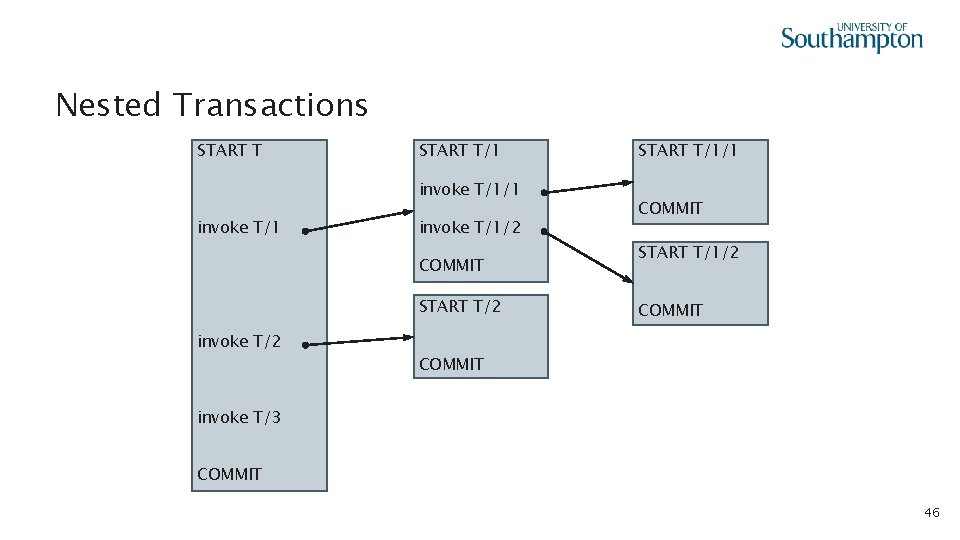
Nested Transactions START T/1 invoke T/1/2 COMMIT START T/2 invoke T/2 START T/1/1 COMMIT START T/1/2 COMMIT invoke T/3 COMMIT 46
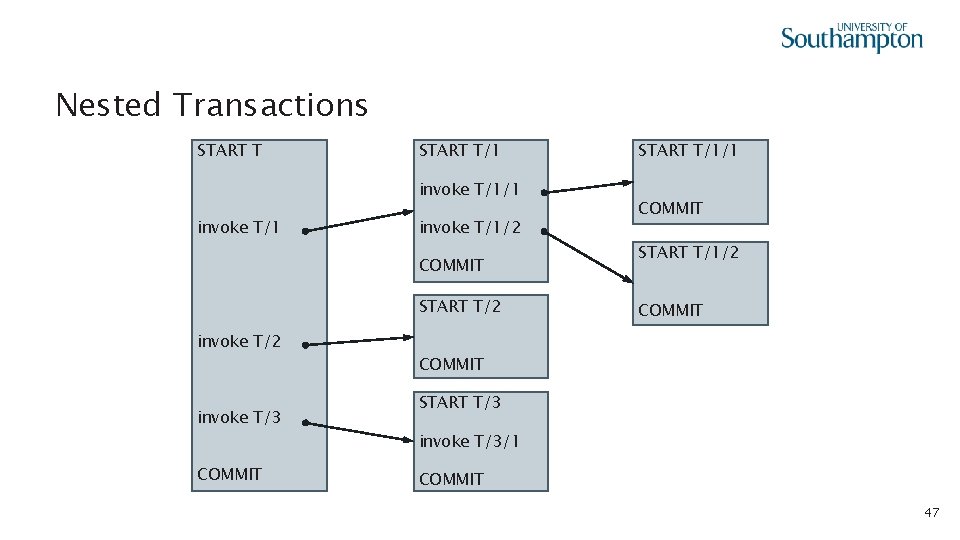
Nested Transactions START T/1 invoke T/1/2 COMMIT START T/2 invoke T/3 COMMIT START T/1/1 COMMIT START T/1/2 COMMIT START T/3 invoke T/3/1 COMMIT 47
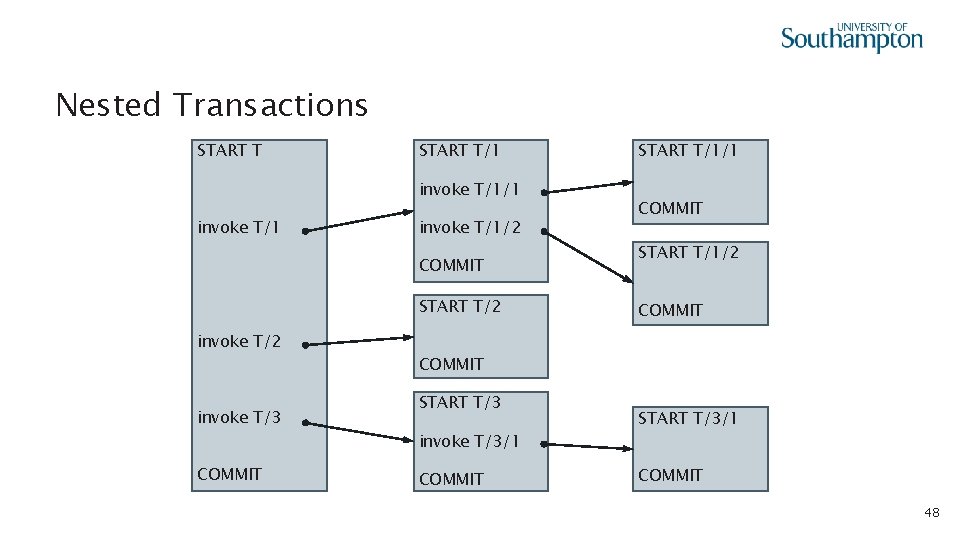
Nested Transactions START T/1 invoke T/1/2 COMMIT START T/2 invoke T/3 COMMIT START T/1/1 COMMIT START T/1/2 COMMIT START T/3 invoke T/3/1 COMMIT START T/3/1 COMMIT 48
Commit Rule The commit of a subtransaction makes the results accessible only to the parent The final commit happens only when all ancestors finally commit 49
![Rollback Rule If any [sub]transaction rolls back, all of its subtransactions roll back 50](http://slidetodoc.com/presentation_image_h2/972e6e3fea1f642ec254e7169648767e/image-50.jpg "Rollback Rule If any [sub]transaction rolls back, all of its subtransactions roll back 50")
Rollback Rule If any [sub]transaction rolls back, all of its subtransactions roll back 50
Visibility Rule Changes made by a subtransaction are visible to its parent Objects held by a parent can be made accessible to subtransactions Changes made by a subtransaction are not visible to its siblings 51
Observations Subtransactions are not fully equivalent to flat transactions: • • Atomic Consistency preserving Isolated Not durable, because of the commit rule 52
Observations Nesting and program modularisation complement each other • Well designed module has a clean interface, and no global variables • If it touches the database, the database is a large global variable • If the module is protected as a subtransaction, then database changes are kept clean too Nested transactions permit intra-transaction parallelism 53
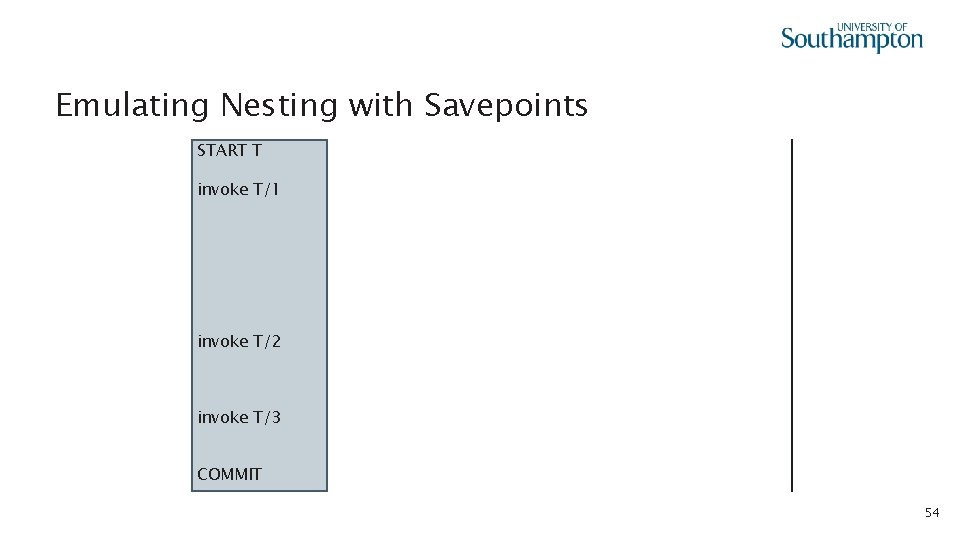
Emulating Nesting with Savepoints START T invoke T/1 invoke T/2 invoke T/3 COMMIT 54
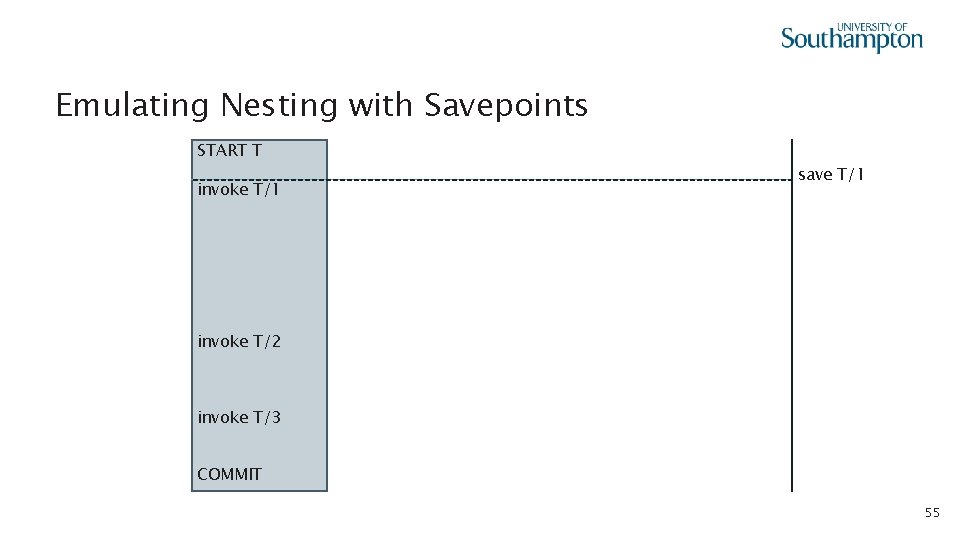
Emulating Nesting with Savepoints START T invoke T/1 save T/1 invoke T/2 invoke T/3 COMMIT 55
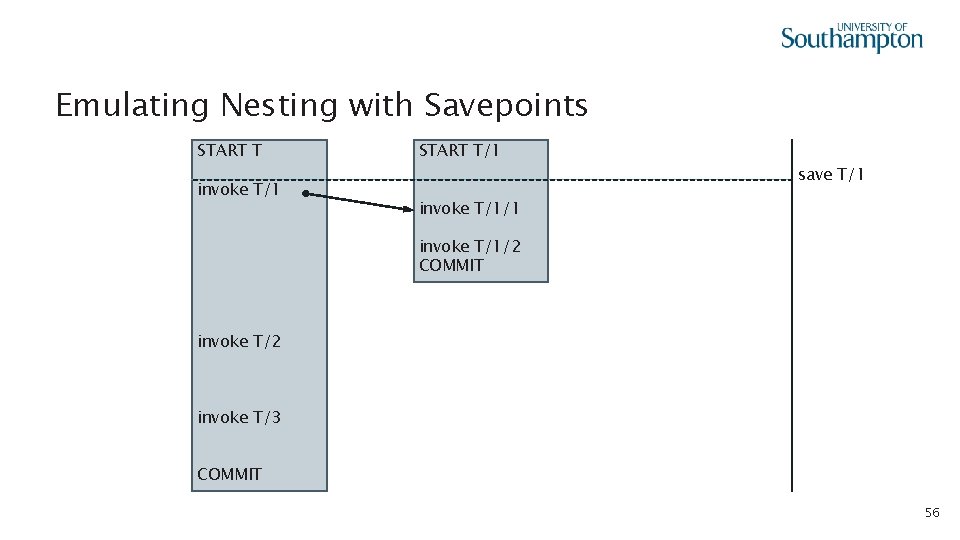
Emulating Nesting with Savepoints START T invoke T/1 START T/1 save T/1 invoke T/1/2 COMMIT invoke T/2 invoke T/3 COMMIT 56
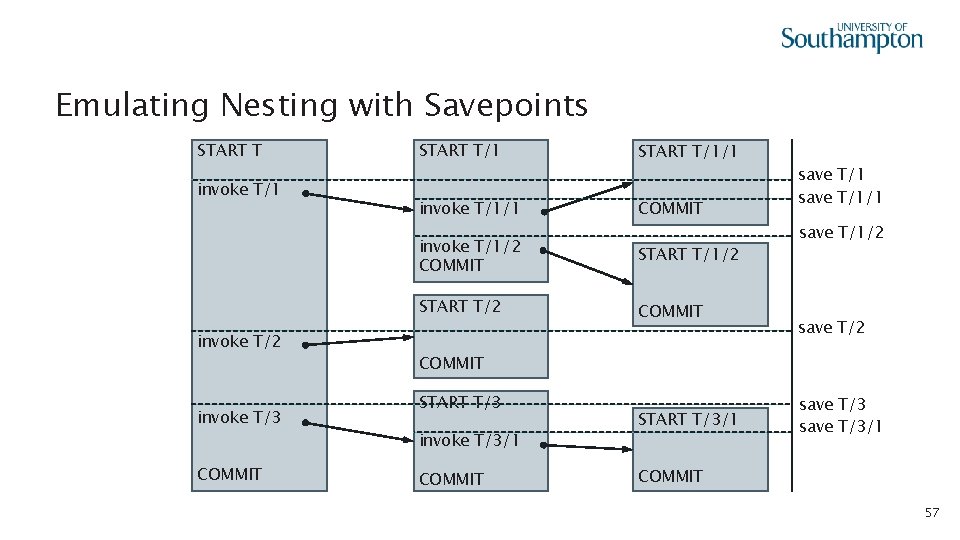
Emulating Nesting with Savepoints START T invoke T/1 invoke T/2 invoke T/3 COMMIT START T/1/1 invoke T/1/1 COMMIT invoke T/1/2 COMMIT START T/1/2 START T/2 COMMIT save T/1/1 save T/1/2 save T/2 COMMIT START T/3 invoke T/3/1 COMMIT START T/3/1 save T/3/1 COMMIT 57
Observations Using savepoints is more flexible than nested transactions for internal recovery • Can roll back further True nested transactions are needed in order to run subtransactions in parallel (Intratransaction parallelism) • Emulating with savepoints needs 'subtransactions' to be run in strict sequence True nested can pass locks selectively • More flexible than savepoints • “Similar but different” 58

Sagas
Sagas Saga: a collection of actions (= flat transactions) that form a long-duration transaction Execution based around notion of compensating transactions • Inverse of actions that allow them to be selectively rolled back • Used to recover from partial execution 60
Sagas specified as a digraph • Nodes are either actions or the terminal nodes abort and complete • One node is designated the start Paths in graph represent sequences of actions • Paths leading to abort are sequences of actions that cause the overall transaction to be rolled back • Paths leading to complete are successful sequences that make persistent changes to the database 61
Saga Execution Each action A has a compensating transaction A-1 Assume that if A is an action and α a sequence of legal actions, then AαA-1 ≣ α If execution of a saga leads to abort, roll back the saga by executing the compensating transactions 62
Next Lecture: Logging and Recovery
- Slides: 63