
Timeprocessing ability and Daily Time Management and Time
Time-processing ability and Daily Time Management and Time aids GUNNEL JANESLÄTT 2014
Introduction • In the time-dependent society of today, persons with limited ability to manage time will show a heightened dependence on others and more need for support, exacerbating their inferior role and vulnerability
What does it take to use the information you get from the clock? • To interpret the clockface /understand digital time • Knowing next important event • To understand time quantity • To calculate differences and add up time periods • To know WHAT you will have time to do in the set time • To understand use time concepts • To compare alternatives
Persons with • Attention Deficit Hyperactivity Disorder, ADHD children (Smith 2002; Abilkoff et al 2013) and adults (Barkley, Murphy, & Bush, 2001; Asherson, Akehurst et al. 2012; Adler and Chua 2002; Carelli and Wiberg 2012; Valko, Schneider et al. 2010; Young and Bramham 2000) • Asperger Syndrome or high functioning Autism (Szelag, Kowalska, Galkowski, & Poppel, 2004; Claessens, van Eerde et al. 2007; Bramham, Ambery et al. 2009) • Intellectual Disability (Arvidsson 2006; Davies 2002; Owen 2006; Janeslätt et al 2010) • Physical disability; CP, MMC (Donlau et al; 2008, 2009, 2010) • Psychiatric illness (Melges in Block 1990; Janeslätt Lindstedt, Adolfsson, 2014) ) • Older students learning disabilities (Manganello 1994) often demonstrate problems in time perception, time orientation and time management, thus in Dailý time managenent September 2021 Gunnel Janeslätt 4
ICF-CY Definitions of concepts of time (WHO 2010) Time perception is the experience of time; specifically the mental functions related to the subjective experiences of the length and passage of time [b 1802] (WHO, 2010) Orientation in time is related to awareness of the day, date, month and year [b 1140] (WHO, 2010) a person’s awareness of and ability to understand physical time (Eisler, 2003; Kylén, 1984) Time management is the mental function of ordering events in chronological sequence and allocating amounts of time to events and activities [b 1642](WHO, 2010) September 2021 Gunnel Janeslätt 5
![In ICF-CY time at Activity/participation level • Managing one’s time [d 2305] managing the](http://slidetodoc.com/presentation_image_h2/c131e2c178fffea6169e070f6c54445d/image-6.jpg "In ICF-CY time at Activity/participation level • Managing one’s time [d 2305] managing the")
In ICF-CY time at Activity/participation level • Managing one’s time [d 2305] managing the time required to complete usual or specific activities, such as preparing to depart from the home and accessing assistive technology and supports time in daily life. • Adapting to time demands [d 2306] Carrying out actions and behaviours appropriately in the required sequence and within the time allotted, such as running to the station when in danger of missing the train. Managing one’s time and Adapting to time are summated into Daily time management All time aids have the purpose to increase daily time management.
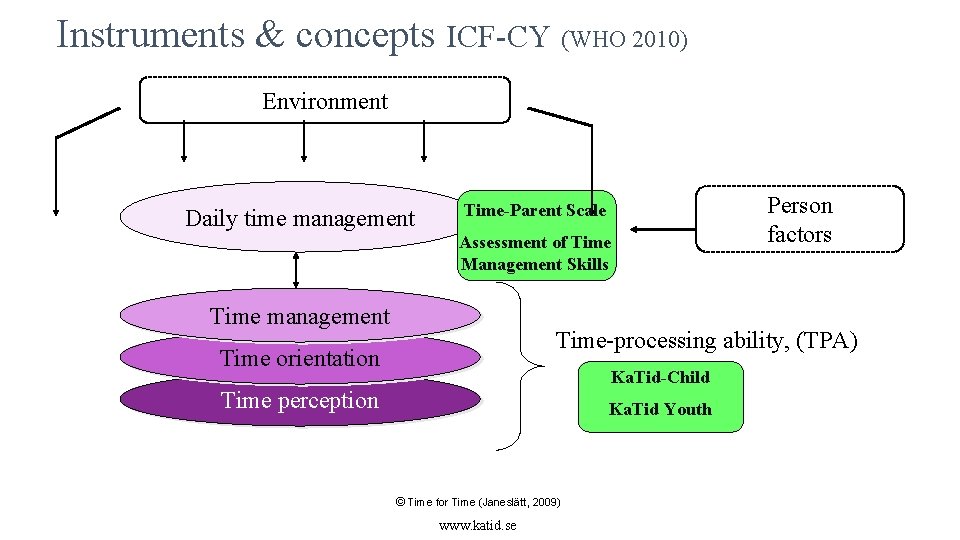
Instruments & concepts ICF-CY (WHO 2010) Environment Daily time management Time-Parent Scale Assessment of Time Management Skills Time management Person factors Time-processing ability, (TPA) Time orientation Ka. Tid-Child Time perception Ka. Tid Youth © Time for Time (Janeslätt, 2009) www. katid. se
![Time-processing ability, definitions (WHO 2010) TIME MANAGEMENT [b 1642] Teenages ORIENTATION in TIME [b](http://slidetodoc.com/presentation_image_h2/c131e2c178fffea6169e070f6c54445d/image-8.jpg "Time-processing ability, definitions (WHO 2010) TIME MANAGEMENT [b 1642] Teenages ORIENTATION in TIME [b")
Time-processing ability, definitions (WHO 2010) TIME MANAGEMENT [b 1642] Teenages ORIENTATION in TIME [b 1140] School years Experience of time/ Time perception [b 1802] Pree school years • Ordering events in chronological sequence, allocating amounts of time to events and activities, and is a super ordinate concept, part of higher-level cognitive functions. ”Timing” • To use aids for orientation in time e. g. the clock, calendar. Time perspektive. Amounts of time, number of days in a week, a month etc. • The mental functions that produce awareness of today, tomorrow, yesterday, date, month and year • The specific mental functions of the subjective experiences related to the length and passage of time. The perception of the duration of activities

Examples of lacking time-processing ability • Time perception – For HOW LONG? ”Always worried about time or bound to strong routines. ” • Orientation in time – WHEN? ”Uncomfortable solutions like waiting for hours in front of the TV. ” • Time Management – Knowing WHAT, WHEN and FOR HOW LONG, ”You can´t plan your day and is developing a strong dependence. ”

Examples of what could be done, ”Managing one’s time” • Time perception – For HOW LONG? ”Showing a certain visual time and how it increase. ” • Orientation in time – WHEN? ”Showing planned events in a visual way. ” • Time Management – ”Using adapted calenders or smartphones. ”
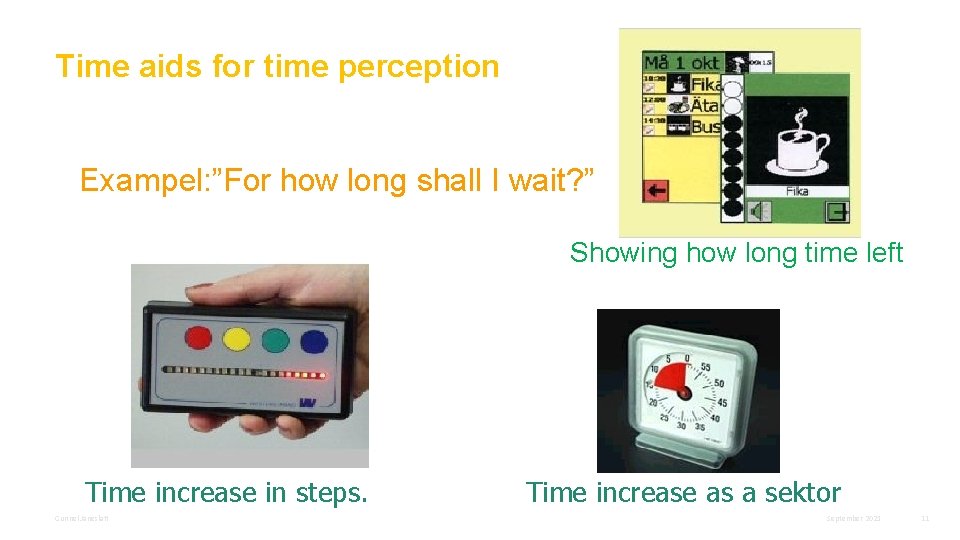
Time aids for time perception Exampel: ”For how long shall I wait? ” Showing how long time left Time increase in steps. Gunnel Janeslätt Time increase as a sektor September 2021 11
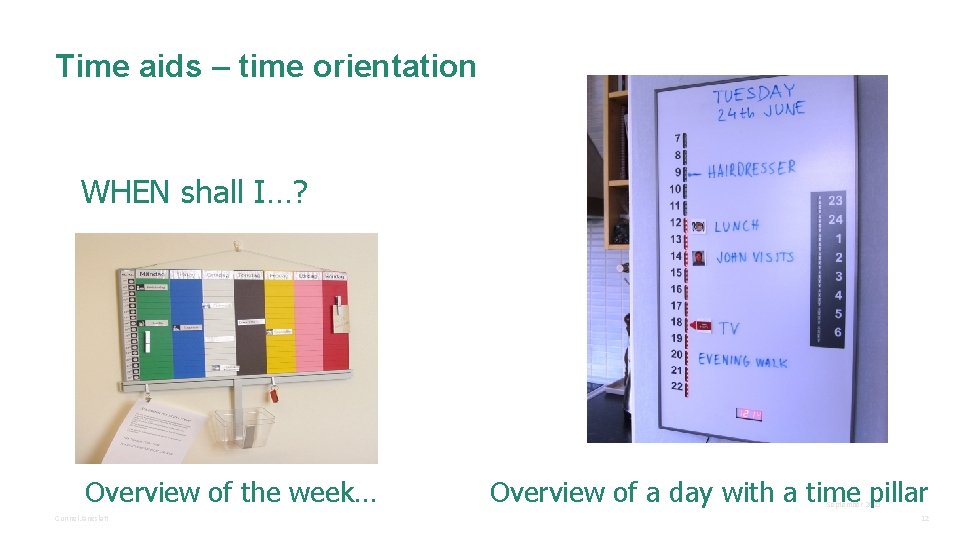
Time aids – time orientation WHEN shall I…? Overview of the week… Gunnel Janeslätt Overview of a day with a time pillar September 2021 12
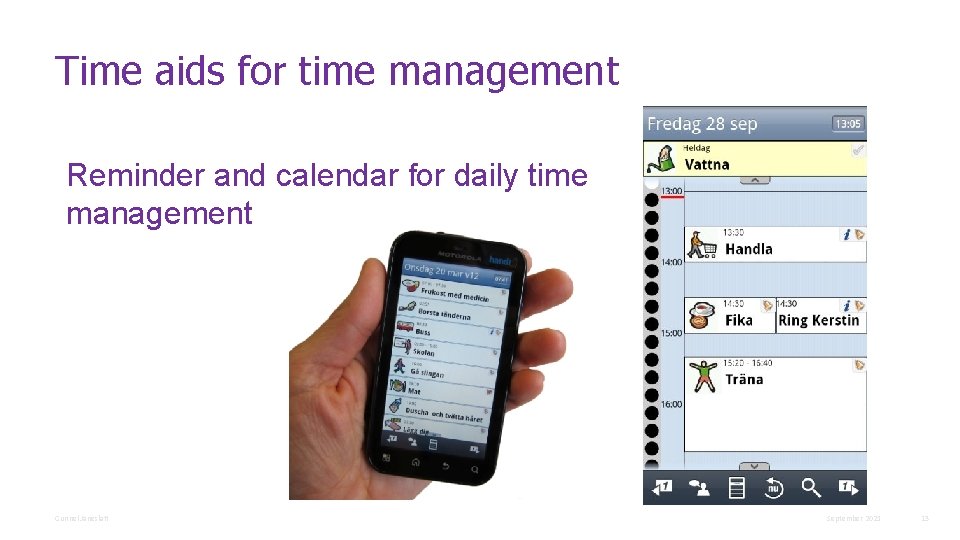
Time aids for time management Reminder and calendar for daily time management Gunnel Janeslätt September 2021 13

Compensatory intervention; examples of time aids at different levels of time-processing ability
Instruments • There are validated instruments to assess • Time-processing ability: Ka. Tid-Child, Ka. Tid-Youth • Daily time management: Time-Self rating scale • Organization Time Management and Planning (OTMP): COSS or ATMS But what can be done?
Methods An overview of literature was done; • search in relevant data bases, Pubmed/Medline, Cinahl • the relevance and quality of reviews and scientific articles found, using the measurement tools recommended by SBU (Swedish Council on Health Technology Assessment).
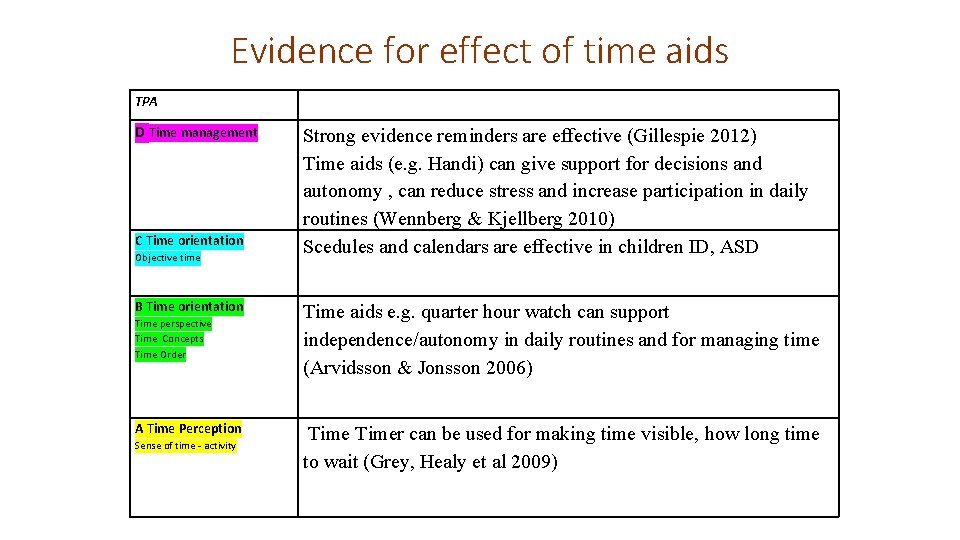
Evidence for effect of time aids TPA D Time management C Time orientation Objective time B Time orientation Time perspective Time Concepts Time Order A Time Perception Sense of time - activity Strong evidence reminders are effective (Gillespie 2012) Time aids (e. g. Handi) can give support for decisions and autonomy , can reduce stress and increase participation in daily routines (Wennberg & Kjellberg 2010) Scedules and calendars are effective in children ID, ASD Time aids e. g. quarter hour watch can support independence/autonomy in daily routines and for managing time (Arvidsson & Jonsson 2006) Timer can be used for making time visible, how long time to wait (Grey, Healy et al 2009)
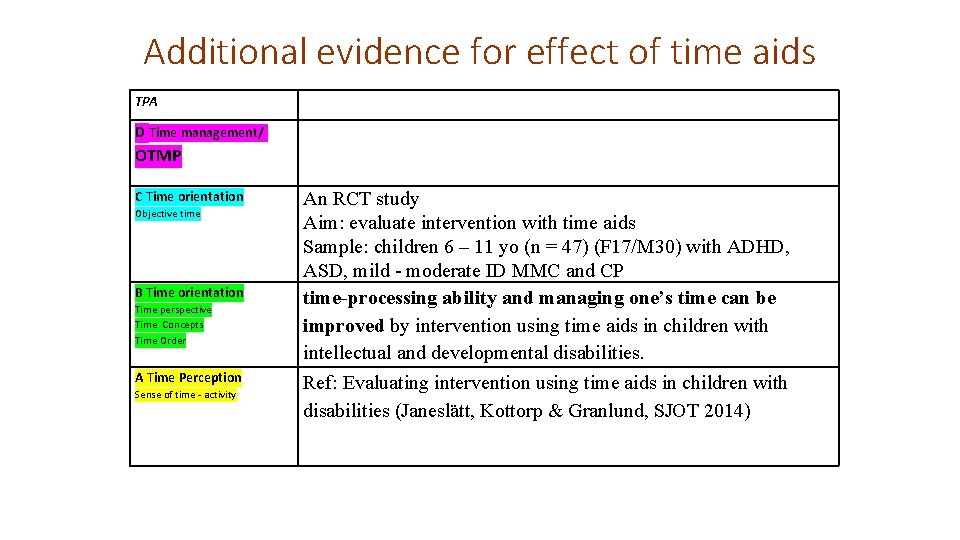
Additional evidence for effect of time aids TPA D Time management/ OTMP C Time orientation Objective time B Time orientation Time perspective Time Concepts Time Order A Time Perception Sense of time - activity An RCT study Aim: evaluate intervention with time aids Sample: children 6 – 11 yo (n = 47) (F 17/M 30) with ADHD, ASD, mild - moderate ID MMC and CP time-processing ability and managing one’s time can be improved by intervention using time aids in children with intellectual and developmental disabilities. Ref: Evaluating intervention using time aids in children with disabilities (Janeslätt, Kottorp & Granlund, SJOT 2014)
Effect in Organization and Planning • Moderate evidence supporting that assistive devices for organisation and planning is effective for adults with TBI/ABI, ID, Demencia to manage primary and secondary ADL (Gillespie et al 2012) • “Prompting”, “task sequencing” step-by-step support in performance via e. g. use computer, alarm, telephone =support to know WHAT to do first and second
Results • There is an emerging evidence Time aids can compensate for lacking time-processing ability in children and adults. • The evidence is strong time aids can compensate for lacking time management using reminders and • at least moderate support for the effectiveness of cognitive devices in supporting organization and planning functions, mainly based on adults with cognitive disabilities.
Conclusions • Occupational therapists should consider integrating time aids when offering intervention to persons with cognitive disabilities using validated instruments to evaluate the intervention • Further research needed to extend the knowledge of time aids for children and for other types of disabilities e. g. ID, psychiatric disorders • New methods for remediation (e. g. My time, Let’s get organized) are being developed
Thank you! If you want to know more, contact gunnel. janeslatt@ltdalarna. se
- Slides: 22