
TimeofFlight Mass Analyzers A time of flight mass








- Slides: 20
Time-of-Flight Mass Analyzers A time of flight mass spectrometer measures the mass-dependent time it takes ions of different masses to move from the ion source to the detector. This requires that the starting time (the time at which the ions leave the ion source) is well-defined. Therefore, ions are either formed by a pulsed ionization method (usually matrixassisted laser desorption ionization, or MALDI), or various kinds of rapid electric field switching are used as a 'gate' to release the ions from the ion source in a very short time. 10/18/2021 1
Time-of-Flight Mass Analyzers Recall that the kinetic energy of an ion leaving the ion source is: The ion velocity, v, is the length of the flight path, L , divided by the flight time, t: 10/18/2021 2
TOF Analyzer Substituting this expression for vinto the kinetic energy relation, we can derive the working equation for the time-of-flight mass spectrometer: or, rearranging the equation to solve for the time-of-flight: 10/18/2021 3
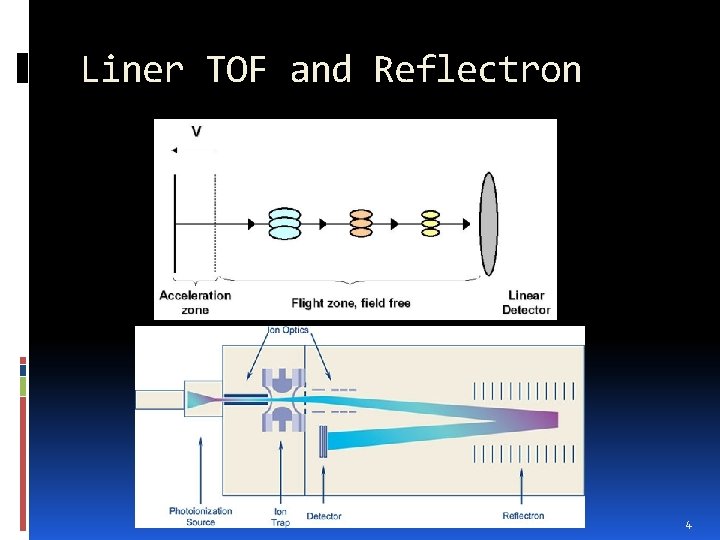
Liner TOF and Reflectron 10/18/2021 4
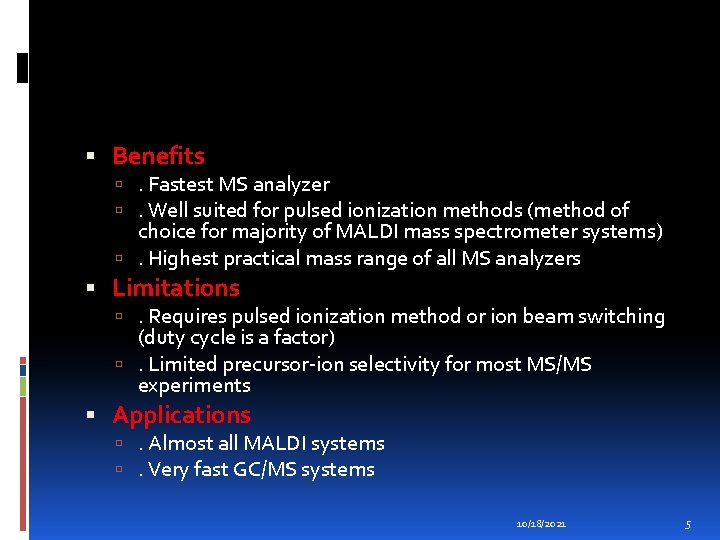
Benefits . Fastest MS analyzer . Well suited for pulsed ionization methods (method of choice for majority of MALDI mass spectrometer systems) . Highest practical mass range of all MS analyzers Limitations . Requires pulsed ionization method or ion beam switching (duty cycle is a factor) . Limited precursor-ion selectivity for most MS/MS experiments Applications . Almost all MALDI systems . Very fast GC/MS systems 10/18/2021 5
Matrix Assisted Laser Desorption Ionisation (MALDI) (F. Hillenkamp, M. Karas, R. C. Beavis, B. T. Chait, Anal. Chem. , 1991, 63, 1193) 10/18/2021 6
FEATURES A Soft Ionization Method deals well with thermo labile, non-volatile organic compounds especially those of high molecular mass The mass accuracy depends on the type and performance of the analyser of the mass spectrometer, but most modern instruments should be capable of measuring masses to within 0. 01% of the molecular mass of the sample 10/18/2021 7
BASIS MALDI is based on the bombardment of sample molecules with a laser light to bring about sample ionization. The sample is pre-mixed with a highly absorbing matrix compound for the most consistent and reliable results, and a low concentration of sample to matrix works best. 10/18/2021 8
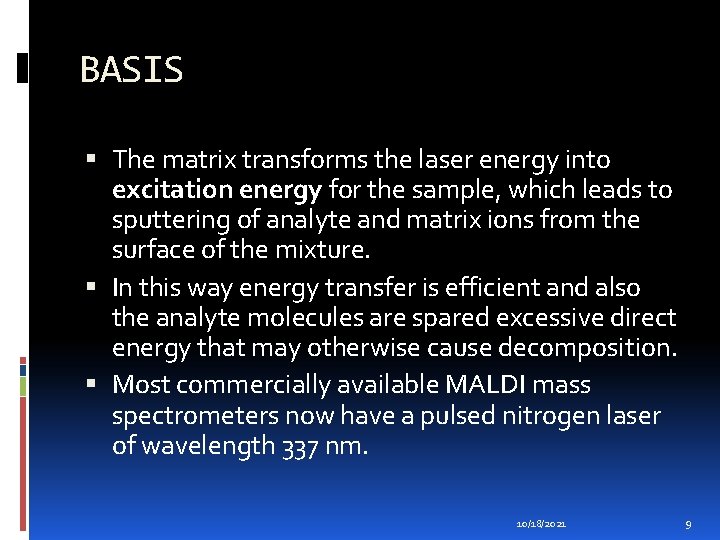
BASIS The matrix transforms the laser energy into excitation energy for the sample, which leads to sputtering of analyte and matrix ions from the surface of the mixture. In this way energy transfer is efficient and also the analyte molecules are spared excessive direct energy that may otherwise cause decomposition. Most commercially available MALDI mass spectrometers now have a pulsed nitrogen laser of wavelength 337 nm. 10/18/2021 9
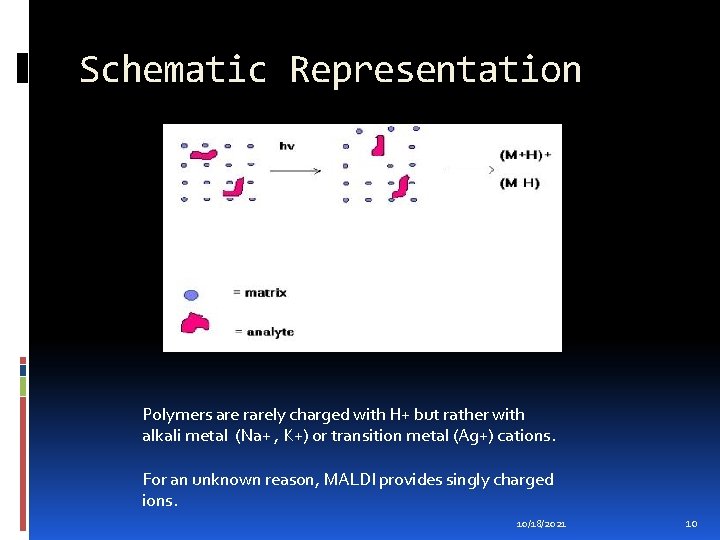
Schematic Representation Polymers are rarely charged with H+ but rather with alkali metal (Na+ , K+) or transition metal (Ag+) cations. For an unknown reason, MALDI provides singly charged ions. 10/18/2021 10
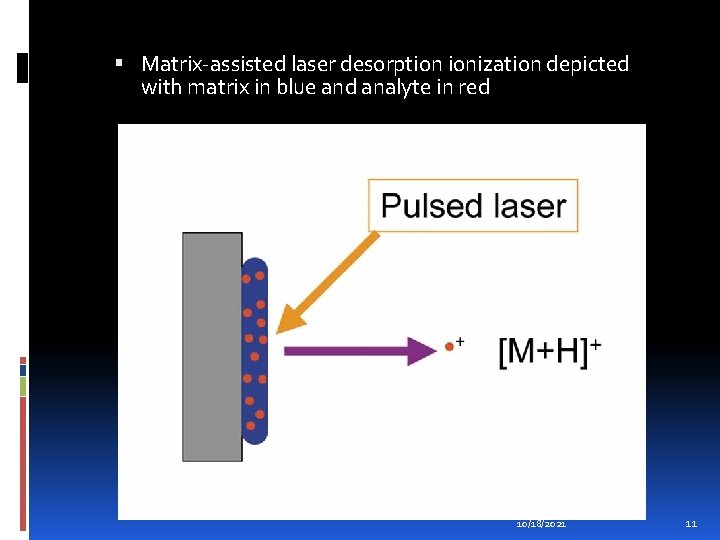
Matrix-assisted laser desorption ionization depicted with matrix in blue and analyte in red 10/18/2021 11
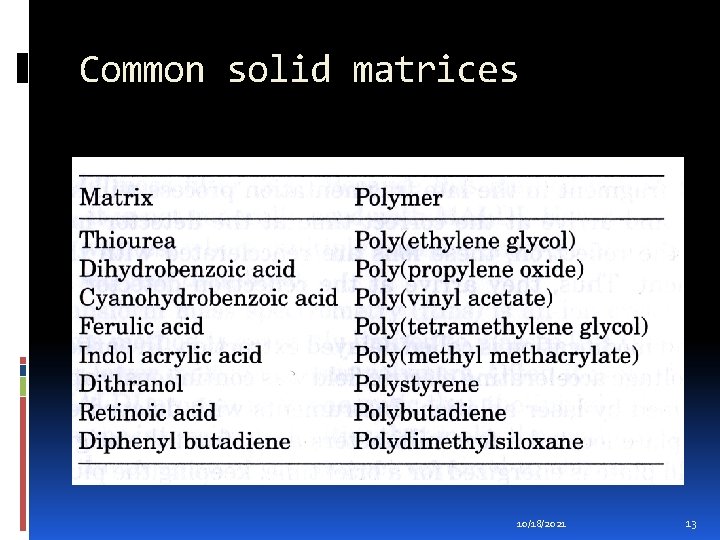
Matrices Liquid Matrices: Like: m-nitrobenzyl alcohol; 2 - nitrophenyl octyl ether Advantages: Homogeneous mixture Disadvantages: high vapor pressure, irreproducible results Solid Matrices: most commonly used type of matrices (next slide) 10/18/2021 12
Common solid matrices 10/18/2021 13
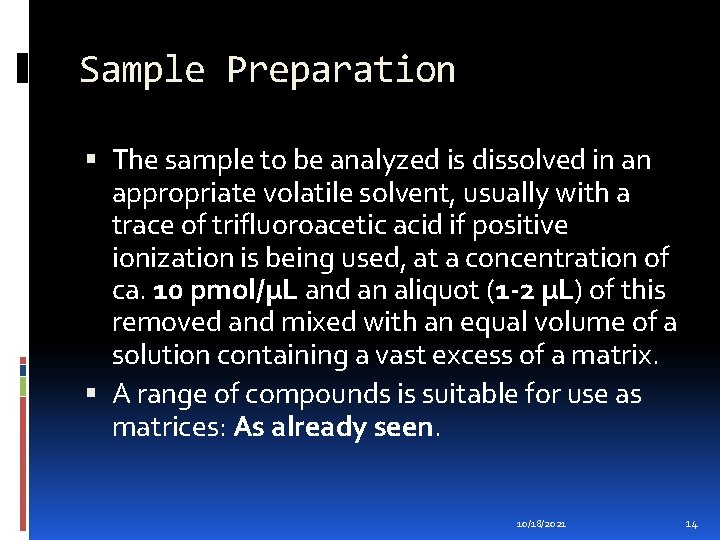
Sample Preparation The sample to be analyzed is dissolved in an appropriate volatile solvent, usually with a trace of trifluoroacetic acid if positive ionization is being used, at a concentration of ca. 10 pmol/µL and an aliquot (1 -2 µL) of this removed and mixed with an equal volume of a solution containing a vast excess of a matrix. A range of compounds is suitable for use as matrices: As already seen. 10/18/2021 14
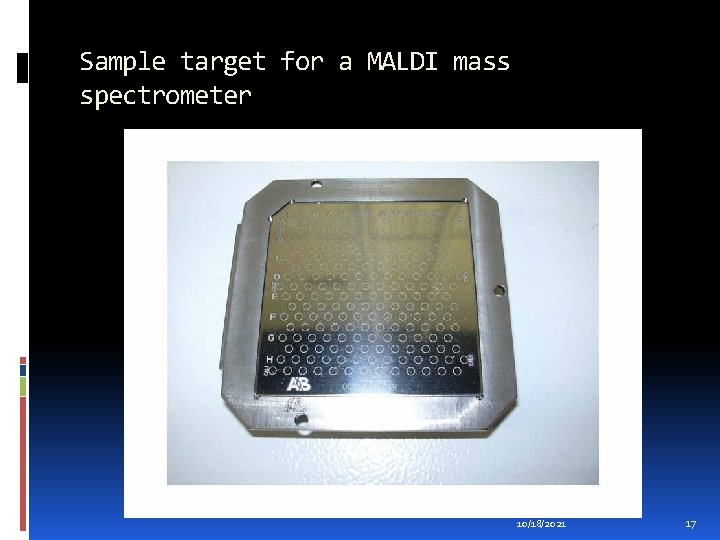
Sample Preparation An aliquot (1 -2 µL) of the final solution is applied to the sample target which is allowed to dry prior to insertion into the high vacuum of the mass spectrometer. The time-of-flight analyzer separates ions according to their mass(m)-to-charge(z) (m/z) ratios by measuring the time it takes for ions to travel through a field free region known as the flight, or drift, tube. The heavier ions are slower than the lighter ones 10/18/2021 15
Sample introduction methods 1. Hand spotting Advantages Disdavantages 2. Electrospary 10/18/2021 16
Sample target for a MALDI mass spectrometer 10/18/2021 17
MALIDI 10/18/2021 18
Mass Axis Quantification Easily done with biopolymers of known molecular masses (usually by three of these) 10/18/2021 19
Signal Axis Quantification Is of utmost importance for synthetic polymers: Uncertainity arising from ablation, ionization, and drift regions Uncertainties arising from the detector 10/18/2021 20