
Timeline of Planet Earth 1 Million l l



- Slides: 31
Timeline of Planet Earth
1 Million l l l 1, 000 A million seconds = 12 days. A million minutes = 1 year, 329 days, 10 hours and 40 minutes. A million hours ago it was 1885 It would take 23 days without sleeping to count to a million.
1 Billion l l l l 1, 000, 000 A billion seconds = 31 years. A billion minutes ago Jesus was alive. A billion hours ago homo sapiens had not evolved. A billion kids on each others shoulders would stretch past the moon. If you counted from one to one billion, you would be counting for 95 years.
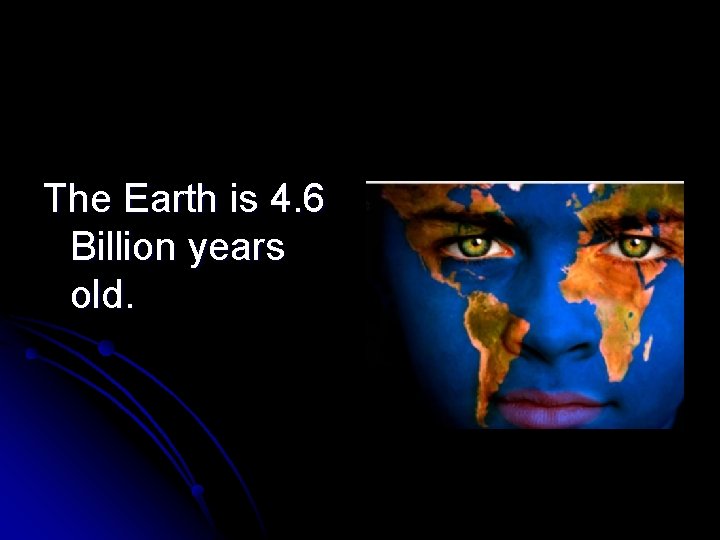
The Earth is 4. 6 Billion years old.
Directions Organize into groups of 2 -4 people. l Gather a meter stick and roll of adding machine tape. l Measure carefully 5 meters of adding machine tape from the roll and cut it off. l Measure 20 cm from one end, draw a line across and label the line “Today”. l Add group member names and hour to that end of the roll, closest to the far end. l
Directions Measure and mark your timeline in 1 meter increments/1 billion year increments ~ starting at the today line. l Label each 1 meter as 1 billion years. (Be precise. ) l l Scale: l 1 millimeter =1 million years. l 1 meter = 1 billion years.
Time Divisions l Earth Time is arranged into Eon’s, Era’s & Periods. l Please measure and label them on your timeline. l Color each Period a different color, and each Era a different color as well. Skip the color coding of the Eon’s. Remember that an Era crosses over several periods so draw them in with pencil before coloring.
Adding Events l Now that your Eras & Periods are labeled and colored, begin adding events into your timeline. Attach the pieces somehow to the timeline. l l Attach to the front? Attach as flip in from the sides with an x showing specifically where it belongs. Measure from the today line, because every thing is measured in m. y. a. or millions of years ago. Remember Your Scale: l l Each millimeter =1 million years. Each meter = 1 billion years.
Making Sense of It All l Once your Events are added, please complete the sheet titled, “Geologic Time Line” (from the packet). Discuss the Poster National Geographic Interactive Timeline: l You Tube (May be watched while completing. ) l l http: //science. nationalgeographic. com/science/pr ehistoric-world/prehistoric-time-line/ Earth: The Making of a Planet http: //www. youtube. com/watch? v=e 1 F 4 lx. JPo 0&list=PL 70 CAF 80 E 5 B 6 E 904 D&index=14&feature=plpp _video
Post Tests l Complete the Post Assignment “Dig in and See What You Know” l Complete the Post Test (on the same sheet as the Pre. Test.
Clickers 1. How many millions are there in a billion? a. b. c. d. 10 100 1, 000 10, 000
Clickers 2. How long is 1 billion years on your timeline? a. b. c. d. 1 millimeter 1 centimeter 10 meters
Clickers 3. How many years does 100 cm represent on your timeline of planet Earth? a. b. c. d. 1 million years 10 million years 1 billion years 10 billion years
Clickers 4. How many years would 1 cm represent on your timeline of planet Earth? a. b. c. d. 1 million years 100 million years 1 billion years
Clickers 5. Which time period is the longest? a. b. c. An Eon An Era A Period
Clickers 6. Which time period is the shortest? a. b. c. An Eon An Era A Period
Clickers 7. Which Era of earth history is the longest? a. b. c. d. Cenozoic Mesozoic Paleozoic Precambrian
Clickers 8. How old is Earth? a. b. c. d. 4. 6 million years old 4. 6 billion years old 4. 6 years old 46 years old
Clickers 9. What Era do we now live in? a. b. c. d. Quarternary Paleozoic Mesozoic Cenozoic
Clickers 10. What Period do we now live in? a. b. c. d. Quarternary Paleozoic Tertiary Cenozoic
Clickers 11. In what period do we find homo sapiens? a. b. c. d. Quarternary Paleozoic Tertiary Cenozoic
Clickers 12. Did ancient cavemen ever hunt dinosaurs? a. b. Yes No
Clickers 13. What Era is known as the “Age of Dinosaurs/Reptiles? ” a. b. c. d. Precambrian Cambrian Quarternary Mesozoic
Clickers 14. What was the first life form to evolve on planet Earth? a. b. c. d. Humans Bacteria Sponges Plants
Clickers 15. A geologic era is generally marked by? a. b. c. d. A mass extinction An ice age Pangaea breaking into continents A new species evolving
Clickers 16. On the geologic time scale, eras are divided into. a. b. c. d. Epochs Indexes Periods Relative dates
Clickers 17. The Mesozoic era is often called the ________. a. Age of Mammals b. Age of Dinosaurs c. Age of Amphibians d. Age of Fishes
Clickers 18. Comparing the age of one rock to the other rocks that are found around it is called. a. b. c. d. Absolute dating Relative dating Carbon dating Online dating
Clickers 19. Fossil evidence exists showing that various organisms once occurred on landmasses that are now far apart suggests that a. b. c. d. The organisms were really good swimmers. The landmasses were once together, and have moved. Similar organisms coincidentally evolved in very different areas Volcanic rock has transported those fossils to very different parts of the world.
Clickers 20. Most fossils are found in _______ rock. A. B. C. D. igneous cemetery sedimentary metamorphic
Music Video’s Darwins Revolution http: //www. youtube. com/watc h? v=Uu. ZTq. LW_MN 4&fe ature=related Symphony of Science. Greatest Show on Earth http: //www. youtube. com/watc h? feature=player_embed ded&v=wx. DOp. AM 2 Fr. Q Unbroken Thread http: //www. youtube. com/watc h? v=h. OLAGYm. UQV 0&fe ature=player_embedded