
Timeline History NOV 2007 Community process began MAY
Timeline History NOV 2007 Community process began MAY 2009 released Draft Recreation and Open Space Element JUL 2010 Funding for the environmental review secured JUN 2011 Revised Draft of the Recreation and Open Space Element released Nov 2013 Open Final Administrative Draft of the Recreation and Space Element Released
§ Mayor’s Open Space Taskforce Outreach • 80 -member taskforce and numerous working groups, 2007 -2008 § Community Meetings • 22 neighborhood-based community meetings, 2008 -2009; Open House-December 2013. § Focus Groups- e. g. nature and natural areas, Chinatown tenants and youth, SPUR, bicycle and pedestrian advocates, etc. , 2008 -2009 § PROSAC Nov. , and Dec. 2007; May-Sept. 2009, August 2011, Jan. 2014 § Recreation and Park Commission Nov. 2008, June 2009, August 2011, January 2012 § Planning Commission October 2008; May 2009; June, August, and October 2011 § Community Working Groups, individual stakeholders, neighborhood groups September, October, and November 2011; November 2013
Role of the General Plan § General Plan Elements are high level policy and visionary documents. § General Plan policies vs. the Planning Code § A guide for directing decisions that are “on balance” in conformity with the GP § Challenging to distinguish between high level policies and detailed actions and programs.

Why should we update the Element? § Updated plans and priorities § Updated information on priority acquisition and renovation areas § Further clarity and guidance on conversion of open space § Emphasize importance and need for community engagement in open space projects § Inclusion of all our supplemental and new types of spaces: living alleys, parklets, POPOS, etc. § Shifting focus from natural areas to nature and local biodiversity
Proposed Objectives & Policies

Well-Maintained and Highly Utilized Open Space System § Flexible and dynamic use of existing open spaces and recreational facilities: user responsive recreational programming, community garden, concessions, active and passive uses. § Preserving open space by restricting its conversion to nonrecreational uses § Maintain open spaces to modern standards
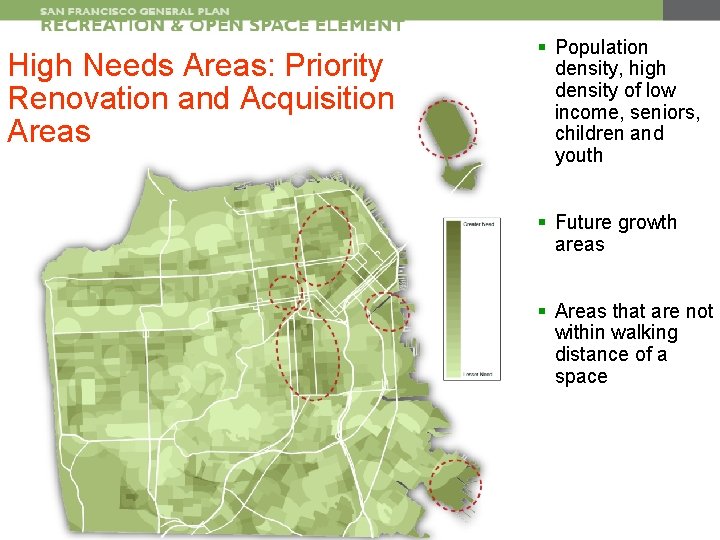
High Needs Areas: Priority Renovation and Acquisition Areas § Population density, high density of low income, seniors, children and youth § Future growth areas § Areas that are not within walking distance of a space
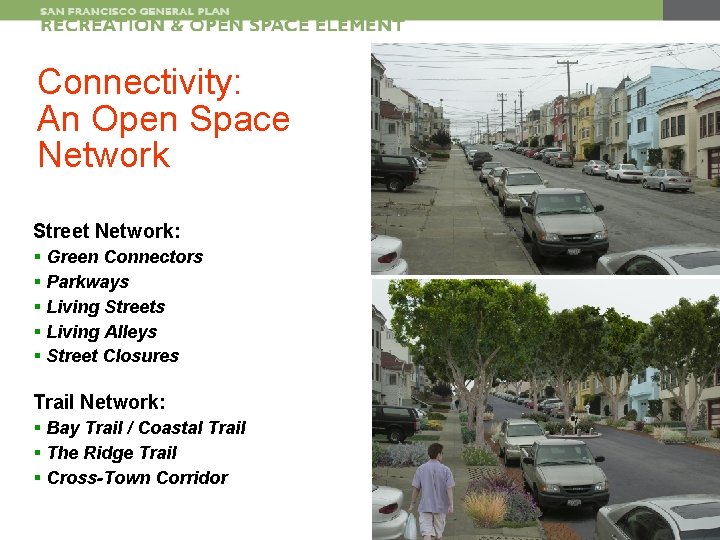
Connectivity: An Open Space Network Street Network: § Green Connectors § Parkways § Living Streets § Living Alleys § Street Closures Trail Network: § Bay Trail / Coastal Trail § The Ridge Trail § Cross-Town Corridor
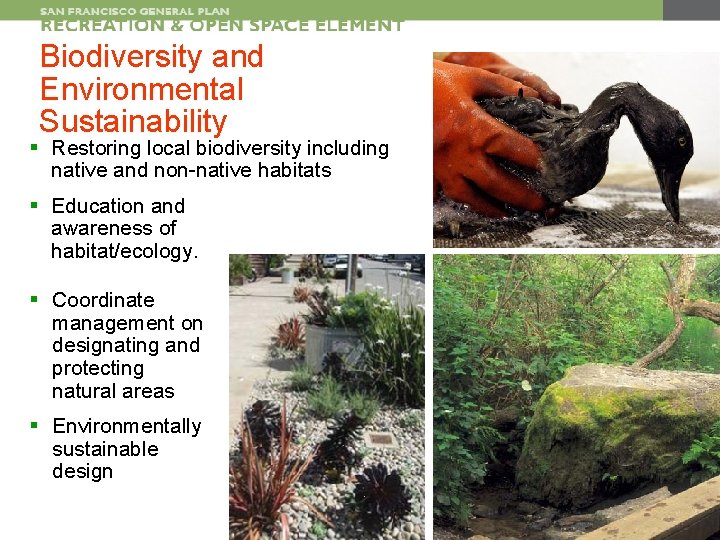
Biodiversity and Environmental Sustainability § Restoring local biodiversity including native and non-native habitats § Education and awareness of habitat/ecology. § Coordinate management on designating and protecting natural areas § Environmentally sustainable design
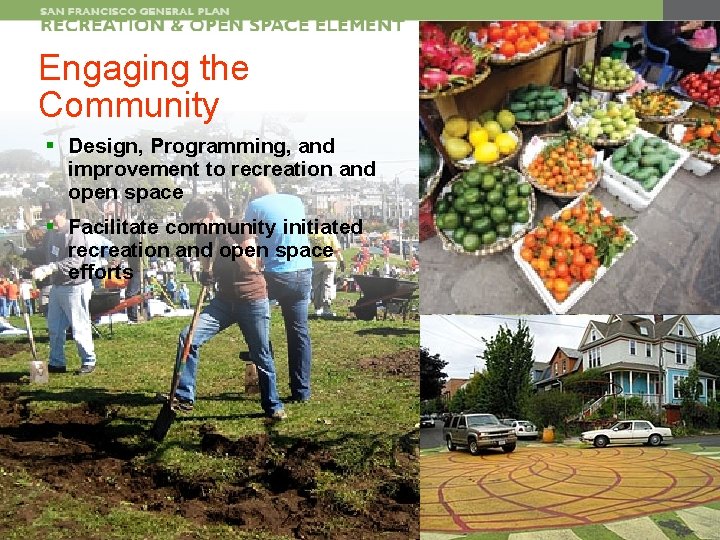
Engaging the Community § Design, Programming, and improvement to recreation and open space § Facilitate community initiated recreation and open space efforts
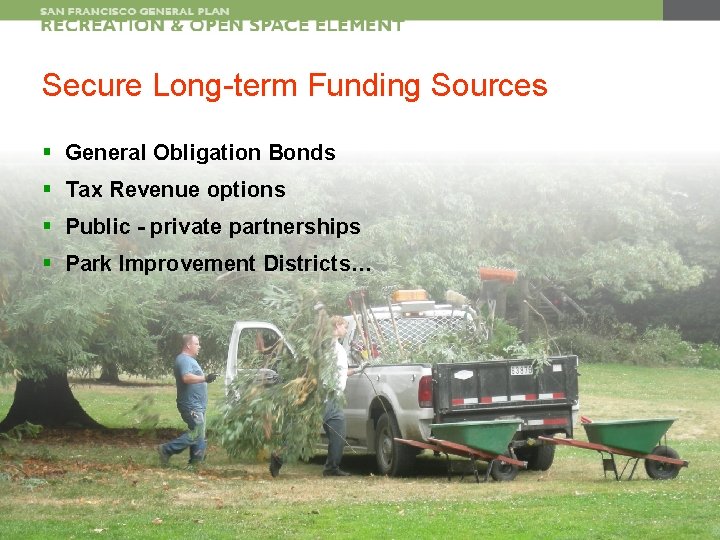
Secure Long-term Funding Sources § General Obligation Bonds § Tax Revenue options § Public - private partnerships § Park Improvement Districts…
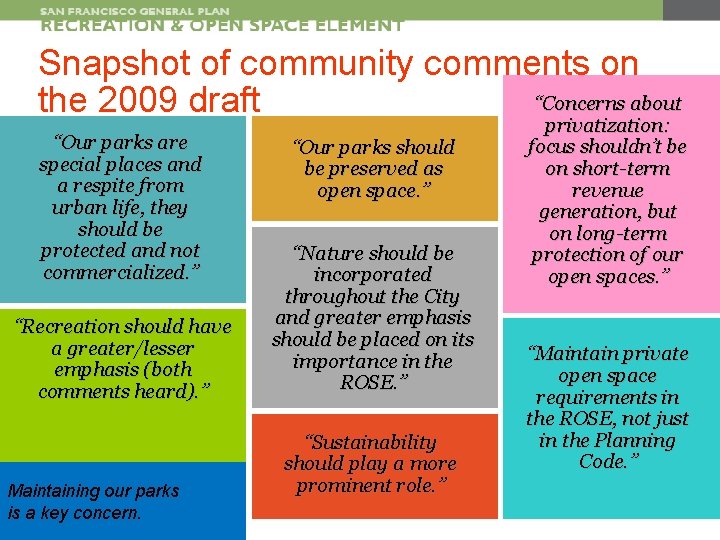
Snapshot of community comments on “Concerns about the 2009 draft “Our parks are special places and a respite from urban life, they should be protected and not commercialized. ” “Recreation should have a greater/lesser emphasis (both comments heard). ” Maintaining our parks is a key concern. “Our parks should be preserved as open space. ” “Nature should be incorporated throughout the City and greater emphasis should be placed on its importance in the ROSE. ” “Sustainability should play a more prominent role. ” privatization: focus shouldn’t be on short-term revenue generation, but on long-term protection of our open spaces. ” “Maintain private open space requirements in the ROSE, not just in the Planning Code. ”
What has Changed since the previous draft?
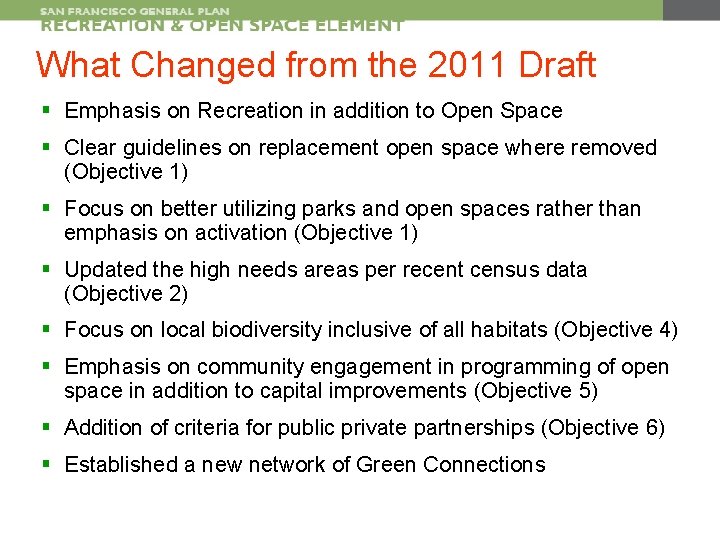
What Changed from the 2011 Draft § Emphasis on Recreation in addition to Open Space § Clear guidelines on replacement open space where removed (Objective 1) § Focus on better utilizing parks and open spaces rather than emphasis on activation (Objective 1) § Updated the high needs areas per recent census data (Objective 2) § Focus on local biodiversity inclusive of all habitats (Objective 4) § Emphasis on community engagement in programming of open space in addition to capital improvements (Objective 5) § Addition of criteria for public private partnerships (Objective 6) § Established a new network of Green Connections
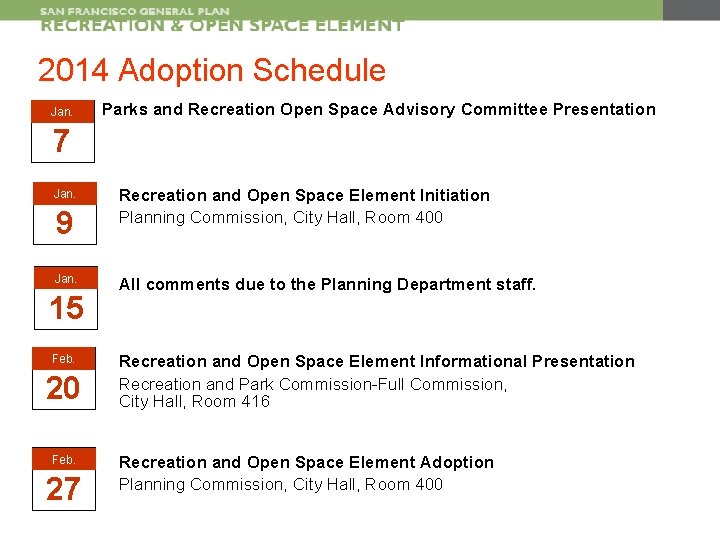
2014 Adoption Schedule Jan. Parks and Recreation Open Space Advisory Committee Presentation 7 Jan. 9 Jan. 15 Feb. 20 Feb. 27 Recreation and Open Space Element Initiation Planning Commission, City Hall, Room 400 All comments due to the Planning Department staff. Recreation and Open Space Element Informational Presentation Recreation and Park Commission-Full Commission, City Hall, Room 416 Recreation and Open Space Element Adoption Planning Commission, City Hall, Room 400
THANK YOU Please send comments to sfgov. org (415) 575 -9068 OR susan. exline@sfgov. org (415) 558 -6332 http: //openspace. sfplanning. org
- Slides: 17