
TimeDependent Dielectric Barrier Discharge Plasma Actuator Modeling Ben
Time-Dependent Dielectric Barrier Discharge Plasma Actuator Modeling Ben Mertz, Thomas Corke Center for Flow Physics and Control University of Notre Dame, IN
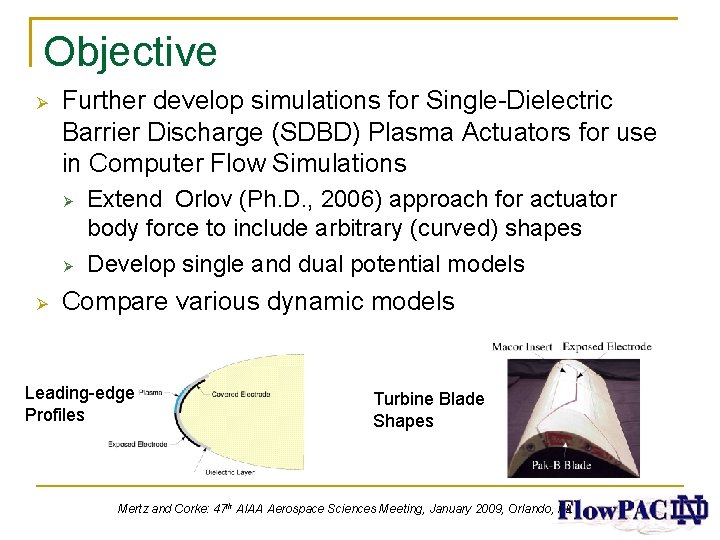
Objective Further develop simulations for Single-Dielectric Barrier Discharge (SDBD) Plasma Actuators for use in Computer Flow Simulations Extend Orlov (Ph. D. , 2006) approach for actuator body force to include arbitrary (curved) shapes Develop single and dual potential models Compare various dynamic models Leading-edge Profiles Turbine Blade Shapes Mertz and Corke: 47 th AIAA Aerospace Sciences Meeting, January 2009, Orlando, FL
Empirical vs. First Principle Models Accurately describes plasma discharge processes Computationally intensive Limited to single streamer Simplified chemistry Gibalov and Pietsch (2008), Golubovskii et al. (2002), Kozlov et al. (2001), Madani et al. (2003), and others Empirical Models Computationally efficient Physics not directly modelled Shyy et al. (2002), Singh and Roy (2008) Do not model spatial-temporal dynamics accurately Mertz and Corke: 47 th AIAA Aerospace Sciences Meeting, January 2009, Orlando, FL
Models Considered Orlov (2006) – Space-time lumped circuit element model Voltage BC (One Phi w/ Voltage BC) Negative of Voltage BC (One Phi w/ Negative Voltage BC) Current used to calculate BC Based on total plasma height (One Phi w/ Current-H BC) Based on fraction of plasma height (One Phi w/ Current -h BC) Suzen et al. (2005) – Two-potential model Current used to calculate BC for charge density (Lemire and Vo, 2008) Two Phi w/ Current-H BC Mertz and Corke: 47 th AIAA Aerospace Sciences Meeting, January 2009, Orlando, FL
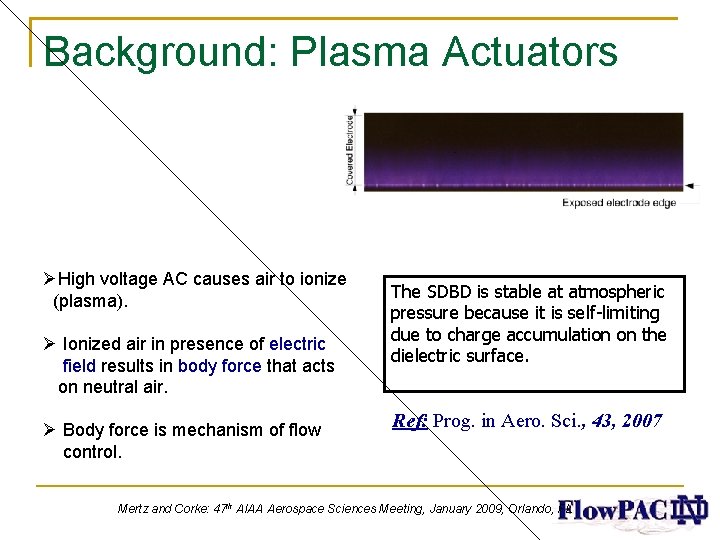
Background: Plasma Actuators High voltage AC causes air to ionize (plasma). Ionized air in presence of electric field results in body force that acts on neutral air. Body force is mechanism of flow control. The SDBD is stable at atmospheric pressure because it is self-limiting due to charge accumulation on the dielectric surface. Ref: Prog. in Aero. Sci. , 43, 2007 Mertz and Corke: 47 th AIAA Aerospace Sciences Meeting, January 2009, Orlando, FL
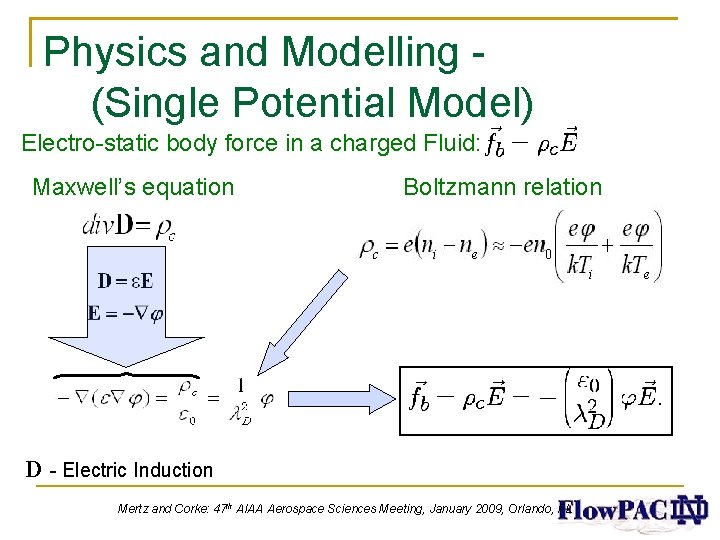
Physics and Modelling (Single Potential Model) Electro-static body force in a charged Fluid: Maxwell’s equation Boltzmann relation D - Electric Induction Mertz and Corke: 47 th AIAA Aerospace Sciences Meeting, January 2009, Orlando, FL
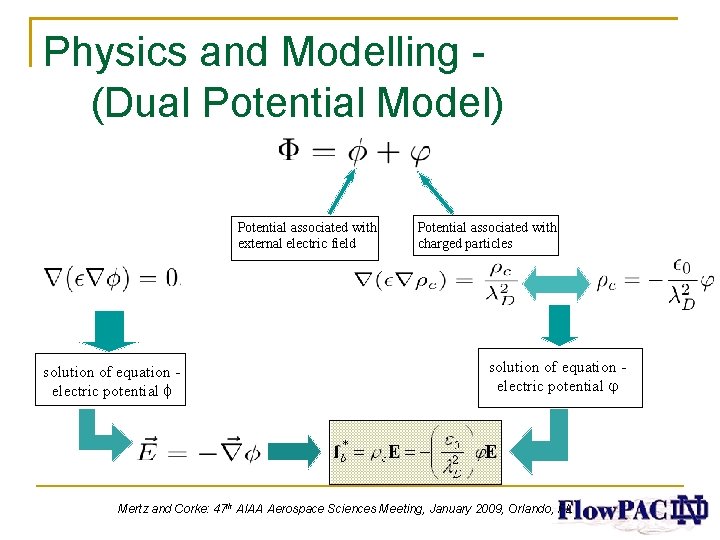
Physics and Modelling (Dual Potential Model) Potential associated with external electric field solution of equation electric potential ɸ Potential associated with charged particles solution of equation electric potential Mertz and Corke: 47 th AIAA Aerospace Sciences Meeting, January 2009, Orlando, FL
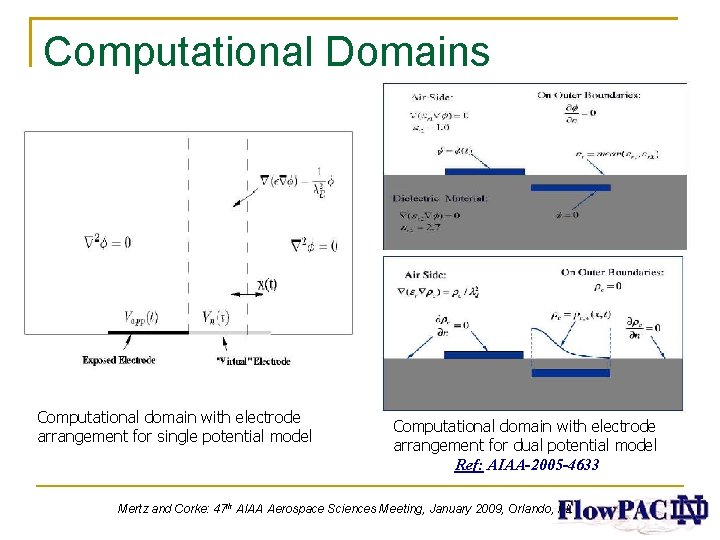
Computational Domains Computational domain with electrode arrangement for single potential model Computational domain with electrode arrangement for dual potential model Ref: AIAA-2005 -4633 Mertz and Corke: 47 th AIAA Aerospace Sciences Meeting, January 2009, Orlando, FL
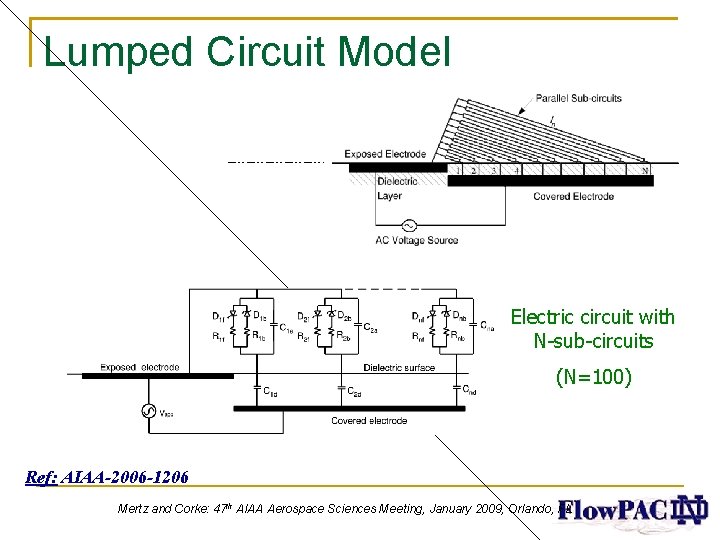
Lumped Circuit Model Electric circuit with N-sub-circuits (N=100) Ref: AIAA-2006 -1206 Mertz and Corke: 47 th AIAA Aerospace Sciences Meeting, January 2009, Orlando, FL
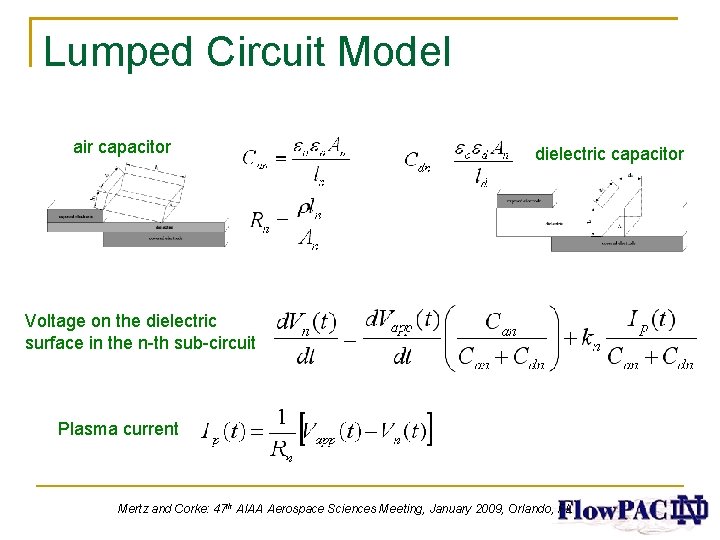
Lumped Circuit Model air capacitor dielectric capacitor Voltage on the dielectric surface in the n-th sub-circuit Plasma current Mertz and Corke: 47 th AIAA Aerospace Sciences Meeting, January 2009, Orlando, FL
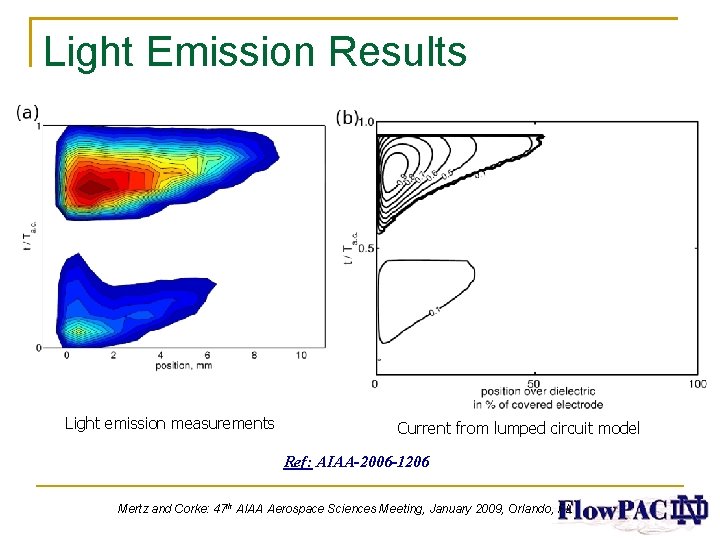
Light Emission Results Light emission measurements Current from lumped circuit model Ref: AIAA-2006 -1206 Mertz and Corke: 47 th AIAA Aerospace Sciences Meeting, January 2009, Orlando, FL
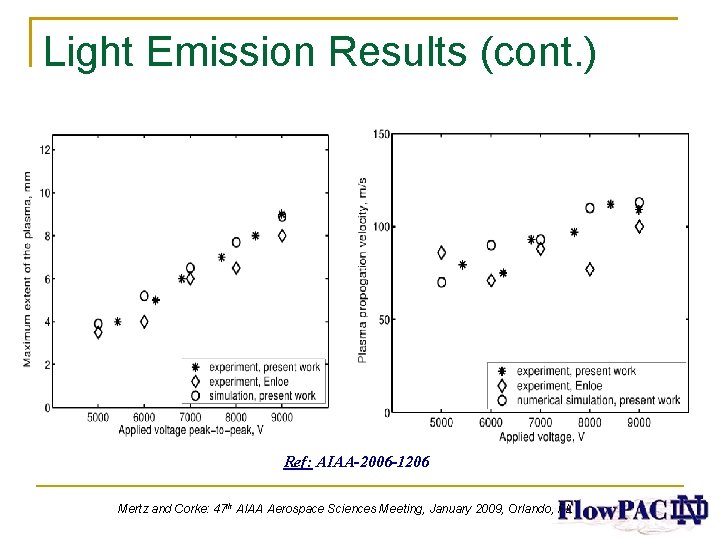
Light Emission Results (cont. ) Ref: AIAA-2006 -1206 Mertz and Corke: 47 th AIAA Aerospace Sciences Meeting, January 2009, Orlando, FL
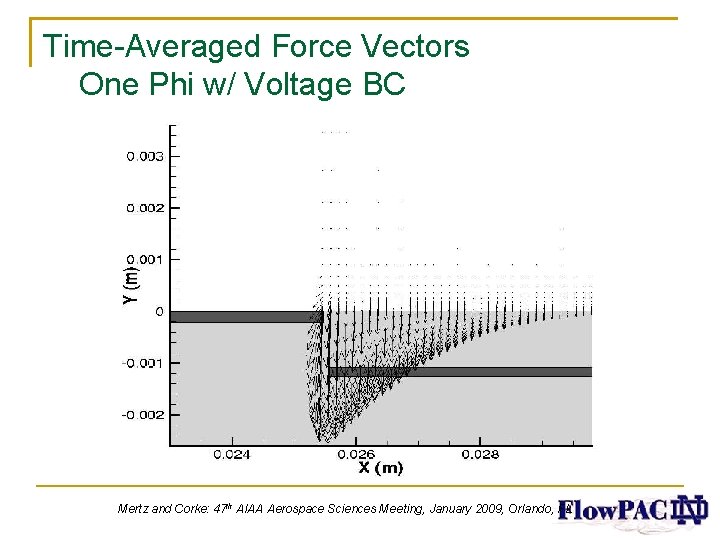
Time-Averaged Force Vectors One Phi w/ Voltage BC Mertz and Corke: 47 th AIAA Aerospace Sciences Meeting, January 2009, Orlando, FL
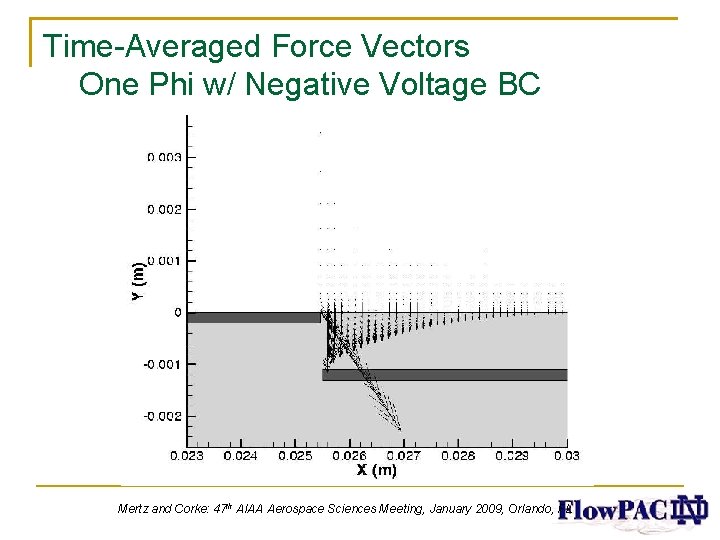
Time-Averaged Force Vectors One Phi w/ Negative Voltage BC Mertz and Corke: 47 th AIAA Aerospace Sciences Meeting, January 2009, Orlando, FL
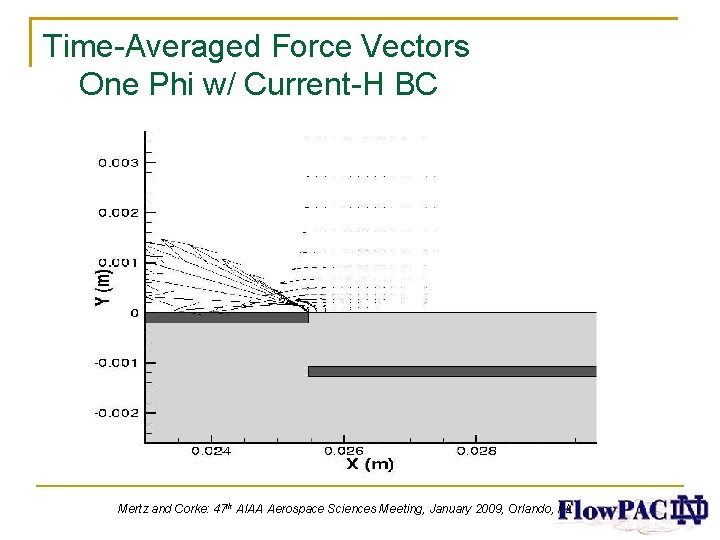
Time-Averaged Force Vectors One Phi w/ Current-H BC Mertz and Corke: 47 th AIAA Aerospace Sciences Meeting, January 2009, Orlando, FL
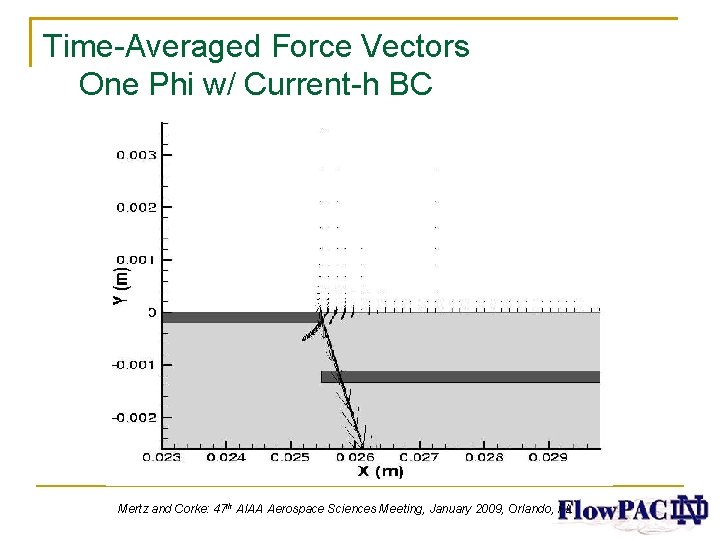
Time-Averaged Force Vectors One Phi w/ Current-h BC Mertz and Corke: 47 th AIAA Aerospace Sciences Meeting, January 2009, Orlando, FL
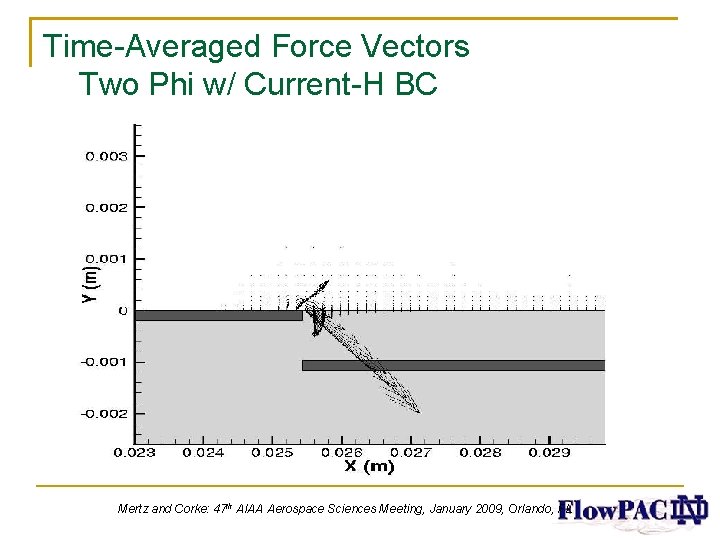
Time-Averaged Force Vectors Two Phi w/ Current-H BC Mertz and Corke: 47 th AIAA Aerospace Sciences Meeting, January 2009, Orlando, FL
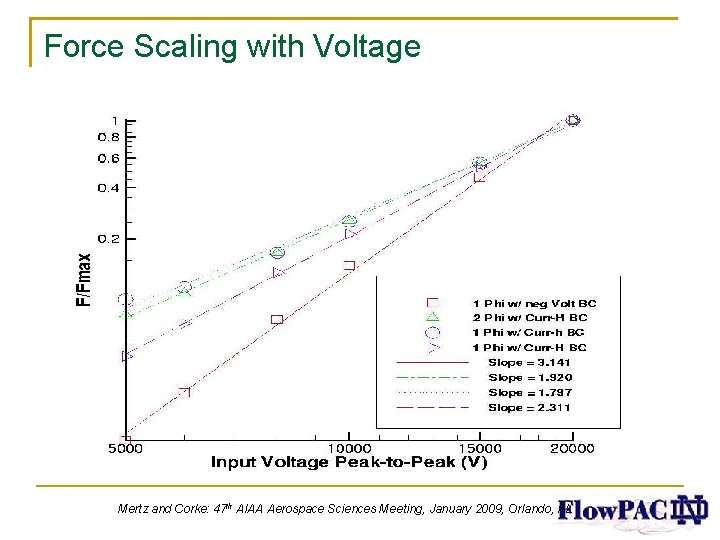
Force Scaling with Voltage Mertz and Corke: 47 th AIAA Aerospace Sciences Meeting, January 2009, Orlando, FL
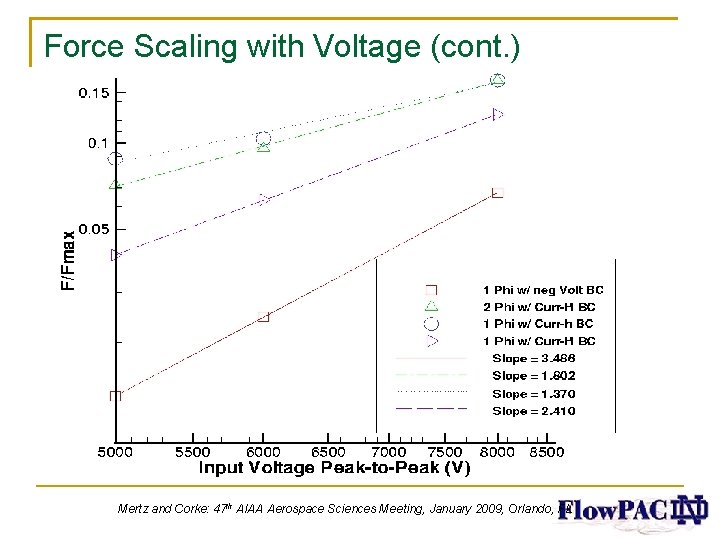
Force Scaling with Voltage (cont. ) Mertz and Corke: 47 th AIAA Aerospace Sciences Meeting, January 2009, Orlando, FL
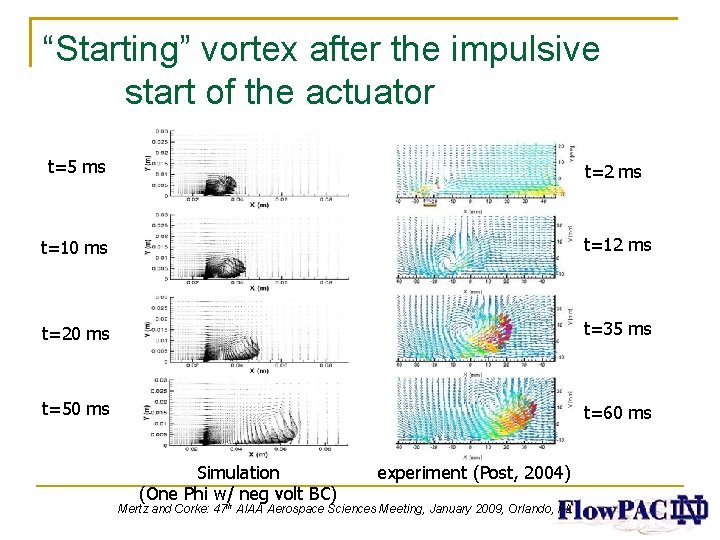
“Starting” vortex after the impulsive start of the actuator t=5 ms t=2 ms t=10 ms t=12 ms t=20 ms t=35 ms t=50 ms t=60 ms Simulation (One Phi w/ neg volt BC) experiment (Post, 2004) Mertz and Corke: 47 th AIAA Aerospace Sciences Meeting, January 2009, Orlando, FL
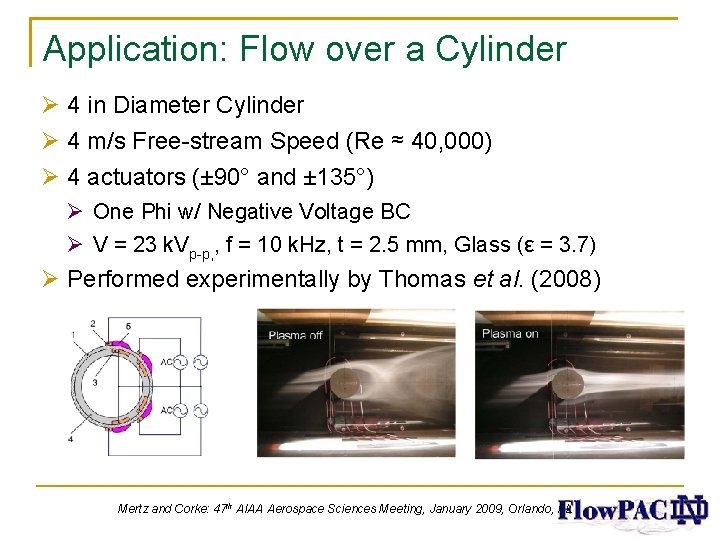
Application: Flow over a Cylinder 4 in Diameter Cylinder 4 m/s Free-stream Speed (Re ≈ 40, 000) 4 actuators (± 90° and ± 135°) One Phi w/ Negative Voltage BC V = 23 k. Vp-p, , f = 10 k. Hz, t = 2. 5 mm, Glass (ε = 3. 7) Performed experimentally by Thomas et al. (2008) Mertz and Corke: 47 th AIAA Aerospace Sciences Meeting, January 2009, Orlando, FL
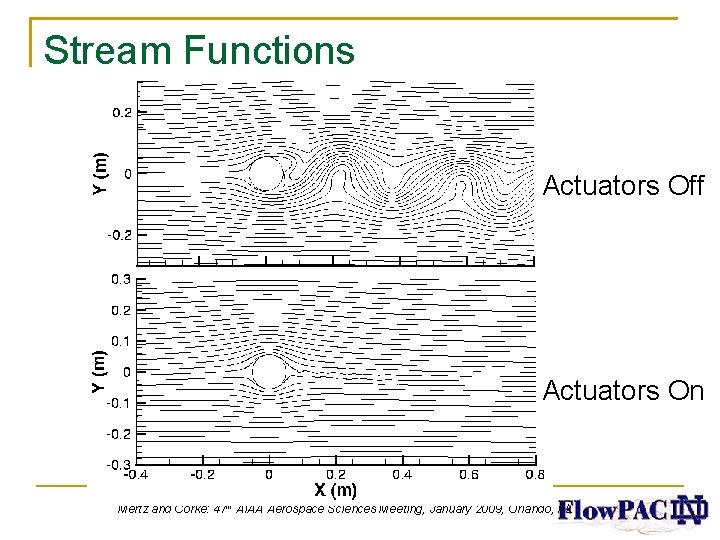
Stream Functions Actuators Off Actuators On Mertz and Corke: 47 th AIAA Aerospace Sciences Meeting, January 2009, Orlando, FL
Summary Comparison of different dynamic models Applied to shedding cylinder Only One Phi w/ Negative Voltage BC matches all experimental evidence Able to eliminate shedding Validates model Future work Apply to other applications Investigate time-dependent force in CFD code Mertz and Corke: 47 th AIAA Aerospace Sciences Meeting, January 2009, Orlando, FL

Questions? Mertz and Corke: 47 th AIAA Aerospace Sciences Meeting, January 2009, Orlando, FL
- Slides: 24