
Timedependent densityfunctional theory Carsten A Ullrich University of
- Slides: 101
Time-dependent density-functional theory Carsten A. Ullrich University of Missouri-Columbia Neepa T. Maitra Hunter College & Graduate Center CUNY APS March Meeting 2010, Portland
Outline 1. A survey of time-dependent phenomena C. U. 2. Fundamental theorems in TDDFT N. M. 3. Time-dependent Kohn-Sham equation C. U. 4. Memory dependence N. M. 5. Linear response and excitation energies N. M. 6. Optical processes in Materials C. U. 7. Multiple and charge-transfer excitations N. M. 8. Current-TDDFT C. U. 9. Nanoscale transport C. U. 10. Strong-field processes and control N. M.
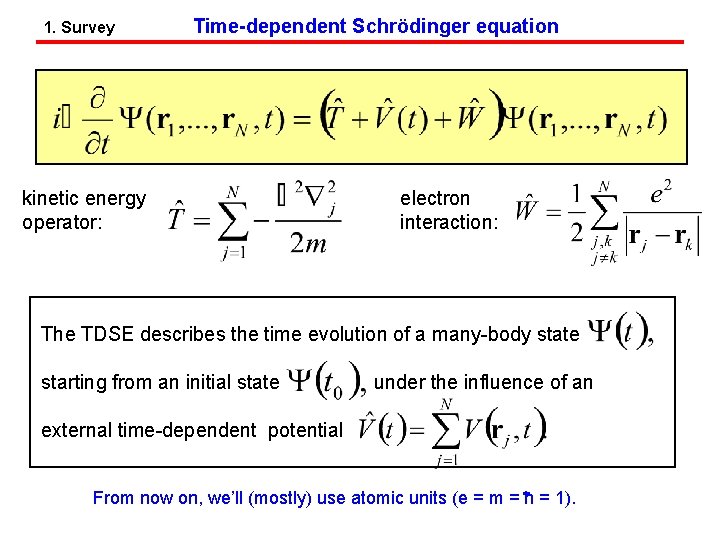
1. Survey Time-dependent Schrödinger equation kinetic energy operator: electron interaction: The TDSE describes the time evolution of a many-body state starting from an initial state under the influence of an external time-dependent potential From now on, we’ll (mostly) use atomic units (e = m = h = 1).
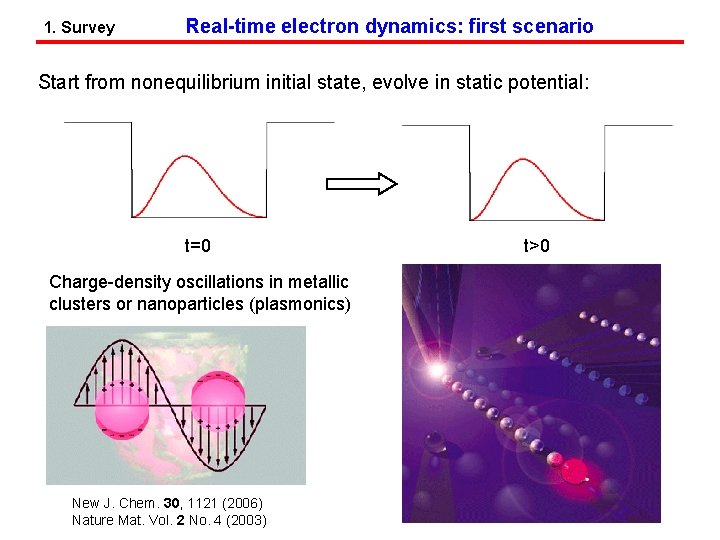
1. Survey Real-time electron dynamics: first scenario Start from nonequilibrium initial state, evolve in static potential: t=0 Charge-density oscillations in metallic clusters or nanoparticles (plasmonics) New J. Chem. 30, 1121 (2006) Nature Mat. Vol. 2 No. 4 (2003) t>0
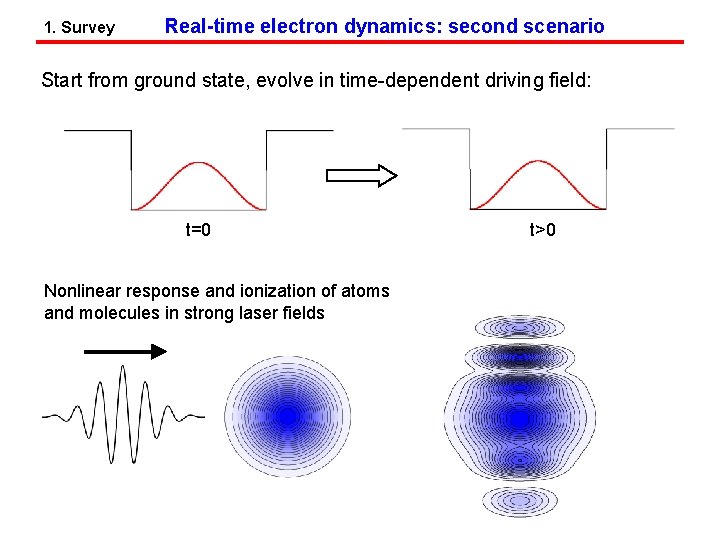
1. Survey Real-time electron dynamics: second scenario Start from ground state, evolve in time-dependent driving field: t=0 Nonlinear response and ionization of atoms and molecules in strong laser fields t>0
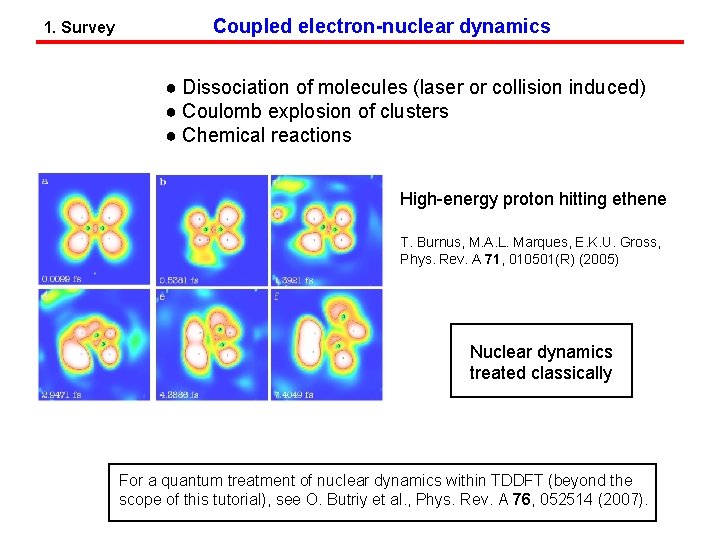
1. Survey Coupled electron-nuclear dynamics ● Dissociation of molecules (laser or collision induced) ● Coulomb explosion of clusters ● Chemical reactions High-energy proton hitting ethene T. Burnus, M. A. L. Marques, E. K. U. Gross, Phys. Rev. A 71, 010501(R) (2005) Nuclear dynamics treated classically For a quantum treatment of nuclear dynamics within TDDFT (beyond the scope of this tutorial), see O. Butriy et al. , Phys. Rev. A 76, 052514 (2007).
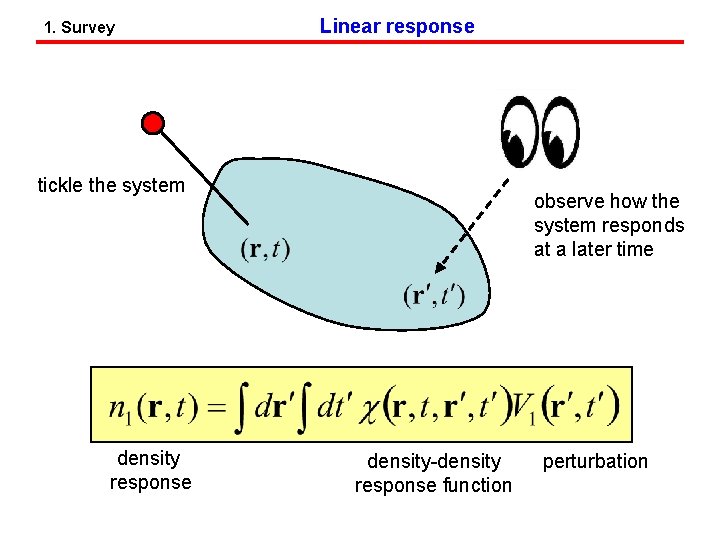
1. Survey Linear response tickle the system density response observe how the system responds at a later time density-density response function perturbation
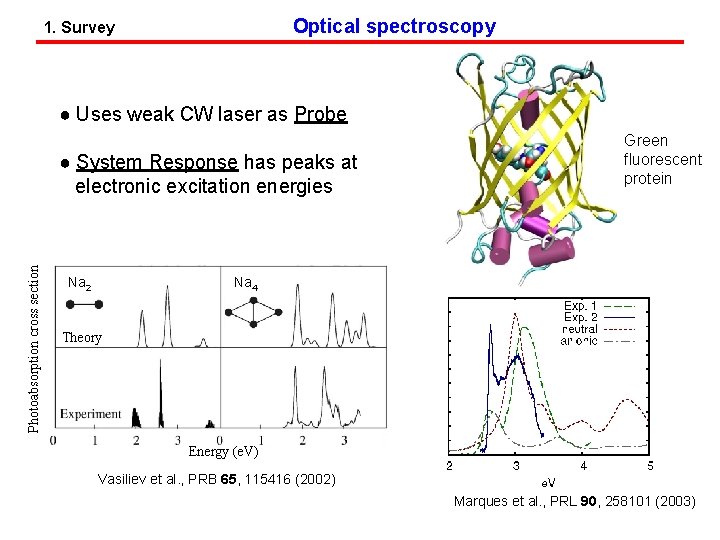
Optical spectroscopy 1. Survey ● Uses weak CW laser as Probe Photoabsorption cross section ● System Response has peaks at electronic excitation energies Na 2 Green fluorescent protein Na 4 Theory Energy (e. V) Vasiliev et al. , PRB 65, 115416 (2002) Marques et al. , PRL 90, 258101 (2003)
Outline 1. A survey of time-dependent phenomena C. U. 2. Fundamental theorems in TDDFT N. M. 3. Time-dependent Kohn-Sham equation C. U. 4. Memory dependence N. M. 5. Linear response and excitation energies N. M. 6. Optical processes in Materials C. U. 7. Multiple and charge-transfer excitations N. M. 8. Current-TDDFT C. U. 9. Nanoscale transport C. U. 10. Strong-field processes and control N. M.
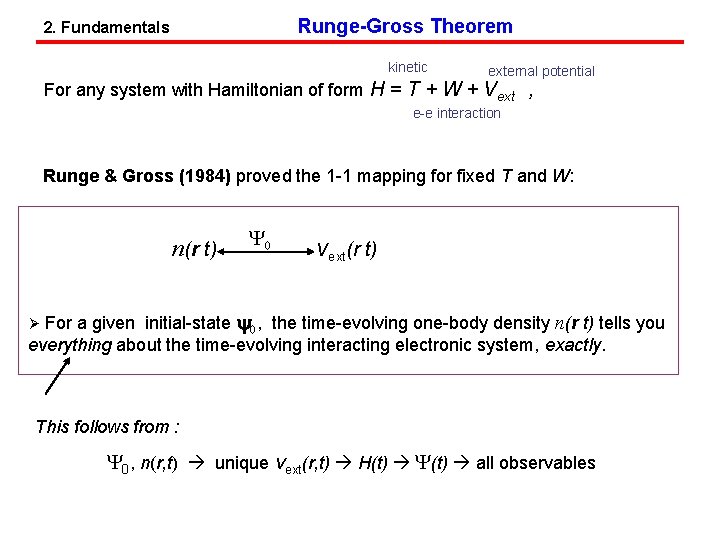
Runge-Gross Theorem 2. Fundamentals kinetic external potential For any system with Hamiltonian of form H = T + W + Vext , e-e interaction Runge & Gross (1984) proved the 1 -1 mapping for fixed T and W: n(r t) Y 0 vext(r t) For a given initial-state y 0, the time-evolving one-body density n(r t) tells you everything about the time-evolving interacting electronic system, exactly. Ø This follows from : Y 0, n(r, t) unique vext(r, t) H(t) Y(t) all observables
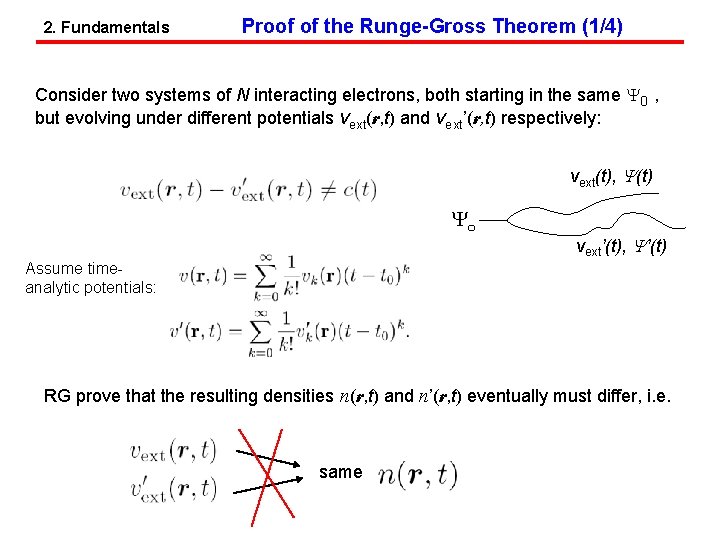
2. Fundamentals Proof of the Runge-Gross Theorem (1/4) Consider two systems of N interacting electrons, both starting in the same Y 0 , but evolving under different potentials vext(r, t) and vext’(r, t) respectively: vext(t), Y(t) Yo vext’(t), Y’(t) Assume timeanalytic potentials: RG prove that the resulting densities n(r, t) and n’(r, t) eventually must differ, i. e. same
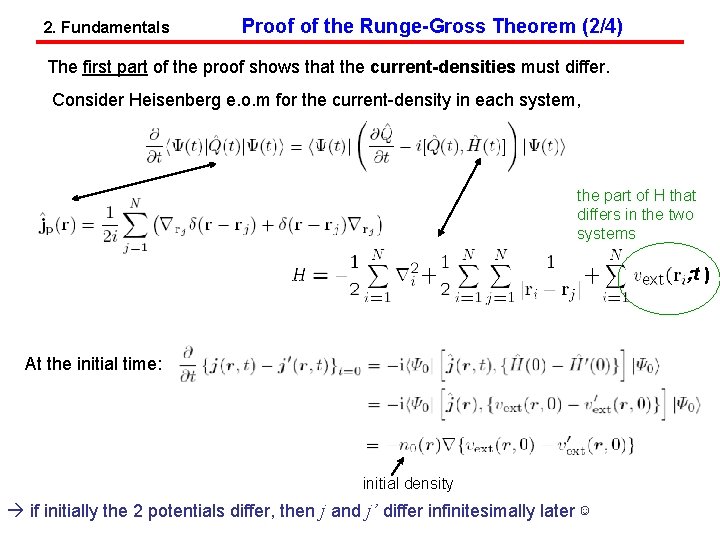
2. Fundamentals Proof of the Runge-Gross Theorem (2/4) The first part of the proof shows that the current-densities must differ. Consider Heisenberg e. o. m for the current-density in each system, the part of H that differs in the two systems ; t ) At the initial time: initial density if initially the 2 potentials differ, then j and j’ differ infinitesimally later ☺
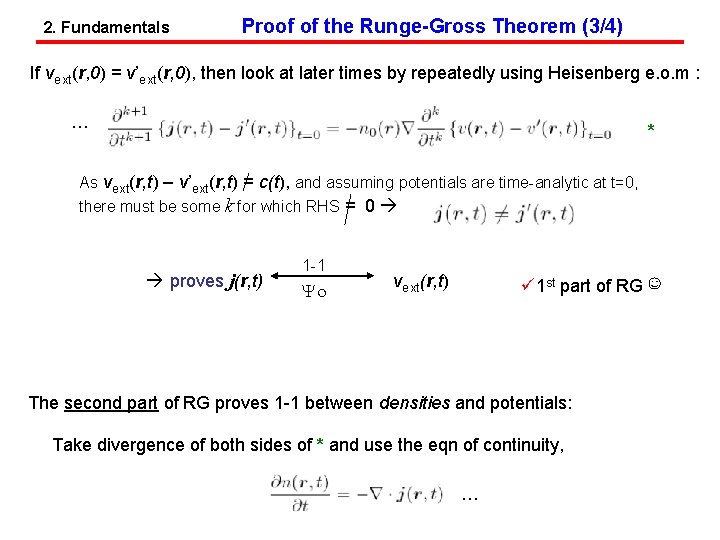
2. Fundamentals Proof of the Runge-Gross Theorem (3/4) If vext(r, 0) = v’ext(r, 0), then look at later times by repeatedly using Heisenberg e. o. m : … * As vext(r, t) – v’ext(r, t) = c(t), and assuming potentials are time-analytic at t=0, there must be some k for which RHS = 0 proves j(r, t) 1 -1 Yo vext(r, t) ü 1 st part of RG ☺ The second part of RG proves 1 -1 between densities and potentials: Take divergence of both sides of * and use the eqn of continuity, …
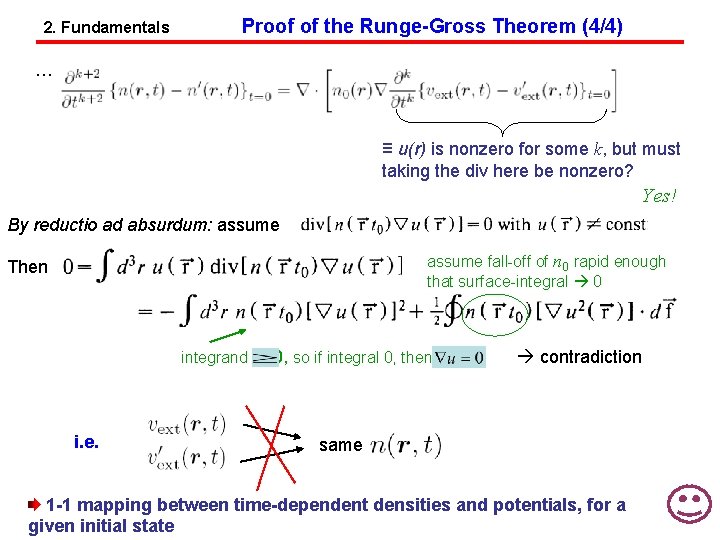
2. Fundamentals Proof of the Runge-Gross Theorem (4/4) … ≡ u(r) is nonzero for some k, but must taking the div here be nonzero? Yes! By reductio ad absurdum: assume fall-off of n 0 rapid enough that surface-integral 0 Then integrand i. e. 0, so if integral 0, then contradiction same 1 -1 mapping between time-dependent densities and potentials, for a given initial state
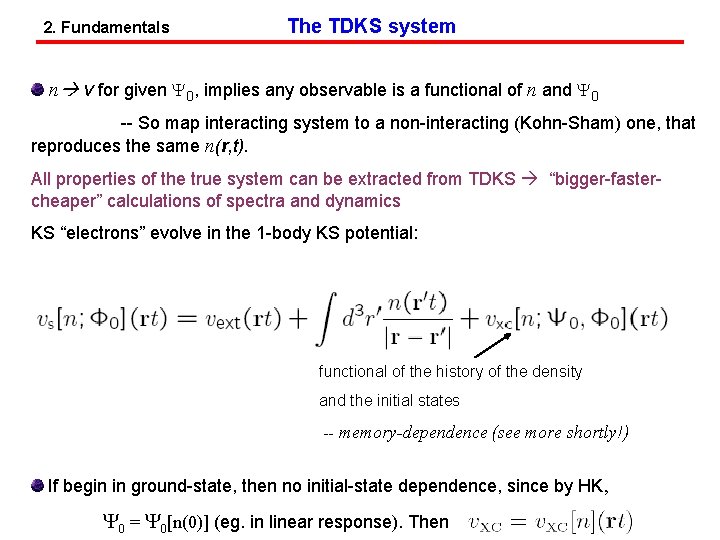
2. Fundamentals The TDKS system n v for given Y 0, implies any observable is a functional of n and Y 0 -- So map interacting system to a non-interacting (Kohn-Sham) one, that reproduces the same n(r, t). All properties of the true system can be extracted from TDKS “bigger-fastercheaper” calculations of spectra and dynamics KS “electrons” evolve in the 1 -body KS potential: functional of the history of the density and the initial states -- memory-dependence (see more shortly!) If begin in ground-state, then no initial-state dependence, since by HK, Y 0 = Y 0[n(0)] (eg. in linear response). Then
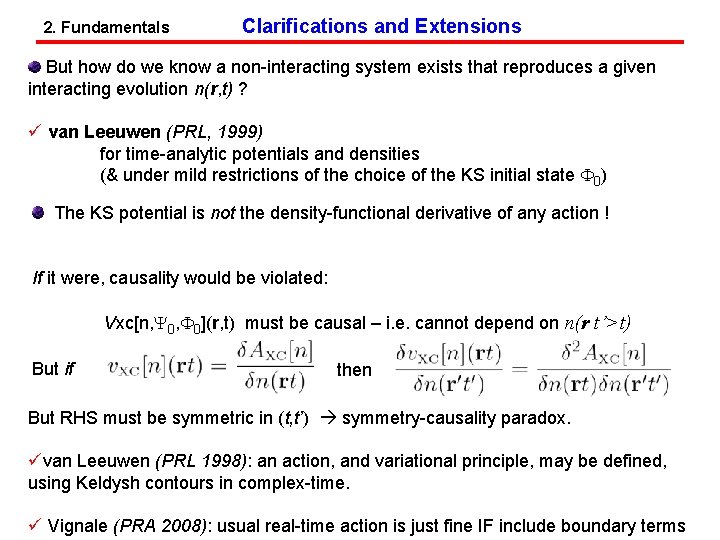
2. Fundamentals Clarifications and Extensions But how do we know a non-interacting system exists that reproduces a given interacting evolution n(r, t) ? ü van Leeuwen (PRL, 1999) for time-analytic potentials and densities (& under mild restrictions of the choice of the KS initial state F 0) The KS potential is not the density-functional derivative of any action ! If it were, causality would be violated: Vxc[n, Y 0, F 0](r, t) must be causal – i. e. cannot depend on n(r t’>t) But if then But RHS must be symmetric in (t, t’) symmetry-causality paradox. üvan Leeuwen (PRL 1998): an action, and variational principle, may be defined, using Keldysh contours in complex-time. ü Vignale (PRA 2008): usual real-time action is just fine IF include boundary terms
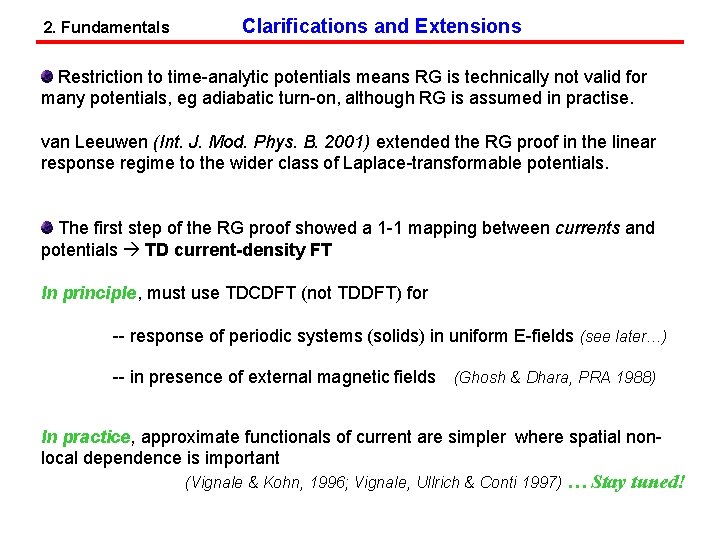
2. Fundamentals Clarifications and Extensions Restriction to time-analytic potentials means RG is technically not valid for many potentials, eg adiabatic turn-on, although RG is assumed in practise. van Leeuwen (Int. J. Mod. Phys. B. 2001) extended the RG proof in the linear response regime to the wider class of Laplace-transformable potentials. The first step of the RG proof showed a 1 -1 mapping between currents and potentials TD current-density FT In principle, must use TDCDFT (not TDDFT) for -- response of periodic systems (solids) in uniform E-fields (see later…) -- in presence of external magnetic fields (Ghosh & Dhara, PRA 1988) In practice, approximate functionals of current are simpler where spatial nonlocal dependence is important (Vignale & Kohn, 1996; Vignale, Ullrich & Conti 1997) … Stay tuned!
Outline 1. A survey of time-dependent phenomena C. U. 2. Fundamental theorems in TDDFT N. M. 3. Time-dependent Kohn-Sham equation C. U. 4. Memory dependence N. M. 5. Linear response and excitation energies N. M. 6. Optical processes in Materials C. U. 7. Multiple and charge-transfer excitations N. M. 8. Current-TDDFT C. U. 9. Nanoscale transport C. U. 10. Strong-field processes and control N. M.
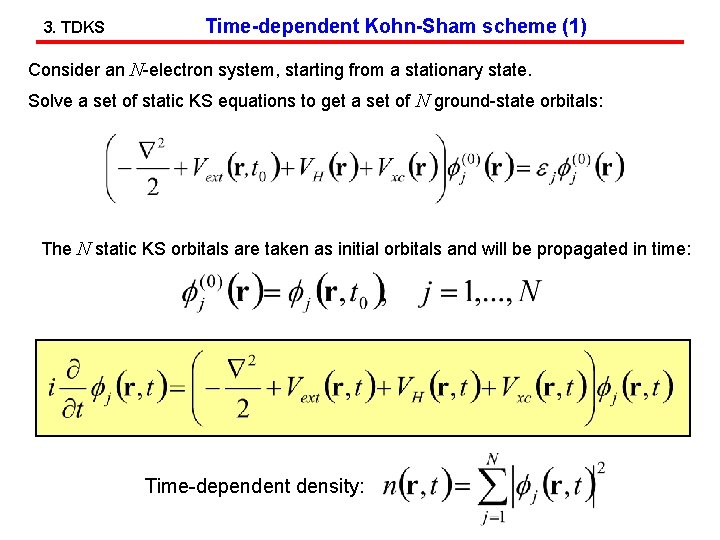
3. TDKS Time-dependent Kohn-Sham scheme (1) Consider an N-electron system, starting from a stationary state. Solve a set of static KS equations to get a set of N ground-state orbitals: The N static KS orbitals are taken as initial orbitals and will be propagated in time: Time-dependent density:
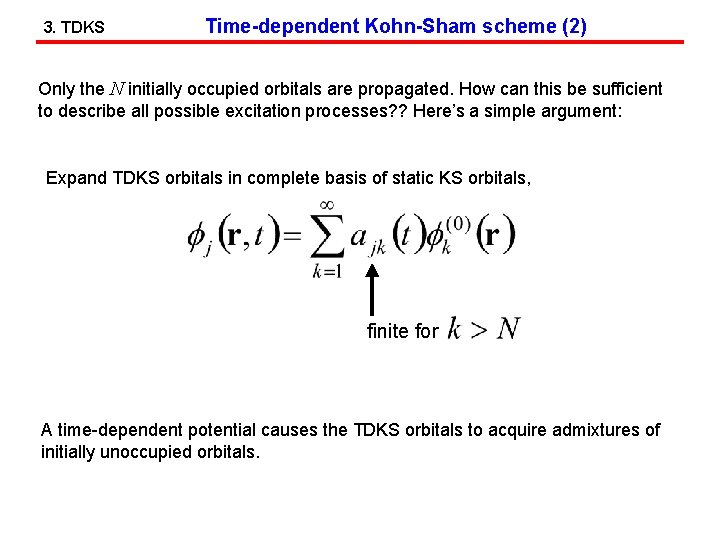
3. TDKS Time-dependent Kohn-Sham scheme (2) Only the N initially occupied orbitals are propagated. How can this be sufficient to describe all possible excitation processes? ? Here’s a simple argument: Expand TDKS orbitals in complete basis of static KS orbitals, finite for A time-dependent potential causes the TDKS orbitals to acquire admixtures of initially unoccupied orbitals.
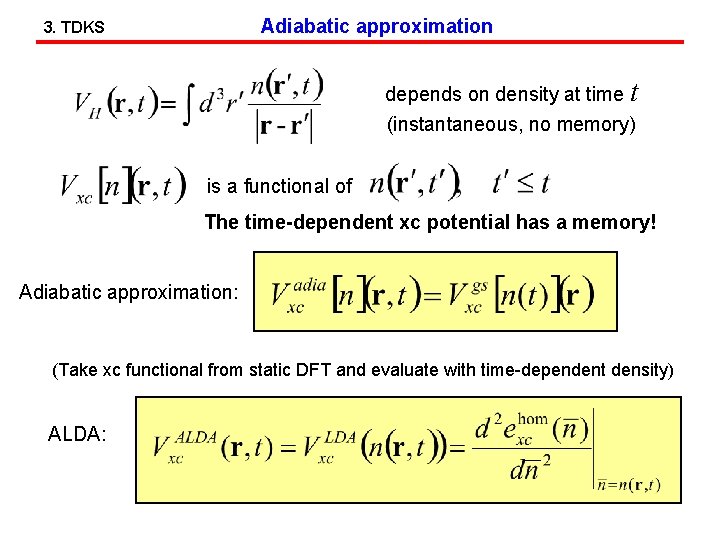
Adiabatic approximation 3. TDKS depends on density at time t (instantaneous, no memory) is a functional of The time-dependent xc potential has a memory! Adiabatic approximation: (Take xc functional from static DFT and evaluate with time-dependent density) ALDA:
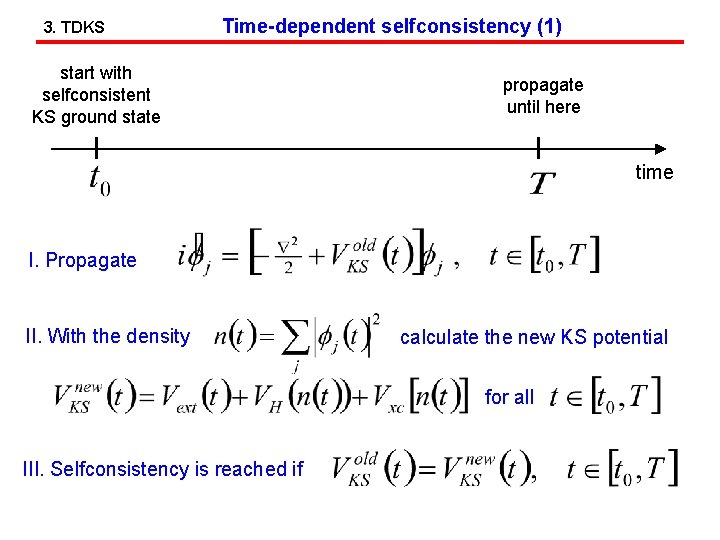
3. TDKS Time-dependent selfconsistency (1) start with selfconsistent KS ground state propagate until here time I. Propagate II. With the density calculate the new KS potential for all III. Selfconsistency is reached if
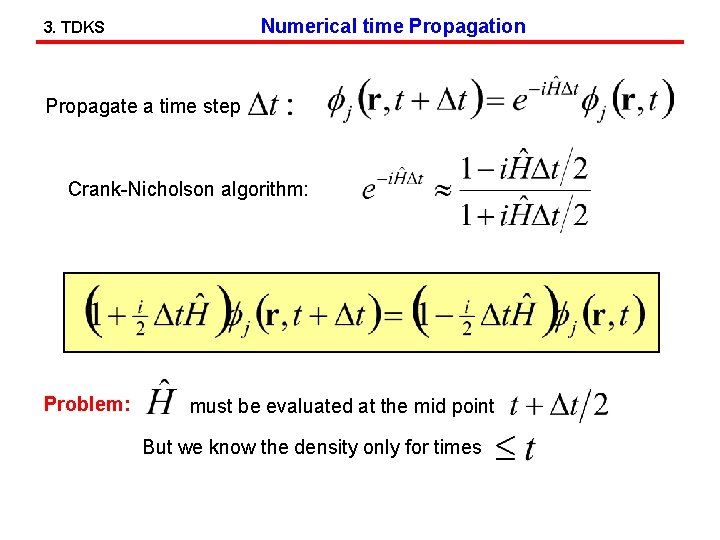
Numerical time Propagation 3. TDKS Propagate a time step Crank-Nicholson algorithm: Problem: must be evaluated at the mid point But we know the density only for times
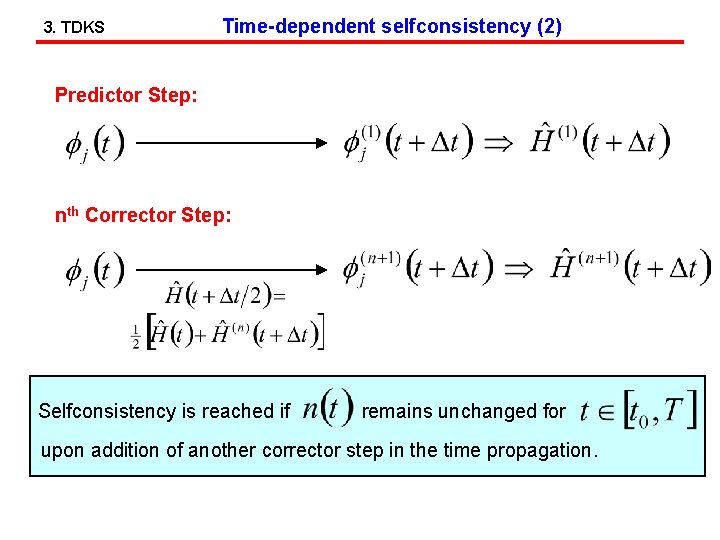
3. TDKS Time-dependent selfconsistency (2) Predictor Step: nth Corrector Step: Selfconsistency is reached if remains unchanged for upon addition of another corrector step in the time propagation.
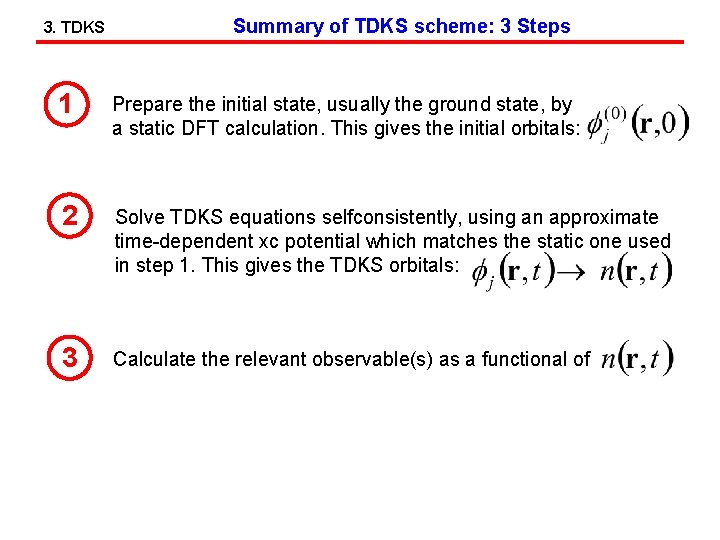
3. TDKS Summary of TDKS scheme: 3 Steps 1 Prepare the initial state, usually the ground state, by a static DFT calculation. This gives the initial orbitals: 2 Solve TDKS equations selfconsistently, using an approximate time-dependent xc potential which matches the static one used in step 1. This gives the TDKS orbitals: 3 Calculate the relevant observable(s) as a functional of
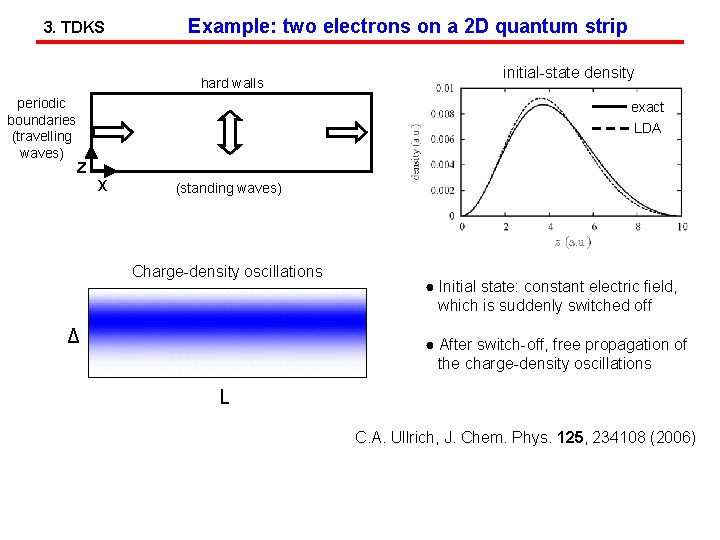
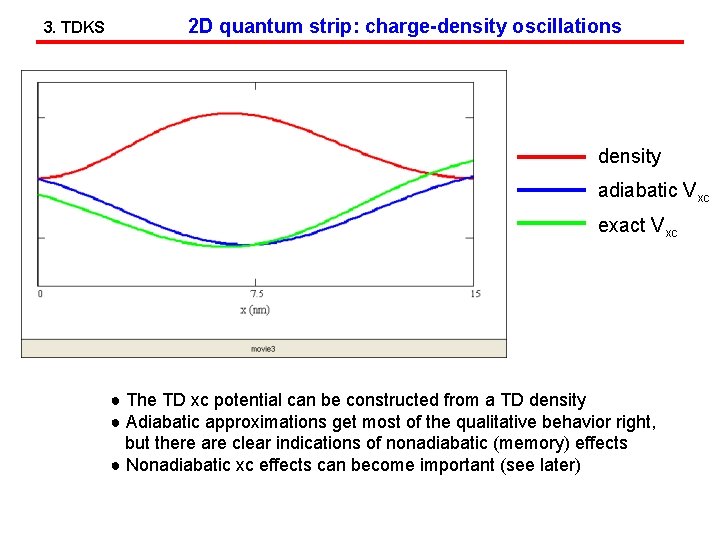
3. TDKS Example: two electrons on a 2 D quantum strip hard walls periodic boundaries (travelling waves) initial-state density exact LDA z x (standing waves) Charge-density oscillations Δ ● Initial state: constant electric field, which is suddenly switched off ● After switch-off, free propagation of the charge-density oscillations L C. A. Ullrich, J. Chem. Phys. 125, 234108 (2006)
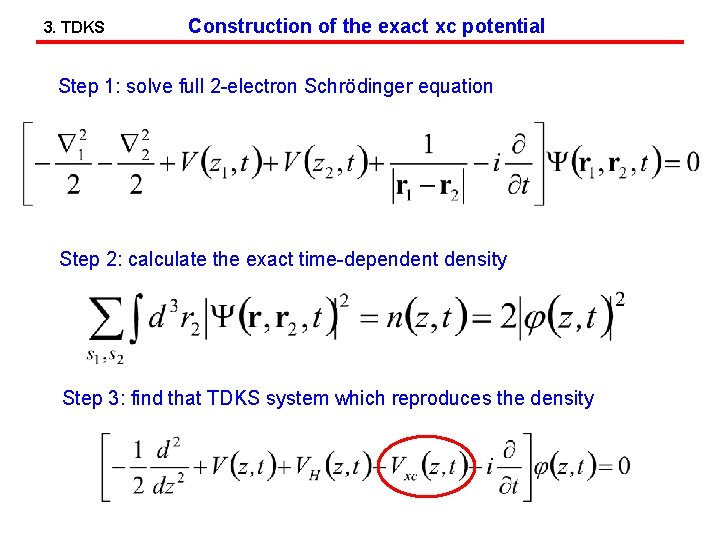
3. TDKS Construction of the exact xc potential Step 1: solve full 2 -electron Schrödinger equation Step 2: calculate the exact time-dependent density Step 3: find that TDKS system which reproduces the density
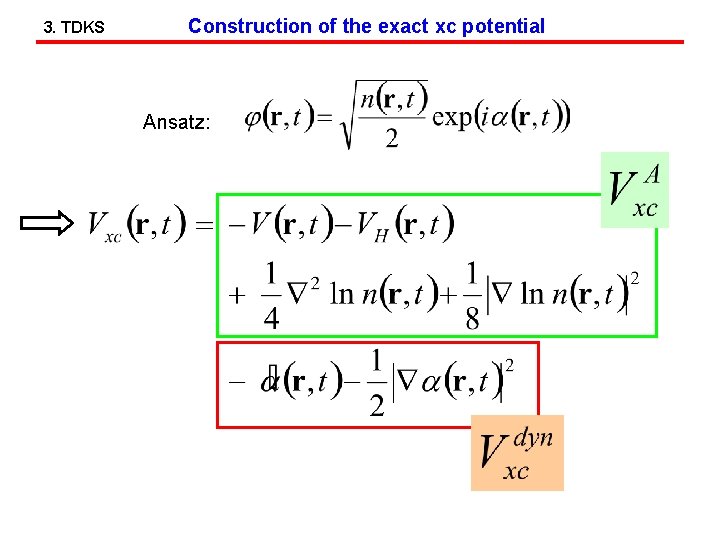
3. TDKS Construction of the exact xc potential Ansatz:
3. TDKS 2 D quantum strip: charge-density oscillations density adiabatic Vxc exact Vxc ● The TD xc potential can be constructed from a TD density ● Adiabatic approximations get most of the qualitative behavior right, but there are clear indications of nonadiabatic (memory) effects ● Nonadiabatic xc effects can become important (see later)
Outline 1. A survey of time-dependent phenomena C. U. 2. Fundamental theorems in TDDFT N. M. 3. Time-dependent Kohn-Sham equation C. U. 4. Memory dependence N. M. 5. Linear response and excitation energies N. M. 6. Optical processes in Materials C. U. 7. Multiple and charge-transfer excitations N. M. 8. Current-TDDFT C. U. 9. Nanoscale transport C. U. 10. Strong-field processes and control N. M.
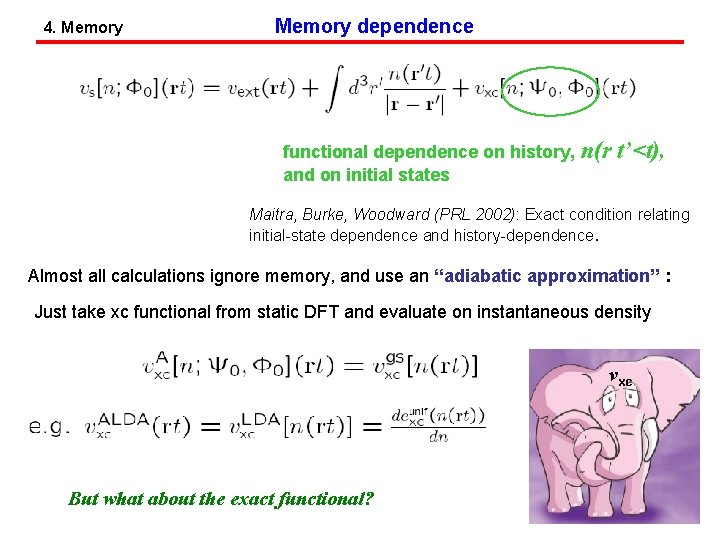
4. Memory dependence functional dependence on history, n(r and on initial states t’<t), Maitra, Burke, Woodward (PRL 2002): Exact condition relating initial-state dependence and history-dependence. Almost all calculations ignore memory, and use an “adiabatic approximation” : Just take xc functional from static DFT and evaluate on instantaneous density vxc But what about the exact functional?
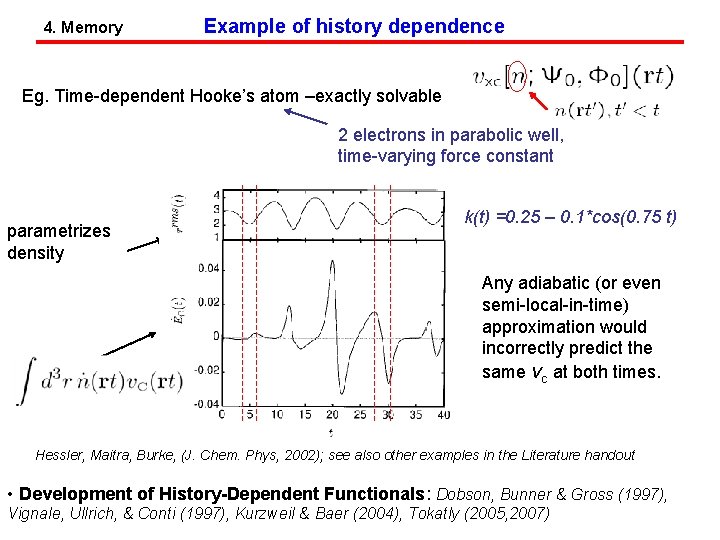
4. Memory Example of history dependence Eg. Time-dependent Hooke’s atom –exactly solvable 2 electrons in parabolic well, time-varying force constant parametrizes density k(t) =0. 25 – 0. 1*cos(0. 75 t) Any adiabatic (or even semi-local-in-time) approximation would incorrectly predict the same vc at both times. Hessler, Maitra, Burke, (J. Chem. Phys, 2002); see also other examples in the Literature handout • Development of History-Dependent Functionals: Dobson, Bunner & Gross (1997), Vignale, Ullrich, & Conti (1997), Kurzweil & Baer (2004), Tokatly (2005, 2007)
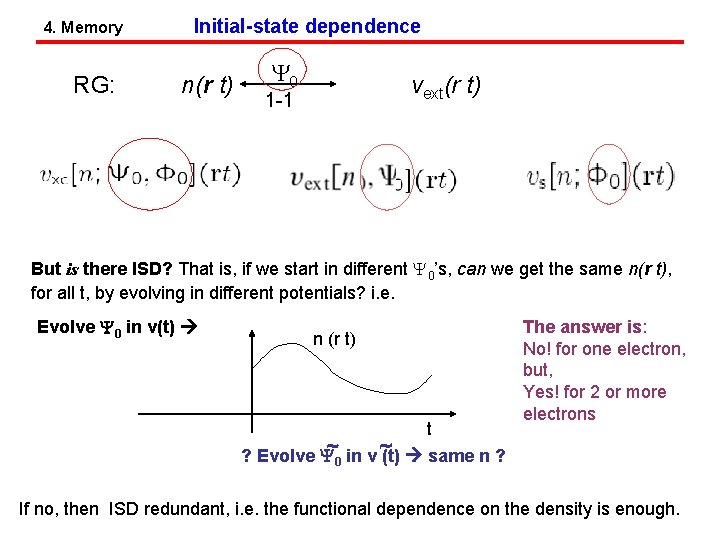
4. Memory RG: Initial-state dependence n(r t) Y 0 vext(r t) 1 -1 But is there ISD? That is, if we start in different Y 0’s, can we get the same n(r t), for all t, by evolving in different potentials? i. e. Evolve Y 0 in v(t) n (r t) t ? Evolve Y~0 in v ~ (t) same n ? The answer is: No! for one electron, but, Yes! for 2 or more electrons If no, then ISD redundant, i. e. the functional dependence on the density is enough.
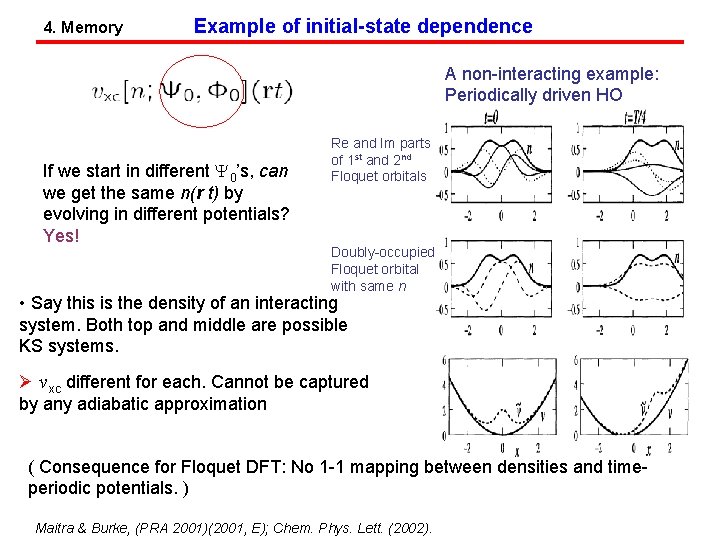
4. Memory Example of initial-state dependence A non-interacting example: Periodically driven HO If we start in different Y 0’s, can we get the same n(r t) by evolving in different potentials? Yes! Re and Im parts of 1 st and 2 nd Floquet orbitals Doubly-occupied Floquet orbital with same n • Say this is the density of an interacting system. Both top and middle are possible KS systems. Ø vxc different for each. Cannot be captured by any adiabatic approximation ( Consequence for Floquet DFT: No 1 -1 mapping between densities and timeperiodic potentials. ) Maitra & Burke, (PRA 2001)(2001, E); Chem. Phys. Lett. (2002).
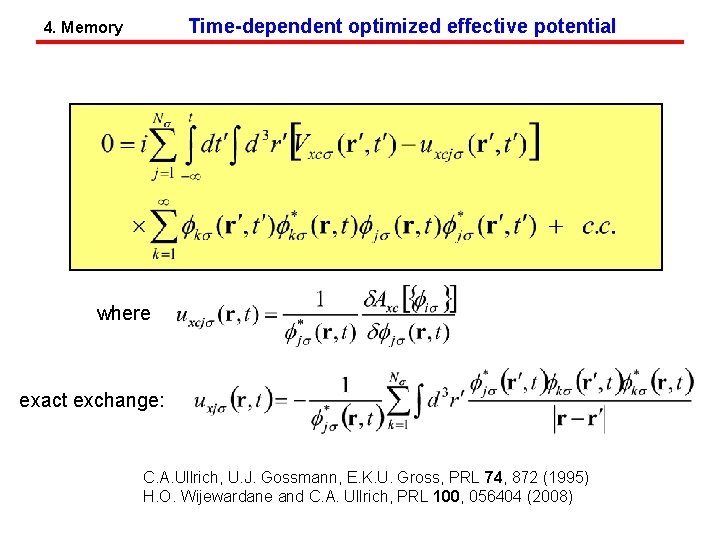
Time-dependent optimized effective potential 4. Memory where exact exchange: C. A. Ullrich, U. J. Gossmann, E. K. U. Gross, PRL 74, 872 (1995) H. O. Wijewardane and C. A. Ullrich, PRL 100, 056404 (2008)
Outline 1. A survey of time-dependent phenomena C. U. 2. Fundamental theorems in TDDFT N. M. 3. Time-dependent Kohn-Sham equation C. U. 4. Memory dependence N. M. 5. Linear response and excitation energies N. M. 6. Optical processes in Materials C. U. 7. Multiple and charge-transfer excitations N. M. 8. Current-TDDFT C. U. 9. Nanoscale transport C. U. 10. Strong-field processes and control N. M.
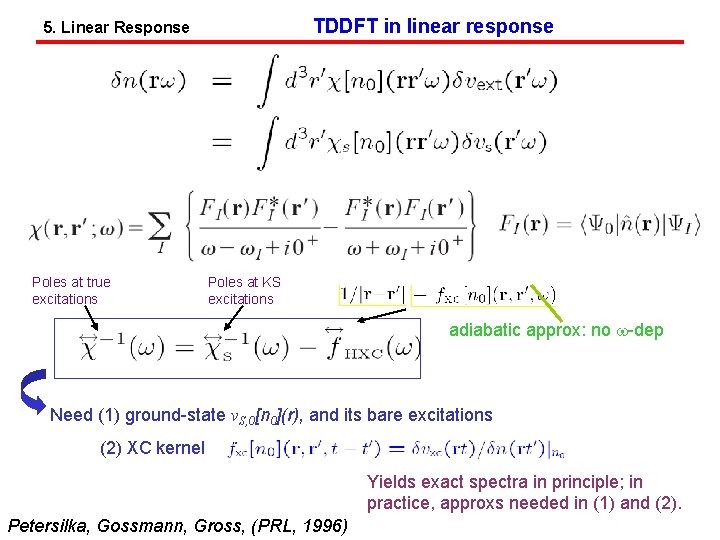
TDDFT in linear response 5. Linear Response Poles at true excitations Poles at KS excitations adiabatic approx: no w-dep Need (1) ground-state v. S, 0[n 0](r), and its bare excitations (2) XC kernel Yields exact spectra in principle; in practice, approxs needed in (1) and (2). Petersilka, Gossmann, Gross, (PRL, 1996)
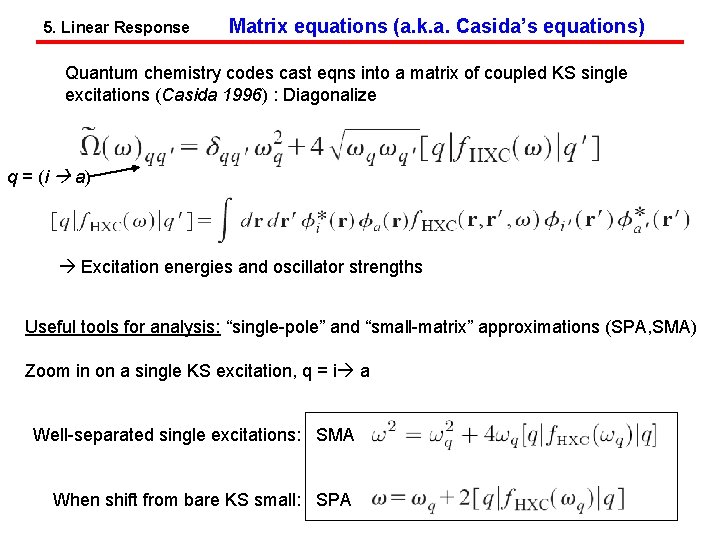
5. Linear Response Matrix equations (a. k. a. Casida’s equations) Quantum chemistry codes cast eqns into a matrix of coupled KS single excitations (Casida 1996) : Diagonalize q = (i a) Excitation energies and oscillator strengths Useful tools for analysis: “single-pole” and “small-matrix” approximations (SPA, SMA) Zoom in on a single KS excitation, q = i a Well-separated single excitations: SMA When shift from bare KS small: SPA
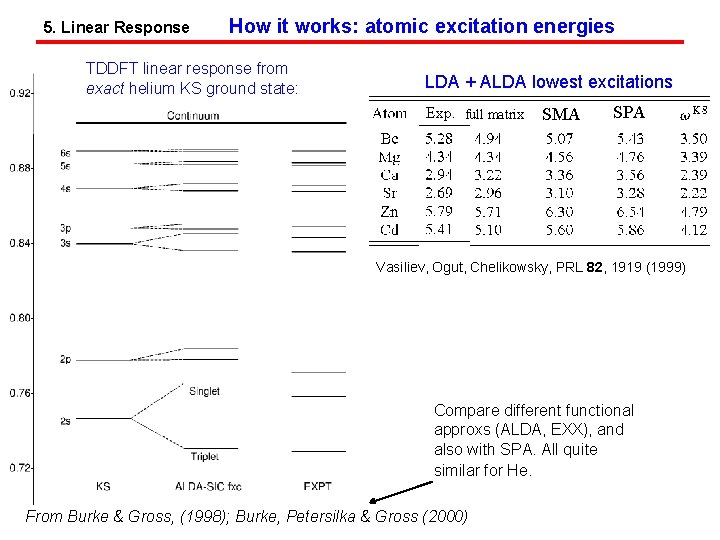
5. Linear Response How it works: atomic excitation energies TDDFT linear response from exact helium KS ground state: LDA + ALDA lowest excitations Exp. full matrix SMA SPA Vasiliev, Ogut, Chelikowsky, PRL 82, 1919 (1999) Compare different functional approxs (ALDA, EXX), and also with SPA. All quite similar for He. From Burke & Gross, (1998); Burke, Petersilka & Gross (2000)
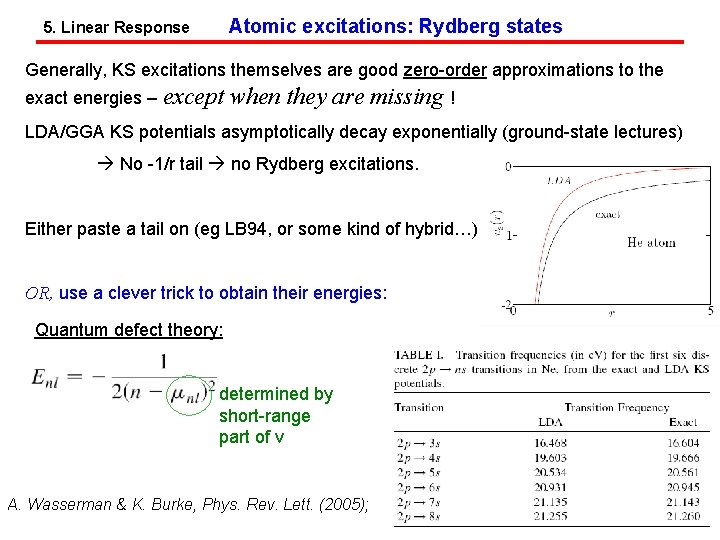
Atomic excitations: Rydberg states 5. Linear Response Generally, KS excitations themselves are good zero-order approximations to the exact energies – except when they are missing ! LDA/GGA KS potentials asymptotically decay exponentially (ground-state lectures) No -1/r tail no Rydberg excitations. Either paste a tail on (eg LB 94, or some kind of hybrid…) OR, use a clever trick to obtain their energies: Quantum defect theory: determined by short-range part of v A. Wasserman & K. Burke, Phys. Rev. Lett. (2005);
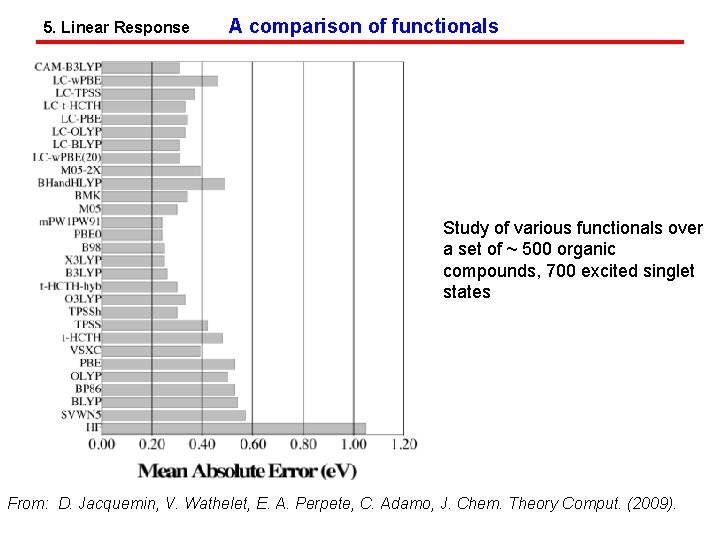
5. Linear Response A comparison of functionals Study of various functionals over a set of ~ 500 organic compounds, 700 excited singlet states From: D. Jacquemin, V. Wathelet, E. A. Perpete, C. Adamo, J. Chem. Theory Comput. (2009).
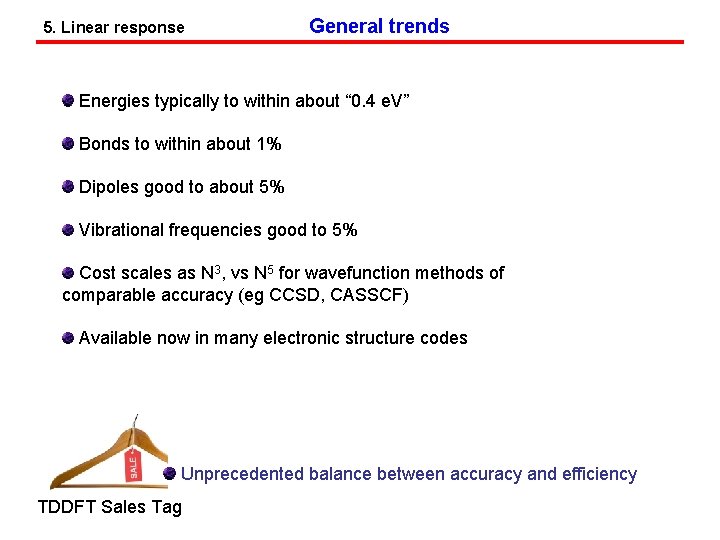
5. Linear response General trends Energies typically to within about “ 0. 4 e. V” Bonds to within about 1% Dipoles good to about 5% Vibrational frequencies good to 5% Cost scales as N 3, vs N 5 for wavefunction methods of comparable accuracy (eg CCSD, CASSCF) Available now in many electronic structure codes Unprecedented balance between accuracy and efficiency TDDFT Sales Tag
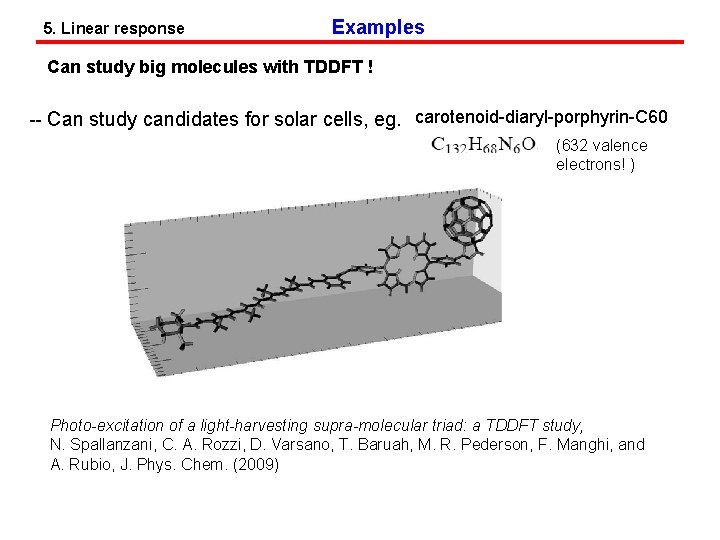
5. Linear response Examples Can study big molecules with TDDFT ! -- Can study candidates for solar cells, eg. carotenoid-diaryl-porphyrin-C 60 (632 valence electrons! ) Photo-excitation of a light-harvesting supra-molecular triad: a TDDFT study, N. Spallanzani, C. A. Rozzi, D. Varsano, T. Baruah, M. R. Pederson, F. Manghi, and A. Rubio, J. Phys. Chem. (2009)
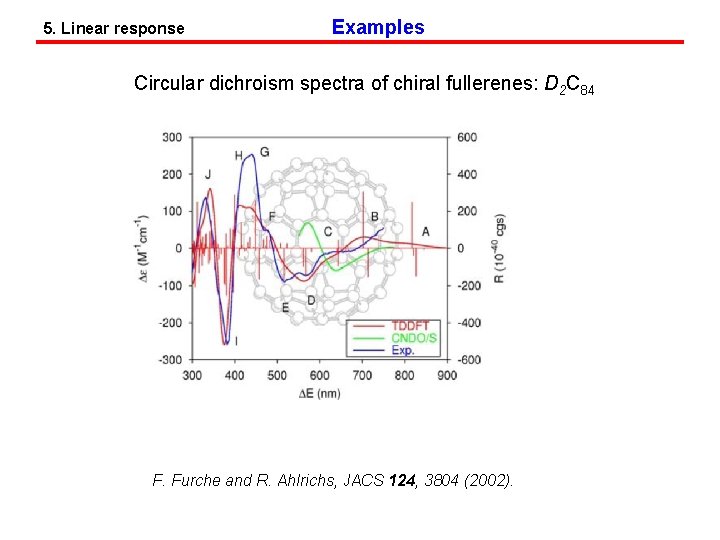
5. Linear response Examples Circular dichroism spectra of chiral fullerenes: D 2 C 84 F. Furche and R. Ahlrichs, JACS 124, 3804 (2002).
Outline 1. A survey of time-dependent phenomena C. U. 2. Fundamental theorems in TDDFT N. M. 3. Time-dependent Kohn-Sham equation C. U. 4. Memory dependence N. M. 5. Linear response and excitation energies N. M. 6. Optical processes in Materials C. U. 7. Multiple and charge-transfer excitations N. M. 8. Current-TDDFT C. U. 9. Nanoscale transport C. U. 10. Strong-field processes and control N. M.
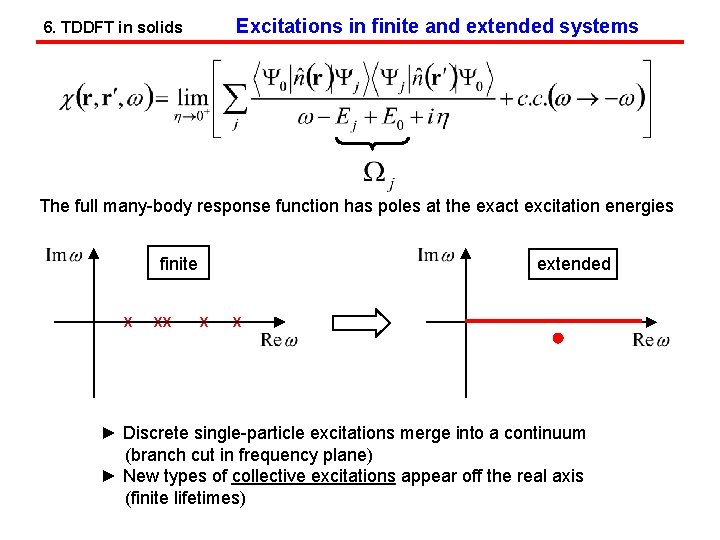
Excitations in finite and extended systems 6. TDDFT in solids The full many-body response function has poles at the exact excitation energies finite x xx extended x x ► Discrete single-particle excitations merge into a continuum (branch cut in frequency plane) ► New types of collective excitations appear off the real axis (finite lifetimes)
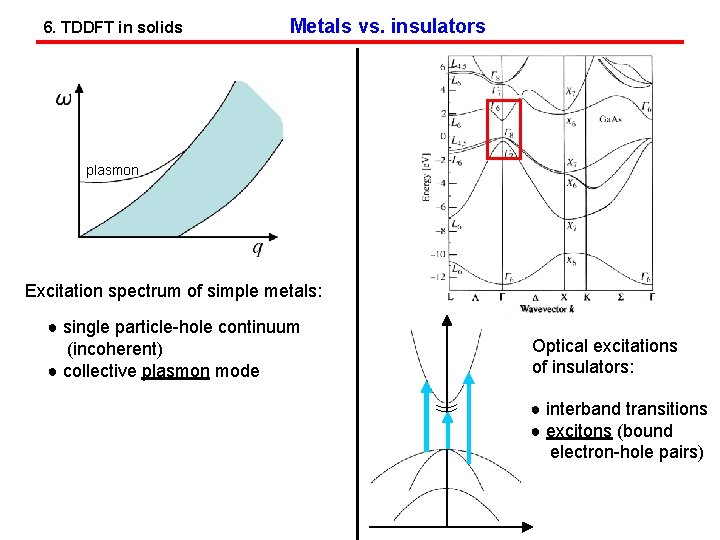
6. TDDFT in solids Metals vs. insulators plasmon Excitation spectrum of simple metals: ● single particle-hole continuum (incoherent) ● collective plasmon mode Optical excitations of insulators: ● interband transitions ● excitons (bound electron-hole pairs)
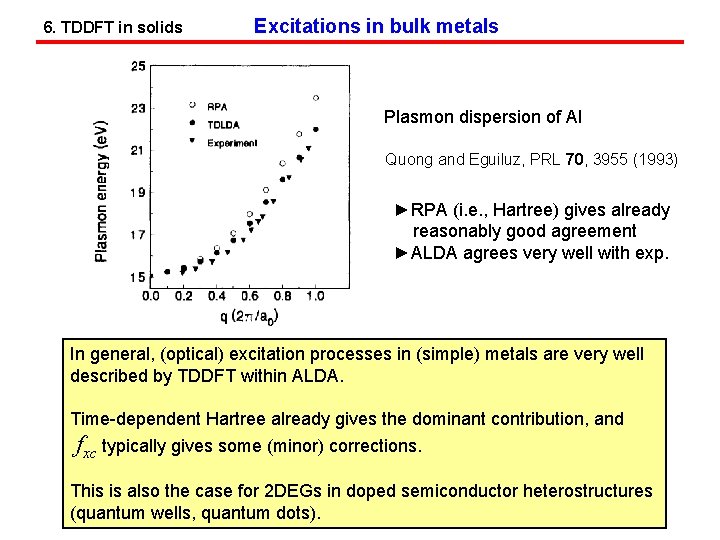
6. TDDFT in solids Excitations in bulk metals Plasmon dispersion of Al Quong and Eguiluz, PRL 70, 3955 (1993) ►RPA (i. e. , Hartree) gives already reasonably good agreement ►ALDA agrees very well with exp. In general, (optical) excitation processes in (simple) metals are very well described by TDDFT within ALDA. Time-dependent Hartree already gives the dominant contribution, and fxc typically gives some (minor) corrections. This is also the case for 2 DEGs in doped semiconductor heterostructures (quantum wells, quantum dots).
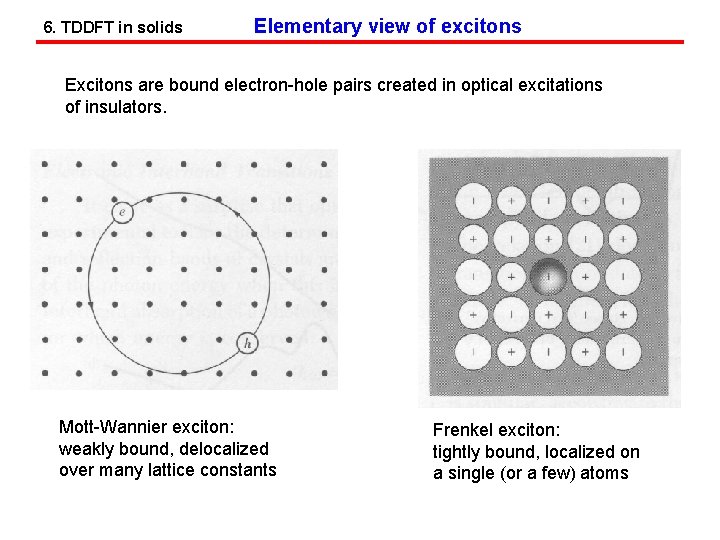
6. TDDFT in solids Elementary view of excitons Excitons are bound electron-hole pairs created in optical excitations of insulators. Mott-Wannier exciton: weakly bound, delocalized over many lattice constants Frenkel exciton: tightly bound, localized on a single (or a few) atoms
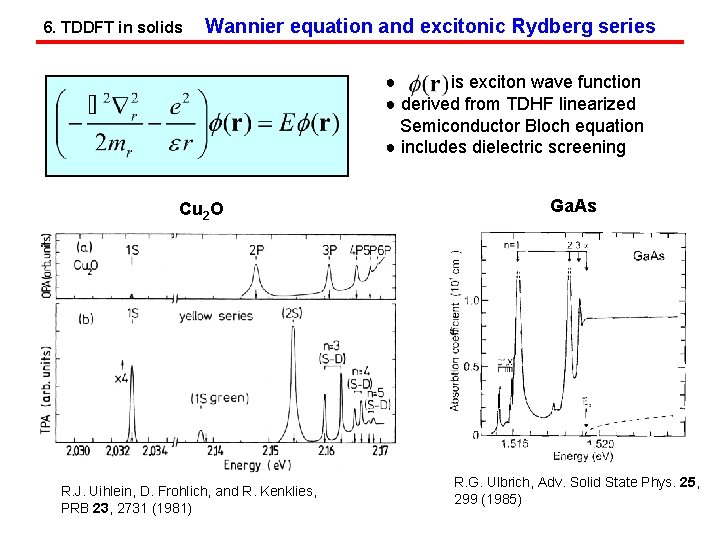
6. TDDFT in solids Wannier equation and excitonic Rydberg series ● is exciton wave function ● derived from TDHF linearized Semiconductor Bloch equation ● includes dielectric screening Cu 2 O R. J. Uihlein, D. Frohlich, and R. Kenklies, PRB 23, 2731 (1981) Ga. As R. G. Ulbrich, Adv. Solid State Phys. 25, 299 (1985)
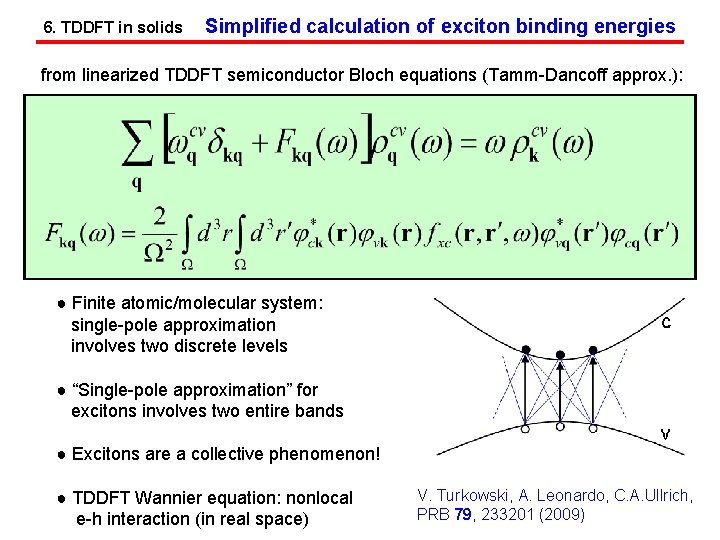
6. TDDFT in solids Simplified calculation of exciton binding energies from linearized TDDFT semiconductor Bloch equations (Tamm-Dancoff approx. ): ● Finite atomic/molecular system: single-pole approximation involves two discrete levels ● “Single-pole approximation” for excitons involves two entire bands ● Excitons are a collective phenomenon! ● TDDFT Wannier equation: nonlocal e-h interaction (in real space) V. Turkowski, A. Leonardo, C. A. Ullrich, PRB 79, 233201 (2009)
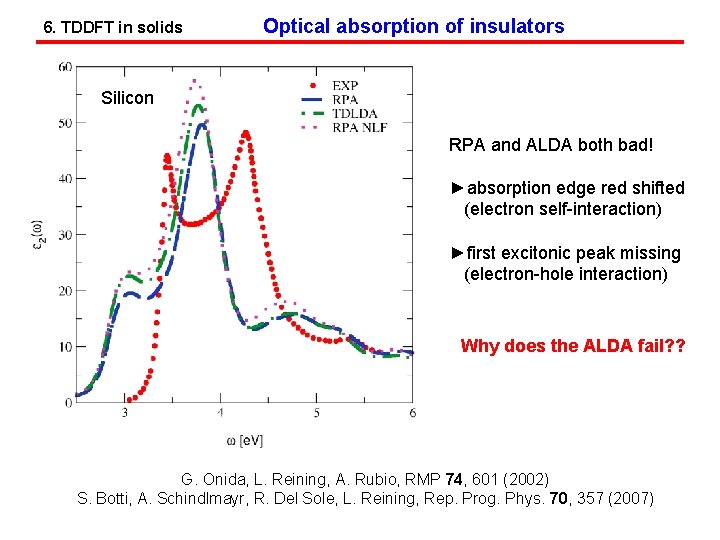
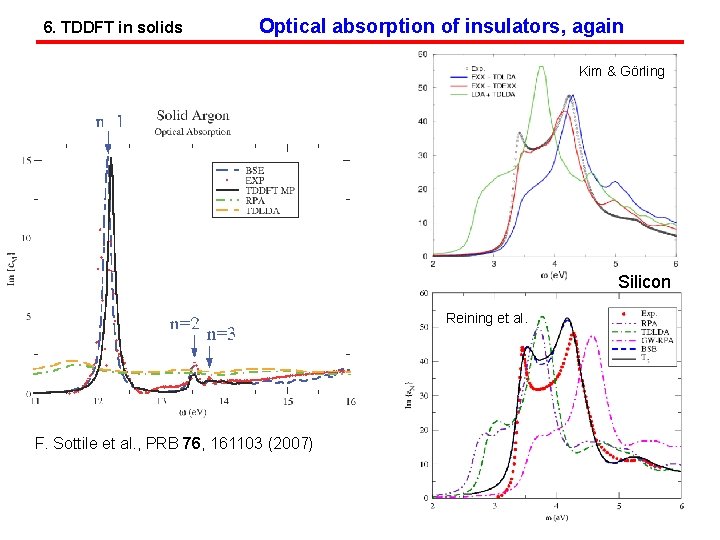
6. TDDFT in solids Optical absorption of insulators Silicon RPA and ALDA both bad! ►absorption edge red shifted (electron self-interaction) ►first excitonic peak missing (electron-hole interaction) Why does the ALDA fail? ? G. Onida, L. Reining, A. Rubio, RMP 74, 601 (2002) S. Botti, A. Schindlmayr, R. Del Sole, L. Reining, Rep. Prog. Phys. 70, 357 (2007)
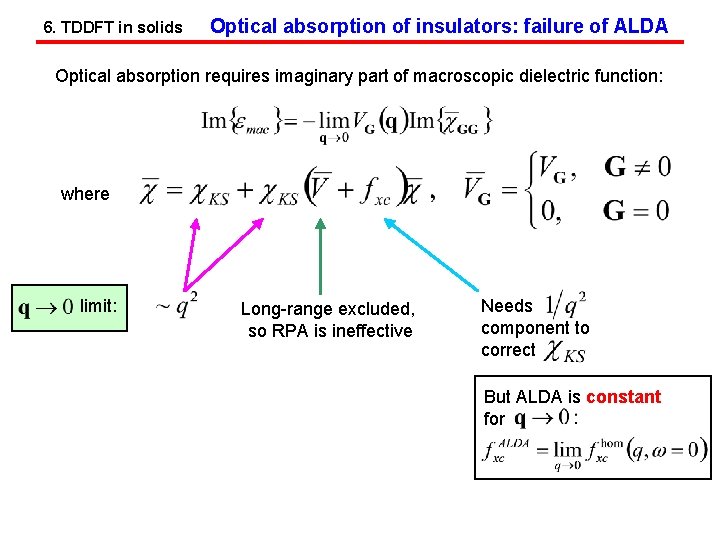
6. TDDFT in solids Optical absorption of insulators: failure of ALDA Optical absorption requires imaginary part of macroscopic dielectric function: where limit: Long-range excluded, so RPA is ineffective Needs component to correct But ALDA is constant for
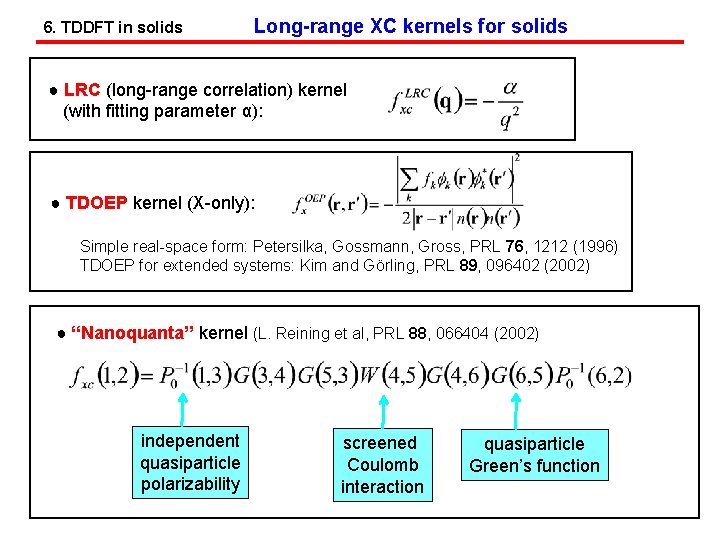
6. TDDFT in solids Long-range XC kernels for solids ● LRC (long-range correlation) kernel (with fitting parameter α): ● TDOEP kernel (X-only): Simple real-space form: Petersilka, Gossmann, Gross, PRL 76, 1212 (1996) TDOEP for extended systems: Kim and Görling, PRL 89, 096402 (2002) ● “Nanoquanta” kernel (L. Reining et al, PRL 88, 066404 (2002) independent quasiparticle polarizability screened Coulomb interaction quasiparticle Green’s function
6. TDDFT in solids Optical absorption of insulators, again Kim & Görling Silicon Reining et al. F. Sottile et al. , PRB 76, 161103 (2007)
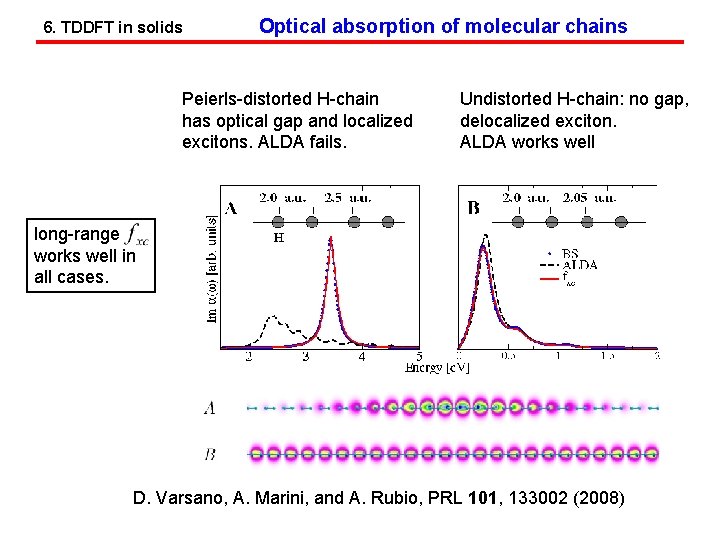
6. TDDFT in solids Optical absorption of molecular chains Peierls-distorted H-chain has optical gap and localized excitons. ALDA fails. Undistorted H-chain: no gap, delocalized exciton. ALDA works well long-range works well in all cases. D. Varsano, A. Marini, and A. Rubio, PRL 101, 133002 (2008)
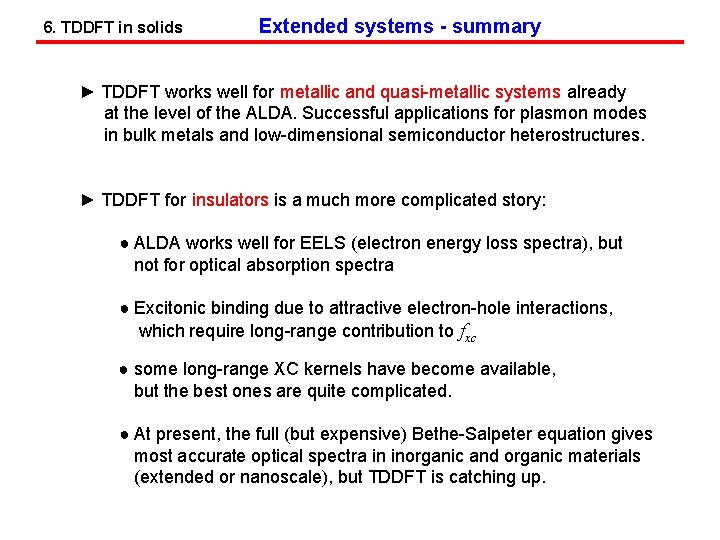
6. TDDFT in solids Extended systems - summary ► TDDFT works well for metallic and quasi-metallic systems already at the level of the ALDA. Successful applications for plasmon modes in bulk metals and low-dimensional semiconductor heterostructures. ► TDDFT for insulators is a much more complicated story: ● ALDA works well for EELS (electron energy loss spectra), but not for optical absorption spectra ● Excitonic binding due to attractive electron-hole interactions, which require long-range contribution to fxc ● some long-range XC kernels have become available, but the best ones are quite complicated. ● At present, the full (but expensive) Bethe-Salpeter equation gives most accurate optical spectra in inorganic and organic materials (extended or nanoscale), but TDDFT is catching up.
Outline 1. A survey of time-dependent phenomena C. U. 2. Fundamental theorems in TDDFT N. M. 3. Time-dependent Kohn-Sham equation C. U. 4. Memory dependence N. M. 5. Linear response and excitation energies N. M. 6. Optical processes in Materials C. U. 7. Multiple and charge-transfer excitations N. M. 8. Current-TDDFT C. U. 9. Nanoscale transport C. U. 10. Strong-field processes and control N. M.
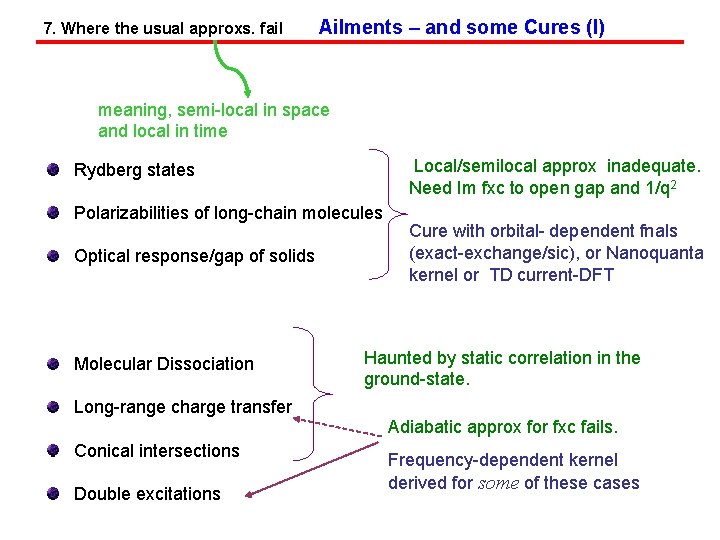
7. Where the usual approxs. fail Ailments – and some Cures (I) meaning, semi-local in space and local in time Local/semilocal approx inadequate. Need Im fxc to open gap and 1/q 2 Rydberg states Polarizabilities of long-chain molecules Optical response/gap of solids Molecular Dissociation Long-range charge transfer Conical intersections Double excitations Cure with orbital- dependent fnals (exact-exchange/sic), or Nanoquanta kernel or TD current-DFT Haunted by static correlation in the ground-state. Adiabatic approx for fxc fails. Frequency-dependent kernel derived for some of these cases
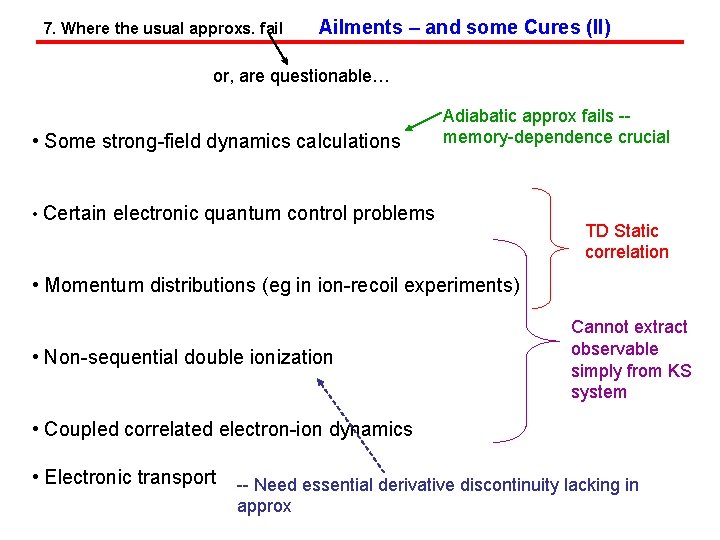
7. Where the usual approxs. fail Ailments – and some Cures (II) or, are questionable… • Some strong-field dynamics calculations Adiabatic approx fails -memory-dependence crucial • Certain electronic quantum control problems TD Static correlation • Momentum distributions (eg in ion-recoil experiments) • Non-sequential double ionization Cannot extract observable simply from KS system • Coupled correlated electron-ion dynamics • Electronic transport -- Need essential derivative discontinuity lacking in approx
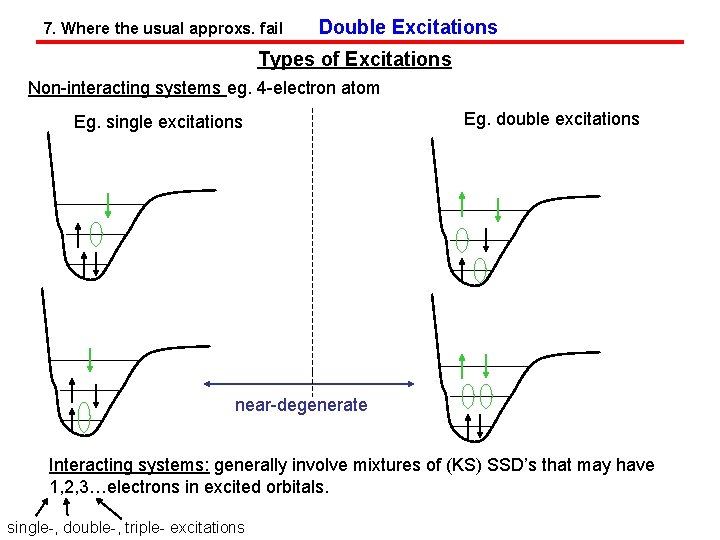
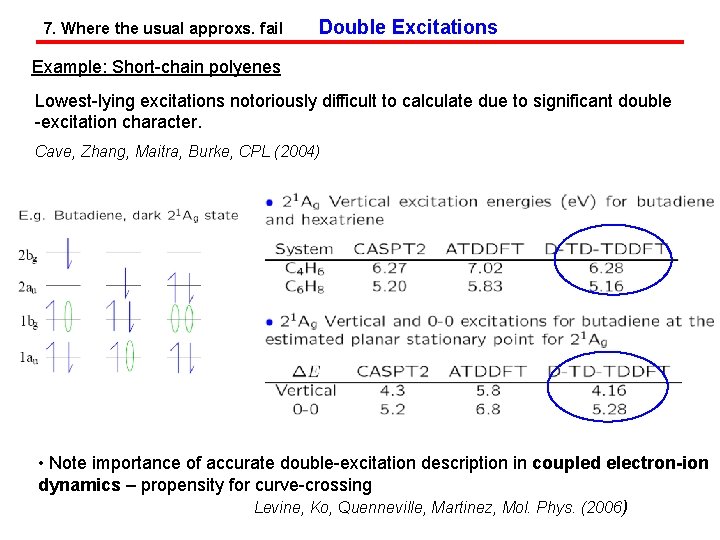
7. Where the usual approxs. fail Double Excitations Types of Excitations Non-interacting systems eg. 4 -electron atom Eg. single excitations Eg. double excitations near-degenerate Interacting systems: generally involve mixtures of (KS) SSD’s that may have 1, 2, 3…electrons in excited orbitals. single-, double-, triple- excitations
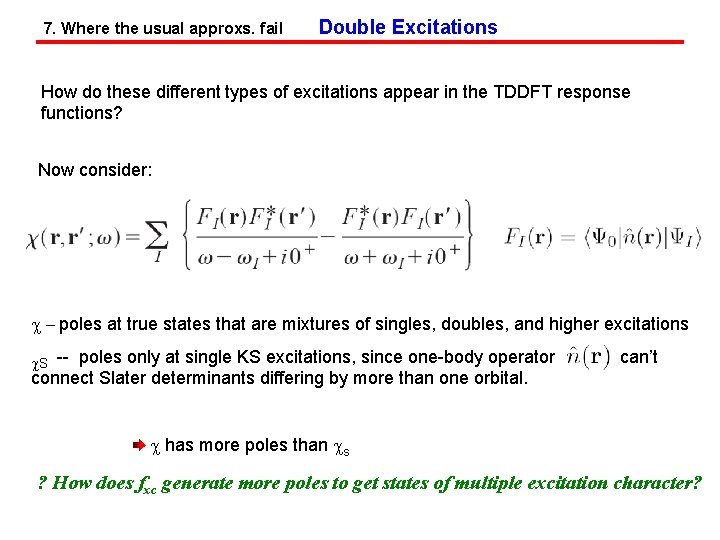
7. Where the usual approxs. fail Double Excitations How do these different types of excitations appear in the TDDFT response functions? Now consider: c – poles at true states that are mixtures of singles, doubles, and higher excitations -- poles only at single KS excitations, since one-body operator connect Slater determinants differing by more than one orbital. c. S can’t c has more poles than cs ? How does fxc generate more poles to get states of multiple excitation character?
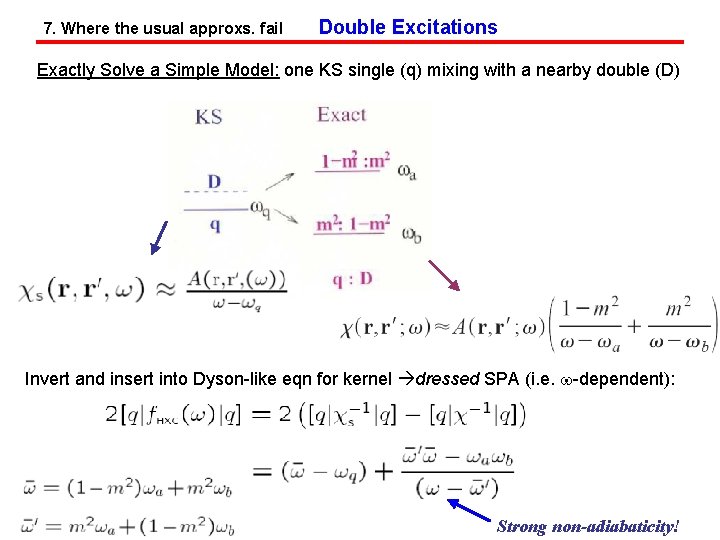
7. Where the usual approxs. fail Double Excitations Exactly Solve a Simple Model: one KS single (q) mixing with a nearby double (D) Invert and insert into Dyson-like eqn for kernel dressed SPA (i. e. w-dependent): Strong non-adiabaticity!
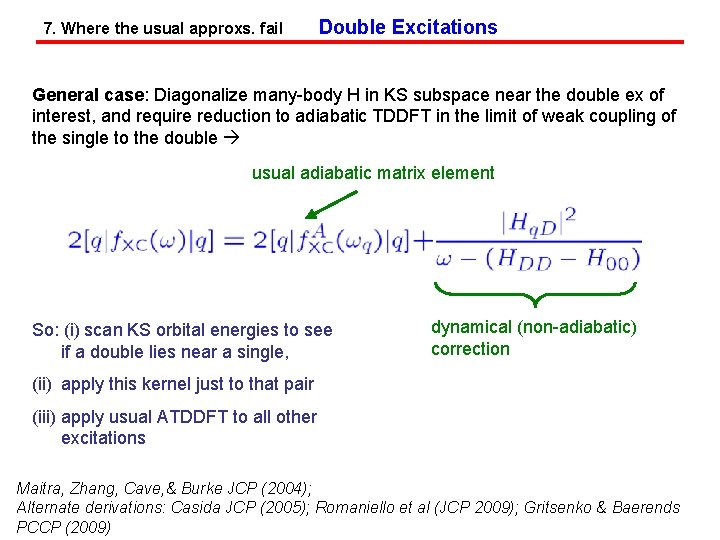
7. Where the usual approxs. fail Double Excitations General case: Diagonalize many-body H in KS subspace near the double ex of interest, and require reduction to adiabatic TDDFT in the limit of weak coupling of the single to the double usual adiabatic matrix element So: (i) scan KS orbital energies to see if a double lies near a single, dynamical (non-adiabatic) correction (ii) apply this kernel just to that pair (iii) apply usual ATDDFT to all other excitations Maitra, Zhang, Cave, & Burke JCP (2004); Alternate derivations: Casida JCP (2005); Romaniello et al (JCP 2009); Gritsenko & Baerends PCCP (2009)
7. Where the usual approxs. fail Double Excitations Example: Short-chain polyenes Lowest-lying excitations notoriously difficult to calculate due to significant double -excitation character. Cave, Zhang, Maitra, Burke, CPL (2004) • Note importance of accurate double-excitation description in coupled electron-ion dynamics – propensity for curve-crossing Levine, Ko, Quenneville, Martinez, Mol. Phys. (2006)
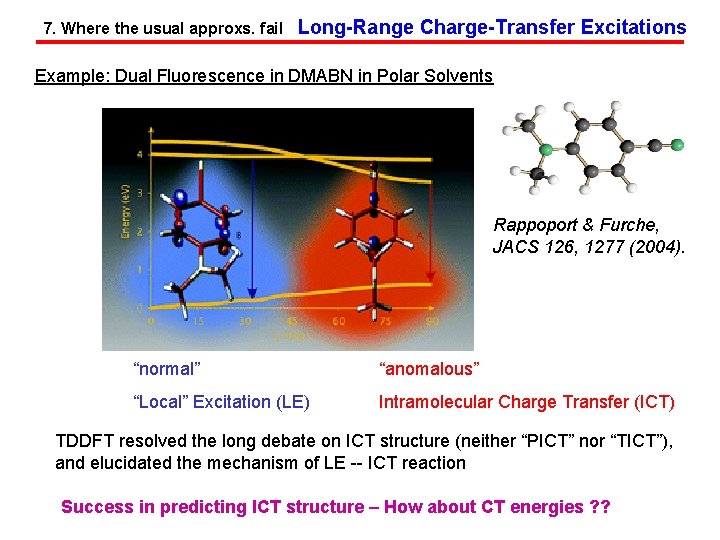
7. Where the usual approxs. fail Long-Range Charge-Transfer Excitations Example: Dual Fluorescence in DMABN in Polar Solvents Rappoport & Furche, JACS 126, 1277 (2004). “normal” “anomalous” “Local” Excitation (LE) Intramolecular Charge Transfer (ICT) TDDFT resolved the long debate on ICT structure (neither “PICT” nor “TICT”), and elucidated the mechanism of LE -- ICT reaction Success in predicting ICT structure – How about CT energies ? ?
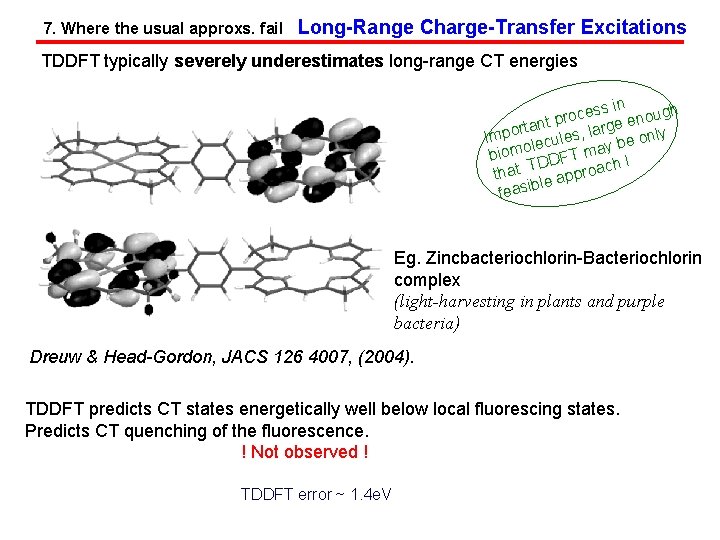
7. Where the usual approxs. fail Long-Range Charge-Transfer Excitations TDDFT typically severely underestimates long-range CT energies ss in ough e c o r n tant p s, large e ly r o p Im e on cule b e l y o a biom DDFT m h! T c a t o a r h p t le ap b i s a fe Eg. Zincbacteriochlorin-Bacteriochlorin complex (light-harvesting in plants and purple bacteria) Dreuw & Head-Gordon, JACS 126 4007, (2004). TDDFT predicts CT states energetically well below local fluorescing states. Predicts CT quenching of the fluorescence. ! Not observed ! TDDFT error ~ 1. 4 e. V
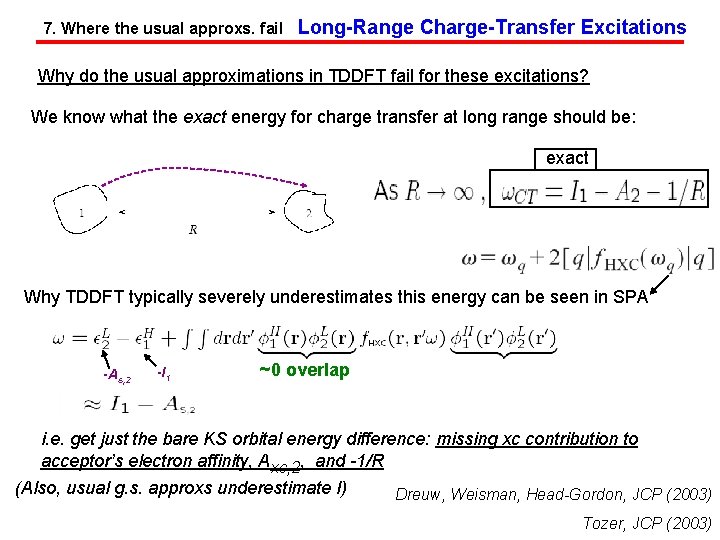
7. Where the usual approxs. fail Long-Range Charge-Transfer Excitations Why do the usual approximations in TDDFT fail for these excitations? We know what the exact energy for charge transfer at long range should be: exact Why TDDFT typically severely underestimates this energy can be seen in SPA -As, 2 -I 1 ~0 overlap i. e. get just the bare KS orbital energy difference: missing xc contribution to acceptor’s electron affinity, Axc, 2, and -1/R (Also, usual g. s. approxs underestimate I) Dreuw, Weisman, Head-Gordon, JCP (2003) Tozer, JCP (2003)
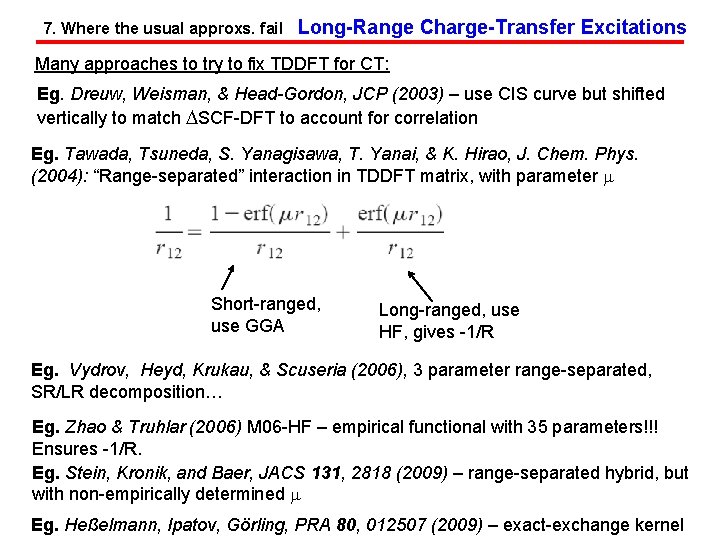
7. Where the usual approxs. fail Long-Range Charge-Transfer Excitations Many approaches to try to fix TDDFT for CT: Eg. Dreuw, Weisman, & Head-Gordon, JCP (2003) – use CIS curve but shifted vertically to match DSCF-DFT to account for correlation Eg. Tawada, Tsuneda, S. Yanagisawa, T. Yanai, & K. Hirao, J. Chem. Phys. (2004): “Range-separated” interaction in TDDFT matrix, with parameter m Short-ranged, use GGA Long-ranged, use HF, gives -1/R Eg. Vydrov, Heyd, Krukau, & Scuseria (2006), 3 parameter range-separated, SR/LR decomposition… Eg. Zhao & Truhlar (2006) M 06 -HF – empirical functional with 35 parameters!!! Ensures -1/R. Eg. Stein, Kronik, and Baer, JACS 131, 2818 (2009) – range-separated hybrid, but with non-empirically determined m Eg. Heßelmann, Ipatov, Görling, PRA 80, 012507 (2009) – exact-exchange kernel
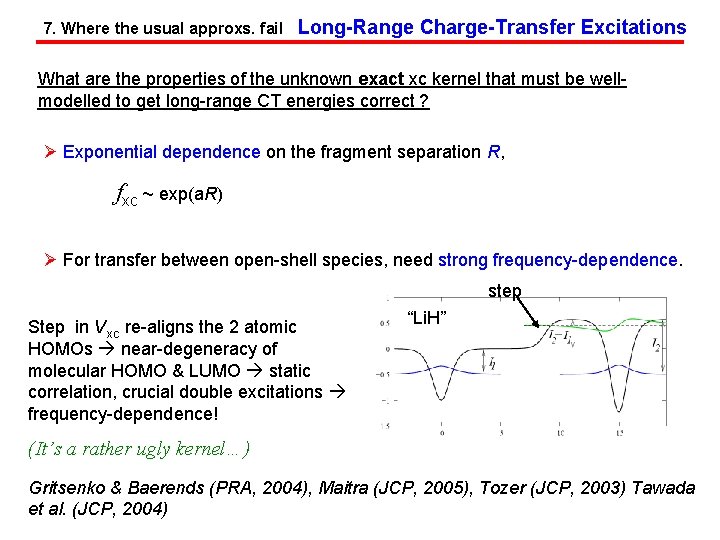
7. Where the usual approxs. fail Long-Range Charge-Transfer Excitations What are the properties of the unknown exact xc kernel that must be wellmodelled to get long-range CT energies correct ? Ø Exponential dependence on the fragment separation R, fxc ~ exp(a. R) Ø For transfer between open-shell species, need strong frequency-dependence. step Step in Vxc re-aligns the 2 atomic HOMOs near-degeneracy of molecular HOMO & LUMO static correlation, crucial double excitations frequency-dependence! “Li. H” (It’s a rather ugly kernel…) Gritsenko & Baerends (PRA, 2004), Maitra (JCP, 2005), Tozer (JCP, 2003) Tawada et al. (JCP, 2004)
Outline 1. A survey of time-dependent phenomena C. U. 2. Fundamental theorems in TDDFT N. M. 3. Time-dependent Kohn-Sham equation C. U. 4. Memory dependence N. M. 5. Linear response and excitation energies N. M. 6. Optical processes in Materials C. U. 7. Multiple and charge-transfer excitations N. M. 8. Current-TDDFT C. U. 9. Nanoscale transport C. U. 10. Strong-field processes and control N. M.
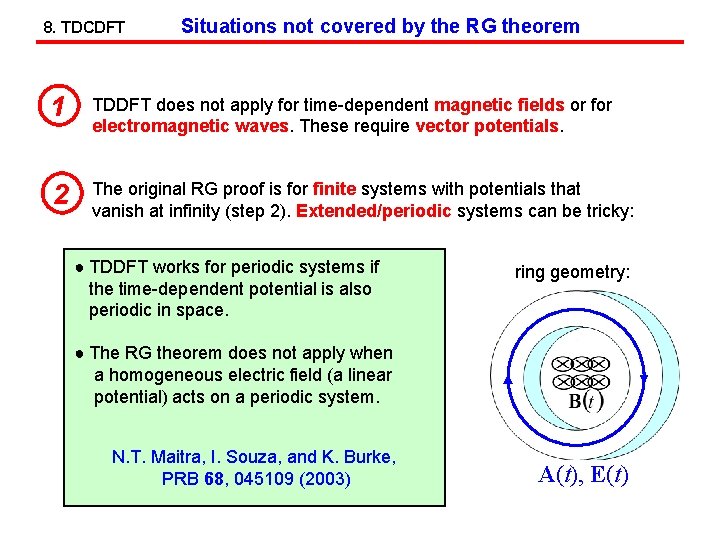
8. TDCDFT Situations not covered by the RG theorem 1 TDDFT does not apply for time-dependent magnetic fields or for electromagnetic waves. These require vector potentials. 2 The original RG proof is for finite systems with potentials that vanish at infinity (step 2). Extended/periodic systems can be tricky: ● TDDFT works for periodic systems if the time-dependent potential is also periodic in space. ● The RG theorem does not apply when a homogeneous electric field (a linear potential) acts on a periodic system. N. T. Maitra, I. Souza, and K. Burke, PRB 68, 045109 (2003) ring geometry: ▲ ▼ A(t), E(t)
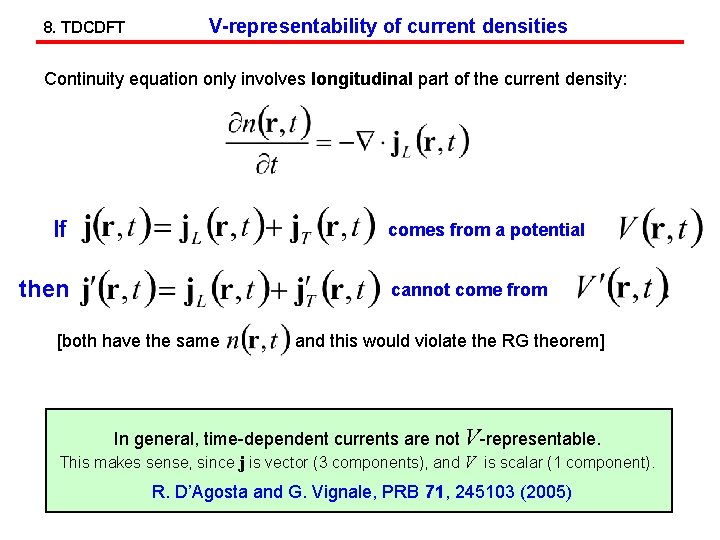
8. TDCDFT V-representability of current densities Continuity equation only involves longitudinal part of the current density: If comes from a potential then cannot come from [both have the same , and this would violate the RG theorem] In general, time-dependent currents are not V-representable. This makes sense, since j is vector (3 components), and V is scalar (1 component). R. D’Agosta and G. Vignale, PRB 71, 245103 (2005)
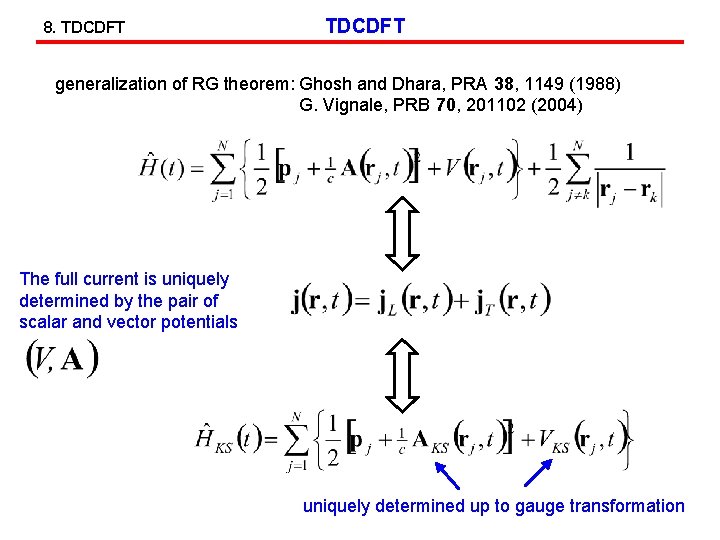
8. TDCDFT generalization of RG theorem: Ghosh and Dhara, PRA 38, 1149 (1988) G. Vignale, PRB 70, 201102 (2004) The full current is uniquely determined by the pair of scalar and vector potentials uniquely determined up to gauge transformation
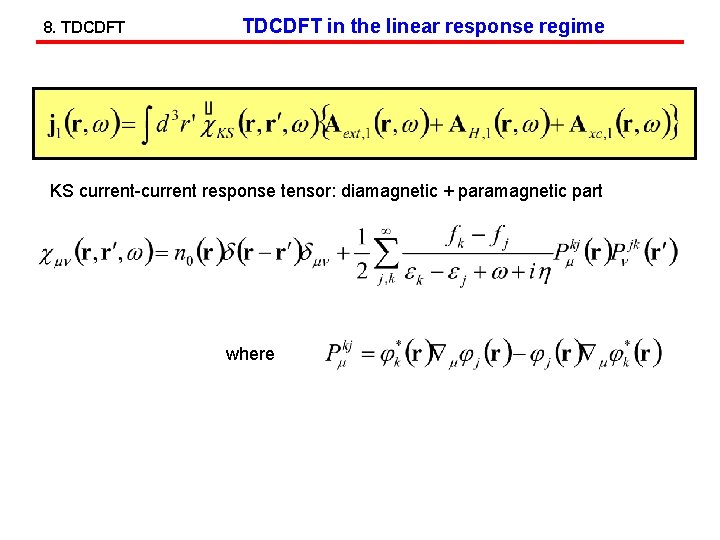
8. TDCDFT in the linear response regime KS current-current response tensor: diamagnetic + paramagnetic part where
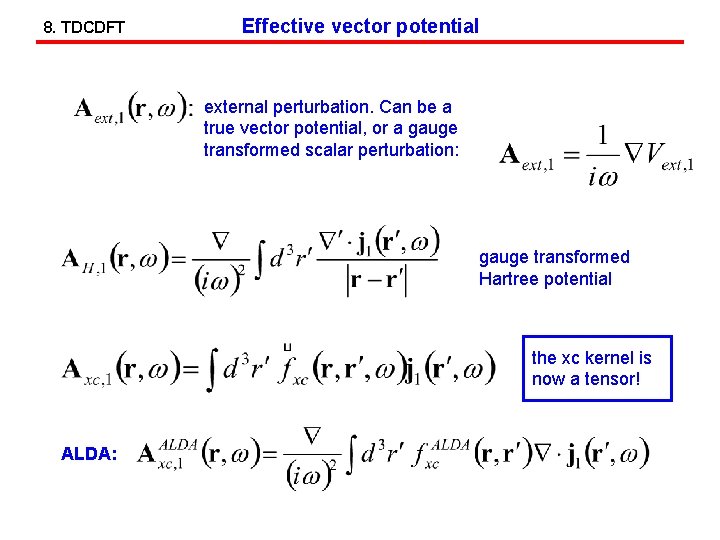
8. TDCDFT Effective vector potential external perturbation. Can be a true vector potential, or a gauge transformed scalar perturbation: gauge transformed Hartree potential the xc kernel is now a tensor! ALDA:
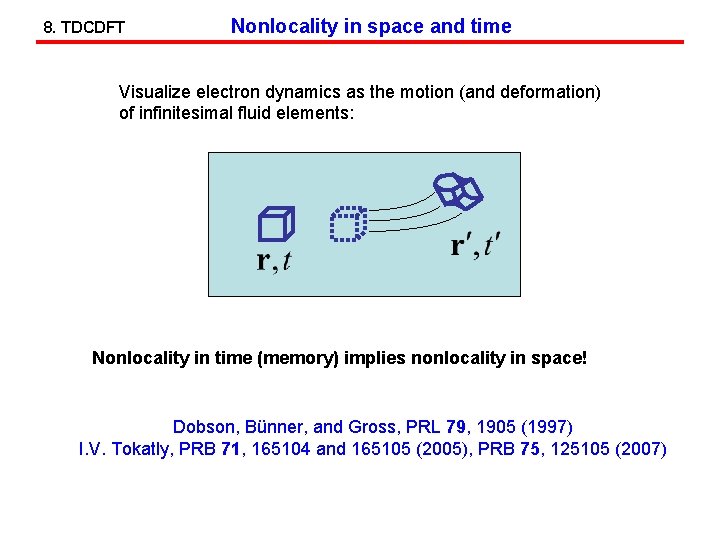
8. TDCDFT Nonlocality in space and time Visualize electron dynamics as the motion (and deformation) of infinitesimal fluid elements: Nonlocality in time (memory) implies nonlocality in space! Dobson, Bünner, and Gross, PRL 79, 1905 (1997) I. V. Tokatly, PRB 71, 165104 and 165105 (2005), PRB 75, 125105 (2007)
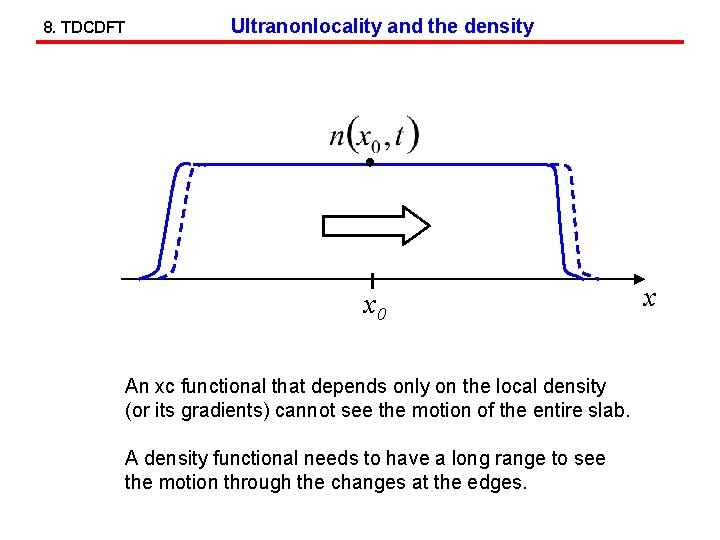
8. TDCDFT Ultranonlocality and the density ● x 0 An xc functional that depends only on the local density (or its gradients) cannot see the motion of the entire slab. A density functional needs to have a long range to see the motion through the changes at the edges. x
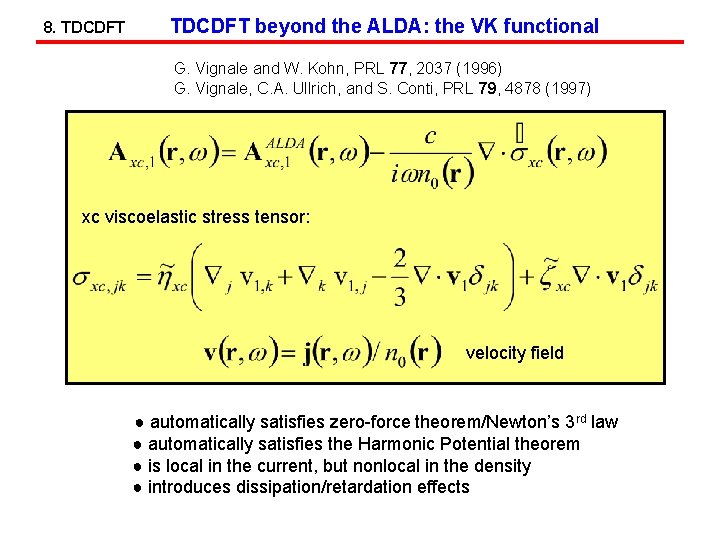
8. TDCDFT beyond the ALDA: the VK functional G. Vignale and W. Kohn, PRL 77, 2037 (1996) G. Vignale, C. A. Ullrich, and S. Conti, PRL 79, 4878 (1997) xc viscoelastic stress tensor: velocity field ● automatically satisfies zero-force theorem/Newton’s 3 rd law ● automatically satisfies the Harmonic Potential theorem ● is local in the current, but nonlocal in the density ● introduces dissipation/retardation effects
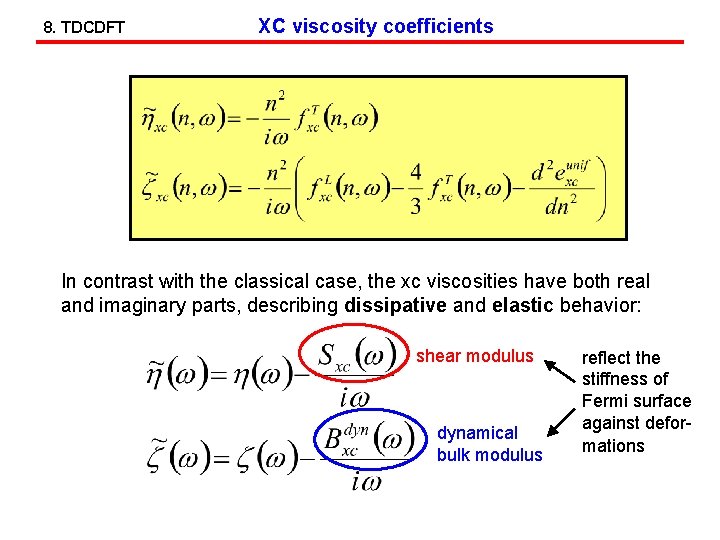
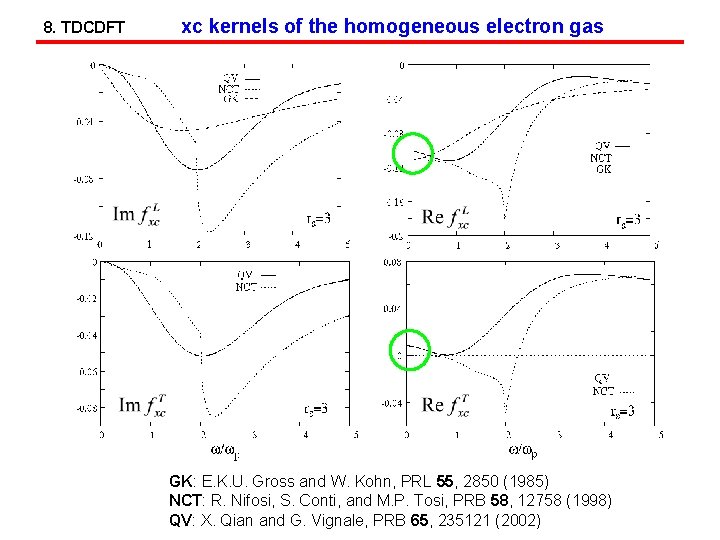
8. TDCDFT XC viscosity coefficients In contrast with the classical case, the xc viscosities have both real and imaginary parts, describing dissipative and elastic behavior: shear modulus dynamical bulk modulus reflect the stiffness of Fermi surface against deformations
8. TDCDFT xc kernels of the homogeneous electron gas GK: E. K. U. Gross and W. Kohn, PRL 55, 2850 (1985) NCT: R. Nifosi, S. Conti, and M. P. Tosi, PRB 58, 12758 (1998) QV: X. Qian and G. Vignale, PRB 65, 235121 (2002)
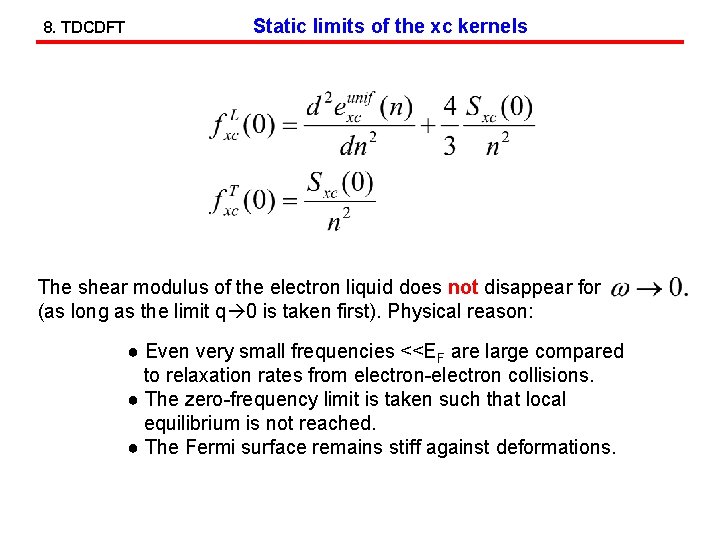
8. TDCDFT Static limits of the xc kernels The shear modulus of the electron liquid does not disappear for (as long as the limit q 0 is taken first). Physical reason: ● Even very small frequencies <<EF are large compared to relaxation rates from electron-electron collisions. ● The zero-frequency limit is taken such that local equilibrium is not reached. ● The Fermi surface remains stiff against deformations.
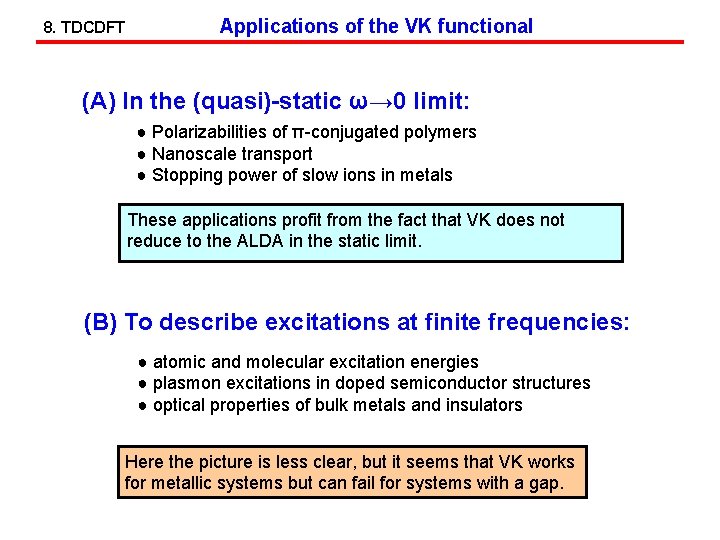
8. TDCDFT Applications of the VK functional (A) In the (quasi)-static ω→ 0 limit: ● Polarizabilities of π-conjugated polymers ● Nanoscale transport ● Stopping power of slow ions in metals These applications profit from the fact that VK does not reduce to the ALDA in the static limit. (B) To describe excitations at finite frequencies: ● atomic and molecular excitation energies ● plasmon excitations in doped semiconductor structures ● optical properties of bulk metals and insulators Here the picture is less clear, but it seems that VK works for metallic systems but can fail for systems with a gap.
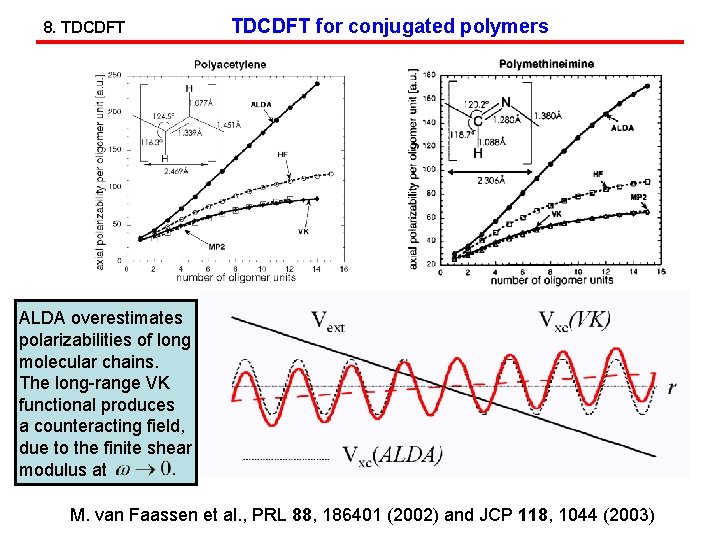
8. TDCDFT for conjugated polymers ALDA overestimates polarizabilities of long molecular chains. The long-range VK functional produces a counteracting field, due to the finite shear modulus at M. van Faassen et al. , PRL 88, 186401 (2002) and JCP 118, 1044 (2003)
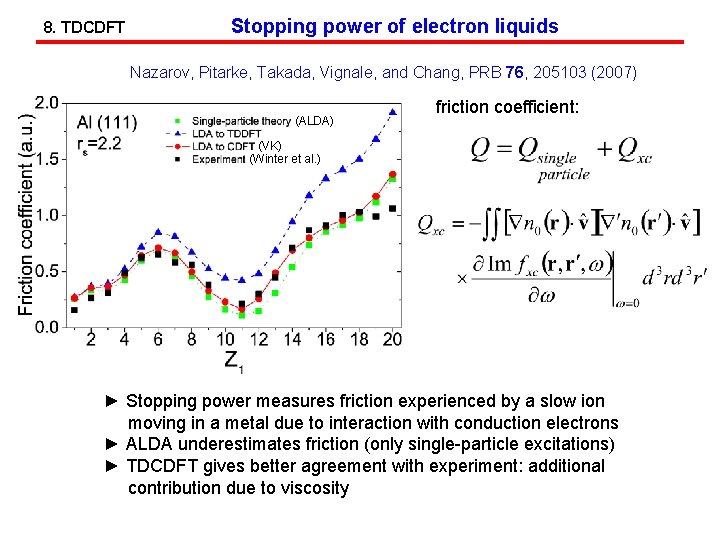
8. TDCDFT Stopping power of electron liquids Nazarov, Pitarke, Takada, Vignale, and Chang, PRB 76, 205103 (2007) (ALDA) friction coefficient: (VK) (Winter et al. ) ► Stopping power measures friction experienced by a slow ion moving in a metal due to interaction with conduction electrons ► ALDA underestimates friction (only single-particle excitations) ► TDCDFT gives better agreement with experiment: additional contribution due to viscosity
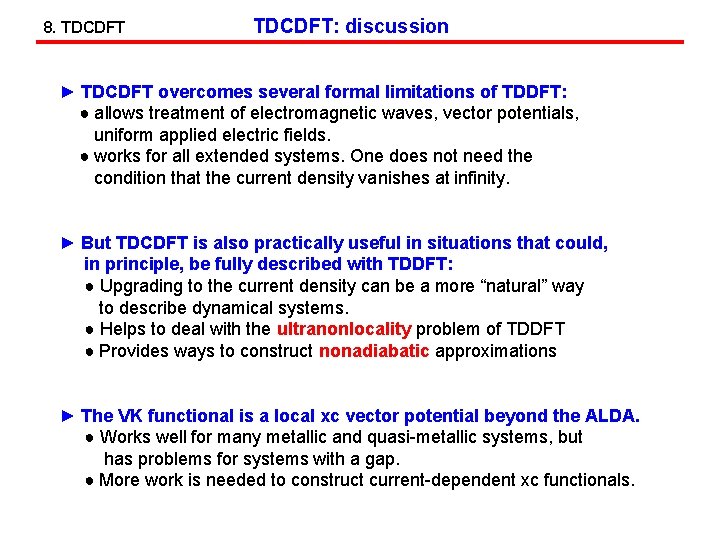
8. TDCDFT: discussion ► TDCDFT overcomes several formal limitations of TDDFT: ● allows treatment of electromagnetic waves, vector potentials, uniform applied electric fields. ● works for all extended systems. One does not need the condition that the current density vanishes at infinity. ► But TDCDFT is also practically useful in situations that could, in principle, be fully described with TDDFT: ● Upgrading to the current density can be a more “natural” way to describe dynamical systems. ● Helps to deal with the ultranonlocality problem of TDDFT ● Provides ways to construct nonadiabatic approximations ► The VK functional is a local xc vector potential beyond the ALDA. ● Works well for many metallic and quasi-metallic systems, but has problems for systems with a gap. ● More work is needed to construct current-dependent xc functionals.
Outline 1. A survey of time-dependent phenomena C. U. 2. Fundamental theorems in TDDFT N. M. 3. Time-dependent Kohn-Sham equation C. U. 4. Memory dependence N. M. 5. Linear response and excitation energies N. M. 6. Optical processes in Materials C. U. 7. Multiple and charge-transfer excitations N. M. 8. Current-TDDFT C. U. 9. Nanoscale transport C. U. 10. Strong-field processes and control N. M.
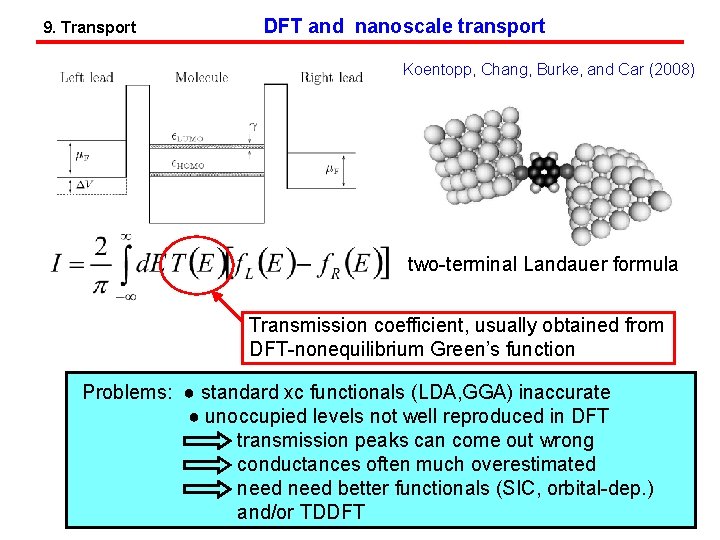
9. Transport DFT and nanoscale transport Koentopp, Chang, Burke, and Car (2008) two-terminal Landauer formula Transmission coefficient, usually obtained from DFT-nonequilibrium Green’s function Problems: ● standard xc functionals (LDA, GGA) inaccurate ● unoccupied levels not well reproduced in DFT transmission peaks can come out wrong conductances often much overestimated need better functionals (SIC, orbital-dep. ) and/or TDDFT
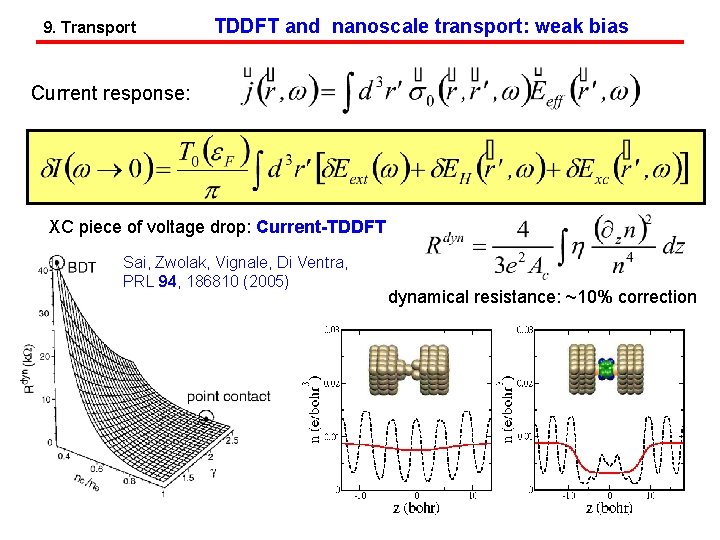
9. Transport TDDFT and nanoscale transport: weak bias Current response: XC piece of voltage drop: Current-TDDFT Sai, Zwolak, Vignale, Di Ventra, PRL 94, 186810 (2005) dynamical resistance: ~10% correction
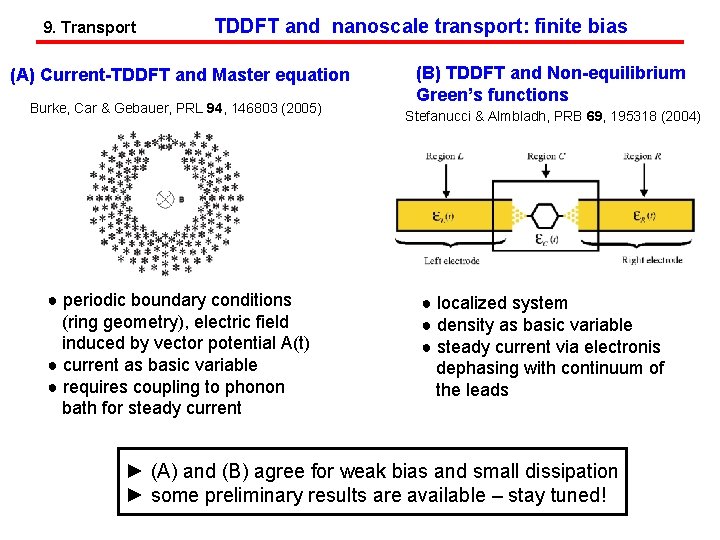
9. Transport TDDFT and nanoscale transport: finite bias (A) Current-TDDFT and Master equation Burke, Car & Gebauer, PRL 94, 146803 (2005) ● periodic boundary conditions (ring geometry), electric field induced by vector potential A(t) ● current as basic variable ● requires coupling to phonon bath for steady current (B) TDDFT and Non-equilibrium Green’s functions Stefanucci & Almbladh, PRB 69, 195318 (2004) ● localized system ● density as basic variable ● steady current via electronis dephasing with continuum of the leads ► (A) and (B) agree for weak bias and small dissipation ► some preliminary results are available – stay tuned!
Outline 1. A survey of time-dependent phenomena C. U. 2. Fundamental theorems in TDDFT N. M. 3. Time-dependent Kohn-Sham equation C. U. 4. Memory dependence N. M. 5. Linear response and excitation energies N. M. 6. Optical processes in Materials C. U. 7. Multiple and charge-transfer excitations N. M. 8. Current-TDDFT C. U. 9. Nanoscale transport C. U. 10. Strong-field processes and control N. M.
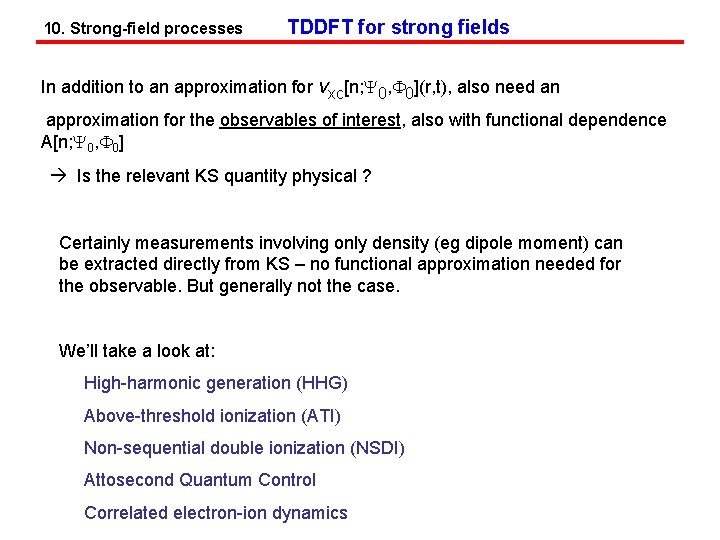
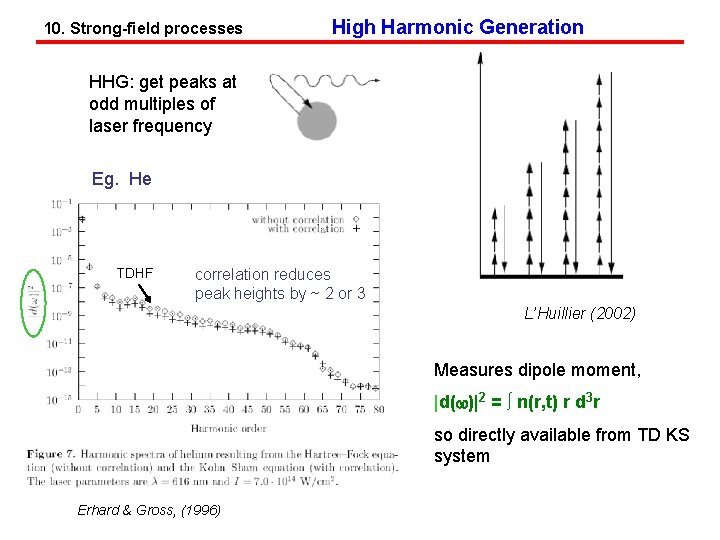
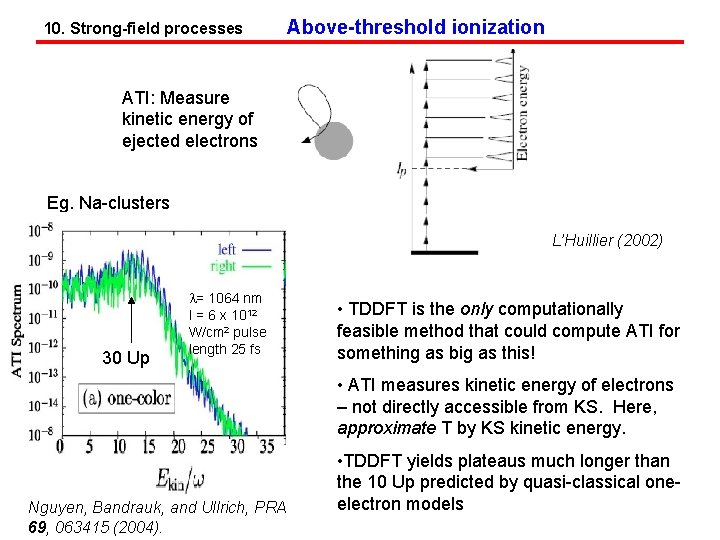
10. Strong-field processes TDDFT for strong fields In addition to an approximation for vxc[n; Y 0, F 0](r, t), also need an approximation for the observables of interest, also with functional dependence A[n; Y 0, F 0] Is the relevant KS quantity physical ? Certainly measurements involving only density (eg dipole moment) can be extracted directly from KS – no functional approximation needed for the observable. But generally not the case. We’ll take a look at: High-harmonic generation (HHG) Above-threshold ionization (ATI) Non-sequential double ionization (NSDI) Attosecond Quantum Control Correlated electron-ion dynamics
10. Strong-field processes High Harmonic Generation HHG: get peaks at odd multiples of laser frequency Eg. He TDHF correlation reduces peak heights by ~ 2 or 3 L’Huillier (2002) Measures dipole moment, |d(w)|2 = ∫ n(r, t) r d 3 r so directly available from TD KS system Erhard & Gross, (1996)
10. Strong-field processes Above-threshold ionization ATI: Measure kinetic energy of ejected electrons Eg. Na-clusters L’Huillier (2002) 30 Up l= 1064 nm I = 6 x 10¹² W/cm 2 pulse length 25 fs • TDDFT is the only computationally feasible method that could compute ATI for something as big as this! • ATI measures kinetic energy of electrons – not directly accessible from KS. Here, approximate T by KS kinetic energy. Nguyen, Bandrauk, and Ullrich, PRA 69, 063415 (2004). • TDDFT yields plateaus much longer than the 10 Up predicted by quasi-classical oneelectron models
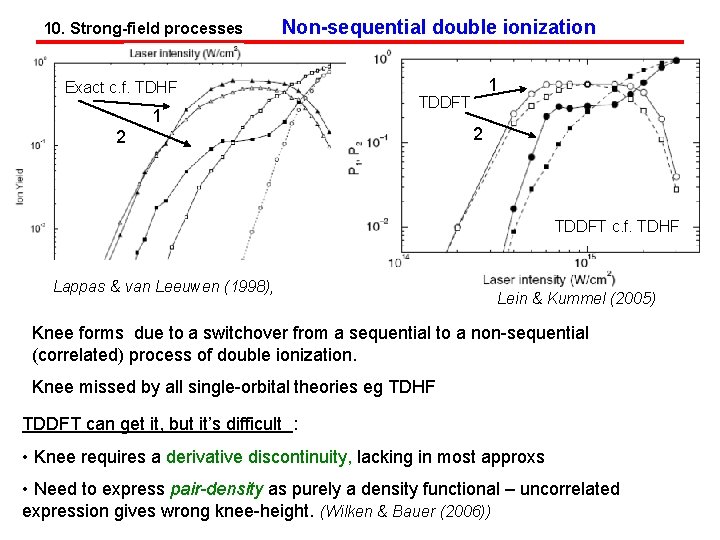
10. Strong-field processes Non-sequential double ionization Exact c. f. TDHF 1 1 TDDFT 2 2 TDDFT c. f. TDHF Lappas & van Leeuwen (1998), Lein & Kummel (2005) Knee forms due to a switchover from a sequential to a non-sequential (correlated) process of double ionization. Knee missed by all single-orbital theories eg TDHF TDDFT can get it, but it’s difficult : • Knee requires a derivative discontinuity, lacking in most approxs • Need to express pair-density as purely a density functional – uncorrelated expression gives wrong knee-height. (Wilken & Bauer (2006))
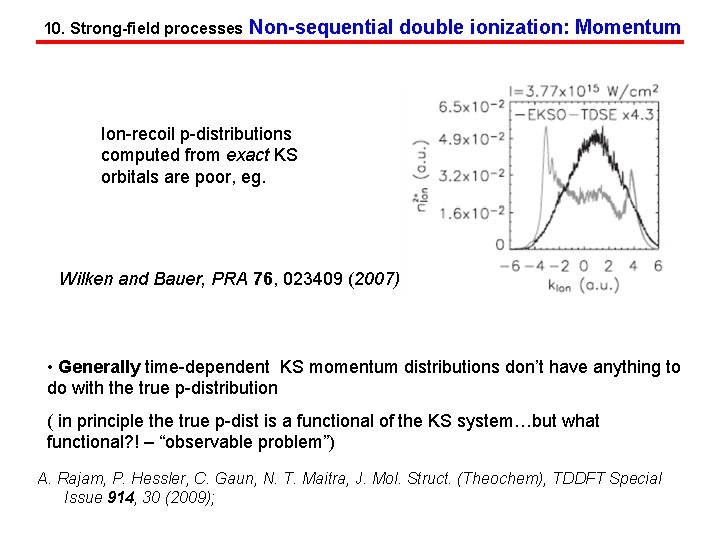
10. Strong-field processes Non-sequential double ionization: Momentum Ion-recoil p-distributions computed from exact KS orbitals are poor, eg. Wilken and Bauer, PRA 76, 023409 (2007) • Generally time-dependent KS momentum distributions don’t have anything to do with the true p-distribution ( in principle the true p-dist is a functional of the KS system…but what functional? ! – “observable problem”) A. Rajam, P. Hessler, C. Gaun, N. T. Maitra, J. Mol. Struct. (Theochem), TDDFT Special Issue 914, 30 (2009);
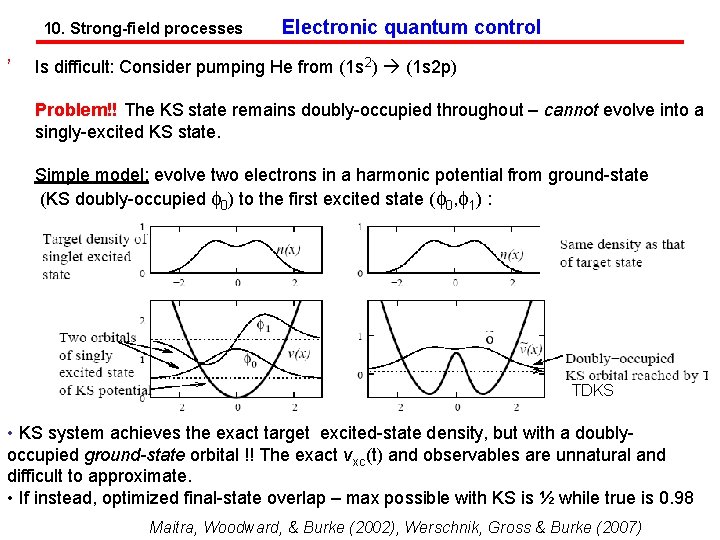
10. Strong-field processes , Electronic quantum control Is difficult: Consider pumping He from (1 s 2) (1 s 2 p) Problem!! The KS state remains doubly-occupied throughout – cannot evolve into a singly-excited KS state. Simple model: evolve two electrons in a harmonic potential from ground-state (KS doubly-occupied f 0) to the first excited state (f 0, f 1) : TDKS • KS system achieves the exact target excited-state density, but with a doublyoccupied ground-state orbital !! The exact vxc(t) and observables are unnatural and difficult to approximate. • If instead, optimized final-state overlap – max possible with KS is ½ while true is 0. 98 Maitra, Woodward, & Burke (2002), Werschnik, Gross & Burke (2007)
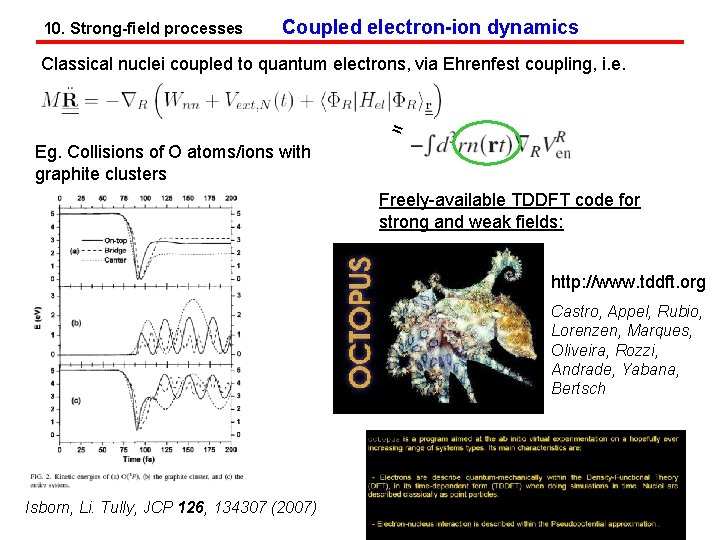
10. Strong-field processes Coupled electron-ion dynamics Classical nuclei coupled to quantum electrons, via Ehrenfest coupling, i. e. = Eg. Collisions of O atoms/ions with graphite clusters Freely-available TDDFT code for strong and weak fields: http: //www. tddft. org Castro, Appel, Rubio, Lorenzen, Marques, Oliveira, Rozzi, Andrade, Yabana, Bertsch Isborn, Li. Tully, JCP 126, 134307 (2007)
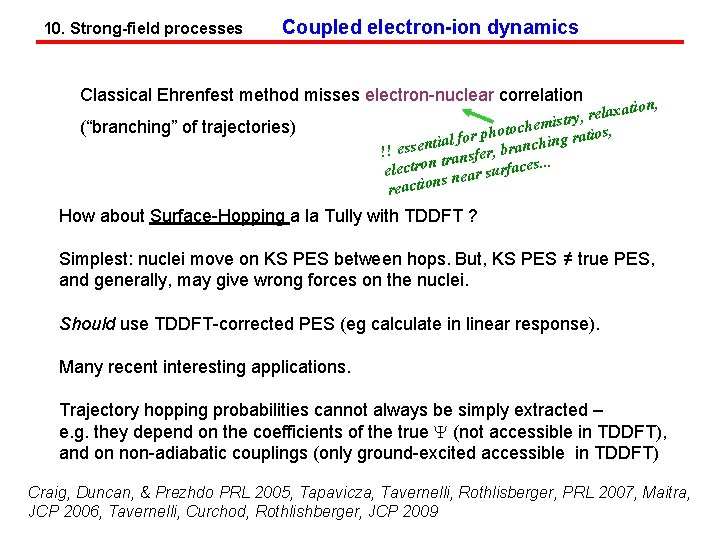
10. Strong-field processes Coupled electron-ion dynamics Classical Ehrenfest method misses electron-nuclear correlation (“branching” of trajectories) , xation a l e r , y tr chemis tios, o t o h p tial for branching ra n e s s e ! ! ansfer, ces. . . r t n o r t elec r surfa a e n s n reactio How about Surface-Hopping a la Tully with TDDFT ? Simplest: nuclei move on KS PES between hops. But, KS PES ≠ true PES, and generally, may give wrong forces on the nuclei. Should use TDDFT-corrected PES (eg calculate in linear response). Many recent interesting applications. Trajectory hopping probabilities cannot always be simply extracted – e. g. they depend on the coefficients of the true Y (not accessible in TDDFT), and on non-adiabatic couplings (only ground-excited accessible in TDDFT) Craig, Duncan, & Prezhdo PRL 2005, Tapavicza, Tavernelli, Rothlisberger, PRL 2007, Maitra, JCP 2006, Tavernelli, Curchod, Rothlishberger, JCP 2009
To learn more… Time-Dependent Density Functional Theory, edited by M. A. L. Marques, C. A. Ullrich, F. Nogueira, A. Rubio, K. Burke, and E. K. U. Gross, Springer Lecture Notes in Physics, Vol. 706 (2006) (see handouts for TDDFT literature list) Codes with TDDFT capabilities NWChem octopus Gaussian Yambo QChem ABINIT GAMESS Parsec Turbomole SIESTA ADF
Acknowledgments Collaborators: • Giovanni Vignale (Missouri) • Kieron Burke (UC Irvine) • Ilya Tokatly (San Sebastian) • Irene D’Amico (York/UK) • Klaus Capelle (Sao Paulo/Brazil) • Robert van Leeuwen (Jyväskylä/Finland) • Meta van Faassen (Groningen) • Adam Wasserman (Purdue) • Hardy Gross (MPI Halle) • Tchavdar Todorov (Queen’s, Belfast) • Ali Abedi (MPI Halle) Students/Postdocs: • Peter Elliott • Harshani Wijewardane • Volodymyr Turkowski • Aritz Leonardo • Fedir Kyrychenko • Ednilsom Orestes • Daniel Vieira • Yonghui Li • David Tempel • Arun Rajam • Christian Gaun • August Krueger • Gabriella Mullady • Allen Kamal • Sharma Goldson • Chris Canahui • Izabela Raczckowsa