
Timed essay Friday 16 th Outline an evolutionary
- Slides: 18
Timed essay: Friday 16 th Outline an evolutionary explanation of one example of group display in humans (4 marks) Discuss genetic factors in aggressive behaviour (4 + 16 marks) 40 minutes to complete
Article vs. magazines You have a scientific journal and an article from Psychology Today magazine to look at. Go through them and make a list of the main differences and similarities between these two types of publications: • Differences: • Similarities:
How do we tell fact from fiction? What do you think peer review involves? Jot down some ideas:
Peer review • In the peer review process, a paper is submitted to a journal and evaluated by several reviewers. (Reviewers are often individuals with an impressive history of work in the area of interest, that is, the specific area that the article addresses). • After critiquing the paper the reviewers submit their thoughts to the editor. Then, based on the commentaries from the reviewers, the editor decides whether to publish the paper, make suggestions for additional changes that could lead to publication, or reject the paper. • The primary purpose of peer review is to ensure that the papers published are valid and unbiased.
Why bother? • “Peer review is one way (replication is another) science institutionalises the attitudes of objectivity and public criticism. Ideas and experimentation undergo a honing process in which they are submitted to other critical minds for evaluation. Ideas that survive this critical process have begun to meet the criterion of public verifiability” (Stanovich, 2007, p. 12). • But really…. why?
Why bother? • Research proposals will be scrutinized to check it is robust • To ensure it can contribute to already existing knowledge • Ethics approval • Encourages academic debate, openness and communication • Ensure there is no bias • Appropriateness of conclusions drawn • Ensure it is worth dissemination- journals • Consider wider implications • Find any errors • Ensure it can be repeated
What does peer review involve? Here are some of the aspects of the research that are scrutinised: • Originality of the research • The appropriateness of the overall research design, including the methods used to collect and analyse the data • Ethical issues • The sample technique used • Potential sources of bias • The operationalization and control of key variables • The reliability, validity and interpretation of the findings • The appropriateness of any conclusions drawn • Recommendations are made by other researchers and reviewers into whether the paper should be published in its original form, revised or rejected.
Peer review this study George has a feeling that people who own dogs are more caring than people who own cats. The reason why he thinks this may be the case is because he believes that dogs take more care than cats and therefore will attract those who have a more caring personality. He decides to ask some of his friends if they agree with him. He tells his friends that he thinks dog owners will be more caring than cat owners and why. Five of his friends agree with him. They suggest other reasons why dog owners may be more caring than cat owners that George had not thought of. Therefore, George concludes that he is right. Dog owners are more caring than cat owners. George consequently posts an article on an online forum stating that dog owners are more caring than cat owners with a discussion of all the reasons why this may be, incorporating the views he has collected from his friends.
Why is peer review so important? This peer review process helps to ensure that any research paper published in a well-respected journal has integrity and, therefore, can be taken seriously because it has been independently scrutinised by fellow researchers. Also, • It is difficult for authors and researchers to spot every mistake in a piece of work. Showing the work to others increases the probability that weaknesses will be identified and addressed. • It helps to prevent the dissemination of irrelevant findings, unwarranted claims, unacceptable interpretations, personal views and deliberate fraud. • Peer reviewers also judge the quality and the significance of the research in a wider context.
Peer reviewing your essays I am going to ask an A 2 student in the other group to mark your essays. What might be the problems with this?
Bias • Reviewer • Publication • Reputation
Past exam question on peer review A. Outline what is meant by the term peer review in psychological research (2 marks) B. Explain why peer review is important in psychological research. (5 marks)
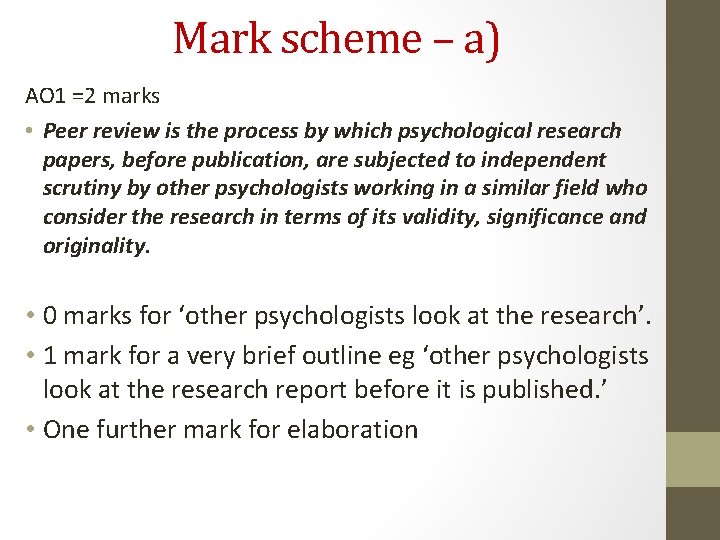
Mark scheme – a) AO 1 =2 marks • Peer review is the process by which psychological research papers, before publication, are subjected to independent scrutiny by other psychologists working in a similar field who consider the research in terms of its validity, significance and originality. • 0 marks for ‘other psychologists look at the research’. • 1 mark for a very brief outline eg ‘other psychologists look at the research report before it is published. ’ • One further mark for elaboration
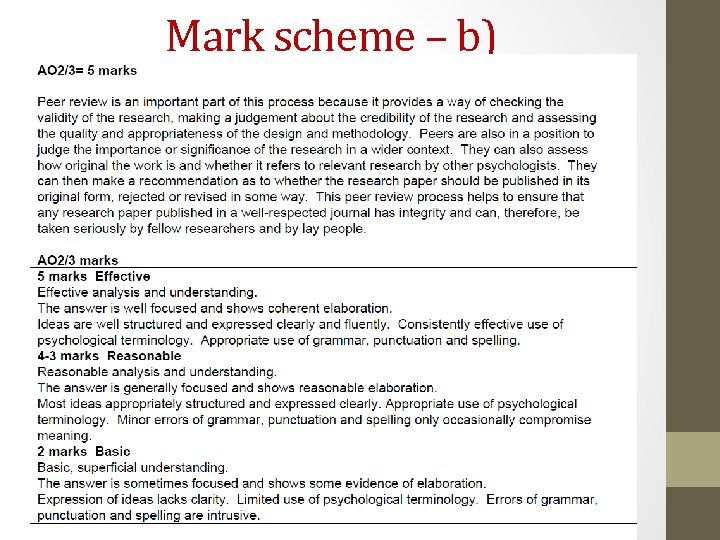
Mark scheme – b)
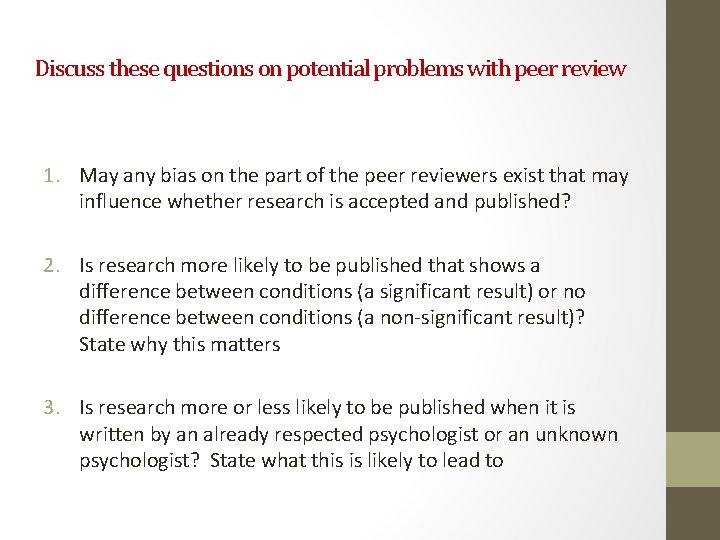
Discuss these questions on potential problems with peer review 1. May any bias on the part of the peer reviewers exist that may influence whether research is accepted and published? 2. Is research more likely to be published that shows a difference between conditions (a significant result) or no difference between conditions (a non-significant result)? State why this matters 3. Is research more or less likely to be published when it is written by an already respected psychologist or an unknown psychologist? State what this is likely to lead to
PSYCHOLOGICAL REPORT WRITING • When a psychologist carries out research, they must write it up in a report. This report always follows the same format. In pairs, look at the example report. Make notes on the different sections of the report and state briefly what type of information is contained in each of these sections
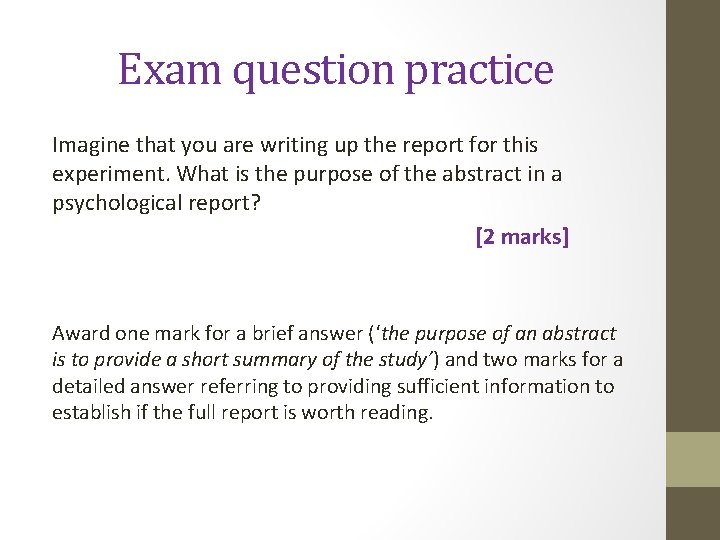
Exam question practice Imagine that you are writing up the report for this experiment. What is the purpose of the abstract in a psychological report? [2 marks] Award one mark for a brief answer (‘the purpose of an abstract is to provide a short summary of the study’) and two marks for a detailed answer referring to providing sufficient information to establish if the full report is worth reading.
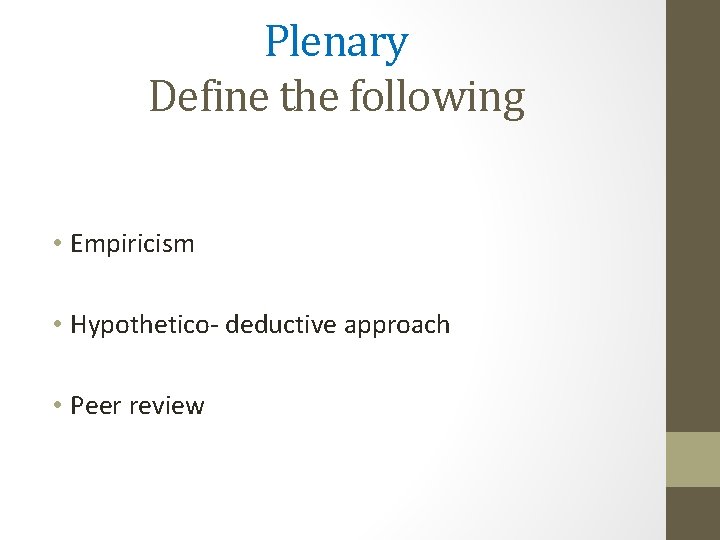
Plenary Define the following • Empiricism • Hypothetico- deductive approach • Peer review