
Timed chair stand test Based on EHES Manual
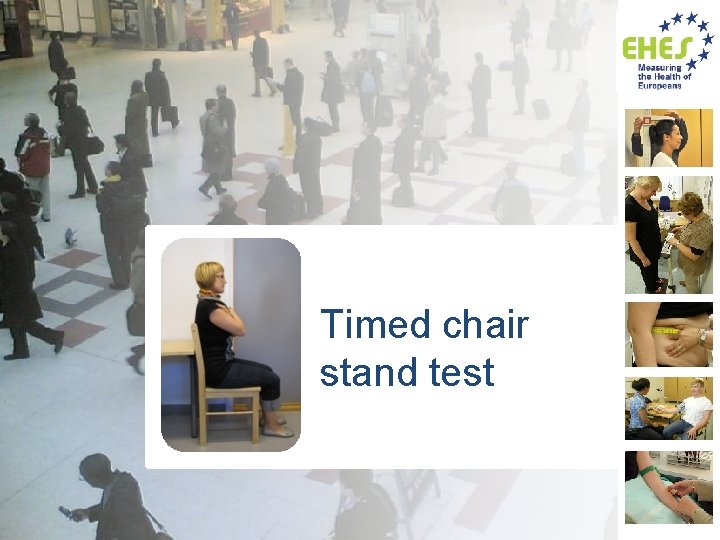
Timed chair stand test
Based on EHES Manual, Part B. Fieldwork Procedures, 2 nd edition (2016) Available at: http: //urn. fi/URN: ISBN: 978 -952 -302 -701 -5 These slides can be used freely, translated and adapted to national use (e. g. concerning the equipment). However, it is important to keep in mind that no changes should be made to the measurement techniques, which need to be standardized.

Equipment • Straight backed, armless and firm chair without stuffing. Height of chair: 43 -45 cm • Stopwatch
Checking • Ensure that the chair is stable and not broken anywhere • Check if stopwatch needs battery charge • Record each checking of the equipment and the outcome in the log book – If problems are observed in the equipment, it is replaced and this is recorded in the log book

Measurement site • Select a private place • Place the chair against a firm table or a wall to hinder chair from moving during the test – If the chair is placed against a wall take care that the participant doesn’t his/her head on the wall during the test
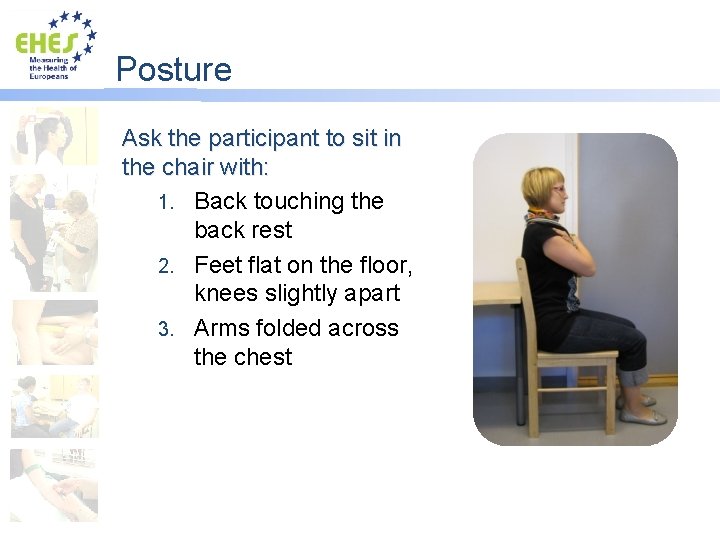
Posture Ask the participant to sit in the chair with: 1. Back touching the back rest 2. Feet flat on the floor, knees slightly apart 3. Arms folded across the chest
Single chair stand test • Perform the test to everyone before continuing with the timed chair stand test • If the participant is not able to stand up without using arms OR has difficulties maintaining an upward posture, record the ability to rise up one time
Preparations for the single chair stand Explain and demonstrate the single rise to the participant Conduct for all participants l E. g. if participant is in a wheelchair he/she may still be able to stand up l Check that the participant wears steady shoes without high heels or slippery soles
Performing the single chair stand test Ask the participant to stand up from the chair as demonstrated l If participant cannot rise without using his/her arms, ask the participant to use his/her arms l If participant is not able to stand up without help record the ability to rise up one time accordingly Record outcome of single chair stand test

Exclusion criteria for the timed chair stand Timed chair stand test is not performed if the participant: l l l Is unable to perform single rise without assistance Has blood pressure 180/110 or higher AND has ever had myocardial infarction, coronary heart disease, angina pectoris or stroke Has blood pressure 200/120 or higher Has a history of myocardial infarction or stroke less than 3 months ago Does not understand instructions due to cognitive limitations Refuses

Preparations for the timed chair stand test • Explain the test to the participant • Demonstrate a few fast rises focusing on: – correct starting position, correct standing position, back touching the chair when sitting down, and speed • Check starting position of participant
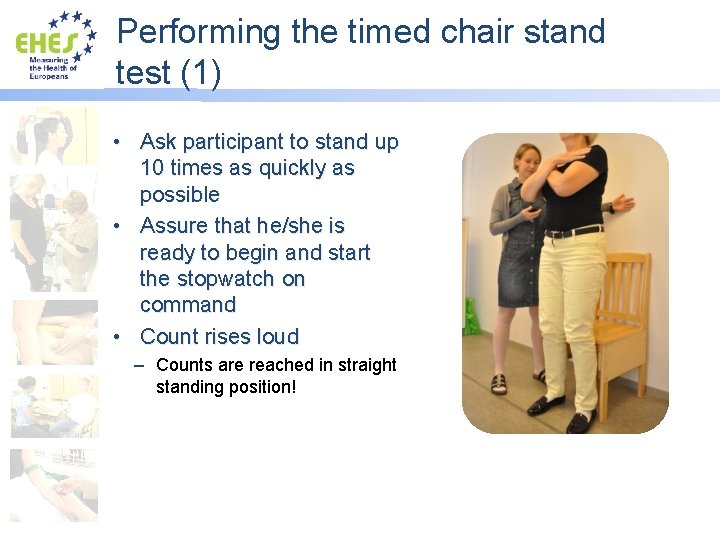
Performing the timed chair stand test (1) • Ask participant to stand up 10 times as quickly as possible • Assure that he/she is ready to begin and start the stopwatch on command • Count rises loud – Counts are reached in straight standing position!
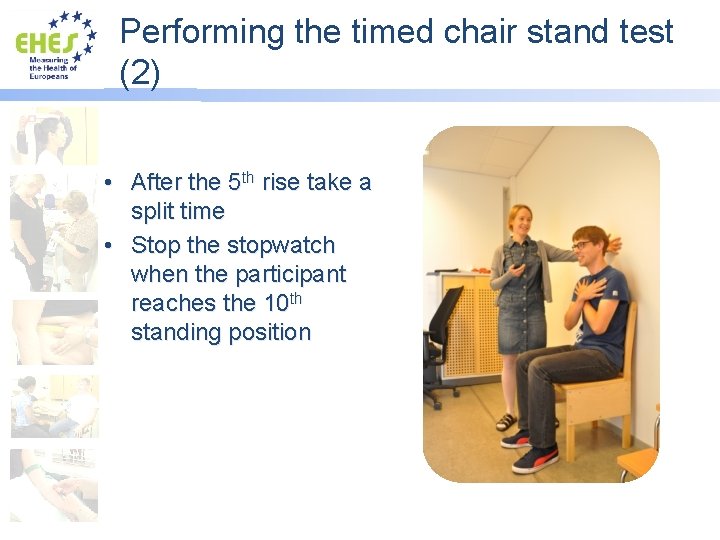
Performing the timed chair stand test (2) • After the 5 th rise take a split time • Stop the stopwatch when the participant reaches the 10 th standing position
Special considerations for the timed chair stand test • Age specific instructions can be used: – for aged 30 -69: 10 rises – for aged 70 and over: 5 rises • Remind the participant during the test to perform ”as quickly as possible”, if necessary • Monitor the performance and stand close enough to provide assistance, if needed
Record the following: l Measurement time l Outcome of single chair stand test l Reason if timed chair stand test was not performed or was interrupted l Time for 5 chair stands l Time for 10 chair stands
Acknowledgements Slides prepared by: Heini Wennman, Hanna Tolonen, Päivikki Koponen Photographs: Hanna Tolonen Chair stand test demonstrations by Heini Wennman and voluntary participants Experiences and feedback from the EHES network have been utilized in the preparation of these slides Funding: Preparation of the slides is part of the activities of the EHES Coordinating Centre which has received funding from the EC/DG SANTÉ in 2009 -2012 through SANCO/2008/C 2/02 -SI 2. 538318 EHES and Grand Agreement number 2009 -23 -01, and in 2015 -2017 through Grand Agreement number 664691/BRIDGE Health

Disclaimer The views expressed here are those of the authors and they do not represent the Commission’s official position.
- Slides: 17